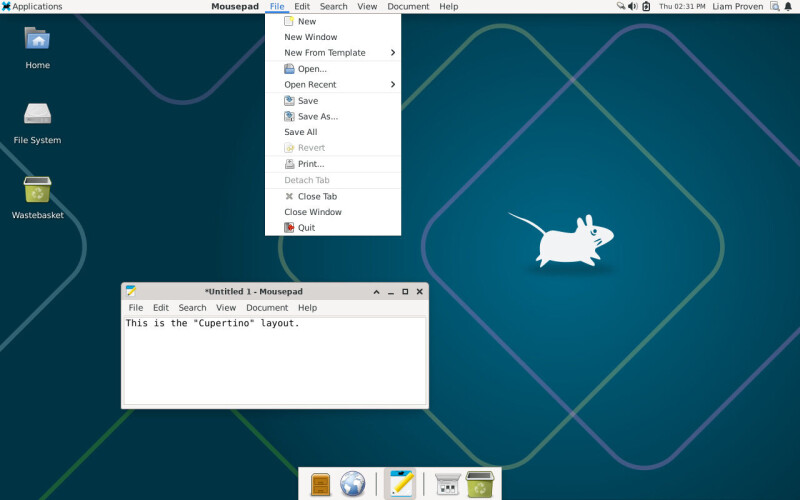
PART 1 Xfce is one of the oldest and smallest desktops, but it's also one of the most malleable: it can look and work like multiple other OSes. Best of all, an optional extra Xfce tool automates away most of the configuration. Xfce has been around for 30 years, undergoing several facelifts while remaining one of the most configurable and lightweight Linux desktops. It started off looking like CDE, then it evolved into something more like Windows 95 before developing its own identity. The good news, though, is that you don't have to spend hours right-clicking and twiddling options to give it a whole new look. It has its own tool for this, called Panel Profiles. It's an optional extra that does the same job as Zorin OS's Appearance tool: it lets you flip between predefined desktop layouts in two clicks. It works on the fly, without even requiring you to log out, and you can also define and save your own custom layouts. With Panel Profiles, you can make Xfce resemble various versions of Windows, Xubuntu, Xfce itself, MATE (or GNOME 2, if you're nostalgic), Mac OS X, or Ubuntu Unity. In Part 1 of this two-part workshop, we'll show you how to install Panel Profiles and the extra components that let it really flex Xfce's muscles. To get the most out of some of the more unconventional layouts, you do need to do a little under-the-hood reconfiguration, and in part 2 we'll cover how to do that: it involves adding a few lines to plain-text files and doing a little manual point-and-click panel tweaking. Before the Qt advocates start shouting at us, it's true that KDE Plasma can do most of this too. The difference is that, as far as we've been able to find, KDE has no automatic layout-switching tool, while Xfce's Panel Profiles does most of the grunt work for you. In KDE, you'll have to DIY ("Do It Yourself," for non-Brits) and learn to navigate KDE's hundreds of settings in dozens of dialog boxes. With Panel Profiles, Xfce makes it much easier – and as our Ubuntu flavor comparison showed, Xfce does it in less code, using less RAM and less disk space. In the vain hope of forestalling questions, we thought we'd explain why we want it. This vulture still uses Ubuntu Unity on several laptops. We really liked the Unity desktop in 2011 and we still do. It's space-efficient on a small screen, but also makes effective use of multiple large screens. Having the Dock app launcher and switcher at the side of the screen is space-efficient, and for fullscreen or tiled apps, it should be on the opposite edge from scrollbars: NeXT put the Dock on the right, but then NeXT put scrollbars on the left. Scrollbars are on the right in all modern GUIs, so the Dock-analog should be on the left edge. The other great thing about Unity is that you can navigate it almost entirely with Windows keystrokes. However, Canonical no longer maintains Unity as Ubuntu's default desktop, and it is not widely packaged outside Ubuntu, while Xfce runs on Linux distributions and BSDs alike. Early this year we tried the Desktop Classic System, a clever Debian remix that uses a customized MATE desktop to provide a spatial desktop: icons and windows remember their locations, stay where they're put, and reappear in the same position when you re-open them. This was one of the most useful but little-appreciated features of classic Mac OS, before it was replaced by Mac OS X (later rebranded just "OS X" and now "macOS" with a small "m"). We liked DCS, but it does have some drawbacks, and for us the big one is that there's no global menu bar. For us, this is also one of the main drawbacks of Elementary OS, which is one of the best-looking desktop distros. Without a menu bar, both have a yawning, empty panel stretching right across the screen with 95 percent of its space wasted. The same is true of GNOME, and although you can fix that with extensions, the result is fragile and it can't do anything about windows conventional title bars, with their standard control buttons, and many of GNOME's other eccentricities. The spatial desktop of the original MacOS was great and we miss it – but these days, a quarter of a century after its replacement arrived, we like tiled windows more. However, for us, a global menu bar is even more useful. Putting the dock's functionality on a separate panel works too: on a smaller screen, you can set it to auto-hide, and switch apps with Alt+Tab. Yes, we know, KDE can do this too, but getting there requires delving deep into KDE's thousands of config settings. Xfce makes it easy, and it is smaller, simpler, and has a relatively slow release cadence. We find Xfce faster, more responsive, and beautifully clean. For the demo, we used plain Debian 13, but the same methods work with MX Linux, Xubuntu, and Alpine Linux, and should also work on openSUSE, Fedora, and other distributions that offer Xfce. When installing Debian, we chose the "desktop" option, cleared the GNOME option, and selected Xfce instead. If you are more used to using sudo than logging in as root for admin tasks, a top tip: when the installation program asks for a password for the root account, just leave it blank. In the next step, when you create a user account, the installer will automatically enable sudo and leave the root account disabled. Step 1 – automating the basics To try Xfce's Tleilaxu face-dancing powers, you need Panel Profiles – but most distros don't install it by default. On Debian, it's as simple as sudo apt install -y xfce4-panel-profiles. On Debian 13, that's it. In the past, we have seen it fail on other distros due to a missing dependency: Panel Profiles also needs the Python psutil module. On Debian-like distros, just run apt install python-psutil. Once you've got Panel Profiles, you can choose among multiple predefined layouts. We suspect their names were chosen not to infringe on any trademarks, but we find them fairly self-explanatory: Cupertino – named after Apple's hometown, this is a somewhat macOS-like config. GNOME 2 – although these days MATE might be more appropriate: a layout with two full-width panels at top and bottom; the top one has app launcher menus and a system tray, and the bottom has window and virtual-desktop switchers. openSUSE Leap 15.x – a Windows 95-style layout, with some Linux improvements: a single panel at the bottom, the more capable Whisker menu first, then a "show desktop" button and a virtual desktop switcher at the right. Redmond – a very minimal Windows 95 layout, meaning the basic Applications menu with no search, no virtual desktops, no app launchers, and no show-desktop button. Redmond 7 – more like Windows 7: searchable Whisker menu, big icon buttons for windows instead of rectangular buttons with text labels, and a show-desktop button at the end of the panel. Unity – similar to the Unity desktop layout, with a full-height application-launcher panel on the left and a panel with a menu bar and status indicators at the top. There are several more, including multiple historical versions of both Xfce's own default layouts, and those of several older versions of Xubuntu. For our purposes, though, we're mainly interested in the "Cupertino" and "Unity" profiles. These are quite similar: both have a top panel with an application menu on the left, status icons on the right, and a global menu bar between them, plus a dock-like second panel. The main differences are that Cupertino centers the dock at the bottom, while Unity has it spanning the whole left edge. Cupertino puts an app launcher at the start of the top panel, while Unity makes it the first entry in the dock. That's about it. Naturally, this being Xfce and configurable, you can move either of these elements if you prefer them somewhere else. But first, a warning: don't try to choose these profiles yet! To get even basic versions of either profile working, you must install some extra components… and to witness the full power of this fully configurable and operational Unix desktop, you'll need to do a little extra legwork, as we'll get to in Episode Two. Manually satisfying Panel Profiles' needs There is one significant stumbling block: installing Panel Profiles does not install the Xfce components its layouts require. You must install them yourself before trying a given profile. If you don't, the tool will quit, leaving you with no panels at all. This is less than ideal, but if it happens, don't panic: right-click the desktop and you can log out. When you log in again, most of the desktop should work. For the global menu bar in "Cupertino" and "Unity," you must install a package called xfce4-appmenu-plugin. This uses the Vala panel global menu, and installing the Xfce plugin should automatically pull the relevant dependencies, including vala-panel-appmenu-common, appmenu-registrar, appmenu-gtk3-module, and appmenu-gtk-module-common. The "Unity" profile also needs another plugin, which moves window-control buttons into the top panel. If it's missing, Panel Profiles complains that it can't find wckbuttons. To avoid that, install xfce4-windowck-plugin. The Xubuntu profiles require another plugin for indicators; to get them working, install xfce4-indicator-plugin. The Xubuntu profiles also want another plugin, but the error message only tells us that (null) is missing, so we haven't been able to work out exactly what it is. As a workaround, we simply installed all the optional packages starting with xfce4- – it's the crude sledgehammer approach, but doesn't use much space. (We suggest excluding xfce4-dev-tools, unless you want to recompile Xfce for yourself – this metapackage pulls in a large number of compilers and other development tools.) Once you've installed all the dependencies, all the Panel Profiles layouts should work. The Cupertino layout pins the app menu to the start of the top panel, where it acts a little like the Apple Menu on a Mac. The Unity layout replaces this with the Whisker menu, configured as a full-screen application launcher and placed as the first button on the panel down the left-hand side. You can hop between layouts on the fly using the Panel Profiles tool. Xfce remembers the last layout selected by each user account and reloads it at the next login. You can explore how they are constructed by examining each panel's controls, then repositioning them or adding your own controls and applications. However, we're not totally happy with either of them. Further customization can improve the experience, and we'll explain how in Part 2. ®
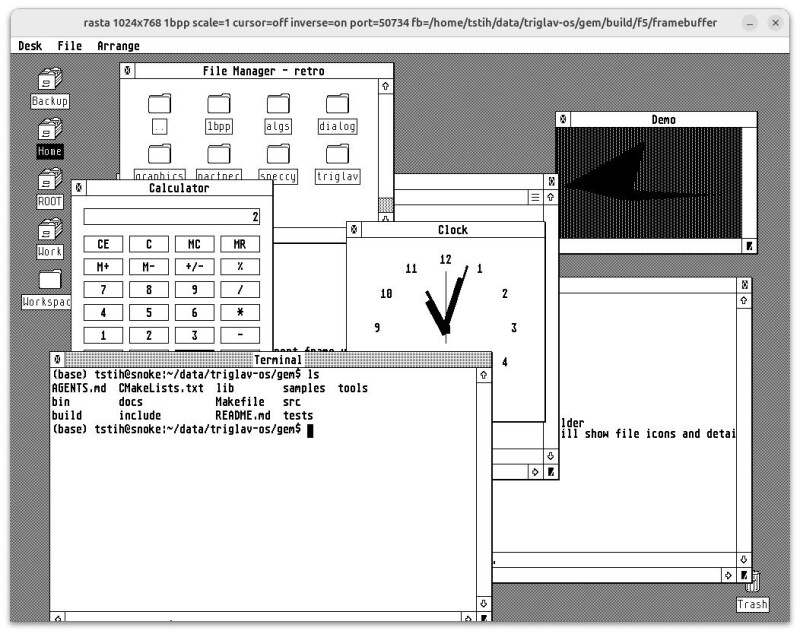
Digital Research's GEM was one of the earliest graphical environments for PC compatibles, and an inspired hack has now resurrected it on Linux. GEM for Linux is a port of the Atari ST's graphical desktop, created by prolific Slovenian developer Tomaž Štih. Applications share a display server that can output directly through Linux's framebuffer or display the desktop in a window using Štih's SDL2-based Rasta framebuffer emulator. In his Linkedin post, he says that it is "derived from OpenGEM and FreeGEM – now secure, optimized, stabilized, and source-compatible with Atari ST GEM." It is derived from the Digital Research GEM source code released by Caldera in 1999, as the still-young Register reported at the time. GEM was among the first successful GUIs for MS-DOS PC compatibles. European readers may remember that it was the graphical desktop bundled with the Amstrad PC1512 and PC1640 – the first affordable mass-market PC compatibles on this side of the Atlantic. In 1985, Apple threatened legal action against Digital Research over GEM's similarity to the Macintosh interface. Digital Research agreed to make the PC version less Mac-like, removing desktop drive icons, overlapping windows, and other features. The lawsuit didn't affect Atari's version, however. That PC version is what Caldera released as open source. Since 1999, the FreeGEM community has enhanced it beyond the ST version, restoring the removed features and adding others. These include Bézier curve drawing from the runtime-only GEM/4 bundled with CCP Artline and 3D-shaded buttons from Timeworks Publisher's GEM/5 runtime. You can see some of the results on John Elliott's FreeGEM page. As far as we know, this is the second modern FOSS implementation of Atari GEM to benefit from the FreeGEM source code. The other is the remarkable EmuTOS project, a completely open source replacement operating system and GUI for original Atari hardware that we mentioned in 2022. Atari's TOS combined GEMDOS, derived from Digital Research technology, with a modified version of GEM for its graphical interface. Quite a lot of DR source code is available online, but despite the clarification of CP/M's legal status that we covered in 2022, much of it is not strictly open source. FreeGEM and the OpenGEM distribution are. Back in the 1980s, DR had a multitasking version called X/GEM for FlexOS, whose history we described later in 2022. We find it delightful to see some of DR's multitasking ambitions revived nearly 40 years later. We don't expect GEM to render Wayland obsolete or usher in a new era of Atari-inspired Linux development. We wouldn't hate that, but there is precedent for taking GEM further. Third-party development eventually turned ST GEM into a multitasking environment in its own right, called FreeMiNT. There was also a commercial multitasking GEM-compatible operating system called MagiC, with a 68K Macintosh version called MagiCMac. Its source was later released publicly, and development continues in the Atari portions of the code. We asked Štih the inevitable question: was GEM for Linux vibe-coded? Štih replied: "No. In my experience, vibe coding tends to produce code bloat and poor architecture. "I use AI, but I practice architecture-driven design. I define the initial architecture, implement the first iteration, refactor, and repeat. "For me, AI is still a junior developer. I remain in control, and I'm ultimately responsible for the architecture and the quality of the code." ®
Oracle has argued AI will strengthen its applications business, by giving customers new ways to use software and making them easier to implement. Co-CEO Mike Sicilia decided to defend applications in his first remarks on Oracle’s Q1 FY 2027 earnings call. “The introduction of AI is an accelerator, not a replacement for packaged applications,” he argued. “Before AI came along, application suites had already proven their effectiveness. Companies have been able to increase their profit margins because end-to-end automation of standardized and efficient business processes proved to be much more effective than one-off custom solutions.” The CEO then admitted that business apps “did require organizations to follow workflows and processes as designed in the system, something that many struggle to achieve consistently across functions, teams and regions.” “AI changes this dynamic,” he said. “Rather than asking every employee to navigate and execute a process exactly as a system expects, AI agents can perform tasks using the organization's established workflows and business rules. Employees then shift to overseeing agents, resolving exceptions and applying human judgment where it matters most.” Sicilia is not alone in that view. Salesforce’s Claudeforce puts an AI interface on the CRM giant’s wares. “We are incredibly confident in the potential for this new paradigm to deliver much more rapid ROI for our customers,” Sicilia said. He then promised that in October Oracle will debut an “agentic AI accelerator” that will “automate and orchestrate implementation at an unprecedented scale, compressing SaaS deployments from years to months and months to weeks.” The CEO offered another reason for investors to be bullish about Oracle’s applications biz. “Our SaaS business is also a wonderful lead generation business for our IaaS business,” he said. SaaS is also a solid performer, growing ten percent even as Oracle’s line item for software revenue slipped three percent to $5.5 billion. The database giant’s cloud biz did rather better, growing revenue 60 percent year-over-year to $11.6 billion. Financial analysts on Oracle’s earnings call wanted to know if the company’s colossal investments in datacenters and AI infrastructure are paying off and co-CEO Clay Magouyrk said Oracle is “constantly finding interesting ways to fund the business.” He also pointed to demand for AI infrastructure remaining strong and customers being willing to pay a premium to access it. “GPU longevity and value continue to impress,” he said. “Of all the GPUs that came up for renewal in Q1, that capacity was renewed or resold at a 20 percent premium to prior contracts.” “The majority of those GPUs are four years or older,” he added. “We see a long useful life with increasing value for the AI capacity we're deploying.” That said, Magouyrk warned that some of Oracle’s datacenter mega-builds are progressing faster than others, meaning it can’t offer precise predictions about when its new facilities will start to produce revenue. Magouyrk argued that’s nothing to worry about. “Anyone that's been in the business of doing construction or large-scale infrastructure development, if their plan relies on 100 percent achievement of every one of their deliverables, we have a term for that. It's called a bad plan,” he said. “And so we try real hard not to make bad plans. So we obviously know the difficulty and the complexity of what we're doing, and we don't assume 100 percent of everything is going to work all the time. And we have backup options for those things, as well as we don't count that everything is going to get done exactly on time all the time.” Oracle’s plans did work well enough that it turned on 850 MW of new datacenter capacity in the quarter, and forecasedt earnings per share for the full year would rise five cents to $8.10 on revenue of at least $90 billion. Initial investor response was positive as Oracle shares popped seven percent in after-hours trading, before settling to levels experienced earlier this week. The company’s stock is down 21 percent over the year and is 38 percent below its June peak. ®
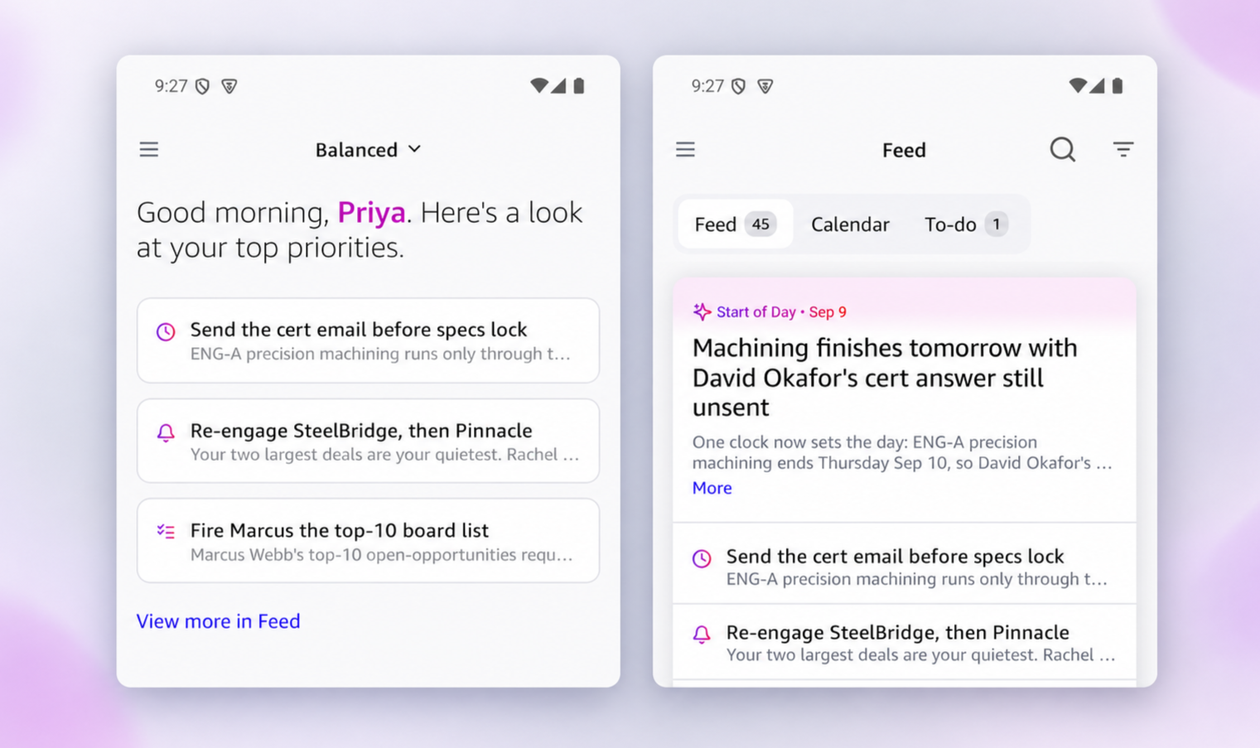
Amazon Quick’s new activity feed on mobile: the morning priority view, left, and the full feed. (Amazon Images)
Amazon is adding the Activity Feed and other features from its Quick desktop app to the AI assistant’s mobile apps for iOS and Android.
The Activity Feed is the signature feature of Amazon Quick. It combines email, Slack messages, calendar invites and CRM updates into one prioritized list, and lets people act on items (opening and responding to emails, for example) without switching apps.
Amazon said Wednesday that the Quick desktop app, released in preview in April, is now generally available on Windows and macOS. The company also said Quick’s agents now run in the cloud, so they keep working after a laptop is closed and deliver results to the feed.
The desktop and mobile apps now sync, as well, so a task started on a laptop can be picked up on a phone, for example.
Quick has a free tier, with paid individual plans starting at $20 per user per month billed annually, and business plans running $20 to $40 per user per month.
Quick is Amazon’s entry in a crowded market for AI assistants at work, competing with Microsoft Copilot, Google Gemini, OpenAI, Anthropic and others. Amazon’s announcements cited business customers for Quick including Southwest Airlines, LabCorp and the PGA Tour.
The desktop app came together fast, as part of a new effort inside Amazon to use small teams to move quickly: Swami Sivasubramanian, the AWS vice president of agentic AI, told GeekWire in June that a team of about six engineers started in late January and shipped April 28.
Zeiss Group has ditched plans for a greenfield ERP migration to latest S/4HANA platform from SAP following years of struggle trying to move off an ageing R/3 system. The industrial optics company with revenue of around €11.896 billion said it was seeking to “realign” its ERP migration plans by moving its existing landscape to the new platform, a so-called "brownfield” migration. SAP has long recommended that customers move to S/4HANA — a completely re-engineered version of its popular ERP system — with a clean-core approach, abandoning old customizations and adopting new processes at the same time. It can prove a challenging, costly, and time-consuming journey for many customers as they grapple with business process and technology change in one project. Reports suggest that Zeiss has sunk €200 million into the project to move from R/3 — the earliest version of which was introduced in 1992 — which began around 2020. A company spokesperson told The Register that the company “continuously evaluates larger projects and adapts them flexibly as conditions change.” They said: “This also applies to the ERP migration, which has now been realigned to achieve faster progress in the transformation and to better meet the diverse requirements of the ZEISS segments. “As a first step, the existing ERP landscape will be migrated to SAP S/4HANA. The segments will then build upon this with individually configured solutions. The result will be a group-wide core system with segment-specific applications that best reflect the similarities and differences in the processes,” they said. The company declined to comment on the spending figure attributed to the project. SAP has declined to comment. Two years ago, CIO Carsten Trapp told the media the company had opted for a greenfield approach in its SAP migration. He said it was a “a lifetime opportunity to clean up” because the company had “messed up our R/3 system over the last 30 years.” Moving to S/4HANA would mean the technology team could set up “all processes cleanly in the SAP standard from the start,” he told CIO magazine. He said that in 2020, the board had recognized the scale of the challenge in moving off R/3 — which was replaced by ECC as SAP's main ERP product in the early noughties. Mainstream support for ECC is set to end in 2027. However, on a call to investors in December last year, Justus Felix Wehmer, CFO of major subsidiary Carl Zeiss Meditec, said administration expenses had increased because of higher IT costs. “We have mentioned that we are introducing a new ERP system, SAP S/4HANA, and that requires additional expenses in that area,” he said. In May, he said that these expenses would be peaking because of the SAP project “over the next two to three years.” Zeiss has an existing relationship with Microsoft, which said in 2024 that the optics company was moving its ERP systems to the cloud, on Azure. SAP has struggled to convince users of the business value of moving from legacy ERP systems such as R/3 and ECC to S/4HANA, despite the promise that it offers greater speed and flexibility owing to its in-memory database. Although the new system was introduced in 2015, as recently as last year, 95 percent of legacy users said building a positive case to migrate requires a big effort or is genuinely challenging, according to research from Freeform Dynamics.®
Microsoft has found another use for AI: providing an off-ramp for Salesforce customers. The software giant on Wednesday gave the world “Dynamics 365 Activate,” software that executive veep for Apps and Agents Jeff Teper described as “a comprehensive, AI-powered tool that can help partners and customers move to Dynamics 365 faster, with less manual effort and lower migration risk.” Microsoft has made the tool available as a public preview that can convert Salesforce implementations to its own SaaS-y Dynamics 365 offering. The company promises it will launch “additional CRM and ERP migration scenarios” starting “later this year.” The software behemoth’s vision for this tool is to create “one agentic implementation experience” that covers starting a new business or business process, migration from an existing tool like Salesforce, or to grow a business that already runs Dynamics. Microsoft’s explanation for how AI can move a major business application says its AI-powered convert-o-tronic machine can profile “data and entities, identify relationships and dependencies, and surface customizations that require attention.” That process apparently “gives implementation teams a clearer blueprint for what should move, what should change, and what should be redesigned before migration begins.” For Salesforce, the tool “will analyze an existing … CRM environment and build a detailed understanding of its data, business processes, customizations, and dependencies.” Microsoft’s partners are a big target for the AI-powered converter, because Redmond thinks it will help them to more quickly understand users’ existing applications. “Partners can use these insights to assess Salesforce environments faster, determine what to preserve, simplify, or redesign around AI and agents, and identify migration risks and dependencies earlier. This approach empowers teams to focus more time on solution architecture, industry expertise, and change management,” states an announcement for partners. Microsoft got serious about building a big business applications business with its 2001 acquisition of Great Plains Software. It’s hard to quantify its success because Microsoft doesn’t report a revenue line item for CRM and ERP, but the Productivity and Business Processes business unit that includes Dynamics won $140 billion of revenue in FY 26, up almost 15 percent year-over-year. It’s thought that Microsoft has earned about 25 percent market share for ERP, but just four or five percent of the CRM market which Salesforce dominates with around 20 percent share. But Salesforce customers may be ripe for a chat with an alternative supplier, as its Agentforce platform hasn’t excited users according to two recent reports – but AI spending at the CRM giant has dented its margins. Oh, the irony, that Microsoft might use AI to prise away Salesforce customers who aren’t happy with its AI! ®
Microsoft will retire Project Online and remove Publisher from Microsoft 365 over the coming weeks, while support for perpetual versions of Publisher and for Office 2021 will end shortly afterward. Publisher, Microsoft's desktop publishing application, dates back to the Windows 3.x era. Microsoft announced its retirement in 2024 and will remove it from Microsoft 365 subscriptions on October 1, 2026. Support for perpetual versions will end on October 13 alongside Office LTSC 2021 and Consumer Office 2021. Project Online will retire on September 30. The following day, Project Online Essentials – a licensing SKU that gives users limited access to Project Online and Project Server – will reach end of life. It has not been available to new customers since October 2025. The retirement could catch out organizations that have not migrated. Essentials provides relatively inexpensive licenses for users who needed to update tasks, submit timesheets, and view project information without the broader capabilities of Microsoft's more expensive plans. Unlike Publisher, which has no direct replacement, Microsoft recommends moving Project Online Essentials users to Planner Plan 1 or Planner and Project Plan 3, depending on the capabilities and Project Server access rights they require. The additional functionality and potentially higher cost may not appeal to everyone, though. There are also third-party replacements. ProjectLibre, for example, launched ProjectLibre Cloud AI 2.0 this week. It costs just under $10 per user per month when billed annually and is one of several third-party alternatives to Microsoft's project management products. While Microsoft will not offer an Extended Security Updates program for Office 2021 after support ends, third-party provider 0patch says it will supply unofficial security fixes for critical vulnerabilities for at least another three years. Organizations still assigning Project Online Essentials licenses must move affected users to supported alternatives before October 1 to avoid interrupting their access. ®
A few weeks back we spotted Microsoft’s Exchange team admitting that AI has found so many bugs it hasn’t found time to deliver a Cumulative Update for the messaging server. And on Tuesday, the Microsoft Edge team revealed it’s also a bit overwhelmed by AI. “Rapid adoption of AI-assisted coding is enabling developers to build extensions faster than ever,” according to a post by the Edge team. AI has also seen “More developers … building, iterating, and submitting extensions.” As Microsoft vets extensions for its browser before allowing users to install them, that means Redmond has more work to do – but fewer people to do it with thanks to regular rounds of redundancies. Microsoft initially tried to address that by introducing what it calls “an expedited review process for high-quality and high-value extensions.” That process is now groaning under the weight of newly submitted extensions. “Since then, submission volumes have continued to increase, and our review pipeline has experienced additional strain, causing an increase in extension review turnaround time,” the Edge team admits in its post. What to do about this problem caused by AI? Use more automation, of course! “To address this challenge, we’ve introduced automation for many of the repeatable validation checks that are part of the review process and streamlined how reviews move through our pipeline,” the Edge team explains, without revealing if that automation uses AI. “This doesn’t change our review standards or reduce the checks an extension must pass,” the team insists. “Instead, it helps us identify known policy violations and security issues more consistently while allowing reviewers to spend more time on complex cases that benefit from human judgment.” That quote makes this the second story in a row on The Register in which the “automation frees people to tackle hard problems” argument has become a response to AI (here’s the last one.) “The result is a more efficient review process that helps extensions move through the pipeline faster while maintaining the high quality and security standards developers and users expect from the Edge Add-ons site,” we’re told. The Edge team says its increased use of automation means it will be able to approve and update extensions more quickly. The team also says its changed practices mean it will be able to refresh the “Featured” badge it applies to Edge add-ons “that align with Best practices for extensions” every 15 days. “With this more frequent cadence, high-quality extensions can earn recognition sooner, and developers receive faster feedback on their investments in quality. At the same time, users benefit from a more up-to-date view of the extensions that meet our quality standards,” the post states. ®
I compared six leading lead scoring platforms for 2026 based on scoring flexibility, predictive capabilities, data quality, automation, CRM fit, and overall value for sales and marketing teams.

 Login
Login