While CCC high-yield credit spreads were blowing out, Strive still raised $700 million for Bitcoin. Jeff Walton, Chief Risk Officer at Strive, explains what that tells us about the growing market for Bitcoin-backed preferred equity. He discusses Strategy’s daily dividend vote, the future of rated capital, and why he believes that’s where the next trillion dollars comes from.
Chapters: 00:00 Strive Raises $700M in SATS Preferred Stock IPO 02:11 Behind the Scenes of the Upsized SATS Offering 05:03 How High Can Strive Take Its Amplification Ratio? 07:01 SATS vs. SATA: A New Tool for Raising Capital 08:36 Strive’s 18-Month Dividend Reserve Explained 11:13 Surviving the Longest Bitcoin Bear Market With No Capital Access 13:36 Strategy’s Daily Dividend Vote and STRC Returning to Par 15:59 “A Gold Rush”: New Capital Pools Chasing Bitcoin 18:54 Raising Capital as High-Yield Credit Spreads Blow Out 22:27 MSCI’s Bitcoin Treasury Exclusion and the Vanguard Parallel
DISCLAIMER: The views and opinions expressed in this show are those of the participants and do not necessarily reflect the official policy or position of BTC Inc., Bitcoin Magazine, or any affiliated entities. This content is provided for informational and educational purposes only and should not be construed as investment, legal, tax, or accounting advice. Nothing contained in this show constitutes a solicitation, recommendation, endorsement, or offer to buy or sell any securities or financial instruments. Viewers should consult their own advisors before making financial or business decisions.
Bitcoin treasury Strive’s preferred stock, SATS, is now trading on the Nasdaq, according to the company.
The stock debuted Tuesday and will pay a 15% dividend every business day, according to an announcement.
Nasdaq-listed Strive said it closed its upsized initial public offering of 7,000,000 shares of SATS at a public offering price of $90 per share.
JUST IN: Strive’s 'SATS' has officially IPO’d on the Nasdaq, and is raising $630 million to buy more Bitcoin and income-generating assets pic.twitter.com/IxqeUENary
It comes as public companies work to financialize bitcoin via different products. OG bitcoin treasury Strategy, which has five different preferred stocks, proposed daily dividends for its products last month.
“The successful, upsized IPO of SATS marks a critical milestone in our strategy to maximize long-term total returns for our common equity investors,” Matt Cole, Chairman and CEO of Strive, said in a statement.
The Nasdaq-listed Strive also has SATA, another preferred stock, which pays a variable dividend.
Strive debuted as an official bitcoin treasury last year and is now the fourth biggest company in the space.
Founded by former Ohio gubernatorial candidate and tech entrepreneur Vivek Ramaswamy, the company holds 36,818 BTC worth over $3 billion at today’s prices. The company on Monday announced another bitcoin buy of 4,045 BTC between October 12 and 16.
In January 2026, it completed the acquisition of Semler Scientific in an all-stock deal — the first instance of a publicly traded Bitcoin treasury company acquiring another such company.
Like with other digital asset treasuries, the idea is that investors can get amplified returns from Strive’s stock. The company buys bitcoin with equity, and maintains a debt-free balance sheet: no bonds, no credit lines, and no leveraged positions that could trigger forced liquidation in a downturn.
Strive is following in the footsteps of software company Strategy, which started buying bitcoin in 2020. Strategy is now the largest corporate holder of bitcoin, with 848,517 coins worth over $60 billion.
Its five preferred stocks are STRF, STRC, STRK, STRD, and STRE.
Strive’s stock, ASST, was trading 4% higher on Tuesday.
Spacecraft propulsion traditionally relies on volatile fuels and separate, bulky systems for different types of maneuvering in space. NASA is working to change that paradigm. Engineers at NASA’s Marshall Space Flight Center in Huntsville, Alabama, recently completed a rigorous series of environmental and physical tests on a new small satellite designed to make spaceflight safer and more efficient.
The ASCENT (Advanced Spacecraft Energetic Non-Toxic) Propulsion Dual Mode mission is a flight demonstration of a spacecraft about the size of a large shoebox. The mission will test a single, integrated propulsion system that uses a common fuel tank to feed two different types of engines.
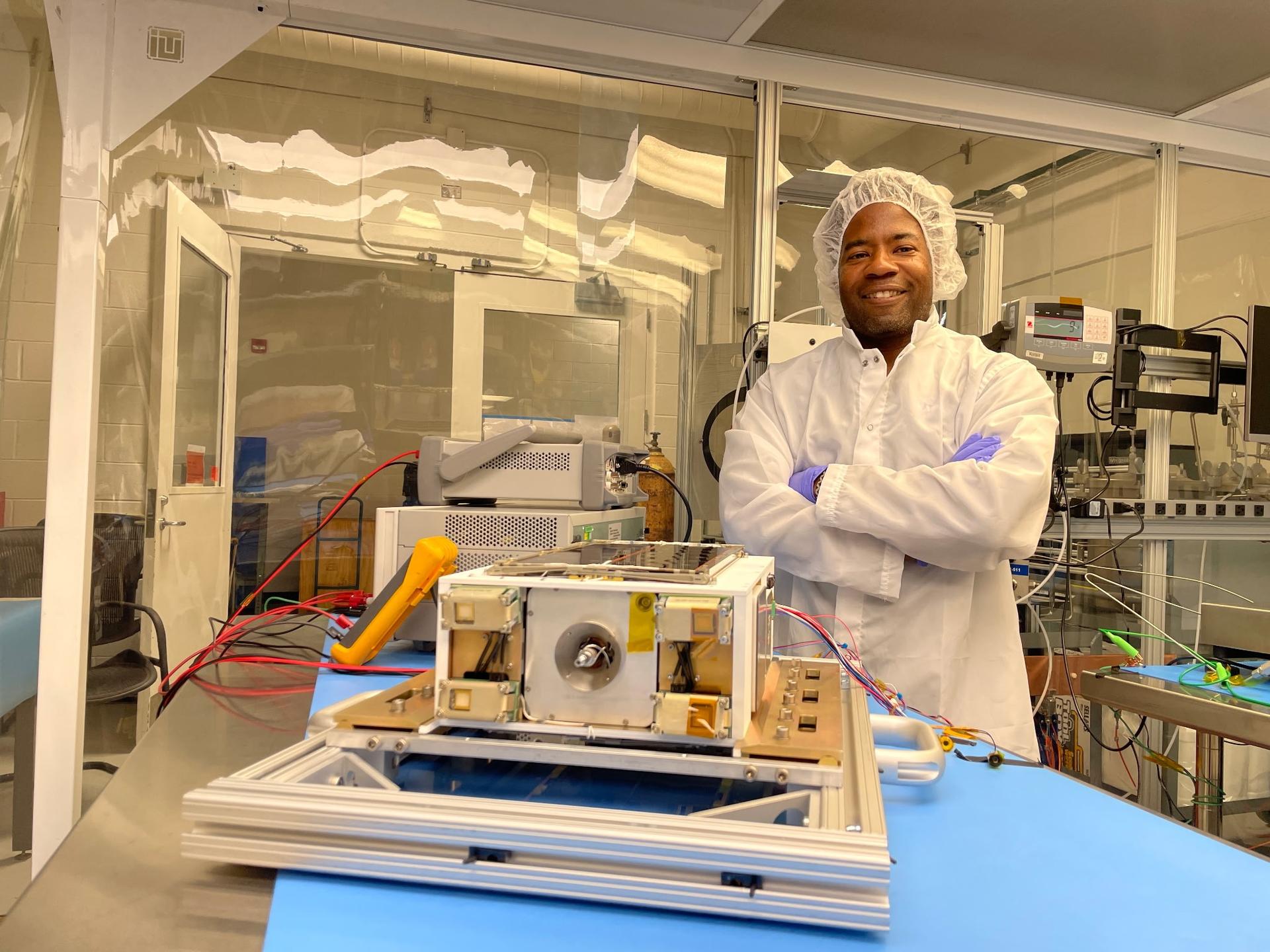
Dr. Nehemiah Williams, the demonstration’s project manager at NASA, prepares to start testing the mission’s flight hardware in a clean room at NASA’s Marshall Space Flight Center in Huntsville, Alabama. The mission will demonstrate a single, non-toxic propulsion system that combines both high-thrust and low-thrust capabilities into a common tank.
NASA/Charles Beason
Typically, spacecraft carry two separate propulsion systems to navigate: a high-thrust chemical system for rapid movements like entering orbit, and a low-thrust electric system for highly efficient, slow maneuvers like maintaining a position. This requires multiple fuel tanks and heavy plumbing, which eats up valuable space and weight.
The spacecraft being developed uses a single non-toxic propellant called ASCENT. By feeding both a high-thrust combustion engine and low-thrust electrospray thrusters from one central tank, the spacecraft saves critical mass and volume. For future missions, this means more room for scientific instruments and the ability to launch on smaller, less expensive rockets.
Bringing this concept to flight requires a nationwide collaborative effort. While NASA Marshall manages the mission, the spacecraft relies on electrospray thrusters developed by the Massachusetts Institute of Technology, a chemical propulsion module built by Plasma Processes, and a spacecraft bus integrated by the Georgia Institute of Technology.
“There are a lot of odds and ends, and a lot of small challenges and some big ones,” said Nehemiah Williams, the demonstration’s project manager at NASA Marshall. “But ensuring the functionality of the propulsion system across all these different teams is what makes the mission successful.”
Before a spacecraft can safely operate in the harsh environment of low Earth orbit, it must pass a battery of tests on the ground. Over the past few months, the engineering team at Marshall has put the flight hardware through its paces inside the center’s Small Spacecraft Servicing and Integration Lab.
To verify the integrity of the unified propulsion system, the team conducted extensive leak testing. Engineers performed a pressurized helium leak test of the spacecraft inside a vacuum chamber to ensure the integrity of the spacecraft’s seals, successfully proving those seals were working as intended. Because the system shares a single tank of ASCENT propellant to feed two different thruster types, ensuring that the fuel lines and valves are perfectly sealed is vital for mission safety and success.
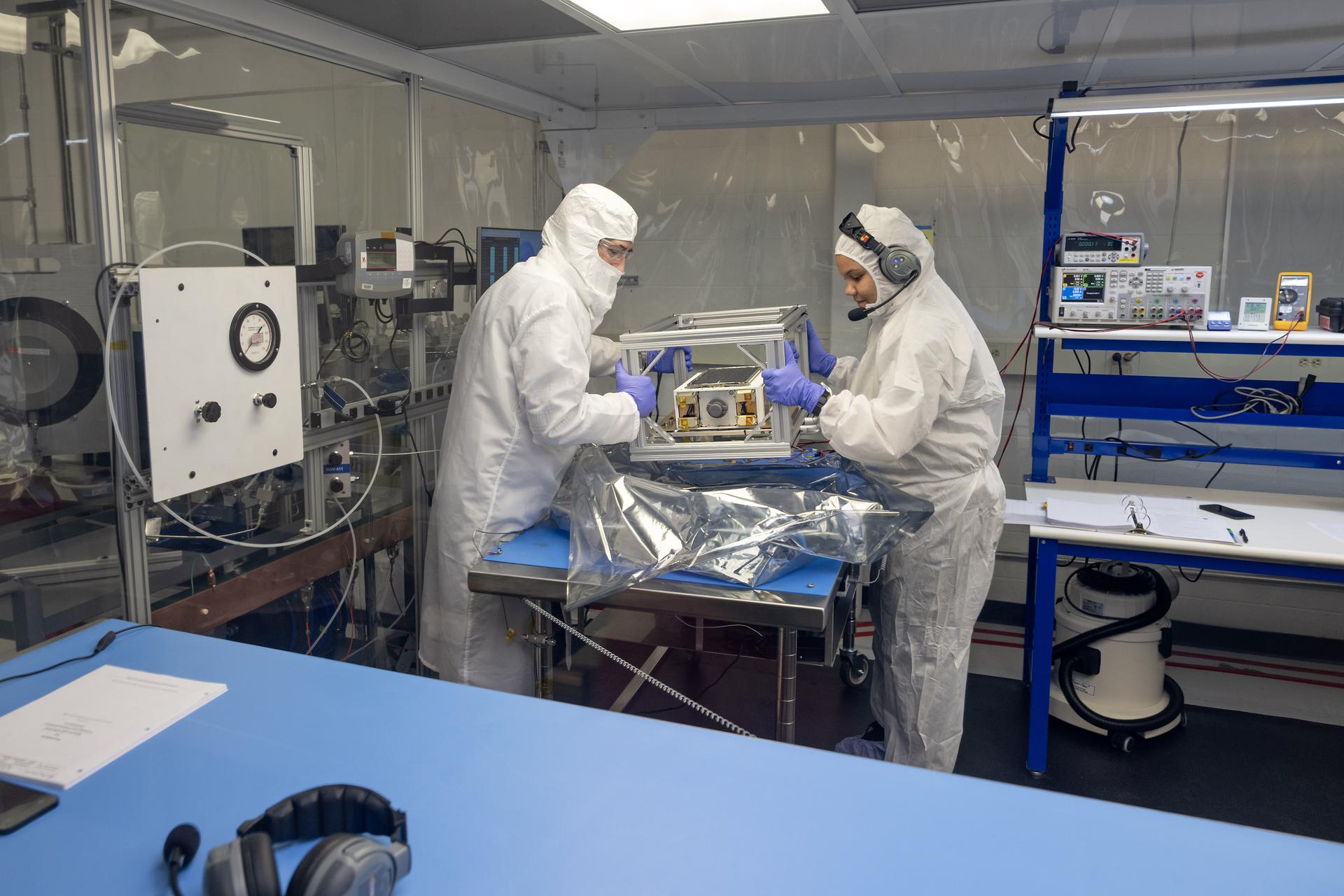
Propulsion subject matter expert Chris Burnside left, and propulsion lead Ebony Bland, right, prepare the mission’s flight hardware for testing inside a clean room at NASA’s Marshall Space Flight Center in Huntsville, Alabama. The 6-U CubeSat recently underwent rigorous spin, thermal vacuum, and leak tests to ensure its innovative, non-toxic propulsion system is ready for the extreme environment of space.
NASA/Charles Beason
The team also subjected the spacecraft to thermal vacuum testing. Space is an unforgiving environment characterized by a total lack of air and extreme temperature swings. By placing the spacecraft inside a specialized vacuum chamber that mimics these harsh conditions, engineers can ensure that the electronics, thrusters, and mechanical systems will operate normally once in orbit.
Additionally, the spacecraft underwent a spin test. Just like a tire on a car, a spacecraft needs to be perfectly balanced. The spin test measures the spacecraft’s mass properties and center of gravity. This validates the CubeSat’s ability to stably fly and maintain the correct attitude, allowing its antennas to communicate with Earth and its solar panels to accurately catch the Sun’s rays.
With the environmental and physical testing now complete, the mission is entering its final stages of preparation. The team will complete the final system checkouts, integrate the spacecraft’s solar arrays, and ship the hardware to its launch destination.
The ASCENT Propulsion Dual Mode mission is manifested to launch no earlier than October 1 as a payload aboard a SpaceX Falcon 9 rocket from Vandenberg Space Force Base in California.
Once deployed into an orbit about 325 miles above Earth, the spacecraft will begin a nine-month mission. After an initial checkout period, the operations team will execute short chemical and electric maneuvers. If successful, the spacecraft will spend several months performing multiple orbit-raising and lowering maneuvers, alternating between its high-thrust and low-thrust engines to prove the dual-mode concept works in space.
The ASCENT Propulsion Dual Mode mission is managed and funded by NASA’s Small Spacecraft & Distributed Systems (SSDS) within the agency’s Research and Technology Mission Directorate at NASA Headquarters in Washington. SSDS is based at NASA’s Ames Research Center in California’s Silicon Valley.

 Login


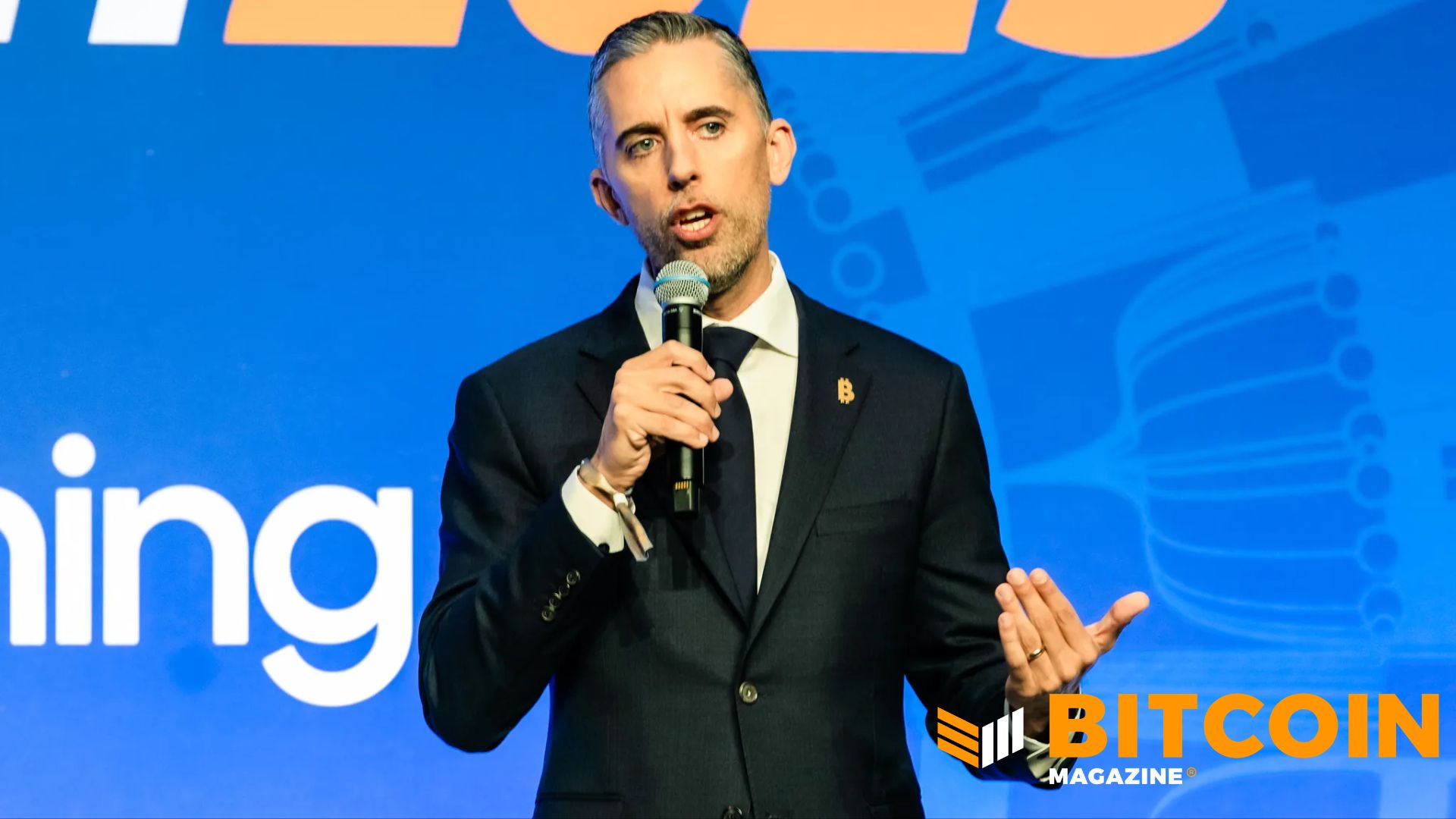
 Strive’s 'SATS' has officially IPO’d on the Nasdaq, and is raising $630 million to buy more Bitcoin and income-generating assets