Reading view

There are new articles available, click to refresh the page.

Sui Launches $10M Fund For AI And DeFi Builders

The Sui Foundation has launched a $10 million ecosystem fund aimed at decentralized AI infrastructure and DeFi-native protocols building on Sui.

It is a very Sui-shaped announcement: high-throughput chain, developer grants, AI angle, DeFi angle, and a clear attempt to pull more builders into its Move-based ecosystem.

The money is not all being sprayed into the market at once. The fund is structured around development support, security audit credits, technical assistance, and milestone-based backing. That is important, because grant announcements can sound bigger than they really are if the terms are ignored.

Still, the signal is clear enough. Sui wants to compete harder for builders in two of crypto’s busiest lanes.

For more details, visit the official Blog platform.

TL;DR

  • Sui Foundation has launched a $10 million AI and DeFi ecosystem fund.
  • The fund is aimed at teams building decentralized AI infrastructure and DeFi protocols on Sui.
  • Grant support is tied to development needs and milestones, not instant full disbursement.

Why Sui Is Leaning Into AI And DeFi

Sui is trying to stand out in a crowded Layer-1 market.

That is not easy. Ethereum has depth. Solana has retail energy. BNB Chain has distribution. Avalanche has institutional and subnet narratives. Newer chains need something sharper than “we are fast and cheap.”

AI and DeFi give Sui two markets with obvious demand.

AI infrastructure needs payments, coordination, data markets, agents, compute access, and identity rails. DeFi needs speed, low fees, liquidity, risk controls, and developer-friendly tools. Sui’s pitch is that its architecture can support applications that need high throughput without making the user experience painful.

A $10 million fund is a way to turn that pitch into actual projects.

Grants Are About Direction

Ecosystem funds are not magic.

They do not guarantee good apps. They do not guarantee users. They do not guarantee TVL. Crypto has seen plenty of grant programs that created short bursts of activity and then faded.

But they do show where a foundation wants the ecosystem to go.

By naming AI and DeFi, Sui is making a clear choice. It wants builders working on categories that can bring usage, liquidity, and attention. It is not just funding abstract research or scattered experiments.

That makes the fund easier to understand.

AI Needs Better Payment And Coordination Rails

The AI angle is interesting because crypto and AI are starting to overlap in more practical ways.

Autonomous agents may need wallets. AI services may need usage-based payments. Data contributors may need compensation. Apps may need programmable settlement. Those are areas where blockchains can be useful if the experience is smooth enough.

Sui is clearly trying to position itself as one of the places those experiments happen.

The challenge is separating real infrastructure from AI branding. A project saying “AI” is not enough. The market will want to see products that actually use decentralized rails in a way that improves the experience.

DeFi Is The Immediate Test

DeFi is probably the more immediate test for Sui.

If the fund helps launch lending markets, DEX infrastructure, derivatives tools, liquidity systems, or risk-management products, the effect may show up in network metrics. More deposits, more trades, more stablecoin activity, and more recurring users would all strengthen Sui’s case.

But again, grants only start the process.

The stronger signal comes when builders stay after incentives fade.

What To Watch

The next step is not the headline fund size. It is who gets funded.

Good grant programs are judged by the quality of teams, the usefulness of the apps, and whether the ecosystem gets something durable from the spending. Audit credits and technical support may be especially valuable if they help projects launch more safely.

For Sui, this is a sensible move.

The network needs builders. Builders need support. AI and DeFi are busy enough to justify the bet. Now the fund has to produce projects people actually use.

This article draws on Sui Foundation materials relating to its AI and DeFi ecosystem fund.

This article was written by the News Desk and edited by Samuel Rae.

This report is based on information released by Blog. at Blog

Sui TVL Holds $1.2B As DeFi Activity Stays In View

Sui Network’s total value locked is holding around the $1.2 billion level, keeping the chain in the conversation as traders watch where DeFi liquidity is moving.

TVL is not the same as users. It is not the same as revenue. It does not prove that every application on the network is thriving.

But it is still one of the most watched signals in DeFi because it shows how much value is sitting inside protocols on a chain. For Sui, holding the $1.2 billion area gives the ecosystem a useful liquidity marker.

For more details, visit the official Defillama platform.

TL;DR

  • Sui Network TVL is holding around $1.2 billion.
  • The figure points to continued DeFi liquidity on the chain.
  • TVL should not be treated as a direct measure of active users.

Why TVL Still Matters

TVL has lost some of its magic since the early DeFi boom.

Back then, every rising TVL chart was treated like proof that a protocol was winning. The market is more careful now, and rightly so. TVL can be boosted by incentives, asset-price changes, looping, or a few large depositors.

Even with those limits, TVL still matters.

It shows whether capital is present. Without liquidity, DeFi apps struggle. Lending markets need deposits. DEXs need pools. Yield products need assets. Traders need depth.

So when Sui holds a $1.2 billion TVL level, it tells the market that the chain has meaningful DeFi capital to work with.

Sui Is Fighting In A Crowded Market

Sui is competing against some very strong ecosystems.

Ethereum and its Layer-2s still dominate much of DeFi. Solana has deep retail momentum. BNB Chain has distribution. Avalanche, Arbitrum, Base, and others all have their own liquidity pockets.

That makes Sui’s TVL important.

The network needs visible metrics to stay in the conversation, and DeFi liquidity is one of the clearest. Holding a billion-dollar-plus level helps show that Sui is not just a narrative chain. It has capital deployed across applications.

TVL Does Not Prove User Growth

This needs to stay clear.

A high TVL number does not mean daily active users are rising. It does not mean transaction quality is improving. It does not mean developers are shipping faster. It simply tells us how much value is locked in DeFi protocols.

That is valuable, but limited.

For a stronger ecosystem read, traders need to pair TVL with DEX volume, active addresses, transaction count, fees, stablecoin supply, developer activity, and app-level usage.

TVL is one piece of the picture.

Why The Level Matters Psychologically

Round numbers matter in crypto.

A chain holding above $1 billion in TVL tends to be taken more seriously than one below it. It signals that enough capital has arrived to support a meaningful DeFi ecosystem.

Sui holding around $1.2 billion therefore gives the network a stronger market position.

It may also help attract builders who want liquidity already in place before launching applications.

What To Watch Next

The next test is whether Sui can convert liquidity into deeper activity.

That means more trading, more lending, stronger apps, better retention, and wider stablecoin usage. If TVL stays high while activity also grows, the network’s DeFi case becomes stronger.

If TVL holds but usage lags, the signal becomes less powerful.

For now, Sui has a solid capital base. The market will want to see whether that liquidity turns into a busier ecosystem.

This article draws on DeFiLlama Sui Network TVL data.

This article was written by the News Desk and edited by Samuel Rae.

This report is based on information released by Defillama. at Defillama

Switchboard Halts Oracle Operations On SUI And Aptos After Potential Compromise

Switchboard has halted oracle operations on several networks, including SUI and Aptos, after detecting a potential security compromise.

The precautionary halt also affects IOTA and Movement, according to the validated incident materials. The key detail is scope: Switchboard’s oracle services were halted on affected chains, not the chains themselves.

That distinction matters.

This should not be framed as SUI, Aptos, IOTA, or Movement halting block production. It is an oracle infrastructure incident, and the impact depends on which applications rely on Switchboard feeds or services.

Still, oracle halts can be serious because DeFi applications depend on accurate, timely data to function safely.

For more details, visit the official Status platform.

TL;DR

  • Switchboard halted oracle operations on SUI, Aptos, IOTA, and Movement.
  • The move followed a potential security compromise.
  • The affected chains did not necessarily halt; the issue concerns oracle infrastructure.

Why Oracle Incidents Matter

Oracles are critical infrastructure.

They bring external data into blockchain applications. Lending markets need prices. Perpetuals platforms need market data. Structured products need reference rates. DeFi protocols depend on oracles to decide liquidations, collateral values, and trading conditions.

If an oracle is compromised, stale, or unreliable, applications can become dangerous quickly.

That is why shutting down operations can be the safer move. A temporary halt may be disruptive, but bad data can cause far worse damage.

Switchboard’s response appears to fit that risk-management logic.

A Precautionary Halt Is Not A Confirmed Exploit

The language matters.

A potential compromise is not automatically the same as a confirmed exploit. Until the provider publishes full incident details, the safer wording is that operations were halted as a precaution after a possible security issue.

That protects readers from assuming funds were lost, chains were hacked, or every dependent application failed.

The incident may still be serious, but it needs to be described accurately.

Security coverage should clarify what is known, what is not known, and which systems are affected.

SUI And Aptos Depend On Reliable Data Layers

SUI and Aptos are both high-performance chains with growing DeFi ecosystems.

For these networks, oracle reliability matters because applications need trusted data to support lending, swaps, collateral, derivatives, and structured products. If oracle services are paused, some protocols may need to pause markets, adjust risk parameters, or rely on fallback systems.

That can affect users even if the base chain keeps running normally.

The same applies to IOTA and Movement if applications there rely on Switchboard services.

Multi-Chain Oracle Risk Cuts Across Ecosystems

One important lesson is that infrastructure incidents can span multiple chains.

A protocol like Switchboard may serve several ecosystems at once. That creates efficiency, but it also means a security concern can affect many networks simultaneously.

This is a broader DeFi risk.

Projects often think in chain-specific terms, but shared infrastructure can become a cross-chain dependency. Oracles, bridges, RPC providers, indexers, wallets, and middleware can all create shared points of failure.

Switchboard’s halt is a reminder of that.

The Next Signals To Watch

Users and developers will be watching for a full incident explanation.

The important questions are straightforward: what was compromised, what services were affected, whether any data was manipulated, whether any protocols took losses, and when operations will resume.

Until then, applications using Switchboard feeds may need to remain cautious.

For the wider market, the incident shows why oracle security remains one of DeFi’s most important issues.

Blockchains can keep producing blocks, but applications still need reliable data. When the data layer stops, the application layer can feel it immediately.

This article is based on Switchboard status materials and public incident information.

This article was written by the News Desk and edited by Samuel Rae.

This report is based on information released by Status. at Status

Binance To Remove Seven Spot Trading Pairs Including SUI And LTC Markets

Binance has announced that it will remove seven spot trading pairs on August 21 at 03:00 UTC, including SUI/BNB and LTC/BNB.

The affected pairs are SUI/BNB, LTC/BNB, ILV/USDC, HIVE/USDC, F/USDC, NMR/USDC, and STEEM/USDC. The move is part of Binance’s usual market optimization process.

The important detail is that Binance is removing specific trading pairs.

It is not delisting SUI, LTC, or the other underlying assets entirely from the platform. Traders may still be able to use other available pairs, depending on Binance’s market support.

That distinction matters because delisting headlines can easily create confusion.

TL;DR

  • Binance will remove seven spot trading pairs on August 21 at 03:00 UTC.
  • Affected pairs include SUI/BNB and LTC/BNB.
  • The assets themselves are not necessarily being delisted from Binance entirely.

Why Pair Delistings Happen

Exchanges regularly review trading pairs.

A pair may be removed because of low liquidity, weak volume, poor market quality, operational considerations, or broader product cleanup. Removing a pair can improve the trading experience by concentrating liquidity in stronger markets.

For example, if most SUI trading happens against USDT or FDUSD, a thin SUI/BNB pair may not need to remain active.

The same applies to LTC/BNB or smaller USDC pairs.

Delisting a pair does not automatically mean an exchange has lost confidence in the asset. It may simply mean the pair itself is not useful enough.

SUI And LTC Headlines Need Care

SUI and LTC are the most recognizable assets in the list, so they will likely get the most attention.

But Binance is not saying SUI or LTC are being removed as assets. The announcement concerns SUI/BNB and LTC/BNB specifically. That means traders need to check which other pairs remain available before assuming broader platform impact.

This is especially important for casual readers.

A headline saying “Binance delists SUI and LTC pairs” can be accurate. A headline saying “Binance delists SUI and LTC” would be misleading if the assets remain supported through other markets.

USDC Pair Cleanup Also Stands Out

The other affected pairs include ILV/USDC, HIVE/USDC, F/USDC, NMR/USDC, and STEEM/USDC.

That suggests Binance is also cleaning up some lower-volume USDC markets. Exchanges often keep the most liquid quote pairs and remove weaker ones to improve order-book quality.

For users, the practical effect is straightforward.

If they trade any of the affected pairs, they need to close or adjust orders before removal. After delisting, they may need to use another available quote pair.

Market Impact Is Usually Pair-Specific

The impact of a pair removal depends on how much volume that pair handled.

If a pair had little activity, the broader asset market may barely notice. If it was an important route for liquidity, traders may shift to another pair and spreads could temporarily change.

For SUI and LTC, the effect is likely to depend on how much trading occurred against BNB compared with larger quote currencies.

For smaller assets like ILV, HIVE, F, NMR, and STEEM, the removal of USDC pairs may matter more if alternative liquidity is thinner.

The Clean Takeaway

Binance is optimizing its spot market list by removing seven trading pairs.

That is a normal exchange operation, but it still matters to affected traders. Orders tied to those pairs need attention, and liquidity may shift to remaining markets.

The key is not to overstate the action.

SUI, LTC, and the other assets are not automatically being removed from Binance altogether. The announcement concerns specific spot pairs.

For traders, the practical move is simple: check open orders, check available alternative pairs, and avoid reading pair cleanup as a full asset delisting unless Binance says so directly.

This article is based on Binance’s official spot trading pair removal announcement.

This article was written by the News Desk and edited by Samuel Rae.

This report is based on information released in disclosures at primary source documentation.

NAVI Prime Brings Curated Institutional Lending Markets To Sui

NAVI Protocol has launched NAVI Prime, a modular lending framework on Sui that replaces shared liquidity pools with independently curated lending markets.

The new framework is designed for more controlled lending environments, allowing customized collateral parameters and risk management for professional allocators. That makes it different from standard open pooled lending, where many users and assets share the same risk environment.

The key phrase is “curated.”

NAVI Prime is not a government-regulated banking product. It is still decentralized, smart contract-based DeFi. But it is trying to bring more structure to how lending markets are created and managed on Sui.

That could matter as DeFi starts courting more sophisticated capital.

TL;DR

  • NAVI Protocol launched NAVI Prime on Sui.
  • The framework uses isolated, curated lending markets.
  • It is DeFi infrastructure, not a regulated banking framework.

Why Curated Lending Matters

Traditional DeFi lending markets are powerful, but they can be blunt.

A shared liquidity pool can make borrowing and lending easy, but it also creates shared risk. If one asset becomes unstable, one oracle fails, or one collateral type behaves badly, the effects can spread through the pool.

Curated markets try to reduce that problem.

By isolating markets and customizing collateral rules, protocols can create more targeted risk environments. One market might support conservative collateral. Another might serve a specific institution, asset type, or risk profile.

That does not remove risk, but it can make risk easier to define.

Sui’s DeFi Stack Gets More Professional

Sui has been building out its DeFi ecosystem, and lending is a central piece of that.

A blockchain can have fast settlement and strong technical design, but users need financial primitives: borrowing, lending, liquidity, collateral, swaps, derivatives, and risk management. NAVI Prime adds a more advanced lending layer to that stack.

For professional allocators, the appeal is control.

They may not want to deposit into a broad market with unknown collateral relationships. They may prefer a market where rules are tailored, exposures are isolated, and risks are more transparent.

That is the direction NAVI Prime appears to be taking.

Professional Does Not Mean Risk-Free

The language around institutional lending can sound safer than it is.

NAVI Prime is still a DeFi product. Smart contract risk remains. Oracle risk remains. Collateral volatility remains. Liquidation mechanics still matter. Market design can reduce some risks, but it does not eliminate them.

This distinction is important because institutional-style branding can create false comfort.

A curated market can be more disciplined than a general pool, but users still need to understand the assets, parameters, and liquidation rules before participating.

In DeFi, structure helps. It does not replace diligence.

Why Isolated Markets Are Becoming Popular

More DeFi protocols are moving toward isolated market designs.

The reason is simple: one-size-fits-all liquidity pools are not always suitable for complex assets. As DeFi adds more long-tail tokens, real-world assets, liquid staking tokens, and institution-facing products, risk isolation becomes more important.

A modular framework gives protocols more flexibility.

They can create markets for specific assets, users, or strategies without putting the entire protocol balance sheet under the same risk umbrella.

That is useful for growth, especially if professional capital wants clearer boundaries.

What To Watch Next

The next question is adoption.

A lending framework only matters if borrowers, lenders, curators, and liquidity providers use it. NAVI Prime will need to show that its market design attracts meaningful activity without creating hidden concentration or liquidation risks.

For Sui, the launch adds another building block to the network’s DeFi ambitions.

The chain now has a more structured lending product aimed at sophisticated users, and that may help it compete with larger DeFi ecosystems.

The real test will be whether curated lending markets become active, liquid, and resilient.

This article is based on NAVI Protocol materials describing NAVI Prime on Sui.

This article was written by the News Desk and edited by Samuel Rae.

This report is based on information released in disclosures at primary source documentation.

Securitize And Neuberger Berman Bring Tokenized HINC Fund To Sui

Securitize and Neuberger Berman have launched the Neuberger Securitize High Income Tokenized Fund, known as HINC, with deployment across Sui, Solana, Avalanche, and Ethereum.

The fund gives eligible accredited investors tokenized access to a portfolio that can include high-yield bonds, leveraged loans, and collateralized loan obligations. Securitize is handling administration and compliance infrastructure, while Neuberger Berman acts as subadvisor.

That structure matters because HINC is not a stablecoin.

It is an actively managed private tokenized fund, and access is restricted. The product belongs in the real-world asset and tokenized finance category, not the simple dollar-token category.

For Sui, though, the deployment is still important. It gives the network another institutional-style asset and another sign that tokenization platforms are willing to use Sui alongside more established chains.

TL;DR

  • Securitize and Neuberger Berman launched the HINC tokenized fund.
  • HINC is deployed across Sui, Solana, Avalanche, and Ethereum.
  • The fund is restricted to eligible accredited investors and should not be described as a stablecoin.

Why HINC Matters

Tokenized funds are becoming one of the more serious areas of crypto adoption.

Unlike speculative token launches, tokenized funds connect blockchain infrastructure with traditional investment products. They use on-chain rails for ownership records, transfer mechanics, settlement, and access management, while the underlying exposure can still come from conventional credit markets.

HINC fits that model.

The fund is not trying to replace stablecoins or create a new meme asset. It is offering tokenized access to income-generating credit exposure through regulated infrastructure.

That is exactly the type of product institutions are increasingly willing to test.

Sui Gets Another RWA Use Case

Sui’s inclusion is notable because the tokenized fund is not deployed only on Ethereum.

Ethereum remains the largest and most established smart-contract network for tokenized assets, but newer chains are competing for real-world asset deployments by offering faster settlement, lower costs, and different developer environments.

For Sui, HINC adds another example of institutional-style infrastructure choosing the network.

That can help Sui move beyond the usual altcoin categories of DeFi, gaming, and retail trading. Tokenized credit products give the chain a more serious financial-market narrative.

The question is whether actual users and capital follow.

Multi-Chain Deployment Is Becoming Normal

The fact that HINC is deployed across four networks says something about where tokenization is heading.

Issuers and administrators may not want to choose a single chain. Instead, they may prefer multi-chain availability, letting investors and platforms interact through the network that best matches their compliance, custody, or operational needs.

That reduces reliance on any one ecosystem.

It also creates competition. Chains need to offer reliability, liquidity, tooling, and institutional confidence if they want tokenized assets to remain active.

Sui is now part of that competition.

Do Not Treat This Like Retail DeFi

The accredited-investor restriction is important.

HINC is not a permissionless retail yield farm. It is a private tokenized fund with compliance controls and eligibility requirements. That means the user base is narrower, but the product may be more attractive to institutions that need regulatory structure.

Crypto markets often blur the difference between tokenized funds and open DeFi products.

They are not the same.

A tokenized fund can use blockchain infrastructure while still preserving traditional investor restrictions, legal wrappers, and compliance procedures.

The Bigger Tokenization Read

The bigger story is that tokenization is becoming less theoretical.

High-yield bonds, leveraged loans, CLO exposure, Treasury funds, private credit, and other traditional products are increasingly being adapted to blockchain rails. The appeal is not only speed. It is also programmability, transfer control, reporting, and potentially broader distribution to approved investors.

Sui’s role in HINC gives the network a place in that trend.

It does not guarantee large inflows overnight, but it adds credibility to Sui’s real-world asset stack.

For now, HINC is another sign that tokenized finance is moving from concept to product — and that newer chains are fighting to be part of the rails.

This article is based on Securitize’s announcement of the HINC tokenized fund.

This article was written by the News Desk and edited by Samuel Rae.

This report is based on information released in disclosures at primary source documentation.

Sui’s USDsui Model Turns Stablecoin Yield Into Ecosystem Buybacks

Sui’s USDsui stablecoin strategy is giving the network a different kind of token-utility story: stablecoin reserve yield being used for daily on-chain SUI buybacks and ecosystem distribution.

According to the validated notes, the USDsui model generates float yield, which the Sui Foundation uses to buy back SUI tokens on-chain. The repurchased tokens are then distributed to ecosystem participants, DeFi protocols, and validators.

That is a much more concrete mechanism than the usual “stablecoins bring liquidity” line.

If the model works as described, Sui is trying to connect stablecoin reserves, ecosystem incentives, and token demand into one loop. The size of that loop still depends on float, yield, usage, and transparency, but the design itself is interesting.

For more details, visit the official Sui platform.

TL;DR

  • Sui’s USDsui strategy uses stablecoin float yield for SUI buybacks.
  • Repurchased SUI is distributed to ecosystem participants, DeFi protocols, and validators.
  • The model is promising, but the impact depends on the actual reserve size and yield.

Why Stablecoin Float Matters

Stablecoins can generate yield because reserve assets often sit in cash-like instruments, short-term Treasuries, or other income-producing structures.

That yield is powerful.

For large issuers, reserve income can become a major business line. For blockchain ecosystems, the question is whether any of that yield can be routed back into users, developers, validators, liquidity, or token economics.

Sui’s model appears to answer that by using USDsui float yield to buy back SUI.

That gives stablecoin growth a more direct relationship with ecosystem support. The more stablecoin float grows, the more yield may be available. The more yield available, the more buyback capacity the system may have.

But the size matters. A small stablecoin float produces small yield. A large float can matter more.

Buybacks Need Transparency

Daily on-chain buybacks sound attractive, but investors should always ask for transparency.

Which wallets execute the buybacks?

How much yield is generated?

How much SUI is bought each day?

Where does the repurchased SUI go?

Which ecosystem participants receive it?

How are validators included?

Can the system be audited?

Those questions are not hostile. They are necessary.

Crypto users have seen too many vague buyback claims over the years. The strongest versions are measurable on-chain, repeatable, and tied to clear governance or foundation policy.

Sui’s advantage is that on-chain execution can make some of this easier to verify, if the data is presented clearly.

This Is Not Automatic Price Pressure

The buyback language needs care.

A buyback can support token demand, but only relative to its size. If the float yield is small compared with SUI’s trading volume, emissions, unlocks, or market selling, the price impact may be limited.

That does not make the model useless.

It just means the market should not treat daily buybacks as guaranteed bullish pressure without seeing the numbers. The better interpretation is that Sui is building a value-recycling mechanism: stablecoin yield comes back into the ecosystem rather than sitting entirely outside it.

That can help incentives, liquidity, and validator economics even if the direct price effect is modest.

Stablecoin Strategy Is Becoming Competitive

Every major chain wants stablecoin liquidity.

Stablecoins bring users, payments, DeFi collateral, trading pairs, lending demand, and institutional settlement. But liquidity is fragmented, and chains need reasons for stablecoins to stick.

Sui’s USDsui model tries to create that stickiness by making stablecoin reserves economically useful to the ecosystem.

That is different from simply hosting USDC or USDT. It is an attempt to design stablecoin growth as part of the chain’s economic engine.

Other networks are experimenting with their own approaches, whether through native stablecoins, yield-sharing, protocol-owned liquidity, tokenized treasuries, or issuer partnerships.

Sui’s version belongs in that broader competition.

A More Serious Sui Tokenomics Story

Sui has often attracted attention for speed, architecture, and consumer-app ambitions. USDsui adds a more financial layer to the story.

If stablecoin usage grows and yield is consistently recycled into SUI buybacks and ecosystem distribution, then tokenomics becomes tied to actual balance-sheet activity rather than only emissions or speculation.

That is a healthier story.

It still needs real data over time. The market will want to see float growth, yield generation, buyback execution, and distribution outcomes. But the mechanism gives Sui something concrete to measure.

For now, USDsui is not just another stablecoin headline. It is an attempt to turn reserve economics into on-chain ecosystem support.

That makes it one of the more interesting stablecoin models to watch.

This article is based on Sui materials describing the USDsui yield and on-chain buyback model.

This article was written by the News Desk and edited by Samuel Rae.

This report is based on information released by Sui. at Sui

SUI Hits 4.5B Transactions As Wallet Activity Climbs

SUI Hits 4.5B Transactions As Wallet Activity Climbs

Sui has crossed 4.5 billion cumulative transactions, according to SuiScan data, marking another on-chain milestone for the Move-based layer-1 network.

The network’s active wallet count has also risen, with the validated figures pointing to 1.2 million daily active addresses. That gives Sui a stronger activity story at a time when layer-1 networks are competing for developers, users, liquidity, and attention.

Still, transaction milestones need careful interpretation.

High transaction counts can reflect real usage, but they can also include automated micro-transactions, arbitrage bots, gaming loops, testing activity, and other programmatic demand. The number is impressive, but the quality of activity matters just as much as the quantity.

TL;DR

  • Sui has crossed 4.5 billion cumulative completed transactions.
  • SuiScan data shows daily active wallets reaching roughly 1.2 million addresses.
  • The milestone is positive, but activity quality matters because automated transactions can inflate totals.

Why Transaction Counts Matter

Transaction count is one of the simplest ways to measure blockchain activity.

If a network is processing more transactions, it suggests people, apps, bots, or protocols are using it. That can be a positive signal, especially for a newer layer-1 trying to prove demand beyond speculation.

For Sui, the 4.5 billion figure supports the idea that the network is becoming an active execution environment.

Sui’s architecture is built around the Move language and an object-centric model. Its supporters argue that this design can support high-throughput applications, consumer use cases, games, DeFi, and other transaction-heavy systems.

A large transaction count helps support that narrative.

But transaction totals alone do not tell the whole story.

A chain can have high activity and still limited economic value if much of that activity comes from low-value automated transactions. That is why traders and analysts need to look at fees, active users, app distribution, DeFi liquidity, stablecoin growth, and developer adoption alongside raw transaction numbers.

Active Wallets Add A Useful Layer

The active wallet spike is important because it adds another dimension.

If transactions rise but active wallets do not, activity may be concentrated among a small number of automated actors. If both transactions and active addresses grow, the network’s usage story becomes stronger.

The validated data points to 1.2 million daily active addresses, which is a meaningful figure for a layer-1 ecosystem.

That suggests activity is not limited to one tiny set of accounts. But here again, the market needs context. Active wallet metrics can also include bots, one-off accounts, and app-generated wallets.

The best signal would be sustained activity across multiple applications.

If Sui can show strong wallet growth alongside DEX activity, gaming usage, stablecoin transfers, and developer traction, the market will take the milestone more seriously.

Sui’s Competitive Layer-1 Position

Sui sits in one of crypto’s most competitive sectors.

Ethereum remains the dominant smart contract ecosystem. Solana has strong retail activity and low-cost execution. BNB Chain has exchange-linked distribution. Aptos, Avalanche, Sei, Injective, and others all compete for similar attention.

For Sui, differentiation is essential.

The network’s performance, Move-based design, and consumer-app focus give it a clear technical story. But technical narratives need user proof. Transaction milestones and wallet activity help provide that proof, as long as the activity is durable.

This is why the latest numbers matter.

They give Sui supporters something concrete to point to. The network is not only pitching future scalability. It is already processing billions of transactions.

The Next Test Is Economic Activity

The next question is whether transaction growth translates into economic activity.

A healthy blockchain ecosystem needs more than high throughput. It needs applications people use, liquidity that stays, developers who keep building, and revenue or fee activity that supports the network’s security and long-term relevance.

For Sui, the 4.5 billion transaction milestone is a positive marker. But investors will want to see whether it lines up with TVL growth, stablecoin usage, NFT or gaming traction, and real application demand.

That is the difference between activity and adoption.

The milestone shows Sui has activity. The next step is proving that activity has value.

If wallet growth stays strong and transaction demand continues across multiple sectors, Sui’s layer-1 case becomes more convincing. If activity fades or remains concentrated in automated flows, the market may discount the headline number.

For now, Sui has added another major data point to its adoption story.

This article is based on SuiScan and Sui materials.

This article was written by the News Desk and edited by Samuel Rae.

This report is based on information released in official primary source disclosures at primary source documentation.

SUI Prints Bullish Flag Pattern As Traders Watch For Breakout

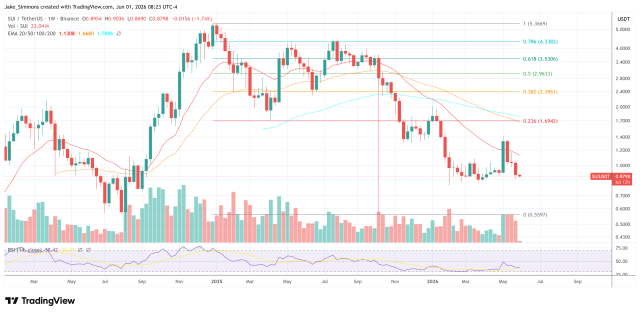
SUI is drawing fresh attention from technical traders after chart analysis pointed to a bullish flag pattern forming on the daily chart.

The setup, shared by crypto analyst Gopal, shows SUI consolidating inside a downward-sloping channel after a stronger upward move. In technical-analysis terms, that kind of structure can become a continuation pattern if price breaks above the upper channel with enough volume.

The key word is “if.”

Chart patterns do not guarantee direction, and a bullish flag can fail if buyers do not follow through. But the setup gives traders a clear level to watch at a time when altcoin momentum is becoming more selective.

For SUI, the question is whether consolidation is cooling the market before another leg higher, or whether the earlier impulse is losing strength.

View original post on X

TL;DR

  • SUI is forming a bullish flag pattern, according to chart analysis shared on X.
  • Confirmation would require a breakout above the channel with volume.
  • Until then, the setup remains a technical watchlist item rather than a confirmed move.
https://x.com/cryptowithgopal/status/2078395615915184320

What A Bullish Flag Means

A bullish flag usually appears after a sharp upward move.

The market rallies, then price begins to consolidate in a controlled downward or sideways channel. Instead of collapsing, the asset holds most of the previous gains while traders take profit and new buyers wait for confirmation.

If price breaks above the channel, traders often interpret it as a sign that the previous trend is resuming.

That is the optimistic reading for SUI.

The danger is that traders see the pattern too early. A channel can look like a flag until it breaks down. Volume can fade. Buyers can fail to show up. A broader market pullback can invalidate the setup before it confirms.

That is why confirmation matters.

For SUI, the bullish case depends on price clearing the upper boundary of the channel with stronger trading activity. Without that breakout, the pattern remains potential, not proof.

Why SUI Is On Traders’ Screens

SUI has become one of the more closely watched altcoins because it sits in the high-performance layer-1 category.

The network competes on speed, developer experience, object-based architecture, and consumer-facing applications. That gives SUI a narrative that can attract traders when capital rotates into newer layer-1 ecosystems.

Technical setups become more powerful when they align with a broader story.

If traders already believe SUI is one of the stronger altcoin candidates in a risk-on move, a bullish flag can give them a clean entry signal. If the wider market is weak, the same pattern may struggle to play out.

That is the current tension.

Altcoin traders are looking for assets that can outperform, but they are also more cautious after a choppy market. SUI needs both chart confirmation and broader risk appetite to turn the setup into a stronger move.

Volume Is The Deciding Factor

The most important part of this setup is volume.

A breakout without volume can be unreliable. It may trap late buyers before price slips back into the channel. A breakout with strong volume suggests new demand is entering and that traders are willing to chase the move.

That is especially important for altcoins, where liquidity can be thinner and false moves more common.

TradingView price action can help validate whether the pattern is still intact, but traders will also watch broader market conditions. If Bitcoin stabilises and altcoins begin moving again, SUI has a better environment for a technical breakout. If majors weaken, even a good-looking pattern can fail.

That does not make the chart useless. It just means the chart needs context.

The Setup Is Clean, But Not Confirmed

The best way to frame SUI here is as a technical setup waiting for confirmation.

The bullish flag structure gives traders a clear invalidation point and a clear breakout zone. That is useful. It creates a tradeable map. But the market has not confirmed the move until price exits the channel with conviction.

For readers, that distinction matters.

Technical-analysis stories can become too promotional when they treat patterns as outcomes. A better approach is to explain what traders are watching, what would confirm the setup, and what would weaken it.

In SUI’s case, the bullish argument is straightforward: consolidation after strength can reset the market before continuation. The bearish or cautious argument is just as simple: without volume, the flag may fade into a normal pullback.

The next move will decide which reading is right.

For now, SUI is on the watchlist because the structure is clear. Traders just need the breakout to make it real.

This article is based on the referenced X chart post and TradingView market data.

This article was written by the News Desk and edited by Samuel Rae.

This report is based on publicly available market and on-chain data. at X

Sui Launches Gas-Free Stablecoin Transfers At Protocol Level

Sui has launched gas-free stablecoin transfers, a move that goes directly at one of the most annoying pieces of crypto payments: needing the network’s native token just to move dollars.

For experienced crypto users, gas is normal. For everyone else, it is friction. A user may have USDC or another stablecoin in a wallet, but if they do not also hold the chain’s native token, they can get stuck. They cannot send funds, make a payment, or move assets without first acquiring gas.

That is a terrible experience for payments.

Sui’s new stablecoin transfer feature is designed to remove that issue by allowing users to send supported stablecoins without holding SUI for transaction fees. The available source material points to implementation through Sui’s Move API, with gas set at zero and the fee burden handled away from the end user.

That sounds technical, but the user-facing idea is simple: stablecoins should move more like money and less like a puzzle.

Reference: Sui

TL;DR

  • Sui has launched gas-free transfers for supported stablecoins.
  • Users can move assets such as USDC without first holding SUI for fees.
  • The change could make Sui more competitive in stablecoin payments and consumer crypto apps.

Why Gas Still Breaks Crypto UX

Stablecoins are one of crypto’s clearest product-market fits.

They are used for trading, settlement, payments, remittances, DeFi collateral, and dollar access in markets where banking rails are slow or unreliable. But even stablecoins can feel awkward when the user has to understand gas.

The problem is especially obvious for new users. Someone may receive stablecoins and assume they can send them immediately. Then the wallet tells them they need the native asset to pay fees. Now they have to find SUI, ETH, SOL, TRX, or another gas token before they can do anything.

That is not how normal payments work.

Nobody expects to hold a separate “fee token” to send pounds from a banking app or dollars from a payment wallet. Crypto users have learned to tolerate that because they understand blockchains. Mainstream users have not, and probably should not have to.

Gas-free stablecoin transfers are an attempt to hide that complexity.

If Sui can make stablecoin movement feel more like a normal payment action, the network becomes easier to use for wallets, apps, merchants, and everyday transfers.

Stablecoin Competition Is About Convenience Now

Sui is not the first network to chase stablecoin payments, and it will not be the last.

Ethereum has the deepest liquidity and most established DeFi ecosystem. TRON has become a major stablecoin transfer network because of its low fees and wide USDT usage. Solana has pushed hard into fast, low-cost consumer payments. Base is trying to combine Ethereum alignment with cheaper transactions and app distribution.

That means Sui needs a real reason for users and developers to care.

Gas-free stablecoin movement is a practical answer. It does not rely on abstract network claims. It solves a visible user problem.

The supported stablecoin list is important as well. According to the cleaned pack, supported assets include USDC, USDsui, suiUSDe, AUSD, FDUSD, USDB, and USDY. That gives the feature a wider stablecoin base than a single-asset implementation.

For developers, the more interesting part may be the infrastructure model. If apps can build payment flows where the user never has to think about gas, Sui becomes easier to integrate into consumer-facing products.

That could matter for wallets, games, DeFi front ends, subscription tools, and cross-border payments.

The Real Test Is Usage

The launch is promising, but the market will judge it by adoption.

Gas-free transfers sound useful, but the feature needs real volume. Users have to adopt it. Wallets and apps have to integrate it cleanly. Stablecoin liquidity has to remain deep enough that the experience feels reliable.

The competitive bar is high. Users already move stablecoins across other networks, and many do not care which chain wins as long as the transfer is cheap, fast, and easy. Sui has to prove that removing gas friction is enough to pull activity into its ecosystem.

There is also a sustainability question. If end users are not paying gas directly, someone else is absorbing or sponsoring those costs. That can work well, but the economics need to make sense over time, especially if volume scales.

Still, the direction is right.

Crypto payments will not become mainstream if every transaction requires users to understand the mechanics underneath. The winning experience probably looks boring: open app, send dollars, done.

Sui’s gas-free stablecoin feature moves in that direction. It is not a guarantee that Sui becomes a dominant payments chain, but it gives the network a cleaner user-experience argument at a time when stablecoin competition is becoming more serious.

This article is based on information from Sui Network.

This article was written by the News Desk and edited by Samuel Rae.

This report is based on information released by Sui. at Sui

❌