It is a classic Hackaday situation. You have an Egret GT E-scooter. It has a screen that shows the usual dash stats, but that led to an annoyance. You could accidentally enter firmware update mode and, from there, enter operational mode without the security PIN. [Ben] couldn’t let that stand, so he reverse-engineered the protocol and rewrote the firmware in Rust. As he put it, “… because I have to break… everything I own…” We get it.
The mobile app was useful for some basic info, since sniffing Bluetooth is fairly easy and analyzing mobile code is, more or less, straightforward. Analysis revealed some data that doesn’t show on the display and that several things are sent back to home base tagged with the scooter’s unique ID — another reason to gut the existing firmware.
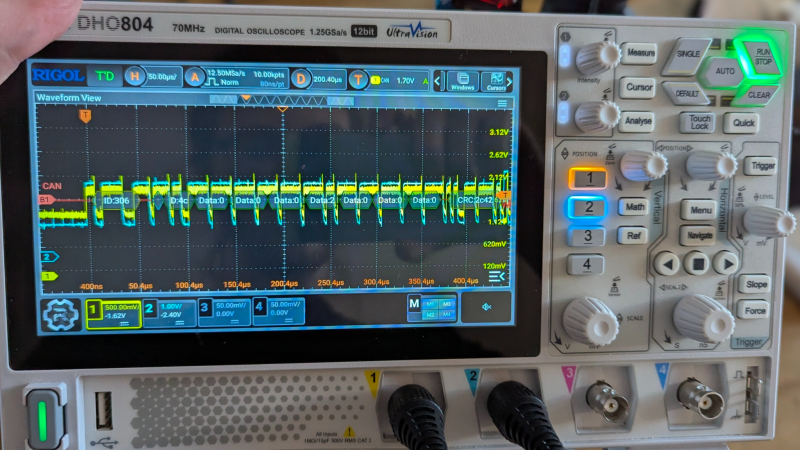
Internally, the scooter uses the CAN Bus, so out came the oscilloscope and a homebrew CAN decoder. Surprisingly, the CAN bus is accessible on the USB-C port’s data pins. Officially, the port is only for charging phones, so you have to wonder what your phone makes of the alien signals on the data pins when it is charging.
Firmware updates actually come in at least three flavors: display, input panel, and main controller. Reverse engineering the firmware update process was crucial to installing the new firmware.
If you own a similar scooter, this post is a goldmine. If you don’t, it is still a very detailed breakdown of a reverse-engineering workflow, and you can apply many of the tools and techniques to your next project.
Of course, another option is to just keep the scooter and replace the brains. If you want to learn more about reverse engineering, there are literally dozens of Hackaday posts to help you get started.
During his continuing analysis of the architecture and microcode of Intel’s highly influential 8087 floating point unit (FPU) co-processor, [Ken Shirriff] has now arrived at the point where he can put together how the 8087’s microcode implements various x87 instructions. One of these, the FSCALE instruction turned out to be far more complicated than assumed, with one might assume to be a straightforward powers-of-two scaling turning out to entail over 140 micro-instructions and three levels of sub-routine calls just to handle all cases.
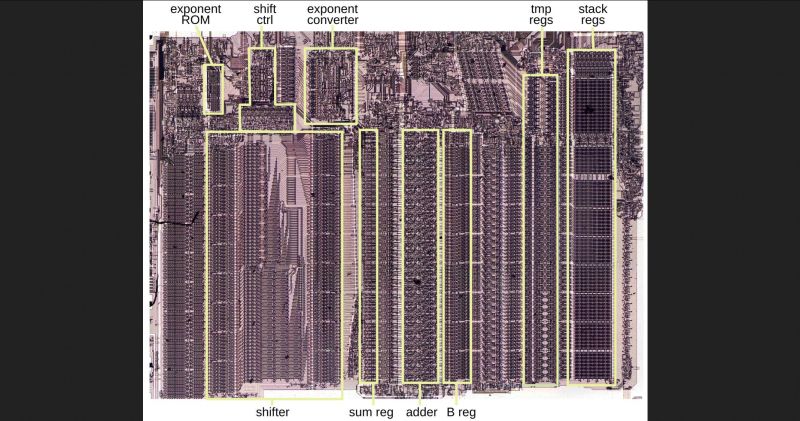
The annotated die shot in the heading image shows the functional blocks that are used by this one x87 instruction, to give some kind of idea of what amount of hardware even ‘just’ scaling a floating point number involves.
Much like with the x86’s CISC-style ISA, these 8087 instructions break down into individual steps that involve everything from loading values into registers, performing operations, checking for and handling error conditions as well as stack management. As can be seen in [Ken]’s breakdown of the FSCALE implementation in the 8087 it’s all very logical, taking a high-level instruction and doing all that’s needed for a robust implementation, without bothering the developer with the details.
Of note is that the 8087’s implementations led to the IEEE 754 floating point standard, providing what definitely at the time was one of the most mathematically accurate FPUs that somehow still was financially responsible enough to make it into a relatively affordable PC.
Things have been a little quiet on Paramount+ lately, unless you've been deep in cover-ops land with Lioness or eagerly awaiting some renewed Harrigan madness with the coming of season two of MobLand on September 18. But on the movie side of things, things are slow, which is a perfect time for a thriller to wake you up.
Singapore has opened online bidding for the first 624 luxury items forfeited in its S$3 billion, or roughly $2.37 billion, money laundering case. Hotlotz said in its auction announcement that bidding for both sales began on Sep. 7. The Singapore…
As we wait patiently for more of Netflix's September crop of TV series to make their way to your algorithm, here's this weekend's lineup of bingable shows to settle in with—my top pick is still hoping for Emmy gold on Monday, and two are great shows, regardless of their age.
With CISA 2015 set to expire in September 2026, Congress has an opportunity to extend the statute beyond cyber to cover AI-related threats and mitigations.
I don’t currently have any visible clocks on display in my house. I’m never without my watch or phone, and I decided that if I were to sacrifice some space for a dedicated timepiece, it would need to be something special, different, or interesting.
The U.S. Federal Bureau of Investigation (FBI) has issued an advisory warning of a wave of OAuth consent phishing attacks targeting “prominent victims, their family members, and personal acquaintances.”
OAuth phishing is an increasingly popular social engineering tactic that tricks users into granting access to their accounts without handing over their passwords.
Some weeks, the easiest way to find something good on Netflix is to skip over the newest releases and instead look into its library. The platform's diverse catalog has a lot to offer, especially when it comes to movies that have swept award shows during their respective runs.
Some things just lie on the surface, while others take time to find. In OSINT, finding the right data often means digging deep. Before you reach a conclusion, there must be solid evidence to support it, and data acquisition is always the most time consuming part of this process. The success of your investigation depends on how well you can find information and connect the dots.
OpenPlanter can automate part of this process.
OpenPlanter
Essentially, OpenPlanter is a recursive language model investigation agent. It ingests different kinds of data, which can be corporate registries, campaign finance records, government contracts and more. It then resolves entities across them and surfaces connections through evidence-based analysis. You can also use it to build profiles of individuals based on publicly available information.
OpenPlanter has both a desktop GUI and a terminal interface. The second one is more convenient.
Setting Up
The setup process is quick. We just need to create a Python environment that will host the needed libraries.
kali > git clone https://github.com/ShinMegamiBoson/OpenPlanter.git
kali > cd OpenPlanter
kali > python3 -m venv venv; source venv/bin/activate
kali > pip install -e .
Once it’s done, we need to give it our API keys.
To make web searches, OpenPlanter needs the Exa API. Exa is cheap to use and gives free credits for new accounts, so you don’t have to pay upfront. OpenRouter API is also needed to run the tool. OpenRouter has free AI models, but there is a daily usage limit. Make an account there and get your free API key.
To configure keys, run this command and paste them:
kali > openplanter-agent --configure-keys
At this point, you can use the tool.
Using OpenPlanter with OpenRouter
The daily API usage limit is enough to run a couple of basic tests, like the one below.
OpenPlanter will use Exa API key to find information. Without Exa, it burns tokens faster and gives incomplete results.
Normally, the tool saves the results in a text file in the current directory, but it doesn’t always happen. Be careful and make sure you don’t lose anything.
Here is our first report.
To make things more interesting, we asked it to find a complete list of Tatneft executives. Tatneft is one of the largest oil and gas companies in Russia.
The report was well organized, but all this information is readily available on the internet, due to the size of the Russian company.
When it was asked to find more information on a specific person from the list above, it struggled to find much and ended up with some generic data and a wrong social media account. Well, maybe that person is hard to find, so we gave it a second chance and picked a unique name from the same list: Nail Ulfatovich Maganov.
kali > openplanter-agent --task "Find as much information as you can on Nail Ulfatovich Maganov who works at Tatneft. If possible, find his Vkontakte, phone number, address, email and check if his email has been in data leaks. Save the results in a text file" --provider openrouter --model openrouter/free
The results can be seen below. OpenPlanter did find his LinkedIn account and extracted information from various places.
It also found OpenSanctions records associated with Nail Maganov.
But he is a well known figure in Russia. What about regular employees at a large Russian company? We will use Sibur for this example. Founded in 1995, it’s Russia’s largest petrochemical company.
We tried two individuals. During the first attempt, the tool didn’t find the correct person. After the second attempt with a different employee, it gave the results.
It found Svetlana’s position (Head of HR). This information was in her LinkedIn account. The rest of the information deserves further validation. Keep in mind, Russia has undergone a massive data blackout, systematically dismantling its open data and public statistics infrastructure. No wonder it’s hard to find things there.
Using OpenPlanter with Ollama – Locally
OpenPlanter’s own docs push toward frontier models (GPT-5.2, Claude Opus 4.6, Cerebras Qwen3-235B), because the whole process is quite demanding. Small local models will be noticeably weaker. But we still gave it a try. The first model was Qwen3:0.6B and its first attempt didn’t produce any results. After the second attempt, it found recent vulnerabilities that Windows had.
We also tried it with Qwen3:4b, but it produced absolutely irrelevant data in its response.
We didn’t stop here and tried it again. The results were still irrelevant. Instead of making a report on Mikhail Karisalov (CEO of Sibur) it spoke about something else.
Using OpenPlanter with Ollama – Remote Servers
If you decide to rent a server with good hardware to test other models, don’t waste your time on it. We tried various models, but none of them worked well. OpenPlanter calls a model, the model replies and then it fails. The output can be seen on the screen.
Here is an example with Qwen3.6:27b. Qwen3.6:35b had the same issue.
We also tried Ornith:35B.
These models support thinking and tooling, but they can’t really do much in this case.
Terminal Interface
It’s also important to mention that there are two ways you can use OpenPlanter in the terminal. So far, you’ve seen only one. If you’re more comfortable with a chat interface, you can use the second option.
kali > openplanter-agent --provider openrouter --model openrouter/free
Here you run your prompts and tweak the tool using the available commands.
Summary
After testing the tool in various ways, we came to the conclusion that it works reliably only with OpenRouter. That’s what gave us the best results. The developers also push towards frontier models or OpenRouter. The whole process of investigation relies heavily on the Exa API. Using it with Ollama models hosted externally (VPS) will not work, as it fails silently even if you select a supported AI model.
The tool might confuse people, especially if their names are common and their social media profiles are empty. Everything it finds deserves validation. Occasionally, it may check the results, marking them HIGH, MEDIUM or LOW depending on its confidence. It doesn’t always do it, but this can be fixed if the prompt explicitly asks for it. Most importantly, OpenPlanter can still save you time.
Learn more with our AI for Cybersecurity training. During the training, we’ll show you different ways of using AI in cybersecurity, set up local models and solve tasks with it.
A recent survey from Experian found that 60% of companies report fraud losses that are “somewhat or significantly higher” than in previous years, with a majority of respondents citing AI-generated phishing attacks as their top AI-related fraud concern.
Documentaries continue to thrive on Netflix this month, as evidenced by the solid stance of the true-crime three-parter Death of the Pastor's Wife that's been holding strong in the top spot on the streamer's Top 10, as of this writing. But the hits keep on coming, with two of this weekend's picks below also occupying space on that chart, proving that Netflix knows how to doc.
Stop letting old devices rot in a drawer and bring them back to life with the help of an inexpensive microcontroller and some code. The ESP32 is perfect for this task.
Researchers at INKY observed a major phishing campaign that used SVG (Scalable Vector Graphics) image files to deliver malicious JavaScript. While abuse of SVG files isn’t new, INKY says their use in phishing campaigns has exploded over the past year.

 Login
Login