Looking for an affordable and powerful applicant tracking system? Check out this list of the five best free ATS solutions for 2026 and find the perfect one for your business.
Looking for an affordable and powerful applicant tracking system? Check out this list of the five best free ATS solutions for 2026 and find the perfect one for your business.
Building a nuclear power plant is one of the world’s most complex construction projects. It requires thousands of trucks to ship parts, often to remote regions, where huge teams of skilled workers like electricians and welders come together to assemble everything over many years.
Financing such projects is difficult, in part because no one wants to risk loaning money to a project that might never generate power and revenue, whether that’s due to technical failures, the inability to recruit enough talent, or regulatory hurdles.
On the first day of his second term, President Donald Trump declared that the United States was experiencing a “national energy emergency.” The “harmful and shortsighted policies of the previous administration,” he wrote in an executive order, had left the nation’s energy resources “far too inadequate,” a situation that “causes and makes worse the high energy prices that devastate Americans.” Since then, Trump has attempted to use the emergency declaration to speed up
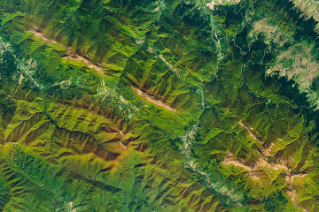
From orbit, today’s space-based laser instruments measure Earth’s forests and terrain one narrow line at a time. Between those lines are enormous gaps that include millions of acres of land scientists never directly measure. NASA’s CASALS instrument will blend machine learning with an ultra-compact lidar instrument to adaptively ‘sweep’ large swaths of Earth’s surface. This new capability for space-based remote sensors allows CASALS to create truly three-dimensional (3D) topographical renderings.
Video from a CASALS flight over the Great Cypress Swamp in Delaware on Nov. 12, 2024, showing tree canopy tops in green, the ground in purple, and near-ground vegetation in blue.
Credit: NASA
A team of researchers at NASA’s Goddard Space Flight Center (GSFC) has developed a new instrument designed to eliminate blind spots between lines of lidar data on the Earth’s surface. Built with support from NASA’s Earth Science Technology Office (ESTO), the Concurrent Artificially-intelligent Spectrometry Lidar System (CASALS) could help researchers map the features of Earth’s surface with unprecedented detail. Rather than mechanically steering a laser with moving mirrors, CASALS steers light using wavelength itself, generating a continuous, 3D swath of the ground below.
John Yorks, a physical research scientist at GSFC and Principal Investigator for CASALS, explained that the instrument features a novel transmitter and optical grating system that manipulates laser pulses without heavy, failure-prone motorized mirrors.
Instead, CASALS uses a fast-pulsing, tunable “seed” laser centered at 1040 nanometers, rapidly cycling through 256 unique wavelengths as it pulses through an optical component with a microscopic pattern of ridges called a transmission grating.
At this point, the physics of diffraction takes over. Because light bends at slightly different angles depending on its exact wavelength, the grating naturally “steers” each of the 256 pulses into a distinct position across the flight path.
This non-mechanical approach paints a continuous 3D swath of the ground. Not only does this eliminate the large unmapped gaps left between the isolated tracks of legacy spaceborne lidars, but stripping away moving parts drastically reduces the instrument’s size, weight, and power (SWaP) requirements. This makes it more reliable for the harsh environment of space.
Another key innovation within CASALS is its detector array. This component features a uniquely high Quantum Efficiency (QE), a variable that describes how effectively a detector converts incoming light (photons) into an electrical signal. CASALS operates at 80% QE. This means CASALS wastes almost none of the light that makes it back to the sensor.
With QE that high, CASALS can detect much weaker return signals, allowing it to collect useful measurements from darker surfaces or through denser vegetation.
This technology isn’t limited to a laboratory environment. In November 2024, an airborne CASALS prototype flew aboard NASA’s B200 King Air aircraft. The instrument produced science-quality datasets on its first campaign, exceeding the team’s expectations.
“I’m very impressed with Guang Yang, Jeffrey Chen, and all our engineers, and how well CASALS performed. This worked really well from the first time we flew it, which is pretty impressive,” said Yorks.
Flying at an altitude of roughly five kilometers, CASALS can distinguish individual tree branches and subtle changes in ground elevation, thanks to its 22-centimeter horizontal resolution.
“We’re able to see really fine details of vegetation structure and changes in the topography of the surface,” Yorks said.
But there’s more work to do to prepare the technology for space. The team plans to make several improvements to CASALS before creating a space-ready prototype. Specifically, they’re widening the instrument’s swath and adding onboard data processing software.
Transitioning from a successful airborne prototype to a fully realized space mission is a challenge, but the CASALS team is up to the task.
“The team’s really done a great job of sticking together and keeping on task and on schedule. We are being funded to optimize and improve the performance, and we’re also then looking at ways to take the technologies used in the airborne instrument and mature them and prepare them for a spaceborne version in the future,” said Yorks.
If successful, CASALS could become the first spaceborne lidar capable of mapping Earth’s forests and terrain as continuous three-dimensional swaths rather than isolated profiles, giving scientists a dramatically more complete picture of our changing planet.
For additional details, see the entry for this project on NASA TechPort.
Project Lead(s): John Yorks, NASA’s Goddard Space Flight Center
Sponsoring Organization(s): NASA’s Decadal Survey Incubation (DSI) program; NASA’s Instrument Incubation Program (IIP); NASA’s Goddard Space Flight Center; University of California, Santa Barbara; Virginia Polytechnic Institute and State University
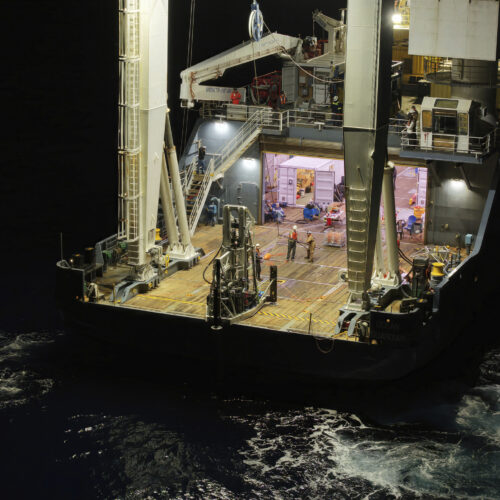
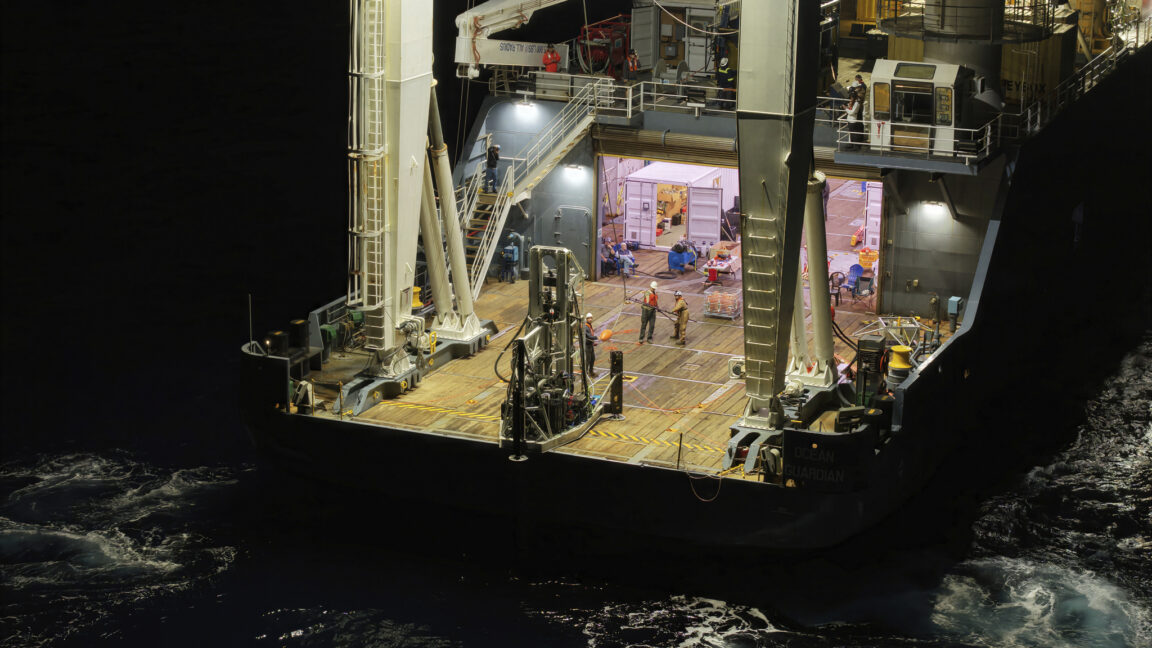
The world’s first demonstration of a subsea geothermal power plant has taken place near an active underwater volcano almost a mile below the ocean surface. It generated less than 10 seconds of net-positive electricity but showed the technical feasibility of tapping another form of renewable energy underwater.
The three-week test deployment of the 3-ton prototype power plant took place at the Axial Seamount in the northeast Pacific Ocean in September. Endurance Energy, the Seattle-based startup behind the effort, aims to eventually commercialize subsea geothermal power for Pacific island nations and other customers looking for alternatives to importing expensive fossil fuels.
“The deep ocean gives us unlimited cold seawater for cooling, and its weight keeps the system and the well pressurized, so our plants can be compact,” said Andrew Redd, founder and CEO of Endurance Energy, in an email to Ars.
The best cybersecurity marketing agencies for B2B vendors combine security expertise with the ability to turn complex products into credible messaging, relevant demand and measurable commercial opportunities. What makes a cybersecurity marketing agency different from a generalist? A cybersecurity marketing agency should understand how security products work, how buyers evaluate them and which claims need [...]
Steve Krauss, Sydney Heimbrock and Nathan Bailey, federal HR experts, say agencies shouldn’t treat the annual engagement survey as a compliance exercise.
African American businessman using cellphone and laptop at workplace, collage with company analytics on imaginary screen. Online business management or marketing strategies concept
NASA Awards Enable Research, Technology to Build Future Workforce
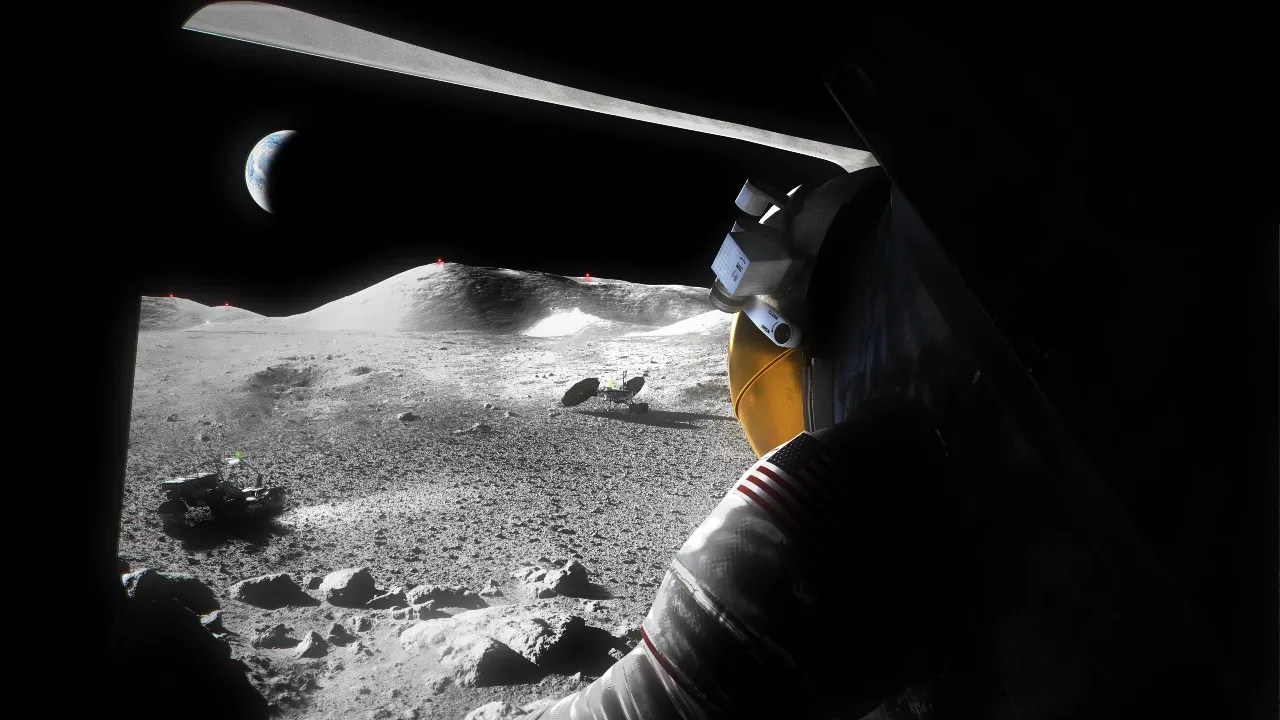
An illustration of a suited Artemis astronaut looking out of a Moon lander hatch across the lunar surface, a Lunar Terrain Vehicle and other surface elements.
Credits: NASA
NASA has selected 12 U.S. institutions to receive $12 million to accelerate academic research and technology development in support of the agency’s priorities for exploring the Moon, Mars, and deep space.
Through NASA’s Minority University Research and Education Project (MUREP) Space Technology Artemis Research (M‑STAR) initiative, selected institutions will each receive up to $1 million to grow their scientific and engineering capabilities, enhance faculty and student engagement in aerospace research, and expand their ability to compete for future federal and commercial research awards.
“We are excited to launch this new cohort of M-STAR investigators,” said Alicia Baturoni Cortez, MUREP program manager in the agency’s Office of STEM Engagement. “NASA investments in our Nation’s research institutions create real opportunities for students and faculty to build skills, knowledge, and infrastructure, while helping NASA close technology gaps for long-duration operations on the Moon and eventually, Mars.”
As NASA enters a Golden Age of innovation and exploration, the M-STAR initiative supports the agency’s mission to develop innovative technologies that improve space transportation, human exploration, robotic discovery, and the growing space economy.
The awardees and their projects are as follows:
California State University, Sacramento Adaptive Vision-Language-Action Models for Resilient Multi-Robot Collaboration in Unstructured Planetary Environments
University of Central Florida, Orlando M-FAST: Multi-Fidelity Aerothermal Simulation & Testing for Artemis
University of Hawaii at Manoa HI-STRIDE: Hawai’i Student Training in Radiation Instrumentation, Detection, and Exploration
University of Houston RODEO: Rover-carried On-surface Deployables for Exploration Operations
University of Texas, San Antonio Characterizing Physical and Mechanical Properties of Regolith at Cryogenic Conditions Using the Multi-Planetary Surface Simulator (MPS2)
Kean University, Union, New Jersey Integrating Terrain Understanding of AI Models With Robust Control for Autonomous Path Planning
Virginia Commonwealth University, Richmond BNNT-Reinforced Multifunctional Composites for Radiation-Tolerant, Hydrogen-Compatible Nuclear Thermal Propulsion (NTP) Secondary Hardware
Shaw University, Raleigh, North Carolina Project ARES (Advanced Regenerative Environmental Systems): A Materials-by-Design Research and Workforce Development Platform for Environmental Control and Surface Infrastructure
Howard University, Washington LumSHRS: Lunar monolithic Spatial Heterodyne Raman Spectrometer for Minirover In-Situ and Standoff Remote Sensing
Prairie View A&M University, Prairie View, Texas Functionally Graded Interfaces for Directed-Energy-Deposition Repair of Copper-to-Superalloy Propulsion Hardware: An Integrated AI/ML Design-to-Validation Research Capability at Prairie View A&M University
University of New Mexico, Albuquerque POWER-Artemis: Extreme-Environment Batteries and Fuel Cells for Sustained Moon and Mars Operations
Fayetteville State University, North Carolina From Documents to Models: Method-Compliant Generative AI for Bootstrapping Model-Based Systems Engineering in NASA’s Artemis Enterprise (Doc2Model)
NASA’s Office of STEM Engagement fosters an ecosystem across education, industry, and government to cultivate a well‑prepared talent pool, while the agency’s Research and Technology Mission Directorate develops the transformative space technologies that enable future NASA missions and ensure U.S. leadership in aerospace. Together, they accelerate mission readiness by aligning cutting edge technological innovation with the workforce needed to carry it forward.
This coverage is made possible through a partnership between Grist and Verite News, a nonprofit news organization with a mission to produce in-depth journalism in underserved communities in the New Orleans area.
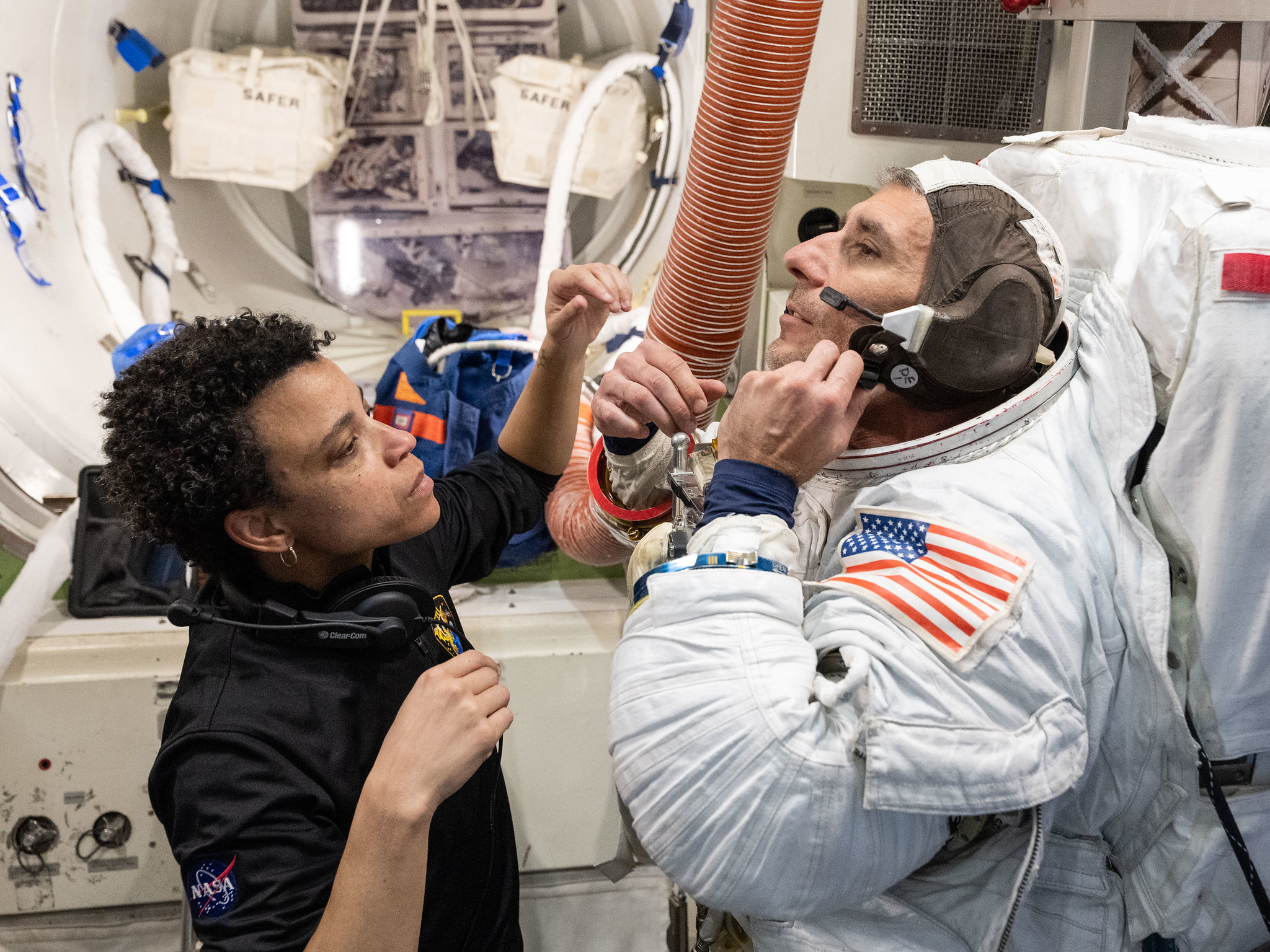
NASA astronaut Jessica Watkins assists NASA astronaut Luke Delaney as he practices suiting up in a spacesuit in an International Space Station airlock simulator on May 5, 2026, at the agency’s Johnson Space Center Space Vehicle Mockup Facility in Houston.
Credit: NASA
Editor’s Note: This article was updated Thursday, Oct. 15, 2026, to reflect a change to the event start time.
Students in Florida will hear from NASA astronauts Jessica Watkins and Luke Delaney as they answer prerecorded STEM questions while aboard the International Space Station.
The Earth-to-space call will begin at 12:30 p.m. EDT Friday, Oct. 16, and will stream live on the agency’s Learn With NASA YouTube channel.
This event is hosted by Sally Ride Elementary School in Orlando, Florida, for students in grades K-12, and the community. This unique opportunity aims to deepen understanding of space exploration and enhance awareness of STEM careers.
Media interested in covering the event must RSVP no later than 5 p.m. EDT, Thursday, Oct. 15, to Jenny Morgan at (407) 858-3100, or at jenny.morgan@ocps.net.
For more than 25 years, people have lived and worked continuously aboard the International Space Station, advancing scientific knowledge and making research breakthroughs not possible on Earth. The space station helps NASA understand and overcome the challenges of human spaceflight, expand commercial opportunities in low Earth orbit, and build on the foundation for long-duration missions to the Moon, as part of the Artemis program, and to Mars.
For more information on NASA in-flight calls, visit:
When supporters of the Trump administration say that oil shipping through the Gulf is “back to normal,” they are referring to a visible and easily quantifiable measure: the number of barrels moving through the Strait of Hormuz.
NASA Opens Applications for Second Season of ORBIT Student Challenge
Following a successful inaugural year of ingenuity and career building, NASA ORBIT (Opportunities in Research, Business, Innovation, and Technology) has officially returned for a second season to bring university and college student innovation to the forefront of Earth technology development and deep-space exploration.
Registration for the 2026–2027 challenge is open through Monday, Nov. 16, 2026, through the NASA STEM Gateway.
Expanded for its second season with up to $500,000 in total prize funding, NASA’s ORBIT invites student teams to explore their boldest ideas and invent their brightest solutions. Through the competition, students must conduct targeted research, conceptualize early models, and perform feasibility analyses to refine their proposals. Top-performing teams earn a spot at the in-person Pitch Showcase to present their solutions to a panel of expert judges, who select award recipients based on their presentations and interactive Q&A sessions.
ORBIT has two challenge tracks for teams to choose from. Participants in the ORBIT Earth track must select a NASA-owned patent and develop novel commercial or nonprofit applications addressing critical terrestrial problems. Whether reimagining drones for reduced noise pollution or designing improved medical technology for better patient care, students must demonstrate clear pathways to public benefit.
The ORBIT Space focuses on next-generation space exploration technology designed to support NASA’s Artemis program and future initiatives to establish a sustainable human presence on the Moon, Mars, and beyond. Teams competing in this track develop viable concepts for power, communications, navigation, living solutions, astronaut health and well-being, and more.
Projects that successfully unite the goals of both the Earth and Space tracks can also qualify for a special Integration Bonus, but this season also introduces two new specialty recognitions: the Faculty Advisors’ Choice Award, celebrating professionalism and cross-team communications, and the Next Steps Award, recognizing teams with the strongest roadmaps to continuing their project development after the conclusion of the challenge.
Together with core prizes, ORBIT celebrates student excellence and drives key technical solutions while building a pipeline of interdisciplinary talent. The challenge provides students with immersive experience in NASA’s core missions, direct access to agency mentors, and industry-ready skills that bridge academia and aerospace careers.
For complete competition details, eligibility requirements, and official rules, visit: https://nasaorbit.org/
Registration is open until Nov.16, 2026, through the NASA STEM Gateway.
Exxon Mobil’s offshore discovery transformed Guyana with a speed almost without parallel in modern development. A country of roughly one million people, long poor despite abundant natural resources, has become the world’s fastest-growing economy and now produces close to 1 percent of global oil output. Its crude has helped Europe reduce dependence on Russian supply and has found buyers in Asia as well.
Beneath the Rocky Mountains, the Sierra Nevada, and the deserts in between, lies a massive energy source — and it isn’t a fossil fuel. The smashing and separating of tectonic plates that produced many of the West’s most dramatic landscapes have also allowed heat from the planet’s core to rise nearly to the surface. Now, an explosion of new geothermal energy companies wants to drill into the Earth and capture that heat for clean electricity. These companies have new technologies to better reach the heat, and a massive new customer base: energy-hungry data centers.
An eight-state coalition filed lawsuits Tuesday challenging the Trump administration’s payments to private companies to cancel offshore wind leases, escalating an ongoing legal battle over the government spending billions of dollars to block wind projects.
Guyana has entered the second half of 2026 with two important developments unfolding at once: an economy still expanding at a pace almost without modern parallel, and a long-running territorial conflict with Venezuela approaching what Georgetown hopes will be a definitive legal resolution. The first reflects the transformative force of offshore oil. The second concerns the security, territorial integrity, and political stability of the country that oil wealth is remaking.
The Department of Energy overstepped when it ordered an aging coal-fired power plant in Michigan to stay open past its planned retirement date last year, a federal court ruled on Friday.

 Login