Reading view

There are new articles available, click to refresh the page.

NBA’s Ballmer crackdown echoes Microsoft antitrust; SF vs. Seattle housing; and a Seahawks tech twist

This week on the GeekWire Podcast: The NBA suspends former Microsoft CEO Steve Ballmer for a year and hits the Clippers with $30 million in fines and five lost draft picks over allegedly sham endorsement deals for Kawhi Leonard, drawing comparisons to the Microsoft antitrust era.

A new Redfin report says San Francisco’s housing market is booming on AI wealth while Seattle slumps, with the Bay Area-to-Seattle migration pipeline nearly dried up.

And the Seahawks sale to the Khosla family officially closes, ending the Paul Allen era, with two familiar Seattle tech names surfacing in the new ownership group.

Plus, the return of the GeekWire Trivia Challenge.

Related Stories and Links

Ballmer / Clippers

Redfin / SF vs. Seattle housing

Seahawks sale

Editor’s note: Join us on Wednesday, Sept. 16 for a live recording of the GeekWire podcast. Co-hosts John Cook and Todd Bishop will discuss the week’s news and interview Zillow’ Senior Vice President of engineering, Toby Roberts, about how AI is changing the real estate business. Details and tickets here.

Subscribe to GeekWire in Apple Podcasts, Spotify, or wherever you listen.

AI wealth fuels San Francisco’s housing boom while tech layoffs weigh down Seattle

The housing markets in San Francisco, left, and Seattle have been diverging for the past year. Prices started falling in Seattle on an annual basis about a year ago, while prices in San Francisco have been rising since November. (BigStock, GeekWire File Photos)

While a fresh wave of AI-generated wealth is pouring fuel on San Francisco’s housing market, Seattle’s real estate scene is getting left out in the cold, stuck in a slump driven by ongoing local tech layoffs, soaring costs, and persistent worker anxiety.

A new report published Wednesday by Seattle-based Redfin illustrates just how dramatically the housing markets in the West Coast’s top two tech hubs have split.

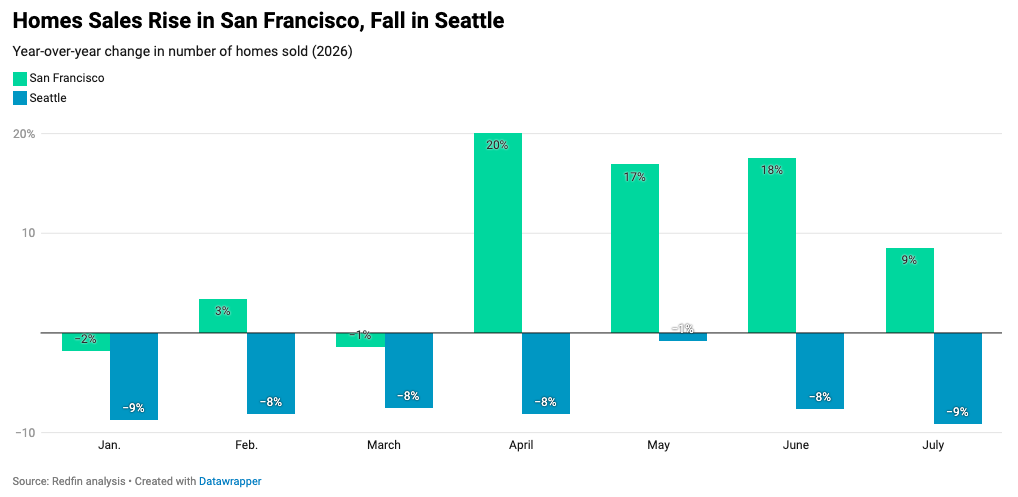
In July, San Francisco’s median home-sale price jumped 6% year-over-year to $1.6 million as home sales rose 8.5%, fueled by an 18.4% drop in active listings—the largest inventory contraction in the country.

By contrast, Seattle’s median sale price dropped 3.6% to $809,479 as home sales fell 9.1% and active listings surged 16.7%, the nation’s steepest inventory increase, leaving local sellers outnumbering buyers by 65%. Redfin detailed the drop in pending sales in the city in an earlier report.

San Francisco’s resurgence is fueled by a concentrated wave of AI wealth. Driven by big salaries, six-figure signing bonuses, and anticipation of massive IPOs for Bay Area giants OpenAI and Anthropic, affluent buyers are aggressively bidding up homes, frequently paying hundreds of thousands over asking price.

The frenzy mirrors findings from The New York Times, which reported in May that cash-flush AI startup employees and secondary stock sales are fueling hyper-concentrated bidding wars across the Bay Area.

In Seattle, the dynamic is reversed. While local tech giants pour billions into AI infrastructure, corporate belt-tightening and lingering layoff fears at companies like Amazon and Microsoft have squelched buyer confidence, leaving prospective buyers cautious, job mobility low, and listings piling up.

Click to enlarge. (Redfin Graphic)

Ground-level real estate agents in the Seattle area are feeling that buyer hesitation firsthand.

“Layoffs in the tech world are dampening homebuying demand in the entire area,” said Sheryl Wingate, a Redfin Premier agent, noting that return-to-office policies are further squeezing demand in outlying suburbs as tech workers avoid long commutes amidst job uncertainty.

Seattle-area real estate isn’t just feeling the squeeze from the heavyweights. Job cuts have hit nearly every tier of the regional tech ecosystem this year, sweeping through engineering hubs for Meta, Google, and Salesforce, consumer brands like Zillow, T-Mobile, and Starbucks, corporate divisions at Expedia and TikTok, and startups including Qualtrics and Amperity.

The chill is hitting the region’s high-end neighborhoods hardest. According to Bloomberg, pending luxury home sales in the Seattle area plummeted 15%, driven by a double hit of tech-sector layoffs and Washington state’s higher taxes on top earners. Once-frenzied markets in Eastside suburbs like Bellevue and Sammamish have stalled, with homes priced over $2 million sitting for an average of 44 days as affluent tech buyers pull back.

By comparison, high-end buyers in San Francisco are doubling their budgets as AI confidence surges. Redfin noted that luxury pending sales in the Bay Area jumped 46% year-over-year, with local agents reporting tech clients doubling their price points — in some cases expanding from $2 million budgets to nearly $4 million — and placing offers as much as $900,000 over asking price.

The shift is also severing a key migration pipeline that long fueled Seattle’s housing boom. While high-earning Bay Area transplants historically moved north to stretch their tech compensation, Redfin migration data shows the net inflow of home shoppers moving from San Francisco to Seattle plummeted to just 369 people in the first quarter — down from over 5,100 five years ago.

Looking ahead, Redfin economists expect these diverging trends to play out across other tech hubs as artificial intelligence reshapes the labor market.

“AI is reorganizing the tech labor market, with San Francisco and Seattle representing two sides of that transition,” said Chen Zhao, Redfin’s head of economics research, adding that while AI creates rapid wealth in some markets, it drives corporate restructuring and caution in others.

Redfin fills CEO role with former Meta VP Alessio Sanfilippo after acquisition by Rocket

Alessio Sanfilippo, CEO of Redin. (Redfin Photo)

Redfin, the Seattle-based real estate brokerage acquired last year by Rocket Companies, has named Alessio Sanfilippo as CEO.

Sanfilippo was previously Meta’s vice president of insights for Reality Labs, where he led teams working in data science, data engineering and user research to develop the company’s AI-enabled wearable glasses. He earlier served as a VP for Meta-owned WhatsApp overseeing data and user research.

Rocket, the nation’s largest mortgage lender, bought Redfin in a deal worth $1.75 billion. The Redfin brand kept its name and Seattle headquarters as a Rocket subsidiary. Redfin’s longtime CEO Glenn Kelman stepped down in January to join the venture firm Greylock as an executive in residence.

Rocket CEO Varun Krishna had been running Redfin since the exit of Kelman, who led the company for more than 20 years and was “one of the industry’s most charismatic and memorable figures,” Real Estate News noted.

In a release announcing Sanfilippo’s hiring, Krishna said that the company’s new leader has spent his career making “complex products work better for enormous audiences.”

“I worked with Alessio at Intuit and saw firsthand how he combines deep analytical thinking with a real instinct for the consumer,” Krishna added. Sanfilippo’s past roles include leadership positions at SAP, goSeek and Hotwire.

Sanfilippo said he has used Redfin for multiple home purchases, adding that the platform “has always helped make an intimidating process easier to understand.”

The company last week joined Zillow in settling an antitrust case with the Federal Trade Commission and five states, just as a trial was set to begin.

The proposed settlement includes an agreement to undo part of a $100 million partnership that the government said effectively paid Redfin to stop competing in apartment rental advertising. The company will now be required to relaunch its apartment advertising operation within six months.

How the FTC’s last-minute settlement with Zillow and Redfin reshapes their $100M rentals deal

GeekWire Illustration

Zillow and Redfin settled an antitrust case with the Federal Trade Commission and five states Monday, just as a trial was set to begin, agreeing to undo part of a $100 million partnership that the government said effectively paid Redfin to stop competing in apartment rental advertising.

The companies, both based in Seattle, have been rivals in online real estate and related services for the better part of two decades, expanding into rentals to build their businesses beyond the market for single-family homes. The FTC alleged the deal combined two of the three largest online apartment listing services against one main competitor, CoStar’s Apartments.com.

The proposed settlement requires Redfin, now owned by Rocket Cos., to relaunch its apartment advertising operation within six months — hiring a general manager, a sales force and a trained customer support team, while committing to spend millions of dollars to grow the business.

Redfin faces fines if it misses deadlines, and must report regularly to the FTC on its progress.

Zillow’s apartment listings will still appear on Redfin.com, Rent.com and ApartmentGuide, and Redfin will keep syndicating them, so Zillow is holding onto the audience it gained in the 2025 deal. The companies say the syndication will run through at least 2030.

What ends is the exclusive nature of the partnership: As part of the FTC settlement, Redfin is no longer barred from selling its own advertising alongside those listings, or from doing business on its own with the property managers shifted to Zillow under their original deal.

Zillow also must help Redfin rebuild. Under the order, which runs 10 years, Zillow is required to give Redfin employee information so it can recruit Zillow workers, waive any noncompete or anti-poaching agreements blocking those hires, and let apartment advertisers locked into Zillow contracts renegotiate without penalty for nine months after Redfin relaunches.

The companies will also pay the states $2 million in costs and fees, according to Washington Attorney General Nick Brown, who co-led the five-state coalition.

Zillow said the partnership “will continue unchanged,” and framed the standalone advertising products both companies plan to launch in 2027 as added flexibility for property managers.

“This resolution is a win for renters and multifamily housing providers,” said Michael Sherman, general manager and senior vice president of Zillow Rentals, in a statement. He said the partnership has brought “more leads and leases to property managers and more options to renters,” and that the standalone products will let Zillow “do even more to support the marketplace.”

The FTC offered its own take: “Today’s settlement unwinds an agreement under which Zillow paid Redfin $100 million to stop competing and hand off all its customers to Zillow,” said Daniel Guarnera, director of the FTC’s Bureau of Competition. “This kind of payment to a competitor to exit a market and stop competing violates the antitrust laws.”

FTC Chairman Andrew Ferguson called it “a complete victory for the American people” in a thread on X early Monday. He added, “This anticompetitive agreement is now history under our proposed settlement.”

Guarnera said the settlement “delivers better, quicker, more certain results” than the agency would have been able to achieve if it had gone to trial and prevailed.

“Today’s settlement will restore competition by paving the way for Redfin to re-enter the market as a stronger competitor,” Brown said in a statement. “Most importantly, consumers will have more choices and won’t be subjected to illegally manipulated prices.”

The FTC and state cases were consolidated last year. Zillow and Redfin moved to dismiss in January, and U.S. District Judge Anthony Trenga denied that motion in May, according to Real Estate News. However, the FTC’s case had met resistance in July, when Trenga denied its request to declare the deal presumptively unlawful, finding genuine disputes of material fact.

Redfin called the outcome “a significant win for Redfin and consumers across the country.”

“This agreement allows us to maintain our rental partnership with Zillow through at least 2030, while building and investing in a standalone rentals business of our own,” a spokesperson said, adding that renters “will continue to have access to the rental inventory they rely on today.”

The proposed settlement, announced Monday morning, requires court approval.

Updated with details from Washington AG Nick Brown.

Tech layoffs hit Seattle housing market as pending sales post sharpest drop in the nation

The Seattle metro area’s median home-sale price is $809,479, roughly double the national average. (GeekWire File Photo / Kurt Schlosser)

As prospective buyers face steep borrowing costs and a turbulent tech job market, home sales nationwide have fallen to their lowest point in nearly two years — and Seattle is feeling the brunt of the slowdown.

According to a new report by Redfin, pending home sales in the Seattle area plunged 15.6% year-over-year in July. It’s the sharpest drop among major U.S. metropolitan areas as prospective buyers grapple with steep prices and job insecurity driven by recent tech-sector layoffs.

Seattle’s drop in pending sales led all major U.S. metro areas in July, outpacing other slowing markets like Houston (-14.3%) and Phoenix (-13.3%). In closed home sales, Seattle’s 9.1% drop put it among the five steepest declines nationwide alongside Detroit (-9.3%) and major Texas metros.

Housing costs in the region remain a primary barrier for buyers. With a median sale price of $809,479, Seattle home prices sit at roughly double the national average of $408,795, making the local market particularly sensitive to elevated mortgage rates and tech-industry caution.

Real estate agents on the ground report that shifting dynamics at major tech employers are directly tempering local home-buying demand.

“Seattle is a tech-driven market, and right now a lot of buyers are feeling cautious about layoffs, AI and job security,” said Chase Costello, a Redfin Premier agent in the Seattle area. “Tech workers aren’t moving between companies — or moving into the area — as much as they used to, and that means fewer people are trading up into new homes.”

High-earning tech workers have long served as the primary engine for Puget Sound real estate growth. But ongoing staff cuts and corporate belt-tightening at major employers such as Amazon and Microsoft have created a chilling effect that extends beyond those directly affected. According to Redfin, even workers who remain comfortably employed are increasingly hesitant to stretch for expensive mortgages amidst broader economic uncertainty.

Amazon started the year with 16,000 corporate job cuts, which came on the heels of about 14,000 layoffs last fall. Microsoft cut about 15,000 jobs in two separate rounds of layoffs in 2025, and last month cut another 4,800, with about 1,600 of those in the Xbox division.

Layoffs have also impacted a variety of tech roles at companies big and small, including T-Mobile, Zillow, Starbucks, Meta, Google, Oracle, Epic Games, Bungie, Salesforce and others, as detailed in GeekWire’s layoff tracker.

The report comes following a period of transition for Seattle-based Redfin itself, after the completion of its acquisition by Detroit-based Rocket Companies and the exit of longtime CEO Glenn Kelman. The Seattle-based real estate brokerage hasn’t been immune to layoffs, cutting 450 employees in February 2025.

While Seattle and major Texas markets saw the nation’s sharpest home-sales pullbacks, a handful of regions managed to buck the broader downturn. According to Redfin, home sales posted strong year-over-year growth in markets like West Palm Beach, Fla. (+17.1%), San Francisco (+8.5%), and Milwaukee (+7%).

In South Florida and the Bay Area, affluent buyers less sensitive to cost helped drive activity, with San Francisco getting an extra push from the ongoing AI boom, while Milwaukee benefited from relative affordability.

Pending sales also surged in West Palm Beach (+14.2%) and Milwaukee (+4.5%), illustrating a stark divergence between tech-heavy, high-cost markets in the West and resilient pockets elsewhere across the country.

Zillow revenue climbs 18% but layoff costs push company to a loss, amid executive changes

Zillow Group’s revenue rose 18% to $772 million in the second quarter, beating its own forecast, but a $36 million restructuring charge from severance and other costs stemming from this week’s layoffs pushed it to a $4 million net loss.

The Seattle-based online real estate company, which on Tuesday laid off more than 500 people, or 7% of its workforce, expects the restructuring to cost $59 million to $64 million in total, with the rest recorded in the third quarter, according to the company’s 10-Q regulatory filing.

Zillow also announced a series of executive changes, including expanding CFO Jeremy Hofmann‘s role to include chief operating officer. Jun Choo, who became COO in 2024, is stepping down to focus on his health, serving as an advisor through the end of the year.

The company created a chief legal and policy officer role and hired Cassandra “Sandi” Knight, a Google vice president of litigation and discovery, who was previously PayPal chief litigation counsel. Knight starts next week.

Zillow and Redfin are set to go to trial Aug. 24 as defendants in an antitrust case brought by the FTC and five state attorneys general over the $100 million rental listings deal between the two companies. Zillow has spent $26 million on the case so far this year, including $10 million in the second quarter.

In addition, Zillow promoted Kathleen Berroth to senior vice president of strategy and operations, and Eric Wilson to senior vice president and GM of mortgages.

For the second quarter, Zillow said the residential real estate industry grew 6%, while industry-wide lending for home purchases was roughly flat compared with a year ago. The number of people visiting real estate sites and apps declined overall as mortgage rates rose, the company said, citing Comscore. Zillow’s own traffic fell 2%, to an average of 239 million monthly users.

Most of the revenue growth came from Zillow’s newer businesses. Mortgage revenue rose 75% to $84 million as Zillow directed buyers on its site to its own lending arm, and rentals revenue rose 31% to $209 million. Residential revenue, from advertising sold to real estate agents, grew 7% to $465 million.

Zillow cuts more than 500 jobs in its largest layoff of the year

GeekWire Illustration

Seattle-based online real estate company Zillow Group laid off more than 500 employees Tuesday, about 7% of its global workforce, its second and largest round of cuts this year.

The layoffs are about “ensuring we have a disciplined cost structure and getting more efficient, with the right people in the right positions,” Zillow Group CEO Jeremy Wacksman said in a company blog post announcing the cuts. He said the decision reflects “both the strides we’re making in our strategy and the reality of what is required of us to grow at scale.”

He added, “Continuing to grow at scale requires us to work differently than we do today.”

Wacksman told real estate executives at the T3 Leadership Summit in April that Zillow employees were being retrained to use AI in their jobs, with gains that “are small, but they’re compounding,” as reported by Real Estate News.

FOLLOW-UP: Zillow layoffs hit 91 jobs in Washington state, with senior roles bearing the brunt

Zillow told GeekWire the cuts were not driven by AI. “Today’s changes are about better positioning Zillow for the path ahead, which includes having the right people in the right roles and being able to move faster,” a company spokesperson said.

The company didn’t disclose which teams were affected, how many of the cuts will hit its Seattle headquarters, or what severance employees will receive.

Zillow Group will report second-quarter earnings Wednesday afternoon. The company’s business has been growing, defying a sluggish housing market. Its first-quarter revenue rose 18% year-over-year to $708 million, while the residential real estate industry grew 2%, according to NAR. Net income climbed to $46 million from $8 million a year earlier.

Wacksman indicated Tuesday that the company is still bucking the trend: “We continue to outperform the category, despite a housing market that has been essentially flat,” he wrote.

However, the company has been spending nearly as fast as it has been growing, on rental listings, loan officers for Zillow Home Loans, advertising and legal bills. Execs told investors in May that the spending would ease up in the second half of the year. Cutting payroll is one way to make that happen, and Zillow’s earnings guidance tomorrow could reflect that.

As for those legal bills: Zillow is headed to trial later this month in an FTC antitrust case over the $100 million deal the company struck in early 2025 to become the exclusive provider of multifamily rental listings on Redfin’s websites.

Zillow cut about 200 jobs in January, but characterized those as performance-related and part of its annual review cycle. It had 7,058 employees as of March 31, down just 10 positions from the end of 2025, meaning it had largely backfilled January’s cuts before Tuesday.

It’s part of a wave of cuts and consolidation in real estate portals and property tech. CoStar has cut its Homes.com inside-sales team by nearly 40% in recent months. Better founder Vishal Garg stepped down as CEO Monday as the mortgage company pushed to cut costs.

Rocket Companies acquired Seattle-based Redfin for $1.75 billion in an all-stock deal that closed in July 2025, then cut about 2% of its combined workforce weeks later. Longtime Redfin CEO Glenn Kelman departed in January after 20 years leading the company.

Along with its flagship Zillow portal, Zillow Group’s brands include Trulia, StreetEasy, HotPads and Out East, plus agent software products Follow Up Boss, ShowingTime and dotloop.

Updated after publication with additional details from Zillow.

❌