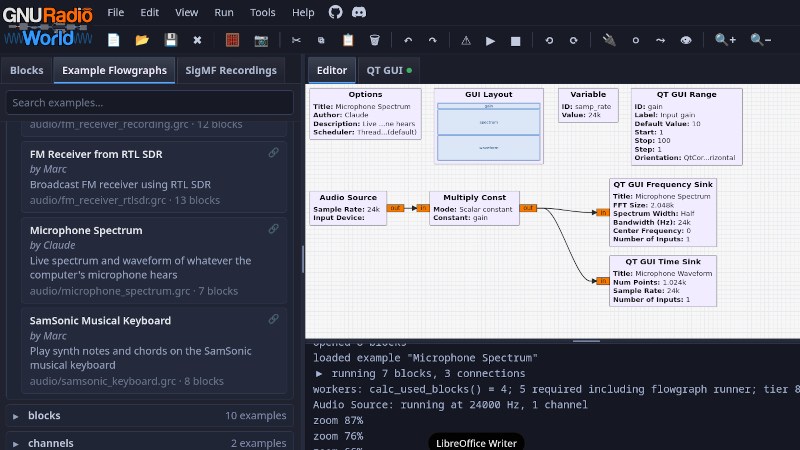
The progression of the web browser from a tool for simple static information browsing into a do-everything computing environment has been inexorable, with package after package making the jump. Today it’s the turn of GNU Radio Companion, lowering the barrier to software defined radio considerably. It’s the work of [Marc Lichtman], who’s name you may recall if you have ever used pysdr.org.
Loading it up gives you a very familiar window if you’re used to GNU Radio Companion, and it comes with a set of example flowgraphs that cover a large range of applications. It supports a collection of software-defined radios (SDRs) including the well-known RTL-SDR, and if that’s not enough it can also use your sound card. There is even a set of recorded off-air captures to experiment with.
We’ve spent a while here playing with it, and it does everything we’re used to from the version outside the browser. The only thing we’re told it won’t do is work with a networked SDR, but that’s no deal breaker.
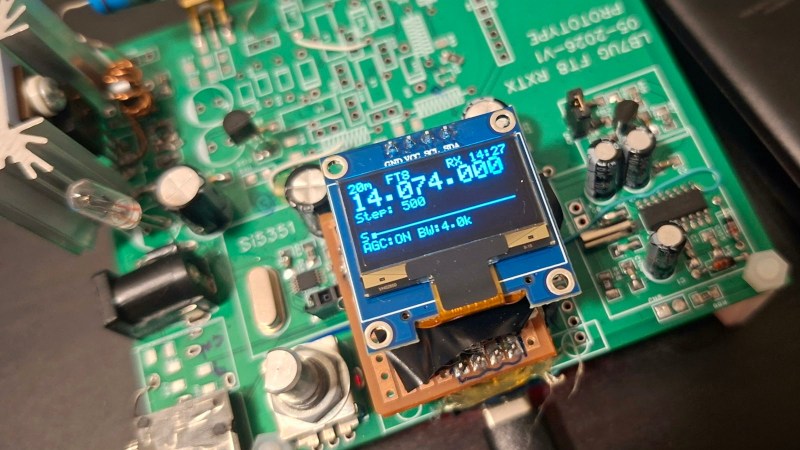
At its heart are three integrated circuits, the familiar Si5351 as a transmit VFO, an Si4372 receiver, and an RP2040 tying it all together. This microcontroller functions both as controller, and as an ADC to provide a software defined radio via its USB port. The Si4372 having an internal SDR architecture and its output being digitized again is not lost on us.
It’s for digital modes and CW only, but we’d venture the opinion that those are where the interesting stuff is anyway. We certainly like it for its simplicity, and also for the one-cable solution it offers. So many other designs need a sound card and extra cables, this one makes for a lot less clutter. We hope we’ll see more development on this design over time, it could become a favorite in the homebrew rig stakes.
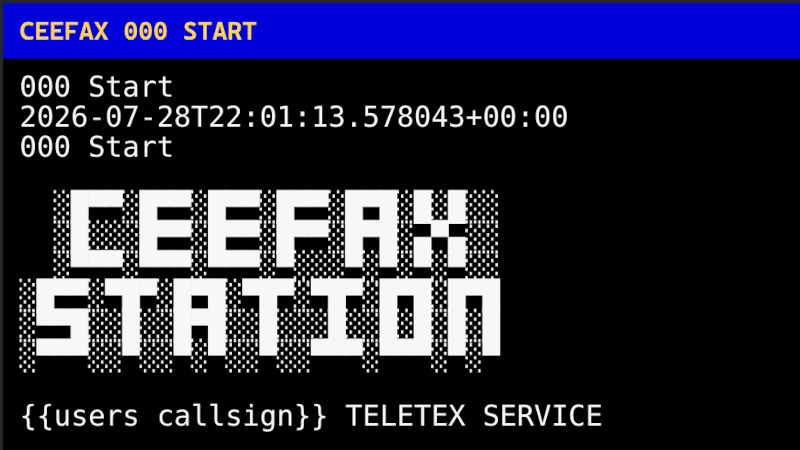
Old-school teletext with its pixelated text and block graphics may now be largely a thing of the past, but that doesn’t mean it’s without enthusiasts or there’s no more life in the idea. [M7TJF] has a project which takes teletext and puts it on amateur radio through the magic of AX.25. It’s called CEEFAX Station, in honor of the BBC’s teletext offering from back in the day.
What you get is a Linux package or a Windows executable, which you run and presumably hook the computer up to a radio. It can either be a transmitting node or a receiving one for browsing pages, and there’s an online map to track who’s doing either and on what frequencies. This is all brand new so there’s not much on there at the moment, but we expect that as people try this mode, this will change.
Sadly it’s a little unclear on how the protocol works and how the pages are encoded, but it’s early days. Meanwhile if you hanker for the real thing, it’s still about in some places.
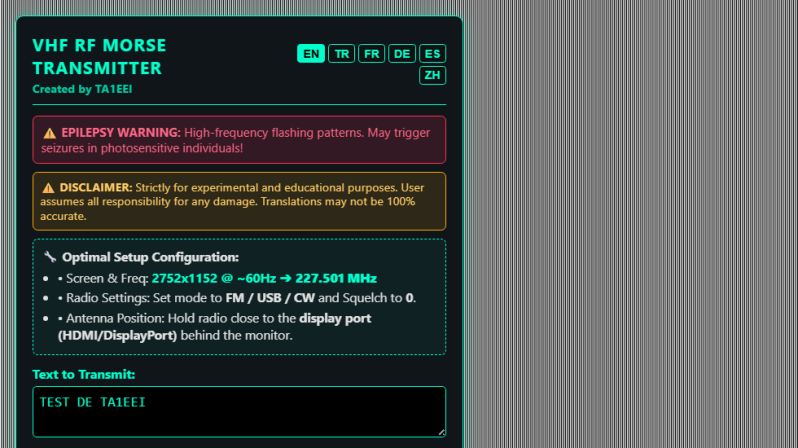
If you’re intending to transmit on the VHF band, you’re probably going to reach for a handheld or some kind of rackmount rig in your ham shack. But you needn’t bother with all that complexity, when you can use the computer on your desk to spit out such signals using a simple browser tool from [Efe].
The concept is straightforward—[Efe]’s tool manipulates pixel clocks in order to create spurious transmissions from your computer’s graphics hardware. The math pencils out pretty easily—multiply the horizontal resolution by the vertical resolution by the refresh rate, while paying attention to the precise timing of the video standard your monitor is using, and you’ve got your transmission frequency. For example, for a screen displaying 1080p at 60 Hz, with the CEA-861 timing standard, your horizontal and vertical resolutions are 2200 and 1125 respectively when paying attention to the requisite blanking intervals. Multiply those by 60 hz, and you’ll find you’re creating a signal at 148.500 MHz. Leverage this by displaying the right pattern of black and white pixels to maximise changes in voltage state on the HDMI or DisplayPort lines, and you might create a strong enough signal that you can actually pick something up. [Efe] created a tool to display these patterns to send simple Morse code messages over VHF just by flickering your screen just right.
You can test the transmitter tool for yourself here, right in your browser. You’ll want to hold your radio’s antenna nice and close to the monitor to see if you can pick up much of a signal. After all, the monitor, connectors, and cable are all built to optimize for clear signal transmission to the display, while preventing signal from leaking out to interfere with surrounding equipment.
Of course, a fair warning—you’re not supposed to intentionally transmit on bands you’re not licensed for, even if it’s incredibly weak and unlikely for anyone else to notice in a scenario like this. Still, it’s an interesting project that shows you just how electromagnetic interference can leak out of just about anything under the right conditions.
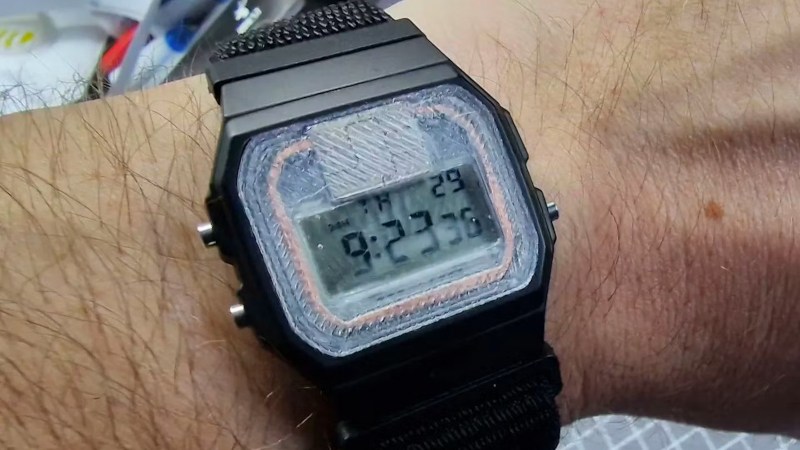
The Casio F-91W digital watch is perhaps one of the most successful pieces of consumer electronics ever made, having quietly supplied the essential function of an inexpensive and accurate LCD digital timepiece for many decades. As a result it has a huge following, and we’ve seen plenty of projects based upon it. [Matteo P] has one that we think you’ll like, he’s turned his Casio into a contactless payment device. We missed it when it came out, but sometimes a good project needs sharing.
If you’re a long-time Hackaday reader you may remember our investigation of 13.56 MHz NFC cards in which we showed you a disassembled card in which he antenna was a tuned circuit covering most of the card, with a small coupling coil for the chip. It’s this kind of card he uses, and ends up with an SLA printed front face for the watch that places the chip above the display and puts a pick-up coil around the outside. The most interesting part of the write-up though isn’t in the build, instead it’s the deep-dive into designing the RF parts and ensuring a good coupling at something close to resonance. Read it, if you fancy trying NFC-enabling any other random items.
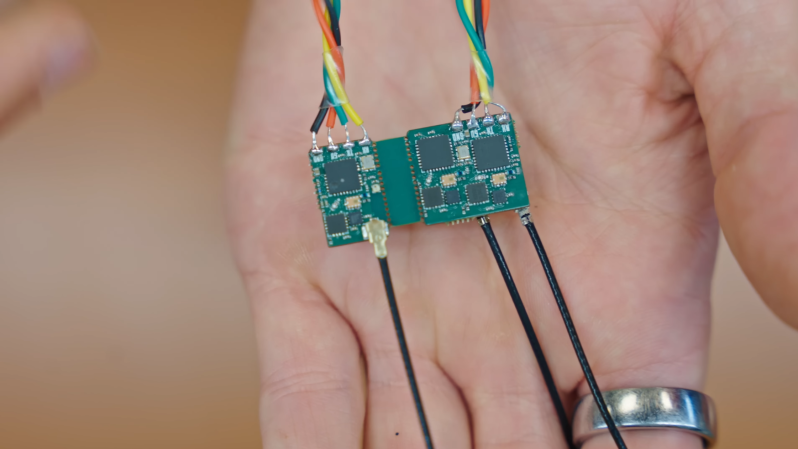
Drone control links are, from a radio signals perspective, nothing short of amazing: using a transmitter capable of transmitting, at most, one watt, a protocol such as ExpressLRS (ELRS) can control a drone over 100 kilometers away. [Stan], who has been building a drone electronics stack from scratch, recently designed four ELRS receivers and went over the principles behind their incredible range.
Up to a certain point, the simplest way to increase a radio’s range is to lower the frequency; lower radio frequencies penetrate better through most materials and don’t attenuate as quickly with distance. However, although ELRS can use 900 MHz bands, [Stan]’s receivers primarily use 2.4 GHz. The major improvement is in modulation: unlike other control protocols, which mostly use frequency modulation, or Wi-Fi, which uses phase and amplitude modulation, ELRS uses Chirp Spread Spectrum modulation. This has a low data rate, but it’s very reliable; every bit is transmitted as a chirp – a linearly rising radio tone – and the data is encoded in the chirp’s starting frequency. To decode this, the receiver multiplies it with an inverse chirp, then takes a fast Fourier transform, revealing the starting frequency. This process has an equivalent gain of 24 dB, which is enough to let it decode signals even below the receiver’s noise floor.
The hardware [Stan] designed to implement this was comparatively simple, just an ESP32 microcontroller, an SX1281 radio chip, and a few peripherals. All four receivers worked in 2.4 GHz, but two had additional 900 MHz antennas. Against RF design convention, one of the receivers used a via to connect the antenna. This would normally cause a significant impedance mismatch, but since there were enough ground-plane vias nearby, the current return path was barely affected; the receiver’s performance hardly changed. In one test, all four receivers maintained a connection at more than five kilometers, despite a forest blocking the signal’s path.
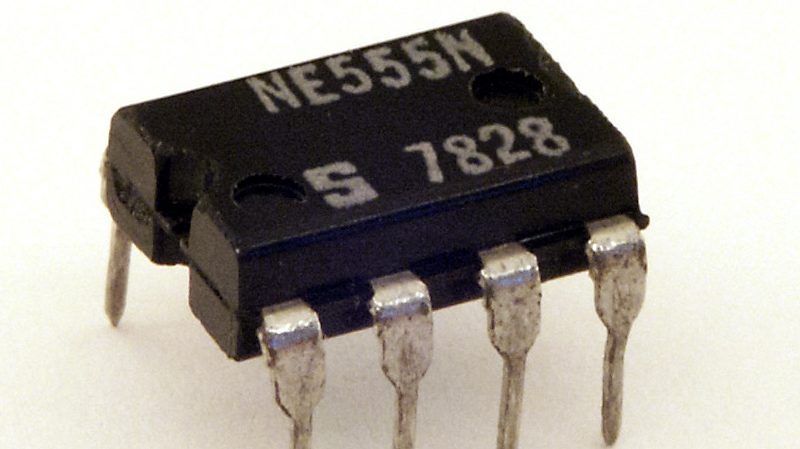
If you’ve got a cheap ham rig, it might not be very practical for you to receive certain transmissions out of the box. However, if you were to hack in a convenient little beat frequency oscillator (BFO) to your rig, then you’d be up and running. Here’s a simple way to do just that with a venerable old part everybody knows and loves.
The build in question concerns the use of a 555 timer IC. It’s seasoned with the right smattering of resistors and capacitors to taste, producing a 455 kHz beat frequency oscillator. This can be injected into the intermediate frequency chain of a receiver, making up for the lack of a steady carrier wave when receiving continuous-wave and single side-band suppressed carrier transmissions. Thanks to a potentiometer in the circuit, it’s tunable, too, from 455 kHz, plus or minus twenty percent or so. Thanks to the versatility of the 555, it’s possible to run the chip on a wide voltage range, anywhere from 4.5 volts to 16 volts, which makes it easy to install in just about any old radio set without requiring adding a specialized power supply. There’s also an alternative design that EDN covered in greater detail some time ago.
If you’re eager to dive into a wider range of transmissions than your radio can currently receive, this old-school ham hack could be just what the shack ordered. We feature plenty of good ham hacks around these parts, and don’t forget—we always want to hear about the freshest ones on the tipsline.

 Login
Login