Reading view

There are new articles available, click to refresh the page.

The Quantum Issue: WTF Is Quantum Computing?

Bitcoin Magazine
The Quantum Issue: WTF Is Quantum Computing?

What is quantum computing? How is a quantum computer different from a regular computer? What relevance does this have to Bitcoin?

New Bitcoiners have been inevitably bumping into these questions and having to confront the issues they dredge up regarding Bitcoin’s exposure to what is very much an existential threat to its existence if a viable quantum computer were to be developed. 

The ability to own bitcoin rests on the foundational assumption that without directly leaking a copy of it, no one but the person who possesses a private key can sign to transact with coins secured by that key. Quantum computing calls that assumption into question. 

Quantum computers are not just “computers, but faster.” They function in a very fundamentally different way from a classical computer, and as such they are much more efficient than classical computers at very specific kinds of computations. Now obviously, I’m not going to actually explain how quantum computers work in minute detail within four pages, but I will give you the core intuition of how they are fundamentally different from a classical computer. 

So let’s take a look at how both kinds of computers interact with things like large cryptographic keys. 

Classical Computers

Everything stored in a classical computer (or just computer from here on out) is stored as a series of 1s and 0s. Each bit (1 or 0) is precisely a 1 or 0; there is no ambiguity. When a piece of data is stored, it’s 1s and 0s. When a piece of data is manipulated or modified, it is done bit by bit, step by step, on each 1 or 0. 

That is how a computer works. It linearly, one step after the other, modifies the discrete unambiguous pieces of data that it is storing. It can’t skip ahead, or shortcut (in terms of the steps it’s taking, not more efficient ways to do things mathematically), it has to go through the steps of whatever computation it is doing one by one. 

When you generate a private key using a computer, it acquires a random value (you inputting dice, general user input, randomness from device hardware, etc.) and stores that in memory as 1s and 0s. From there it has to multiply this value by the elliptic curve’s generator point to get a public key. This is accomplished with an algorithm, that boiled down to its most basic level, is literally instructions on what bits to take, how to modify them, what circuits to “push” them down on a physical level to accomplish that, and in the end put the new value that has been modified bit by bit back into memory. 

There are other steps to arrive at an actual valid address, but for the purposes of this article those are not necessary to go into (but they are just like the above step, just step by step instructions on how to modify 1s and 0s in memory). 

So what if someone wanted to use a computer to guess someone else’s private key? 

There are 2256 possible private keys. That’s 115,792,089,237,316,195,423,570,985,008,687,907,853,269,984,665,640,564,039,457,584,007,913,129,639,936 different possible keys. 

A computer would have to try every single one of those possible private keys, one after the other (or however many at a time it can do in parallel), step by step following the exact instructions above for generating keys. The more of them you try to check in parallel, the more computing power you need, with no ability to find any shortcuts around that cost. 

The less computing power you want to use, the more time it will take, the less time you want it to take, the more computing power you need. 

This is an impossible task to accomplish with a computer. On one side you have a computation cost that every computer on Earth is not enough to pay, and on the other side you have a cost in time that is so high every star in the universe would die before you checked them all. 

To actually accomplish your goal, you need another option besides checking one by one linearly or in parallel. That’s where quantum computing comes in.

Quantum Computers

Quantum computers don’t work with discrete states. Everything is precisely a 1 or a 0. The most basic piece of information in a quantum computer is a qubit (the quantum version of a bit). Unlike a bit, a qubit is in a superposition where it is both simultaneously a 1 and a 0. It only settles into one or the other discrete states when it is observed

This is one of the key building blocks that allow a quantum computer to compute differently. The other is entanglement. Qubits aren’t just stored in isolation, the physical atoms representing them and collapsing to a discrete state when observed are entangled together. This means when entangled atoms are observed and collapse to a single state, the entangled atoms collapse to the same state, no matter how far apart they are. 

Now here’s where things get weird, and I’m going to have to get a little hand-wavy; you should still walk away with an intuitive understanding of why quantum computers are fundamentally different from a classical computer. An algorithm on a classical computer is a set of instructions to take a specific set of bits, and step by step modify them according to the algorithm’s instructions, until finishing and outputting the finished set of new bits. So the algorithm step by step takes one discrete state and turns it into another. 

Qubits don’t store discrete states until they are observed and collapse to one. They store probabilities. When you have a set of qubits entangled of any given size (like in this hypothetical case 2256), each given possible state that it collapse to has a certain probability of collapsing to that given state. 

Quantum algorithms, rather than being step by step instructions to operate on discrete states, are a set of instructions on how to operate on those entangled qubits in a way that alters the probabilities of different outcomes. Constructive interference is used to increase the probability of a correct outcome, and destructive interference to decrease the probability of incorrect outcomes (note that this is NOT the noise or interference that makes it difficult for physical quantum computers to function accurately, that is a different concept). 

So while a classical computer would have to check each individual private key one by one to find the one matching a specific public key, a quantum computer can simply run a few times using the right algorithm and arrive at the correct answer. It does not do this by “checking all the possibilities at once.” It simply modifies the probabilities of what a superposition will collapse into. 

This is why a quantum computer could break the assumptions underlying elliptic curve cryptography, and a classical computer could not (and it is also why quantum computers are only useful for certain types of computations with a massive possible space of answer candidates to check). 

Don’t Panic

This fundamental difference between classical and quantum computation means, that yes, if a viable quantum computer is actually produced, that functions correctly, then the underlying assumption that secures all Bitcoiners’ individual bitcoin is broken. All of those funds are insecure. 

Yes, this is a serious risk if such a device is actually manufactured, and it works, but we are not entirely unprepared. We understand the problem, we understand the exposure, and a good number of possible solutions to many different facets of the problem are coming together. 

Breathe, and relax. Through the rest of this issue we are going to walk you through the whole problem. 

This piece is featured in the latest Print edition of Bitcoin Magazine, The Quantum Issue. We’re sharing it here as an early look at the ideas explored throughout the full issue.

This post The Quantum Issue: WTF Is Quantum Computing? first appeared on Bitcoin Magazine and is written by Shinobi.

Ethereum targets quantum-resistant L1 by 2029

The Ethereum Foundation has published ratings for 62 Hegotá proposals after collecting 397 assessments from about 60 protocol specialists across nine teams. The Ethereum Foundation said in a Sept. 7 post on X that its Protocol Cluster had released two…

Post-Quantum Network Readiness

The Quantum computing industry is making leaps and bounds towards developing quantum computers that can–among other things–break the encryption that keeps our data safe and confidential. Some say it will take place in as little as two years, but even the most conservative estimates are for four years or 2030. In either case, it is time to begin to prepare your network for the coming post-quantum world.

To learn more about this risk, see my interview with David Bombal on Quantum Computing here.

When that day arrives, all of our encryption– and therefore all our data– will be exposed to anybody who has a quantum computer. Initially, this will be only nation state actors such as the US, China, Israel, and Russia.

No need to fret or stress as people have been preparing for this day for many years and have developed post-quantum cryptography (PQC). This field is in constant flux and recently one of the post-quantum cryptographic algorithms (HAWK) was found to be breakable by quantum computers. The point here is that this field is changing rapidly, not unlike artificial intelligence.

Some people have compared this to the Y2K crisis that took place some 26 years ago. At that time, nearly everybody was looking for a crisis that would break systems once we transitioned from a two-digit year to a four-digit year.The fact that no crises took place in 2000 can be attributed to years of preparedness for that potential crisis. Companies and institutions spent at least two or three years preparing for it and as a result nothing adverse really took place. It all went very smoothly.

For your organization, you need to start preparing now. To help you to prepare, Hackers Arise has developed a course on preparing your network for the post-quantum world. The training will be offered over 3 days October 13-15.

Post-Quantum Network Readiness

Outline

1.What are Quantum Computers are What Makes them Different

2. The Quantum Countdown: Harvest-Now-Decrypt-Later & Why Your Network Is Already Exposed

3. Know Your Attack Surface: Automated Cryptographic Discovery & CBOM

4. The New Arsenal in Action: NIST PQC Standards (ML-KEM, ML-DSA, SLH-DSA) with OpenSSL 3.5 & liboqs

5. Hardening the Wire: Hybrid TLS 1.3 & Quantum-Safe Tunnels

6. Post-Quantum PKI at Scale: Certificates, Signature Bloat & Real Network Performance Impact

7. From Vulnerable to Quantum-Ready: A Phased Migration Roadmap, Crypto-Agility & End-to-End 

The post Post-Quantum Network Readiness first appeared on Hackers Arise.

Quantum Resistance: Scanning Company Assets for PQC Readiness

Welcome back, cyberwarriors! 

Almost a year ago, OTW spoke about quantum computers and the risk of our encryption getting broken within three years. In March, Google shared its concern on the same issue, moving up its own post-quantum migration deadline to 2029. Some companies are migrating to mitigate that risk, but not many are taking it seriously. Eventually, a huge number of companies are going to get left behind with weak and breakable encryption. Hackers will only benefit from that negligence.

To help you minimize the risk and get an actionable plan with recommendations tailored to your company, we want to show you how AC-Scanner works.

AC-Scanner

AC-Scanner is basically a script for post-quantum cryptography exposure assessment. It maps your full cryptographic attack surface across TLS endpoints and SSH services, assesses every asset against NIST post-quantum standards and generates a structured Cryptographic Bill of Materials (CBOM).

Before we continue with the scan, you might want to watch a video by OTW and David Bombal on the risk of quantum computing being able to decrypt things at mass scale and expose session keys.

Setting Up

Docker is the easiest way to get started. We’ll start with the CLI version first, then show you how to get the web version up and running. They both work the same way, so you can choose any.

First install Docker on your system:

ubuntu > sudo apt update
ubuntu > sudo apt install docker.io

Then switch to root and pull it:

root > docker pull qubitac/acscanner:latest
docker pull

Now it’s ready, so let’s see the help menu. 

root > docker run --rm -it qubitac/acscanner:latest bash -c 'rm -f /.dockerenv && cd /app/scripts && ./scan.sh -h'
ac scan help menu

We’re only interested in the presets here. As you can see, you can test basically any of your assets.

Scanning Assets – CLI

Let’s choose some random Russian company for this scan. We don’t intend them to benefit from the results, we will just use it for demonstration to show how prevalent the issue is.

For our scan we used –all to scan everything: 

root > mkdir -p ~/ac-scans/example.com && docker run --rm -it -v ~/ac-scans/example.com:/app/scripts/example.com qubitac/acscanner:latest bash -c 'rm -f /.dockerenv && cd /app/scripts && ./scan.sh --noinstall example.com --all'
scanning the assets

If you’re testing a big company, it will take time. 

results

Results will be stored in ~/ac-scans

files

Here we only need crypto-bom.json that’s hiding in cbom.

Results

Upload crypto-bom.json to the dashboard by clicking Load CBOM. You will see the overview. 

dashboard

You can already see the infrastructure is not PQC ready and has several critical issues. 

The next step is HTTPS. Although 9 of their endpoints are using HTTPS, it’s vulnerable and the risks are high.

https

The scanner tried to fingerprint the SSH endpoints too, but they weren’t open.

ssh

Let’s look at the issues that the company has. It will show all the affected hosts with severity assigned to each. 

issues

Quantum risks may help tracking the progress of your migration. The results below are from a different company, but you can see they have only 3 PQC ready hosts out of 308. 

Recommendations will help you address issues by giving you prioritized actions. 

The recommendations were intentionally redacted by us to make them unusable. However, you can still clearly see how the page is structured.

Finally, your main goal is migration. Here it lists all the migration phases and gives you deadlines by which they need to be completed. 

pqc migration

As you can see, legacy TLS should be abandoned by 2027 and hybrid PQC key exchange should be introduced no later than 2028. That applies to everyone, not just this organization in particular. The report gives clarity and orients your client so there’s no confusion.

Scanning Assets – Web

If you don’t want to work in the terminal, you can use the web version. 

root > docker pull qubitac/acscanner
root > docker run -d --name acscanner -p 8080:80 qubitac/acscanner:latest 
docker web version

It’s available in the browser on http://localhost:8080/.

ac scanner web

Summary

AC-Scanner is easy to work with if you use Docker, otherwise you’ll run into some incompatibility issues. The dashboard has all the valuable information and most importantly it’s actionable and orienting. You don’t just see the vulnerabilities, you get a guide with recommendations on how to fix them too. Your client will definitely appreciate that.

Want to learn how to prepare your network for the post-quantum world? Join our Preparing Your Network for the Post-Quantum World training, taking place October 13-15 at 3 PM UTC. Available exclusively to Subscriber PRO students.

The post Quantum Resistance: Scanning Company Assets for PQC Readiness first appeared on Hackers Arise.

New report offers Washington state a way out of its quantum conundrum

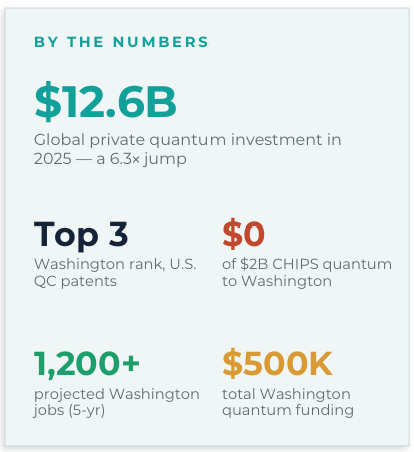
Chart from “Quantum Technology in Washington State.”

Washington state has assembled the country’s deepest bench of quantum technology assets — including two major cloud platforms, a national lab and the first U.S. quantum computer factory — but has captured almost none of the federal money now driving the industry.

That disconnect is the focus of a report released Tuesday morning by the Washington Technology Industry Association, the Northwest Quantum Nexus and the state Department of Commerce.

Since a January 2023 assessment, Washington state’s quantum ecosystem “has grown denser, more visible, and physically larger,” reads the report, authored by Nirav S. Desai, CEO of innovation consultancy Moonbeam Exchange. “Yet the state has fallen behind peers on the coordinated public investment that converts assets into a resilient cluster.”

The report makes five recommendations:

  • Use the governor’s office to convene a standing group — universities, the Pacific Northwest National Laboratory, companies, investors and the Commerce Department — that decides which federal grants to pursue and assembles joint bids for funding.
  • Pick one to three specialties to compete in, such as post-quantum cryptography or industry applications, rather than chasing all of quantum.
  • Build the workforce at all three levels: developers first, then the missing undergraduate and technician programs.
  • Position the Seattle region and Washington state as a landing pad for Japanese, Korean and Taiwanese quantum companies.
  • Create a single point of contact for founders, and promote the quantum machine access the state already has but hasn’t advertised.

“This isn’t a resource problem; it’s a coordination problem, and that’s the good news,” said Nick Ellingson, WTIA’s vice president of innovation and entrepreneurship, in a news release.

Quantum computers, which have yet to be proven commercially viable, can hold multiple states at once and could eventually solve problems beyond the reach of conventional machines.

The report points to efforts by states including Illinois, Maryland and Colorado, which have committed $500 million, roughly $200 million and $127 million respectively to quantum campuses and research hubs.

In Washington state, Microsoft and Amazon are among the major tech companies leveraging their research to build quantum platforms and technology. Maryland-based IonQ’s Bothell, Wash., plant, the country’s first dedicated quantum computer factory, employs about 100 people, part of an expansion the report says could generate 1,200 to 2,000 jobs within five years.

Gov. Bob Ferguson vetoed $100,000 for a state quantum strategy in May 2025, citing fiscal pressure, while directing the Commerce Department to build industry partnerships and produce policy recommendations. Tuesday’s report was funded by a grant administered by Commerce.

In April, Ferguson steered $500,000 from the state’s Strategic Reserve Fund to IonQ’s Bothell expansion, Washington’s first direct investment in quantum.

Illinois, by comparison, has committed more than $500 million to the Illinois Quantum and Microelectronics Park, a campus near Chicago anchored by PsiQuantum and IBM.

Read the full report here.

Legendary Investor Ray Dalio Still Holds Bitcoin — But Only 1% of His Portfolio 

Bitcoin Magazine

Legendary Investor Ray Dalio Still Holds Bitcoin — But Only 1% of His Portfolio 

Legendary investor Ray Dalio still only holds 1% of his portfolio in Bitcoin — and prefers gold instead. 

Speaking on a Thursday episode of the Diary of a CEO podcast, the Bridgewater Associates founder explained that while there are different types of money, and Bitcoin was one of them, gold was a better investment.  

Dalio has gone from saying he wouldn’t invest in Bitcoin over the years to finally admitting it was in his portfolio. 

“[Bitcoin] is a type of money that can’t be printed, but there are technologies that can hurt it — in other words, if there’s quantum computing,” he said. 

“And it can be monitored by governments and so on, and it could be taxed. And digital currencies are somewhat similar.”

Dalio added that Bitcoin only makes up 1% of his portfolio. “I prefer that — I’m pointing to the gold bars here — rather than the Bitcoin,” he added on the show. 

Last year, Dalio also admitted that Bitcoin only made up 1% of his investments. 

This isn’t the first time Dalio has criticized Bitcoin and praised gold: Back in 2020, the billionaire investor said that the cryptocurrency was too volatile to use as money but said everyone should have some gold in their portfolio. 

Dalio continued that governments could crack down on Bitcoin. “When the governments say I don’t want it, they have the power, therefore, to do whatever they want with it, and central banks will not own any significant amount of that because of the reason I said: they want their transactions to be private and in their control.”

While Dalio still takes a cautious approach to Bitcoin buying, over the years, the asset has become more widely accepted among traditional investors and even Wall Street heavyweights — including BlackRock, the world’s largest asset manager.  

BlackRock CEO Larry Fink in recent years has called Bitcoin an “international asset” and a way of “digitizing gold.” 

This post Legendary Investor Ray Dalio Still Holds Bitcoin — But Only 1% of His Portfolio  first appeared on Bitcoin Magazine and is written by Mathew Di Salvo.

❌