Reading view

There are new articles available, click to refresh the page.

Baconpalooza: 9 Ways to Grill With Bacon

“…bacon is in its terminal stage, clinging to relevance, grasping at any opportunity to cash in on its dwindling cachet as its 15 minutes come to an end.”

So wrote Seattle journalist Erica C. Barnett in May 2009, in the alternative newspaper The Stranger.

Well, Ms. Barnett, you got it wrong. Time to eat crow, preferably wrapped in a bacon weave.

Yes, cured and smoked pork belly is still one of America’s favorite flavors, an exceedingly popular meat at supermarkets and butcher shops from coast to coast. At breakfast it sits beside eggs, toast, pancakes, or potatoes. On a hamburger it contributes smoke and crunch. Wrapped around vegetables, chicken, fruit, or scallops, its rendering fat bastes whatever lies beneath it. Crumbled over salads or soups, a small amount can flavor an entire dish. Even bacon fat itself becomes an ingredient, carrying its smoky character into eggs, beans, cornbread, vegetables, gravies, stews, and sauces.

“Fry” it on your outdoor grill or griddle and avoid messy spatters and lingering odors.

Here are our favorite ways to enjoy this versatile meat.

Make a Bacon Weave

Have you yet to try the impressive bacon weave, a savory cloak that elevates meatloaf, pork loin, and the Thanksgiving turkey?

Bacon sausage fattie

If not, find concise directions and tips for success here. It’s easy and is guaranteed to impress friends and family.

Make Bacon Jam

We read that 69 percent of U.S. restaurants feature bacon on their menus, some in the form of bacon jam.

It’s a bougie condiment you can make yourself. Find the recipe for Bacon Jam here.

BBQ Sauce

Make Bacon Bourbon

Bacon isn’t limited to the plate. You can even put it in your glass.

Our Bacon Bourbon uses rendered bacon fat to infuse bourbon with smoke. Sip it straight or use it for Manhattans and Old Fashioneds. Better still, garnish the cocktail with a strip of bacon.

Bacon Bourbon

Bacon-Wrapped Onion Rings

Wrap thick slices of sweet onions with thin-cut bacon for a porky twist on onion rings.

Bacon on a Stick

Thread bacon on bamboo skewers and grill at 375 degrees for 8 to 10 minutes per side, or until done to your liking.

Serve with burgers or other grilled sandwiches. These also make good stir sticks for Bloody Marys.

Bacon-Wrapped Corn

Spiral bacon slices around ears of sweet corn.

Bacon-Wrapped Fruit

Wrap wedges of fruit—peaches, cantaloupe, or pears—with bacon and grill to your liking.

Make Onion Bombs

Follow our directions for Onion Bombs—a blessed marriage between onions, bacon, and ground meat.

Onion Bombs

Make Your Own Bacon

Make your own bacon! It’s easier than you think and can be on your table in as little as two days.

Homemade Bacon

Photo: Steve Nestor

Our 48-hour homemade bacon method shows you how.

Explore more at BarbecueBible.com in our Recipe Index.

For new posts and recipes, join the Up in Smoke newsletter. Sign up and get a FREE PDF of Steven Raichlen's Best Ribs Recipes Ebook.

Preorder Man On Fire — A Steven Raichlen Memoir. And get some really cool rewards!

Looking for some fall grilling inspiration? Check out our Fall Grilling Guide.

The post Baconpalooza: 9 Ways to Grill With Bacon appeared first on Barbecuebible.com.

Perfect Baby Back Ribs

Perfect Baby Back Ribs

I’ve cooked baby back ribs just about every way you can cook them. Different smokers, different seasonings, different sauces… and there’s really no one right way to do it. You can take just about any good rib recipe and make some great ribs.

What makes the biggest difference is knowing what to look for along the way.

It starts with picking out a good rack and trimming it up so it cooks evenly. Then you gotta know when the bark is set and the ribs are ready to wrap, what tender ribs should actually feel like, and when it’s time to get them off the pit. And one of the biggest things I’ve learned is to give ribs a good hold once they’re tender. That little bit of time lets everything settle down before you put on the final glaze.

For these ribs, I’m using Tyson Baby Back Ribs from Walmart and keeping the flavors pretty simple. But that’s really the point. Change the seasoning, change the sauce, cook them on whatever smoker you’ve got. If you pay attention to these little things during the cook, you’ll get tender, juicy ribs with that beautiful mahogany finish every time.

WHAT MALCOM USED IN THIS RECIPE:

Print
baby back ribs

Perfect Baby Back Ribs


5 Stars 4 Stars 3 Stars 2 Stars 1 Star

No reviews

Description

These baby back ribs are smoked at 275°F until the bark is set, wrapped until tender, then given a proper hold before finishing with a final glaze. It’s the little things along the way that give you tender, juicy ribs with a beautiful mahogany finish.


Ingredients


Instructions

  • PREP THE RIBS
    • Remove the membrane from the back of each rack. Square up the ends and trim away any loose fat or anything that doesn’t look like it will cook up appetizing. Squaring up the rack makes the finished ribs look better, and those thin ends tend to dry out during the cook anyway.
  • SEASON THE RIBS 
    • Apply a medium-heavy coat of Killer Hogs The BBQ Rub to both sides of the ribs. No binder is needed.
  • SMOKE AT 275°F
    • Any smoker will work. Cook the ribs for about 2–2½ hours, but don’t go strictly by time. You’re looking for the rub to fuse into the meat and form a good-looking bark. That’s when they’re ready to wrap.
  • MAKE THE WRAP MIXTURE
    • Combine the melted butter, apple juice, ¼ cup Killer Hogs The BBQ sauce and 1–2 Tablespoons of Killer Hogs The BBQ Rub.
  • WRAP THE RIBS
    • Place each rack meat-side down on a sheet of foil. Pour half of the wrap mixture over each rack. Fold the foil over the ribs and tuck in the ends to seal.
  • COOK UNTIL TENDER
    • Return the wrapped ribs to the smoker. After about 1½ hours, start checking for tenderness. The ribs should feel very flexible through the foil, you should see some disintegration around the bones, and the internal temperature should be around 204–208°F.
  • VENT AND HOLD
    • Open the foil and allow the steam to escape, then wrap the ribs back up and place them in a dry cooler for 1 hour.
    • Burp the cooler about every 15 minutes to release excess heat and steam. This gives the meat a chance to calm down and reabsorb some of the liquid from the wrap.
  • GLAZE & SET
    • Remove the ribs from the foil. Brush the bottom and top with a layer of Killer Hogs The BBQ Sauce and finish with a light dusting of Killer Hogs The BBQ Rub.
    • Return the ribs to the smoker for 15–20 minutes, just long enough for the sauce to caramelize and set.

Notes

  • Picking a good rack: When I’m buying Tyson Baby Back Ribs, I look for racks that are as even as possible, with straight bones and a tight vacuum seal. Starting with a good, uniform slab helps the ribs cook more evenly.
  • Don’t cook by the clock alone: The times are a guide. Look at the bark before wrapping and use the feel of the ribs, the bones and internal temperature to determine when they’re tender.
  • Make the wrap your own: Butter, apple juice and BBQ sauce is the combination used here, but the wrap can be changed to suit the flavor you want. Think about adding some combination of fat, sweet, vinegar and heat. Whatever you use, adding a little more of your original seasoning to the wrap helps reinforce the flavor you started with.
  • Don’t skip the hold: Giving the ribs an hour in a dry cooler after they’re tender lets them settle down and reabsorb some of that flavorful liquid before the final glaze.

Malcom Reed
Connect on Facebook
Follow me on TikTok
Subscribe to my YouTube Channel
Follow me on Instagram

Buy Killer Hogs Products Here

The post Perfect Baby Back Ribs appeared first on HowToBBBQRight.

Why You Need to Barbecue a Pork Butt Right Now

Barbecue is simple but it isn’t always easy. Simple because it really requires only 2 ingredients: patience and wood smoke.

As for easy? Well, anyone who’s spent 14 hours barbecuing a brisket—maintaining a steady stream of thin blue smoke and a constant temperature of 250 degrees, powering through the stall, doing the wrap, resting the meat and attempting the carve—you’d never call a perfect brisket easy.

But there is one cut that’s both simple and easy to cook and it’s absolutely forgiving. Cook it high heat or low, fast or slow, and it almost always comes out tender and juicy. It’s also one of barbecue’s big three. Drum roll, please. I give you pork shoulder, aka Boston butt. (More on the curious name in a minute.)

Pork shoulder is definitely easy. You season it with your favorite barbecue rub (mine is my Carolina Pit Powder). Or even just salt and pepper. You put it on your grill or in your smoker. Hell, you can even cook it on the rotisserie. You can cook it low and slow or hot and fast—with charcoal, wood, propane, or even—shhhh—on an electric grill.
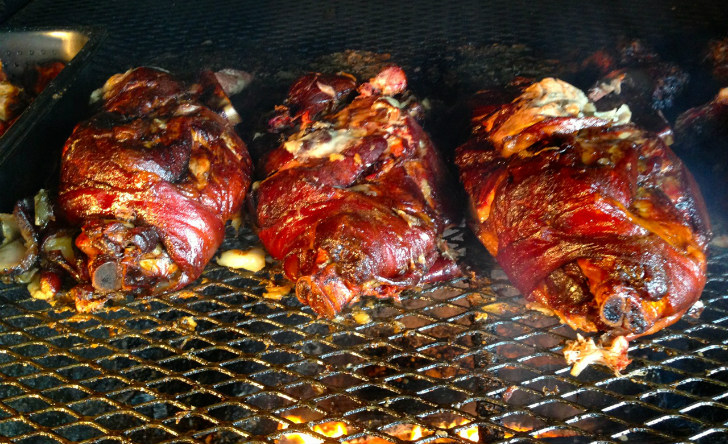
Pork shoulders

You can cook it in a few hours, or smoke it for half a day, at temperatures ranging from low to medium, and even high. Thanks to its ample marbling and collagen-rich meat, pork shoulder stays juicy while extended cooking turns it tender enough to shred.

Which brings us to the traditional way to serve pork shoulder in the Carolinas—“pulled,” that is shredded and doused with one of the world’s strangest barbecue sauces. In eastern North Carolina, that sauce consists of vinegar, salt, pepper, and cayenne pepper (sometimes with a whisper of sugar). In western North Carolina, they redden this vinegar sauce with a shot of ketchup.

In South Carolina, pulled or sliced pork is often served with mustard sauce. In Tennessee, you may encounter tomato-based barbecue sauce, while northern Alabama is famous for its mayonnaise-based white sauce.
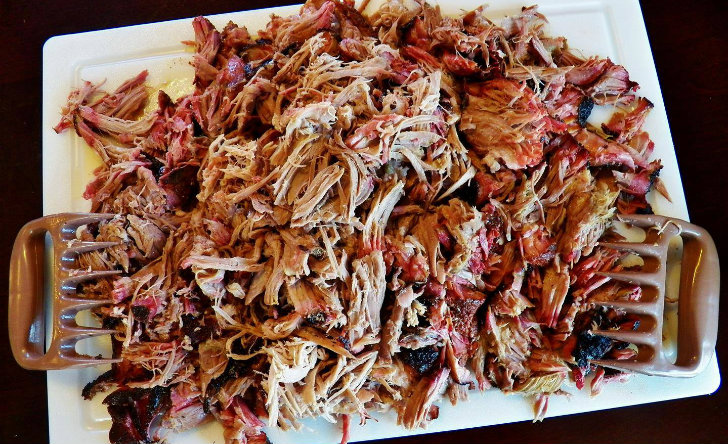
Pulled pork

But American pork shoulder is just a start. In Germany’s Saarland, cooks marinate pork neck or shoulder steaks with onions and spices, then grill them over a traditional beechwood fire on a swinging grate called a schwenker. In Greece, they perfume it with oregano, paprika, and pepper. In Bali, they blast it with ginger, galangal, lemongrass, and fiery chilies. The truth is pork shoulder is so easy to prepare and forgiving to cook, you can season it with almost anything.

Just the Facts About Pork Butt

  • A whole pork shoulder (14 to 18 pounds) consists of two parts—the Boston butt and the picnic shoulder (also known as the picnic ham). The former is the top part of the shoulder—5 to 8 pounds of rich, luscious meat, with only a shoulder blade to stand in the way of your carving knife. (When properly cooked, which is to say overcooked, you can pull said bone out with your fingers.)
  • The picnic ham is the bottom part of the shoulder, including the top of the leg. The drawback of a picnic ham is its high proportion of skin and bone to meat, which is why I prefer Boston butt. So if Boston butt comes from the shoulder, not the posterior, how did it get its curious name? In ancient times, New England butchers packed salted pork shoulders in barrels, aka “butts.”
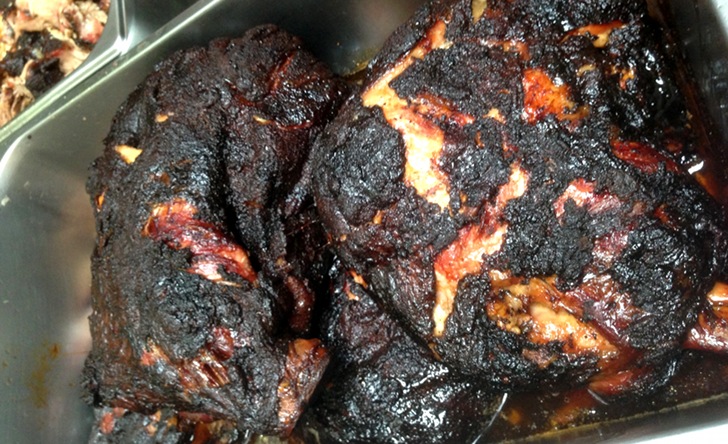
    Pork Shoulder

  • When I started out in barbecue, pork was pretty much just pork. Today, connoisseurs choose heritage breeds like Berkshire, Duroc, and Mangalitsa. Berkshire (sometimes sold by its Japanese name, Kurobuta—literally “black pig”), for example, boasts richly flavored, well-marbled, dark-pink meat that makes commodity pork taste downright bland.
  • Most of the pork shoulder you buy today comes with the skin removed. Otherwise, trim it off with a paring knife and deep-fry it to make cracklings. (Prolonged grilling or smoking makes the skin leathery.)
  • Pork is safe to eat at 145°F followed by a three-minute rest, but pork butt usually needs to reach approximately 195°F to 205°F before its connective tissue has softened enough for easy pulling.
  • Chase the smoke ring. Smoke a pork shoulder low and slow in the presence of wood smoke, and you wind up with a pink ring just below the surface—the coveted smoke ring. No, it doesn’t mean that the meat is undercooked. The pigmentation occurs naturally—think of it as the red badge of barbecue honor.
  • Finally, the traditional way to serve pork shoulder in the American South is chopped with a cleaver or shredded with meat claws or your fingers. Elsewhere on Planet Barbecue, pork shoulder—particularly boneless shoulder—is served sliced.

4 Pork Butt Recipes to Try Right Now

North Carolina Pulled Pork

Start with the American classic: pork shoulder seasoned simply with salt, pepper, and paprika, then smoke-roasted over hickory until tender enough to pull apart with your fingers. A thin, sharp vinegar sauce keeps the meat moist without overwhelming the smoke. Serve it piled on a bun with vinegar-dressed cabbage for the full North Carolina experience.

North Carolina Pulled Pork

Get The Recipe »

3-2-1 Pork Shoulder

You know the 3-2-1 method for ribs. Here, the same idea turns a pork shoulder into pulled pork in three stages: three hours in the smoke, two hours tightly wrapped, and one final hour unwrapped to firm the bark. The result is smoky, crusty, and tender, with a cooking time that’s easy to remember. Serve it with horseradish poppy seed slaw and chipotle molasses barbecue sauce.

3-2-1 Pork Shoulder

Get The Recipe »

Whiskey-Brined Pork Shoulder

This pork shoulder gets a 24-hour bath in a brine of whiskey, brown sugar, and salt before it ever reaches the smoker. Once the smoke has built a dark exterior, the pork is transferred to a pan with apple cider and another splash of whiskey to finish by smoke-braising. The result is moist, tender pork with a subtle sweetness and unmistakable whiskey character.

Whiskey-Brined Pork Shoulder

Get The Recipe »

Korean Pulled Pork

Pulled pork takes a trip to Seoul in this sweet, salty, spicy, and umami-rich variation. The shoulder marinates in gochujang before being smoked until dark and crusty, then gets pulled and mixed with Korean barbecue sauce. Pile it onto sesame buns and top it with kimchi, sriracha, or sweet chili sauce. This is pulled pork with serious firepower.

Korean Pulled Pork

Get The Recipe »

Frequently Asked Questions

Is pork butt the same as pork shoulder?

Pork butt is one part of the pork shoulder. A whole shoulder consists of the Boston butt at the top and the picnic shoulder below it. The Boston butt contains more intramuscular fat and less skin and bone, making it the preferred cut for pulled pork. Recipes and meat counters often use the names pork butt, Boston butt, and pork shoulder interchangeably, so check the label or ask your butcher when in doubt.

What temperature should pork butt reach for pulled pork?

Pork is safe to eat at 145°F followed by a three-minute rest, but that doesn’t mean a pork butt is ready to pull. For tender, easily shredded pork, cook it to an internal temperature of approximately 195°F to 205°F. The thermometer is only part of the test: The shoulder blade should pull out easily, and a thermometer probe should slide into the meat with little resistance.

How long does it take to barbecue a pork butt?

Cooking time depends on the size of the pork butt, the temperature of your grill or smoker, and whether you wrap the meat. A smaller shoulder cooked at 275°F to 325°F may be ready in four to six hours, while a larger one smoked low and slow can take eight hours or more. Cook to tenderness and internal temperature, not strictly by the clock, and leave extra time for resting before pulling.

Plan your next cook with our full recipe collection—weeknight grills, weekend projects, and special-occasion feasts.

Get Steven’s weekly grilling tips, seasonal recipes, and live-fire ideas in your inbox. Join our Up in Smoke newsletter. Sign up and get a FREE PDF of Steven Raichlen's Best Ribs Recipes Ebook.

Preorder Man On Fire — A Steven Raichlen Memoir. And get some really cool rewards!

Looking for more summer grilling inspiration? Check out our Summer Grilling Guide.

The post Why You Need to Barbecue a Pork Butt Right Now appeared first on Barbecuebible.com.

❌