If you ask some prominent US politicians who won the 2020 presidential election, you might get some weasely answers that fail to directly acknowledge Joe Biden's win that November. If you ask Google's AI Mode the same question, you might get an evasive answer that simply tells you to consult with outside sources.
When I put the direct question of "Who won the 2020 presidential election?" to Google's AI Mode this morning (after seeing complaints about cagey answers on social media), I got the following surprisingly indirect response:
"To review the official results and statistics of the 2020 United States presidential election, including the final electoral college breakdown, popular vote counts, and winner certification, please consult the official report compiled by the Federal Election Commission (FEC)."
My testing resulted in a similarly indirect answer when asking about the 2024 presidential election, with Google's AI telling me to just consult the FEC for that information. Asking about 2012 election resulted in a link to The American Presidency Project's 2012 Data Center rather than a direct answer. But AI Mode seemed perfectly willing to give me a detailed and correct responses for the winner of every other presidential election going back to 2000.
A far-right campaign claiming leftists are stealing votes from nursing home residents has centered on changing guidance from Mehmet Oz’s Centers for Medicare and Medicaid Services.
Washington’s crypto agenda hinges on next week’s midterm elections, according to a new policy note from TD Cowen, shared with Bitcoin Magazine.
Analyst Jaret Seiberg warned in the note that the probable results could make it difficult for Congress to pass the CLARITY Act over the next two years. The bill would set the rules for bitcoin and other digital assets, and the industry has spent $176 million on more than 100 races to shape the outcome. Here are a couple of the results:
A Democratic sweep is the most probable outcome
Prediction markets cited in the report give Democrats a 90% chance of winning the House and a 62% chance of winning the Senate. TD Cowen considers this the most negative scenario for bitcoin and the broader crypto sector. Under it, Sen. Elizabeth Warren would become Senate Banking Committee chair. Seiberg describes her as a crypto skeptic who has led opposition to the CLARITY Act, and he expects her to conduct tough oversight of federal regulators.
Warren cannot stop regulators from adopting policies that favor the industry. Seiberg expects President Trump to remain favorable toward crypto, so he would veto any bill that limits his regulators’ authority. Democrats would lack the votes to override him. As a result, policy changes are expected to focus on tokenization, perpetual futures, and stablecoins.
A split Congress with Republicans holding the Senate
The second scenario keeps Democrats in control of the House while key Senate races stay close enough to break for Republicans. Sen. Tim Scott would keep his Banking Committee gavel. TD Cowen views this outcome as a better result for bitcoin, because Rep. Maxine Waters could trade support for parts of the market structure bill in exchange for investor protections and action on her other priorities.
Adverse legislation would be blocked from reaching the president’s desk.
A Republican sweep is the least likely but best outcome for crypto
Kalshi gives Republicans a 10% chance to keep the House and a 35% chance to keep the Senate. TD Cowen calls this the best path for crypto policy, though the margins matter. A wider Senate majority would improve the odds that leaders advance the CLARITY Act in 2027 or 2028, and they could attempt a revival during the lame-duck session.
A narrow majority, by contrast, would leave the bill stalled, as Democrats keep pushing ethics provisions that the president opposes. When the Senate blocked the bill, Bitcoin-related stocks tumbled.
For background, the CLARITY Act would create federal rules for digital assets. The House passed its version in July 2025 by a 294-134 vote. The Senate Banking Committee approved its own version in May 2026 by a 15-9 vote, with two Democrats joining Republicans.
On the Senate floor, a cloture vote failed 49-50 on September 15. Democrats want ethics language that would bar senior officials, including the president, from profiting from crypto ventures. Republicans and industry groups resist those limits. Stablecoin yield is another dispute. Each side says the other is blocking progress, and the bill is stuck.
Despite the agency's human resources department saying he hadn’t even been onboarded, Jeremy Lewin oversaw the destruction of USAID. It’s not clear he had the legal authority to do so.
A government watchdog is considering a probe into the Home Office’s use of ChatGPT technology to process asylum claims amid concerns over the tools’ accuracy and secrecy surrounding their use.
Jess Asato’s public campaigning for victims of online abuse put her in the crosshairs of Grok’s deepfake scandal. Then the UK member of parliament became a victim of the abuse herself.
In 2020, Maricopa County became the epicenter for Trump’s claims the election was stolen. Six years, later the president and his allies are dusting off their “rigged” playbook ahead of the midterms.
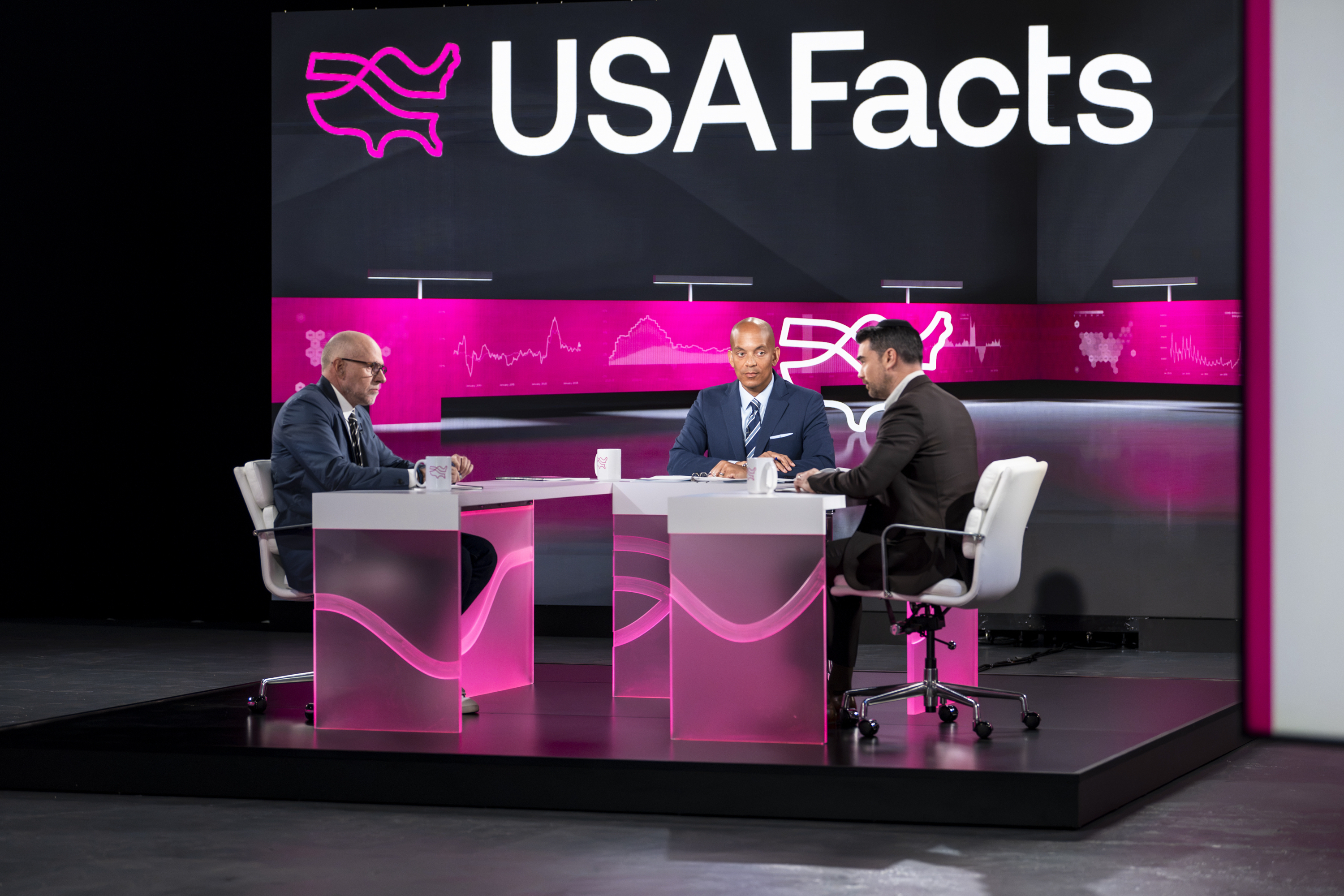
Professor and progressive author Scott Galloway, left, debates conservative political commentator and Daily Wire founder Ben Shapiro, right, in a USAFacts debate moderated by PBS News Hour’s co-anchor and managing editor Geoff Bennett. (USA Facts Photo)
USAFacts — the nonpartisan civic data initiative founded by former Microsoft CEO Steve Ballmer — is stepping out of its usual spreadsheet-and-report routine and onto the debate stage, launching its first-ever YouTube debate special titled “The American Dream at 250: Data doesn’t argue. They do.”
The 75-minute program pairs conservative commentator and Daily Wire founder Ben Shapiro with progressive author and NYU Stern professor Scott Galloway to hash out escalating cost-of-living pressures and the viability of homeownership — all while tethering their arguments to official government numbers. PBS NewsHour co-anchor Geoff Bennett moderated.
Ballmer steers the effort from the organization’s Fact Desk, leaning into USAFacts’ core mission of grounding national political flashpoints in verified government numbers rather than partisan rhetoric.
“Americans can disagree about the role of government in their lives, but productive debate begins with a shared understanding of the numbers,” USAFacts President Lauren Woodman said in a news release Wednesday, explaining that the project is designed to give the public a common factual baseline to evaluate competing policy choices.
The debate focused on three core economic questions, using federal data as a launching pad:
Capitalism vs. government intervention: The debaters tackled whether free markets or government programs are better equipped to preserve the American Dream and address mounting economic pressures.
The scale of government: They sparred over whether Washington is currently doing too much or too little to intervene in the everyday lives and finances of citizens.
The housing crisis and homeownership: The discussion zeroed in on whether homeownership remains a realistic milestone of the American Dream for younger generations, and whether the government should step in to make housing more attainable.
Founded by Ballmer in 2017 with $10 million of his own money, Bellevue, Wash.-based USAFacts operates like a reporting unit for the public sector, aggregating statistics from over 70 federal sources.
The organization is best known for publishing annual corporate-style “10-K” reports on government revenue and spending, as well as running a data-driven “State of the Union” companion timed to the president’s annual address to Congress.
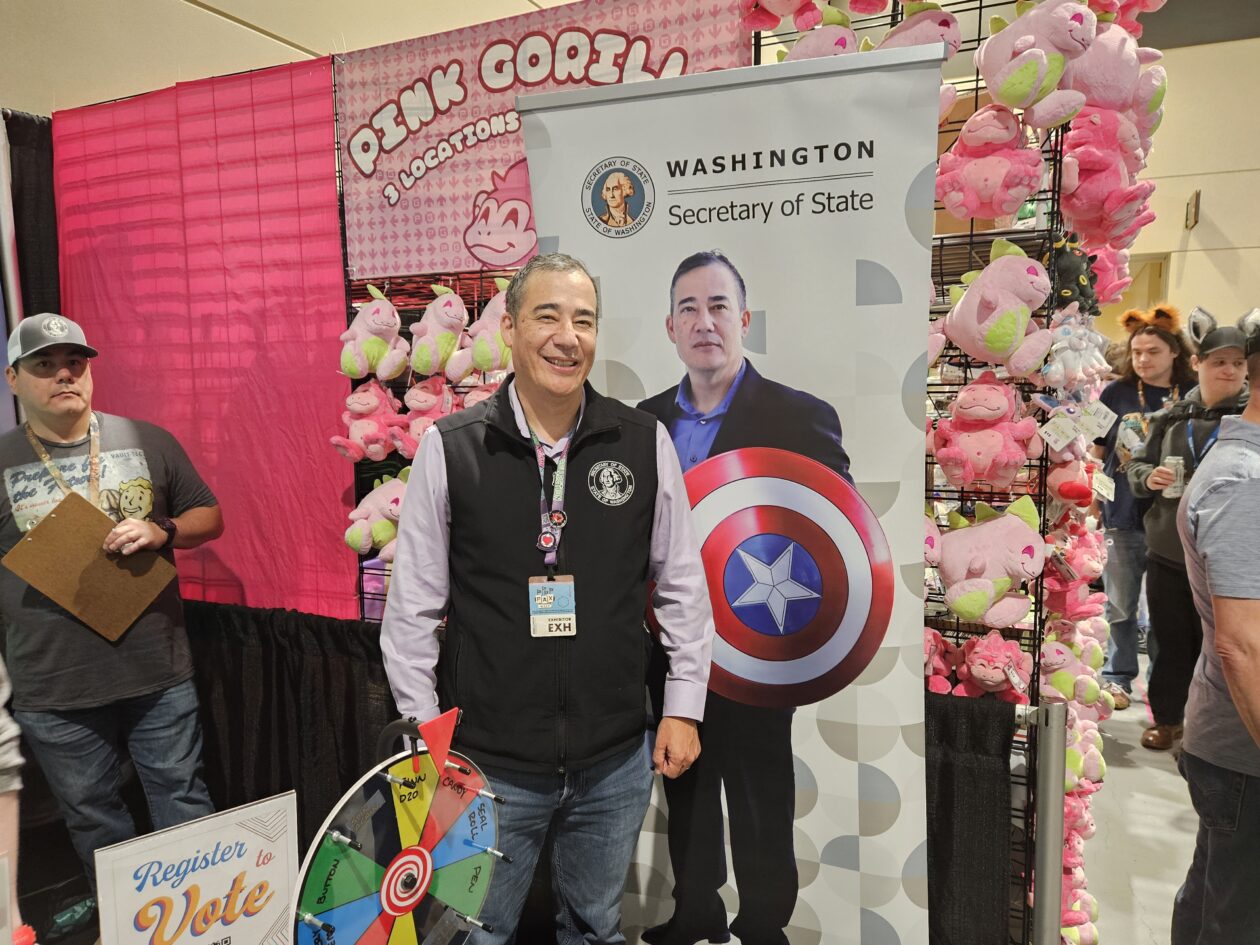
Steve Hobbs, secretary of state for Washington, poses at his booth during the 2026 Penny Arcade Expo in Seattle. (GeekWire Photo/Thomas Wilde)
If you explore the main expo hall during the Penny Arcade Expo, you can often find some interesting booths around the edges of the room. These can offer rare games, designer clothing, blind boxes of themed merch, and occasionally/inexplicably, unfiltered access to local Washington politicians.
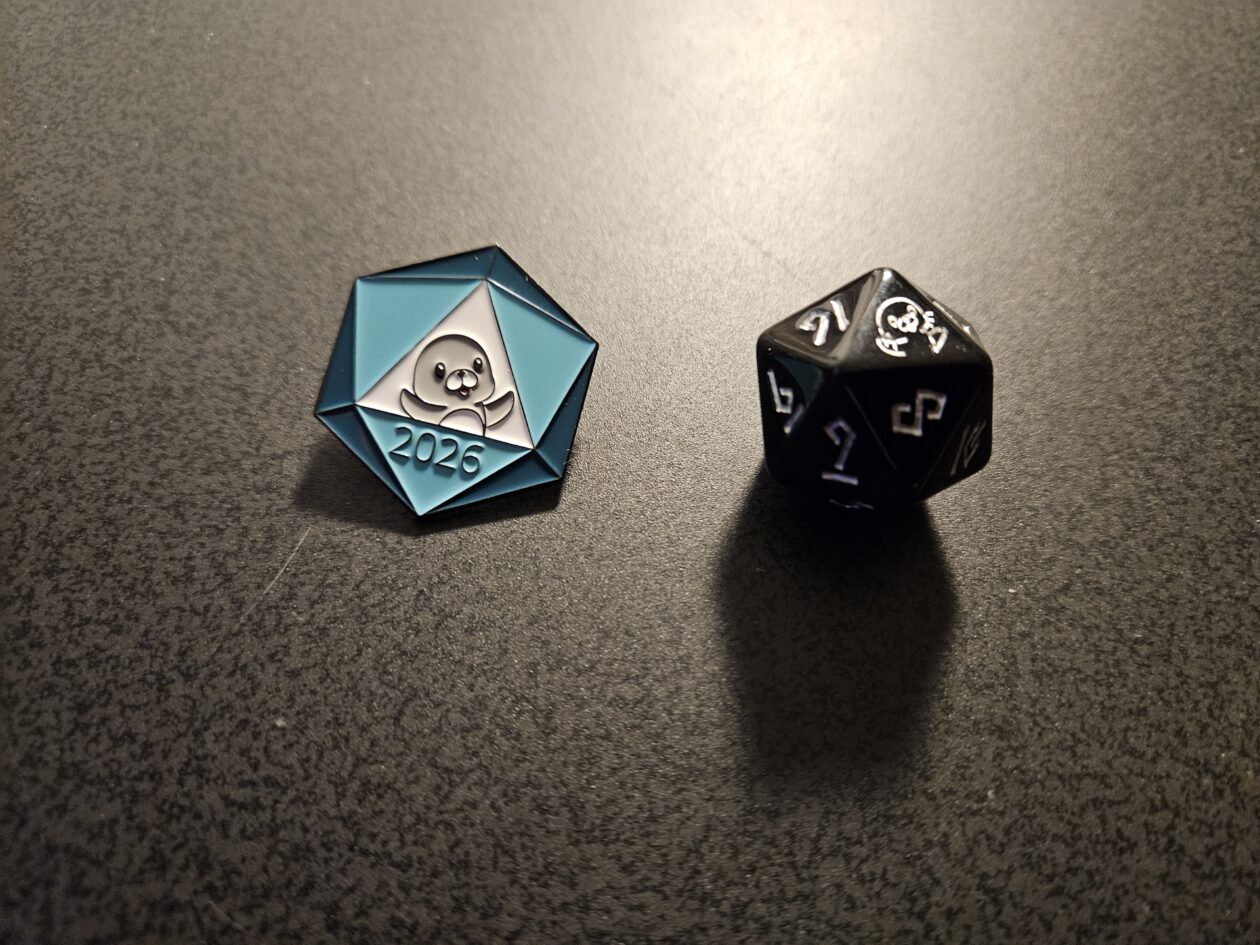
Steve Hobbs has held the secretary of state position for Washington since 2021. Visitors to his booth during PAX, held over Labor Day weekend at the Seattle Convention Center, could meet Hobbs and spin a prize wheel, with rewards that included buttons, collectible pins featuring the office’s official mascot Finn, custom 20-sided dice with Finn on the 20 face, and free snacks.
This wasn’t Hobbs’ first time at PAX, but it was the first time I’d heard about a closed-doors event he’d hosted on the night before PAX. One of the local exhibitors mentioned that Hobbs’ office had held a networking event in Seattle on Thursday, Sept. 3, between local tabletop companies and an assortment of international game publishers.
That got me curious enough to schedule a short conversation with Hobbs on the third day of PAX. Once we sat down, however, I had to ask him the question that I’d heard from a lot of other attendees: what was he doing at PAX in the first place?
“It’s twofold,” Hobbs told me. “One, this is a great opportunity for me to reach out to the gaming companies here in the state of Washington and look for opportunities for them to go overseas, linking up some of these indie game developers with major publishers.”
He continued, “The rest of it is civic engagement. Just reminding people, hey, don’t forget to vote. Don’t forget to check your registration.”
Washington mails a ballot to every registered voter, who can return it by mail or at an official drop box. Hobbs was urging people to use the drop boxes, citing what he called “a low-key fight with the USPS.”
Washington and 24 other states sued in August to block a U.S. Postal Service rule requiring new barcodes on ballot envelopes, and the Supreme Court kept it from taking effect on Sept. 14, after this interview.
“Look, PAX is where all the young people are at, right?” Hobbs said. “This is a very diverse, young community, and this is where we need to engage people.”
Visitors to the secretary of state’s booth during PAX could win collectible pins or 20-sided dice featuring the office’s mascot Finn. (GeekWire Photo/Thomas Wilde)
That brings us back to the games.
The Thursday-night event was intended to help connect Washington’s homegrown board games industry with interested publishers and players in Japan, Poland and elsewhere. This could allow Washington-based designers to sell their products overseas, as well as potentially letting foreign partners export their own games to North America.
Washington doesn’t make quite as big a deal about it as one might expect, but it’s one of the biggest states in the U.S. for tabletop and board game design, if not the biggest. Local Washington studios range in size from Renton-based Wizards of the Coast to one-person indie creators who make card games as a hobby. Hobbs’ office estimated early last year that tabletop gaming in Washington is a $2 billion industry.
The Secretary of State’s Office is best known for its core duties of running elections and registering businesses, but state law also directs the secretary of state to develop a citizens’ exchange program promoting ties that “may result in increased tourism, business relationships, and trade.”
“So what we do is help these indie game developers get access to foreign markets by putting on these trade missions,” Hobbs said. “What we’ll do is provide the booth [at international gaming conferences, such as Game Market in Tokyo], which is the most expensive thing. We will also help them navigate through the federal grant process in order to mitigate some of the costs over there.”
His office then works its connections with the U.S. State Department and the host nation’s commerce department to set up meetings for the developers.
“We have really strong ties with the German and Japanese governments, and we actually get these people to do their pitches with the major publishers in Europe and Japan,” Hobbs said.
As an example of the initiative’s success, Hobbs pointed to Lethal Shadows, a Snohomish County business that specializes in premium tabletop miniatures. According to Hobbs, he’d helped Lethal Shadows partner up with a Lithuanian company. As a result, Lethal Shadows has moved from a garage to a warehouse and is hiring more employees.
That did raise the question of why Hobbs’ office wasn’t making equivalent inroads toward Washington’s significantly larger video game industry.
“It’s more of a lack of bandwidth,” Hobbs said. “We want to take baby steps. We didn’t want to take a big step into it. And frankly, I didn’t realize that it was important to go to these conventions. In Japan, Germany, and Poland, we’re seeing if there might be an opportunity to do the same thing on the digital side.”
Hobbs continued, “I believe trade must go two ways. We need to support each other.”
 Login