This week on the GeekWire Podcast: A study commissioned by the City of Seattle says the city is not in decline but is in danger — finding that 10 companies, nine of them in tech, pay three-quarters of the payroll tax on large employers, and that the tax structure uniquely penalizes the hiring of senior, high-compensation workers.
The report says Seattle should be most concerned about AI but most active in cleantech, the one industry the city can actually shape, since it owns the electric utility and controls permitting, building codes and land use.
Meanwhile, the Seattle Times and Newsday sue Microsoft and OpenAI, accusing them of copying hundreds of thousands of articles to train their AI models, putting Microsoft’s hometown paper against a company that helps fund some of its journalism.
Which leads us to a new GeekWire Trivia Challenge about the Microsoft products that Apple later turned into categories. Stick around to the final segment to see if you can figure it out.
Upcoming Event
AI meets real estate
GeekWire, in partnership with Real Estate at Work, is recording the GeekWire Podcast live at 4 p.m. Wednesday, Sept. 16, with Toby Roberts, SVP of Engineering at Zillow. John Cook and Todd Bishop host with Real Residential broker Leka Devatha at Atmosphere Seattle. Grab a ticket.
CMS chief operating officer Kim Brandt and CIO Patrick Newbold say a new culture of delivering IT capabilities and scaling them quickly is taking hold.
Close up of a stethoscope and digital tablet with virtual electronic medical record of patient on interface.Digital healthcare and network on modern virtual screen, DNA medical technology and futuristic concept.
In this specially-numbered podcast episode that lines up quite nicely with our Retrocomputing Challenge, Elliot Williams and Kristina Panos met over surprisingly low latency and loud beverages to bring you the best of the previous week’s hacks.
But first, the news. German company Isar Aerospace can now claim that they’ve launched the first spacecraft into orbit from Europe. Be sure to check out the in-link, where we reported on the building of the spaceport.
In Hackaday news, the aforementioned Retrocomputing Contest had 64 entries at last check, which is just perfect for Episode 386. Will yours be the 65th?
Supercon Ten tickets are selling out, and per Elliot, the talks have been chosen, pending approval by each submitter. Keep an eye on the blog for the official announcement!
After reviewing the news, Elliot reached into the ol’ Mailbag and found two missives, including another from [Vik Olliver] regarding the printing of LEGO. The other is from [Mendel Munkis], who has been enjoying Wikipedia offline since 2018, thanks to a 32-bit ARM9 processor. Then, it was on to the hacks.
Check out the links below if you want to follow along, and as always, tell us what you think about this episode in the comments!
This week Jonathan chats with Olivier Vernin of Updatecli, the tool that helps you update everything! Need to roll out dependency updates intelligently? Or even automatically deploy to a server on changes? Updatecli can help!
Did you know you can watch the live recording of the show right on our YouTube Channel? Have someone you’d like us to interview? Let us know, or have the guest contact us! Take a look at the schedule here.
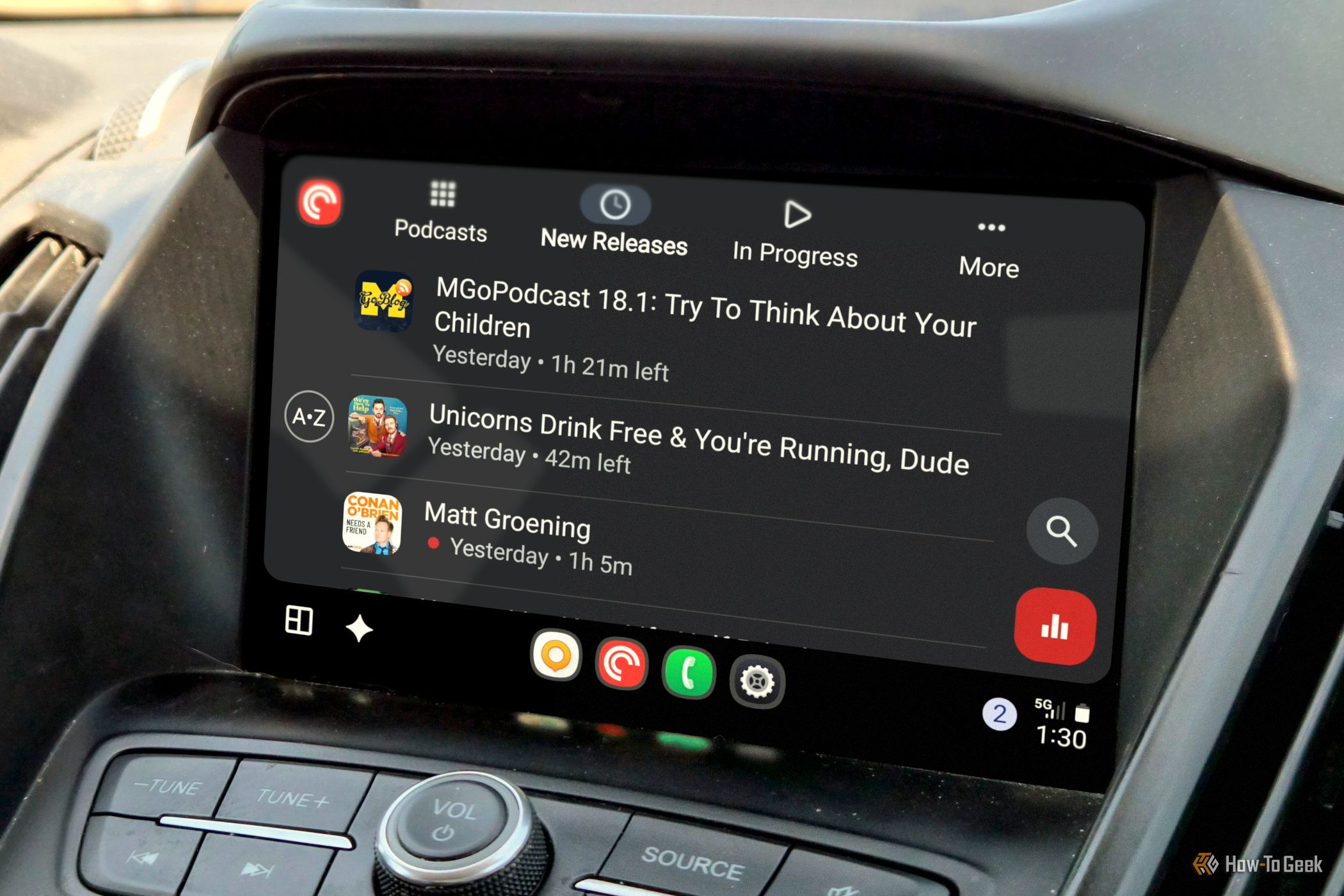
I always find that Android Auto is at its best when you keep it as stripped back as possible. It's great for navigation and music, but throw a podcast app into the mix, and it can quickly start to complicate things again. You don't want to be browsing through hundreds of episodes or fiddling with complicated menus while driving.
This week on the GeekWire Podcast: The NBA suspends former Microsoft CEO Steve Ballmer for a year and hits the Clippers with $30 million in fines and five lost draft picks over allegedly sham endorsement deals for Kawhi Leonard, drawing comparisons to the Microsoft antitrust era.
A new Redfin report says San Francisco’s housing market is booming on AI wealth while Seattle slumps, with the Bay Area-to-Seattle migration pipeline nearly dried up.
And the Seahawks sale to the Khosla family officially closes, ending the Paul Allen era, with two familiar Seattle tech names surfacing in the new ownership group.
Plus, the return of the GeekWire Trivia Challenge.
Editor’s note: Join us on Wednesday, Sept. 16 for a live recording of the GeekWire podcast. Co-hosts John Cook and Todd Bishop will discuss the week’s news and interview Zillow’ Senior Vice President of engineering, Toby Roberts, about how AI is changing the real estate business. Details and tickets here.
As the calendar turns a leaf into September, Elliot Williams is joined by Jenny List for our weekly look at all things Hackaday.
In the news, our retrocomputing competition is well under way, but there’s plenty of time to get an entry in if you’ve got a cool old-style project to show us. And then Elliot’s been chasing seismic surveyors in Munich, where they’re looking for geothermal energy.
In the stand-out hacks there’s a discussion of smoothing 3D prints using frickin’ lasers, the effect of unreasonably high RAM and storage prices on the single board computer ecosystem, and an unfortunate air conditioning system that’s tricked into believing it’s a hot day. Finally, we look in depth at PETG, and take a dive into reverse Polish notation.
In out mailbag this week we had [Kevin Opalka] asking about roadtrip hacks and [Matthew Rowberry] explaining that most versatile yet underrated prototyping medium: the humble Lego brick. Which in turn gives us the chance to mention Lego House: Right Next To Denmark’s Legoland, But Way Cooler, a trip we made back in 2019.
Got something to say? Send an e-mail or an audio clip to mailbag@hackaday.com.
This week Jonathan chats with Benjamin Samuels of Trail of Bits! The conversation focuses on Patch the Planet, a new initiative to help Open Source projects deal with the fallout from AI coding and vulnerability research. What’s the unexpected dichotomy driving the polarized response to LLMs? And what does the future look like for Open Source in the age of AI? Watch to find out!
Did you know you can watch the live recording of the show right on our YouTube Channel? Have someone you’d like us to interview? Let us know, or have the guest contact us! Take a look at the schedule here.
Bill Gates, shown here in April 2025, released a memo this week warning that the world isn’t ready for AI. (GeekWire Photo / Kevin Lisota)
This week on the GeekWire Podcast: Bill Gates published a new essay warning that the AI industry is crossing the safety lines it set for itself, and that nobody is preparing for what’s coming. At age 70, he also uses AI more than most people half his age, and he finds it enthralling, as you’ll hear on this week’s show, with highlights from our interview with him.
Along the way, we dig into his three proposals: new institutions for managing the transition, a category of jobs reserved for humans, and a tax on the use and purchase of AI and robots.
The change in his own tech usage: “I joke with people that I used to have Claude-like people that I would send email to, but they were so slow, and there were some topics they didn’t actually know. … It’s three a.m. I want to understand sodium batteries, and now there’s no reason to go to sleep. Here we go. Yeah, it’s crazy.”
How he uses AI specifically: “If you’re a curious person, this is a mind-blowing time. When I’m working on malaria, nutrition, my poor humans that I work with always get these long conversations from me, where I paste in — me, Claude, me, ChatGPT. Sometimes I do it if there’s three of us: Claude, ChatGPT and me, debating these things.”
On where personal agents are headed: “We will get to a point where you won’t buy things yourself. You just won’t. … You won’t go to those applications. You’ll just go to your personal agent. … From a productivity point of view, we are in heaven.”
What has surprised him: “I was shocked by ChatGPT, and I was shocked by Claude Code. Those are both things where I went, oh my God. … I did not expect that a statistical machine would essentially learn to read, and the idea that the code is better than human code. Those are two stunning thresholds.”
On writing this essay: “It’s very unnatural for me to think that innovation may be a net negative if it’s not managed properly. The more I wrote the memo, the more I was like, Jesus, we really need to get our act together here. Even though this may come across as negative, that’s the truth. If we don’t step up, the negatives will substantially outweigh the positives.”
What AI leaders say privately: “You’re in this perverse period right now where people in the AI industry who are willing to say that AI might have some negative effects are told, ‘Hey, you’re hurting our PR while we’re trying to raise trillions of dollars.’ … I know they’re all worried. Or all of them that I know, which is basically everybody but Elon.”
On losing control of AI: “The wake-up for the memo is that the bad stuff thresholds are all being crossed. Even lack of control that I thought would be many years from now, we’re seeing lack of control. … These are people who are super expert on the thing, going, well, maybe we won’t be able to control these things. What kind of risk have we chosen to run here?”
On how fast robots are coming: “What’s weird about AI is it’s better at doing jobs across the entire economy, including physical jobs when the robots come — which you can guess when that is, but my view is it’s only a couple of years.”
Is he still an optimist? “I don’t think being pessimistic is helpful. I do think, wow, this is sure an interesting time. I’m the guy who in my 30s thought people in their 50s or 60s didn’t understand anything. So it’s kind of bizarre if a guy who’s 70 comes and writes a memo that’s actually helpful. … But I am very concerned. And honestly, when you get people one-on-one, so are they.”
What did Hackaday editors Elliot Williams and Al Williams read in Hackaday last week? Probably everything, but you can tune in and hear about their favorites on this week’s podcast. They heard from lots of listeners this week, and also saw DIY projects running from a 3D-printed Stirling engine, to clogs, to LEDs.
There are some over-the-top hacks like a refit for a decades-old watch to do tap-to-pay and a — for lack of a better word — a record player that optically reads MOD files. Want to emulate an iPod? Talk to Eliza? Print a hand-operated rail car? Hackaday is the place to read about it all.
The can’t miss articles included a talk from Hackaday Europe about making magical PCBs and a not-so-brief history of space stations starting in the 1800s.
Check out the links if you want to follow along, and as always, tell us what you think about this episode in the comments!
This week Jonathan chats with Nathan Freitas of the Guardian Project! What is going on at the forefront of Open Source and privacy advocacy? Where are we on a true Tor browser on iOS? And what’s the ideal solution to the Android Lockdown issue? Watch to find out!
Did you know you can watch the live recording of the show right on our YouTube Channel? Have someone you’d like us to interview? Let us know, or have the guest contact us! Take a look at the schedule here.
This week on the GeekWire Podcast: Amazon’s delivery drones are going national, nearly 13 years after Jeff Bezos unveiled them on 60 Minutes. We listen back and discuss what’s next.
Plus: We go inside Anduril’s unmarked Bellevue office as the defense company builds toward 1,000 Seattle-area engineers; a reporter hides an AirTag in a rare book and tracks it to a secret Amazon book-scanning facility in Las Vegas; and an Anduril-themed trivia challenge.
In this week’s episode, Hackaday Editors Elliot Williams and Tom Nardi start things off by getting excited about the recently announced 2026 Retrocomputing Challenge. From there the conversation will cover efforts to improve desktop 3D printing with lasers, an expensive grill with an ESP32 controller and an open source firmware, open source tools underground, and some impressive techniques to squeeze a bit more utility out of the common QR code.
You’ll also hear about turning PVC pipes into flat stock, old school Radio Shack electronic kits, and VR soldering demos. Stick around to the end of the episode learn about the latest developments in over-the-counter hearing aids and the 1-bit CPU that’s enjoying an unexpected fandom nearly 50 years after its release.
Check out the links if you want to follow along, and as always, tell us what you think about this episode in the comments!
This week on the GeekWire Podcast: What should Liverpool FC fans expect from Jeff Bezos as a member of the storied English Premier League club’s new minority ownership group? We consult the Amazon leadership principles for the answer.
Plus, a tip and an SEC filing lead to a scoop on a former Meta AI director’s new startup, the GeekWire Editorial Board convenes to decide whether Dave Clark’s Auger stays on the GeekWire 200 after moving its HQ to Dallas, and Microsoft quietly semi-retires its AI blob.
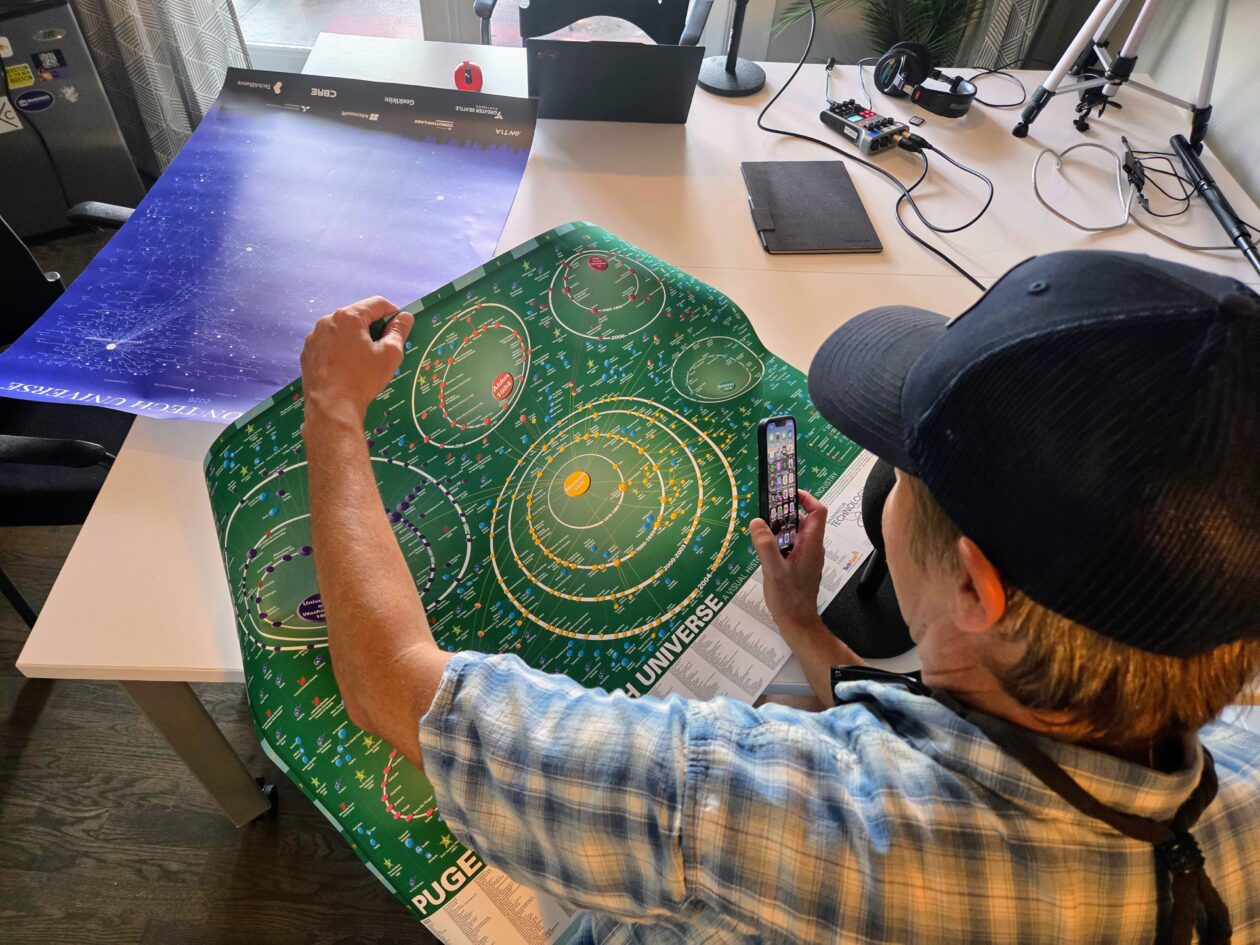
John Cook studies the 2009 Puget Sound Tech Universe map while recording this week’s GeekWire Podcast, with WTIA’s 2026 Washington Tech Universe map on the table behind him. (GeekWire Photo / Todd Bishop)
This week on the GeekWire podcast: SpaceX reports its first quarter as a public company, and Elon Musk says Starlink could deliver a majority of the world’s internet within a decade, leveraging production facilities in Redmond. Musk also explains the company’s data center ambitions, calling terrestrial infrastructure a trivial problem next to reusable rockets.
Plus: we bring two Washington tech universe posters into the studio, 17 years apart. The 2009 original turns up gems including Boeing’s unlikely connection to Classmates.com, the 1990s forerunner to Facebook. It also brings back memories of Teledesic, the Craig McCaw venture backed by Bill Gates that tried to beam internet from space decades before Starlink.
Finally, the GeekWire Trivia Challenge returns with a timely question about Google’s origins.
This week on the GeekWire podcast: Microsoft and Amazon both reported quarterly numbers, and both stocks rose on cloud results that beat expectations. Is all that AI spending paying off? And in related news, Microsoft sees a rare annual headcount decline, hitting product R&D hardest.
Plus: Satya Nadella builds a Power BI dashboard out of an analyst’s research report, and touts it on the earnings call to make a bigger point. Jeff Bezos names Amazon’s chips business as the long-awaited fourth pillar. And AI House managing director Jacob Colker delivers a much-needed pep talk for Seattle tech, calling on the region to recognize and build on its strengths.
In this episode of the podcast, host Paul Roberts interviews Nishawn Smagh of the firm GreyNoise Intelligence about the findings of their State of the Edge report, an analysis of GreyNoise data on risks stemming from compromised edge devices such as broadband routers, VPN gateways, smart home devices and more. Shawn and Paul talk about how attackers are turning edge devices into their favorite entry point, and strategies for organizations to counter the growing risk of compromised edge devices.

 Login
Login