
 Login
Login
What’s working in climate tech (and what’s not): 4 big ideas from a rooftop full of investors and founders
Subscribe to Positive Charge: Apple Podcasts, Spotify, Amazon Music, All Episodes
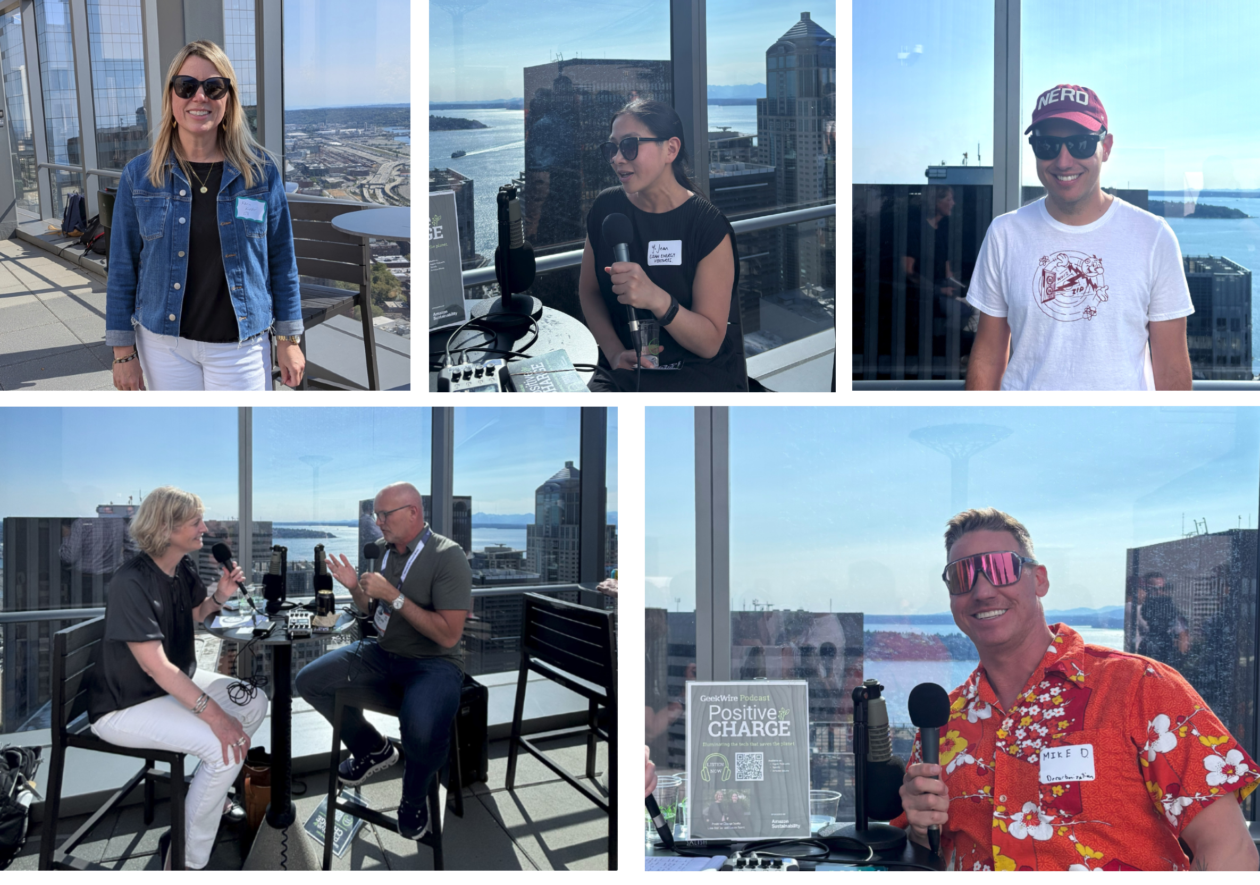
Most climate news these days is grim. But at a rooftop happy hour during Pacific Northwest Climate Week, the mood in Seattle was upbeat — and not out of wishful thinking or environmental altruism. The hope was rooted in business fundamentals.
“We actually have all the tools right now to decarbonize,” said Mike Dieterich, an executive with Decarb Advisory. “We just need to focus on how to scale what’s working.”
Beneath the enthusiasm, however, investors and founders were clear about where capital should and shouldn’t flow. While pushing back against a wave of “tourist cash” chasing AI data centers and nuclear startups, attendees argued that profitable climate innovation often sits in essential infrastructure: grid upgrades, EVs, next-generation solar and ag-tech.
Karin Kidder, executive director of E8, a climate-focused angel-investing organization, is buoyed by the commitment from her group’s increasing membership. While decreased federal support and global politics are straining sustainability companies, “on an individual level, people are stepping up,” she said.
The annual climate tech event spanned Seattle, Portland and two Vancouvers — one in Washington, the other in British Columbia — with 313 events and nearly 7,000 participants.
GeekWire pulled attendees at the kickoff happy hour aside to ask about the most overhyped and underappreciated technologies, as well as what made them optimistic about the planet’s climate prospects, and what worried them.
Here’s what we heard.

The data center ‘cash grab’
“Data center solutions are probably overhyped at this point,” said Jonathan Azoff, co-founder and general partner of the venture capital firm SNØCAP. “There’s a million of them, and they’re all trying to cash grab the big AI race.”
Azoff and others acknowledged that AI data centers, with their carbon-intensive building materials and huge energy demands, need innovation. But the concern is that some entrepreneurs are rushing into the space with half-baked, undifferentiated ideas that draw outsized dollars.
“They’re solving big problems for hyperscalers, and it’s worth a lot of money to [the tech giants],” said Yi Jean Chow, investment partner with Clean Energy Ventures. “So there are definitely investment opportunities there, but overhyped and high valuations for sure.”
Susan Su, partner at the venture capital firm Toba Capital and founder of the Climate Money podcast and Substack, also cautioned that data centers are stoking interest in costly nuclear fission and fusion energy. Customers and investors “think that nuclear is just going to be the end-all, be-all to power demand, and in reality it’s … taking the most time, costing the most money,” Su said.
That said, Azoff was excited to invest in an even riskier, more controversial form of nuclear — something called muon-catalyzed fusion. If the company, called LazeraH, were to succeed, “I can look back at and say this was my mark on clean energy,” he said.

Promising economics in sustainability
Companies in climate, sustainability and clean energy technologies are succeeding because they’re more affordable and perform better.
“People are choosing climate solutions, climate products, not because of the climate value, but because they offer other value propositions, too,” Chow said.
That includes the economics of electric vehicles, said Duncan Logan, co-founder and CEO of 9Zero, a climate innovation hub with Seattle and San Francisco locations. EVs are a “cheaper, better, faster way to move around” compared to combustion engine vehicles, he said.
Logan contrasted the U.S. with China, which is adopting electric semis, buses and scooters at lower costs. “We are falling so far behind,” he said. “So it’s a competitive thing.”

Don’t underestimate longstanding solutions
Longstanding climate-tech workhorses like solar, ag-tech and green construction are no longer shiny new sectors, but they’re still undergoing innovative breakthroughs.
Su said Chinese solar is becoming more expensive, and there are increasing opportunities for U.S.-made solutions beyond traditional photovoltaic panels. The emerging standard for solar is “silicon perovskite tandems” — a solution that stacks a thin layer of perovskite on a traditional silicon solar cell to capture much more sunlight. That transition, she said, “completely levels and reopens the playing field for new players to come in.”
Logan called out robotic farming devices, such as weed-zapping and rock-moving machines. Dieterich pointed to the use of AI to efficiently design sustainable buildings.
“We can build zero-carbon buildings at the same price point as code-built buildings,” he said. “So [AI] would allow us to do that faster and probably even cheaper.”

An unprecedented time for the grid and batteries
The electrical grid is the linchpin for many areas of clean energy deployment, and opportunities to address that long-overlooked infrastructure can be game changing.
“We need to triple our grid by 2050, and for the first time, we now have people with large bags of money showing up to get the power now,” said Ben Shwab Eidelson, co-founder and partner of Stepchange Ventures and co-host of the Stepchange Show podcast. That influx of resources can create a “magic moment.”
Darian Parrish, founder of PwrOn, a Seattle startup developing portable clean power, is eager to see more batteries paired with grid operations, but worries about overblown safety concerns when the impacts of burning oil, gas and coal are more dangerous in many regards.
“Do you want a bunch of fire risk from fossil fuels and the inhalation of all those chemicals and exhaust, or do you want a lesser risk [from batteries] that might be hyperbolic in the media at the moment, but actually net safer?” Parrish said.
Kidder highlighted a company called It’s Electric that provides EV charging by plugging into buildings with excess energy available, bypassing the wait for additional grid capacity.
Tech alone won’t save us
Climate-friendly technologies that outperform polluting solutions are catching on and adoption is expanding. But human actions pulling in that direction are still essential.
“Technology alone will not, and was never going to save us,” said Su, of Toba Capital. “Only we can do that, and we have to do that through policy, through collective action, through awareness, and through behavior change. And those things are really hard. In many ways, they’re much harder to crack than nuclear fusion.”

Sources and references
Interviews:
- Jonathan Azoff, co-founder and general partner of the venture capital firm SNØCAP
- Yi Jean Chow, investment partner with Clean Energy Ventures
- Mike Dieterich, author and sustainability executive for Decarb Advisory
- Ben Shwab Eidelson, co-founder and partner of Stepchange Ventures, co-host of the Stepchange Show podcast
- Karin Kidder, executive director of E8, a Pacific Northwest-based climate angel organization
- Duncan Logan, co-founder and CEO of 9Zero, a climate innovation hub with Seattle and San Francisco locations
- Darian Parrish, founder of PwrOn, a Seattle startup developing portable clean power
- Susan Su, partner at the venture capital firm Toba Capital and founder of the podcast and Substack Climate Money
Additional sources:
- PNW Climate Week, organizer of the annual event
- It’s Electric, an EV charging startup mentioned by Karin Kidder
- LazeraH, a nuclear startup pursuing muon-catalyzed fusion mentioned by Jonathon Azoff
