A military aircraft has crashed in Russia’s Moscow region near the town of Zvenigorod, with the pilot reportedly ejecting before impact, according to Russian local media and Telegram channels reporting from the scene. Footage circulating from the crash site shows wreckage and emergency response activity near Zvenigorod, roughly 40 miles (65 km) west of central […]
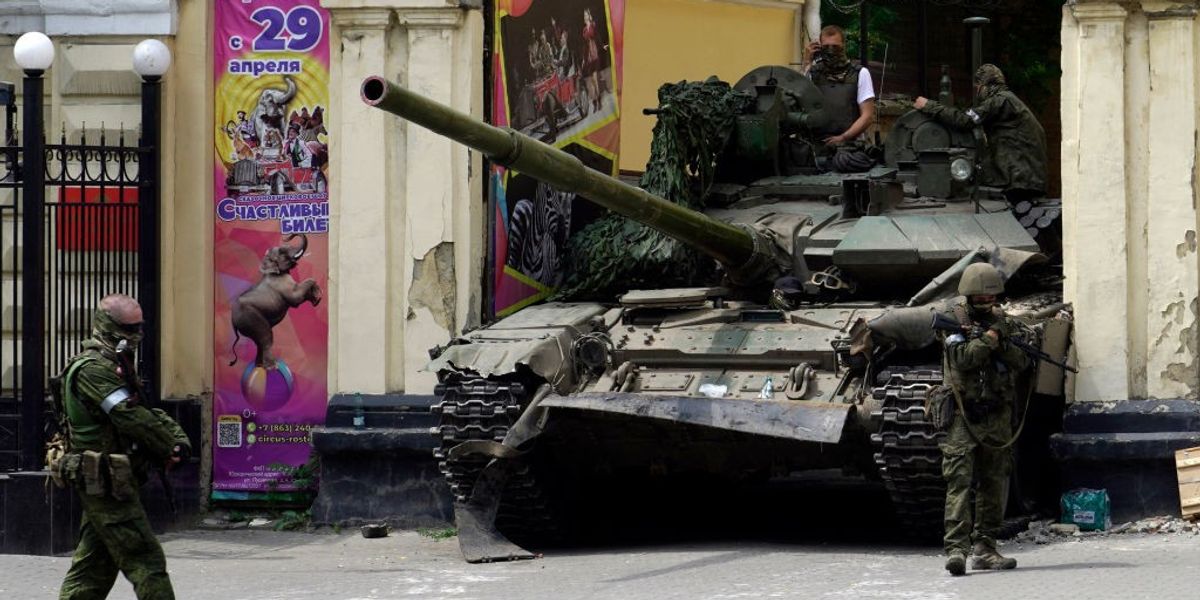
KREMLIN FILES/COLUMN: Three years ago, in June 2023, the Kremlin confronted one of the most dramatic internal crises of Vladimir Putin's quarter-century in power. Yevgeny Prigozhin, the former convict turned oligarch, Wagner founder, and longtime Kremlin insider known as Putin's "chef," launched an armed mutiny that stunned Russia and captivated the world. Wagner fighters seized the headquarters of Russia's Southern Military District in Rostov before beginning an astonishing march toward Moscow, encountering remarkably little organized resistance along the way.
For nearly twenty-four hours, the aura of Kremlin control appeared to evaporate. The episode immediately fueled predictions that Putin's regime was beginning to unravel. Some declared the mutiny the beginning of the end. Others saw it as the first crack that would inevitably bring down the Russian dictator. Three years later, those predictions have not aged well. But similar predictions now are all over U.S. and European news sources about another imminent collapse. The anniversary, therefore, offers an opportunity not to revisit sensational headlines but to remember three enduring lessons—especially at a time when rumor, hopeful thinking, and unfounded speculation once again dominate discussion over Russia and the Ukraine war.
Rumor and Reality
Prigozhin survived a negotiated settlement and the initial aftermath of his short-lived rebellion only to have his plane fall out of the sky months later. Wagner was dismantled and its elements incorporated into the Russian armed forces and intelligence agencies. Putin remains firmly in power, and the past three years have only seen a strengthening of his security and intelligence services.
Russia continues its war against Ukraine. And there are more rumors in recent months, from experts around the world, claiming Putin is “more vulnerable than ever.” This assumption is mostly grounded in Ukraine’s tremendous progress in escalating the drone war, its long-range strikes making a real impact on Russia’s energy sector, and heavy Russian casualties at the front continuing to mount throughout the year. There has also been more public criticism among Russia’s ruling elite than at any time during the war. But speculating from those facts thatPutin is now substantially weaker as a dictator, or even, as some have suggested, “ripe for a coup,” is mostly wishful thinking.
Such rumors from alleged intelligence agency leaks, and experts cited by media outlets, offer a tempting, albeit false, notion that the Ukraine war might come to an end without the West having to do more; that Putin will just be overthrown and a more democratic alternative might come to power. Or that resolve and strong support for our Ukrainian allies, who are still fighting and dying every day, are not really needed, and that the “war is surely coming to an end…” That was the response giventhis week when Germany was pressed on providing long-range weapons: “well, Ukraine is doing better than ever!” But none of that is based on reality, and Ukraine needs NATO and the U.S.’s support to see this war through to a just settlement, one where Ukraine does not sacrifice long-term security for peace.
Looking back at the war and to Prigozhin’s mutiny, the first lesson to remember is that the Prigozhin’s move exposed important vulnerabilities within the Russian state, ones that have existed for decades. Wagner's convoy advanced hundreds of miles while much of the security apparatus appeared confused, hesitant, or absent altogether. The episode reinforced what many who study Russia have argued for years: corruption, patronage, bureaucratic dysfunction, and institutional rivalries remain defining characteristics of Putin's system. Loyalty often trumps competence, and political reliability frequently matters more than military effectiveness.
Those weaknesses are real. They were discounted by far too many Western military experts before the 2022 invasion, who predicted a quick Russian victory. I have documented numerous examples of such failures across the Russian intelligence, military, and security establishment in my ownbook: Tradecraft, Tactics, and Dirty Tricks: Russian Intelligence and Putin’s Secret War (Naval Institute Press 2026).
Russia’s intelligence services (RIS) remain capable, adaptive, and ruthless. They have repeatedly demonstrated an ability to recover from mistakes, suppress internal threats, and preserve the regime. They get the very best in terms of resources and reconstitution from any losses, and they are expanding their hybrid war against Europe and the U.S.
Weakness and Resilience in Putin’s Russia at War
Weakness and resilience are not mutually exclusive. Prigozhin’s mutiny revealed both. This is the second lesson from three years ago. War has strengthened the RIS and, especially, the FSB’s chokehold on the Russian people. Their economy has largely weathered sanctions and repeated hits, and their population, unfortunately, remains hypnotized by heavy propaganda. Sadly, most Russians support Putin as strongly as the Nazi Germans did Hitler, even to their bitter end. Unfortunately, Russian propaganda today has many more tools than Dr. Goebbels did, and they use them very well.
Prigozhin knew it. He was not marching on Moscow to overthrow Vladimir Putin. This has been widely misunderstood. Throughout the crisis, Prigozhin directed his fury overwhelmingly at Defense Minister Sergei Shoigu and Chief of the General Staff Valery Gerasimov. His extraordinary public denunciations in the weeks prior to the mutiny, shouting at both on Russian TV, stunned all of Russia but received little attention in the West. Prigozhin accused the military leadership of corruption, deception, and catastrophic mismanagement of the war in Ukraine. His objective was to humiliate them, force their removal, and compel Putin to intervene—not to replace Putin himself. He was screaming into Russian cameras, “Shoigu! Gerasimov!!” But not once did he shout Putin’s name. He knew where to stop with his ire.
Western observers too often interpreted the mutiny through their own hopes for regime change. It was an elite struggle within the existing system, not a revolutionary movement against it. Understanding that distinction is essential. Elite infighting should not automatically be mistaken for the imminent collapse of the regime.
Putin is a master, just like Stalin was 80 years ago, at playing his lieutenants and loyalist Siloviki against one another. While they jostle for power, he remains firmly in control, and they are constantly trying to curry his favor. Prigozhin sat at his table—and prepared that table—for decades. He knew it.
The third lesson is perhaps the most consequential. Putin's system was never designed to depend solely on the regular armed forces. It rests on multiple overlapping centers of coercive power, principally at the hands of the intelligence services. The Federal Security Service (FSB) remains the dominant institution protecting the regime. Alongside it stands the National Guard (Rosgvardia), with its vast manpower and domestic security mission, and the Federal Protective Service (FSO), whose responsibilities include safeguarding the country's leadership (first and foremost in the personage of Putin). These organizations were deliberately structured to counterbalance one another, prevent any single institution from becoming too powerful, and ensure that threats to the regime can be contained from multiple directions. Putin is a master at it.
The Wagner mutiny did not invalidate that architecture. If anything, the aftermath demonstrated its durability. While the regular military was embarrassed, the broader security state remained intact. Rosgvardia was strengthened immediately after the mutiny, receiving more heavy equipment, tanks, and APCs designed to put down even the most serious uprising by disloyal units, should they ever get past the wary watch of the FSB. It is headed by General Viktor Zolotov, a loyal former KGB colleague of Putin’s. That layered system and those allegiances help explain why authoritarian regimes like Putin’s can absorb dramatic shocks without collapsing (Iran provides parallels, and no doubt Russia and Iran continue to learn from one another).
None of this means Putin's regime is invulnerable. History offers countless reminders that authoritarian systems often appear stable until they suddenly are not. Internal rivalries matter. Economic pressure matters. Military setbacks matter.
But careful analysis requires distinguishing between long-term structural vulnerabilities and near-term political collapse. Those are not the same thing. Russia under Putin has shown a remarkable ability to overcome its structural and corrupt vulnerabilities to launch out repeatedly with aggression.
Three years after the Wagner mutiny, the greatest analytical mistake would be the same one made in June 2023: allowing hope to substitute for honest assessment. We cannot simply hold our breath, wait for the next rumor of elite discord, and convince ourselves that the dictator—and the security state he has painstakingly constructed over twenty-six years—will collapse under its own weight.
It will not be that easy. If Russia's aggression is ultimately to be defeated, it will require sustained Western resolve, continued support for Ukraine, and a clear-eyed understanding of both the strengths and the weaknesses of the adversary we face. Strategy demands as much patience as the current optimism calls for. But our strategy also demands more resolve, as well as something else missing in 2022—and for much of Putin’s reign—a more credible deterrent from the West.
All statements of fact, opinion, or analysis expressed are those of the author and do not reflect the official positions or views of the US Government. Nothing in the contents should be construed as asserting or implying US Government authentication of information or endorsement of the author's views.
The Cipher Brief is committed to publishing a range of perspectives on national security issues submitted by deeply experienced national security professionals. Opinions expressed are those of the author and do not represent the views or opinions of The Cipher Brief.
Have a perspective to share based on your experience in the national security field? Send it to Editor@thecipherbrief.com for publication consideration.
The late-June 2026 death of Sergei B. Ivanov - the man once thought the most likely successor to Vladimir Putin - as well as the Russian President’s age, his rumored health problems, and the discontent over the economic impact of his disastrous invasion of Ukraine; have renewed speculation over when, under what circumstances and to whom he might cede power. The constitutional changes Putin orchestrated in 2020 potentially allow him to remain in office until 2036. Further, he has refused to answer questions about whether he will stay until then saying it is too early to discuss such matters and citing his focus on running the nation. However, given that Putin would be 83 in 2036, it is highly likely a leadership change will occur before then. How might Putin – assuming he is in a position to do so - handle such a transition? Ivanov’s history with him is instructive in this regard.
Like Putin, Ivanov hailed from St. Petersburg. They both served in the KGB’s foreign intelligence arm, the First Chief Directorate. But there was a difference between them that likely nettled the prideful Putin. While he served in Dresden, working with the allied East German State Security Service (a posting that earned him the not wholly complimentary sobriquet “Stasi” among his KGB colleagues), the polished, English-speaking Ivanov battled the ‘Main Enemy’ on the hostile side of the East-West divide. The two maintained a close relationship while Putin came to power and into the early years of his rule. Ivanov was the most-trusted of the coterie of St. Petersburg intelligence and security service veterans who formed the core of Putin’s governing elite as he founded what would become a de facto ‘Chekist” state in Russia.
When Putin was appointed Director of the Federal Security Service (FSB) by then-President Boris Yeltsin, he named Ivanov as his deputy. As he moved on from the FSB to become prime minister and then president of Russia, Putin kept Ivanov at the center of his security apparatus, appointing him successively as Secretary of the Security Council from 1999 until 2001; as Defense Minister from 2001 until 2007; and then as First Deputy Prime Minister. Apparently seen by Putin as too ambitious and difficult to control, Ivanov’s influence began to gradually wane in 2008 as the Russian president named the more pliable Dmitry Medvedev as a placeholder president while he himself actually ran the country from his perch as Prime Minister pending a return to the presidency. Although Ivanov remained a trusted player in Putin’s orbit for years thereafter - subsequently serving as Deputy Prime Minster and Chief of Staff of the Presidential Administration – the window for him to succeed his boss had long since closed. In 2016, he was relegated to a ceremonial position overseeing environmental and transport matters.
Repeating a Medvedev-like managed transition arrangement – that is Putin “retiring” while orchestrating events like a puppet master behind the curtain - is one likely scenario should he decide to depart the presidency. Another possibility is the constitutionally sanctioned model like that which played out in 1999 wherein the man Yeltsin named prime minister – in that case Putin himself - became his heir apparent. Putin went on to become acting Russian president and then president in 2000 following Yeltsin’s resignation.Another possibility is that Putin couldprecipitously decide to extra-constitutionally designate a successor.
The problem with these scenarios is that Putin to date has given no indication he might be willing to cede power. Nor, even if so inclined, is he likely to do so at least until he has secured something he can, however speciously, call ‘victory’ in Ukraine, a result that – at minimum - hinges on his ability to secure either through negotiations or force of arms the four oblasts Russia claims to have annexed in 2022. For Putin, successful resolution of the war is both a strategic imperative and central to his personal legacy. Given the grinding nature of the Russian Army’s advance in Donbas and the ferocious resistance being mounted by the Ukrainians, such an outcome appears unlikely in the foreseeable future if ever.
It is conceivable that the military or security services could mount a coup to topple Putin. Yet, despite the massive human and economic costs his war has imposed on the Russian people, there are to date no discernible indications such a putsch is in the offing. Additionally, the security measures taken following the abortive 2023 Wagner mutiny – to include the 2024 restoration granting of the Soviet-era Dzerzhinskiy title/honorific to a division of the Putin-created National Guard (‘Rosgvardiya’) protecting the country’s leadership and the ‘no man, no problem’ retaliation meted out to Yevgeny Prigozhin in its wake – mitigate against the success of any such attempt to overthrow the regime.
Given Putin’s age, and the fact that he rules a country wherein the male life expectancy is roughly the mid-to-high 60s, another likely scenario for an end to his regime involves his sudden death or incapacitation in office. Such an eventuality would unleash a period of leadership tumult in Moscow akin to that which followed the 1953 death of Stalin. With the demise of the Soviet dictator, it was widely assumed he would be succeeded by one of his closest lieutenants, Georgy M. Malenkov. Malenkov indeed became Chairman of the Council of Ministers. He successfully conspired with Red Army Marshal Georgy Zhukov, Foreign Minister Vyacheslav Molotov and Nikita Khrushchev to dispose of the odious Lavrentiy Beria. Nonetheless, even though he was effectively the Soviet premier and the head of government, Malenkov was unable to consolidate power because he controlled neither the security apparatus nor the Soviet Communist Party. And it was Khrushchev - by then First Secretary of the Party – who ultimately won the fight between Stalin’s lieutenants to succeed him.
During a 1959 discussion with Khrushchev, former U.S. Ambassador W. Averill Harriman addressed Stalin’s lack of a succession plan, asking the Soviet leader who Stalin thought wouldsucceed him. Khrushchev’s reply that: “Stalin didn’t think; he thought he wouldlive forever” was, as was the case with much of what he said, calculatingly apocryphal. Stalin, notoriously conspiratorial by nature, clearly feared that if he acknowledged his rule would someday come to an end, his power would rapidly erode as plotting to hasten that indefinite date commenced. As the fight to succeed him would attest, he was surely correct in that judgement. After all, as Golda Meir would famously observe to Henry Kissinger in 1973: ‘Even paranoids have enemies’.
Reference in Ecclesiastes 7:15 to “the righteous perishing in their righteousness, and the wicked living long in their wickedness” certainly applies not only to Stalin but also to Putin. Nevertheless, absent some highly unlikely actualization of the scheme he discussed with Xi Jinping in 2025 of indefinitely extending his mortality by replacing organs in a manner akin to that of a Bond villain, Putin knows that his death is an actuarial certainty. But, like Stalin, he surely (and rightly) understands that any designation of a successor would inevitably and immediately lead to an erosion of his own power as others vied for his throne.
A precipitous end to the Putin regime would almost certainly trigger a period – perhaps an extended period – of crisis and uncertainty in Russia. Even in the best-case scenario – such as a decision by Putin to name a successor or wield power from behind-the-scenes as he did with Medvedev - it is likely that a contest among aspirants to his purple would follow. In addition to the character, worldview and policy goals of any new man in the Kremlin, the key determinants in any transition will be how it comes about and strength of support for that new leader. Putin has not allowed any subordinate to become an alternative center of power and the Russian political system is deliberately opaque with respect to any political matter, much less an issue as sensitive as leadership transition.
According to the Russian constitution, in the event of a president’s death, resignation, incapacity, or impeachment, the prime minister - currently Mikhail V. Mishustin - would serve as acting president pending a presidential election within three months. In practice, however, succession would likely be less about constitutional procedure than about who can best ensure elite status, security, property and de facto immunity from any legal accountability. The presidential administration, security services, state corporations, courts, political parties, media, and regional governors all look to the Kremlin for direction and sustenance.
Consequently, a decision on who would succeed Putin would involve bargaining among elites with roots in those sectors. While Mishustin would temporarily fill in as president in a sudden constitutional transition, he lacks the charisma, nationalist credentials, independent public backing, and security-service connections to become a permanent successor to Putin. That said, because the prime minister is the formal acting president in extremis, replacing Mishustin with another figure would be a clear signal that the person named is being positioned to succeed Putin.
Any change in leadership in the Kremlin, however it comes about, will - if only because Russia is a major nuclear power – engender worries about the nature of any regime following that of Putin. This was also the case after Stalin’s death when then-Vice President Richard Nixon voiced concern that his successor “might very well prove more difficult to deal with than Stalin himself.” As the recklessness Khrushchev displayed in deploying missiles to Cuba attested, Nixon was right to be worried. The Russian leadership itself probably understands such concerns and wants to avoid fueling them. That is one reason that the next Russian president is less likely to be an advocate of change than a continuity figure. Domestically, any successor would likely concentrate on consolidating his rule and avoiding anything that looks like defeat in Ukraine. Even if the next leader is less personally ideological than Putin, the governing structure he inherits will inevitably push him toward continuity. This would mean repression of any opposition, or perceived opposition, at home; deep suspicion of the West; protection of elite wealth; and management of the Ukraine war and its consequences.
In any transition scenario, but particularly in the case of an unexpected transition, the security services - the best organized and most powerful internal organizations supporting and enforcing Putin’s rule - will play a key role in determining who will follow him. Not surprisingly, then, several of those thought best positioned to succeed Putin have deep security service roots. Most prominent among them is ex-Putin bodyguard and former governor of Tula oblast Alexei Dyumin. Hewas given a position in the Kremlin and subsequently made secretary of the State Council, actions seen by many as signs he is seen by Putin as a possible successor. Another leading candidate, Deputy Prime Minister Dmitry Patrushev, is the son of the hard-line former Director of the FSB and Secretary of the Russian Security Council Nikolai Patrushev. Even potential candidates seen as technocrats or managers, such as First Deputy Chief of the Presidential Administration Sergei Kiriyenko and Moscow Mayor Sergei Sobyanin, will have to account for the pervasive influence of the security services should they aspire to succeed Putin.
As Mark Galeotti, an expert on organized crime and the security state in Russia has noted, that country “is effectively a state with a nationalized mafia.” Officers and contacts of those services have leveraged their authorities and connections not only to the benefit of the Putin regime but also to line their own pockets. And there is no reason to suppose that the end of Putin’s rule - however it comes about - and the inevitable departure from the scene of Ivanov and other aging KGB veterans such as Nikolai Patrushev and FSB Director Alexander V. Bortnikov will herald an end to the Chekist State. Moreover, any idea that the new generation of security-state linked ‘siloviki’(strongmen) will willingly cede their sway on the most senior levels of Russian leadership is, to put it mildly, improbable.
On the contrary, for as long as the Ukraine war goes on the security services’ sway over the Russian state will almost certainly grow. Indeed, anyone succeeding Putin is likely to rely heavily on those same services to monitor and suppress any extant opposition to the war and his establishment of control over the levers of power. The impact of the security services on the Russian state after Putin will be much like their central role under him only more so. On becoming Prime Minster in 1999, Putin quipped that “a group of FSB colleagues dispatched to work undercover in the government has successfully completed its first mission.” Sadly for Russia, its people and the people of Ukraine in particular, that mission continues with no end in sight.
The Cipher Brief is committed to publishing a range of perspectives on national security issues submitted by deeply experienced national security professionals. Opinions expressed are those of the author and do not represent the views or opinions of The Cipher Brief.
Have a perspective to share based on your experience in the national security field? Send it to Editor@thecipherbrief.com for publication consideration.
Russian President Vladimir Putin can no longer conceal the cost of his Ukraine war from the Russian public. There are fuel shortages throughout the Russian Federation. Videos show hundreds of automobiles lining up to get a few liters of gasoline at gas stations around Moscow. Gasoline sales to civilian vehicles in occupied Crimea have been suspended as the Ukrainian blockade of the peninsula takes effect. Russia continues to make painfully slow progress in its efforts to capture territory in Ukraine and at a staggering cost in casualties.
“…sound out idols... by pos[ing] questions here with a hammer... scrutiny will reveal that they are actually hollow and meaningless—not the high, noble standards of conduct that their proponents claim them to be." — Friedrich Nietzsche
Twilight of the Idols
Ukrainian Defense Minister Mykhailo Fedorov recently says that Ukraine has successfully regained the strategic initiative on the battlefield and Kyiv’s use of long-range weapons to hit targets deep inside of Russia is aiming to force Moscow to end the war through asymmetric attrition. Ukraine has recently intensified precision strikes 20-300 kms behind Russian lines to isolate Russian infantry, destroy high value air defense systems and disrupt the flow of supplies to the front line. The long-range drone campaign is systematically targeting Russia’s energy infrastructure with devastating economic and psychological effect.
Vehicles are lining up to cross the Kerch Strait bridge following successful Ukrainian drone strikes on the Tavriiska thermal power plant, major electrical substations and the Kerch and Dzhankoi oil depots. These strikes have caused blackouts in Sevastopol and Simferopol, the two largest cities in the peninsula. The panic caused by the energy shortages and the fear of total collapse has led many to flee, causing the massive backups at the bridge—with sometimes as many as 2,500-3,000 vehicles lining up to cross. The Crimean Peninsula is the crown jewel of Putin’s campaign against Ukraine which he re-ignited with its annexation in March of 2014.
But Crimea is just one of the many challenges facing Putin. Omsk is burning, having been struck on July 6 by Ukrainian forces in their deepest strategic strike of the war. The Omsk oil refinery is located approximately 2600 kms from Ukrainian territory and is Russia’s largest oil refinery and its top producer of gasoline. There are still lingering oily black clouds over Moscow from the June 18 Ukrainian strike on the Gazprom Neft refinery in southeast Moscow—just ten miles from the Kremlin. The refinery was struck by over 200 drones and sent thick greasy black clouds of burning petroleum directly over the high-rise and residential areas fthat are avored by Moscow’s elites. The clouds created “black rain” and forced disruptions at Moscow’s four airports.
A few weeks before, there were oily black clouds over St. Petersburg as Russia hosted its annual St. Petersburg International Economic Forum in early June. International visitors to the Forum (whose attendance has seen a significant drop since 2022) were re-routed to avoid risk of Ukrainian drone strikes and to avoid the clouds of burning petroleum. This read like quite the humiliation for the architect of Russia’s current economic disaster.
As devastating as Ukraine’s attacks have been, the situation on the front is even worse.
A recent thinktank study indicates that Russian forces have suffered 1.4 million total casualties including 450,000 deaths on the battlefield. Approximately 32% of Russian casualties result in death, a fatality ratio that is much higher than modern Western military standards would allow. Reports by analysts and Russian military bloggers indicate that once a Russian soldier is deployed directly into an active combat zone, their average life expectancy drops to just 20-25 minutes. The average survival time for a raw recruit measured from the moment they arrive at a regional training ground to their death in Ukraine, ranges from ten days to three weeks. Even by the Russian standards that were established for casualties in World War II, these losses are staggering and must be causing alarm bells to go off amongst Russia’s elite leadership. There is more visible criticism of how Putin is conducting this war than has even been seen before.
On the diplomatic front, challenges for the Russian president are rising. This week’s NATO summit is yielding results on Europe’s commitment to defense spending and re-armament, led by Germany which is considering incurring state debt to finance defense spending which would be unprecedented for a postwar German government. Putin’s confidence in his ability to count on President Trump to put pressure on Ukraine to end the war on terms that are favorable to Moscow may be eroding and Trump has recently acknowledged Ukraine’s success in the war.
Putin’s reliable ally in Belarus, Alexander Lukashenko, seems also to be reconsidering the state of play and his enthusiasm for allowing Moscow to drag Belarus deeper into the conflict with Ukraine. resident Zelensky recently demanded Belarus take offline four relay facilities in Belarus’s Brest and Gomel regions near the Ukrainian border. These relay stations acted as signal boosters for Russian drones used to attack Ukrainian cities. The relays have been taken offline.
President Zelensky has just authorized a forty-day intelligence and security operation to heavily amplify pressure on the Kremlin to end the war. He is arguing that Russia’s elites live in Moscow and St. Petersburg and therefore, the war must be brought to their doorsteps. He also predicted that “When not one hundred drones but a thousand start reaching Moscow…Putin will be advised to move somewhere beyond the Urals. Zelensky is right and Ukrainians know Russia better than anyone in the West.
Despite the pressure he is under, it is too early to count Putin out. He has largely and cleverly managed his tenure as Russia’s leader. He is still two years short of Stalin’s 29 year record at the helm, but he is getting close and in his 27 years of running Russia, he has dug his tentacles deep into every level of the country’s power structure and has certainly accumulated kompromat on any potential rival or replacement. Many have speculated that if Putin departs the scene, his replacement could be an even worse partner for the U.S. and the West. I won’t argue that any replacement or coalition that follows Putin will be less anti West than Putin, but whatever constellation follows, they will not have the benefit of having roots and leverage as deep in Russia as Putin does.
For the moment, Putin still has escalatory options he can use to respond to increasing pressure.
In recent weeks, Russia has taken steps to close or severely restrict seven critical railway border crossings and road traffic crossings into Finland, Estonia, and Latvia. Apparently, negotiations are under way to restrict crossings into Kazakhstan and other central Asian states. The motivations for the abrupt closures are unclear but they suggest that Putin may be considering a mass mobilization and is trying to stem the likely departure of military age males to avoid the departures that have occurred since February 2022.
Mobilization alone will not solve Russia’s problem of shortages of equipment and training for conscripts as well as Russia’s World War I-style battlefront tactics. President Zelensky spoke on the margins of the NATO summit this week and said Ukraine is causing over 30,000 Russian casualties a month.
Putin can also rattle the nuclear saber again, but that is likely to be largely ignored as has his previous saber rattling. Most experts are confident that Putin has received firm guidance from his only remaining reliable ally China that he should not open the nuclear Pandora’s box in Ukraine.
The intelligence and security services in the Baltic States, Sweden, and Poland have recently assessed that Putin may try a provocation against one of the bordering NATO states in order to force an Article V action—which he hopes Trump would reject. But few analysts think Putin would risk an all-out war against NATO. That would be a path that could only accelerate Ukraine’s path toward NATO membership and could lead to further disasters for the Russian military, which many experts considered to be the most powerful conventional military in Europe prior to February 2022.
Putin’s most likely response to his current challenges is to continue to take advantage of weaknesses in Ukraine’s air defenses, particularly against ballistic missile attacks and hope that at some point, Ukraine’s morale weakens and pressure increases on Zelensky to end the war on terms that are more favorable to Russia. Such a change in Zelensky or Ukraine is inconceivable to any rational analysis of the current state of the war, but Putin is clearly not rational.
The Cipher Brief is committed to publishing a range of perspectives on national security issues submitted by deeply experienced national security professionals. Opinions expressed are those of the author and do not represent the views or opinions of The Cipher Brief.
Have a perspective to share based on your experience in the national security field? Send it to Editor@thecipherbrief.com for publication consideration.
Read more expert-driven national security insights, perspective and analysis in The Cipher Brief
BLUF: Armenia, a small country of about 3 million people, is located at an important strategic crossroads among Europe, Russia, the Middle East and Central Asia. For centuries, this position has left the landlocked country vulnerable to foreign rule, conflict, irregular warfare tactics, and geopolitical influence. With its 7 June parliamentary election, Armenia has taken an important step in the direction of balancing its foreign policy and playing the role that its geography has positioned it for by bringing these crossroads together. The story is not over however, and Moscow will not let Armenia easily continue down this road. Moscow will continue to pressure Armenia, using all its expertise in irregular warfare, to keep Armenia in its orbit.
Moving Toward the West
Armenian Prime Minister Nikol Pashinyan came to power in May 2018 following a “velvet revolution” that ousted the party that had ruled pro-Moscow Armenia for nearly twenty years. The previous leadership had strong ties to the embattled Nagorno-Karabakh exclave and had made Armenia dependent on Russia for security and its economy.
In the eight years since Pashinyan came to power, he has started peace talks with Azerbaijan, moved the country closer to the West, and cut some ties to Russia. The June 7 parliamentarian election was interpreted as a positive mandate on the direction Pashinyan is taking the country. However, while he won a majority, the pro-Russia opposition held a strong minority position, ensuring that the battle for Armenia’s future was not over.
What the Election Means for a Peace Treaty with Azerbaijan
Last August, the White House brokered a deal between Armenia and Azerbaijan for a ceasefire over ongoing violence in the disputed Nagorno Karabakh territory and set the conditions for the beginning of a peace treaty. As part of the deal, Azerbaijan demanded Armenia approve a new constitution that removed references to Nagorno Karabakh. Changes to the Armenian constitution require two thirds vote in the parliament. Pashinyan failed to secure a two-thirds majority, which means that he cannot change the constitution.
Official preliminary results gave Pashinyan's Civil Contract Party 64 seats in the 105-seat legislature. Two Russian-leaning opposition parties took the remaining seats, while a third appeared to have fallen narrowly short of the 5 percent barrier for entry into parliament pending a recount.
This was the first election since Armenia's military defeat to Azerbaijan in 2023 and a key part of Pashinyan's pitch was what he called "real Armenia," meaning accepting the country's current borders and improving relations with neighbors that have traditionally been hostile -- namely Azerbaijan, but also its patron, Turkey. During the last year, Pashinyan has reached out to the European Union and Turkey, along with the US, to strengthen ties and balance Armenia’s once Russia-focused foreign policy.
In May, dozens of European leaders and representatives of key EU institutions traveled to Yerevan for the first-ever meeting of the European Political Community (EPC) in the South Caucasus, as well as the very first EU-Armenia summit. This was a strong signal toward the West at a pivotal moment for Armenia.
Moscow
The gradual erosion of Russian influence in Armenia may become one of the most strategically important geopolitical shifts in Eurasia since the collapse of the Soviet Union. Armenia was Moscow’s last reliable foothold in the Caucasus. If Russia continues to lose its dominant position in Yerevan, the consequences are likely to extend far beyond the Caucasus, accelerating a broader decline of Russian influence across Central Asia. Underscoring the importance of Armenia to Moscow, President Vladimir Putin threatened Armenia with a "Ukrainian scenario" if it continues building ties with the EU.
For Russia, the loss of Armenia would mean:
· Collapse of Russian strategic dominance in the South Caucasus;
· Weakened Russian military logistics and intelligence networks in the region;
· Decline of Moscow’s political authority among post-Soviet states;
· Destruction of the image of Russia as a reliable security guarantor;
· Expansion of Turkish and Western influence toward the Caspian region.
Most importantly, it would demonstrate that Moscow can no longer preserve its traditional sphere of influence. This would be a major psychological blow to Moscow who is simultaneously fighting a losing war in Ukraine and growing concerns among the population regarding the economic direction of their country.
Moscow has shown that it is prepared to fight for continued influence in Armenia. During the final stretch of the parliamentary election campaign, it launched cyberattacks and disinformation campaigns. The EU sent specialists to help Armenia counter these threats.
In retaliation for Armenia’s continued outreach to the EU, Russia’s Federal Service for Veterinary and Phytosanitary Surveillance banned imports of potatoes, eggplants, fruits — apples, pears, and quince — and dried fruit from Armenia, effective June 3, 2026.
Russia also barred the transit of those agricultural products through its territory to other Eurasian Economic Union member states, citing “the absence of mechanisms to confirm that quarantine-controlled goods have reached those countries.”
The restrictions carry no end date — they will remain in force “until a corresponding procedure is developed to ensure the safety of shipped goods.” More recently, Moscow has banned the import of Armenian fish.
Moscow also has recalled its Ambassador to Armenia for consultations because of the steps taken by the Armenian leadership on a rapprochement with the European Union. The Russian Foreign Ministry said that these steps undermined cooperation with the Eurasian Economic Union. The Eurasian Economic Union (EEU) is a single market which, besides Armenia, is also made up of Russia, Belarus, Kazakhstan and Kyrgyzstan. Moscow has previously stressed that Armenia cannot be a member of both the EU and the EEU.
US Focus
The US is pulling out all the stops to support Armenia. Secretary of State Marco Rubio arrived in Yerevan the week prior to the parliamentary election in a show of support for Pashinyan and his government. President Trump publicly endorsed Pashinyan and his party.
The Trump administration has been working closely with Pashinyan on a road-and-rail corridor initiative called the Trump Route for International Peace and Prosperity (TRIPP), which would run through Armenia and connect Azerbaijan with its Nakhchivan exclave. Rubio said he took another step in the TRIPP project with the Armenian Foreign Minister Ararat Mirzoyan.
"This agreement marks the biggest step to date on making this historic route a reality, on advancing peace and on increasing prosperity in Armenia and frankly in the region," Rubio said at a signing ceremony at Yerevan airport.
Multi-track Foreign Policy
Pashinyan’s focus on diversifying Armenia’s foreign policy makes sense given Armenia’s geo-location. This way forward gives Armenia the possibility of increased status in global trade and potentially in global strategy. Russia will surely attempt to derail Pashinyan and the US’s plans. The question is whether the West will allow Russia to be successful.
The Cipher Brief is committed to publishing a range of perspectives on national security issues submitted by deeply experienced national security professionals. Opinions expressed are those of the author and do not represent the views or opinions of The Cipher Brief.
Have a perspective to share based on your experience in the national security field? Send it to Editor@thecipherbrief.com for publication consideration.
Read more expert-driven national security insights, perspective and analysis in The Cipher Brief
I was sitting in the front seat of a “Yandex Taxi” in Moscow in the summer of 2018, dropping off some friends after we had drinks together at a local bar. As the driver, a Russian male in his 50’s, maneuvered through traffic, he asked me if the couple were Americans? “Yes. They are Americans.” “How about you?” he asked. “I am also an American.” Hearing this, the driver continued “You know, 10 years ago I started a small company in Moscow and was doing pretty well. Business was not bad and I enjoyed being an entrepreneur. But then after 2014, when foreign sanctions were placed on Russia my business started to suffer. The Government here claims that sanctions actually ‘help’ our economy, but not in my case. Two years ago I had to shut down my business completely and now I’m driving a taxi to make money to support my wife and daughter.”
Hearing his story, I wondered if this man blamed the U.S. for the sanctions and their impact on his life. “I’m sorry to hear about your troubles” I said. The driver must have understood what I was wondering, and he responded “Don’t misunderstand me. I do not blame you or your country for my problems. I don’t blame the U.S. for the sanctions. No. I blame our “great leader”. Vladimir Vladimirovich Putin. He is the reason for the sanctions. He decided to invade Ukraine in 2014 and, as a result, we were hit with sanctions. And for what reason? Why? Because it would make my life better? Is my family's life better? No. Because it pleased his ego. Because he wanted to feel important and get attention. No. I don’t blame anyone but our own President and his selfish ego.”
This conversation took place during the 2018 World Cup, which was hosted by Russia. Speaking about that event, the driver continued “look around? Look how much money Putin has put into hosting the World Cup. Billions of USD. Our money. The people’s money? Building a new stadium. Re-paving roads, cleaning up cities and refurbishing airports. Teaching police officers and bus drivers how to speak some English and translating street signs and metro signs into English to accumulate the thousands of foreign tourists coming to attend the World Cup. It is all a big show for Putin. An opportunity for him to show off to the world. But will any of this benefit us, the Russian people? Will we see any return on our investment? No. I doubt it. If there is any profit from all of the tourism, it will go into the pockets of Putin and his friends. My family and I will never see any benefit from hosting the World Cup in Russia.”
Last night, watching South Korea play Mexico in the 2026 World Cup, I was reminded of that conversation. If, by any chance, the driver was wrong in 2018 and Russia saw some benefit from the influx of tourists that visited Russia in the summer of 2018, there is little chance that the benefits continued after February 2022, when Putin decided to up the ante and expand his aggression against Ukraine. That disastrous decision has not only resulted in the humiliation of the Russian Armed Forces, deaths of hundreds of thousands of Russians, crippling of the Russian economy but it also resulted in the increasing isolation of Russia. If hosting the World Cup in 2018 was meant to present Russia as a tourist destination for foreigners, how many tourists would dare visit Russia today?
According to some estimates, the Kremlin spent over 11 billion USD to prepare Russia to host the World Cup in 2018. Cities like Moscow and St Petersburg were given makeovers. Other Russian cities that hosted matches had to build new stadiums, and Moscow had to invest billions to build or modernize infrastructure. All part of a Kremlin campaign to present Russia to the world as a modern and developed country. Classic soft power strategy.
At the time, the strategy appeared to work. Hundreds of thousands of World Cup fans poured into Russia. Downtown Moscow was filled with foreign tourists. Despite the political tensions between the U.S. and Russia at the time, and the fact that the U.S. did not even qualify for the World Cup in 2018, Americans made up the largest number of foreign visitors to Russia during the World Cup. During that period, many of the visitors came away with a positive impression of Moscow. Of Russia. Of Russians. Many had a great time celebrating and partying. Russia had a great marketing opportunity to present itself to the world.
Unfortunately, my taxi driver was right. The 11 plus billion USD invested by the Kremlin in Putin’s soft power gamble was erased by Putin’s ego. His gambit to assert full control over his western neighbor in February 2022 led to a significant decline of tourism to Russia and a darkening of Russia’s image in the eyes of the world. How many tourists today would seriously consider visiting a country that is accused of committing war crimes against the Ukrainian population? A country run by an oppressive regime that regularly kills its critics and has forced millions of its own citizens to flee abroad to seek refuge. A country that itself is now being regularly targeted by increasingly effective drone strikes in response to Putin’s continued attempts to terrorize Ukraine. As World Cup fans watched Mexico and South Korea play on 18 June, how many would seriously be interested in visiting the Russian capital, which was covered in dark, black toxic fumes rising from a fire caused by a Ukrainian strike against a Russian Oil refinery in Moscow? I suspect not many.
I often think of that Russian taxi driver, who was trying to make a living after his business was forced to close because of Russia’s growing economic problems in 2018. At the time he understood that without Putin’s ego and poor decision making, there would have been no sanctions. Markets would have remained open to Russia goods and businesses. And, like many Russians I knew at the time, he did not blame Washington, Brussels or Kyiv for Russia’s economic problems. He rightly blamed Putin. And I suspect more and more Russians today feel this way – even if they are afraid to openly admit it.
All statements of fact, opinion, or analysis expressed are those of the author and do not reflect the official positions or views of the US Government. Nothing in the contents should be construed as asserting or implying US Government authentication of information or endorsement of the author's views.
The Cipher Brief is committed to publishing a range of perspectives on national security issues submitted by deeply experienced national security professionals. Opinions expressed are those of the author and do not represent the views or opinions of The Cipher Brief.
Have a perspective to share based on your experience in the national security field? Send it to Editor@thecipherbrief.com for publication consideration.
Read more expert-driven national security insights, perspective and analysis in The Cipher Brief