❌

Reading view

There are new articles available, click to refresh the page.

NASA’s Artemis III Mission to Test Future Moon Lander Operations

Before astronauts return to the lunar surface, NASA will first conduct one of the most ambitious and complex test missions in the agency’s history. 

Launching in 2027, Artemis III will send NASA astronauts Randy Bresnik, Frank Rubio, Andre Douglas, and ESA (European Space Agency) astronaut Luca Parmitano aboard the Orion spacecraft into low Earth orbit to perform a series of demonstrations with test versions, or test articles, of human landing systems being developed by industry partners Blue Origin and SpaceX. During the planned 14-day mission, crews and flight controllers will practice the rendezvous, docking, habitation, and operational procedures that will be essential when Artemis astronauts begin landing near the Moon’s South Pole in 2028. The mission is designed to reduce risk, validate hardware, and gain operational experience before NASA attempts a crewed lunar landing.  

“Every piece of this mission in Earth orbit is designed to reduce risk before we put astronauts back on the Moon,” said Jeremy Parsons, NASA’s Artemis program manager. “We’re launching three spacecraft on three different rockets and testing how they operate together — something NASA has never attempted. Every lesson we learn here gets us closer to landing on the Moon in 2028.” 
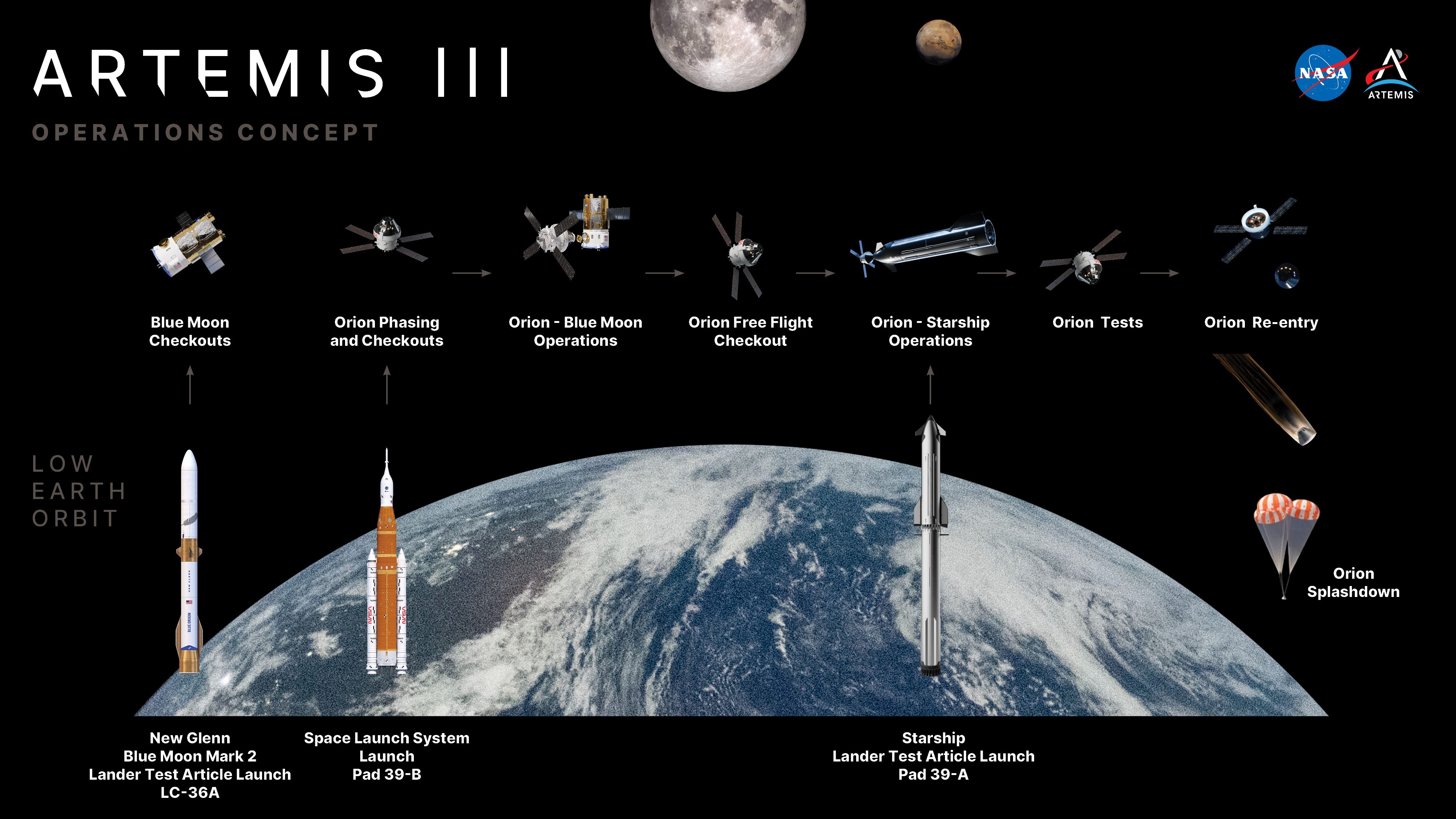
This graphic shows NASA’s concept of operations for Artemis III. The mission will send four astronauts to low Earth orbit next year to test critical systems needed for future lunar landings.
NASA

First stop: Blue Origin’s lunar lander test article 

Earlier Artemis missions used only NASA’s SLS (Space Launch System) rocket and Orion spacecraft. Artemis III will involve three separate spacecraft launched on three different heavy-lift rockets within a relatively short period of time. 

The mission begins with Blue Origin launching a test version of its Blue Moon Mark 2 lander into a circular low Earth orbit approximately 273 miles (237 nautical miles) above Earth. The spacecraft can remain on orbit for up to 30 days providing schedule flexibility. Artemis III is designed as a tightly choreographed campaign, with NASA planning to launch Orion on top of SLS from the agency’s Kennedy Space Center in Florida only days after the Blue Moon test article launch and confirmation the vehicle is healthy and ready for joint operations. 

Following launch, Orion will initially enter an elliptical Earth orbit of 18 x 1122 miles (16 x 975 nautical miles). It will use its service module to perform a series of maneuvers to transition to a circular orbit at about 345 miles (300 nautical miles) for thermal stabilization before then gradually setting up its rendezvous with the waiting Blue Moon lander test article. Because each spacecraft operates in slightly different orbital regimes optimized for its mission requirements, Artemis III requires a carefully choreographed sequence of orbital maneuvers and rendezvous operations throughout the flight. 

During the first two days of flight, the crew will check out Orion’s systems, prepare for proximity operations, and gradually position themselves for the mission’s first major objective: rendezvous and docking with the Blue Moon test vehicle. 

The operation represents NASA’s first opportunity to evaluate how Orion and a commercial lunar lander work together in space. Engineers will assess how software aboard both spacecraft, guidance systems, communications systems, and operational procedures perform in real-world conditions, while flight controllers gain experience coordinating activities across multiple teams and organizations. 
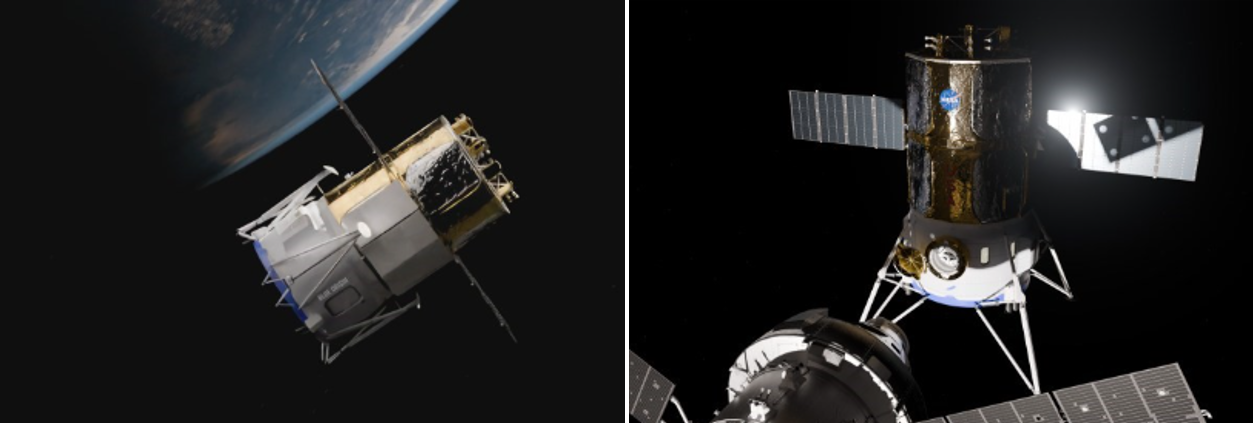
These artist’s concepts depict Blue Origin’s Blue Moon Mark 2 human landing system test article in Earth orbit and docked with NASA’s Orion spacecraft as part of NASA’s upcoming Artemis III demonstration mission in low Earth orbit.
Blue Origin

Once docked, astronauts will spend approximately two days conducting evaluations aboard the Blue Moon test article. Crew members will open the hatch and enter the spacecraft, allowing them to assess the cabin environment, controls, and life-support systems firsthand. Teams will verify the spacecraft’s ability to maintain the proper atmosphere and pressure. 

The Blue Moon test article incorporates many of the avionics, software, flight-control systems, crew-cabin technologies, and life-support functions planned for future lunar missions. Testing those systems in orbit will provide the first opportunity to evaluate how many of the lander’s flight systems perform in space as an integrated vehicle. 

By the time Orion undocks, NASA will have completed its first evaluation of a commercial lunar lander with crew, gathering data on spacecraft systems, crew operations, and spacecraft interoperability not possible on the ground. 

Starship docking demonstration  

After completing operations with Blue Origin’s lander, Orion will undock and reposition to support the next phase of the mission: a second rendezvous operation. 

SpaceX will launch a Starship Version 3 test article from Florida. Because Starship is designed for a much shorter on-orbit lifetime than Blue Origin’s lander, launch occurs later in the mission, allowing NASA to efficiently sequence the two docking demonstrations. Starship will enter a lower orbit at 206 nautical miles, optimized for communications coverage, and will carry an added docking system mounted at the forward end. 

These artist’s concepts depict NASA’s Orion spacecraft and SpaceX’s Starship human landing system test article during docking operations as part of NASA’s upcoming Artemis III demonstration mission in low Earth orbit.
SpaceX

Orion will rendezvous and dock with the spacecraft during a test expected to last up to two hours. Crew will not enter Starship during this test. The demonstration is focused on validating how Orion and Starship interact as a docked system in space. NASA and SpaceX plan to evaluate spacecraft controllability, communications, integrated software performance, and the dynamics associated with docking and undocking operations. 

The docking itself also presents a unique test, using different docking geometries. Orion will connect to a port beside Blue Moon’s crew cabin, then later align its forward docking system with the one at Starship’s nose. Testing both approaches during a single mission gives NASA an opportunity to assess different operational concepts while gathering valuable engineering data.  

Together, the two docking campaigns will demonstrate how Orion interfaces with two very different commercial lander architectures during a single mission. 

Testing Orion for future exploration 

Even after docking activities are complete, Artemis III will continue generating data that supports future missions. 

Once the Starship demonstration is complete, Orion and its crew will have up to five additional days available in orbit before beginning preparations for the journey home. NASA plans to use this time to complete a variety of test objectives that support future Artemis missions, including additional evaluations of the Orion Crew Survival System suits, docking sensor tests, acoustic and thermal measurements, human-factors assessments, and a range of science and technology demonstrations. 

Several investigations led by NASA will build on studies conducted during Artemis II, collecting additional data that will help inform future deep-space missions. The crew also will conduct a proof-of-concept study examining how astronauts could perform health-related assessments when they are unable to communicate directly with mission control, an important capability for future lunar surface expeditions and other missions farther from Earth. 

NASA also plans to fly a cellular biology experiment during the mission while researchers use the flight to test concepts for returning lunar samples to Earth. Teams will evaluate how future samples could be transported, received, and moved into curation facilities after landing, while also conducting assessments of Orion’s environment to better understand potential contamination considerations for future lunar missions. 

The mission also will include Earth and solar observations that help astronauts continue developing critical observation skills while taking advantage of the spacecraft’s unique orbital vantage point. Plant seeds will fly aboard Orion as well, providing opportunities for scientific study and educational engagement following the mission. 

Mission planners have also built flexibility into the flight timeline, providing additional opportunities to complete test objectives depending on how operations unfold in real time. 

When ready, Orion will begin phasing for return, and the crew will configure the cabin for reentry and splashdown, which will occur in the Pacific Ocean, off the coast of California. Orion and its crew will be recovered by NASA personnel and the United States Navy. 

Practicing for Moon missions 

Every activity performed during Artemis III supports a larger goal: reducing risk before astronauts return to the lunar surface. 

The mission will provide NASA with experience operating alongside multiple commercial partners while managing complex rendezvous and docking operations involving three different spacecraft. Engineers will gain insight into spacecraft interoperability, mission-control coordination, communications architecture, crew operations, and hardware performance. 

By the time Artemis III concludes with Orion’s splashdown on Earth, NASA will have demonstrated technologies and operational concepts that future lunar crews will rely on as they travel to and from the Moon.  

Most importantly, Artemis III will provide the operational experience needed to transform plans for future lunar landings into proven flight procedures. The lessons learned throughout the mission will help refine future exploration plans, strengthen partnerships with industry, and ensure astronauts are prepared for humanity’s next giant leap at the Moon. 

As part of a Golden Age of innovation and exploration, NASA will send Artemis astronauts on increasingly difficult missions near the lunar South Pole to explore more of the Moon than ever before. In addition to providing economic benefits and advancing scientific discovery through its Moon missions, NASA will establish an enduring human presence on the lunar surface and build on the agency’s foundation for the first crewed mission to Mars. 

To learn more about Artemis, visit: 
www.nasa.gov/artemis 

NASA Provides Progress Update on Moon Base Rovers

6 min read

Preparations for Next Moonwalk Simulations Underway (and Underwater)

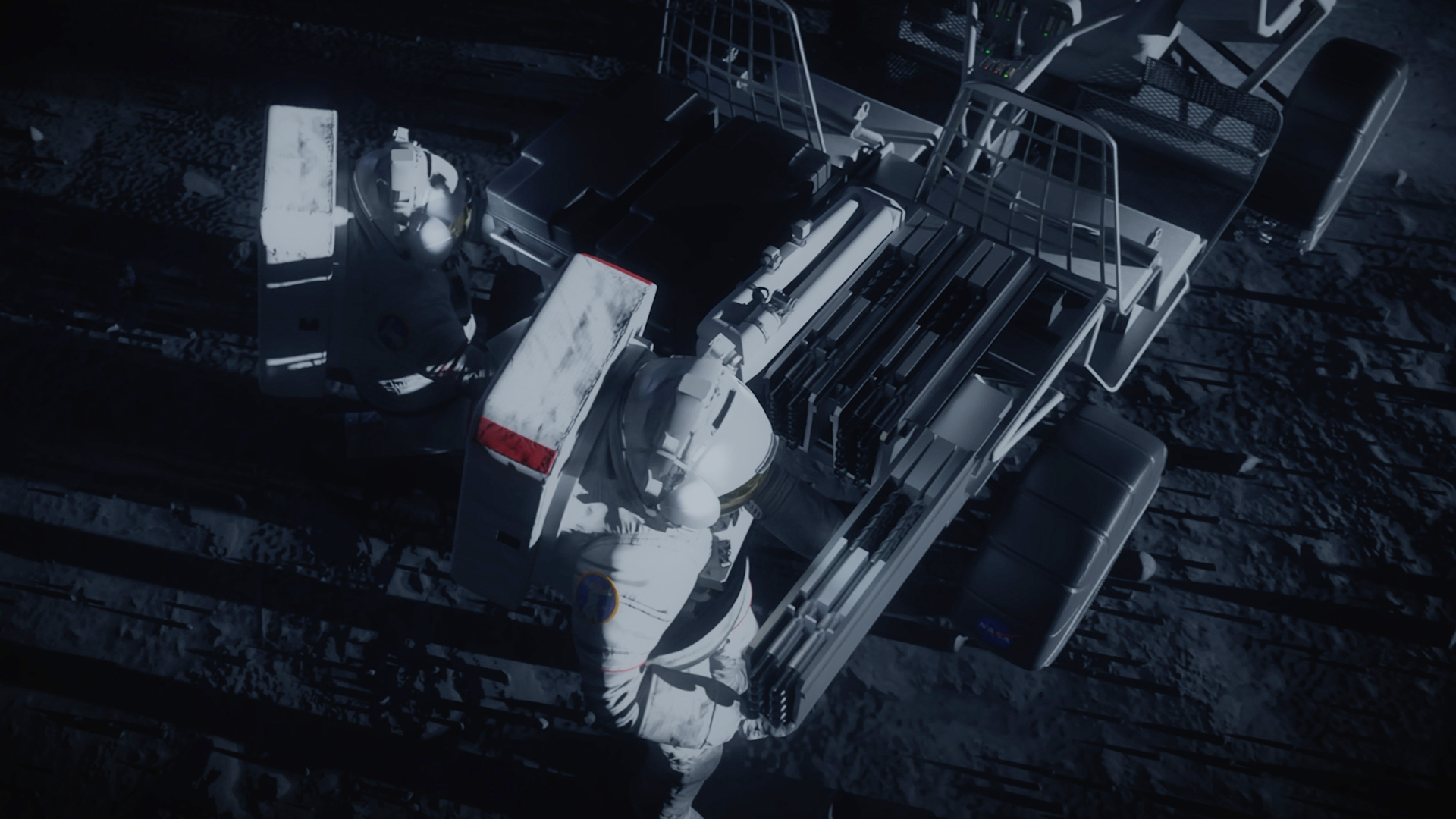
An illustration of two astronauts are working on the lunar surface next to a lunar rover. The astronauts are wearing white spacesuits with red stripes shown on the back of the suit. One astronaut is standing up and appears to be grabbing something off of the lunar rover and the other astronaut is kneeling down working on something.
Artist’s rendering of astronauts working next to a lunar terrain vehicle on the lunar surface.
NASA

As NASA works to build the Moon Base, crewed and robotic lunar rovers will play a crucial role during early development through technology demonstrations, astronaut transport, terrain mapping, scientific investigations, and resource prospecting. Data from these early missions will inform future mobility systems and infrastructure needed for astronauts to live and work on the Moon.

On Tuesday, NASA released a Moon Base video update offering a closer look at the progress being made on the commercial lunar terrain vehicles and robotic rovers that will enable the surface mobility needed to build humanity’s first lunar outpost.

“Lunar rovers are central to our surface mobility strategy,” said Robert Pickle, director of the Surface Mobility Office within the agency’s Moon Base Program. “Their performance will lay the groundwork for the mobility systems that will define the next era of exploration and ultimately determine how effectively we can build, operate, and expand the infrastructure required for long‑duration exploration.”

Learn more about NASA’s VIPER

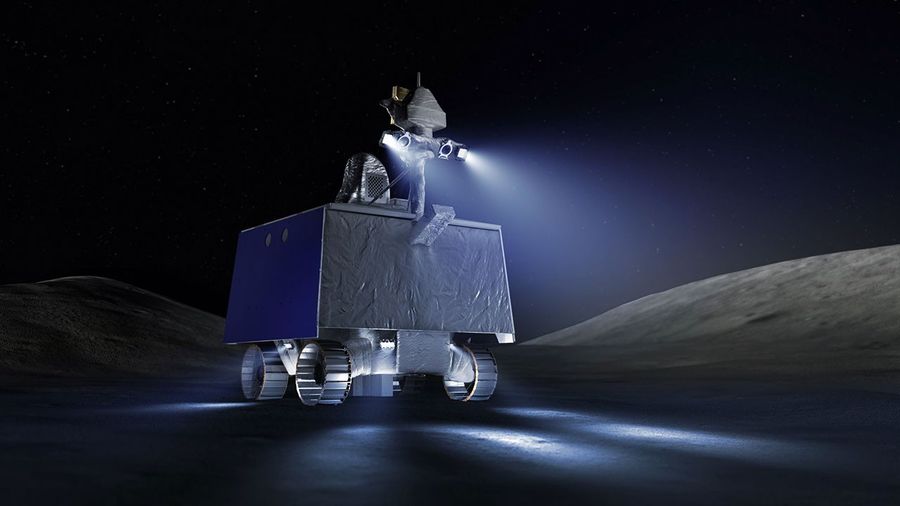
An artist’s concept of NASA’s VIPER lunar rover on the surface of the Moon.
NASA/Daniel Rutter

NASA’s VIPER (Volatiles Investigating Polar Exploration Rover) will embark on a mission to the lunar South Pole region in 2027 to venture into permanently shadowed craters looking for water and other valuable resources essential for sustainable exploration. 

After delivery to the lunar surface by a Blue Moon Mark 1 lander, VIPER will travel more than 18 miles (30 kilometers), collecting information about the thermal, lighting, and terrain environment in the Moon’s South Pole region. This data could provide information about the origin and distribution of water on the Moon, help determine how lunar resources could be used for the Moon Base, as well as better understand the history of the Moon, Earth, and the processes that helped shape conditions for life.

Mission operations for VIPER will be run out of NASA’s Ames Research Center in Silicon Valley where teams are simulating possible scenarios for when the rover begins its mission on the Moon.

The VIPER rover is currently at NASA’s Johnson Space Center in Houston where it is fully built and undergoing final testing before traveling to NASA’s Kennedy Space Center in Florida for launch to the Moon. 

Lunar terrain vehicles

To advance surface mobility on the Moon, NASA awarded Astrolab and Lunar Outpost task orders to build the first phase of Moon Base rovers capable of carrying crew, called lunar terrain vehicles (LTVs), that will be delivered to the Moon ahead of crewed Artemis missions. NASA awarded Blue Origin a task order to deliver the LTVs to the lunar South Pole region by 2028 through the agency’s CLPS (Commercial Lunar Payload Services) initiative.


The LTVs will be remotely operated from Earth, traversing up to 3.7 miles (6 kilometers) a day, mapping the lunar surface to help scientists produce high-resolution maps of the region, prior to crew arriving on future missions. The rovers also will collect information to help NASA and its partners learn about operating in this extreme environment, such as data on lighting, navigation, and how well the LTVs preserve energy and function when driving in and out of permanently shadowed regions that can reach minus 334°F (minus 203°C). This will help inform Moon Base development and improve on design and capability for future mobility systems, hardware, and infrastructure. 

During missions on the lunar surface, Artemis astronauts will drive the LTVs as they explore geologically diverse areas of the lunar South Pole region, gathering geology samples to bring back to Earth for scientists to study. The LTVs will be able to support up to three moonwalks per Artemis mission, transport up to 176 pounds (80 kilograms) of lunar samples and tools, and travel up to six miles (10 kilometers) on a single battery charge.

Astrolab

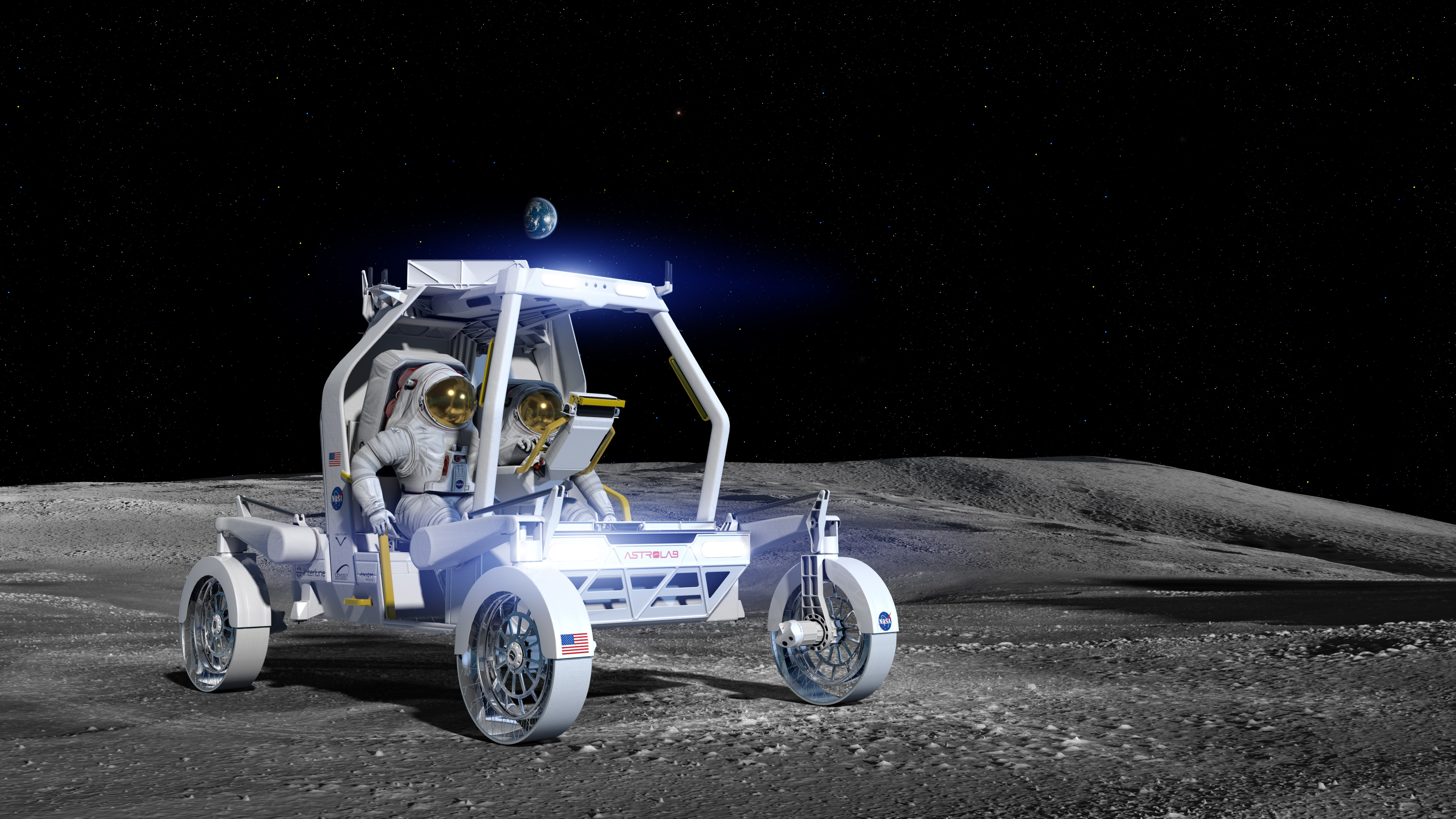
An artist's concept of two astronauts in white spacesuits sitting inside a white unpressurized lunar terrain vehicle developed by Astrolab. A large display is centered between them and the headlights of the rover are on.
An artist’s concept of Astrolab’s Crewed Lunar Vehicle, or CLV-1, on the surface of the Moon.
Astrolab

Astrolab’s Crewed Lunar Vehicle 1, or CLV-1, is a rover adapted from the company’s FLEX (Flexible Logistics and Exploration Vehicle) LTV architecture. Astrolab recently delivered a mockup of CLV-1 to Axiom Space, where NASA astronauts wore mock-ups of the Artemis lunar spacesuit and evaluated the lunar rover’s design, crew cabin, and display interfaces.

Prior to CLV-1 arriving to the Moon, Astrolab will send its first robotic rover, FLIP (FLEX Lunar Innovation Platform), to the lunar surface as a payload on Voyager Technologies’ Griffin Mission One scheduled to launch in late 2026. FLIP will study the environment of the South Pole and serve as a testbed for critical subsystems on CLV-1, which will include similar tires, batteries, radios, and cameras.

In the next few weeks, Astrolab engineers will head to NASA’s Glenn Research Center in Cleveland where they will use the center’s Simulated Lunar Operations laboratory to evaluate the how CLV-1’s flexible, airless wheels perform while driving on a simulated lunar surface.

Lunar Outpost

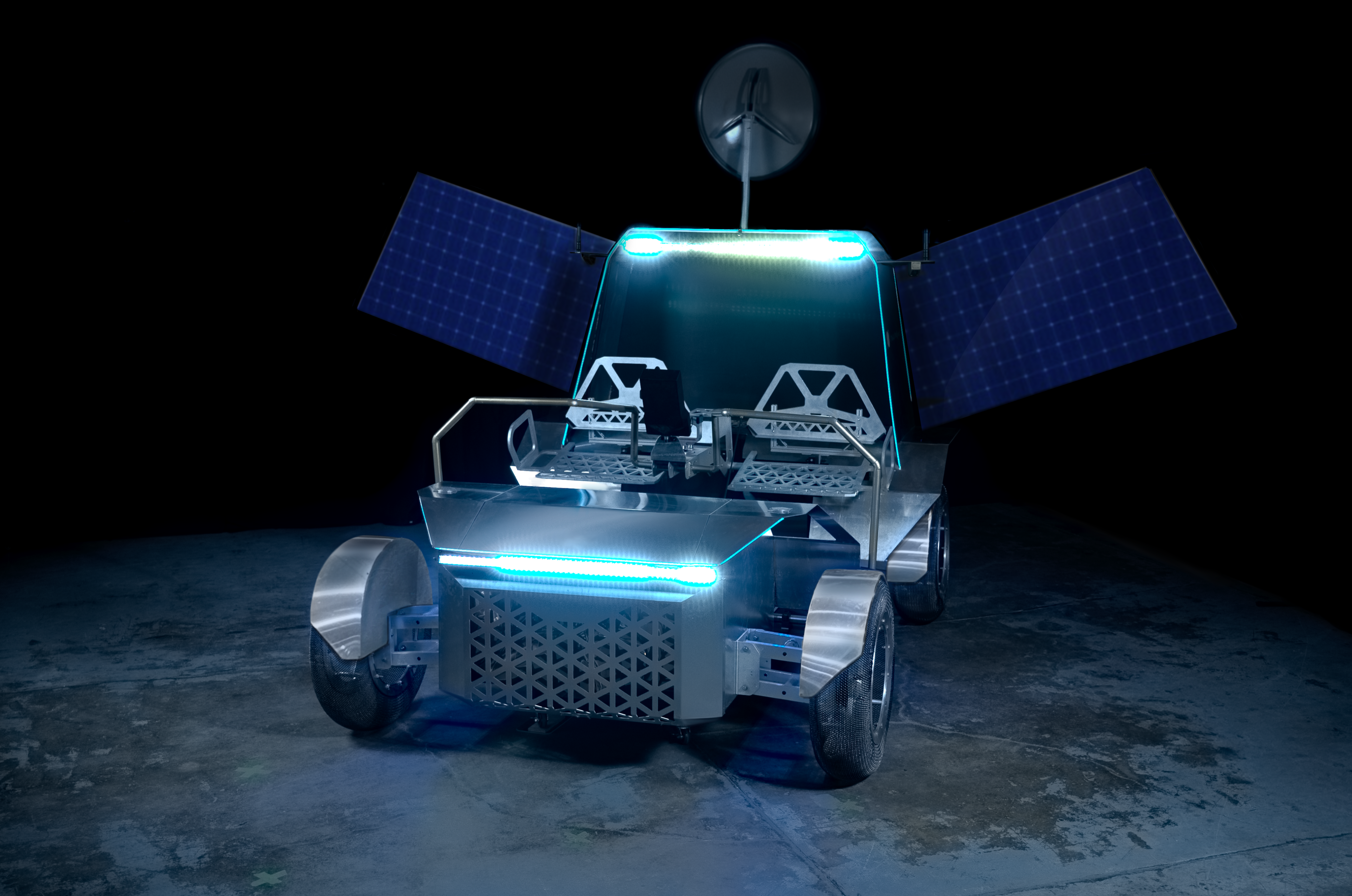
A photo of a full-scale prototype of Lunar Outpost's Pegasus lunar terrain vehicle. The rover can seat two astronauts, is fabricated out of metal, has mesh tires, has two solar arrays deployed, and is lit up by blue lights.
A full-scale prototype of Lunar Outpost’s Pegasus lunar terrain vehicle.
Lunar Outpost

Lunar Outpost’s Pegasus crewed LTV is a lighter, mission-ready evolution of the company’s Eagle LTV. Prior to the award, Lunar Outpost built two mockups of Pegasus and recently delivered a third static mockup to NASA’s Johnson Space Center for crewed testing. During the test, NASA astronauts wore pressurized spacesuits and evaluated the rover’s design, usability, and crew comfort. 

In 2025, Lunar Outpost’s robotic exploration rover MAPP (Mobile Autonomous Prospecting Platform) operated at the Moon’s South Pole. During the mission, MAPP acted as a testbed and collected data, achieving flight-proven readiness for key hardware and software subsystems, like its automatic thermal control system, navigation cameras, and mission control software that will be used to remotely operate Pegasus. With a second MAPP rover scheduled to launch in early 2027, Lunar Outpost is advancing many of the key technologies that are directly transferable to Pegasus.

In the next few weeks, Lunar Outpost teams also will head to NASA Glenn to test and evaluate the soil mechanics, traction, and mobility of Pegasus’ spring mesh tires.

In the coming months, both Astrolab and Lunar Outpost will test drivable LTV mockups with NASA crew to evaluate how the rovers drive and operate in a simulated lunar environment. Lunar Outpost is scheduled to complete the preliminary design review of their LTV in October, and Astrolab is scheduled to complete their preliminary design review by the end of December. Both companies are on schedule to deliver the flight-ready hardware to NASA at the end of 2027.

As part of a Golden Age of innovation and exploration, NASA will send Artemis astronauts on increasingly difficult missions near the lunar South Pole to explore more of the Moon than ever before. In addition to providing economic benefits and advancing scientific discovery through its Moon missions, NASA will establish an enduring human presence on the lunar surface and build on the agency’s foundation for the first crewed mission to Mars.

To learn more about the Moon Base, visit:

https://www.nasa.gov/moonbase

Instagram logo

💾

There's a lot of ground to cover when you're building a Moon Base. From robotic rovers exploring the rugged lunar landscape to lunar terrain vehicles carryin...

Driving On the Moon at a Blistering 11.6 MPH

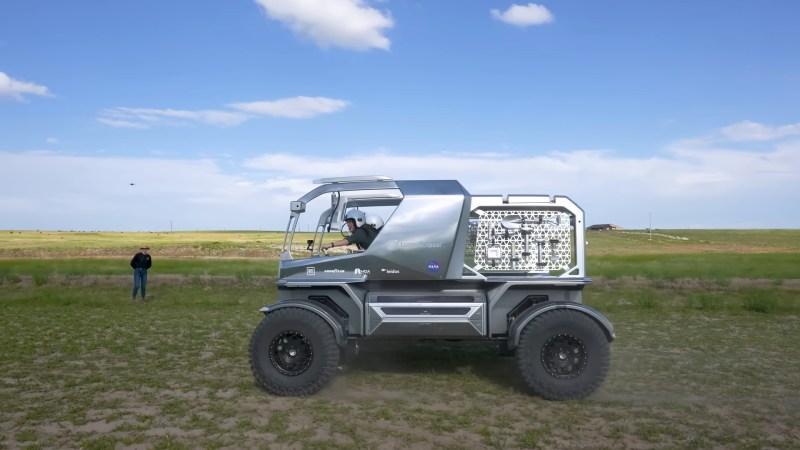
A shiny, silver vehicle with tools on a mesh rack on the back half and a large open cab up front drives across a grassy field under blue, partly cloudy skies. A person in a black shirt stands in the background with a drone hovering above their head. Two women in white helmets are piloting the vehicle from the cab.

As NASA continues humanity’s slow march back to the Moon, different pieces of the puzzle of establishing a more permanent base there are falling into place. One of these pieces is the the Lunar Terrain Vehicle (LTR), and [Cleo Abram] and [Michelle Khare] got a look at the LTR candidate from Lunar Outpost.

Designed to help astronauts traverse the lunar surface as well as function as a semi-autonomous rover when uncrewed, the LTR will be an integral part to any future Moon base. NASA announced earlier this year that it would be moving forward with the LTR featured in this video and another from competitor Astrolab. Regardless of manufacturer, the LTR will have to deal with some wild conditions in the lunar environment.

Lunar dust is abrasive, so the LTR generates an electric current to pull the dust under the truck to prevent it from entering the cab of the vehicle as it moves along. Given the extreme temperature swings on the moon (-200˚C to 200˚C), the space truck will also be fitted with wire mesh tires as nobody wants to be changing a flat in space. The two seats in the cab are oversized and can help lift the astronauts up as space suits hamper their agility to a significant degree. There are compartments for storing samples, and the truck has a robot arm that can grab samples to bring back if no one is along for the ride.

We’ve still got a few years before crews arrive on the moon, but when they do, there’s a good chance they’ll be using the LTR to explore the lunar south pole in hopes of water.

NASA JPL Testing Readies Voyager Technologies Lander for Moon Mission

4 min read

Preparations for Next Moonwalk Simulations Underway (and Underwater)

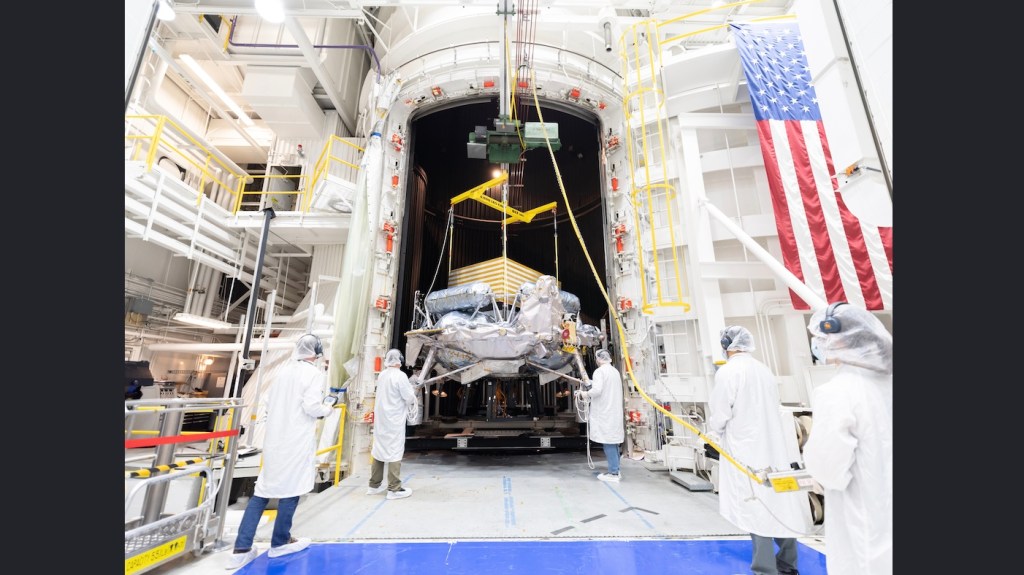
Engineers in white clean-room garb and hairnets guide a spacecraft suspended from a crane into a large thermal vacuum chamber inside a high-bay facility with an American flag hanging on the wall.
Engineers and technicians use a crane to position Voyager Technologies’ Griffin-1 lunar lander within the 25-Foot Space Simulator at NASA’s Jet Propulsion Laboratory on Aug. 31. The spacecraft recently completed a series of rigorous environmental tests at JPL ahead of launch to the Moon later this year.
NASA/JPL-Caltech
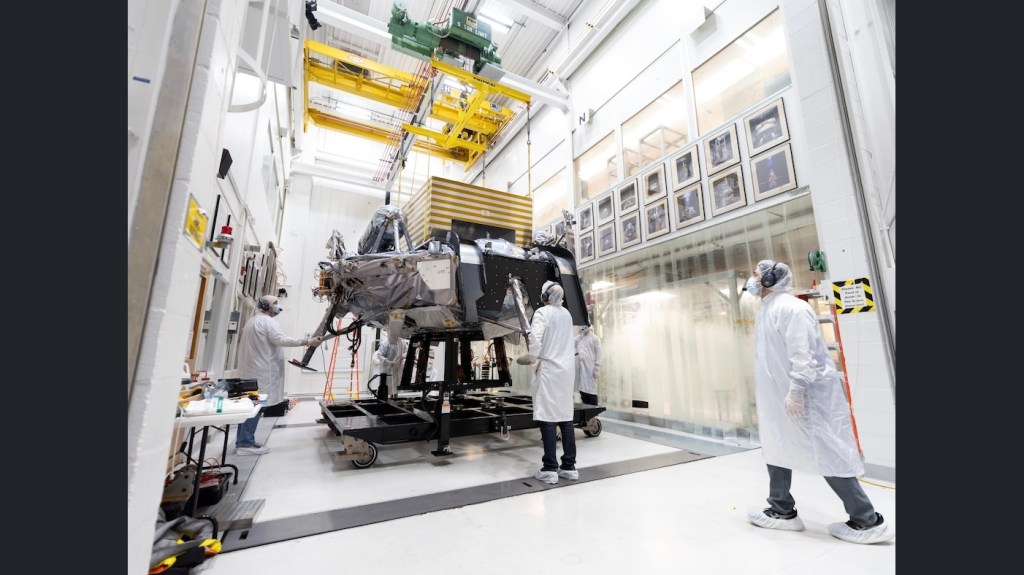
Engineers in white clean-room garb monitor a large spacecraft as it is hoisted by a yellow overhead crane in a hallway in a bright, high-tech laboratory. Framed photos line both sides of the hallway.
The testing team moves Voyager Technologies’ Griffin-1 through a hallway to the 25-Foot Space Simulator at JPL. The corridor features photos of the historic spacecraft that have been tested in the facility since the 1960s, from the Ranger program to NASA’s Europa Clipper.
NASA/JPL-Caltech

A commercial lander that will be at the forefront of NASA’s efforts to establish a Moon Base, humanity’s first lunar outpost, has passed a series of critical tests at the agency’s Jet Propulsion Laboratory in Southern California. The tests simulated the extreme temperatures and vacuum of space, as well as the intense shaking and ear-splitting roar of launch. Results show that Voyager Technologies’ Griffin Mission One (Griffin-1) spacecraft is ready to survive the rigors of space exploration.

As part of NASA’s CLPS (Commercial Lunar Payload Services) initiative within the Moon Base Program, Griffin-1 is expected to launch later this year aboard a SpaceX Falcon Heavy rocket. It will deliver more than 1,100 pounds (455 kilograms) of cargo to Nobile Crater near the lunar South Pole, which categorizes it as an infrastructure-class lander. Griffin-1 will carry 10 science and technology demonstrations from six countries, including the largest commercial payload ever delivered to the Moon, Astrolab’s FLIP (FLEX Lunar Innovation Platform) rover.

“NASA JPL’s Environmental Test Laboratory has been putting robotic explorers to the test since the Ranger program gave us NASA’s first up-close views of the Moon’s surface in the mid-1960s. We’re proud to provide our expertise and facilities to support this new phase of commercial lunar exploration,” said Charles Whetsel, manager, Exploration Systems Development Office at JPL.

A lunar lander equipped with dark solar panels and foil-wrapped legs sits on a platform inside a dark anechoic chamber lined with blue and gray foam spikes.
Long foam spikes that absorb sound waves and electromagnetic waves cover the walls of a specialized anechoic chamber at JPL where Voyager Technologies’ Griffin-1 underwent electromagnetic interference and electromagnetic compatibility testing.
NASA/JPL-Caltech

Griffin-1’s testing journey

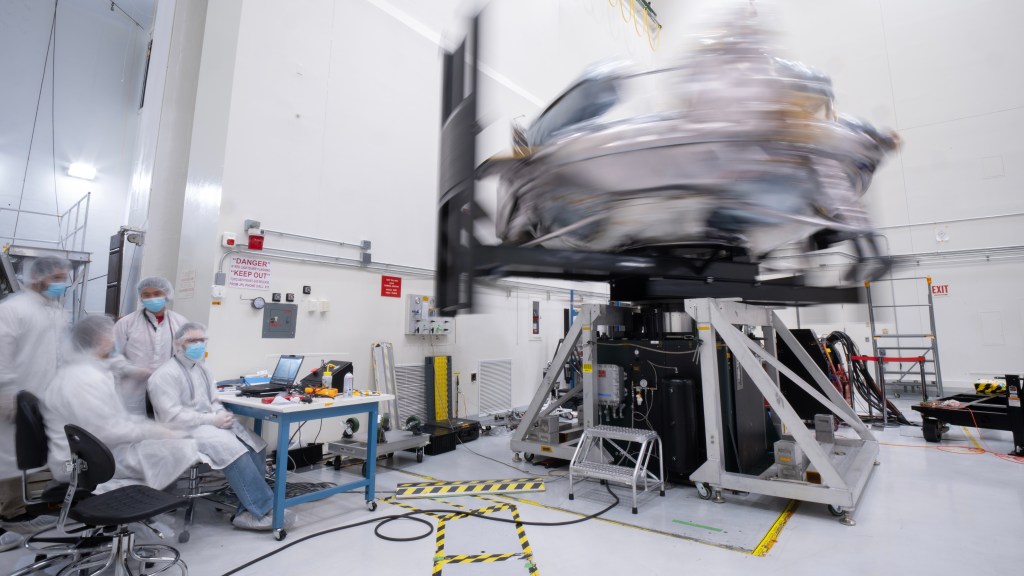
Testing began in July after the 2,789-pound (1,265-kilogram) spacecraft took a cross-country road trip from Voyager Lunar Systems’ manufacturing facilities in Pittsburgh to JPL in the San Gabriel Mountain foothills. Engineers spun the spacecraft on a special table to measure its mass properties, a test that enables them to look for any unexpected wobbles as they assess how the lander will move through space. Data gathered in mass properties testing is key to understanding the spacecraft’s readiness for navigation in flight and landing on the lunar surface.

To make sure signals from the spacecraft’s electronic components don’t interfere with one another, Griffin-1 underwent electromagnetic interference and electromagnetic compatibility testing inside what’s called an anechoic chamber, in which long foam spikes line the walls to absorb sound and electromagnetic waves.

During vibration testing, hundreds of sensors monitored Griffin-1 as a “shaker table” rattled it in three directions, with increasingly intense force, to simulate the ride out of Earth’s atmosphere on a massive rocket. To mimic the roar of launch, giant horns, powered by compressed nitrogen gas, blasted the spacecraft with up to 153 decibels inside a sealed acoustic chamber.

Environmental testing took place in several clean-room facilities at JPL, culminating in the 25-Foot Space Simulator, a thermal vacuum chamber listed on the National Register of Historic Places for its role in supporting historic missions like those of the Ranger, Surveyor, Mariner, and Voyager programs. Dozens of other missions (along with plenty of upgrades to the testing facility) have followed over the decades, including the Perseverance Mars rover and Europa Clipper.

Engineers in white clean-room frocks monitor a silvery spacecraft spinning so rapidly it’s blurred on a test rig inside a bright laboratory.
Voyager Technologies’ Griffin-1 lunar lander spins on a special table in a test to measure its mass properties, which enables engineers to look for any unexpected wobbles as they assess how the vehicle will move through space. The test took place in JPL’s Environmental Test Laboratory on July 20.
NASA/JPL-Caltech
A silvery spacecraft sits on a test frame surrounded by microphones and testing equipment inside a bright white acoustic test chamber, while an engineer in a lab coat works nearby.
Microphones are arrayed around Griffin-1 on Aug. 12 during acoustic testing that mimics the intense roar of launch. Giant horns powered by compressed gaseous nitrogen blast the spacecraft with up to 153 decibels inside a sealed acoustic chamber at JPL.
NASA/JPL-Caltech

Beneath the thermal vacuum chamber’s soaring 85-foot (26-meter) ceiling, for about two weeks, Griffin-1 alternately baked at up to 167 degrees Fahrenheit (75 degrees Celsius) and froze at temperatures as low as minus 148 F (minus 100 C). This testing simulates the temperature extremes the lander will experience during its journey through the vacuum of space and its operations on the lunar surface.

“Griffin-1 is being built for a historic purpose: to deliver the infrastructure and capabilities to the Moon. Seeing the spacecraft complete this demanding environmental testing is a major milestone because it demonstrates that Griffin-1 is ready for the extreme journey ahead: launch, through deep space, to the lunar South Pole,” said John Thornton, executive vice president, Voyager. “This spacecraft represents a new era of commercial lunar exploration, where missions like Griffin-1 are laying the groundwork for the Moon Base and helping turn sustained lunar exploration from a vision into a reality.”

After proving its mettle at JPL, Griffin-1 has returned to Voyager Lunar Systems’ facility for final assembly. Next up: launch-readiness operations before shipment to Cape Canaveral.

To learn more about the Moon Base, visit:

https://www.nasa.gov/moonbase

Media Contact
Melissa Pamer
Jet Propulsion Laboratory, Pasadena, Calif.
626-314-4928
melissa.pamer@jpl.nasa.gov

2026-071

Mapping the Gaps in NASA’s Return to the Moon, featuring Richard Spolzino

“I want to be able to look at a rocket launch and say, ‘I touched a piece of this.’”

That’s how Richard Spolzino describes the thing he’s chasing. Not a title, not a specific mission, not even NASA itself, just the ability to point at something real and know his work made it possible. At NASA’s Langley Research Center in Hampton, Virginia, Spolzino works within Moon Base’s mission architecture and systems interoperability effort, helping identify what NASA still doesn’t know about the Moon and Mars, and making sure that missing information gets found before it becomes a problem.

Official NASA portrait of Richard Spolzino, aerospace engineer, in front of an American flag backdrop
Aerospace engineer Richard Spolzino
Credit: NASA


“For me, it kept coming back to where can I have the most impact? Where can my work touch the most things?“


From History to Aerospace

Spolzino didn’t set out to end up here.

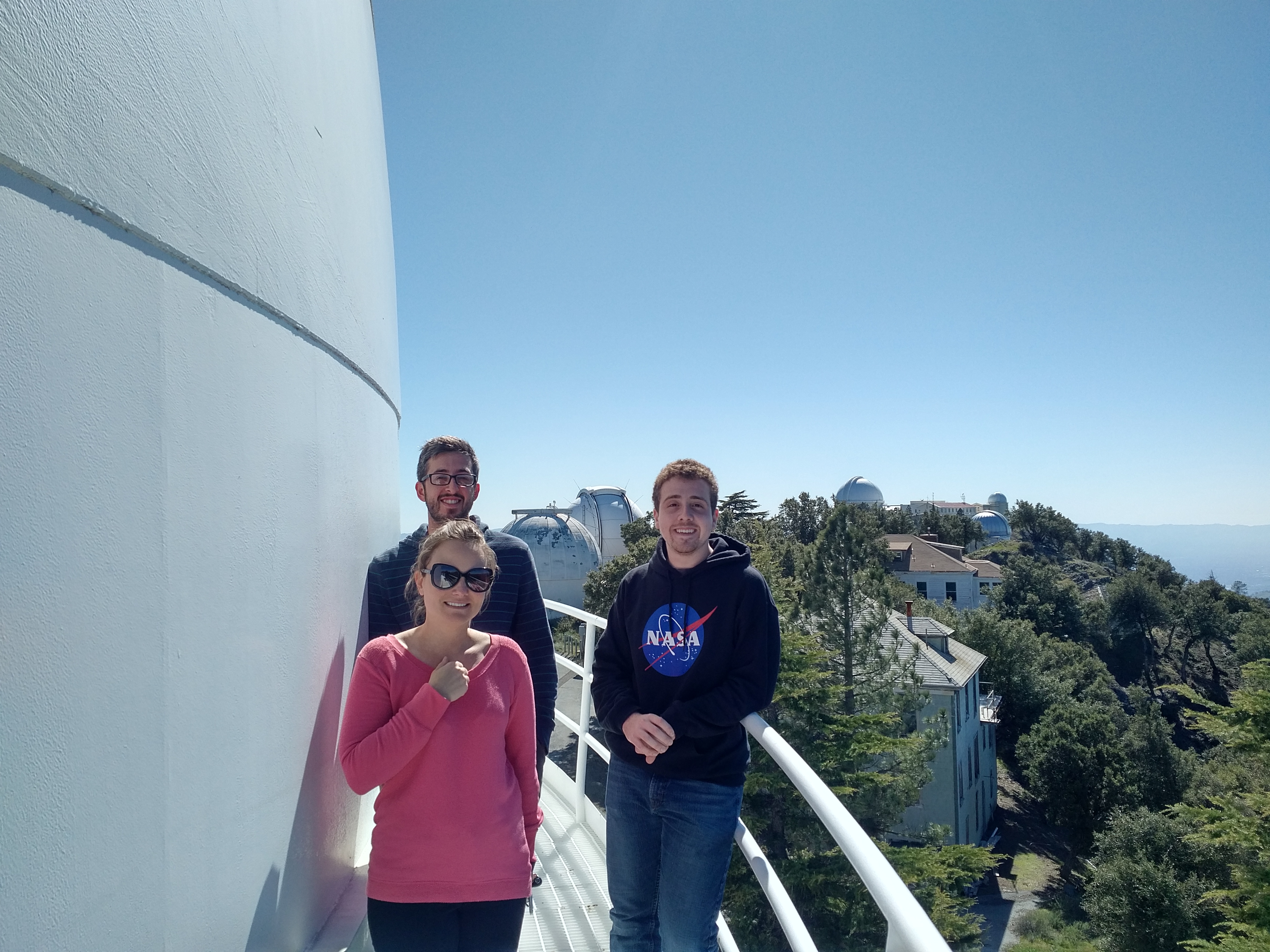
He started college as a history major. He switched to a physics track at Santa Clara University, thinking he’d end up in astrophysics. A research stint at Lick Observatory studying interstellar dust polarization taught him two things: the work was fascinating and, “I don’t think the staying-up-all-night thing is for me,” he says.

Richard Spolzino stands with his research adviser and a fellow grad student on an outdoor walkway at Lick Observatory, hills visible in the distance.
Spolzino (on right) at Lick Observatory with his physics research adviser Dr. Kristin Kulas (left, front) and then-grad student Dr. Ilija Medan (back).
Credit: Richard Spolzino

After graduation, he started down the path of Officer Candidate School in the Navy, hoping to fly jets. It didn’t pan out, and that detour led him to a graduate program at the University of Houston, combining aerospace engineering and space architecture — not the habitat-design kind of architecture people usually picture, but the systems-level kind, where a lunar oxygen plant connects to the rovers that feed it, which connect to the processor, which connects to the user drawing down the resource. “I was always more attracted to how all the pieces work together than to any single piece,” he says.

Chasing Impact

Ask Spolzino if he dreamed of working at NASA, and the honest answer is no.

“I really admire people who’ve had that drive their whole life,” he says. “For me, it kept coming back to where can I have the most impact? Where can my work touch the most things?” A University of Houston program with strong ties to Johnson Space Center put NASA on his radar alongside other options in industry and government. What ultimately drew him in wasn’t the agency’s name, it was the scope of the problems and the direct line he saw to senior decision-makers shaping the return to the Moon.

That’s also, he adds, exactly why NASA is worth considering for people who aren’t sure it’s their calling yet. The culture rewards people willing to take on more than their assigned lane and gives early-career employees room to grow into problems bigger than their job description, something he says he might not have found moving up more slowly in industry.

Documenting the Missing Piece

Spolzino’s day-to-day work centers on a deceptively simple idea: the data gap.

“You can think of it as synonymous with a knowledge gap,” he explains. “It’s a way of documenting the thing we don’t know.” Take the geotechnical properties of lunar regolith — moon dust, essentially, but the specifics matter enormously. How much weight can it bear? What’s its shear strength? Answering those questions shapes everything from how far a rover can safely drive to whether a habitat’s foundation will hold.

A data gap lays that out formally: what we don’t know, why it matters, what we currently have that falls short, and, critically, a specific measurable target industry and international partners can aim for. “Once we’ve identified what’s missing,” he says, “our partners can look at that list and see exactly where their contribution would be valuable.”

His team started with roughly 25 published data gaps last year. They’re on track for 60 by the end of this year.

From Concept to Cargo

The concept only matters if it changes decisions, and Spolzino cites two recent examples where it did.

When the lunar lander company now known as Voyager (formerly Astrobotic) was preparing its upcoming Griffin-1 mission, the team didn’t help them figure out what instruments to fly since that was already locked in. Instead, Spolzino’s team helped them prioritize what data gets sent home first through a communication pipeline that can’t carry everything at once. “How do you prioritize all the things you say you want, and what gets sent back through that constrained pipeline?” he asks.

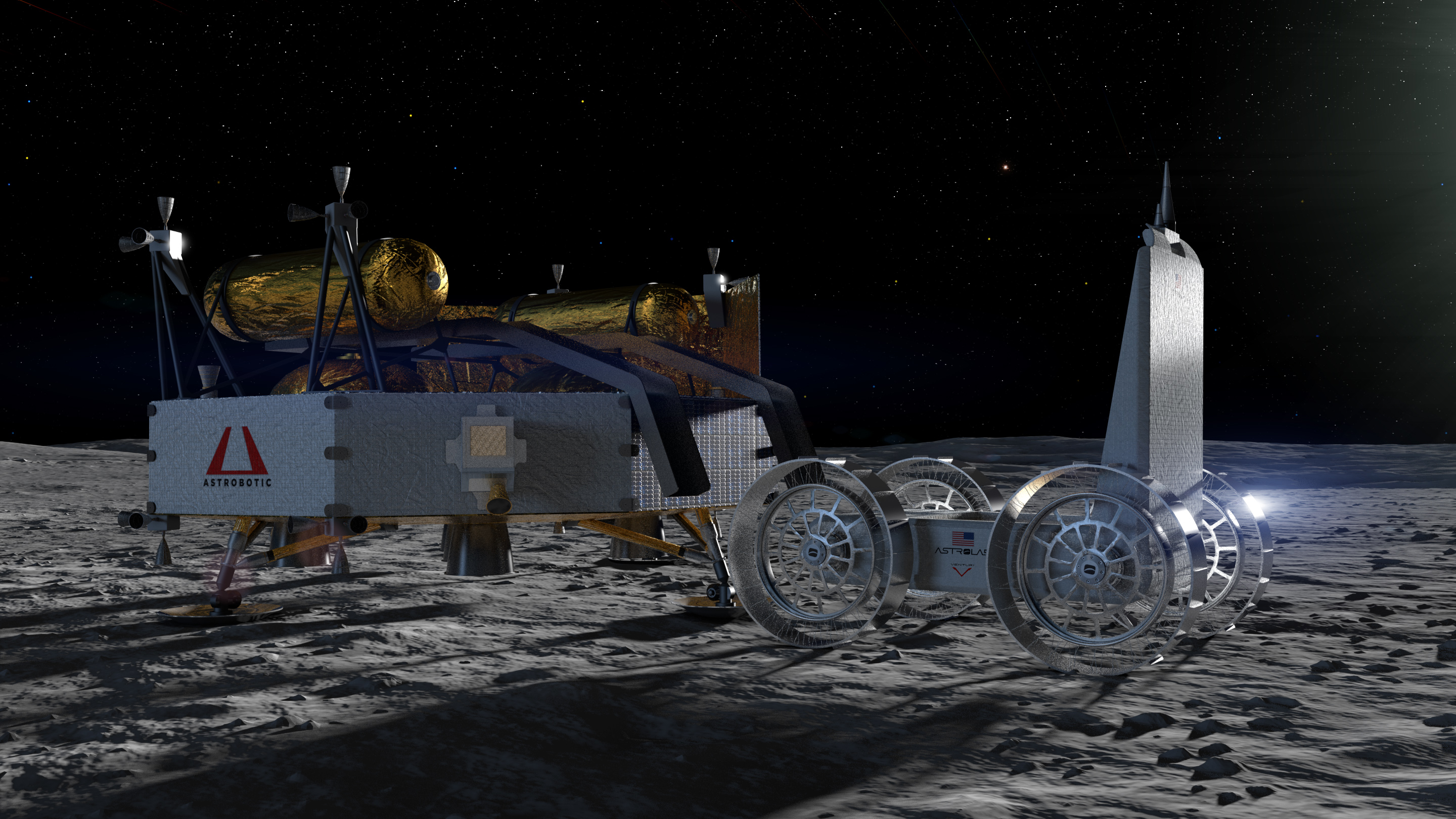
Artist's rendering of Astrobotic's Griffin Mission One lunar lander on the Moon's surface, deploying the FLIP rover, against a starry black sky
Artist’s rendering of Astrobotic’s Griffin Mission One lunar lander delivering the FLIP rover to the lunar surface. The mission is part of NASA’s Commercial Lunar Payload Services (CLPS) initiative supporting future lunar exploration and technology demonstrations.
Credit: Astrobiotic

On the other side of the pipeline, Spolzino has spent recent months evaluating proposed instruments (spectrometers, sample collection tools, tech demonstrations) against the published data gaps to help leadership decide what’s worth flying. Some proposals map cleanly onto a documented need. Others don’t align with anything NASA has said it’s missing. “That’s used to filter down what gets pushed forward as a real candidate,” he says. Industry partners have taken notice, and leadership now asks companies pitching new instruments to show how their proposal maps to a data gap before the conversation goes any further.

Figuring It Out Takes Work

Spolzino admits the job reshaped an assumption he carried out of graduate school — that NASA had everything figured out, and that the agency’s reputation meant every question already had an answer somewhere inside its walls.

Three years in, he sees it differently. “Keeping the kind of reputation NASA has takes constant, deliberate work,” he says. “Everyone’s genuinely trying to pull in the right direction, but it’s not automatic.” That realization was clarifying for him. The agency runs on people figuring things out in real time, which means there’s room for someone early in their career to contribute meaningfully, rather than just executing someone else’s playbook.

His advice to students considering NASA is practical, not sentimental: Grades matter less than people think. “The projects you work on, and the results of that work, are what people look at first,” he says. His advice is to join clubs, take on real projects, and build something. “It’s less about credentials and more about giving yourself something to show up with.”

On Spolzino’s Sci-Fi Shelf

The Three-Body Problem trilogy by Liu Cixin

Spolzino was already deep into the second book, The Dark Forest, on a flight from New York to Houston when the plane was diverted to San Antonio. “I did not care that I was three or four hours late,” he says. “I had that book, and I was just devouring it.”

Kerbal Space Program

An older game, but a formative one. Spolzino credits it with cementing his interest in space before college even started. “It’s a space program simulator where you build rockets piece by piece, and the physics are simplified but accurate enough that you’re doing a lot of the same math as an actual mission design tool,” he says. “That really had a huge impact on me figuring out that space was the thing I wanted to do.”


Part of the Systems Analysis and Concepts Directorate at NASA’s Langley Research Center.
Learn more about our work by visiting our website.

NASA Adds New Science Investigations for Moon Base

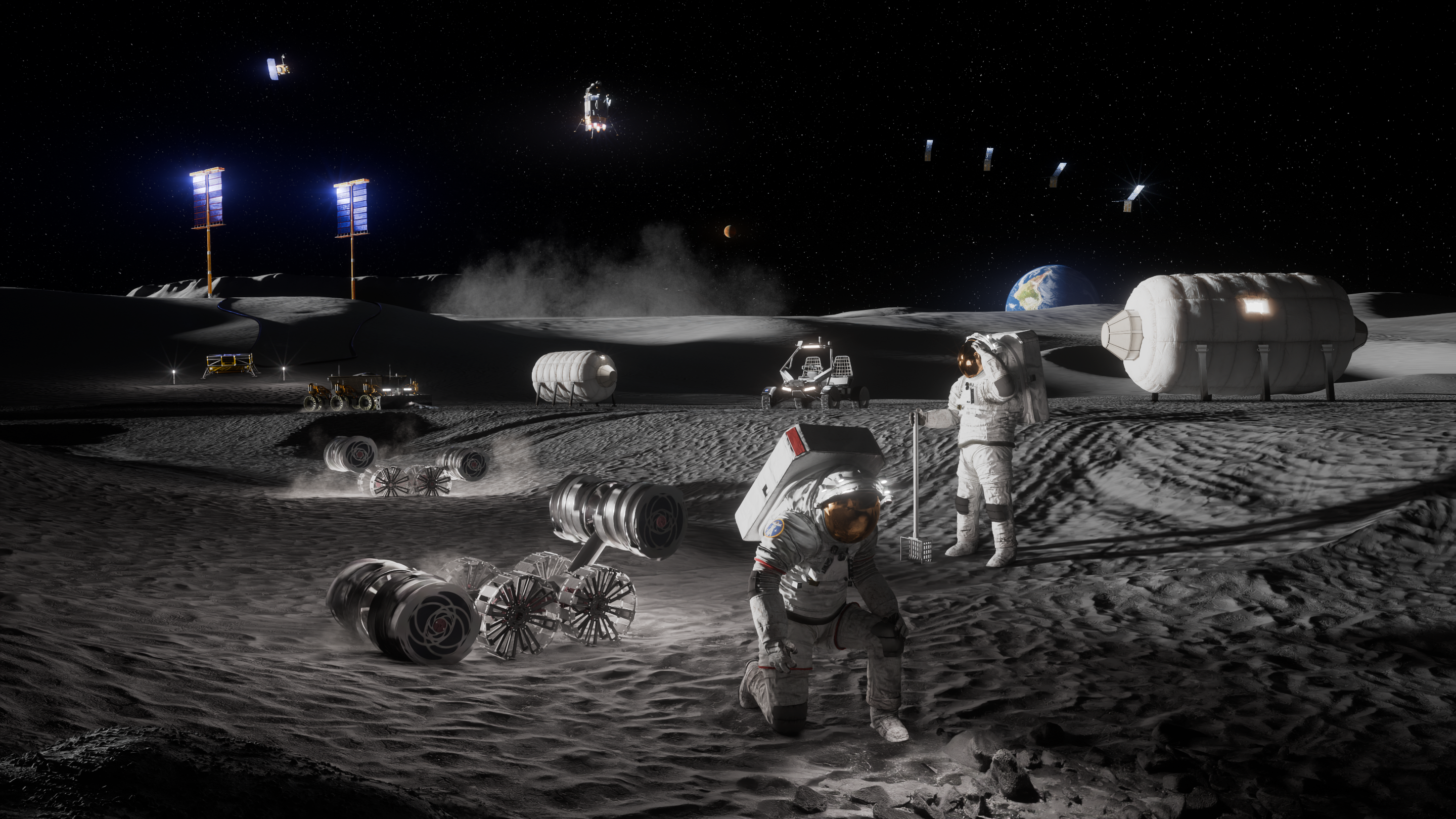
Artist’s rendering depicting astronauts, habitats, rovers, power systems, and cargo operations supporting sustained human activities at the Moon Base near the lunar South Pole.
Credit: NASA

Editor’s note: This release was updated on Sept. 30, 2026, to correct the name of the DISCO payload.

NASA selected three new scientific investigations and their payload suites to advance our knowledge of the Moon and help pave the way for building humanity’s first lunar outpost, Moon Base.

The suite of science instruments and technologies was selected through NASA’s Payloads and Research Investigations on the Surface of the Moon (PRISM) program and will fly to the lunar surface using the CLPS (Commercial Lunar Payload Services) initiative as part of the agency’s Moon Base Program. The payloads will help researchers understand lunar resources, map natural shelters, and assess environmental hazards, laying the foundational groundwork for a safe and sustained human presence under the agency’s Artemis and Moon Base programs. 

“NASA Science is building the ultimate interplanetary survival guide to ensure that science goes first to the lunar surface to provide our future astronaut crews with the vital information, resources, and safety precautions needed ahead of time to survive the night on the Moon,” said Nicky Fox, associate administrator, Science Mission Directorate, at NASA Headquarters in Washington. “These PRISM selections will directly help NASA minimize risks to our astronauts while maximizing our agency goals as we set up humanity’s first lunar outpost in preparation for sending the first astronauts to Mars.”

The three payload suites are:

Lunar Environment Monitoring Station – South Pole (LEMS-SP):

  • The autonomous LEMS-SP instrument suite will serve as a long-term environmental and hazard monitoring station. The instrument will be designed to help build a picture of the lunar environment by monitoring falling micrometeoroids and tracking the abundance of volatiles, or materials that can easily shift into gas, that drift into the Moon’s thin outer layer of gases. Using a short‑period seismometer to detect seismic events, the instrument could deliver the critical hazard assessments needed to ensure the physical safety of Moon Base hardware.

Principal Investigator: Dr. Mehdi Benna, University of Maryland, Baltimore County

 Geophysical Investigation for Mapping Lunar Interior (GIMLI):  

  • The GIMLI payload will be deployed at the Marius Hills Pit on the lunar surface to hunt for subterranean lava tubes and aid in our understanding of fundamental lunar volcanic processes. The payload will scan beneath the Moon’s surface to see whether the Marius Hills Pit leads into a large underground lava tube. If it does, these natural underground spaces could offer future astronauts ready‑made protection from extreme temperatures and harmful radiation — important groundwork for safe, long‑term living on the Moon. Confirming these void spaces now could shift future habitat planning, offering natural, ready-made shelters that provide crucial thermal stability and shielding from deadly ionizing radiation and micrometeoroid bombardment.  

Principal Investigator: Dr. Nathaniel Putzig, Planetary Science Institute

Depth Imager with Spectral and Color Optics (DISCO):  

  • The DISCO payload will provide the first direct, on-the-ground measurements of ice hidden in lunar micro-cold traps and also will lay the groundwork for lunar resource utilization and surface operations. The payload will study how the lunar surface behaves, from how rocket exhaust disturbs the ground to how stable it is for mobility, while also pinpointing where ice exists and how much of it is there. Together, this information will help NASA design safe surface operations and develop the technologies needed to turn ice into a usable resource for the future Moon Base.

Principal Investigator: Dr. Ariel Deutsch, NASA’s Ames Research Center in California’s Silicon Valley

“Each new PRISM selection strengthens our ability to deliver ambitious, transformative science to the lunar surface,” said Brad Bailey, director of the Exploration Science Strategy Integration Office in NASA’s Science Mission Directorate. “These investigations exemplify how Artemis and Moon Base are expanding the frontier of lunar exploration, advancing innovative technologies, deepening our understanding of the Moon’s environment, and paving the way for future astronaut missions.”

NASA is increasing its cadence of lunar missions to build a Moon Base, delivering science investigations and technology payloads that contribute to American scientific preeminence, strengthen a sustained presence on the Moon, and advance future human exploration.

NASA’s CLPS initiative supports the Moon Base Program, as the agency works with American companies to deliver scientific, exploration, and technology payloads to the Moon’s surface and orbit.

For more information, visit:

https://science.nasa.gov/lunar-science

-end-

Tiffany Blake
Headquarters, Washington
202-358-2546
tiffany.n.blake@nasa.gov

❌