❌

Reading view

There are new articles available, click to refresh the page.

Ten Decrees: Old Masters, New Money

Bitcoin Magazine
Ten Decrees: Old Masters, New Money

On August 15, 1971, Richard Nixon announced that he had directed Treasury Secretary John Connally “to suspend temporarily the convertibility of the dollar into gold.” The suspension was never lifted. Fifty-five years later to the day, Lucho Poletti unveiled the first of ten drawings responding to that decree.

Europe had experienced its own monetary upheavals. Hieronymus Bosch and Pieter Bruegel the Elder worked during an era of expanding banking, credit, and speculation. Antwerp, where Bruegel worked, became one of Europe’s great commercial centers. Both painters populated their compositions with hundreds of figures, constructing elaborate worlds in which human behavior, social order, and moral judgment could be examined simultaneously.

Master Cuts Out The Stone (after Hemessen), Pepenardo (2025)

Bitcoin artists have increasingly returned to this visual tradition. Pepenardo’s Master Cuts Out the Stone, exhibited by BMAG earlier this year, reimagined Jan Sanders van Hemessen’s The Surgeon as a study of who extracts and who is extracted from. Carlijn Kingma’s The Waterworks of Money, shown at Bitcoin Amsterdam last year, depicted the modern monetary system as an interconnected landscape. Complex systems seem to invite pictures that hold everything in a single frame.

Lucho Poletti has made bitcoin-related art since 2017, describing his practice as visual propaganda for the monetary revolution. A contributor to the Bitcoin Conference art gallery since 2021, he returns to Bitcoin Amsterdam this November with Ten Decrees.

The series reimagines ten paintings, four by Bosch and six by Bruegel, around money. Fiat, Latin for “let it be done,” becomes the organizing principle. Nine titles issue commands: let there be fury, profit, chaff, a game, folly, hunger, refuge, collapse, and ash. The tenth, Ultima Fiat, reverses that authority: let it be the last.
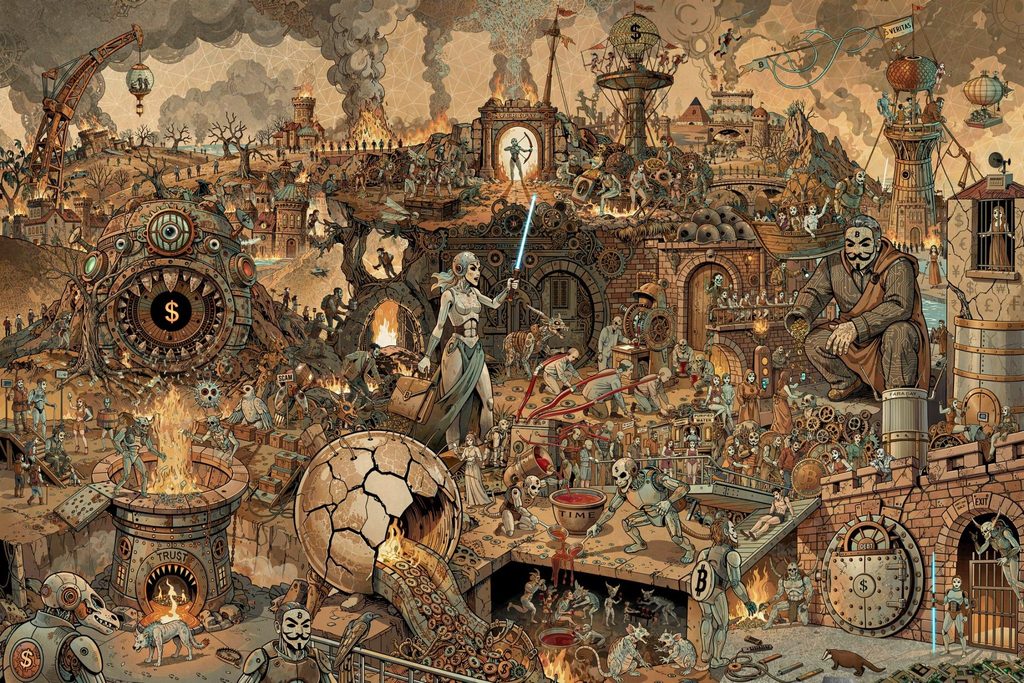
Furia Fiat: Let there be fury, Lucho Poletti (2026)

Unveiled on August 15, 2026, the anniversary of Nixon’s announcement, the series follows a biweekly release schedule beginning August 29 and concluding January 3, 2027, the anniversary of Bitcoin’s Genesis Block. Each drawing contains hundreds of figures and objects, with inscriptions often visible only at close range. The 30-by-20-inch prints, produced in editions of ten, form a composition spanning approximately four meters when arranged in two rows of five.

Five drawings have been released, most recently Fiat Moria, after Bruegel’s Netherlandish Proverbs, on October 24. The sixth, Fiat Fames, follows November 7.

Ahead of Bitcoin Amsterdam, November 5–6, I spoke with Poletti about the recurring influence of Bosch and Bruegel on bitcoin art, the relationship between allegory and propaganda, and translating his densely detailed drawings to the conference’s main-stage LED installation.
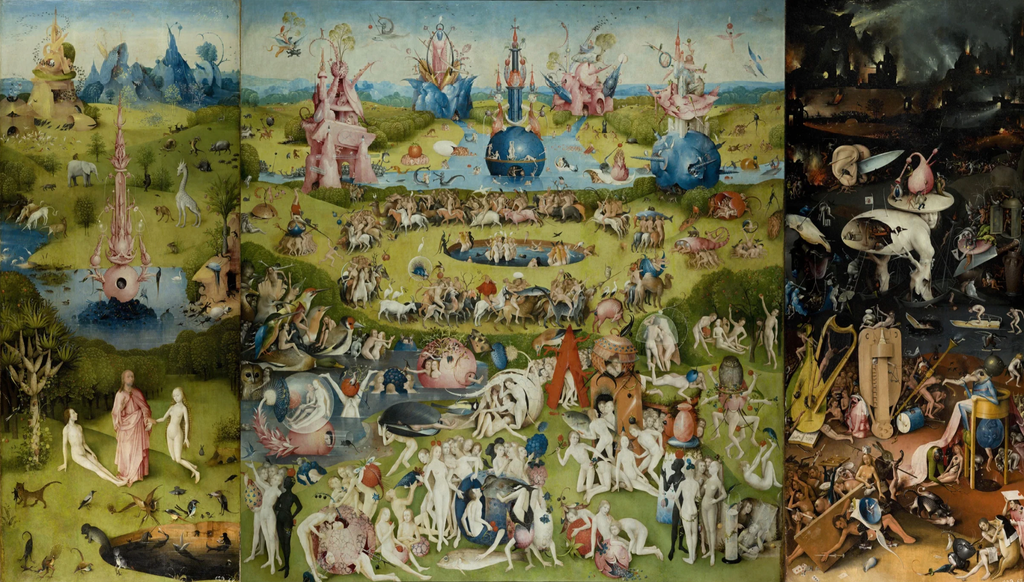
The Garden of Earthly Delights, Hieronymus Bosch (c. 1490–1510)

BMAG: Bosch and Bruegel seem to be having a synchronistic moment among artists interested in Bitcoin. Both worked in what is now Belgium and the Netherlands, during a period when Antwerp was emerging as a major financial center and the Habsburgs were debasing coinage. What is it about transitional periods (like the current one) that draws artists back to Bosch and Bruegel and their densely populated landscapes?

Lucho Poletti: Because they had already solved the problem I was stuck with: how do you draw a whole society going wrong at once? Bosch and Bruegel put hundreds of people in a single frame, each busy with their own concerns. The system shows up in the sum of it. You don’t look at a Bruegel, you search it. It’s a great way to depict the effects of money, which nobody really sees and everybody feels.

They also lived through a money problem a lot like ours. Silver from the Americas poured into Europe through Seville and on to the bankers in Antwerp. Prices across Western Europe rose sixfold over 150 years. Philip II defaulted in 1557 and the crash spread across all of Europe. Two years later Bruegel painted Netherlandish Proverbs, a village where everyone is absorbed in something foolish and nobody can see the whole.

The four Bosch pieces are about appetite: the temptation, and the bill that shows up after. The six Bruegels are about the crowd, and how society behaves once the rules stop making sense. 

Fiat Lucrum: Let there be profit, Lucho Poletti (2026)

BMAG: The series draws on the original meaning of the F-word every bitcoiner knows. Nine of your titles use fiat as a command, while the tenth, Ultima Fiat, seems to reverse that authority. How did you arrive at Latin as the language of the series, and why does the final decree change speaker?

Lucho Poletti: Fiat was never a noun. In Latin it’s a verb, “let it be done.” It’s the word God speaks in the Latin Genesis before the light comes on: fiat lux. Someone with authority says so and it happens. That’s a literal description of how fiat money comes into existence, so I wanted the verb in every title.

Latin wasn’t a stretch for me. I’ve titled work in it for years: Moneta Divina, Cypher Deos, and Novus Moneta Seclorum dating back to 2020. The dollar already speaks it, too. Turn over a one-dollar bill and there are three Latin mottos on the back. Ultima Fiat, Fiat Lucrum and Furia Fiat had their names before the series did. Once there were three decrees in concept, I kept going until I had ten, and the name for the whole series became obvious. Ten Decrees has the Ten Commandments sitting under it, which suits work rebuilt out of painted sermons. In Fiat Lucrum there’s a lighthouse at the top left with FIAT LUX GENESIS 1:3 engraved into it. The title is the phrase rewritten for the money printers: let there be light turned into let there be profit.

Fiat Lucrum (detail), Lucho Poletti (2026)

Nine of the decrees are issued to you, in the flat voice an institution uses. Let there be profit, let there be hunger, let there be a game. The tenth is the only one we get to say back. Ultima fiat means “let it be the last,” which is closer to a plea than an order. Every one of us has been living under the first nine since 1971, whether we noticed or not, and Bitcoin is how we issue the tenth. It closes the series on January 3, the anniversary of the Genesis Block, which also happens to be my birthday.

BMAG: Bosch and Bruegel constructed extraordinarily complex visual worlds where allegory, satire, religious symbolism, and everyday life coexist. Their paintings invite close inspection but rarely offer a single, definitive interpretation. In Ten Decrees, you’re borrowing their compositions while introducing a more explicit critique of the monetary system. How do you approach the relationship between ambiguity and message in your work?

Lucho Poletti: The words carry the message so the people don’t have to. Bosch’s Garden of Earthly Delights doesn’t have a single word in it. Fiat Lucrum has more than fifty lettered objects, and some are as blunt as a protest sign: four money presses lettered QE-1, QE-2, QE-3 and QE-∞, and a little hand-lettered card on a broker’s desk that reads genius, we print, you pay, have a nice day. Nobody has to wonder what I think of the money system.
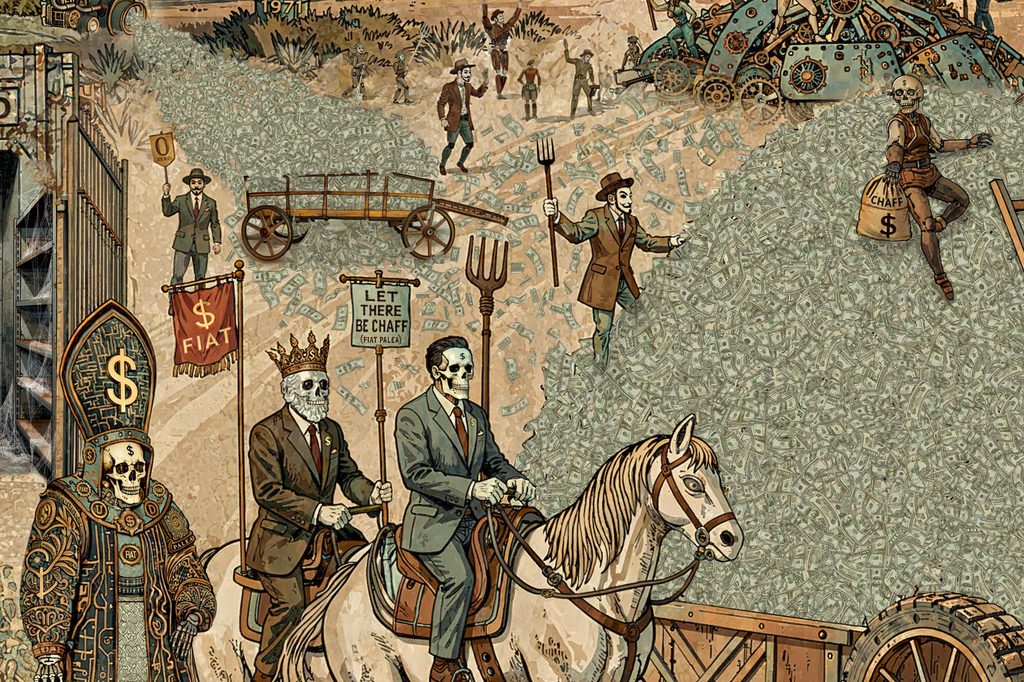
Fiat Palea (detail), Lucho Poletti (2026)

I keep the ambiguity in the people. In Fiat Lucrum there’s a crowd cheering a woman who holds up a $ on a golden staff under a sign that says ETF, and that crowd is wearing my mask. So is the man signing the leverage contract, and so is the woman taking the mortgage. In Fiat Palea a man in the mask is knee-deep in a pile of printed bills. Bosch drew his own neighbors into the middle of the garden, and I drew mine. If the ₿ on a forehead were a badge of honor, I wouldn’t hand it out like that. It’s more a badge of the aware, the initiated. Knowing the money is broken doesn’t make one a saint.

I’m careful with endings too. These pieces show the exit while not promising a way out. Near the middle of Fiat Moria there’s a lit doorway with MONEY ₿ BETTER WORLD over the arch, and a plain-faced man on the step looking back at the square. He hasn’t gone in yet, and nobody’s stopping him. Where you’d be standing in that picture is your call.
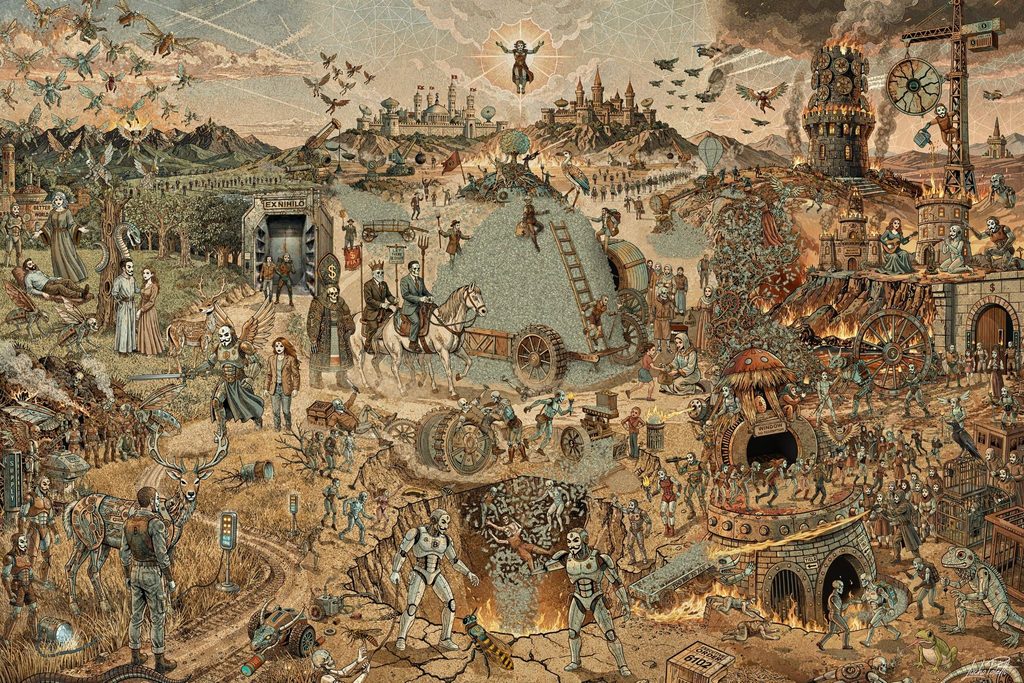
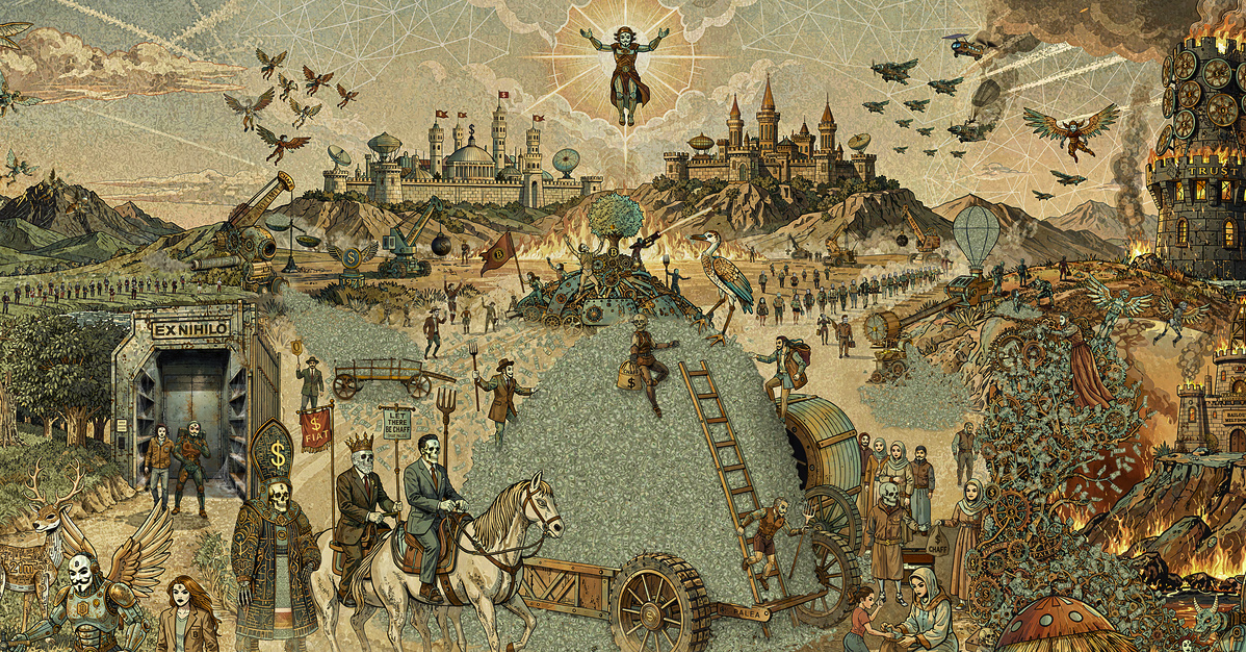
Fiat Palea: Let there be chaff, Lucho Poletti (2026)

BMAG: In Fiat Lucrum, your reinterpretation of Bosch’s Garden of Earthly Delights, you introduce a system of waterworks: pipes, reservoirs, and flowing liquidity. Bosch often allowed viewers to recognize things that the figures within his paintings could not. What possibilities does that kind of visual allegory offer you when depicting something as abstract as the monetary system?

Lucho Poletti: What Bosch never had in his garden was plumbing, so I gave it some. Water organizes the whole of Fiat Lucrum. It starts clean high in the mountains on the left, pours out of a machine in Eden and settles in a reflecting basin. Cut into the basin’s wall there’s an inspection window with fish swimming behind the glass. Somebody built a viewing port into the reservoir so you could check it, and every full node on the Bitcoin network is that window.

Downstream the water widens into a lake. In the middle sits a glass tank lettered FRESH LIQUIDITY, with BOTTOMLESS engraved on the bowl, and eight people are having the party of their lives inside it. The valve wheel that controls the flow is on top of the dome, outside the glass, where none of them can reach it. Monetary policy gets set by someone who isn’t at the party. And the tank leaks. From there the water runs orange, down a stream and over a waterfall into a pool where a tick with a $ on its cheek drinks it through a hose.
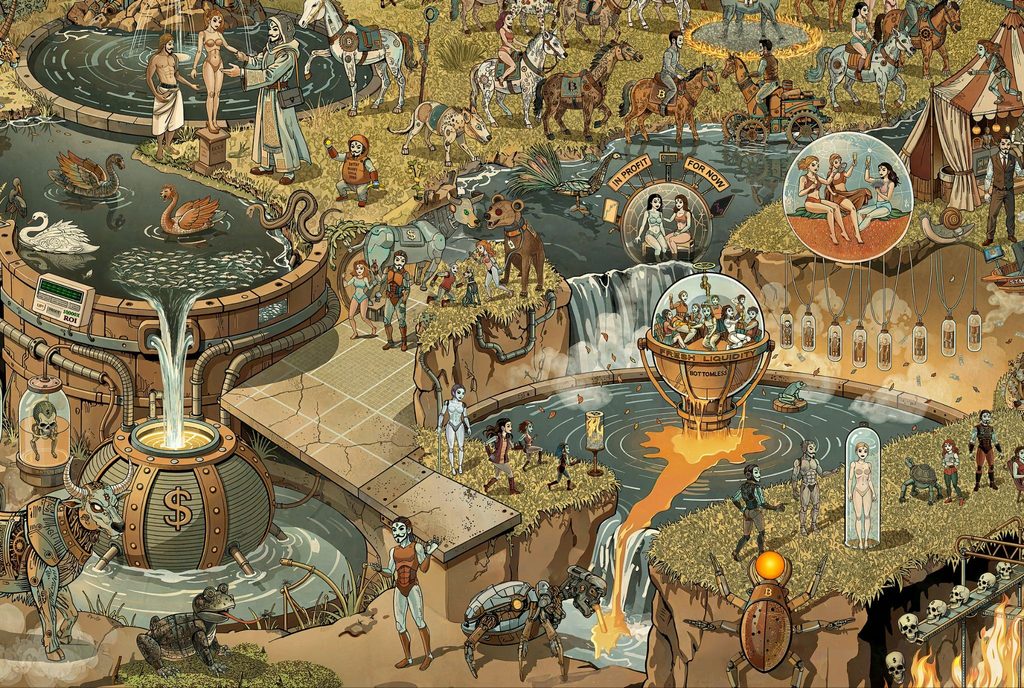
Fiat Lucrum (detail), Lucho Poletti (2026)

That’s the Bosch trick you’re describing. The bathers can’t see the leak or the valve, and you can see both from across the room. Richard Cantillon worked out around 1730 that new money helps whoever gets it first and costs whoever gets it last. I drew it as a watercourse because everybody already understands water: whoever’s upstream drinks first, and everyone downstream gets what’s left.

BMAG: Looking across the series, are there particular details, references, or artistic decisions that you feel are especially important but might be overlooked by viewers? What would you want someone encountering these drawings for the first time to spend more time looking at?

Lucho Poletti: Up close is where these work, and most of what matters in them is small.

Start with the plain faces. Everybody spots the Satoshi masks and the $ skulls first because they’re the loud ones, but the plain faces belong to the people the system is happening to. In Furia Fiat a line of bald men crawl on their hands and knees with red tubes plugged into the backs of their skulls, and the red is the same color as the fluid in a bowl a few meters away that says TIME. That’s what’s being drained out of them. In Fiat Palea, Adam and Eve stand under a serpent with a $ for an eye. They’re wearing the mask, but neither of them has a ₿ on the brow yet.
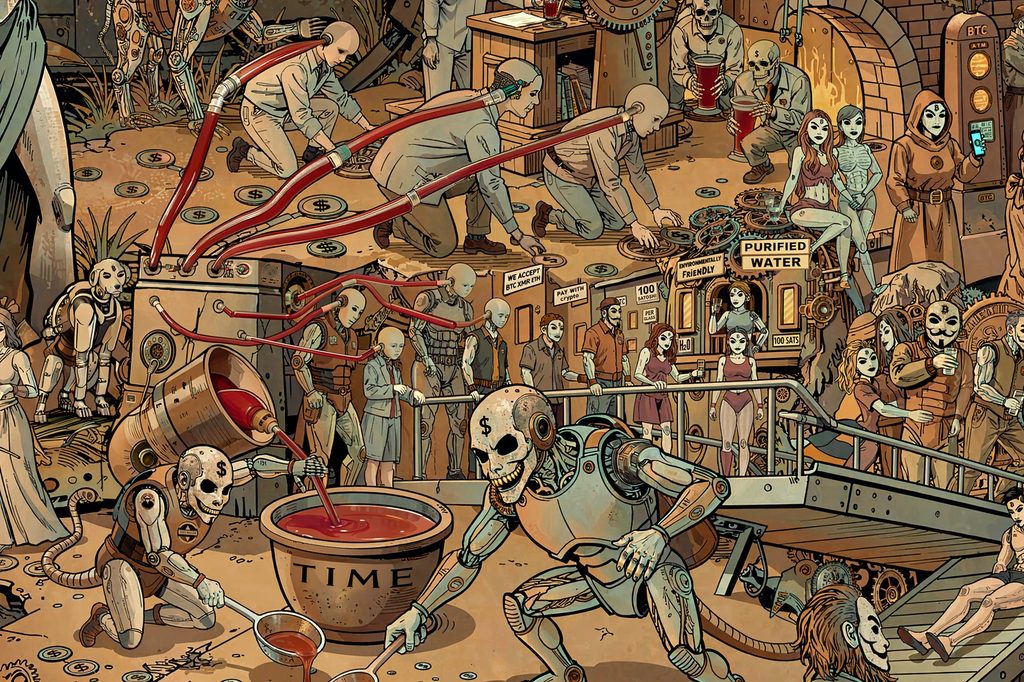
Furia Fiat (detail), Lucho Poletti (2026)

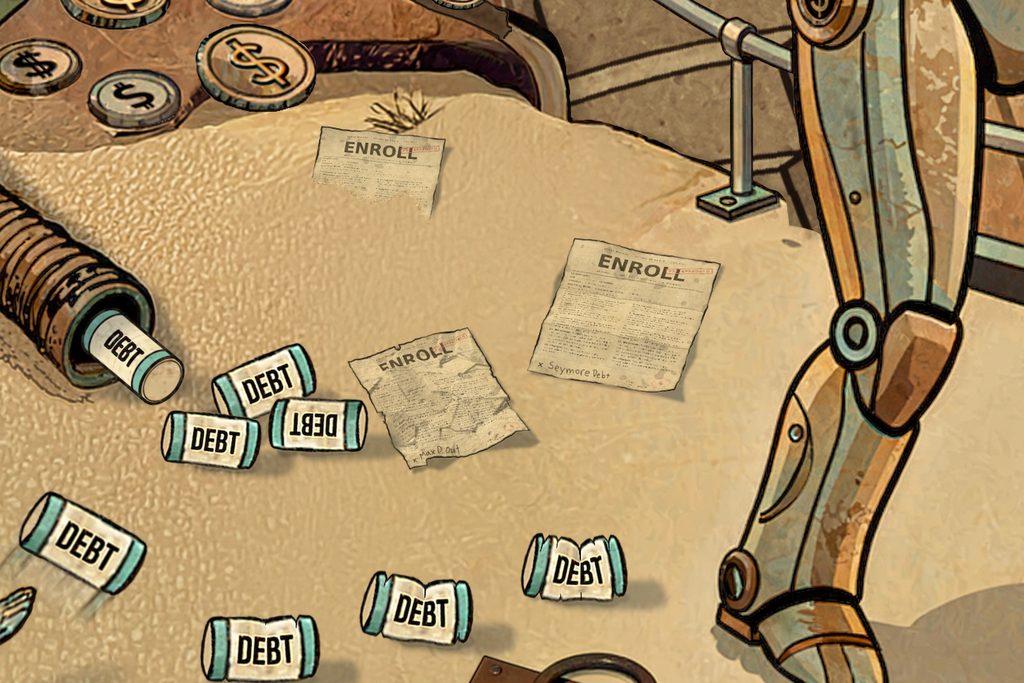
Then look at how characters connect across a distance. In Fiat Ludus a sack lettered STIMULUS sits on a bench next to an older figure, and a little way off a kid walks away with the same sack on his back, lettered THE BILL. A blindfolded boy feels around with his arms out while the man lunging in beside him holds up a bunch of $ balloons the boy can’t see. Even the enrollment forms are signed by Seymore Debt and Max D. Out. 

Fiat Ludus (detail), Lucho Poletti (2026)

In Fiat Palea a broken crate stenciled EXECUTIVE ORDER 6102 sits in the straw, and further back, bolted across a vault, a plate reads WINDOW, NO REDEMPTION. Roosevelt took the gold in 1933 and Nixon closed the window in 1971, and I put the two close enough that you read one and then find the other. Up higher in the same piece, a guy in the mask with WHOOPS across his vest is pouring gasoline on a burning bank. In Furia Fiat, the $ skulls stand on GNOSIS and clutch books of knowledge, keeping them for themselves.

The bubbles are dated. Fiat Ludus has a sphere with tulips growing out of the top, marked 1637 and 1720, and another with a hen sitting on a WALL STREET egg, marked 1929 and 2008. Variety’s front page the day after the 1929 crash read WALL ST. LAYS AN EGG. Some of the skies have thin straight lines of cloud behind the smoke, the kind a plane leaves.

Fiat Ludus (detail), Lucho Poletti (2026)

Watch the prices, too. A price in dollars only goes up: at CANTILLON’S hot dog stand in Fiat Ludus the 5¢ is crossed out and the sign says $9. A price in sats only goes down: a fish stall in Fiat Moria has 4000 crossed out, then 2000, and now it’s 1000 SATS. In Fiat Ludus, the carrots changing hands have dropped from 7,500 to 3,000 SATS on the chalkboard next to the dollar hopscotch.
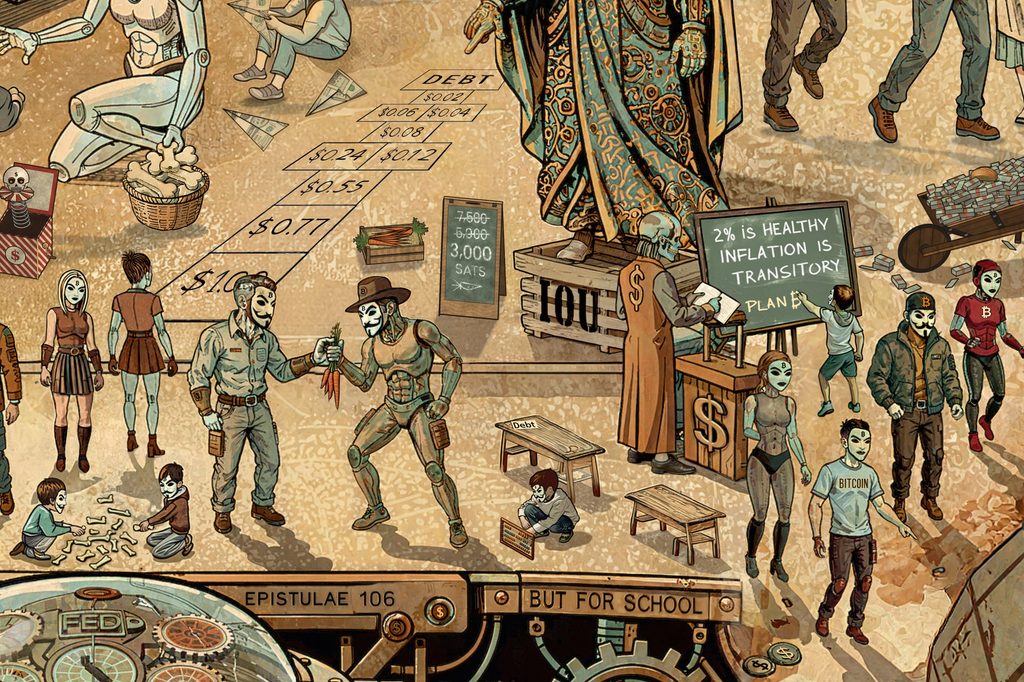
Fiat Ludus (detail), Lucho Poletti (2026)

The Latin is there to be read. MORITURI TE SALUTANT, those who are about to die salute you, is carved around the rim of the arena in Fiat Ludus. EX NIHILO, out of nothing, is cut over an empty vault in Fiat Palea. In Fiat Moria the $ skull leaning out of the window has a plaque on either side of him: MUNDUS VULT DECIPI, the world wants to be deceived, and $TULTORUM INFINITUS EST NUMERUS, the number of fools is infinite, with a $ for the S. Fiat Lucrum has a little panel that runs a whole life in four stops: school, debt, work, death.

And in Fiat Moria there’s a small round time machine with NO RETURN on its side and 1944-2026 on the dial. A man is climbing out of it, staring at the village. 1944 is Bretton Woods, when the world tied its money to the dollar and the dollar to gold. He left then and he’s only just arrived, and he can’t quite believe what he’s looking at.

Fiat Moria (detail), Lucho Poletti (2026)

None of that comes with a caption. You find it by standing close for a long time, the way you would with a Bruegel, and the finding is the whole point.
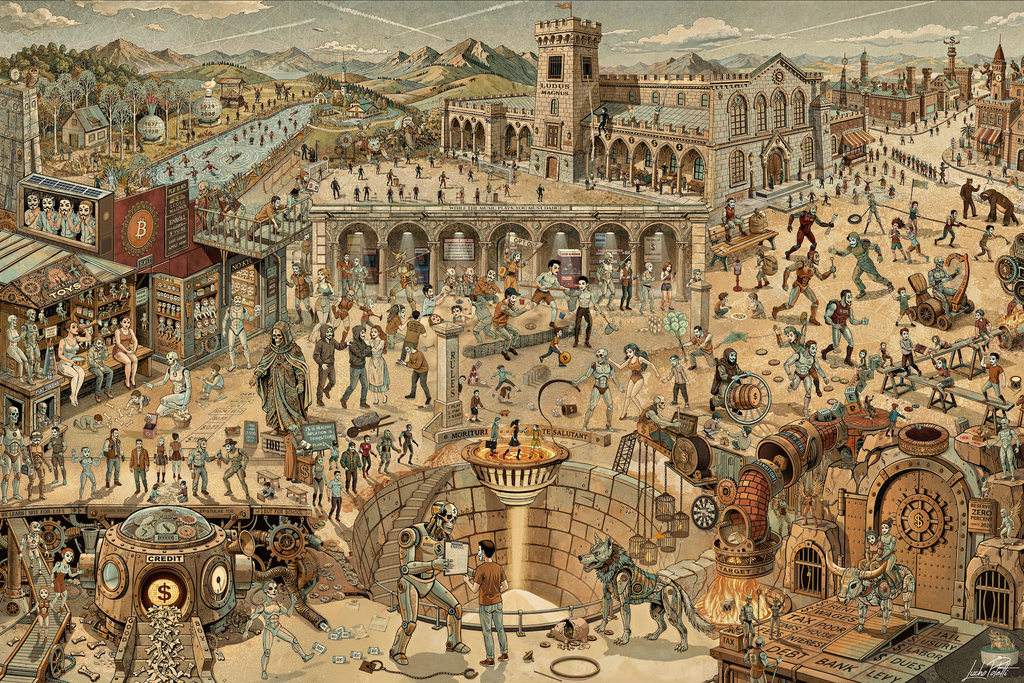
Fiat Ludus: Let there be a game, Lucho Poletti (2026)

BMAG: Each drawing is 18,000 pixels wide, populated by hundreds of figures, with every Satoshi mask drawn by hand and details that only reveal themselves up close. You’ve described the work as “crafted, not generated.” At a time when AI can convincingly imitate the Old Masters, what significance does that labor have for you, and how does it shape the way you want these works to be experienced?

Lucho Poletti: “Crafted, not generated” is a phrase I came up with to sum up where the work in these pieces actually is. There are machines in my process, but they’re only one part of it. A model I trained on years of my own work does the rough first pass on a composition. I think of it as an apprentice. Bosch came out of a family workshop, and the masters of his day leaned on assistants for the groundwork so their own hours could go into the meaning. Mine roughs out the scene and gives me a base to build toward the standard they set. Then I spend weeks on each piece in a grueling manual process in Photoshop, making the decisions and drawing in hundreds of figures, objects, symbols and phrases until the art says what I mean.

Fiat Moria (detail), Lucho Poletti (2026)

AI can imitate the look of a Bosch or a Bruegel pretty convincingly now. What it can’t do is mean anything. It won’t decide that the valve on the liquidity tank in Fiat Lucrum belongs outside the glass, where the bathers can’t reach it. It won’t decide that the slop on the ground should be piggy banks wired into the money presses, each with its own name: SAVINGS, PENSION, NEST EGG. It doesn’t make jokes either. It’s never going to sit a fool in a jester’s cap on a platform lettered TAKE IT AT FACE VALUE while a $ skull does his makeup. My personal philosophy is that if I don’t do the majority of the work, it’s not my art. I hold myself to that, and anyone who looks at these up close can see a person made the decisions that matter.

That’s how I’d like people to take these in: up close, and for a long time. I don’t ask anyone to trust me on how they were made. The work answers that better than I can.
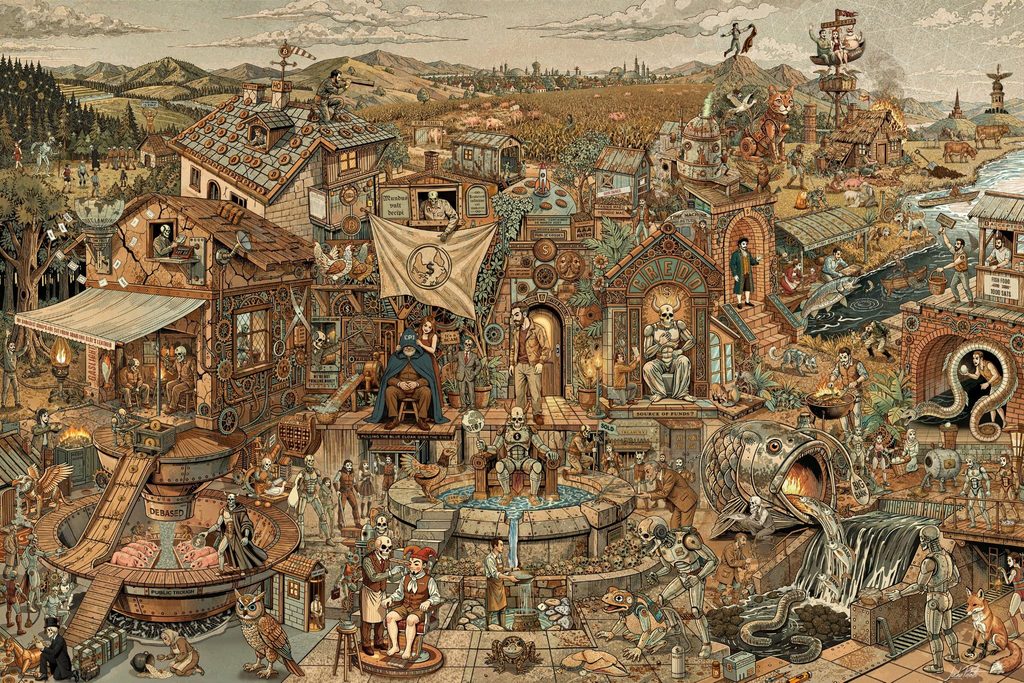
Fiat Moria: Let there be folly, Lucho Poletti (2026)

BMAG: You’ve been part of the Bitcoin Conference since 2021, and this November Ten Decrees comes to the main stage at Bitcoin Amsterdam, not far from the historical centers where Bosch and Bruegel worked. These drawings are extraordinarily detailed, designed to reward close inspection. How are you approaching their translation to monumental LED screens, and does exhibiting them in the Netherlands carry any particular significance for you?

Lucho Poletti: The prints were meant for one person standing close to search the work and find details that speak to them. An LED wall gets a thousand people at fifty meters, which is an amazing opportunity to create a visual experience for the still pieces, so I’ve done my best to create a compelling one for each piece.

Each one gets fifteen seconds, in the order they were released. The big center wall carries the center of each piece in one slow pass from left to right, so the room gets the shape of it. The screen on the right opens on the Bosch or Bruegel it came from, with its name and date, and halfway through it wipes across to mine. The screen on the left side pulls out lateral details you’d never catch from the floor, like the ship of fools riding the mast in Fiat Moria, or the pigs feeding at the DEBASED trough. All five released so far play back to back as one loop, old master and new money side by side the whole way through.
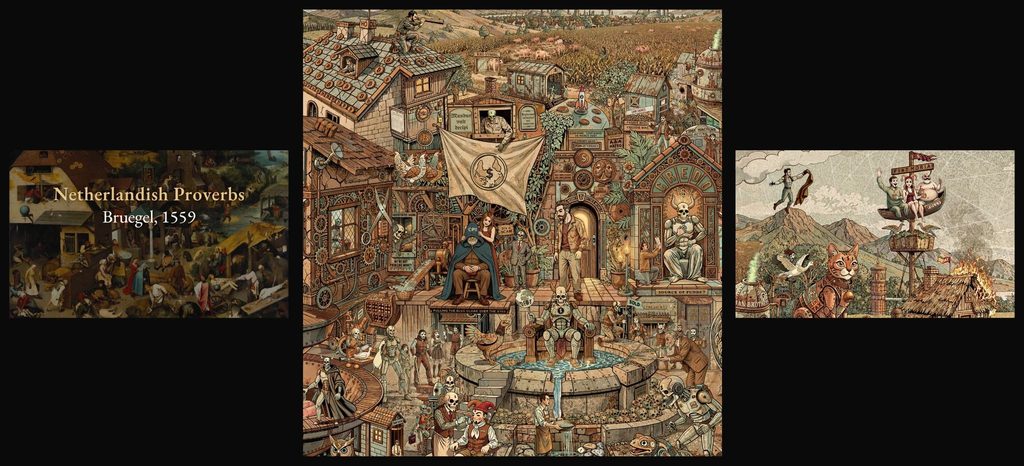
Ten Decrees, Bitcoin Amsterdam main-stage visualization rendering, Lucho Poletti (2026)

The Netherlands matters to me. Bosch spent his whole life in ’s-Hertogenbosch, about an hour south of Amsterdam by train. Some of Bruegel’s proverbs are still in use in Dutch: people still say someone hangs his cloak to the wind when he turns with the crowd, and in Fiat Moria, a man wearing a Satoshi mask jumps off a mountain, holding his cloak in his hand—a reference to the Dutch proverb about changing one’s position to suit the prevailing winds.

Amsterdam has its own chapter in this story. The Bank of Amsterdam opened in 1609 to give merchants a money nobody could debase, and for over a century its bank guilder traded at a premium over ordinary coin because people trusted the silver was in the vault. David Hume held it up as the model of a fully backed bank. It had been lending to the Dutch East India Company quietly, and when that became public in 1790 the premium vanished and the bank declared itself insolvent. I can’t think of a better city to show a series about monetary decrees and trust, two months before the last one lands on the Genesis Block anniversary.
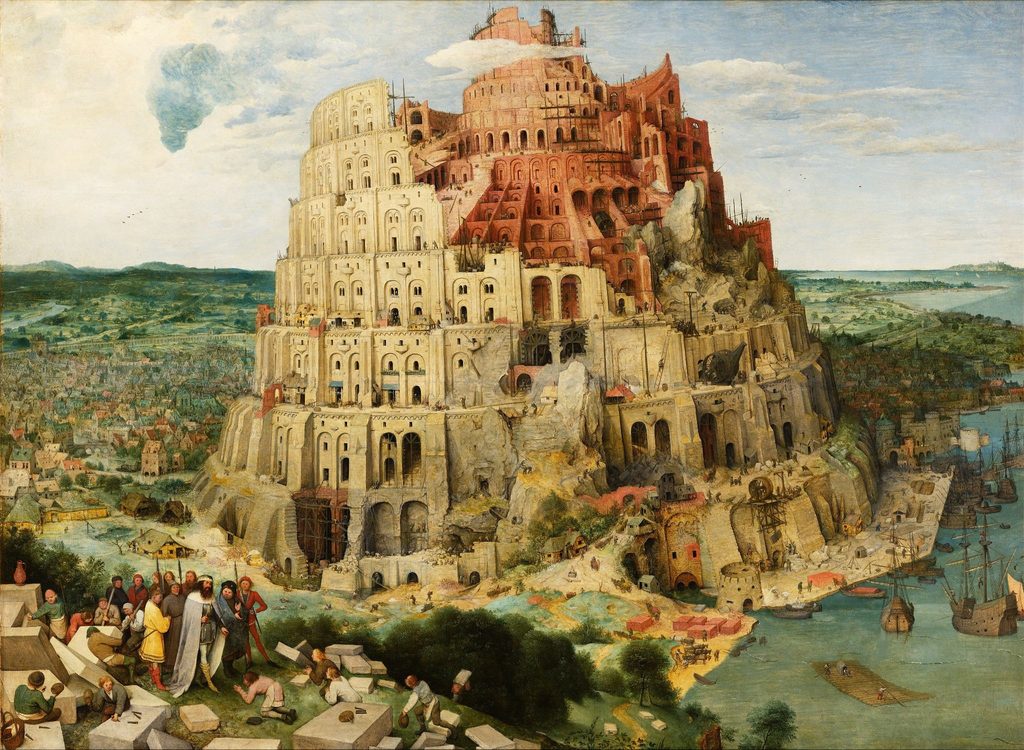
The Tower of Babel, Pieter Bruegel the Elder (1563)

Exhibition & Further Reading

Lucho Poletti’s Ten Decrees will be on view on the main stage at Bitcoin Amsterdam, November 5–6, 2026, as part of the Bitcoin Museum & Art Gallery (BMAG) programming. Explore Poletti’s detailed write-ups on each Decree for a deeper look at the artwork, symbolism, and historical references throughout the series, and follow him on X.

Read more from BMAG’s Bitcoin Amsterdam series: The Undercurrent: Three European Artists on Making Money Visible and The Architecture of Money: Mapping Financial Power in the Age of Bitcoin.

The Bitcoin Museum & Art Gallery (BMAG) organizes international exhibitions, auctions, and artist collaborations exploring bitcoin and its cultural implications.

Join us at Bitcoin Amsterdam, November 5–6, 2026, and use code BA26-BMAG20 for discounted admission. Get your tickets here.

This post Ten Decrees: Old Masters, New Money first appeared on Bitcoin Magazine and is written by Dennis Koch.

Moving Crypto Out of South Africa? What the Draft Capital Flow Rules Mean for Your Business

Photo by Kathrine Heigan on Unsplash

South Africa’s Crypto Rules Are Changing Direction: What Investors and Businesses Should Prepare For

South Africa is taking an important step towards answering a question that has hung over its crypto market for years:

How should crypto assets be treated under the country’s rules on moving money across its borders?

The problem is not new.

South Africa has long run an exchange-control system to manage capital flowing in and out of the country. The National Treasury and the South African Reserve Bank (SARB), through its Financial Surveillance Department (FinSurv), administer it under the Exchange Control Regulations of 1961.

The problem is that crypto does not fit neatly into a system built around banks, foreign currencies and conventional payment channels.

That raises a legal question:

Is crypto “capital” for the purposes of exchange control?

The Courts Disagreed

Two High Court decisions show the uncertainty.

In Standard Bank of South Africa Ltd v South African Reserve Bank, SARB had forfeited funds linked to cryptocurrency transactions involving Leo Cash and Carry (Pty) Ltd.

Standard Bank challenged the forfeiture, arguing that cryptocurrency was not “capital” under Regulation 10(1)(c). The court agreed, finding that cryptocurrencies fell outside the definitions of “money” and “capital” in the Regulations, and set the forfeiture aside.

In Mangundhla & Dangaiso, the court went the other way. The case involved roughly 1,680 Bitcoin, bought in South Africa and valued at under R182 million, which were sent to wallets reachable through exchanges outside the country. SARB forfeited certain Bitcoin and funds held in the applicants’ Standard Bank and Luno accounts.

This time the court held that Bitcoin could constitute capital, based on the ordinary meaning, context and purpose of the legislation.

This result is the real gap.

If crypto is capital, its cross-border movement can fall under exchange control. If it is not, applying the old framework becomes very difficult. The position is also still unsettled, because the Standard Bank decision is subject to appeal. The courts exposed the problem, but they did not solve it.

The Reform

That is the background to the Draft Capital Flow Management Regulations, 2026, published for public comment on 17 April 2026. On 15 May 2026, the National Treasury and SARB followed with a joint statement covering, among other things, how crypto assets are treated, held and traded, and how they move across borders.

The draft regulations are broader than crypto. They are meant to replace the 1961 regulations and modernise how South Africa manages international capital flows, moving towards a risk-based, surveillance-oriented model. Instead of relying mainly on prior approvals, the aim is to let legitimate transactions flow while strengthening reporting, monitoring and intervention for high-risk activity.

For crypto, the key point is that the draft does not build a separate system. It places crypto assets inside the existing framework, alongside foreign currency, securities and gold.

What the Draft Regulations Would Do

Buying and selling

Purchases, sales, borrowing and lending of crypto above a set threshold would generally have to go through an Authorised Crypto Asset Service Provider (CASP), or otherwise meet permission requirements. A CASP could only carry out the activities it is authorised for, and the National Treasury could add conditions or bar it from dealing with particular people, assets or transactions.

Moving crypto abroad

This is arguably the most significant part. Taking or sending crypto out of South Africa, delivering it for removal, and certain payments involving people outside the country would generally need permission from the National Treasury or an authorised body.

Declaring foreign crypto

A person in South Africa who gains control or possession of a foreign asset or crypto asset may have to declare it within a set period. The declaration would cover when and how it was acquired, where it is held and whether it is linked to a foreign liability. Once declared, later sales or transfers could be restricted.

Seizure, blocking and forfeiture

If there are reasonable grounds to believe crypto is connected to a contravention, authorities could seize it or block dealings with it in an account, and it could eventually be forfeited to the State.

The draft even deals with the practicalities of crypto: after forfeiture, the previous holder may be required to hand over the passwords, PINs or codes needed to access the assets.

The proposed draft contains safeguards. Forfeiture decisions must comply with the Promotion of Administrative Justice Act, and affected people can challenge attachment, blocking, and forfeiture through judicial review.

The Crypto Asset Manual and Its “Trigger Point”

The Draft Crypto Asset Manual for Cross-Border Activities supplies the operational detail. Its main job is to say when a crypto transaction becomes a cross-border one for exchange-control purposes.

  • Domestic authorised CASP to offshore CASP: an outward cross-border flow.
  • Domestic authorised CASP to a non-custodial wallet: also an outward flow.
  • Offshore CASP to domestic authorised CASP: an inward cross-border flow.

These flows are intended to be identifiable and reportable to FinSurv.

The treatment of non-custodial wallets stands out.

With a non-custodial wallet, the user holds the private keys and there is no intermediary holding the assets. Even so, the framework treats a transfer from a domestic CASP to such a wallet as an outward movement of value.

It also takes a stricter line on certain inward transfers from non-custodial wallets, treating them as non-permissible. The focus is not on whether an asset sits on a blockchain, but on where the value comes from, where it goes and whether it crosses the border.

For now, the Manual is narrow on who can send crypto offshore. Individuals can do so through authorised CASPs using their existing foreign-exchange allowances, such as the Single Discretionary Allowance (SDA) or Foreign Capital Allowance (FCA), subject to the applicable requirements. That is not a general permission for every person or business to move crypto abroad, and other categories will depend on the final rules.

What Is South Africa Trying to Do?

Taken together, the draft is not trying to prohibit cross-border crypto activity. It is trying to make crypto movements visible to the capital-flow system. Exchange control was designed for a world of identifiable institutions and bank accounts, and crypto can move value across borders without passing through any of them. The trigger-point approach gives regulators a way to see when that movement matters.

It is also activity-based.

At this stage it does not distinguish between types of crypto asset, and it does not treat crypto as official currency or legal tender.

So the framework is less about whether Bitcoin or a stablecoin is “money,” and more about whether an activity amounts to a movement of value that should be subject to capital controls.

This will sit on top of existing oversight.

The Financial Sector Conduct Authority (FSCA), the Financial Intelligence Centre (FIC) and the South African Revenue Service (SARS) already play roles in regulating crypto activity. A crypto business may therefore need to ask two separate things:

Am I authorised to provide this service, and does this particular transaction create an exchange-control or reporting obligation?

My Views

The draft regulations supply the legal architecture for bringing crypto into South Africa’s capital-flow regime, and the Manual supplies the practical test for when a transaction is caught.

What I find most telling is where the rules choose to focus. They do not try to settle what crypto is. They regulate what crypto does when it crosses a border.

That is a pragmatic response to the court split, because it sidesteps the “is it capital?” debate by looking at the movement of value instead.

For businesses and users, three questions will matter most:

  • Can the transaction take place at all?
  • Does it need prior permission, or must it go through a particular channel?
  • Is it reportable to FinSurv?

For regulators, the goals are clear: better visibility over cross-border crypto flows, fewer chances for regulatory arbitrage and stronger detection of illicit finance, without choking off legitimate digital-asset use.

The open question is how well that balance survives the final text. Rules on non-custodial wallets, in particular, will test whether visibility can be achieved without making ordinary self-custody impractical.

The proposals are still subject to consultation and may change. But the direction is clear. Crypto may be borderless, but its movement across South Africa’s borders will increasingly come with rules on permission, reporting and oversight.

If you enjoy analytical commentary on digital asset regulation, crypto markets, and emerging financial technologies, consider subscribing to my newsletter where I share additional research, commentary, and industry insights.

https://samuel-ayodeji.kit.com/profile

Also, if your company, startup, or publication needs clear, well-researched content on blockchain, digital assets, fintech, or emerging technology law, my inbox is always open.


Moving Crypto Out of South Africa? What the Draft Capital Flow Rules Mean for Your Business was originally published in Coinmonks on Medium, where people are continuing the conversation by highlighting and responding to this story.

I Ignored Web3 for Years. One Question Finally Made It Click

What Web3 actually is, without the jargon, the cartoon monkeys or the “to the moon” nonsense.

Every time someone said “Web3,” I zoned out.

Wallets. Gas fees. DAOs. Every explanation came with three more explanations I hadn’t asked for, and the person explaining usually had a cartoon ape as their profile picture. Not a great look.

Then a friend who works in payments watched me nod along for the tenth time and said, “Stop thinking about the tech. Just ask who owns what.”

That’s it. That’s the whole thing. I wish someone had said it to me in 2021.

Image Generated by ChatGpt

Two internets down, one to go

Web1 was a library. You walked in, read something, walked out. Late 90s, early 2000s. Somebody built the page and you looked at it.

Web2 is the one you’re on now. You can post, comment, upload, sell, review. Instagram, YouTube, Amazon. And it’s great, genuinely. But somewhere along the way the deal changed. You make the stuff. They hold the keys.

Web3 is the idea that you could read, write and own. The last word is the one doing all the work.

Quick test

Think about something you’ve built online. A following, a channel, a gaming account you’ve put hundreds of hours into.

Who can switch it off?

Not you. I know people who’ve lost accounts to a wrong automated flag, then spent weeks pinging a support form that answered with a template. Weeks without income, waiting on a reply from something that isn’t even a person.

Web3 is a bet that this setup is a design choice, not a law of nature. What if your account and your money and your stuff were with you, and the apps just plugged in?

What’s under the hood

It sounds complicated and it mostly isn’t. Four pieces.

Blockchain. A shared record book. Thousands of computers each hold the same copy. Somebody writes “Priya sent Tom five euros,” every copy updates, done. To fake an entry you’d need to fool most of them simultaneously, which is why nobody needs a bank to vouch for the book.

Wallet. Your account, except no company holds it. You hold a private key. Think front door key. Lose it and there’s no locksmith and no “reset password” link. Some people hear that and feel free. Others feel sick. Both reactions make sense to me.

Token. A digital item recorded on a blockchain. Could be money, a ticket, a membership, a piece of art. It sits in your wallet, so nobody can quietly take it back.

Smart contract. A small program that runs on the blockchain and does what it was told. Payment lands, item gets released. No middleman. Which is lovely until the code has a bug, because then there’s nobody to phone.

NFTs, DeFi, DAOs, all the names you keep hearing: those are just these four stacked in different combinations.

Picture a musician

She uploads a track to a streaming platform. The platform decides what a play is worth. Money arrives weeks later, after the label and the distributor each take a bite. If the platform changes the rules, she adapts or leaves.

Now imagine the split is written into a smart contract. Each sale divides automatically between her, the producer and the co-writer, in the percentages they agreed to. Minutes, not months. Nobody emails anybody about a missing payment.

Is that real today? In small pockets, yes. Will it replace Spotify next year? No chance. But it shows you the shape of the idea, and once you see it it’s hard to unsee.

The scam part (I won’t skip it)

Skipping this is how people get hurt, so here goes.

Web3 has an ugly history. In 2021 and 2022 people paid silly money for NFT images, and most of those prices fell off a cliff. Loads of crypto projects were pure speculation. Some were just fraud. People lost savings, and that’s not a small thing.

My own view, and you’re free to disagree: the technology and the casino that grew around it are two different things. A lot of people came for the casino and called it Web3. The dot-com crash wiped out a pile of companies in 2000 and the internet is still around.

Still, I’m careful. My rules:

  • Guaranteed returns means a lie. Walk away.
  • Your seed phrase stays with you. No real support team will ever ask for it.
  • If I can’t say in one sentence how a project makes money, I don’t touch it.
  • Only money I could lose without crying. Dull advice. Still true.

Where it’s quietly going

Forget the memes. The serious work is in finance. Banks and institutions are testing tokenized assets, faster settlement and payments that carry their own rules. Cross-border transfers are slow and pricey today, and blockchain rails could change that. Central banks have been running experiments with digital versions of their currencies too.

Nobody tweets about settlement times. That’s partly why it’s easy to miss.

So, should you care?

Know it. Don’t obsess over it.

You don’t need to buy anything this week. You don’t need a wallet by Friday. But the question underneath all of this, who owns your digital life, isn’t going away. More of our work, money and identity moves online every year, and someone will answer that question with or without your input.

Knowing the basics is also just self-defence. The people who get burned are usually the ones who didn’t know what they were buying.

At a dinner party

If someone asks, try this: “It’s the idea of an internet where you own your accounts, your money and your stuff, instead of renting them from a few big companies.”

Good enough. Nod at the rest.


I Ignored Web3 for Years. One Question Finally Made It Click was originally published in Coinmonks on Medium, where people are continuing the conversation by highlighting and responding to this story.

Over $600 Million In Polymarket Election Trades Took Place After Races Ended

An anonymous reader quotes a report from Wired: Prediction market boosters often tout the platforms as barometers of public opinion, or even "truth machines" offering a clearer picture of where things are headed than polling or other data. In 2024, for example, Kalshi beat many pollsters in forecasting the outcome of the US presidential race. But their trading activity can also tell more perplexing stories. Two global election markets on Polymarket's offshore platform, for instance, generated over $600 million in trading volume, far more than most political markets typically attract. Most of the activity took place buying and selling contracts tied to long-shot candidates who ultimately did not win. The report focuses on suspicious trading activity surrounding elections in Ethiopia and Romania, where researchers uncovered $284 million in questionable trades tied to Ethiopia's election and periods when 99.6% of trading volume in a Romanian election market was flagged as suspected "wash trading." According to Wired, "wash trading is a type of market manipulation in which accounts repeatedly buy and sell assets to create the illusion of heavy trading activity, when in reality, money is simply moving back and forth." Some accounts may also be artificially inflating their activity to qualify for potential cryptocurrency token rewards, a practice known as "activity farming." In response to the Ethiopian trading activity, Polymarket told Wired that the company "immediately flagged this activity, investigated, and blocked the accounts from trading." The company did not explain why the suspicious trades were allowed to continue for months before action was taken.

Read more of this story at Slashdot.

CoreWeave's Debt Stress Tests Private Credit's AI Financing Boom

An anonymous reader quotes a report from Reuters: Private credit's expanding role in financing AI infrastructure faced one of its clearest market tests this week as CoreWeave's bonds fell to distressed levels, raising questions about how lenders are pricing a boom built on chips, data centers and customer contracts. CoreWeave has about $50 billion of debt, according to LSEG data, making it one of the largest borrowers linking private credit to the AI buildout. The cost of insuring its debt against default climbed to about 1,200 basis points this week, while yields on some of its bonds rose to roughly 15% to 16%, signaling sharply increased investor concern over its credit risk. "There is still a price. Investors are still comfortable financing it, but they're demanding more compensation for it," said James Martin, senior US credit strategist at SMBC, referring to projects further from completion. Carlyle estimates that private credit could finance roughly $1 trillion of the AI infrastructure buildout but warns that aggressive lending could create concentration risks similar to those seen in software lending. "The clearest lesson is not to avoid AI compute exposure, but to set concentration limits before the buildout accelerates further, not after," Carlyle said.

Read more of this story at Slashdot.

IMF Warns of the Real AI Threat: Debt

"Along with the dangers of continuing cyberattacks, the International Monetary Fund (IMF) reports that the threat of an AI market crash is putting the global markets at risk," writes Slashdot reader databasecowgirl, citing the IMF's latest semiannual Global Financial Stability Report. Here's a summary: Three salient risks could trigger a sharp tightening of financial conditions and market turmoil. Weaker or less durable investment and profitability in artificial intelligence could lead to a correction in AI-related asset prices, amplified by rising leverage and concentrated exposures. Resurgent inflation or fiscal concerns could drive a sharp rise in sovereign bond yields, with potentially broad repercussions across financial markets. Meanwhile, increasingly sophisticated cyber threats pose growing risks as finance becomes more digital and interconnected. Underlying financial vulnerabilities could amplify these risks and turn market stress into systemic events. Although the global banking system remains broadly resilient, pockets of weaker banks persist. Liquidity mismatches among insurers and pension funds have increased, while rising leverage and contingent liquidity risks in private credit could amplify stress. While hedge funds support market functioning in calm times, their use of leverage and exposure to crowded trades could exacerbate market stress too and create spillovers to prime brokers. Some emerging markets have seen policy buffers erode, and frontier economies have increasingly relied on less transparent forms of financing. Finally, although markets for tokenized assets remain small and could offer efficiency gains in several areas, they can create new channels for the buildup of leverage and mismatches in liquidity and maturity, in addition to elevating risks related to technology and infrastructure. These vulnerabilities underscore the need for policies that strengthen resilience, enhance transparency, contain excessive leverage, and improve preparedness for future shocks. The full report can be found here (PDF).

Read more of this story at Slashdot.

Ten Million in Stablecoins, Three Million Untouchable. Now What?

Ask a board how much of the treasury they’re comfortable putting to work, and you’ll usually get a shrug and “it depends.” That’s fair, but a shrug doesn’t approve a budget, so here’s how this decision could realistically play out.

Picture a crypto-native company sitting on a large pile of stablecoin reserves. Treasury wants that money to earn something, so the board gets asked to approve placing part of it in a business deposit plan.

The first question in the room isn’t really about yield. It’s how much they can lock up without getting caught short when a bill lands. In the meeting I’d imagine, one director keeps asking what happens if the market drops the same week payroll is due, and honestly that’s the right question to keep asking.

Where the Providers Come In

Once the board is on side with the idea, the treasury starts comparing providers. It’s worth looking at a few of the options side by side, since each one suits a different part of the reserve.

A product like WhiteBIT Crypto Lending for Businesses could suit a team that wants fixed-term deposits: individual plans start from 600,000 USDT, terms can run from about 10 days to a few years, and you can open plans in several cryptocurrencies to spread the risk.

If the company would rather stake than lend, it might also look at BitGo Staking, which says it serves thousands of businesses and lets you delegate from self-custody or custodial wallets, or at Kraken Institutional Staking, which covers custodial and non-custodial staking across 40 protocols with 24/7/365 support.

Staking works differently from a lending deposit. Rewards depend on the network instead of a set term, so those options would probably suit a different slice of the reserve.

Writing The Rule

Now the board’s real job starts. Rather than debating every placement, they write a rule. A sensible version could say, “Keep a fixed operating buffer untouched, let treasury place anything above it in deposit plans within agreed term limits, and review the whole thing every quarter.” The buffer is the part that makes everyone sleep. It’s the money that pays suppliers and salaries even if every deposit is locked up at the same time, so it should never be treated as spare cash.

Putting Rough Numbers On It

Say the company holds $10M in stablecoins, and its operating buffer covers three months of expenses, which is $3M. That leaves $7M available to place. At the 600,000 USDT minimum, that could in theory cover around eleven plans, though most boards would rather keep it to a few larger ones that are easier to track. The term cap might be twelve months, so no single placement tied up cash for longer than the board is comfortable with.

Who Holds The Pen

Who can change the split matters just as much as the split itself, and this is where a lot of treasury policies get fuzzy. Boards often write the number but forget to write the person. In this setup, treasury can move money between placements inside the rule, but anything that breaks the buffer or the term cap goes back to the board. Then the quarterly review checks whether the buffer still fits the actual cost base, because a company that doubled its headcount last year doesn’t need the same cushion. If the numbers have shifted, the policy gets updated in the same meeting, not quietly rewritten by someone in treasury three months later.

The Boring Result

The result is pretty boring, and honestly that’s the point. Nobody gets a dramatic story out of a good treasury policy. Treasury gets clear room to act, the board keeps control through the policy and the reviews, and nobody has to re-argue the same question every time a deposit comes up 📋

Disclaimer: This is not financial or investment advice. Do your own research before making any decisions. Use at your own risk.


Ten Million in Stablecoins, Three Million Untouchable. Now What? was originally published in Coinmonks on Medium, where people are continuing the conversation by highlighting and responding to this story.

Skydance's Discovery+ Prices Increase By Up to 20%

Discovery+ has raised prices for new subscribers, increasing its ad-free plan from $10 to $12 per month and its ad-supported plan from $6 to $7. The hike comes shortly after Paramount Skydance acquired Warner Bros. Discovery. Ars Technica reports: The new prices take effect for new subscribers immediately. Current subscribers to the streaming service, which primarily features unscripted content, like reality shows and documentaries, will receive 30 days' notice before the new prices take effect, starting with bills issued as of November 12. [...] However, a Skydance spokesperson told Ars Technica that the pricing changes were in the works before Discovery+ knew about the merger's closing date and were not planned in anticipation of a merger. The spokesperson said that Discovery+'s prices are regularly evaluated to ensure that they are in line with the content and experience that the service offers, and the new prices reflect that. Discovery+ has increased its prices three times since launching in 2012. Before today, the most recent price hike occurred in January 2025, when ad-based monthly subscriptions increased from $5 to $6, and ad-free plans went from $9 to $10.

Read more of this story at Slashdot.

Why Big Payments Still Cost More Than They Should

The World Bank has been tracking what it costs to send money across borders for more than a decade, and its latest global average is about 6.4% of the amount sent. That figure is measured on small $200 transfers, the kind families send home, so a company wiring tens of thousands of euros pays a much lower rate. Still, it shows how the industry prices a transfer: as a share of whatever you send, so a bigger payment automatically means a bigger bill.

For a treasury team that moves large amounts, this is what makes planning awkward. You can’t put a percentage into next quarter’s budget without guessing the volumes first, and the guess usually misses in the direction you didn’t want.

One Urgent Payment, Two Ways To Send It

Imagine a company that has just agreed a deal with a supplier outside the EU and has to pay €90,000 by Friday. Finance expects the transfer to cost around a hundred euros and moves on to other things.

🔴On the bank route, the bill builds up piece by piece. The daily online limit is €50,000, so there are two transfers instead of one. Each one picks up a fee of about 0.2% and an intermediary bank deduction of around €40, and converting the euros into the supplier’s currency costs roughly another 1%. Together that’s around €1,100, so the supplier receives less than the invoice, and the company sends a third transfer to cover the gap. In between, the bank asks for documents showing where the €90,000 came from. That’s a normal check, but it lands at the worst possible moment.

🔴The second route sends the same amount through an on/off-ramp, with the supplier paid in USDC, and this is where flat pricing changes the picture. WhiteBIT On/Off-Ramp, for example, charges institutional clients a fixed €5 on deposits and withdrawals, whether the amount is €500 or €90,000. A single transaction can go up to €100,000 with individual limits. The company’s KYB and AML checks were done once at onboarding, so the payment clears via SEPA with no surprise requests in the middle of the week.

Where the Market Is Heading

Companies are already moving in this direction. McKinsey and Artemis estimate that business-to-business payments in stablecoins now run at about $226 billion a year, roughly 60% of all real stablecoin payments, and that this volume grew more than seven times over the year. They want the same thing as the finance team in our example: a payment that arrives in full and a cost they can name before pressing “send.”

Different providers have built for different parts of that demand. Zero Hash On/Off Ramp, for example, is infrastructure for platforms that want ramps inside their own app. It works with ACH, RTP, SEPA, and PSP rails, covers the whole US with a strong focus on dollar flows, and lets the platform set its own pricing. Bridge Global Payouts, part of Stripe, covers the payouts side: it converts between USD, EUR, MXN, and stablecoins through one API and is designed mostly for companies that pay contractors, sellers, and teams in many countries.

What to Take Into the Next Budget

Before comparing providers, open the last quarter’s payment log and check two things: how many transfers went out and how large they were on average. Percentage pricing gets expensive for companies that send fewer, larger payments, and that’s usually where a flat fee starts to pay off. If you take the three providers I mentioned above, each of them is built around a different payment pattern, so your own log will tell you more than any comparison table. Add the conversion terms on top, and the transfer line in the budget becomes a number you can count rather than guess.

Disclaimer: This is not financial or investment advice. Do your own research before making any decisions. Use at your own risk.

Why Big Payments Still Cost More Than They Should was originally published in Coinmonks on Medium, where people are continuing the conversation by highlighting and responding to this story.

What Real Finance’s Strategic Advisor Said Across Three Spaces in Three Weeks — And Why the…

Five Real Finance Spaces. Five Transcripts. One Pattern I Couldn’t Ignore.

FIVE SPACES. FIVE TRANSCRIPTS. ONE PATTERN.

I attended every Space.
I recorded the audio.
I read the transcripts.
Then I put them side by side.
What I found wasn’t another tokenization pitch.
It was a repeated admission that the hardest part of RWA infrastructure may not be putting assets on-chain.
It may be getting institutions to actually use them.

What emerged was more interesting than any single announcement.
Across five conversations, Real Official Strategic Advisor kept returning to the same problems: institutional trust, distribution, liquidity, regulation, privacy, and the gap between putting an asset on-chain and getting real financial institutions to actually use it.
This is not a summary of those Spaces.
It is my reading of the pattern.

The Announcement 34,100 People Missed

Sal’Ad Labs RWA Founders Mixer - May 2, 2026

The host mentioned STOs - security token offerings from six years earlier.

Most conversations would have moved on.

Pauli did not.

The idea was never wrong. It was that the market wasn’t ready to carry it.”

Her argument was straightforward.

Custody had improved.

Compliance frameworks were becoming clearer.

Institutions were paying more attention.

The technology was not necessarily the only thing that had been missing in 2019.

Then came a much more concrete statement.

When asked about the assets Real Finance was focusing on, she said:

“We will tokenize soon in two to three weeks from now around 50 to 100 million from one of our partners, Wiener Private Bank.”

The host moved on.

But I stopped.

Because that was not a generic roadmap statement.

It was a specific institution, a specific value range, and a specific timeframe.

That would put the expected execution window around May 20–27.

The same conversation also touched on the RWA trilemma: the tension between compliance, decentralization, and scalability.

Pauli's position was clear:

“True decentralization in the RWA space can only be achieved after establishing unshakeable trust and compliance with the traditional financial world.”

That sequencing matters.

Trust and compliance first.

Greater decentralization later.

Whether that is ultimately the right model is debatable.

But it helps explain the architecture Real Finance has been building.

Banks Are Asking Why They Need This At All

OneAsset “The Next Phase of RWAs” May 14, 2026

Two weeks later.

Different host.

Different audience.

Similar message.

Pauli described the RWA market as being in an “awkward teenage phase.”

Big enough that institutions cannot ignore it.

Still immature enough that important infrastructure is missing.

She identified gaps including:

  • secondary-market liquidity
  • cross-border legal clarity
  • bank and custodian integration
  • instrument standardization
  • verifiable asset performance

Then came one of the most revealing statements in the series.

She was asked about bringing institutional capital into tokenization.

Her response:

“We’re speaking with different banks and they’re like - why would we need to tokenize anything?”

That sentence changed how I read the rest of the conversation.

Because the problem is not simply technical.

A blockchain can settle an asset.

A smart contract can automate a process.

A token can represent ownership.

But none of that automatically creates demand.

If the institution does not see enough value in changing its existing workflow, the technology does not matter.

That is why I would describe this less as a pure technology problem and more as an adoption problem.

Later in the Space, Pauli identified two vulnerabilities that Real Finance's Layer 1 was designed to address:

Oracle latency.

On-chain legal enforcement.

Those are very different problems.

One is technical.

The other sits at the boundary between technology and law.

Both expose the same weakness: an on-chain representation is not automatically equivalent to an enforceable real-world claim.

She summarized another part of the challenge this way:

“Regulation and asset quality tell you if a platform is allowed to play the game. Secondary market liquidity and deep institutional integration tell you if it’s actually playing to win.”

That became one of the central themes of the research.

The Moment She Changed Her Mind Publicly

PIPO AMA “RWA & Global Tokenization” May 16, 2026

The third conversation introduced another layer.

Roman D. from PIPO had previously discussed pre-IPO tokenization.

Now Pauli referred back to that conversation:

“You woke me up several weeks ago about pre-IPO.”

I found that interesting for a reason that had nothing to do with Real Finance's technology.

It showed an advisor publicly acknowledging that another participant had changed or expanded her thinking.

She then explained why pre-IPO had become interesting.

Companies can remain private for 10 to 15 years while growing substantially before entering public markets.

By the time an IPO happens, a significant part of the value creation may already have occurred.

That creates an interesting question:

What happens if some of that private-market value becomes accessible before the traditional IPO event?

She also referenced an analogy from an interview with the CEO of Maverick:

“We used to call songs MP3s. Now we just say I love this song on Spotify. Same will happen with tokenized assets in 10 years. We will not say I want to buy tokenized gold. We will just say I want to buy gold.”

The idea is simple.

If tokenization becomes successful infrastructure, users may eventually stop caring that the asset is tokenized.

They will simply interact with the asset.

Then came the line that, for me, tied the entire conversation together:

“Stop focusing on tokenization and start focusing on distribution. The real battle is getting regulated capital and real users to actually use the system daily.”

And immediately after:

“The winners will not look like crypto startups. They will look like financial infrastructure companies with better UI.”

That was the shift.

The conversation was no longer mainly about putting assets on-chain.

It was about distribution.

Four Patterns That Kept Appearing

By the time I compared all five transcripts, four themes stood out.

1. Banks are not ready

This appeared repeatedly.

Not necessarily because banks reject blockchain.

Rather, many institutions still need a convincing reason to change established processes.

That changes the question from:

“Can we tokenize this?”

to:

“Why should an institution use the tokenized version?”

That is a much harder question.

2. Infrastructure without distribution is useless

The conversations repeatedly returned to liquidity and real users.

A technically sophisticated RWA platform can still fail if nobody uses it.

This is why the distinction between tokenization and distribution matters.

Tokenization creates the representation.

Distribution creates the market.

3. The gaps were discussed openly

Oracle latency.

On-chain legal enforcement.

Banks questioning the need for tokenization.

Legal structures delaying timelines.

The possibility that some assets will never become fully permissionless.

These admissions stood out because they were not all coming from the same conversation or the same audience.

Across multiple Spaces, the same limitations kept resurfacing.

That consistency is what I found important.

4. The infrastructure company may matter more than the crypto startup

The repeated framing was that successful RWA companies may eventually look less like traditional crypto startups and more like financial infrastructure providers.

That makes sense.

Institutional infrastructure has to survive audits, compliance requirements, operational failures, and stress events.

It cannot be built only for the good days.

That framing also connects directly with Real Finance's architecture:

Dual validators.

Risk grading.

Slashing.

A Disaster Recovery Fund.

Privacy infrastructure.

The architecture is being designed around institutional constraints rather than simply around token issuance.

Space 4 - iExec x Real Finance

“The Black Box” May 28, 2026

The fourth conversation moved into an area that RWA discussions often underplay:

Privacy.

Not anonymity.

Not hiding everything.

Programmable privacy.

Controlled disclosure where institutions can determine who sees sensitive information, when it is disclosed, and what they are allowed to see.

Pauli made the distinction clearly:

“Institutional finance is not trying to become anonymous. Banks, asset managers, and regulators still need verified identities and compliance checks. What institutions need is confidentiality around sensitive operations while still keeping trusted parties informed when necessary.”

Then came the problem that explains why this matters.

“A hedge fund or asset manager will not move billions on-chain if a competitor can analyze their positions in real time like some blockchain detective on Twitter.”

That is a serious institutional constraint.

Public blockchains create transparency.

Institutional markets also require confidentiality.

The challenge is not choosing one.

It is building systems that can support both.

The iExec partnership addresses this through confidential computing and Trusted Execution Environments, with selective disclosure intended to preserve privacy while allowing required parties to access relevant information.

Her closing line captured the idea:

“The future of finance will not choose between privacy and transparency. It will finally learn how to use both.”

That may be one of the most useful ways to think about institutional blockchain infrastructure.

Space 5 - CoinGecko Virtual Meetup

May 28, 2026

The fifth conversation happened on the same day.

But the context was different.

Brandon Kazakoff, VP of Growth at Real Finance, appeared on a CoinGecko virtual meetup alongside representatives from Figure and Maple Finance.

That made the conversation useful for another reason.

Real Finance was not speaking only to its own community.

It was explaining its architecture in a broader RWA discussion.

On risk grading, Brandon said:

“Real is not designed around the protocol simply declaring that an asset is safe or having a marketing badge stamp of approval. Risk scoring should reflect identifiable inputs - asset structure, financial information, coverage terms, default risk analysis, and the accountability of the parties making assessments.”

On preventing gaming:

“There are economic incentives for these real world business entities to act as validators. But there are also penalties if they are negligent, omitting information, or assessing something incorrectly.”

And on regulation:

“The projects that will scale institutionally are not the ones treating regulation as an obstacle. It is the ones that are operationally aware of compliance and make it easier, more transparent, and more programmable.”

He also described Real Finance as materially de-risked compared with other early-stage Layer 1 projects and referenced a pipeline involving more than 100 projects, protocols, custodians, and regulated institutions.

That claim is significant.

But it is also the kind of claim I would want to verify against primary documentation before treating it as independent evidence of adoption.

Then came another teaser:

“I wish I could spill the beans on all of it but lots of it isn’t public info yet but a pretty extensive pipeline for us.”

Two senior representatives.

Two different platforms.

The same day.

Similar messaging about upcoming developments.

I would not call that proof of anything by itself.

But it is a signal worth recording.

What the Five Transcripts Actually Show

After reading all five conversations together, I think the most interesting finding is not any individual announcement.

It is the evolution of the problem.

The first conversation focused on whether the market was finally ready.

The second exposed institutional resistance.

The third moved toward distribution and pre-IPO markets.

The fourth introduced privacy as a core institutional requirement.

The fifth put the architecture into a broader industry conversation.

The story moved from:

Can we tokenize real assets?

to:

Can institutions actually use tokenized assets at scale?

That is a much more difficult problem.

The Real Test

I started covering Real Finance as part of the UCCC content creation contest.

But this article is different.

It is a research record.

I attended the Spaces.

I recorded the audio.

I read the transcripts.

Then I compared the conversations rather than treating each Space as an isolated event.

That gave me something I would not have seen from a single AMA.

The Wiener Private Bank discussion.

The admission that banks are asking why they need tokenization.

The shift toward distribution.

The emphasis on privacy.

The defense of the validator and risk architecture.

Taken individually, each point is interesting.

Together, they reveal a clearer thesis:

The hardest part of RWA tokenization may no longer be putting assets on-chain. It may be building the trust, distribution, privacy, compliance, and liquidity infrastructure that makes institutions willing to use them.

That is the pattern I found.

Whether Real Finance can execute on it is still an open question.

The pipeline has to become actual assets.

The architecture has to survive real users.

The partnerships have to produce real usage.

And the announcements have to become execution.

That is what I will be watching next.

I was paying attention.

That is the edge research gives you.

Not knowing the future.

Seeing the pattern early enough to know what to watch.

Tokenizing an asset is one problem. Building a system that people can trust when the asset, counterparty, insurer, or market fails is a much harder one.


What Real Finance’s Strategic Advisor Said Across Three Spaces in Three Weeks — And Why the… was originally published in Coinmonks on Medium, where people are continuing the conversation by highlighting and responding to this story.

Understanding Digital Money and Digital Yield

Bitcoin Magazine

Understanding Digital Money and Digital Yield

The new business model of building on top of digital credit to create digital money and digital yield can be roughly categorized into two different architectures. 

  1. Debt-based, tranching structures 
  2. Full-reserve, spendable balance structures 

This article gives a general overview of these models, with an analysis of economic implications. 

Digital Credit, Digital Money and Digital Yield 

To get started, I will define these terms. Digital Credit is the credit-like instruments issued by corporations with large Bitcoin balance sheets. Today they are five Nasdaq-listed perpetual preferred equity—STRC, SATA, STRK, STRF, STRD—and all five are the top five most liquid preferred equity securities in the United States. Digital Credit is L2 because it is built on top of Bitcoin, which is L1. 

Digital Money and Digital Yield are the L3 products that could be built on top of Digital Credit. 

Now obviously, Bitcoin is Digital Money. In this article I am using the terms popularized by Michael Saylor in corporate bitcoin discourse to describe the economic ecosystem that is emerging on top of public company issuance of Bitcoin-linked securities. 

Under that paradigm, Digital Money refers to something that holds a very stable fiat-denominated value that is built on top of Digital Credit. And Digital Yield refers to something that concentrates and amplifies the yield of Digital Credit. Both Digital Money and Digital Yield are L3, since they exist on top of L2 Digital Credit. 

Now that we know Digital Money and Digital Yield, we will move on to the different architectures for them. 

Debt based tranching

The first and primary one is a debt-based tranching structure in which the digital credit is used as the base collateral asset. The junior tranche is effectively leveraged long digital credit, and the senior tranche is effectively principal protected via the junior tranche’s permanent capital. Right now this is by far the most common structure because we see quite a lot of AUM inside these types of systems. For example, Saturn is a tokenized protocol that holds a lot of STRC, and the financial engineering built on top of Saturn is Strata, which uses the same tranching approach (the name “Strata” likely refers to stratifying the different financial layers within the setup). 

Another very important example is UTXO Management’s Preferred Income Strategies LP. This is a dual-class fund: a junior fund share class and a senior fund share class. The juniors are effectively leveraged long the underlying digital credit portfolio and the seniors receive a highly principal-protected 7.5% annual yield. Now, the caveat is the portfolio value cannot fall below the invested capital representing the senior’s original principal. Seniors must get all their principal back before the juniors can get paid. UTXO is able to run some other alpha-generating strategies which may reduce downside risk of the digital credit portfolio or employ relative value trades to capture market mismatches. Such actions increase the returns of the total portfolio. And since the juniors are leveraged long this portfolio, they have the potential to outperform. Meanwhile, the seniors have the entire principal protection cushion. Tranching using the two share classes therefore matches different parties’ risk preferences and desires for total return in a way that services both investor profiles.

You might notice that this basic structure is quite similar to what a digital credit issuer like Strategy or Strive does with their own capital structure. If the issuer raises capital using preferred equity or debt, they have created a more senior layer—that becomes the principal protected layer, albeit it is asset value coverage rather than encumbered, callable protection—while the common equity becomes the junior tranche that is effectively leveraged beyond the underlying asset. In other words, the digital yield and digital money products built on top of digital credit using this tranching structure is a higher order retelling of the same digital credit and digital capital maneuvering done one layer below.

Now, it’s important to realize that any kind of leveraged system that borrows money and then invests the borrowed money into digital credit, is effectively engaging in the Layer 3 methodology of tranching, because that person is now leveraged long, and his counterparty is another person who becomes principal protected. Outside of raw asset coverage ratios, the specific degree of principal protection depends on whether the collateral asset—in this case the digital credit instrument—is sitting in some kind of custody that can be enforced. 

Put differently, should the digital credit position go underwater, the creditor is able to possess the assets, liquidate the collateral, and be made whole. Enforceability depends on the exact parameters of these structures. Within the case of something like Strata, it is enforced by a blockchain consensus dependent smart contract. The successful execution of that smart contract is where the trust resides. Within the UTXO Preferred Income Fund, you have an enforceable structure within the confines of a regulated hedge fund that all LPs partake in.

One key insight is that such a debt-based structure is far broader and more general than one might initially suspect. Let’s say somebody takes out a mortgage against their house and buys digital credit with it. They have somewhat created that L3 concept because money is being created via the traditional fractional reserve banking process, and collateral has been encumbered. Now, in this case, digital credit isn’t exactly the collateral because the house is the collateral. However, the entire economic setup would not be possible without the presence of digital credit serving as an investable asset and a location to deploy borrowed capital. In a sense, there is a bit of a shadow banking condition that emerges if a widespread group of people take out loans of various forms that might be secured by other assets or even unsecured, and then use the borrowed capital to invest in digital credit in order to be leveraged long digital credit.

The assets that emerge out of this type of behavior is basically conventional credit. It is not tokenized, and there is nothing special about it. It takes the form of an asset-backed security, and frankly, you wouldn’t even know that digital credit was on the other side of it most of the time. And for this reason, it’s not completely precise to call it the L3 digital yield concept, because it does not deal directly with digital credit. At the same time, it is a meaningful market mechanism which may emerge, and we should actively monitor the emergence of this behavior as digital credit scales.

Now I will go into the potential problems and current shortfalls of this type of debt-based, tranching method. The most obvious one is that there is no backstop besides the debtors’ own balance sheets and there is a constant need for debtors to take the leveraged long side for this to work. This is a persistent issue that caps the scalability of L3 digital money and digital yield solutions. If it is the case that you always need a leveraged long party in order to create the principal protection for the senior tranche, then you become constrained by the availability of leveraged long parties. First, there may be much better things to be leveraged long, so you might not have junior capital if there are more compelling opportunities out there. Second, there is always a push-pull relationship between the seniors and the juniors. Because the entire thing exists within a tranche structure, the total portfolio is a zero-sum game. Whatever the seniors gain, the juniors must lose, and vice versa. And because of this, the seniors can only demand yield up to a certain level before the juniors leave. Concurrently, the juniors must receive a return at least to a certain level before they would be willing to take the risk. This relationship needs to reach an equilibrium clearing price. But even at that clearing price, it is doubtful that there will be enough demand for leveraged long digital credit to persistently create the senior principal protected position. 

This exact challenge is supported by the anecdotes of the tranching structures I am aware of: there appears to be a relative shortage of folks willing to be juniors and a relative surplus of folks willing to be seniors. 

Now, the way the fiat system solves this problem actually presents a very interesting case study for L3’s current shortcomings. You see, fiat solves this problem by having an elastic public balance sheet behind the private credit system. Commercial banks can create credit and deposit money, while the central bank supplies the ultimate settlement asset (which is often called: M0, base money, or bank reserves). When systemwide deleveraging threatens the monetary system, the central bank can create reserves and replace disappearing private liquidity, while the Treasury, deposit insurer, or other public institutions can absorb or redistribute credit losses where policymakers choose to do so. This means the fiat system does not require a private actor to remain willing to be the marginal leveraged long investor during a panic: the public sector can temporarily take that role and prevent forced deleveraging. Thus fiat money can remain present even when the leverage behind it disappears. (Digital Money implemented via the tranching architecture cannot do this.)  

Equity and creditors can still be wiped out in fiat. But the distinctive feature of fiat is that there is no hard nominal constraint on the public sector’s ability to manufacture the settlement asset needed to stabilize the financial system. The ultimate macroeconomic constraint on sustained use of that capacity is the availability of real resources and the ability for individuals to tolerate the inflationary impact of such currency debasement. This is the true limit of fiat’s debt-based system at a societal level; and indeed this is also the core conclusion of Modern Monetary Theory.

Now, it should be easy to see that digital credit does not have this type of backing today. It is doubtful that any central bank today would consider buying digital credit when it is underwater to make investors whole (even though central banks do this often with traditional forms of credit like mortgages and other bank loans). And so in that sense, the concept of a fiat-banking-like system that is constructed on top of digital credit to serve as widespread L3 digital money is dubious at best within the next few years. Certain things need to happen—the main one being better Basel risk weights for Bitcoin—and even then meaningful progress would likely be quite slow.

Lacking the support of the commercial banking system or the central banking system, the only capital that can come in as the leveraged Digital Yield juniors to support the creation of the Digital Money seniors is private capital willing to take the risk. 

Full reserve, spendable balance 

This now brings us to the second form of L3 digital money. These are full-reserve, spendable balances. (A quick disclaimer here is that just because this one is “full reserve” does not imply that the tranching structure is “fractional reserve”. Full reserve just means that the available spendable balance is fully supported by unencumbered shares held on the spot.) 

This concept is to combine digital credit with a basket of other credit instruments to create a composite benchmark that is both highly liquid and yields over the risk-free rate (here the risk-free rate just means the short-term U.S. T-bill rate). And if this asset also had daily liquidity and could accrue interest on a daily basis, then you have what is like a money market fund with added risk premium and volatility. If this thing could then be tokenized or turned into a spendable balance, then you now have what could be considered a digital currency that pays higher yield. Note that the composite benchmark is not required: one could have only digital credit in the balance and make it spendable too. Since the volatility of digital credit is higher than short duration credit instruments like FLOT or FLTR (floating rate note ETFs) or JAAA or CLOA (AAA-rated CLO tranches), purely digital credit will be a more volatile albeit higher yielding spendable balance. 

The real hurdle for this concept is regulatory acceptance. Consider the recent plight over stablecoins and the Clarity Act, and how banks rejected Clarity because stablecoins serve as a big competitor to them. One of the most contentious issues was stablecoins paying yield, which would compete with traditional bank deposits. Now if we had a spendable balance with relatively stable par value that pays a higher-than-risk-free yield due to a credit risk premium, then this would probably create even more of an issue. In that sense, the idea of using relatively-stable-value securities (of which digital credit is just one group) as spendable balances is something that is sensitive when considering the different parties that need to be satisfied for this to become legally possible.

A softer version of the spendable balance concept is something like Castle: businesses can hold reserves in STRC, liquidate STRC into cash on demand, and then use that cash for operating expenses. The conversion follows normal securities T+1 settlement. This is like a brokerage account connected to a payment provider. Neither the shares nor representation of the shares (like a token) are being transferred to the final recipient of the payment. 

Of course, there are far less obstacles to creating a simple fund that holds digital credit without making the fund interests peer-to-peer transferable. OranjeBTC has done exactly this with their Digital Credit ETF launched in Brazil. In this specific case, OranjeBTC has even employed a currency hedge procedure to deliver yields denominated in Brazilian Real. Even though this return stream can probably be replicated without much difficulty, it is nevertheless far more convenient for most people to buy a single ticker that takes care of everything. 

Conclusion 

The existing developments and current regulatory parameters suggest that the debt-based tranching solution will likely be more of the activity within the L3 field. There are several different variations of both archetypes: within this article we’ve gone through a few different versions. 

I aim to explore such models—existing and theoretical—in greater depth in the future. Stay tuned.

Disclaimer: This content was prepared on behalf of Bitcoin For Corporations for informational purposes only. It reflects the author’s own analysis and opinion and should not be relied upon as investment advice. Nothing in this article constitutes an offer, invitation, or solicitation to purchase, sell, or subscribe for any security or financial product.

This post Understanding Digital Money and Digital Yield first appeared on Bitcoin Magazine and is written by Allard Peng.

From wallet data to evidence: how AI is rewriting source of wealth

Written by Liande Visscher Founder and CEO of BARP

For years, I have worked at the intersection of crime, technology and financial investigation. My background did not start with blockchain. It started with people. Early in my career, I worked with young people involved in criminal behaviour. Later, my work shifted towards organised crime, online crime and financial crime, working alongside professionals from law enforcement, government and other organisations involved in preventing and investigating criminal activity. One lesson has remained remarkably consistent throughout that journey: crime starts with human behaviour. People make decisions. They interact with other people. They move through social and financial networks. And those decisions create patterns.

The technology changes. The behaviour often does not. That became particularly interesting when cryptocurrencies and other digital assets entered the financial system. Blockchain created new opportunities for consumers, investors and businesses. But it also created a challenge for the traditional financial and compliance world: How do you establish where digital wealth actually came from?

The source of wealth problem

Financial institutions and other regulated professionals have long been required to understand their clients. Know your customer, customer due diligence and anti-money laundering processes are designed to answer fundamental questions: Who is this person? What is the purpose of the relationship? Where does the money come from? And does the financial behaviour make sense? In traditional finance, answering these questions usually involves documentation. Payslips. Bank statements. Company accounts. Tax returns. Contracts.

Transaction records: crypto complicates that process

Imagine a client tells an accountant, lawyer, notary or financial institution that €500,000 of their wealth originated from cryptocurrency investments. Knowing the current value of a wallet is not enough. The real questions are much more difficult: When were the assets acquired? How were they acquired? Which exchanges or wallets were involved? What happened between the original purchase and the current balance? Were assets transferred between wallets? Were they swapped into other tokens? Did funds interact with services or addresses presenting elevated risk? And, ultimately, does the blockchain activity support the story the client is telling? Suddenly, a ‘source of wealth’ investigation becomes partly a blockchain investigation. And that presents a problem. Most compliance professionals are not blockchain investigators — nor should we expect them to be.

Blockchain as an evidence layer

This is where blockchain technology offers something unusual. Traditional financial investigations often depend heavily on information supplied by institutions or clients. Public blockchains introduce an additional source of information: a transaction history that can, in many cases, be independently examined. Transactions can contain timestamps, wallet addresses, transaction hashes, amounts and movements between addresses. That does not automatically tell us who owns a wallet or why a transaction took place. But it does provide something extremely valuable: an independently observable trail of activity. This changes the nature of source of wealth and source of funds investigations. Instead of asking only: “What documents has the client provided?” We can also ask: “Does the activity visible on chain support the explanation being provided?” That distinction is important. A blockchain should not be treated as a magical source of truth. But it can function as an additional evidence layer.

The advantages — and the limitations

There are several important advantages to using blockchain technology in financial investigations. The first is transparency. On public blockchains, transaction activity can often be independently examined without relying entirely on a client’s own records. The second is traceability. Digital assets can sometimes be followed across multiple transactions, creating a timeline that helps investigators understand how assets moved. The third is verifiability. Transaction hashes and blockchain records provide evidence that can be independently checked. And the fourth is automation. Machines are much better than humans at processing thousands of transactions, calculating balances, identifying timestamps and detecting recurring patterns. That means technology can significantly reduce the amount of manual investigative work required.

But blockchain technology also has serious limitations

A wallet address is not an identity. Seeing that funds moved from wallet A to wallet B does not automatically tell us who controlled either wallet. Blockchain data can show what happened, but not necessarily why it happened. Off-chain activity creates another challenge. Funds may move through centralised exchanges, banks or other services where important information exists outside the blockchain. There are also privacy-enhancing technologies, cross-chain activity, bridges and increasingly complex decentralised financial structures. And perhaps most importantly, data without context can create false confidence. A transaction may be technically visible while its economic meaning remains unclear. That is why I believe the future of financial investigation is not just using blockchain technology instead of traditional compliance. It is the deployment of blockchain-powered solutions combined with traditional evidence, professional judgement and contextual information.

Where AI changes the equation

This is where artificial intelligence becomes particularly interesting. Blockchain provides enormous quantities of structured data. Compliance investigations generate enormous quantities of unstructured information. Documents, transaction histories, policies, client explanations, risk indicators and regulatory requirements all need to be interpreted together. AI can potentially become the bridge between those worlds. Instead of asking an analyst to manually review hundreds or thousands of transactions, AI-assisted systems could help identify unusual patterns, reconstruct timelines and highlight transactions that deserve human attention. It could also help translate highly technical blockchain information into language that a compliance professional can actually use. For example, an AI-supported system might identify that assets were accumulated over several years, moved through multiple self-controlled wallets and eventually transferred to an exchange before being converted into fiat currency. Rather than presenting an investigator with hundreds of blockchain transactions, the technology could structure that activity into an understandable narrative, whilst retaining the underlying evidence so that the conclusions remain auditable. This distinction is crucial. AI should not replace the investigator. It should reduce the investigative burden.

The danger of automating judgement

There is an important warning here. AI introduces the same problem that blockchain analytics can introduce false certainty. A sophisticated model can produce an extremely convincing explanation that is still wrong. In financial crime investigations, that matters. A compliance decision may affect whether a client is accepted, whether a transaction is escalated or whether suspicious activity is reported. Therefore, explainability, auditability and human oversight are essential. The question should never simply be: “What did the AI conclude?” The better questions are: “Which evidence produced that conclusion? Can we verify it? And does a qualified human agree with the interpretation?” For that reason, I see AI as an investigative assistant rather than an autonomous decision-maker. It can collect, structure, compare and prioritise information at a scale humans cannot. Humans still need to understand context, challenge assumptions and make decisions. From a compliance problem to a technology solution These challenges eventually influenced the development of BARP, the Blockchain Analysis & Reporting Platform. The idea was not to build another tool that simply visualises blockchain transactions.

The problem we wanted to solve was more practical: How can professionals who are not blockchain specialists conduct defensible source of wealth and source of funds investigations when crypto is involved? That requires bringing several components together. Blockchain activity needs to be reconstructed. Wallet ownership needs to be substantiated. Assets and balances need to be understood over time. Risk indicators need to be considered. Client explanations and supporting evidence need to be incorporated. And ultimately, the findings need to become a report that another professional, or potentially a regulator, can understand and review. In other words, the objective is not simply blockchain analytics. It is translating blockchain data into compliance evidence.

Technology does not remove the human. There is sometimes an assumption that more automation will eventually remove humans from compliance. I think the opposite may happen. Technology will remove more of the repetitive work so that humans can focus on the part machines struggle with most: judgement. The strongest future model may therefore combine three layers. Blockchain provides a verifiable record of digital activity. AI helps process, interpret and structure enormous quantities of information. Humans provide context, professional scepticism and accountability. Each layer compensates for weaknesses in the others. Blockchain without context is just data. Human investigation without technology increasingly struggles with the scale and complexity of digital finance. Together, however, they create something much more powerful.

The bigger opportunity

Crypto may be forcing us to rethink source of wealth investigations today, but the underlying question is much broader. As financial activity becomes increasingly digital, how do we create evidence that can be independently verified, efficiently analysed and clearly explained? That question applies far beyond cryptocurrency. We are moving towards a world where financial crime prevention will increasingly depend on our ability to connect data across systems whilst maintaining privacy, accountability and human oversight. The organisations that succeed will not necessarily be those that collect the most data. They will be the organisations that can turn data into understandable, verifiable and actionable evidence. And perhaps that is the most important lesson from combining traditional financial investigation with blockchain technology.

Technology does not eliminate the need to understand human behaviour. It gives us new ways to see it.


From wallet data to evidence: how AI is rewriting source of wealth was originally published in Coinmonks on Medium, where people are continuing the conversation by highlighting and responding to this story.

Bitcoin ETFs Explained: Who Actually Runs This Thing?

Behind every ticker symbol is a crowd of banks, custodians and trading desks most investors never think about

Remember when buying Bitcoin meant a trip down a rabbit hole? Exchange signup, ID photos, a hardware wallet that arrives in the mail, and a 24-word phrase you’re told to write on paper and hide somewhere. Mess up any step and nobody is coming to help.

Then January 10, 2024 arrived. The SEC approved the first eleven spot Bitcoin ETFs, and all that hassle became optional. You could type a ticker into the same app where you hold your index funds and be done in thirty seconds.

ChatGPT Generated Image

Simple on the surface. Underneath, it’s a surprisingly busy machine. Let’s open the hood. I’ll keep the jargon light and the opinions honest, because this topic attracts plenty of hype in both directions.

First, what is a spot Bitcoin ETF?

It’s a fund that owns real Bitcoin and sells shares against it. The share price tracks Bitcoin, minus an annual fee. That’s it.

The “spot” part matters. Back in October 2021 the first Bitcoin ETFs launched, but they held futures contracts, and futures have to be swapped out every month. That rollover quietly eats returns, so those funds lagged the actual coin. Spot funds skip the problem.

The SEC said no to spot funds for about a decade. Its main worry was manipulation on crypto exchanges. Then a federal appeals court ruled in 2023 that the agency couldn’t approve futures funds while rejecting nearly identical spot ones. Awkward for the regulator, and the dam cracked soon after.

What you get as a buyer:

  • Trading during normal market hours
  • Compatibility with IRAs and brokerage accounts
  • No keys or wallets to babysit
  • Regular SEC filings, so holdings are public

The cast of characters

Nobody tells you how many companies touch a single share of IBIT. Here’s the short list.

  • Issuers package the fund. Eleven launched together, among them BlackRock (IBIT), Fidelity (FBTC), Bitwise, ARK 21Shares, VanEck and Grayscale.
  • Custodians store the Bitcoin, mostly in offline vaults. Coinbase handles a huge share of it. Fidelity keeps its own.
  • Authorized participants are the big firms allowed to create or cancel shares in bulk.
  • Market makers quote prices nonstop so you can buy or sell at a fair number.
  • Pricing providers publish the benchmark rates that value each fund every day.
  • The SEC watches over all of it.

Honestly, the authorized participants and market makers are the least famous and most important group here. Without them, the ETF price would wander.

The clever bit: creating shares

Picture the ETF trading a little above its Bitcoin’s value because everyone wants in. Here’s what happens next.

  1. An authorized participant notices the gap.
  2. They hand the issuer cash (since 2025, Bitcoin itself also works).
  3. The issuer makes new shares, and the custodian ends up with matching coins.
  4. Extra shares hit the market, and the price sinks back to fair value.

Demand falls? Same thing in reverse. Shares get cancelled and Bitcoin goes back out.

This loop is why a healthy ETF almost never strays far from its holdings. When you do spot a big premium or discount, something is stressed.

Fees, flows and one big winner

Issuers went to war over price. Most settled between 0.2% and 0.3% a year, and a few waived fees entirely for a while. BlackRock offered a temporary discount on IBIT. Fidelity waived FBTC’s fee for the early months.

Grayscale was the odd one out. Its old trust, GBTC, was converting into an ETF and charged 1.5%, which looked silly next to everyone else. Money poured out for months, since holders stuck in the old structure finally had a cheaper exit.

Meanwhile IBIT raced ahead, collecting tens of billions faster than almost any ETF in history. The lesson: when products are nearly identical, people pick the name they trust and the lower price.

Why this matters

  • Easier entry. Millions of people who’d never open a crypto exchange account now hold Bitcoin exposure.
  • Respectability. Advisors and institutions finally have something their compliance teams can sign off on.
  • Transparency. Holdings and flows get reported, so there’s real data to argue about.
  • A ripple effect. Spot Ether ETFs, options on Bitcoin ETFs and looser listing rules for other crypto funds all followed.

Whether Bitcoin deserves a place in portfolios is a separate debate. The ETFs just made it easy to join that debate with real money.

What can go wrong

Easy doesn’t mean safe. Think about these before buying.

  • Wild swings. A 10% move in a week isn’t unusual, and your ETF follows.
  • You don’t own coins. You own shares. No withdrawals, no using it for payments or apps.
  • Concentrated custody. A handful of custodians hold most of the Bitcoin. One serious failure could ripple across funds.
  • Fees add up. Small percentages become real money over a decade.
  • Taxes. Rules differ by country and account type, so look yours up.
  • Weekend gaps. Bitcoin never sleeps, but the stock market does. Big news on Saturday waits until Monday for your ETF to react.

ETF or self-custody?

Neither is “right.” It depends on what you want.

If you want simplicity, retirement-account access and a regulated structure, the ETF fits. If you want full control, the ability to move coins anywhere and round-the-clock access, hold your own. A lot of people split the difference, and honestly that seems sensible.

Where this goes next

Keep an eye on a few things:

  • Advisors adding Bitcoin to standard model portfolios
  • More crypto ETFs beyond Bitcoin and Ether
  • Rule changes around staking and custody
  • Fees dropping further

The takeaway

Crypto invented the asset. Wall Street built the on-ramp. The result is a market where your neighbor can own Bitcoin without knowing what a private key is, and that’s both the whole point and the whole risk.

My advice, for what it’s worth: understand what’s inside the ticker, compare expense ratios, and don’t put in more than you can stomach losing. Bitcoin has humbled plenty of confident people, and an ETF wrapper won’t change its temperament.

So which camp are you in, ETF or your own wallet? I’d like to hear why in the comments.


Bitcoin ETFs Explained: Who Actually Runs This Thing? was originally published in Coinmonks on Medium, where people are continuing the conversation by highlighting and responding to this story.

❌