Reading view

There are new articles available, click to refresh the page.

A Defrag Simulator In Your Browser

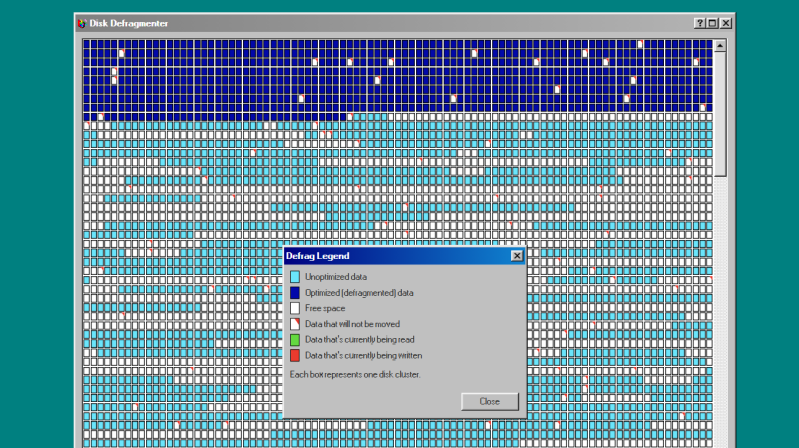
Disk Defragmenter was a wonderful utility that Microsoft included with Windows back in the day. Back then, you’d use it to theoretically speed up disk access. Today, you can run a fun simulation right in your browser thanks to [Dennis Morello].

The theory behind defragmenting hard disks was simple. Your hard drive would store data on spinning magnetic platters. Sometimes, a given file or group of files would end up with their different parts scattered across different parts of a platter, or even multiple platters, as the file system tried to slot everything into the space available over time. On a drive accessed with a literal physical mechanism, this fragmentation of files across multiple areas of a disk could cause functional read speeds to drop. To solve this, you could defragment the drive, wherein a utility would grab disparate bits of different files and put them physically closer together on the drive platters, such that the read heads could access larger contiguous chunks of files more easily.

[Dennis’s] project does none of that. It just simulates the visuals and sound of running Microsoft’s disk defragmenter tool from Windows 98. It’s got the little rows of squares that get rearranged, blue for unoptimized data, dark blue for defragmented data, and white boxes for free space. It’s got the progress bar along the bottom, too, and a nice little simulated sound of a hard disk ca-chunking away as it shuffles little bits of data to and fro. This was the kind of thing you’d do on a rainy Saturday afternoon in the 1990s, just watching your PC make itself a few percent faster while you drank coffee and wondered if your ex-wife Jacinta was ever coming back. She never did, but you did notice that Age of Empires II loaded a fair bit quicker after you ran a full defrag on your main drive. Sometimes, that’s as good as it gets.

Modern file systems are better at managing issues like fragmentation, and the virtually instant seek speeds of solid-state drives essentially eliminated the need for defragmentation for good. Still, it’s fun to visit an ancient tool from yesteryear and remember what it meant to us way back when. Maybe you could give Jacinta a call, too, just for old times sake, and discuss that time a Janet Jackson song started crashing brand-new Windows laptops right out of the box…
Building An Energy-Harvesting Business Card

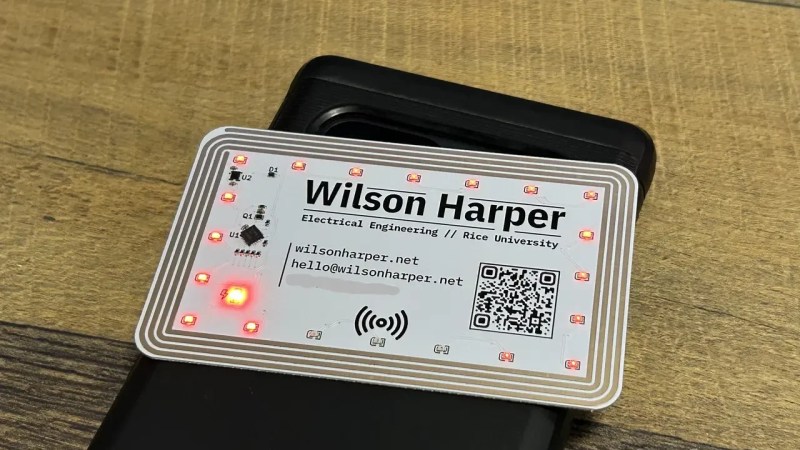
The hope is always that a good business card will leave a good impression. For those in the electronics field, they also serve as an opportunity to showcase creative design skills. [Wilson Harper] demonstrates that ably with a rather nifty energy-harvesting build.

The card is based around a thin PCB in the typical business card size. It’s populated by 21 Charlieplexed LEDs, a small microcontroller, and some supporting components. Now, this is normally where you might expect the device to be powered by a small coin cell, maybe deftly integrated into the PCB thickness itself to make the card less cumbersome. But no—[Wilson] went a different route. The thing is that in 2026, most of us are carrying phones with NFC readers built in. Thus, the card was built to harvest this source of energy with a PCB trace antenna, designed with the aid of STM’s antenna inductance tools and an LLM script lobbed into KiCad. All one needs to do is to pop the card on the back of a phone and the LEDs animate joyfully.

Design files are on Github for the curious. You might also like to check out some of the fancy business cards we’ve featured in the past. Of course, if you’re working on just such a project yourself, you’re more than welcome to send it in to the tipsline!

Hackaday Europe 2026: PCBs With A Plot

Printed circuit boards were developed first for function over form. They were a way to mount components and connect them in a stable, robust fashion, while taking into regard things like packaging and cooling requirements to enable a circuit to function. Circuit boards often end up looking cool in a techy kind of way, but their aesthetic is usually very much secondary to their actual purpose.

Katrin Dietzsch likes to use her PCBs a little differently, however. She designs boards that are intended to be a narrative tool for tabletop roleplaying, and came down to Hackaday Europe 2026 to walk us through the development of this very whimsical hardware.

Roll For It

Katrin starts her talk by explaining how she came to design circuits specifically for tabletop gaming. She saw an opportunity to combine her hardware hobby with the world of TTRPGs to help maintain both hobbies amidst a busy lifestyle. She also found that hardware she built could be a great artistic medium for supporting mystery and storytelling in the tabletop world. With the right design, her circuits became very much part of the narrative themselves.

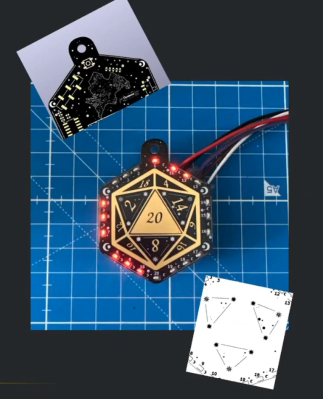
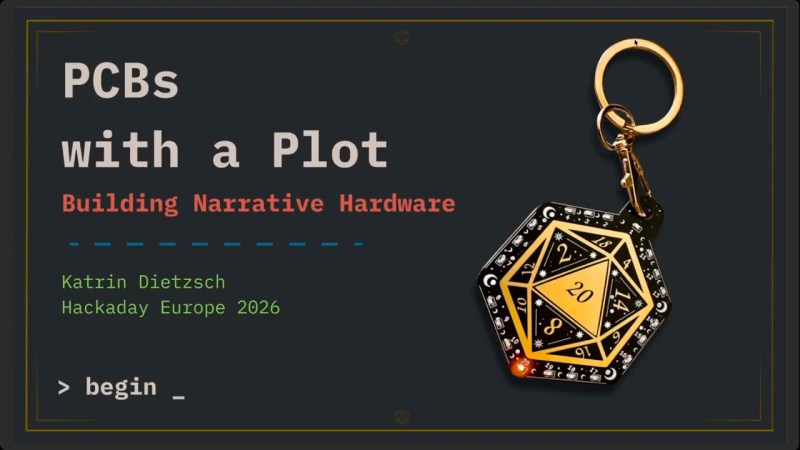
Getting to see Katrin’s PCB D20 is a highlight of the talk. It’s a great example of creative board design.

How does one create a piece that becomes special, rather than just being another art project thrown in a drawer, though? Katrin notes that meaningful objects are the ones that gather stories about them and gain emotional baggage, and thus, relevance. Interaction is also key; she relates the familiar tale that many of us have yelled at a printer before. We often anthropomorphize objects or assign them personalities just because they have some level of strange behaviour, or even if they just blink at us. Often, she’ll also start a build not from specs, but from story and the game itself. The questions asked are about how to engage players, and how to help them reach their goals, and answering those can help guide the design process.

There are also elements drawn from typical ideas around magic and artifacts that can be drawn from. For example, many tabletop roleplaying games feature the concept of attunement, where a character may have to physically and spiritually connect with an object to access its magical features. This is something that can be readily recreated in the electronic world with the use of things like capactive touch sensing. Katrin also notes that using RF can be great for creating items or puzzles that respond based on proximity, and there is all sorts of fun to be had with things like IR beams, motors, switches, or whatever else players can interact with. Code is also a beautiful place to hide secrets and easter eggs—you get to write the behaviour of the device to be as beguiling and confounding as you like.

You could use paper maps… or perhaps you could whip up a PCB with traces and solder mask and silkscreen and interactivity all woven together to create something altogether more compelling and interactive. There are grand possibilities in this space for your tabletop game to transcend the usual.

There’s also the visual side of things. It’s something that should be remarkably familiar to anyone who has been to a modern hacker or maker convention and seen the wonderful variety of badge designs created by the community. Everything from the copper layers to the silkscreen to the very routing of the fiberglass board itself can be leveraged to create an art piece that captivates and inspires. Particularly in this era when it’s so easy to find board houses that will produce your designs with soldermask in all the colors of the rainbow. Katrin’s wonderful D20 PCB serves as the perfect example of these techniques being applied well.

Like any good tabletop aficionado, Katrin has a great sense of practicality too. There’s no point designing some fantastic electronic gizmo for your game if you can’t afford the bill of materials, can’t solder the parts, or your players can’t figure out how they’re supposed to use an in-circuit programmer to interact with it. Most of us live very busy lives, so our hobby projects have to be achievable within the constraints of our lifestyle. She also notes that it’s great if you build something with longevity, rather than something that serves only as a single-use tchotchke for a one-off bit.

If you’ve ever contemplated bringing your electronics skills to bear in your role as a dungeon master, Katrin’s talk is a great place to start. Your little creations can serve as a wonderful bridge between your player’s experience and the world of imagination you’re collectively creating, and that’s always a fun time!

Hacking A Cat Litter Box

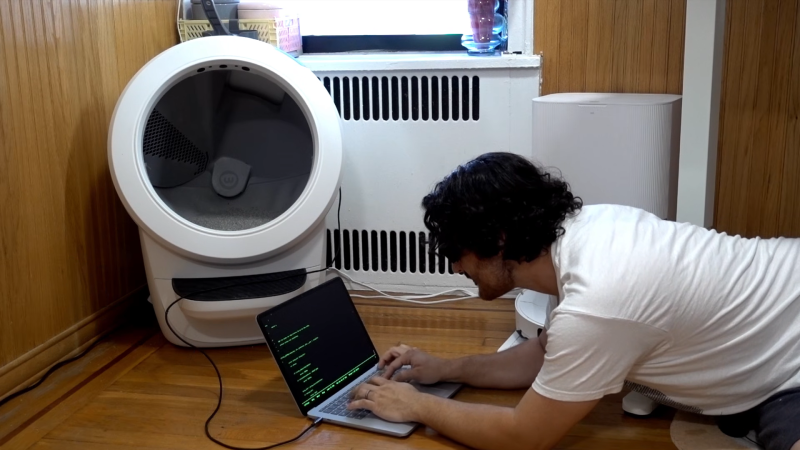
[Joseph DiGiovanni] is the owner of a Litter Robot 4. It’s a convenient mechanized litter box for cats that can clean itself to reduce unwelcome odors inside the home. He wanted to run automations based on the operation of the litter box, but was not eager to use the manufacturer’s cloud service to do it. Instead, he set about reverse engineering the device for his own ends.

Since the Litter Robot 4 relies on an ESP32 microcontroller for external connectivity, it was entirely possible for [Joseph] to whip up a custom firmware for the device instead. He started with ESPHome as a base, which is a popular firmware used for building smarthome devices based on Espressif hardware. The architecture of the Litter Robot 4 helped in this regard. It uses a PIC microcontroller to handle the low level hardware control, while the ESP32 is responsible for connecting to the cloud over WiFi. This allowed [Joseph] to mess with the connectivity features and get the device hooked up to Home Assistant without compromising the basic mechancial functionality of the device or any of the safety features.

All [Joseph] had to do was figure out how the original hardware’s ESP32 talked to the PIC and emulate that in his own firmware, which was achieved with some snooping and data capture and processing with an LLM. This was used as a basis to whip up an ESPHome firmware that could integrate the hardware neatly with Home Assistant.

Files are on Codeberg for those eager to tinker. It’s not the first time we’ve looked at cat litter management, and it won’t be the last. Video after the break.

Homebrew 68K Machine Has A PCI Bus

The Peripheral Component Interconnect (PCI) bus was first introduced all the way back in 1992. It quickly became the standard way to interface add-on cards on the PC platform, supplanting earlier buses like ISA and various other oddball standards. You wouldn’t expect to see a PCI bus on a Motorola-based machine, but [maniek86]’s homebrew rig offers just that. 

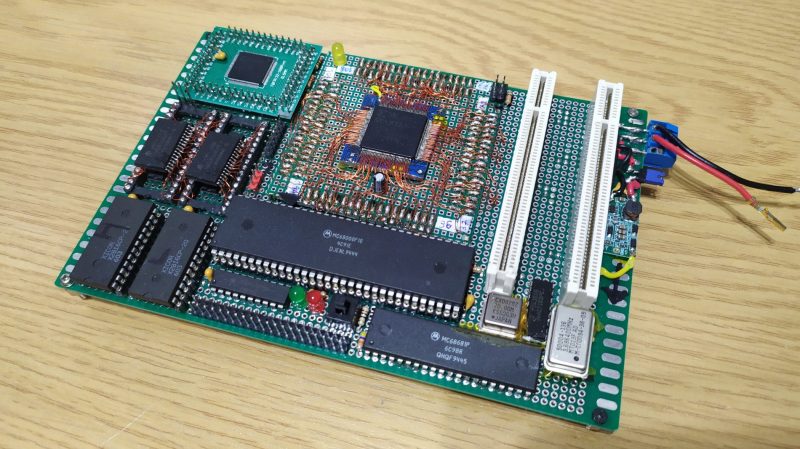
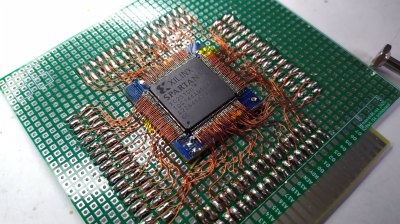
That’s a lot of soldering.

This computer is a beautiful piece of homebrew engineering, constructed out of protoboard and loose wires rather than any fancy PCB. At the heart of the build lies a Motorola 68000 running at 10 MHz. It’s got 1 MB of SRAM, 4 KB of ROM, and a MC68681P acting as a UART, timer source, and I/O controller. Where things get special, though, is in the inclusion of a Xilinx Spartan II FPGA (XC2S100), which acts as a PCI bridge. It provides the machine with two 32-bit 5-volt PCI slots which are interrupt capable, albeit with no bus mastering. A XC95144XL CPLD also sits present to act as glue logic to help lace everything together.

[maniek86] does a great job of explaining exactly why the PCI bus was hard to implement, and how it was pulled off in the end. The guide also covers how the system was able to interface various cards, from a PCI serial expansion to a Cirrus VGA adapter. It’s all good stuff.

We’ve featured other work from [maniek86] before, too, like this brilliant 486-based single-board computer. Video after the break.

❌