❌

Reading view

There are new articles available, click to refresh the page.

The U.S. Military Has Much to Learn From Ukraine

“What does Ukraine really need? How do we make sure they're delivering what they actually need? And you know, right now those are air defense munitions, it's funding for drones, it's extended range artillery, electronic warfare, etc. And then the other big thing was to try to improve predictability because, you know, Ukraine could only plan operationally, if they knew what they were getting. And so how could we help better inform their planning efforts and their ability to operate together?”

That was just-retired -- on October 1-- Army Lt. Gen. Curtis Buzzard, most recently the former U.S. Commander of Security Assistance Group – Ukraine (SAG–U) and NATO Security Assistance and Training for Ukraine (NSATU), speaking last Wednesday on the Center for Strategic and International Studies (CSIS) streaming podcast, The Last Line of Defense.

Being in charge of both these headquarters, located in Wiesbaden, Germany, Buzzard said he had traveled to Ukraine “some 30 times” over the past two years and was able to “develop close relationships with government officials, with the general staff, with units, and really watch them evolve over this period, visit the unmanned systems force, [and] visit some of these underground command posts.”

As a result, he said, “I think this is the most consequential environment to observe the evolution of warfare right now. And it really gave me firsthand observations about the future of war. It's really an action, reaction, counter-counter-reaction at an incredible pace.”

After Russia’s February 2022 invasion, Ukraine has turned it into “a brutal contest of wills,” Buzzard said, adding, “Who would have imagined they've [the Ukrainians] essentially halted the Russian offenses, and Russia's not accomplished a strategic objective in this war yet. And the Ukrainians have been doing this largely with innovations in unmanned systems, particularly drones.”

Buzzard confirmed reports that Ukrainians “largely have stopped Russian advances and these continued attacks are at great cost to Russia.” He continued, “You know over 30,000 [Russian] casualties a month generally and, from reporting, over 60 percent are fatalities. So this is incredibly lethal and that costs Russia money to recruit and to pay death gratuities.”

But it were the details that Gen. Buzzard went on to describe that made his presentation most interesting.

For example, Buzzard said, “When when anybody wants to talk about employing unmanned systems [in Ukraine]…I'd say the secret sauce is really Delta. It's this mission command system that enables them to be…fast, flat, and accurate [with] over 200,000 users -- on a handheld device like your cell phone or a tablet.”

Developed by Ukraine’s Centre of Innovations of the Ministry of Defense and Aerorozvidka, a prominent Ukrainian civic-tech volunteer NGO and military unit specializing in aerial reconnaissance, Delta is a cloud-based, modular situational awareness and battle management system that gathers and integrates data from diverse sources, and mapping it in real time.

Buzzard said, “I used to carry [a] tablet with layers of intelligence so you can see where the enemy is. You can coordinate missions. You can do targeting on there. You can also see every drone feed, and they've got an app called Vasia which allows you to ingest every drone feed, so you're not having to [deal with], you know, proprietary computers with imagery or whatever.”

Actually, Vasia, according to her Instagram, is the call sign of vasylynanakonechna, a well-known female drone operator and the Deputy Commander of a UAV unit within the Ukrainian Armed Forces called the White Demons. “War is brutal and dangerous,” she has written, “but our goal is simple: risk technology instead of people whenever possible.”

Buzzard last Wednesday continued saying of Delta, it “allows them to fight so fast and rapidly upload BDA. I mean battle damage assessment. Yeah, to rapidly upload what they've just done, and then using that data to better understand what tactical effects they've had on the battlefield.”

Buzzard identified “the guy that's really remarkable doing this” was Major Robert Yosypovych Brovdi , Commander of the Unmanned Systems Forces of Ukraine, “who was a businessman three years ago, a grain trader, art dealer.”

Buzzard went on, “I mean, his [Brovdi’s] underground command posts are kind of a surreal experience because you're watching essentially like a Vegas stream of what effects they're having on the battlefield in terms of destruction of enemy. And then there's this incredible piece of art with a QR code [quick response matrix bar code] on it where I could look up the history of it.”

“You know,” Buzzard said, “they're sitting on the world's best combat data when you think about all the imagery feeds, all the understanding of Russian attacks into Ukraine and what routing speeds -- you know all this stuff. And so there's opportunities to work with them to use this to inform aided target recognition…to support Ukraine first and foremost, but also to learn ourselves. There's a professional responsibility to do that. This data in particular reinforces this idea of a lab, a battle lab that this fight in Ukraine is kind of like the Silicon Valley. I mean, they already had a real knack for technology and innovation.”

I should insert here that Buzzard also said Ukraine drone companies put a QR code on each drone.

“So, if you're out on the front,” he continued, “you get a drone from a company and there's something wrong with the drone, you scan the QR code; it'll go right back to a 24-hour op center of a Ukrainian company; then probably down to a team that's there to help you out; or you may even talk to them right away. And then, if it needs to be adjusted, they're probably changing the production line within 48 hours. So you know how to adjust that rapidly or if the [radio] frequencies change how rapidly they got to change what frequencies are on. So just an incredible amount of innovation [arrives] at a pace that is important and gives you combat advantage quite honestly. And so I got to think about how do we learn from this?”

At one point, Buzzard said, “The number one thing I've learned, and a lot of people would ask, is it technology, you know, drones, is it whatever? It's this velocity of learning that the Ukrainians demonstrate -- from observing, to learning, to adapting. to then fighting it again. This loop, action, reaction, counter-action, is just unbelievable. And I think it equates to combat power. And when you look at a lot of the success they've had on the battlefield, it's due to their own innovation.”

For example, he said the Ukrainians “didn't have enough mid-range strike capabilities, so they invented their own…There weren't enough interceptors to engage [Iranian-designed] shaheds.” These were one-way attack unmanned combat aerial vehicles and loitering munitions and now there are jet-powered shaheds.

Buzzard went on, “So they created their own. They created drone interceptors which actually from a cost standpoint are tremendously cheaper than what it would normally cost,” adding, “And they've really kind of mastered, I would argue, the cost of war -- developed cheap attritable [interceptors] because they haven't had expensive and exquisite. And I think that's an important lesson for us to learn, you know, what's the right balance of that, and how do you layer this capability with some of the very exquisite stuff that that we have also.”

Buzzard also noted, “It's just unbelievable how quick they iterate. As you look at some of the [Ukraine] long-range strike with drones, you know, even over the course of several months, it's a different drone, a different technique…What's used in the latter, you know, an earlier and a later one as you compare these things.”

He also noted “some incredible innovation particularly in the middle, deep-strike [drones], and then they're learning a lot just about how to do this. How do you weave through the electromagnetic signature, the EW [electronic warfare], the air defense; what's the right weapon to target pairing? What's the type of redundant network? How do you dynamically control all kinds of other things that I think would be hugely valuable for us, but again it all comes back to that velocity of learning from unit to industry to government funding.”

Buzzard also talked about some Ukraine counterattacks that have not gotten much public attention in the U.S.

“Right now,” he said, “there's one,Operation Vivaldi, a lot of folks are talking about with [Ukraine’s] Third Army, Gen. [Denys] Prokopenko down at Donetsk had done counterattacks, and Gen. Oleh Apostol, the Airborne Commander down south had done them in Zaporizhzhia.”

Buzzard continued, saying, “They've been taking back terrain too in the midstrike [areas] that's been very effective, about 20-to-30-to-150 kilometers, to help relieve pressure on the front so they've been very effective at striking logistics nodes, command and control, etc., electronic warfare.”

Buzzard also talked of “Ukrainians deep strike into Russia, most of that's with indigenous capabilities and a ton they've learned on just how to execute that. But that's clearly had an impact. Also, most recently, these huge logistics sites, Wildberries.” The latter, Wildberrries,

being Russia's largest online marketplace, and the attacks are part of a Ukraine campaign to disrupt Moscow's wartime economy.

Buzzard concluded, “So collectively I think this all aggregates to be military pressure, economic pressure [on Russia]…You know if I'm inflicting a lot of [Russian] casualties on the front, he's [Putin] potentially losing terrain. His economy is getting worse every day. Ideally at some point would he think that a deal today is better than a deal tomorrow?”

Buzzard went on to speculate, “And I don't know whether that'll actually end up happening or not, but they're [the Ukrainians] certainly in a position that in terms of what they're doing and I think these long-range strikes you're seeing from Russia to Ukraine now are really somewhat of desperation, because they're not achieving anything on the front or very little gains. And so the only thing they [the Russians] can do, and a lot of its impact is due to [shortage in Ukraine of] global supply of air defense interceptors, is [for Putin] to strike into Kiev and make it seem like they're more effective [against Ukraine] than what they really are.”

Buzzard presented a more optimistic view for Ukraine than I see, in part because he has left out President Trump’s recent moves that favor Putin and the Russian side. I don’t believe that either Putin or Trump know what’s going to happen next. Only Ukraine President Volodymyr Zelensky seems to have a set path, and that is to continue defending his country by seeking continuing aid from supportive countries.

The Cipher Brief is committed to publishing a range of perspectives on national security issues submitted by deeply experienced national security professionals. Opinions expressed are those of the author and do not represent the views or opinions of The Cipher Brief.

Have a perspective to share based on your experience in the national security field? Send it to Editor@thecipherbrief.com for publication consideration.

Read more expert-driven national security insights, perspective and analysis in The Cipher Brief
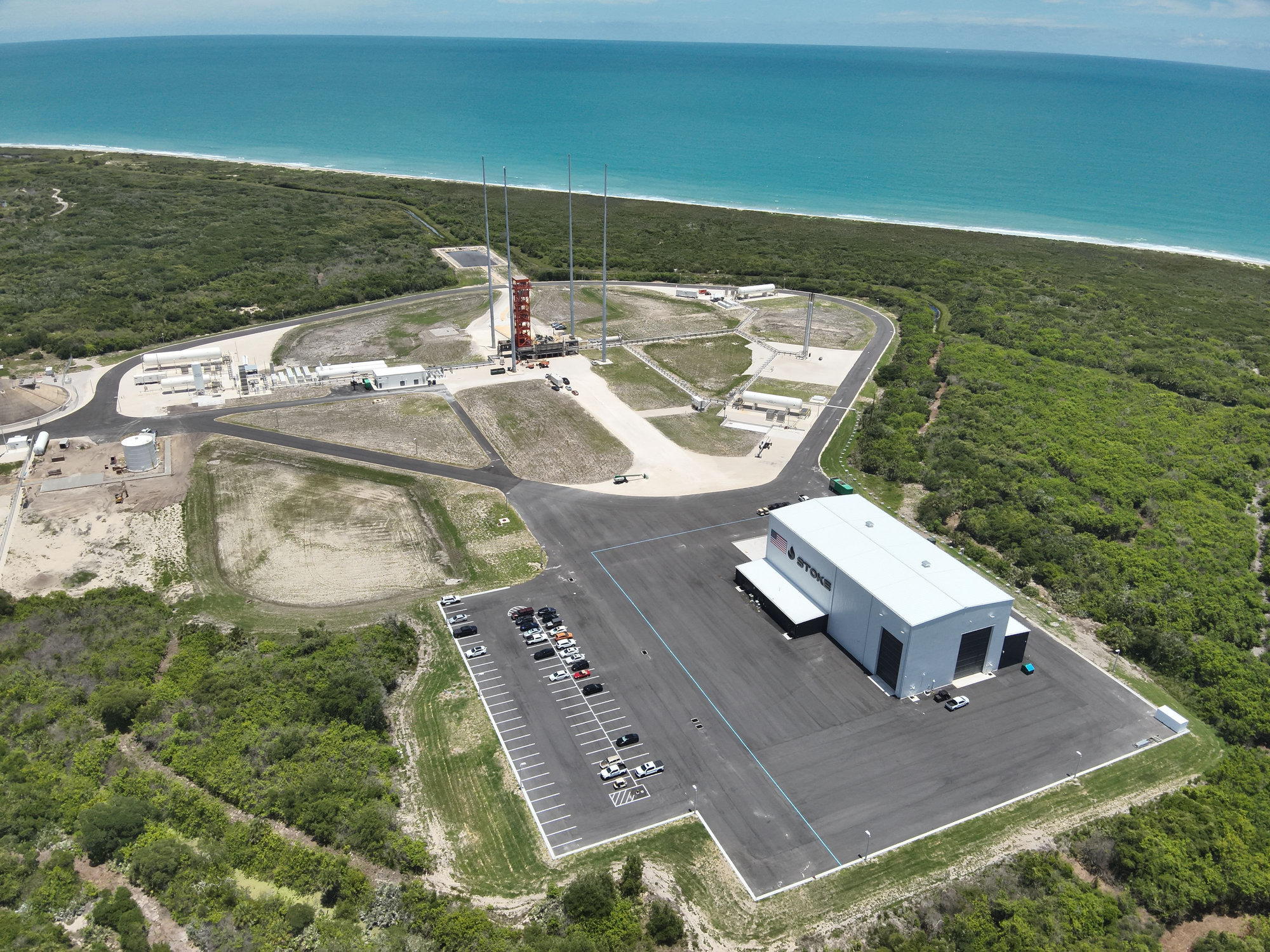
Stoke Space lines up $150M Pentagon loan for a second launch pad in Florida

Stoke Space’s existing Cape Canaveral launch site in Florida. (Stoke Space Photo)

Kent, Wash.-based Stoke Space has secured a conditional commitment for a $150 million loan from the Department of War’s Office of Strategic Capital to build a second launch pad at Cape Canaveral for a larger version of its fully reusable rocket.

The loan isn’t final until Stoke meets a list of financial, legal, technical and due-diligence requirements. The announcement Monday comes less than two months after Stoke raised roughly $1 billion in a Series E round, bringing its total funding to about $2.3 billion.

The new pad would serve Stoke’s Nova Block 2 rocket, which is designed to carry up to 15 metric tons to low Earth orbit. That’s five times the capacity of Nova Pathfinder, which Stoke plans to launch for the first time from its existing pad in early 2027. Block 2 is slated to debut in 2029.

The loan would be paired with private capital to pay for the pad, according to the Department of War. Jordan Sebold, senior managing director for investments at the Office of Strategic Capital, said in a statement that adding launch infrastructure would “enhance the overall capacity and resilience of the commercial space industrial base.”

The Office of Strategic Capital was set up in 2022 to draw private investment into technologies seen as critical to national security. The following year, Congress gave it the power to make loans and loan guarantees to companies in those fields. Space launch is one of the technology categories it targets.

“By expanding domestic launch facility capacity, this investment enables launch service providers to ensure our commercial and defense partners have reliable, high-cadence access to space,” David Lorch, the office’s director, said in the news release.

Stoke is already lined up for military launch work. In 2025, the Space Force added the company to a pool of providers that can compete for national security missions under Lane 1 of the program’s third phase. Lane 1 is the tier meant for newer launch companies and less demanding payloads. Stoke can’t bid on those missions until it completes a successful orbital flight.

The company has other federal ties as well. The Defense Innovation Unit awarded Stoke a $4.5 million contract in 2024 to study rapid delivery of cargo to orbit, and possibly back to Earth. In June, Stoke was one of 37 companies NASA chose for unfunded partnerships. Stoke’s project focuses on returning Nova’s upper stage safely through the atmosphere.


Nova is designed so both of its stages can return and fly again. The booster flies itself back for recovery. The upper stage uses a metal heat shield cooled by liquid hydrogen that circulates through channels inside it, to survive the heat of reentry. Only SpaceX, with its much larger Starship, is pursuing the same goal, and it hasn’t fully achieved it yet. Stoke has yet to launch a rocket to orbit.

Stoke was founded in 2019 by two Blue Origin veterans: Andy Lapsa, the CEO, and Tom Feldman, the chief technology officer. The company has about 400 employees. Most work at its 168,000-square-foot factory and headquarters in Kent, and about 50 are at its test site in Moses Lake, which is expanding from 75 to 550 acres. About 50 more work at Cape Canaveral.

GeekWire reached out to Stoke Space for comment and we’ll update this story when we hear back.

America's Defense Department Is Building an 'Elite New Tech Sabotage Agency'

America's Defense Department "has spent months quietly building an elite new tech agency," reports Politico, "to help covertly disrupt and sabotage foreign technology programs considered threats to American military superiority." Information on the Technology Support Office, or TSO as it is called internally, is nearly impossible to find on Pentagon websites, and the agency is mentioned by name only in several previously unreported Defense Department historical records and memoranda. While the specifics of its work are highly classified, POLITICO spoke with 12 current and former U.S. national security officials with varying degrees of knowledge about TSO to understand how the agency came to be, the broad contours of its mission and why its operations are shrouded in secrecy... [The Pentagon's Defense Secretary and Deputy Defense Secretary] established TSO quickly and without attracting outside scrutiny because they largely built the agency by reorganizing two classified Pentagon intelligence programs that have conducted similar clandestine tech-sabotage efforts at a smaller scale since 2023. But by creating an agency dedicated to expanding that work, the Defense Department is signaling its intent to ramp up a range of aggressive covert activities abroad — potentially including cyberattacks, supply chain disruptions and disinformation operations. Many of the people who spoke to POLITICO argued that the aggressive new initiative is needed to help the Pentagon counter foreign adversaries they say are harnessing artificial intelligence and advanced commercial technologies, such as drones, in creative ways that could erode America's military advantage... While TSO lacks the legal authority to conduct clandestine operations directly, it works closely with senior U.S. military and intelligence officers to develop cutting-edge tools and strategies to disrupt adversaries' access to critical defense technologies — or subvert them from afar. TSO is staffed with engineers, special operators and intelligence officers, and its work spans everything from building bespoke hacking tools to planning elaborate deception operations that trick adversaries into installing faulty components — likely designed by TSO — in key foreign weapons platforms. TSO's overarching goal is to "buy time or stop adversaries from developing technologies" that would most threaten the U.S. military in a major conflict, said a former U.S. intelligence official who worked closely with the agency... A second former Pentagon official and a former U.S. national security official said the agency has told some defense contractors it's interested in offensive hacking capabilities. The former senior Pentagon intelligence official estimated that its budget for classified contracts alone is likely north of $1.5 billion. They are seeking contractors on "the leading edge of technology," that official said, and hope to procure "a whole host of tools wherever your imagination can go." Pentagon staff had been exploring the need for a new agency for over a year, the article explains. Creating a new agency with its own budget and procurement powers "would empower the agency to more quickly integrate cutting-edge tech from the private sector," Pentagon staff concluded, "and think more strategically about which foreign defense technologies pose the biggest threats across U.S. military organizations." "Several people who spoke to POLITICO support TSO's mission but worry that the secrecy surrounding its work could embolden current Pentagon leadership to carry out missions that flout international law or funnel coveted classified contracts to political allies." Thanks to long-time Slashdot reader schwit1 for sharing the news.

Read more of this story at Slashdot.

America's War Department Will Test Heat Ray Weapon For Potential Use

Longtime Slashdot reader destinyland shares a report from CNN: The Pentagon has given the Department of Homeland Security permission to test a military-grade heat ray and develop tactics to potentially use it in operations at the southern US border, according to a memo signed by Defense Secretary Pete Hegseth last month and obtained by CNN. The heat ray, officially known as the Active Denial System, is a nonlethal weapon that shoots an invisible beam of electromagnetic waves that can reach a little more than half a mile away, according to the US military. The energy beam causes a burning sensation when it comes into contact with the human skin -- which Pentagon officials have previously compared to feeling a blast of heat when opening a hot oven. Military officials have said the resulting "tingling effect" lasts between 10 and 15 minutes but also generates "an instinctive and irresistible urge to run from the effect."

Read more of this story at Slashdot.

Ukraine Claims World's First Drone Evacuation of Wounded Soldier

Ukraine says it carried out the world's first evacuation of a wounded soldier by aerial drone, using a heavy-lift hexacopter after enemy drones and landmines made conventional ground evacuation too dangerous. NBC News reports: Shared by the 92nd Separate Assault Brigade on Monday, the video shows the soldier strapping himself into a large drone and being flown at what appears to be relatively low altitude over blurred-out territory. The drone carefully lowers him, and the drone operator greets him with "Welcome back to the ground!" The video also shows blurred faces of drone operators who carried out the mission. The post said the unidentified infantryman was wounded at his position. "Due to intense enemy drone activity and the presence of landmines, evacuation using conventional unmanned ground vehicles was impossible," the brigade said. "At that point, the specialists in our unit took it upon themselves to attempt something that had never been done before: evacuating a serviceman using an aerial drone," it added. The craft was a heavy-lift hexacopter, it said, originally designed as a bomber by a Ukrainian manufacturer. It looks about twice the size of the soldier in the video. The specialists working on the mission had to ensure the drone could carry a human being without flipping over or swaying excessively, according to the unit.

Read more of this story at Slashdot.

Ukraine’s drone rescue of wounded soldier puts much touted idea into practice

Ukraine’s unprecedented drone rescue of a wounded soldier from the battlefield has shown once again how battlefield necessity can spur innovation. The operation was revealed just days after separate Ukrainian drones designed for casualty evacuation were deployed for frontline testing—taking a step beyond the US military’s decades of experimentation with similar concepts.

The drone evacuation of the injured soldier took place at an undisclosed time and place on the frontline where the presence of Russian drones and landmines made it impractical to send in a wheeled ground robot, according to The Kyiv Independent. On October 19, Ukraine’s Army shared a video of the drone evacuation, showing the wounded soldier securing himself in a harness suspended beneath a heavy hexacopter drone with six rotors before being flown to safety.

“This is a historic event, the next stage of evacuating the wounded, which we will all come to,” said Napalm, a programmer of the 92nd separate assault brigade's unmanned ground systems company, who went by his callsign per Ukrainian military practice, in a statement. “Now the serious systematic work begins, so that such missions are carried out constantly.”

Read full article

Comments

© 92nd Separate Assault Brigade of the Ukrainian Ground Forces

Hegseth’s dubious low-T screening may flag up to 25 percent of the Army

Up to a quarter of active-duty Army members could receive a low testosterone result from mandatory military screening, despite the true prevalence of the condition likely being a tiny fraction of that figure, according to a study published Thursday in JAMA.

The finding adds to concerns that the mandatory screening announced by Defense Secretary Pete Hegseth in July will lead to a cascade of unnecessary medical evaluations for military members. Those evaluations could result in inappropriate testing, inaccurate results and diagnoses, and overtreatment that could cause harm, including infertility. Medical experts, including the Endocrine Society and the American Urological Association (AUA), have recommended against blanket screenings for these reasons. Still, the Pentagon has moved forward with the plans, releasing clinical guidance in September.

The JAMA study highlights the reasons why testosterone levels are not measured in men without symptoms—and also offers a glimpse of how many Army members could become ensnared in the clinically dubious screenings.

Read full article

Comments

© Getty | Win McNamee

America’s Military Has a GPS Problem

“The Department of Defense’s (DoD) Global Positioning System (GPS) is the principal source of positioning, navigation, and timing (PNT) information for the U.S. military and civilian users. Due to DoD’s reliance on it, GPS also represents a potential single point of failure for DoD. We [the Government Accountability Office (GAO)] previously reported on DoD’s efforts to modernize GPS with a more jam resistant, encrypted, military-specific signal, referred to as military code (M-code), and we found that DoD is years away from fielding this capability after spending more than two decades and billions of dollars.”

That was the opening of a GAO letter sent last Wednesday to Congress accompanying a 58-page report titled PRECISION NAVIGATION SYSTEMS: Challenges Remain with Fielding New Capabilities, which explains the key role that GPS delivery of PNT data plays in this country’s military and civilian activities -- and the need to update the system.

The M-code secure, jam-resistant GPS signal is designed to be used by roughly 700 U.S. weapons systems deployed by Army, Navy, Marine Corps and Space Force services, but because of a limited supply of specialized microchip sets and production bottlenecks of other key elements, some M-code deployments have been pushed back to 2049, according to the GAO.

I will discuss this more below. Meanwhile, the U.S. military services continue to rely on legacy GPS receivers or alternative systems for PNT-guided operations. For example, the GAO report described “non-satellite-based PNT using data derived from internal or external sources of information to sensors, from geophysical sources, or from celestial sources (e.g., inertial measurement units, cameras or terrain sensors, magnetic or gravity sensors, and celestial sensors).”

First, a bit of GPS background and history supplied in part by the GAO.

GPS consists of three segments: a constellation of approximately 31 medium Earth-orbiting satellites, with at least 24 continuously broadcasting their position and time data; a ground control segment – Space Command’s Delta 8 at Schriever Air Force Base, Colo. -- for command and control of the satellite constellation; a user segment, comprising receivers used globally by military and civilians in aircraft, ships, land vehicles, precision-guided munitions, and handheld devices.

The user equipment receives signals from four GPS satellites and, with that transmitted data, instantly calculates the user’s location and precise time.

Although the U.S. Government created and continues to control and maintain GPS, it is freely accessible to anyone with a GPS receiver. There are three other similar global systems: Russia’s GLONASS was developed during the Cold War; the European Union manages Galileo, and China operates the BeiDou Navigation Satellite System.

Today’s U.S. GPS originated in 1973 when the Defense Navigation System, later named NAVSTARS GPS, was approved, primarily to guide ships. In 1978, the first GPS satellite was launched into orbit, with the full satellite complement not reaching initial operational capability until 1993. By then, it had been made available for civilian use as well as military, a decision made by President Reagan in 1983 after the Russian downing of Korean Air Lines Flight 007.

By the 1991 Persian Gulf War, the GAO report said, “GPS equipment was small and inexpensive enough to also be used on aircraft and other military vehicles. Since then, further advances, such as the development of even smaller microchip-sized receivers, have allowed GPS to provide precise PNT information for individual soldiers, munitions, smaller weapons technology applications, and civilian applications, like smart phones.”

Meanwhile, according to the GAO report, “GPS signals are being actively targeted by adversaries who seek to disrupt or deny GPS to U.S. warfighters. These threats include (1) jamming, (2) spoofing, (3) cyber, and (4) direct attacks on satellites or satellite infrastructure.”

DoD is mitigating jamming attacks “by installing specialized antennae -- referred to as controlled reception pattern antennae (CRPA) -- on weapon systems and munitions,” according to the GAO report, which added, “These antennae provide the ability to identify and filter out the jamming signals.”

Spoofing is being dealt with “in part by developing and installing receivers with M-code capability, which will provide more secure encryption,” the report said. As for cyberattacks, DoD is “ensuring that computer systems and networks are protected against cyber attacks that can target satellites and their associated ground control systems,” according to the GAO.

Since 2000, the Air Force -- and later the Space Force – have pursued a multibillion-dollar effort to modernize the existing GPS capability. The modernization effort included adding the more robust and more securely encrypted GPS military signal capability, known as M-code. It also included: 1) satellites that broadcast the M-code signal, 2) a ground system that controls both the existing and new M-code GPS satellites, and 3) user equipment to receive the M-code signals.

The first satellites capable of broadcasting M-code have been on orbit since 2005, with upgraded versions referred to as GPS III.

The launch of the GPS III third generation of 24 M-code satellites was completed on April 21 of this year, providing eight times the anti-jamming capability and four times the accuracy of previous iterations. “The next generation of satellites, known as GPS III Follow-on, or GPS IIIF, are in production by Lockheed Martin, and will begin launching as early as 2028,” according to a Space Systems Command press release.

However, it’s a different story with the new generation ground system, referred to as Next Generation Operational Control System (OCX). It began development in 2010 and was supposed to achieve transition to operations by June 2017. Instead, there were numerous technical problems and protracted delays. Costs rose from $3.7 billion to almost $7 billion or more, and in April 2026, DoD directed the Air Force to formally terminate the OCX program, according to the GAO report.

Despite the cancellation of the OCX program, then-Chief of Space Operations Gen. Chance Saltzman said in April the new ground control system needs to be prepared to support future GPS satellites, including GPS IIIF and beyond.

However, despite the OCX problems, the Space Force has been making upgrades to the existing GPS ground control segment through Lockheed Martin. Last week, an Air and Space Forces Magazine daily report said, “Since April, the Space Force has awarded Lockheed an additional $199 million…to support launch and command and control for GPS IIIF satellites…and to begin a full technology refresh of the GPS ground segment hardware and software.”

The final problems harming total GPS modernization – including delays and mounting costs – are best portrayed in the GAO report’s description of the military services’ development and procurement of separate receivers for the M-code data.

While development of the M-code-capable receiver cards has been led by the Space Force and Air Force, the eventual fielding of receivers to specific operational platforms, such as weapons, has remained the responsibility of the individual services.

According to the GAO report, “Currently, there are more than 50 priority weapon systems [considered in the GPS modernization programs]. The largest numbers of priority weapon systems are in munitions and aviation systems. The Navy has the highest number of systems, followed by the Army…Priorities for M-code modernization take into account the needs of the specific classified operational scenario as well as the expected life spans of the weapon systems involved. Weapon systems that are expected to no longer be in use around or before 2030 are not priority weapon systems.”

Congress mandated the PNT Oversight Council in the Fiscal Year 2016 National Defense Authorization Act, and DoD established it with the mission of overseeing the department’s GPS modernization portfolio.

However, as the GAO report explains, “Budget authority for key aspects of DoD’s PNT efforts remains under the control of the [separate military] services. This budgetary fragmentation complicates efforts to align interdependent PNT capability development and fielding efforts to ensure timely delivery to the warfighter.”

For example, the GAO found that despite recommendations from the PNT Oversight Council concerning inadequate Air Force funding for aviation receiver programs, “chronic underfunding” continued and the Air Force aviation receiver programs did not meet their development goals on their expected timelines.

“Pursuing modernized GPS and complementary PNT technologies to augment GPS,” the GAO report concludes at one point, “requires foresight and planning. Integration timelines for weapon systems are often lengthy, and schedules must be properly aligned for the development of such modernized PNT technologies and their integration into weapon systems. Additionally, these timelines for integrating new PNT technologies can be further complicated by the interdependence of systems. For example, the military services will likely upgrade some munitions to use M-code before the capability is integrated into weapon systems that fire those munitions.”

Since, as the GAO points out, the GPS system “is vast and touches almost all vehicles, ships, aircraft, precision-guided munitions, and dismounted personnel within the [Defense] Department,” I would say more DoD attention needs to be paid to getting this modernization back on track.

The Cipher Brief is committed to publishing a range of perspectives on national security issues submitted by deeply experienced national security professionals. Opinions expressed are those of the author and do not represent the views or opinions of The Cipher Brief.

Have a perspective to share based on your experience in the national security field? Send it to Editor@thecipherbrief.com for publication consideration.

Read more expert-driven national security insights, perspective and analysis in The Cipher Brief

Russia Was Not Ready For the Data Center War It Started With Ukraine

An anonymous reader quotes a report from Ars Technica: When Russia began attacking Ukrainian data centers and telecommunication infrastructure, it apparently failed to prepare for possible retaliation. Now Russia's digital services are facing widespread outages after Ukrainian drone strikes knocked out three of the largest data centers owned by Russian tech giant Yandex within several days. Pro-Kremlin bloggers are warning that Russia's centralized digital economy could collapse because the country is not prepared for the "data center war" it started, according to posts translated by the pseudonymous independent researcher ChrisO_wiki. The Russian commentators also suggested that Ukraine's decentralized digital services could prove more resilient than Russia's system if the countries continue trading such blows. Russia initially launched a drone strike campaign targeting Ukrainian data centers and mobile phone networks in late September. The attacks temporarily disrupted Internet and cell phone service for up to 100,000 households in the Ukrainian capital of Kyiv and came as part of a broader long-range strike campaign that has involved Russian missiles and jet-powered drones hitting Ukraine's power grid infrastructure, transportation hubs, and even residential apartment building blocks. But Ukraine soon began striking back at data centers owned by the Russian company Yandex, also known as "Russia's Google," in what Ukrainian President Volodymyr Zelenskyy has described as a "symmetrical response." [...] More importantly for Russian society, the damage to Yandex's data centers has reportedly caused interruptions or outages to popular Russian payment apps and digital banking services, email, e-commerce platforms, video streaming services, ride-hailing and food delivery apps, and navigation and map services. Yandex's search engine also accounts for about 70 percent of the market share in Russia. The disruptions are even more widespread, because the data center damage also impacts Yandex's cloud computing service, which counts some of Russia's largest companies as customers, according to The Moscow Times, an independent newspaper. These include large grocery and fast-food chains as well as a household appliance retailer.

Read more of this story at Slashdot.

Overland AI unveils IBEX, a new autonomous ground vehicle selected by the Marine Corps

Overland AI’s IBEX vehicle at the company’s proving grounds. (Overland AI Photo)

Seattle defense startup Overland AI has unveiled IBEX, a new fully autonomous ground vehicle selected by the U.S. Marine Corps to support counter-drone air defense operations and execute high-risk frontline missions, including resupply, breaching, and electronic warfare.

IBEX was developed under a Department of War APFIT production contract that recently expanded to $25 million with added funding for the Army’s 75th Ranger Regiment. The initial $20 million milestone deal made Overland AI the first ground autonomy startup to serve as a primary defense hardware supplier, with the Marine Corps selecting the platform for integration into its Marine Air Defense Integrated System (MADIS).

Built on the chassis, engine, and drivetrain of the Polaris MRZR — an ultra-light utility vehicle already used, fueled, and maintained across the armed forces — IBEX can carry a 2,000-pound payload and reach fully autonomous speeds exceeding 35 mph. The vehicle offers a 250-mile cruising range at 20 mph and is sized to fit inside a V-22 Osprey for air transport.

IBEX is powered by Overland AI’s proprietary OverDrive software stack, which combines real-time terrain perception with adaptive route planning to navigate complex, off-road environments at speed without relying on GPS signals or pre-mapped routes. Drivers can control multiple uncrewed vehicles simultaneously using OverWatch, the startup’s command-and-control software.

IBEX provides 5 kW of export power to run onboard sensors and defense systems, addressing energy limits in forward field operations. The company describes each vehicle as a combined power, communications, and compute node designed to operate independently in environments with limited or disrupted communications.

“We pride ourselves on developing technology that is informed directly by the warfighter,” Greg Okopal, co-founder and chief operating officer of Overland AI, said in a statement, adding that IBEX can be deployed on day one and maintained with the parts and fuel units already have.

The vehicle joins the startup’s existing flagship platform, ULTRA, as the company continues scaling production at its Seattle manufacturing facility to meet growing military demand for autonomous ground systems.

Founded in 2022 as a spinout from the University of Washington, Overland AI has rapidly expanded its defense operations, raising $100 million in Series B funding earlier this year.


The startup — No. 7 on the GeekWire 200 ranked index of the Pacific Northwest’s top startups — has raised over $140 million in venture funding to date.

In 2025, Overland opened a 22,000-square-foot production facility in the Rainier Beach neighborhood south of downtown Seattle. And this summer, the startup established an engineering outpost in Burlingame, Calif., aiming to tap into the Bay Area’s robotics and autonomy talent pool.

Overland AI’s growth reflects a broader defense technology boom across the Seattle region, where established firms and fast-growing startups are building major hardware and software footprints.

Companies expanding in the region include Shield AI, which selected the Seattle area for a massive manufacturing facility to build its autonomous X-BAT fighter jet; Anduril, which sees a path to 1,000 Seattle-area engineers across its Bellevue and Seattle hubs; and Echodyne, which opened a $40 million radar manufacturing factory in Woodinville to support drone detection demand.

Shield AI lands $150M Navy contract to advance AI-piloted fighter jet that will be built south of Seattle

Shield AI’s new X-BAT autonomous fighter jet is designed to take off and land vertically. Photo via Shield AI.

Defense technology startup Shield AI has secured a $150 million contract from the U.S. Navy to advance development of its X-BAT autonomous fighter jet — providing fresh federal backing for the program as the company establishes its first major manufacturing footprint south of Seattle.

Last week, GeekWire reported on Shield AI’s plans to open a 420,000-square-foot engineering and production facility in Des Moines, Wash., dubbed “X-Forge 3.” The company, which is looking to add an additional one million square feet of space in the region, said it expects to employ about 4,000 workers in the Seattle area by the early 2030s.

The new $150 million contract with the Navy adds funding from the Office of the Under Secretary of Defense for Acquisition and Sustainment through its Defense Exportability Features program. The agreement supports efforts to design security and export capabilities directly into the X-BAT, a process that enables advanced U.S. military hardware to eventually be sold to international allies without exposing sensitive domestic technologies.

San Diego-based Shield AI, which raised a $2 billion venture capital round at a $12.7 billion valuation earlier this year, is matching the award with $150 million of its own capital.

Combined with a prior $100 million joint investment finalized in August under the Navy and Defense Innovation Unit’s (DIU) expeditionary strike effort, cumulative commitments behind the X-BAT now stand at $400 million.

Designed to take off and land vertically, the X-BAT is built to operate from amphibious assault ships, destroyers, commercial cargo decks, and highway strips without relying on traditional concrete runways or aircraft carrier catapults. It launches from a specialized Launch and Recovery Vehicle — a mobile trailer that erects the jet vertically, allowing it to be towed on interstate highways or loaded onto ships.

At the time of its introduction last year, Shield AI co-founder and president Brandon Tseng, a former Navy SEAL, called X-BAT a “transformative, runway-independent aircraft” and noted that “airpower without runways is the holy grail of deterrence.”

The urgency behind runway-independent airpower was underscored last weekend when the U.S. Air Force withdrew strategic B-1 bombers from R.A.F. Fairford in Britain following reports of potential drone threats targeting the air base.

Shield AI expects to begin producing aircraft in Des Moines in 2028, scaling to a target production rate of roughly 150 jets per year by the early 2030s. While prototyping is based in Frisco, Texas, and flight testing will take place at Newton City-County Airport in Kansas, the Des Moines plant will house the core production line and engineering teams.

In an interview with GeekWire, Shield AI executives emphasized the speed at which it hopes to roll out the AI-piloted aircraft in Des Moines.

“This is a large program,” Armor Harris, senior vice president of aircraft at Shield AI, told GeekWire. “Building a next generation fighter jet is no small endeavor, and with the amount of interest that we’ve seen, both from our U.S. government customers and from international customers, we could be looking at building these at rates greater than fighter jets have been built in a really long time.”

Harris noted that keeping development and manufacturing closely linked allows the company to move significantly faster than traditional defense procurement cycles.

“We are testing early and often while working on the aircraft, mission systems, ship suitability and production in parallel,” Harris said in Thursday’s press release. “That approach helps us identify and resolve issues earlier, reduce development risk and move more quickly toward flight testing.”

An engineering team of roughly 500 across Shield AI and key suppliers — including GE Aerospace — is currently building flight-test aircraft.

While the X-BAT has yet to make its maiden flight, the program cleared major hardware milestones in mid-2026. Engineers completed ground engine light-off and thrust-vectoring nozzle integration using GE Aerospace’s F110 engine, alongside wind-tunnel testing to validate internal weapons bay aerodynamics at both low and high speeds.

The aircraft is powered by Shield AI’s Hivemind autonomy software, an AI pilot designed to execute tactical strike missions in contested environments where GPS and satellite communications are jammed.

The jet features a 1,000-nautical-mile combat radius and a 2,000-nautical-mile total range, topping the estimated 590-nautical-mile combat radius of the conventional Lockheed Martin F-35A.

Initial flight tests are scheduled for late 2026 in Kansas, with first production aircraft deliveries targeted for late 2028.

“X-BAT is being built to enhance the lethality, survivability and combat power of U.S. Naval Aviation,” said J.J. “Yank” Cummings, Shield AI’s head of mission solutions for the U.S. Navy and former commanding officer of the aircraft carrier USS Gerald R. Ford. “Its runway-independent design and small deck footprint can increase sortie generation and extend long-range air combat power.”

Hegseth’s Vision for a New American Military

“It's worth saying again so that the fake news understands it. We are no longer the woke department or the weak department. Simple translation of that: No fatties, no trannies, no beardos, no weirdos, no wimps, no radicals, just warriors -- just tough, ready, committed troops. The War Department, as you know, is colorblind, gender neutral, and merit-based. Or, as the President likes to say to me: ‘Pete, central casting. I want central casting.’”

That was Defense Secretary Pete Hegseth speaking on The State of the Force last Wednesday at the Marine Corps Base, Quantico, Virginia to a group of 600 selected O-3 junior officers (Captains in the Army, Marine Corps, Air Force, and Space Force; Lieutenants in the Navy and Coast Guard) and E-6 enlisted service personnel (Staff Sergeants in the Army and Marine Corps; Petty Officers First Class in the Navy and Coast Guard; Technical Sergeants in the Air Force and Space Force).

President Trump wants a military that looks like “central casting,” and Defense Secretary Hegseth, who looks and acts as if he, himself, came out of central casting, gave last week’s speech, reminiscent to anyone over 45 of the 1970 movie Patton, where George C. Scott playing Gen. George S. Patton also spoke before a full-screen American flag.

“The ideological clowns are out,” Hegseth said, “The patriotic cowboys are in with testosterone testing on top.”

He is correct.

He spoke of bringing back PT (physical training) “for every combat MOS (military occupational specialty),” adding, “We now have a combat field test, again, set at the highest male standard, only because combat doesn't care. That means two PT tests every year for every unit.”

As for picking senior leaders, Hegseth said, “We got rid of the DEI-based (diversity, equity and inclusion), social, emotional, evaluations known in the Army as BCAP [Battalion Commander Assessment Program] and CCAP [Colonels Command Assessment Program]. You won't have to endure them. They were [former-Joint Chiefs Chairman Gen. Mark A.] Milley and [former Defense Secretary Lloyd] Austin specials, intended to create politically-correct quotas for race and gender. Under the guise of double-blind psychology assessments, the previous administration forced out so-called toxic leaders in favor of promoting risk-averse, get-along to go-along conformists.”

However, Hegseth left out the important fact that BCAP and CCAP were products of the first Trump administration, put together by Casey Wardynski, then-President Trump’s appointed Assistant Secretary of the Army for Manpower and Reserve Affairs.

In prepared testimony for a March 11, 2020, Senate Armed Services Subcommittee on Personnel, Wardynski said, “The Army is currently prototyping, piloting, or implementing talent management initiatives from Talent Based Branching (TBB) to Battalion Commander

Assessment Program (BCAP), with the goal of implementing most of these initiatives by December 2020… Exit interviews and surveys from participants, board members, and distinguished visitors indicate BCAP is better than the legacy system for selecting battalion commanders and other key Lieutenant Colonel positions. Seven hundred and fifty candidates participated in the first iteration of the BCAP in January and February 2020.”

In a September 21, 2020, Army release about testing the new Colonels Command Assessment Program (CCAP) for bias at Fort Knox, Kentucky, Wardynski is quoted saying of the CCAP program, “When we started things like talent management and then this [CCAP], the question of fairness came up. A lot of the focus of fairness was to the individual.”

Although Milley was Army Chief of Staff at the time Wardynski’s BCAP and CCAP were being introduced, then Gen. Austin was head of Central Command and not involved.

Since January 25, 2025, when he became Defense Secretary, Hegseth has changed the senior leadership of the military and even has plans that could affect the leadership in years to come, and I will discuss that below.

First I want to point out that Wardynski was not the only originator that Hegseth ignored during last week’s speech.

For example, former-Defense Secretary Ash Carter and his Deputy Defense Secretary Robert Work in 2015 established the Pentagon’s Defense Innovation Unit (DIU) which was the initial effort to bridge the gap between the Defense Department and commercial technology through rapid investments in autonomous systems, human-machine teaming, and even early Artificial Intelligence (AI).

Project Maven, linked to DIU in 2017, focused on integrating computer vision and AI into drone operations, allowing computer algorithms to autonomously scan hours of aerial drone video footage to detect and tag potential tactical targets.

This sounds a lot like Hegseth’s new Autonomous Warfare Command (AutoWarCom). And to tie the connection further to Carter and Work’s DIU, Hegseth named Owen West, who up-to-now has been DIU’s Director, to be Chief Executive Officer of AutoWarCom.

Then there is Project Meridian, which is supposed to -- in Hegseth’s words -- “Creatively look to the future and identify the domains that we must conquer and capabilities we must master.”

We old-timers knew Andrew (Andy) Marshall and his Office of Net Assessment at the Pentagon which was started in 1973. With a small staff and a wide range of consultants, Marshall covered many areas related to national security. When he retired in 2015, his work was carried on until Hegseth disestablished it in March 2025.

Hegseth’s March 2025 memo called for a plan to rebuild the Marshall office in a manner “consistent with [Hegseth’s] priorities.”

Project Meridian may be that. As Hegseth described it last week, “We need to be looking forward into the future to achieve technological and military dominance on the battlefield for

decades to come. It is futuristic on purpose. Their work will be focused on discovering, developing, and fielding the weapons and systems that our children and our grandchildren will need in their lifetimes without any creative limitations or restrictions.”

Hegseth said last week that he has from the beginning wanted a 20 percent reduction of flag officers “across the board,” adding, “Now, the media calls that a purge. I call it accountability, long overdue and frankly the bare minimum…You see you can't change a culture with the same people who enabled it.”

A list of those fired, compiled by CBS, is impressive: Air Force General Charles Q. Brown, chairman of the Joint Chiefs of Staff; Navy Admiral Lisa Franchetti, chief of naval operations; General James Slife, Air Force vice chief of staff; General Randy George, Army chief of staff; General David Allvin, Air Force chief of staff; Army Lieutenant General Joseph B. Berger III, Army Judge Advocate General; Air Force Lieutenant General Charles Plummer, Air Force Judge Advocate General of the Air Force; Admiral Alvin Holsey, head of U.S. Southern Command; General Christopher Donahue, head of U.S. Army Europe and Africa; Air Force General Timothy Haugh, NSA director and head of U.S. Cyber Command; Lieutenant General Jeffrey Kruse, head of the Defense Intelligence Agency; Air Force Lieutenant General Jennifer Short, senior military assistant to Defense Secretary; Vice Admiral Nancy Lacore, Navy Reserve chief; Rear Admiral Milton Sands, head of Naval Special Warfare Command; General David Hodne, Army Transformation and Training Command; and Major General William Green, head of the Army Chaplain Corps.

In addition, I add Navy Secretary John Phelan and Army Secretary Dan Driscoll.

Needless to say, nothing like this has happened in the past to the U.S. military, and it doesn’t end there. We don’t know the full extent of the individuals Hegseth has knocked off promotion lists, although indications are clear they are most often women and minorities.

In another effort to affect the future, Hegseth not only has sought to force changes in the Service Academies’ curricula and civilian tenured teaching staffs, he announced in last week’s speech an attempt to influence college ROTC units and thus the future generation of young officers.

He also announced establishment of a new program, America’s Core of Cadets, to be initiated at five specified institutions: Louisiana State University (LSU), Liberty University, Tuskegee University, Mississippi State University, and Hillsdale College.

The publication Inside Higher Ed reported last week that LSU will establish a four-year military or national security program; create a self-governed student military organization – a cadet corps -- led by an independent commandant who reports to LSU’s president; and cadet members will be required to wear uniforms during all academic hours.

On top of all this, Hegseth also announced establishment of an Office of Religious Affairs, which will report straight to the Defense Secretary, or as he put it: “No staff filters, no bureaucratic dilution, a direct line to the Secretary. This is not going to be a paper-pushing shop. It's going to have real teeth. They'll protect budgets, demand infrastructure, and strengthen religious support.”

To justify this religious office, Hegseth pointed out, “Less than five percent of our force identifies as non-religious. Less than five percent. Meaning 95 percent of our force recognizes an almighty God.”

As with other statements made by Hegseth, this is not totally true.

According to a 2019 study conducted by the Congressional Research Service, approximately 73 percent of all military service members identify as people of faith, compared to less than three percent who are atheist or agnostic. Religious diversity in the military is broadly representative of the U.S. population, with nearly 70 percent of active duty military personnel who consider themselves to be Christian.

Hegseth said last week, “Our department is, you might say, putting on the full armor of God, because while we wage physical war, we all know the real battle is spiritual.”

Reviewing all Hegseth is doing, as a drafted, two-year Army veteran from the 1950s, I would say our Defense Secretary is taking the spirit of true government service out of the military I have known.

Update: We corrected an earlier misquote from Pete Hegseth.

The Cipher Brief is committed to publishing a range of perspectives on national security issues submitted by deeply experienced national security professionals. Opinions expressed are those of the author and do not represent the views or opinions of The Cipher Brief.

Have a perspective to share based on your experience in the national security field? Send it to Editor@thecipherbrief.com for publication consideration.

Read more expert-driven national security insights, perspective and analysis in The Cipher Brief

Shield AI selects Seattle area to build X-BAT autonomous fighter jet, plans to add 4,000 jobs by early 2030s

The X-BAT autonomous fighter jet will be built at a new facility in Washington state. Renderings and images via Shield AI.

DES MOINES, Wash. — Defense tech powerhouse Shield AI is establishing a massive advanced manufacturing hub in Washington state, tapping the Seattle region’s deep aerospace and tech roots to build a next-generation autonomous fighter jet called the X-BAT. 

The project could transform the regional labor market: Shield AI says it expects to have 4,000 workers in the region by the early 2030s as it ramps up mass production of the AI-piloted, 26-foot long aircraft.

It marks a major expansion of advanced aerospace manufacturing in the Seattle region, bringing autonomous military aviation directly into Boeing’s backyard and cementing the state’s position at the center of the AI-defined defense era.

The San Diego-based company, valued at $12.7 billion following a $2 billion venture capital round earlier this year, is looking to complete construction on a 420,000-square-foot facility in Des Moines, Wash., just south of Seattle, next spring. 

That physical footprint is expected to grow quickly. Armor Harris, senior vice president of aircraft at Shield AI, told GeekWire that the company is actively looking to add another 1 million square feet in the region to support its long-term manufacturing push.

Named X-Forge 3, the initial facility will serve as the primary manufacturing and engineering center for the X-BAT. It’s now under construction about 15 minutes south of Sea-Tac airport in the Des Moines Creek Business Park West, at 1800 S 216th St.

Developed by Panattoni, the site was selected by Shield AI midway through construction. The company is now taking it to completion, with Harris noting that they are “putting the roof on right now.”

Shield AI’s new X-Forge 3 facility south of Sea-Tac airport is currently under construction with an opening date slated for next Spring.

Unveiled last year, the X-BAT is an AI-piloted strike fighter that takes off and lands vertically, carries up to 2,000-pound class weapons in internal bays, and is designed for a 1,000-nautical-mile combat radius — which, when it takes flight, would top the estimated 590 nautical mile combat radius of the Lockheed Martin F-35A.

An economic analysis released by the company estimates Shield AI’s X-BAT program will inject roughly $73 billion into Washington state’s economy over the next two decades as production scales toward full capacity. Projections provided by the company say up to 27,000 direct and indirect jobs — including suppliers — will be generated by the expansion by 2046. 

“This is a large program,” said Harris in an interview with GeekWire. “Building a next generation fighter jet is no small endeavor, and with the amount of interest that we’ve seen, both from our U.S. government customers and from international customers, we could be looking at building these at rates greater than fighter jets have been built in a really long time.”

Harris said he expects the first X-BAT aircraft to roll off the line in Des Moines in 2028, with full production ramping up to about 150 aircraft per year by the early 2030s.  

The company evaluated more than a dozen sites for the facility, and chose the Seattle area for a simple reason: talent. 

Harris cited the region’s robust aerospace legacy, as well as technology giants like Amazon and Microsoft and a burgeoning space and satellite industry which has taken shape in recent years. A number of fast-growing and heavily funded defense tech companies — including Anduril, Armada and Nominal — have also established beachheads in the region in recent years. 

He described the X-BAT as a “modern sixth-generation fighter jet” that’s essentially a “flying sensor suite,” ingesting information in real time in order to make lightning-fast decisions. 

Deep aviation and technology roots

Building that type of aircraft takes a very specialized workforce, one that Harris said is rooted across technology, aerospace, artificial intelligence, materials science and advanced manufacturing.  Those are major strengths of the Seattle area workforce. 

“We’re able to tap into that existing lineage and not have to necessarily train a workforce from the ground up, which would be hard to do on the timelines we’re trying to execute,” said Harris, who is planning to relocate to Washington state from Dallas.

To support its ambitious production schedule, Shield AI is actively recruiting across both software engineering and specialized aerospace roles. The initial hiring push for the Des Moines facility spans autonomy developers, flight-control software engineers, composite technicians, and shop-floor assembly specialists. 

In one job listing for an engineering manager to lead the X-BAT hardware test software team, the company notes that the ideal candidate “has personally built or led the development of automated hardware test systems used in production, manufacturing, qualification, or other high-consequence environments.” 

In another Seattle area job listing for a staff fuel engineer, the company says it is looking for a someone with “strong thermofluid fundamentals, engineering judgment, and the ability to understand fuel system behavior across demanding aircraft operating conditions while serving as the focal point between propulsion, vehicle teams, suppliers, and flight operations.”

Pay across those engineering roles ranges from $169,000 to $300,000 annually, according to the company job postings.

The company currently lists more than 110 open roles in the Seattle area, including a dozen or more in categories such as avionics and electrical; mechanical and thermal; software and networks; and aerostructures.

Choosing Washington also allowed Shield AI to buck a pervasive defense industry trend: separating engineering teams from physical factory floors to shave down labor costs.

While shifting assembly lines to lower-cost regions can cut costs, Harris said that remote manufacturing introduces hidden operational friction when building complex, software-defined aircraft like the X-BAT.

“We fundamentally believe in the colocation of engineering and production is the fastest way to bring capability to our customers,” said Harris, adding that combining engineering and production in a common facility is “one of the secret sauces of Shield.”

In a statement, U.S. Rep. Adam Smith (D-Wash.) — whose district includes Des Moines — welcomed Shield AI and the X-BAT manufacturing facility to King County. 

“This hub will create high-quality jobs, strengthen Puget Sound’s expanding technology and aerospace sectors, and further diversify our local economy,” Smith said. “Reimagining aviation will have a rightful home here in Washington’s Ninth District.”

Katherine Caffrey, the city manager for City of Des Moines, welcomed the new jobs and economic investment in the community.

“Des Moines sits at the heart of the Puget Sound aerospace industry, and these jobs and this investment reflects exactly what we want Des Moines to be, a place where families can build strong careers close to home,” Caffrey said.

The ‘holy grail of deterrence’ 

Shield AI officially introduced the X-BAT program to the public at an October 2025 event in Washington, D.C., unveiling the aircraft before an audience of military leaders, elected officials and defense industry partners. 

At the time, Shield AI co-founder and president Brandon Tseng, a former Navy SEAL, called X-BAT a “transformative, runway-independent aircraft” and noted that “airpower without runways is the holy grail of deterrence.”

That vision quickly gained momentum.

Last month, the U.S. Navy backed the program through an initial $50 million development contract, envisioning the autonomous fighter jets operating directly from destroyers, amphibious assault ships and converted cargo vessels to project long-range airpower without relying on traditional aircraft carriers.

Shield AI recently won a contract with the U.S. Navy for the X-BAT, designed to take off and land vertically.

That momentum grew internationally earlier this month, when Shield AI signed a five-year letter of intent with Polish defense companies PGZ and WZL-2. Under the framework, the companies are exploring plans to help build, supply, and repair the X-BAT, a partnership that could give NATO allies a fighter jet capable of operating even if local airfields and runways are destroyed or non-existent.

The X-BAT launches and lands vertically using a specialized Launch and Recovery Vehicle —a mobile trailer that erects the jet vertically, allowing it to be towed on interstate highways or loaded onto cargo ships to set up a field launch pad in minutes. 

Harris noted that while a final site selection for manufacturing the LRV trailers has not been made, expanding production into the Puget Sound region remains on the table given the area’s deep manufacturing base.

In addition to the mammoth manufacturing facility in Des Moines, Shield AI announced that it is expanding its presence in both Texas and Kansas. 

In Frisco, Texas, the company operates its X-Forge 1 site to handle core prototyping, software integration, and initial engineering for the autonomous fighter. Meanwhile, at X-Forge 2 in Newton, Kansas, Shield AI has expanded its airport footprint to serve as the program’s dedicated flight test, customer acceptance and maintenance hub.

Shield AI expects its X-Forge 2 site in Kansas to support approximately 1,800 regional jobs by the early 2030s, growing to 2,900 positions by 2046 with a projected $5 billion in regional economic impact over that period.

Addressing the cross-country logistics of moving completed aircraft from the Puget Sound assembly line to Kansas for flight testing, Harris explained that the X-BAT can be easily moved via the existing transportation corridors.

“The X-BAT is designed to be road transportable,” he said. “So we’re taking advantage of that.”

Beyond the immediate manufacturing logistics, Harris views the multi-billion-dollar expansion as a major long-term validation of the region’s industrial relevance.

“There’s been a strong narrative of like, ‘Hey, all the jobs are migrating elsewhere,’ and I think this is a big win for the region to capture a major program from a rapidly growing company like this,” Harris said. “This can be the backbone for years of growth in the future.”

That’s a message that Gov. Bob Ferguson is getting behind, saying Washington state is a place where “big ideas take flight.”

“Shield AI’s decision to build its new X-BAT manufacturing facility here is another sign that the future of aerospace is being built in Washington,” Ferguson said in a statement. “We welcome Shield AI and the thousands of good-paying jobs this investment will bring.”

The Military’s Race to Operationalize AI

“I feel as though I was catapulted into a dystopian future in which the battlefield (or ‘kill zone’ as Ukrainians call it) is dominated by drones and sensors, and will increasingly be shaped by AI [Artificial Intelligence], too. It’s where those in command centers digest huge quantities of data to plan operations, allocate drones to target areas, and hunt Russian soldiers and their supplies on myriad computer screens. It’s a type of warfare where the speed of innovation and the ability to scale those innovations are critical assets.”

That was Zanny Minton Beddoes, Editor-in-chief of The Economist, writing last week about a recent trip she and several of her colleagues took to Ukraine, where they were the first foreign journalists to spend a day at the command headquarters of the Nemesis Brigade, one that nation’s top drone units.

She said it felt like being in “a cross between a Silicon Valley startup and a gamers’ gathering,” where, “in the ‘battle room,’ a cavernous space full of banks of monitors and men with consoles, Pavlo Laktionov, the brigade’s deputy commander, explained to me the ‘e-point’ system: The unit can upload video evidence of successful strikes to win points. The value of the Russian target determines the number of points awarded and a leader-board displays which brigade is ahead. He [also] talked me through the way the unit was structured to optimize the speed of speed-back loops between front-line units, the command center, and the brigade’s R&D [research and development] facilities.”

I was fascinated by Beddoes’ modern warfare description coming to me last week at the same time that Air Force Secretary Dr. Troy Meink and Joint Chief Chairman Gen. Dan Caine spoke publicly at an Air & Space Forces Association conference about U.S. gains in developing autonomous warfare capabilities. Meanwhile, I must add, runaway AI has emerged as a new national concern.

When Secretary Meink spoke last Wednesday, most press coverage was directed at his saying, “The United States now has on-orbit space control weapons capable of defending the joint force against hostile adversary action.”

What caught my eye was Meink’s earlier observation: “In the European theater, one-way attack drones have replaced artillery as the primary killer on the battlefield, while armor often sits idle on the side. When I first came into this office, AI really wasn't a commercial thing. Today, it competes with some of the world's top programmers, cyber operators, and hackers. And these technologies are revolutionizing the battlefield.”

He went on to say, “We will be dramatically increasing our combat power by adding large numbers of highly autonomous systems,” and “using novel concepts such as [AI] open systems

architecture to accelerate procurement which has also increased competition from industry resulting in better choices, better prices and in the end more combat power.”

Meink talked about having a significantly different force by 2032, describing “special operators,” not pilots, who will “have the ability to employ thousands of autonomous one-way attack systems, and we will have autonomous fighters like the Collaborative Combat Aircraft or CCAs,” which are un-crewed aircraft powered by jet engines, and potentially equipped for missions including air-to-air combat; air-to-ground combat; electronic warfare; targeting; and intelligence, surveillance, and reconnaissance.

He said, “We intend to have at least 500 of these in service by 2032, and they'll be performing many of the same missions that we do with manned fighters today,” adding, “The first FQ42 and FQ44 increments are already rolling off the assembly line, and I'm excited to name them here for the first time…Fury [FQ-44] and Vengeance [FQ-42].”

Meink pointed out, “These aircraft went from contract award to first flight in 18 months or under; 18 months or under, that's almost unheard of in aircraft development.”

He also said, “And this is not the only class of autonomous aircraft we are aggressively pursuing,” indicating that in the joint U.S.-Israeli Epic Fury, against Iran, “ISR [intelligence surveillance and reconnaissance] strike platforms have been essential.”

“Building on these lessons,” Meink continued, “we are developing a family of low-cost, multi-role, strike platforms called the Mass Modular Aircraft or MMAs [that] will provide affordable attritable [low-cost enough to lose in combat], long-range strike, and we will be able to field them at scale.”

He added, “Our intent is to field 100 MMAs in 2029 at even a lower cost than the CCAs, and a fraction of cost of air-manned aircraft we build today. Then by 2032, 500 of these [unmanned] platforms will join our force operational field fleet.”

Meink also noted, “We are making…progress in our space data network and we are launching our [initial] AMTI [satellites] for our Air Moving Target Indication constellation this month.” AMTI satellites will track airborne threats, such as drones, missiles and aircraft from Low Earth Orbit and replace surveillance aircraft such as the E-3 AWACS. The operational goal is 2028.

“When people look back at this moment,” Meink said, “they will not judge us on whether or not we implemented these autonomous systems, because eventually we're going to. But what we're going to be judged on is how quickly we operationalize them, right? That is whether we operationalize them fast enough to maintain our advantage.”

Meink noted, “We've had autonomous weapons -- I mean whether it's a Tomahawk [long-range, subsonic, precision-guided missile] or any of our air missiles that operate independently at some point in time -- terminal guidance things like that. But the big difference here is really taking

advance advantage of the autonomous capability that the deep-learning [computers] and all these other things [AI] offer.”

He then described having “more autonomy both in the platform as well as in the weapon system itself where even if the weapon loses its outside information stream” but having “enough autonomy to do what we've told it to do in absence of that.”

Reflecting today’s public debate about AI, Meink said, “That's where people start getting nervous, but that is something we have to figure out -- how to get comfortable [with], how to test it, how to verify, certify, that these weapons are going to do what they want when they go into an autonomous mode.”

In his speech last Thursday, Gen. Caine said, “While the fundamental nature of war will always remain the same, a clash of human wills, the character of war, how we fight, the speed at which we fight is changing really, really fast.”

He pointed out, “Information moves so fast that leader decision times has compressed from weeks, down to days, down to seconds. In the future fight, advantage will go to the side who can see first, who can understand first, decide first, and act first -- and along the way be a learning organization. And no factor is accelerating change as fast as Artificial Intelligence and advancing cyber capabilities.”

As Meink had done, Caine said, “AI is here now and it's already changing the way militaries see, sense, decide, and act. And across the joint force, we're putting AI to work every single day to move faster, to make better decisions through active adaptation on every single battlefield by leaders in your joint force.”

As an example, he spoke of what happed last June 8, after a U.S. Army Apache AH64 helicopter on patrol went down near the coast of Oman.

“U.S. Central Command (CENTCOM) launched a rapid, responsive, joint search-and-rescue effort to recover the [two-man] crew,” Caine said, adding, “That response drew on the totality of the joint force and ultimately was required to use enabled, unmanned, vessels to participate in the rescue of [the] downed U.S. service members for the first time ever.”

He explained, “That capacity did not appear overnight. It came from the men and women of Task Force 59, CENTCOM's forward-leaning, unmanned, joint maritime unit, who spent the last several years testing, integrating, and operationalizing unmanned systems and AI, in one of the most demanding and kinetic environments on Earth right now.”

Caine added, “What made this possible was a bunch of entrepreneurial sailors and members of

the joint force on watch floors… managing networks of unmanned systems across thousands of miles of water and using AI to turn massive amounts of data into a crisp, clear, perfect maritime picture that allowed us to go grab those two soldiers in the water.”

He then described Ukraine where, he said, “We see first-person-view drones operating in heavily contested [electromagnetic] environments. Some now using AI-enabled computer vision to continue to drive towards targets even when there's no GPS [Global Positioning System] or the [computer] links are cut. That gives small units affordable precision and shows how quickly software and autonomy are changing what is possible at the tactical edge.”

Caine described the stark result: “In certain locations on the front line of troops right now, the life expectancy of a new Russian recruit arriving on the front lines is as little as 20-to-30 minutes. Think about that. This is what happens when low-cost precision is fielded fast, adapted quickly, and scaled across the battlefield.”

“From the Strait of Hormuz to the front lines in Ukraine,” Caine said, “show how quickly technology is changing the character of war…We must move together because the window to build the force that we need is closing. We can buy almost anything in life, but we cannot buy time."

The Cipher Brief is committed to publishing a range of perspectives on national security issues submitted by deeply experienced national security professionals. Opinions expressed are those of the author and do not represent the views or opinions of The Cipher Brief.

Have a perspective to share based on your experience in the national security field? Send it to Editor@thecipherbrief.com for publication consideration.

Read more expert-driven national security insights, perspective and analysis in The Cipher Brief
Can America’s All-Volunteer Force Survive the Next War?

“It made sense for the United States to transition from this mixed force of conscripts and professionals to an All-Volunteer Force. It has enabled us to develop a truly professionalized force. It's a professionalized force that's a lot smaller than what we saw during the draft era. And the implications of that is that it can detach the military from society or society's understanding of the military.”

That was Katherine Kuzminski, director of studies at the Center for New American Security, speaking last Wednesday at the Center for Strategic and International Studies (CSIS) as one of the editors of the book, Bend But Do Not Break: Shaping the Future of the All-Volunteer Force.

Appearing with Kuzminski in what became a wide-ranging discussion of the military and All-Volunteer Force were co-editors Jason Dempsey, a former US Army Infantry Officer who's with the Center for Veteran Transition and Integration at Columbia University, and Jaron S. Wharton, a career infantry officer who recently commanded a brigade in the U.S. Army's 82nd Airborne Division and is currently a visiting fellow at CSIS. Moderating the panel was Eliot Cohen, Arleigh Burke Chair in Strategy at CSIS and former Counselor of the Department of State.

Early in the conversation, Kuzminski pointed out that while “the shift to an All-Volunteer Force, which would enable a more professional force, there was ‘a caveat,’” It was “supported by a standby draft. So the draft is actually still on the books. It would require Congress and the President to pull that trigger, should we need it.”

Wharton picked up on that saying, “The All-Volunteer Force’s success or continued success is not a foregone conclusion. It requires a lot of maintenance and sustainment. And because it's been so long since we've enacted that draft, it's not in people's [minds]…And so that almost makes it a relic. And that's a muscle that we can't allow to atrophy, especially in the worst contingency, if you might believe, for example, that we're on the verge at some time in our future of a large-scale combat operation, that would dwarf the absorptive capacity of the All-Volunteer Force.”

Wharton went on to point out “Most problematic with the public's understanding is the very term All-Volunteer Force because this is not a gang of volunteers. Everybody is paid. And so it's interesting that you know when we started out there were economic concerns…and they were largely couched around individual freedom…people should not be forced to do something they don't want to do.”

Dempsey added, “What the public misses now is this [the All-Volunteer Force] is a costly enterprise and nobody is serving for free. Nobody is a true volunteer and so if we actually start peeling back and interrogating those costs I think we come to a better understanding on the strength, resilience, or fragility of the system.”

Dempsey went on to point out a major change the All-Volunteer Force has created.

“The black population saved the All-Volunteer Force,” Dempsey said explaining, “When, you know, it turned out that they relying on young white males to fill the conscription [draft] Army. And then once that went away, the folks who looked at the opportunities and the economic incentives present in the military, and the ones that started flocking to it, were young blacks, and a lot of black women.”

He added, “You know, it's ironic that much of our enlisted ranks for over 20 years were dominated by senior black women in leadership positions, because it was all part of that cohort from late 70s, early 80s who saw a once-in-a-lifetime opportunity for economic mobility.”

At that point Moderator Cohen noted, “What about immigrants? I'll tell you one of the things I remember during the Iraq war. I was over there on a fairly regular basis going to a naturalization ceremony in one of Saddam Hussein's gaudy palaces. But it was an amazing and deeply moving sight just how many men and women in uniform, who had not been citizens, were becoming citizens in the middle of a combat tour.”

To which Dempsey described enlisting immigrant volunteers as “Hugely important and we've seen massive growth of the Hispanic population over the last 15 years in the military.”

At one point, Wharton noted, “Women in the military were once capped at 2%...If you had a female service member that was married to a civilian male, that female service member wouldn't get a full housing allowance with dependents. That's actually not that long ago, if you can believe that. And over time that 2% cap has grown to we're about 17% [women] in the aggregate.”

He added, “What wasn't anticipated is not just the family dynamic, but the role, the prominence of women. So let me be clear, women have saved quantitatively and qualitatively the All-Volunteer Force. This experiment would not be sustainable without them in our ranks.”

There also was extensive discussion of the impact on deployments thanks to the All-Volunteer Force.

Kuzminski said, “I don't think that in 1973 [when transition to the All-Volunteer Force took place] they were thinking about the impact of the size of the Reserve component and the competition for talent among the Active Duty and the Reserve. The Reserve component was orders of magnitude larger with more relevant recent military experience back at the transition…So we had a more sustainable kind of backbench of folks that we could tap into should we need to.”

She said, a cultural change was needed because before 1973, “It was easy for the Active component to say, ‘Oh, our little brother, the National Guard, or you know, the Reserve component isn't at the same level as us.’”

The change took place as Kuzminski explained, “We certainly saw a heavy deployment and a use of the operational Reserve in the wars in Iraq and Afghanistan, both for the Reserve component and for the National Guard. But when we look at our recently retired or inactive Reserve it's much smaller than what we had in the past. And that is kind of the first line of defense should we have a truly existential crisis.”

That led to what Kuzminski described as, “We've had to bend the rules sometimes or bend this construction of a truly All-Volunteer Force to have elements of compulsory service that is separate from how the broader society is thinking about deployment.”

In a way, she said, “We had compulsory service. It just looked a little different. So, the Army shifted from 12-month deployments to 15-month deployments while people were downrange. The recall of the Retired Reserve was implemented…They thought they were, you know, completing their contract and turns out that they weren't.”

Wharton raised the question about “a [future military] conflict that would require some sort of mobilization of broader society, and over time we've seen that that actually hasn't been the case. Now, would that be the case if we were fighting a near peer? I think that forces potentially an entirely set of different conclusions. But when you're fighting someone that is not a near peer, you can rely, at least we've proven that you can rely with some policy changes on the margins, the All-Volunteer Force to sustain that.”

Dempsey, referring to the current concerns caused by the Iran War, said, “We constantly look at the defense industrial base and everybody wants to talk about how many shells we can produce, you know, how many interceptors we make. And I think we really need to spend some time on the human dimension of all this, because one of the things that those of us who study this constantly talk about are two factors uh, eligibility and propensity.”

“The All-Volunteer Force, as currently built, requires a very educated force, a very disciplined force and folks that kind of want to be there,” Dempsey said, adding “And so in terms of eligibility, we know that because of rising obesity rates, drug use, lack of educational attainment, we're down in the 20s [percentage of males who qualify for military service]…We, most Americans, aren't even eligible to join the military.”

Dempsey continued, “So among those who say yes, I want to join,…you have a very, very, small subset of Americans who are willing and able to serve.” That led, he said, “at the height of Iraq and Afghanistan was a lowering of standards, waivers. And I will tell you having been in an operational unit at that time, you know, your waivers always account for your biggest disciplinary problems.”

Although the military services say they are filling their new enlistee quotas this year, Dempsey asked, “How are we going to restructure this force to accommodate people who maybe don't have the educational attainment, maybe are slightly overweight unfit, and what incentives we have to give them?...Short of a draft, how much money would we have to throw at the American public and our youth just to get a small bump in a short period of time.”

Dempsey went on to talk about “If the military is the most trusted institution, let's just make everybody join the military or let's do National Service, or all these things that somehow we can extrapolate from the military to solve all the rest of these societal ills.” To which he responded that “is not the military's mission, right? We're not a character-building summer camp for wayward youth, right? Our mission is to fight and win wars. And so people lose that and want to use the military for all these other things.”

Wharton brought up talk about “this growing warrior caste,” about which he said, “It is 100% real…I'm blanking on the data point at the moment, but there is a greater [number] than you would expect…In part that's because youth growing up in a military family are exposed to opportunities. It is not that different from families of doctors, families of firefighters.”

But Wharton went on to say, “We should be leery if there happens to be a nuance in this data where you start to see a veteran [military] population -- and there has been some evidence of this -- where they don't support necessarily their children going. Or they don't want them to [join], but once they go in they do choose to support them and there has been some evidence. Please correct me if I'm wrong that that is actually starting to be the case.”

Looking to the future, Kuzminski said, “I think it takes understanding the population that we're actually trying to recruit, versus those who are in service right now, and sticking to what would incentivize them.”

She noted the recruitment problems with Gen Z “who you know now are actually towards the upper end [of their time in military service]” and “now we're thinking about Gen Alpha who is coming up behind them.”

“When we think about what has motivated their [Gen Alpha] career decisions,” Kuzminski said, “it's been a desire to be mission-focused in the work, whatever it is that they do. It’s a desire to have multiple jobs over the course of a career” She then pointed out, “Over the course of a 40-year career in the military, you live in multiple different places, have multiple different roles, you grow through the organization. When the military is functioning at its highest ideal good, it is a mission focused organization that does look different from the rest of society. I think we just need to find a way to match the reality of that military service with what it is that those we're trying to recruit are looking for.”

On the future, Dempsey said, “Right now we're very, very, comfortable both as a nation and as a military where whenever there's a issue just throw more money at it. And right now we're able to throw $1.5 trillion at our military. I'm not sure that's sustainable, and so I'm not sure how long we can keep putting off some of these third-rail hard conversations about what real structural reform means” when it comes for the All-Volunteer Force.

Wharton said of the future, “I'm optimistic absent, with a heavy caveat, of an existential crisis because that fundamentally changes the game…This [the All-Volunteer Force] is an enormous cost to maintain, this experiment, and it requires change on the margins.”

One thing is clear, the All-Volunteer Force, the National Guards and Reserves need further study, along with some understanding of who in the future will be willing to undertake U.S. military service. Or does the U.S. need to return to a draft?

The Cipher Brief is committed to publishing a range of perspectives on national security issues submitted by deeply experienced national security professionals. Opinions expressed are those of the author and do not represent the views or opinions of The Cipher Brief.

Have a perspective to share based on your experience in the national security field? Send it to Editor@thecipherbrief.com for publication consideration.

Read more expert-driven national security insights, perspective and analysis in The Cipher Brief
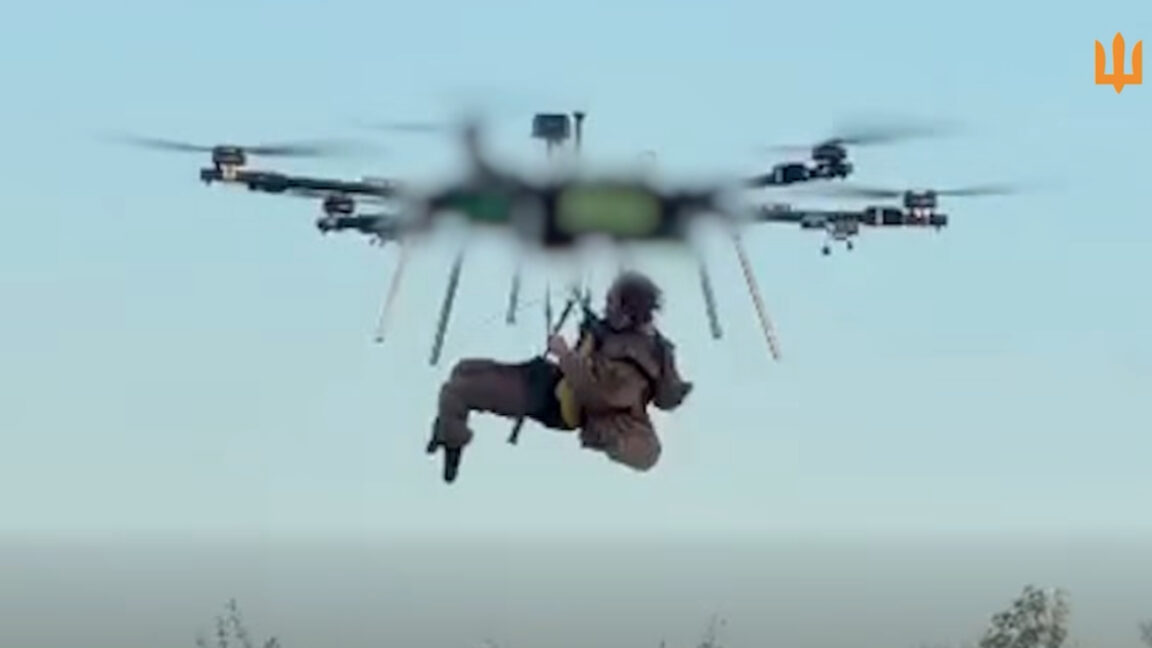
How Ukraine Is Changing the Way the U.S. Army Fights

“To me, the biggest way that we're doing this is introducing technology into the [U.S. Army] formations that is not fully baked. And so all of us who were in the Army in the 90s, the 2000s, even the 2010s, you were issued a piece of equipment and that was it -- maybe a TM (technical manual) and you didn't have any say in how it was made or how it should be altered. And today in a number of different [Army] organizations, we're putting the tech in an immature state in front of the soldiers -- and industry is with them -- to be able to iterate and make things so much better, so much faster. So that to me is compelling to them and they can give very real feedback and everybody that's dealt with soldiers knows they're not going to pull any punches, right?”

That was Under Secretary of the Army Michael Obadal speaking July 30, on The Future of U.S. Land Powerat the Center for Strategic and International Studies (CSIS) along with former-Army Secretary Ryan McCarthy, who held that job during the first Trump administration.

Together, the two provided insightful looks at how the Army is dealing with the introduction of new technology.

Obadal, for example, described a personal experience from a day or two earlier when he got into an autonomous vehicle with a staff sergeant. “We're getting ready and he's showing me all this stuff, and I said, ‘This is incredible. What do you think?’ And he said, "Yeah, I don't like it.’ And I said, ‘Okay.’"

Obadal then recalled he and the sergeant had a 15minute conversation and he learned when the sergeant told him “I think this is really cool tech, but it's the integration of that tech” that bothered him. For Obadal that was something “that you don't get in a lab, you get it only by putting those things in the hands of soldiers.”

“We're introducing them [new Army enlistees] at the very onset of their Army career to technologies being pushed down in[to military] units.” Obadal said, adding, “There is additional skill-type, identifier-training that they can go to. We have a software factory in Austin, Texas [Army Software Factory of the U.S. Army Transformation and Training Command] that's incredibly capable. It's a two-year program where they really are able to code and create new applications, all really software based.”

McCarthy recalled, “If you go back to 2017, there was nowhere near the emphasis on pushing autonomous systems into the formations. A lot of that's cultural. If you go even back to like 2008 and the Air Force's resistance to taking on more Predator [an unmanned reconnaissance aircraft] caps in the Middle East, my former boss, [Defense] Secretary [Robert] Gates, making it a priority with the department. So, culture is a big part of it. The good thing is it's 10 years later, we have younger people, much more technologically savvy than I ever was.”

As with most people, Obadal starts his discussion of change with Ukraine, which he described as an “incredible battle lab,” about which he said, “not just the Army, the entire [Defense] Department has gone to great lengths to understand what are the lessons that are coming out of there, because no one is iterating technology faster than the Ukrainians.”

He then described the initial Russian-Ukraine fighting as “positional warfare, because neither side possessed an actual maneuver, combined-arms, army.” Instead, Obadal said, “two uncoordinated armies really came together, got into positional warfare, and then we saw the innovation of the drones and a number of other things, but specific is the drones.”

Currently in the Russian-Ukraine war, Obadal said, “You have a dead zone of several kilometers between these two positions and it's very reminiscent of World War I,” where artillery was introduced, and “now the drone…is an enabler of soldiers. So how do you deny terrain with drones? How do you actually take terrain with drones?”

“We've taken all of those lessons and incorporated [them] in,” Obadal said, “so now at this point in basic training our soldiers are actually operating drones. Not something that was happening two or five years ago. But they get that familiarization as soon as they are coming into the Army in our training centers.”

At the Army National Training Center, Fort Irwin, California, Obadal said he watched U.S. operational forces conducting exercises “utilizing a number of different drones to have certain effects – electronic warfare, observation, calling-for-fire, and first-person, viewer-kinetic action. That's the ‘operationalization’ of it [drone warfare].”

But Obadal was most interesting to me when he expanded on how the Army had “spent billions on buying commercial off-the-shelf drones that are customized for military use,” and shipped them to “almost every [Army] division and even down in regiments.” There, he continued, “We have small groups of soldiers that have been pulled in by the leadership, given some budget, small budget, and given a facility and said, ‘Put together drones that we can go out on our training areas and utilize.’”

The result of this localized drone creation was, Obadal said, “They [the drones] are not exquisite. They cost very little to make. It's okay to crash them. But what it's doing is not just the technology, the other thing we're learning, [as] from the Ukraine, is you have an incredibly capable core [of Army personnel] that knows how to utilize drones in every aspect of it.”

Another purpose, Obadal explained, “It's not about flying an FPV [first-person view/controlled] drone that's part of it, it's about how do you team them together; how do you do all of the things that we're watching the Ukrainians do; so we we're baking that in into our organizations by letting them…mass-produce as many low-cost drones as they can so that they can get the repetitions…We have to go through hundreds of repetitions a day in our Army to build that repository of knowledge, turn that into doctrine, which is constantly evolving, and then spread it throughout our Army.”

Commenting on the Army drone system, McCarthy said, “They're allowing leaders at every level to be entrepreneurial in nature, to look at the capability, to learn the technology, and make recommendations to the changes in task organization. They're going to have to change the

business model of the Army. There might not be 40 people in a rifle platoon five or 10 years from now. There might be half as many. So we have the luxury where we can be a little deliberate. We may want to go faster. The world's complicated, but doing it the right way, the smart way, they're going to make better choices.”

For example, at a February 2026 exercise at Fort Stewart, Georgia, soldiers experimented with electronic warfare payloads on medium-range reconnaissance systems and tested various configurations on FPV drones to determine system limitations and capabilities, according to an

Army press release. “The ongoing innovation includes stressing equipment through rigorous training to understand what works best for operational units,” the release said.

The Army, Obadal said, is “trying to encourage small [drone making] companies, new entrants that have compelling technology. We're trying to leverage as much external capital, because there is a large amount of external capital that's invested in the defense technology industry, but we just haven't rewarded it at the right level.”

Army Assistant Secretary for Acquisitions, Logistics and Technology Brent Ingraham is changing acquisition processes that are intended to foster rapid prototyping, rapid fielding and rapid acquisition of new capabilities, Obadal said.

He continued, “What it's about is continuing to prototype and experiment at scale and then feed all of that into our Combined Arms Center (CAC).” There, he said, Lt. Gen. James P. Isenhower III, CAC Commanding General will determine “now how do we put our findings back into areas that will change force management or capability requirements.”

Summing up, Obadal said, “Today we have young men and women that I see out in the organizations with highly technical capabilities that allow them to do direction-finding, to do pinpoint locations of enemy emissions, and then utilizing other capabilities to visually confirm feeding all of that back into a data-centric C2 [communications] system. So it's that human machine teaming of giving the right capabilities to our soldiers allows them to be far more effective than they were just a couple years ago.”

Obadal added, “It's an important thing to remember right now we're not replacing soldiers with autonomous or unmanned weapons. What we're doing is we are unburdening the soldier from the mundane tasks or the most dangerous tasks so that they can take a step back and they can do the things that only humans -- whether it's soldiers, commanders -- can do.”

Read more national security insights from experienced experts exclusively in The Cipher Brief.

Winning the Peace: The Democratic Dilemma of Limited War

In our previous article, we argued that overwhelming military superiority no longer guarantees strategic success.

Today, military and political outcomes have become increasingly disconnected.

As Carl von Clausewitz observed, war is fought to achieve political objectives, with military force only one instrument among many in statecraft.

Modern professional militaries are exceptionally proficient at identifying and destroying adversary military capabilities. Yet, they remain far less able to reshape the political, ideological, and social foundations that sustain an adversary's resilience.

The challenge confronting modern democracies is therefore not simply winning wars, but achieving what might be termed strategic translation—the successful conversion of military success into enduring political outcomes.

This predicament of strategic translation has intensified in recent years.

Operations involving Iran, Ukraine, and Gaza have once again raised questions about whether military success alone can produce durable political outcomes, echoing debates that followed the conflicts in Iraq and Afghanistan.

Strategic rivals such as Russia and China have closely monitored these outcomes, adjusting their own strategies to exploit the gap between military supremacy and political consolidation discussed in this article.

The inability to translate military victory into a long-term political settlement has evolved from a tactical issue to a defining test of democratic strategic competency as information flows quicken and domestic audiences examine protracted wars in real time.

Democratic Institutions: Competing Cultures

The principal obstacle facing democratic societies is not a lack of military capability but the complexity of democratic governance itself.

Political authority is intentionally dispersed among elected governments, legislatures and independent public institutions, each possessing different responsibilities and professional cultures. While this diffusion safeguards liberty and accountability, it complicates the integration of national strategy.

Military power achieves its greatest strategic effect only when synchronised with diplomacy, intelligence, economic statecraft and political engagement.

Yet democratic institutions frequently develop these capabilities in parallel rather than as a unified enterprise. Foreign affairs, defence, treasury and justice each define success differently, compete for resources and optimise their own organisational objectives.

Ironically, modern armed forces have become increasingly network-centric, integrating intelligence, logistics, cyber, space and operational planning within a single command framework. Governments, however, largely remain vertically organised.

Democracies have therefore become highly proficient at conducting limited tactical military campaigns while remaining less effective at integrating the broader instruments of national power necessary to convert battlefield success into enduring strategic advantage.

Selling Grand Strategy to Democratic Societies

Developing grand strategy is only half the challenge.

Democratic governments must also sustain public support over time. Unlike authoritarian systems, they must continually justify long-term strategic investment to electorates whose immediate concerns are economic security, healthcare, education and the cost of living.

Electoral competition naturally encourages governments to emphasise visible achievements—military operations, defence acquisitions, and capability announcements—rather than articulating the long-term political objectives these activities are meant to achieve.

Public debate therefore becomes centred on operations rather than strategy.

Without a compelling strategic narrative, public confidence gradually becomes tied to individual events rather than broader national objectives.

Procurement controversies, budget debates, and political disagreements increasingly dominate public discourse, making defence appear as a collection of expensive projects rather than as one component of an integrated national strategy.

Grand strategy that cannot be communicated to democratic societies cannot be sustained by democratic societies.

Democratic Time versus Strategic Time

Winning in combat requires strategic focus, but democratic politics inherently operates on short attention spans as highlighted by researchers in RAND Corporation. Electoral cycles, typically lasting two to five years, create strong incentives for governments to prioritise immediate, visible achievements over the sustained political, diplomatic, and institutional investments required to build long-term national power, as the UK Parliament's House of Commons Public Administration Committee has provided detailed structural barrier on this.

In coalition governments, differing party priorities and narrow parliamentary majorities can further complicate strategic continuity, encouraging short-term political compromise over long-term policy consistency.

The twenty-four-hour news cycle and social media amplify these pressures by encouraging governments to respond rapidly to headlines and shifts in public opinion, often elevating short-term tactical developments over long-term strategic objectives.

A single controversy, whether involving procurement, diplomacy or battlefield casualties, can dominate public debate and increase pressure for policy adjustments that disrupt strategic continuity.

This tension between political urgency and strategic reality was perhaps most evident in Afghanistan.

Throughout that conflict, successive US administrations increasingly balanced military objectives against domestic political pressures, with troop deployments and withdrawal decisions becoming closely linked to electoral cycles and public opinion.

President Obama's 2009 troop surge, while designed to reverse Taliban momentum, was accompanied by a July 2011 timetable for the start of withdrawal, signalling that the United States' commitment was not open-ended.

More than a decade later, the 2020 Doha Agreement established a fixed timeline for withdrawal despite persistent concerns over the readiness of Afghan security forces and the absence of a comprehensive political settlement.

In both cases, strategic decisions became increasingly shaped by political timelines, illustrating how democratic governments can struggle to align long-term national objectives with short-term domestic pressures.

Among NATO allies, these pressures were further compounded by divergent domestic political calendars and national priorities. France, for example, withdrew its combat forces in 2012 following President Hollande's election pledge, while Canada and several allies imposed national caveats that restricted how and where their troops could operate. NATO summits in Riga (2006) and Lisbon (2010) exposed persistent disagreements over troop contributions, burden-sharing and operational commitments, reflecting domestic political constraints as much as collective strategic planning.

As political priorities shifted across allied capitals, long-term strategic coherence became increasingly difficult to sustain.

Without stronger institutional continuity and bipartisan commitment, democratic grand strategy risks becoming reactive, fragmented and ultimately unable to translate military success into enduring political outcomes.

Winning the Peace Requires Political Campaign Design

If democracies are to prevail in limited wars, they must plan for peace before the first military operation begins.

Military campaigns should never exist independently of political campaigns. Governance, justice, policing, economic recovery, institution-building, and strategic communications must be integrated from the outset, rather than improvised after battlefield success.

Repeated strategic frustration also carries risks for democracy itself.

Failure to improve strategic integration may encourage growing calls for more centralised executive authority, expanded emergency powers and greater restrictions on civil liberties in the name of national security.

Democracies should resist this temptation.

Instead, democracies should strengthen institutions capable of ensuring long-term strategic continuity while remaining firmly accountable to constitutional government.

One possibility would be an independent National Strategy Commission, bringing together diplomatic, military, economic and informational expertise to preserve institutional memory and support integrated strategic planning across successive governments.

Conclusion

Democracies do not need to lose their democratic character in order to become more strategically effective.

Authoritarian systems maintain continuity through control, whereas democracies must maintain it through design.

Instead, the task is to create long-lasting institutions, such as an independent National Strategy Commission, that can sustain strategic memory across changing governments without consolidating authority or undermining accountability.

This requires achieving cross-party consensus on essential national goals and integrating diplomatic, military, economic, and informational tools from the outset, rather than improvising after victory.

Failure results in continued frustration and increasing demands for concentrated power.

In a period of limited conflict, success will be defined not just by battlefield successes, but also by long-term political effects.

The Cipher Brief is committed to publishing a range of perspectives on national security issues submitted by deeply experienced national security professionals. Opinions expressed are those of the author and do not represent the views or opinions of The Cipher Brief.

Have a perspective to share based on your experience in the national security field? Send it to Editor@thecipherbrief.com for publication consideration.

Read more expert-driven national security insights, perspective and analysis in The Cipher Brief

Winning Battles, Losing Strategy: Why Military Superiority No Longer Guarantees Victory

America’s battlefield dominance remains unmatched, but Iraq, Afghanistan and now Iran shows that tactical success increasingly fails when military power is not matched by a coherent political strategy.

No military in modern history has possessed the technological reach, global mobility and combat capability of the United States. Yet, its greatest battlefield victories have increasingly produced some of its most difficult strategic dilemmas.

This contradiction lies at the heart of American military intervention over the past several decades. Washington has repeatedly demonstrated its capacity to defeat formidable opponents, overthrow governments and deploy troops across vast distances. But military supremacy has not always produced the stability, legitimacy or political order American policymakers sought.

Afghanistan revealed the limits of occupation and state-building, ending not in lasting transformation but in the return of the Taliban in 2021 after their initial ouster by American forces twenty years earlier. Iraq showed how removing a hostile regime could unintentionally strengthen Iran’s strategic position and deepen regional instability. Iran itself has proven resilient, with external pressure often hardening rather than weakening its strategic posture. Meanwhile, the Arabian Gulf has become an unpredictable region, where security, energy and great-power rivalry intersect with global consequences.

These cases raise a central question: why do tactical victories so often produce strategic setbacks?

The answer lies in the changing character of ‘limited war,’ in which military superiority remains decisive on the battlefield, but political endurance increasingly determines strategic outcomes.

The Post-War Pattern: Tactical Success, Strategic Frustration

The paradox at the heart of American military intervention is neither new nor uniquely American.

Since the end of the Second World War, the United States has repeatedly demonstrated an unparalleled ability to project power globally. From Korea and Vietnam to the Gulf War, Afghanistan, and Iraq, no nation has matched America’s technological sophistication, logistical reach, intelligence capabilities, or ability to sustain expeditionary operations over long distances. This record is well documented in studies published by the RAND Corporation and the U.S. Army War College Press.

Yet history demonstrates that battlefield dominance alone does not guarantee political success.

The Korean War (1950-53) ended in containment rather than reunification, while Vietnam (1965-75) exposed the limitations of overwhelming firepower against an adversary willing to absorb enormous losses in pursuit of political objectives. The Coalition victory in the 1991 Gulf War reinforced the belief that precision-guided weapons, advanced command-and-control systems, and overwhelming technological superiority had fundamentally transformed warfare.

Following the collapse of the Soviet Union (1991), many policymakers concluded that American military superiority could reshape political realities well beyond the battlefield. Historical assessments by the U.S. Department of State Office of the Historian and the U.S. Army Center of Military History trace the evolution of these campaigns and their strategic consequences.

While military force remains highly effective at defeating conventional armies, destroying infrastructure, and removing governments. It has proven considerably less effective at building legitimate political institutions that can endure after foreign forces depart. As Carl von Clausewitz argued in his classic work, On War, war is an extension of politics by other means. Military victory therefore achieves little if political objectives remain undefined, unrealistic, or ultimately unattainable.

The challenge confronting modern intervention is not one of military capability but of strategic translation. Tactical victories increasingly fail to produce durable political outcomes because the post-intervention political environment is often more complex than the military campaign itself. As scholars of strategy, such as Lawrence Freedman, and the research communities at the Center for Strategic and International Studies (CSIS) and Royal United Services Institute (RUSI) have argued, the decisive challenge for modern military power is no longer winning the battle but securing a sustainable political end state.

Iraq: Breaking the Anti-Iran Bulwark

The invasion of Iraq in 2003 removed Saddam Hussein from power but also eliminated Iran’s principal regional counterweight.

What Washington saw as a decisive blow against a hostile regime became, in strategic terms, a gift to Tehran.

The collapse of Iraqi state institutions created a vacuum filled by sectarian competition, militia politics, and external influence. As Iraqi institutions weakened and political fragmentation deepened, sectarian identities grew more powerful, armed groups gained legitimacy, and the state’s monopoly on force eroded.

Iranian influence expanded through political allies, security networks, and Shia militias that embedded themselves in Iraq’s evolving political, post-Saddam order.

In an ironic twist, the U.S. intervention in Iraq was meant to reduce internal danger and violence; instead, it fostered a more favourable environment for Iran and the country’s political influence.

The United States spent enormous blood and treasure removing a regime that had contained Iran for decades. In seeking to eliminate one threat, Washington disrupted the regional balance and inadvertently strengthened another. Historically, Iraq stands not only as an example of a military campaign governed by ‘shock and awe,’ but remains a stark warning about the unintended consequences of overthrowing a state without understanding what will replace it.

The occupation of Iraq damaged U.S. credibility in the Middle East by disrupting power balances without a clear post-war strategy.

It increased uncertainty among allies, created opportunities for rivals, and enabled Iran to expand its influence, reshaping the strategic landscape and contributing to greater instability.

Afghanistan: The Limits of Military Occupation

Nowhere is this paradox of modern limited war intervention more apparent than in Afghanistan.

The United States and its allies rapidly dismantled Taliban rule following the attacks of 11 September 2001. Within months, al-Qaeda’s sanctuary had been destroyed, Taliban formations dispersed, and a new Afghan government established under international protection. Militarily, the campaign was remarkably successful. Contemporary assessments of the campaign and its objectives are documented by the U.S. Department of State Office of the Historian and the CFR.

The challenge emerged only after the battlefield had been won.

Over the next two decades, Coalition forces invested enormous resources attempting to build functioning political institutions, professional security forces, and a democratic state capable of sustaining itself. Yet legitimacy proved far more difficult to establish and sustain than military capability. Extensive investigations by the Special Inspector General for Afghanistan Reconstruction (SIGAR) repeatedly highlighted the disconnect between military achievements, governance reform, corruption, and institutional resilience.

Corruption, weak governance, factional politics, and ongoing insurgent pressure steadily eroded public confidence in Kabul’s authority. The human, financial and strategic costs of the intervention have been comprehensively documented by the Brown University Costs of War Project.

The Taliban understood a fundamental principle of limited war: they did not need to defeat NATO militarily, only to outlast the West’s commitment to supporting Kabul.

As domestic political support in Coalition capitals diminished, strategic patience shifted in favour of the Taliban-led insurgency. The collapse of the Afghan government in 2021 demonstrated that two decades of military success could not compensate for the absence of enduring political legitimacy. Subsequent analyses by the CFR and the SIGAR conclude that institutional fragility ultimately proved more decisive than Coalition military capability.

Afghanistan, therefore, offers a broader lesson. In modern limited wars, technologically superior powers often discover that destroying hostile forces is considerably easier than replacing the political order those forces once sustained.

The lesson from Afghanistan is not unique.

In modern conflicts, technologically advanced militaries increasingly find that battlefield success is becoming decoupled from political outcomes. This reflects a broader evolution in limited war, where endurance, legitimacy and the capacity to impose continuing costs frequently outweigh conventional military superiority.

Recent assessments by the RUSI, the CSIS and the Modern War Institute at West Point (MWI) increasingly argue that political resilience and strategic endurance have become as important as battlefield dominance in determining the outcomes of contemporary conflicts.

Conclusion: Rethinking Military Success

There is an old regional saying that, rather than killing the snake, repeated attempts to strike it often make it more dangerous.

The 2026 Iran War is the starkest test of that proposition in a generation.

The US-Israeli military campaign that began on 28 February inflicted severe damage on Iran’s nuclear and missile infrastructure and, according to multiple reports, killed Supreme Leader Ali Khamenei. Judged by the metrics Washington and Jerusalem set—degrading capability and decapitating leadership—the campaign appeared to succeed.

Yet strategic outcomes are far less straightforward.

Reporting from Reuters, the BBC, and other outlets indicated that despite the shock of the strikes, the Iranian system moved quickly to preserve continuity. The Revolutionary Guard and other coercive institutions positioned themselves as defenders of a nation under attack. This pattern aligns with longstanding scholarship on external pressure and authoritarian resilience, which shows that coercion may consolidate regimes as easily as it weakens them. Iran’s economy was battered, its proxies pressured, and its deterrent credibility damaged, but the outcome Washington most wanted to prevent—regime survival—persisted.

This is not a defence of the regime, nor an argument that the strikes were unjustified.

Rather, it is an argument that force applied without a coherent theory of political aftermath can entrench the very resilience it seeks to break.

Iran has been hit hard, but it has also adapted, hardened, and become more difficult to read strategically. That unpredictability does not stop at Iran's borders; it radiates outward, especially across the waterway connecting Iran to global markets.

The lesson from Iraq, Afghanistan, and Iran is not that military intervention should never occur, nor that the United States should retreat from its global responsibilities.

Instead, the character of limited war is evolving in ways that increasingly favour politically resilient adversaries over technologically superior expeditionary powers.

This shift has become a recurring theme in contemporary strategic analysis published by the RUSI, the CSIS, and the MWI.

Cheap autonomous systems have fundamentally altered the economics of military power.

During the Cold War, technological superiority rested upon expensive platforms fielded by a handful of industrialised states. Today, relatively inexpensive drones, AI-enabled targeting systems and commercial technologies have dramatically lowered the barriers to resistance, enabling weaker actors to impose disproportionate costs upon militarily superior opponents.

Recent assessments by the Center for Strategic and Budgetary Assessments (CSBA), CSIS, and RUSI suggest that the strategic premium once attached to technological superiority is steadily being eroded.

Meanwhile, democratic powers continue to operate under political constraints imposed by public opinion, electoral cycles, international law, alliance commitments, and coalition management.

Their adversaries often face far fewer such limitations.

Victory is therefore no longer determined solely by military technology, but increasingly by which political system can sustain the contest for longer.

This observation reflects the enduring insights of Carl von Clausewitz and later strategic thinkers such as Robert Endicott Osgood, whose work Limited War: The Challenge to American Strategy (1957) emphasised the intimate relationship between military operations and political objectives.

The United States remains the world’s most capable military power.

Nothing in Iraq, Afghanistan, and now Iran diminishes that reality. These conflicts, however, reveal that military superiority alone no longer guarantees strategic success.

The ability to destroy an adversary’s military capability is no longer synonymous with the ability to shape the political environment that follows. As recent analyses by the International Institute for Strategic Studies (IISS) and RUSI continue to argue, the decisive challenge for modern armed forces increasingly lies in translating battlefield success into enduring political outcomes.

The challenge for American policymakers is therefore not simply how to strike harder or faster, but how to ensure that military action serves coherent political objectives capable of enduring long after the shooting stops.

Great powers rarely decline because they lose battles.

More often, they decline because they mistake military victory for strategic success.

Military technology can destroy armies. It cannot, by itself, create political legitimacy.

Until strategy gives equal weight to what happens after the battlefield falls silent, even the most technologically advanced militaries will continue to confuse tactical victory with strategic success.

The Cipher Brief is committed to publishing a range of perspectives on national security issues submitted by deeply experienced national security professionals. Opinions expressed are those of the author and do not represent the views or opinions of The Cipher Brief.

Have a perspective to share based on your experience in the national security field? Send it to Editor@thecipherbrief.com for publication consideration.

Read more expert-driven national security insights, perspective and analysis in The Cipher Brief

Endless Warfare – Part II: Countering Endless Warfare and its Networks


Author’s Note: This article is not about ‘endless wars’ as a critique of U.S. military interventions — that debate belongs elsewhere. It examines a distinct and increasingly visible pattern: how U.S. adversaries wage continuous, long-term conflict against the United States across peace and war, both below and above the threshold of open conflict. The aim is to clarify the nature of the competition we are already in.

Countering Endless Warfare and its Networks

The United States is not at peace. As I argued in Part I, the United States is already in a continuous, long-term conflict with determined adversaries who are waging warfare without crossing the threshold into open conflict. Endless Warfare is a framework for understanding how those adversaries pursue an enduring approach to erode and supplant U.S. power, influence, and global leadership over time.

Endless Warfare is not simply another label for the gray zone or cognitive warfare. Both are important elements and merit their own approaches, but Endless Warfare describes the adversary’s persistent, long-term strategy, not just the elements that enable it.

Given this operating environment, this is about far more than terminology. It is about how we understand conflict, how we achieve deterrence, how we protect decision autonomy, how we retain leverage, and, most importantly, how we disrupt the networks that fuel Endless Warfare.

What are the essential next steps?

Endless Warfare Requires a Different Strategic Mindset

Militaries are often criticized for planning to fight the last war. Russia’s invasion of Ukraine was undermined by Russia’s underestimation of how much warfare had evolved since Georgia in 2008 and Crimea in 2014. The United States potentially faces that same risk today. It is important that we are prepared to fight and win the next conventional war, but there are risks in a focus on only that strategy. We must also prepare to fight and win—with the appropriate instruments of national power—the Endless Warfare being waged on the United States by its adversaries; warfare that incorporates gray zone activity, cognitive warfare, weaponized negotiations, proxies and surrogates, and other subversive networks.

This change in strategic mindset is not because of a lack of capability. The United States has considerable experience, resources, and capabilities in this space. Endless Warfare is conceptually different from conventional war—particularly given the ambiguous nature of gray-zone activity and cognitive warfare—and therefore demands a different approach.

Yet because it is a continuous state of conflict, it also requires the same level of national leadership and vision, organization, critical thinking, sense of urgency, and collaboration with allies that we apply to conventional conflict. This is achievable but will take some effort. It may require a senior White House official, such as a Deputy National Security Advisor for Strategic Competition, to integrate interagency action and coordinate a sustained national response to this threat.

That Deputy National Security Advisor would not replace existing responsibilities of Departments and Agencies. The role would be to ensure that strategic deterrence in the gray zone, cognitive advantage, conflict negotiations when adversaries seek to extend rather than resolve conflict, and network disruptions are integrated into a coherent and sustained national response to the threat of Endless Warfare against the United States.

Strategic Deterrence in the Gray Zone

Strategic deterrence is one component of a broader approach to countering Endless Warfare. Gray zone activity is a powerful enabler of Endless Warfare because it gives our adversaries a space to undermine the United States while avoiding armed conflict.

Our adversaries have calculated that there are more gains than risks in the gray zone and that any risks they do face are acceptable. Actions that seek to counter or defend against gray zone activity but that do not impose meaningful costs or create credible deterrence may simply reward gray zone activity.

An effective strategy for achieving strategic deterrence in the gray zone rests on deliberate preparation, clear communication, a national approach, and the resolve to change the risk calculus of our adversaries.

Deliberate preparation means collecting and analyzing information on adversary gray zone trends, capabilities, and intent before they act; routinely coordinating at the national level so roles, responsibilities, and decision paths are clear; and reorienting institutions and the interagency to maintain effective balanced capability in both conventional and gray domains.

We also must communicate clearly domestically, to our allies, and particularly to our adversaries. A simple but clear message for our adversaries: “We will see what you’re doing, we will publicly attribute it to you, and we will impose costs that exceed your gains.”

This message is credible only if it is backed by action over time. The United States must convincingly demonstrate its resolve to proactively and persistently employ national capabilities to change the risk calculus and behavior of our adversaries.

This range of national capabilities includes coordinated diplomatic and allied action, economic sanctions and restrictions, cyber operations, legal and financial disruption, public attribution, denying access to critical technologies, cognitive measures, military posture and partner capability-building and—when necessary—kinetic responses. Recent examples illustrate that imposing costs is possible.

In 2021, the United States publicly attributed the SolarWinds supply-chain compromise to Russia, expelled Russian Intelligence Officers, and imposed broad financial penalties under the International Emergency Economic Powers Act.

In early 2025, the U.S. Treasury sanctioned Sichuan Juxinhe Network Technology Company and associated individuals for their role in Salt Typhoon for attacks on network infrastructure of multiple major U.S. telecommunication and internet service providers.

These were hard-earned wins for U.S. Departments and Agencies involved, but Russia and China appear to have absorbed the costs and continued their operations. Achieving strategic deterrence means that actions like these must become the norm, not the exception.

The goal of strategic deterrence in the gray zone is to shape adversary decision-making before action is taken. It means proactively shaping the environment so adversaries hesitate before they act—a critical step in disrupting the cycle of Endless Warfare.

Gaining a Cognitive Advantage

Countering the impacts of cognitive warfare is essential to countering Endless Warfare. My colleague, Austin Branch, and I argued in The Cipher Brief that it was possible—and necessary—for the U.S. to seize a 21st-century cognitive advantage.

That argument is even more urgent today given the central role of cognitive warfare in our adversaries’ strategies of Endless Warfare. Cognitive Security, at its core, is the protection of human cognition and decision autonomy—our individual and collective ability to accurately perceive global events, to trust the knowledge we have and the information we receive, and to make confident, independent decisions free from external manipulation, influence, or coercion.

Cognitive Security is also about offense—outthinking, outpacing, and outmaneuvering our adversaries in the cognitive domain.

Our adversaries should understand that their leaders, institutions, networks, proxies—and decision-making—are vulnerable to cognitive pressure and influence. The goal is to force them—not the United States—to confront the uncertainties and risks of cognitive warfare and to weaken their ability to wage Endless Warfare.

There are some positive steps at the national level.

We now have a first-ever NSC Cognitive Advantage Director, and the FY26 NDAA directs the Secretary of Defense to formally define cognitive warfare for the Department. The Department’s Strategic Capabilities Office recently launched a Cognitive Warfare Project to advance the military’s cognitive warfare capabilities. There is clearly opportunity here.

Yet, these early steps remain fragmented. In contrast, China’s United Front Work Department, Russia’s Active Measures networks, and Iran’s diverse network of surrogates reflect centralized national direction and a long-term horizon as elements of a national strategy.

In this vital process, America’s approach has to be equally well-coordinated and strategic. It is essential that these new efforts avoid bureaucratic hurdles, over-prescription that may stifle innovation, and creating silos. Our adversaries will not wait for us to catch up.

Our national narrative—America’s Story—also plays an important role. As Branch and I argued in the Cipher Brief, our national narrative is both sword and shield. It projects power, influence, and advances our interests. It tells the story of our values, history, aspirations, and view of the world. It supports confidence in our actions, our institutions, and our global commitments.

Importantly, America’s Story counters adversary narratives and actions that seek to undermine America at home and abroad. It can serve as a powerful antidote to adversary campaigns that use cognitive warfare to sustain prolonged conflict. America’s Story was built at a time when much of the world saw America as liberator, peacemaker, builder, global diplomat, and above all, a powerful symbol of sacrifice, freedom, and self-determination. The long arc of America’s Story is its strength.

The United States cannot let this national narrative get lost in episodic political turbulence—its role in countering our adversaries is too vital.

Countering Weaponized Negotiations

In the era of Endless Warfare, adversaries often use negotiations as a continuation of conflict by other means—not as instruments of resolution. Negotiations can play an outsized role in Endless Warfare even though they only occur periodically. The central challenge is distinguishing when talks aim to legitimately resolve a conflict versus when they are designed to shape its next phase.

Today, drawing lessons directly from Russia’s behavior—from Georgia to Ukraine—and from Iran, several principles emerge that can strengthen our negotiating posture when facing adversaries that practice weaponized negotiations.

Those key principles include:

No upfront concessions. Make no upfront concessions to get an adversary to the negotiating table. Such actions erode diplomatic, economic, and military leverage and can shape the entire negotiations on unfavorable terms.

Establish clear overarching objectives and non-negotiable redlines early. This preserves decision autonomy, provides a framework for decision-making, and prevents adversaries from reshaping objectives to their advantage.

Proactively counter narratives. During negotiations over Ukraine, Russia repeatedly pushed narratives, such as “Ukraine can never win” and “territory concessions are inevitable,” to shape Western perceptions of what constituted a realistic outcome. Anticipating and countering false narratives ensures negotiations are not manipulated.

Concessions must be conditions-based. Any concessions given during negotiations must be based on measurable, verifiable actions with automatic snap-back mechanisms if commitments are violated.

Be willing to walk away. The desire for any agreement should never outweigh core national security interests. Suspending or ending talks is better than enabling or accepting a settlement that resets the conflict in an adversary’s favor.

Chester Karrass put it plainly, in life you don’t get what you deserve, you get what you negotiate. This is a powerful counter to American assumptions that raw power or battlefield success will carry the day at the negotiating table.

Countering Endless Warfare Networks

These measures—deterrence, cognitive advantage, and managing weaponized negotiations—greatly improve America’s posture, but they do not by themselves disrupt Endless Warfare networks.

The ultimate goal is systematically confronting the adversary networks that pose an enduring threat to the U.S. These networks fall into two broad categories: state institutional structures and more ambiguous structures that blur the line between state and non-state activity.

Institutional networks include military organizations, intelligence services, party organizations, proxy structures, and state-directed organizations such as IRGC-QF, MSS, GRU, and FSB, as well as the specialized units responsible for assassinations and sabotage, influence operations, and cyber-attacks as a few examples.

Ambiguous networks include ghost fleets, shell and front companies, criminal organizations, illicit financial systems, logistics systems influence networks, cyber hacktivists, proxy militias, smuggling organizations, and other similar entities.

These networks are not abstract. Iran, Russia, and China employ different approaches to Endless Warfare, but each illustrates how adversaries develop and employ both institutional and ambiguous networks to achieve persistent strategic objectives over a long timeframe. Just as a few examples:

Iran’s network of proxies and surrogates, built over decades, allows Iran to project power, coerce and intimidate its neighbors, and get inside the decision space of its adversaries at relatively low cost. The IRGC is an enabler of Iran’s distributed networks with global reach.

Russia’s networks conduct cognitive warfare against the U.S. and the West and conduct sabotage, assassinations, and political coercion across Europe. Russia’s “ghost fleets” have allowed it to generate billions in revenue despite Western sanctions.

China’s Cyber networks probe and penetrate U.S. critical infrastructure to sustain access, collect information, and provide a disruption capability during a crisis. Its networks enable sophisticated influence operations inside the U.S. and the transfer of critical technologies that directly enhance its military capabilities.

Shared and overlapping networks in gray and ambiguous spaces play a critical role. Ghost fleets, front companies, terror networks, illicit financial organizations, and criminal enterprises allow adversaries to bypass sanctions, sustain operations, and reduce international pressure.

Some of these networks are visible and attributable, others are intentionally obscured and decentralized to complicate attribution and defy sovereignty, international law, and national laws, including those of the U.S. We should expect our adversaries to fiercely protect these resilient, adaptive, and self-recovering networks they have carefully developed over time, often over decades, to gain and sustain a strategic advantage.

The critical question is how the U.S. can systematically reduce the effectiveness of these networks.

To paraphrase H.L. Mencken, for every complex problem there is an answer that is clear, simple, and wrong. That is the dilemma facing the U.S. now. Overly simplistic approaches or single solutions that do not take into account the complexities of Endless Warfare and the commitment of our adversaries to that approach will consume time and resources but ultimately fail.

Countering Endless Warfare requires a sustained, network-centric strategy employing the instruments of national power—diplomatic, military, economic, technological, informational, cognitive, and kinetic—rather than a series of independent actions. This strategy consists of three mutually reinforcing lines of effort built on one foundational principle.

First, identify and prioritize the networks that pose the greatest long-term threat to the United States. There are no official estimates of this ecosystem of networks—and what constitutes a network has not been clearly defined—but Iran, Russia, and China, collectively direct or enable a very large number institutional, commercial, criminal, cyber, intelligence, influence, and proxy networks worldwide.

Second, sustain campaigns to daylight, degrade, disrupt, and impose costs on institutional networks that conduct and oversee attacks on the United States and our allies. It is unlikely that the U.S. can dismantle foreign institutional networks, but those networks can be degraded, constrained, and made costly and less effective.

Third, dismantle, disrupt, and prevent the regeneration of ambiguous networks by severing the financial, logistical, technological, and organizational systems that support them. This is not a one-time activity. Ambiguous networks are more vulnerable, but they are often adaptive and can regenerate or be replaced.

Cognitive Security and Cyber Defenses have a combined vital role to play. None of these efforts will succeed unless American citizens, business leaders, military commanders, and policy makers are less vulnerable to influence, manipulation, and coercion—preserving America’s decision autonomy—and unless governments, institutions, organizations, and critical infrastructure are less vulnerable to technological exploitation and disruption.

Summary

The concepts in this paper are difficult to neatly categorize because they describe a form of warfare that is not fully defined. As conventional warfare evolves, so do the more nuanced aspects of warfare that take place below and above the threshold of conflict and in the ambiguous space between peace and war. I offer four takeaways.

First, Endless Warfare is a distinct adversary strategy already underway by China, Russia, and Iran and should be treated as a current strategic threat—not just a future one.

Second, endless Warfare is sustained by sophisticated and interconnected networks that must become a primary target for U.S. and allied efforts.

Third, countering Endless Warfare requires a proactive, persistent, and network-centric approach backed by national-level leadership, a new framework for strategic planning, a sense of urgency, and coordinated interagency action. Is ittime to consider a senior White House official, such as a Deputy National Security Advisor for Strategic Competition, to integrate interagency action and coordinate a sustained national response to this threat?

Fourth, strategic deterrence in the gray zone, cognitive advantage, disciplined negotiations, and network-focused disruption are core tools of that sustained national response to make Endless Warfare increasingly ineffective, costly, and ultimately unsustainable for China, Russia, and Iran.

Endless Warfare will not end because our adversaries choose peace. It will end when it is no longer effective.

All statements of fact, opinion, or analysis expressed are those of the author and do not reflect the official positions or views of the U.S. Government. Nothing in the contents should be construed as asserting or implying U.S. Government authentication of information or endorsement of the author’s views.

The Cipher Brief is committed to publishing a range of perspectives on national security issues submitted by deeply experienced national security professionals. Opinions expressed are those of the author and do not represent the views or opinions of The Cipher Brief.

Have a perspective to share based on your experience in the national security field? Send it to Editor@thecipherbrief.com for publication consideration.

Read more expert-driven national security insights, perspective and analysis in The Cipher Brief

❌