Reading view

There are new articles available, click to refresh the page.

NLM Photonics adds key investors in quest to reduce the power needed to move data between chips
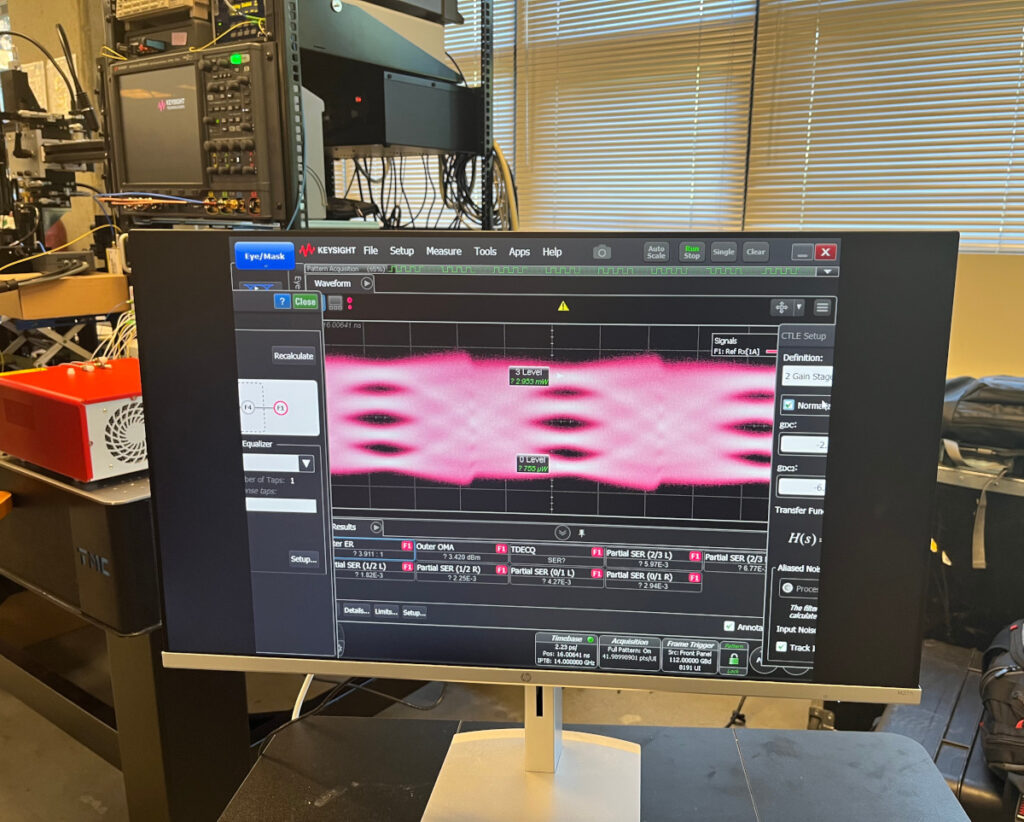
Test equipment measures a chip that uses NLM’s technology, showing how cleanly it carries high-speed data. (NLM Photonics Photo)

NLM Photonics, a Seattle-based chip materials startup and University of Washington spinout, announced two new investors: Pangaea Ventures and Diamond Edge Ventures, the investment arm of Mitsubishi Chemical Corp.

They joined as part of a funding round that totals $13 million, according to a Form D filed with the Securities and Exchange Commission. NLM has reported at least $26 million in funding since 2018, according to SEC filings.

The company offers a way to move more data without burning more power. Inside a data center, information travels between chips and servers as pulses of light. The part that puts the data onto the light beam, called a modulator, is normally made of silicon. It limits how much data a link can carry, and how much power that takes.

NLM’s technology, sold under the name Selerion, is an organic electro-optic material that goes on as a liquid and hardens in place on the chip, taking over the modulator’s job from the silicon underneath. The company says it does the work 10 to 15 times more efficiently.

Applications for the technology include fiber-optic networking equipment and the links between servers in AI data centers. NLM says it could also be used in quantum computing.

Five existing investors participated in the round, which the company described as a Series A2: Emerald Technology Ventures, Oregon Venture Fund, Idemitsu, Tokyo Ohka Kogyo and StoryHouse Ventures. Private investors and company employees also took part.

Pangaea Ventures, which has offices in Canada, the United States and Japan, backs startups built on advances in materials, chemistry and biology. It says it has invested in more than 40 companies over more than 20 years. David Weekes of Pangaea is joining NLM’s board, which already includes Frank Balas of Emerald.

Diamond Edge Ventures, led by president Curtis Schickner, has $200 million to invest through 2030. It backs companies in Mitsubishi Chemical’s core markets, including advanced materials, polymers and electronics, and its portfolio includes Boston Materials, DigiLens and Eridan.

Hamamatsu Photonics, which invested previously, is not part of this round but is still a shareholder, according to the company.

The company was incorporated in 2018 as Nonlinear Materials Corp. It licensed its patents from the University of Washington, building on 25 years of research there in the labs of chemists Larry Dalton and Bruce Robinson. Robinson is one of the company’s co-founders, as is Lewis Johnson, a longtime UW researcher who is chief technology officer.

Pack Ventures, the UW-affiliated venture fund, is an investor in NLM and is also listed among the advisors to its board.

GeekWire covered NLM’s launch in 2019, when the company was raising a $1.25 million seed round and running a small production lab on campus.

NLM Photonics CEO Brad Booth. (NLM Photo)

Brad Booth, who spent nine years at Microsoft and joined NLM’s board in 2023, took over as CEO in 2024 from co-founder Gerard Zytnicki, who is now a corporate advisor to the company. The company raised $1 million from Tokyo Ohka Kogyo and Hamamatsu in 2023.

Last year NLM said outside testing confirmed that a 1.6-terabit chip combining silicon with its materials ran at 224 gigabits per second on each of eight channels. It started sending samples of 1.6- and 3.2-terabit chips to customers in March.

NLM is not alone in trying to build a better modulator. Lightwave Logic, a publicly traded Colorado company also working with organic materials, named NLM among its smaller competitors in its annual report for 2024.

Some of the company’s rivals have raised a significant amount of funding. HyperLight, a Harvard spinout that uses a crystal called lithium niobate instead of an organic material, has raised $117 million, including $80 million in June led by MediaTek.

NLM has worked to get its materials onto other companies’ production lines. In March the company said the chips going out to customers were made at GlobalFoundries, and that it had built modulators using Tower Semiconductor’s high-volume silicon photonics process.


Elon Musk’s xAI used child porn to train Grok models, lawsuit says

xAI has now been accused of training Grok on child sex abuse materials (CSAM), as regulators and courts continue to probe how far the problem goes, and some Grok users have been arrested.

In a complaint filed on Wednesday, a plaintiff known as Jane Doe explained that she was preschool-age in the early 2000s when adult men repeatedly raped her to create CSAM to sell to pedophiles online. Since then, Doe’s images have been hashed by groups like the National Center for Missing and Exploited Children (NCMEC) and the Canadian Centre for Child Protection (CCCP).

For her safety, Doe has opted to receive alerts from the US Department of Justice Victim Notification System any time she may be a victim in a new criminal investigation. Although she has received countless alerts, she was shocked when the CCCP notified her that it had identified AI-generated CSAM on xAI that depicted her. This re-traumatized Doe, whose complaint alleged that messages were found on online forums “between offenders chatting about creating AI generated CSAM of Plaintiff and other similarly situated known, legacy, victims of CSAM.”

Read full article

Comments

© CHARLY TRIBALLEAU / Contributor | AFP

Not dead yet: The race to give spent EV batteries a second life on the grid and beyond

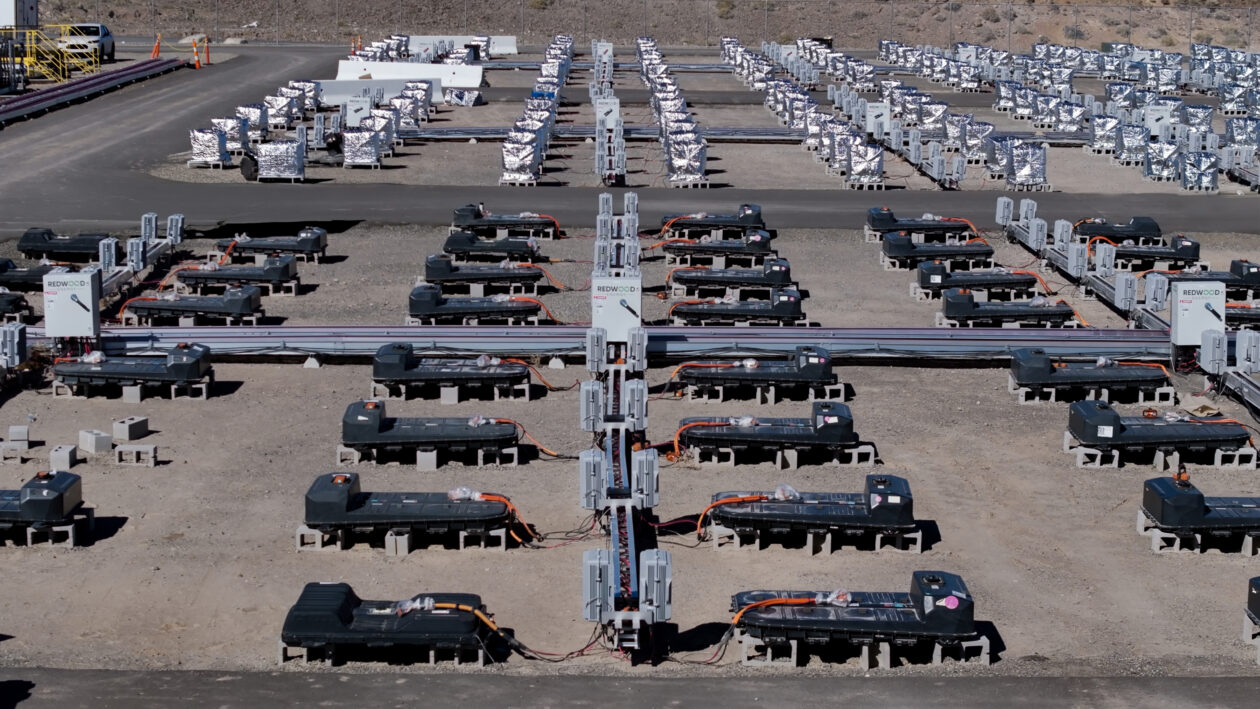
In the foreground are battery packs just as they would look installed in an EV, now repurposed by Redwood Materials and plugged into the microgrid serving Crusoe’s data center at Redwood’s campus in Nevada. (Redwood Photo)

Subscribe to Positive Charge: Apple Podcasts, Spotify, Amazon Music, All Episodes

A decade or two on the road will drain an EV battery’s range and hobble its acceleration. But while it peters out for daily commutes, that battery still has a lot of juice left.

A cohort of battery entrepreneurs is giving these units a second life, powering off-grid communities, industrial sites and energy-hungry data centers. Industry leaders — British Columbia’s Moment Energy and Redwood Materials in Nevada — are rapidly scaling up as the supply of aging batteries surges.

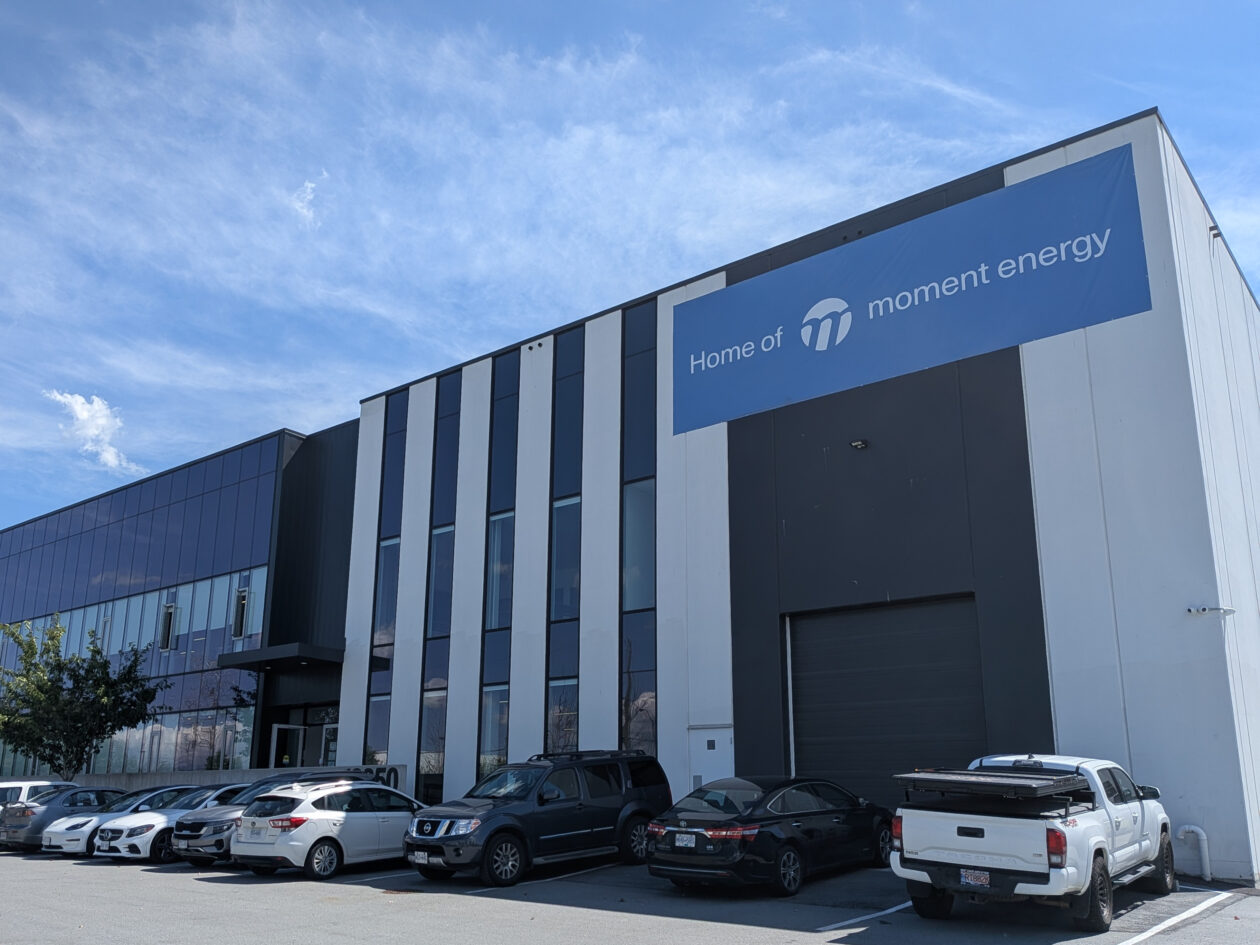
This summer, Moment moved into its 100,000-square-foot Megafactory 1 near Vancouver, converting a shell into its new HQ and manufacturing space in six weeks. It’s also building a Texas Gigafactory expected to open in January.

Redwood is likewise ramping up after unveiling the world’s largest used-EV battery system in June 2025: A 63-megawatt-hour solar and battery installation powering a Nevada data center run by AI infrastructure company Crusoe.

Absent reuse, these batteries end up in landfills or recycling shredders.

“Why recycle this battery prematurely when there’s over 95% life left?” asked Eddy Chiang, CEO and co-founder of Moment. When the batteries get recycled, some companies send the material to China for refinement, exporting valuable raw materials.

The market’s potential is massive. Chiang estimates that the used batteries available today could match Denver’s electricity use 20 times over — and 90 times over in four years.

The ‘Christmas light’ problem

Moment Energy moved into its new 100,000 square foot MegaFactory 1 in Surrey, B.C., which will allow it to increase manufacturing of its repurposed EV battery storage systems. (GeekWire Photo / Lisa Stiffler)

So why pull an EV battery that still has 80% or more of its life left? Think Christmas lights, says Chiang.

Particularly with lights sold in the past, “if one light bulb burnt out, the whole string burns out,” he said. “And that’s what’s happening in the battery pack. The actual failure mode for EVs is actually due to a single cell failure, like that light bulb.”

EV battery packs contain hundreds or thousands of cells that are grouped into modules, which are housed in large metal shells affixed under the vehicle’s floorboard. The cells can be similar to the AA batteries in consumer electronics, while others are larger blocks or pouches.

When Moment receives used batteries, it first runs diagnostics to test their performance. Then it breaks down the packs into modules, and racks them in cooled shipping containers. Moment uses proprietary software to redirect energy away from weak cells to healthy ones to extend battery life.

The company’s largest storage system is called Luna, delivering up to 1 megawatt hour of energy, which is enough electricity to power roughly 49 Seattle households for 24 hours. It’s preparing to launch a new model, but keeping the details under wraps.

Moment customers range from God’s Pocket Resort, an eco-lodge on a tiny Canadian island where its system slashed the use of diesel generators, to Vancouver International Airport, which avoided up to $20 million in grid upgrades to power fast chargers for its EV fleet, Chiang said. “Instead, they bought a couple of our batteries.”

From recycling to reusing

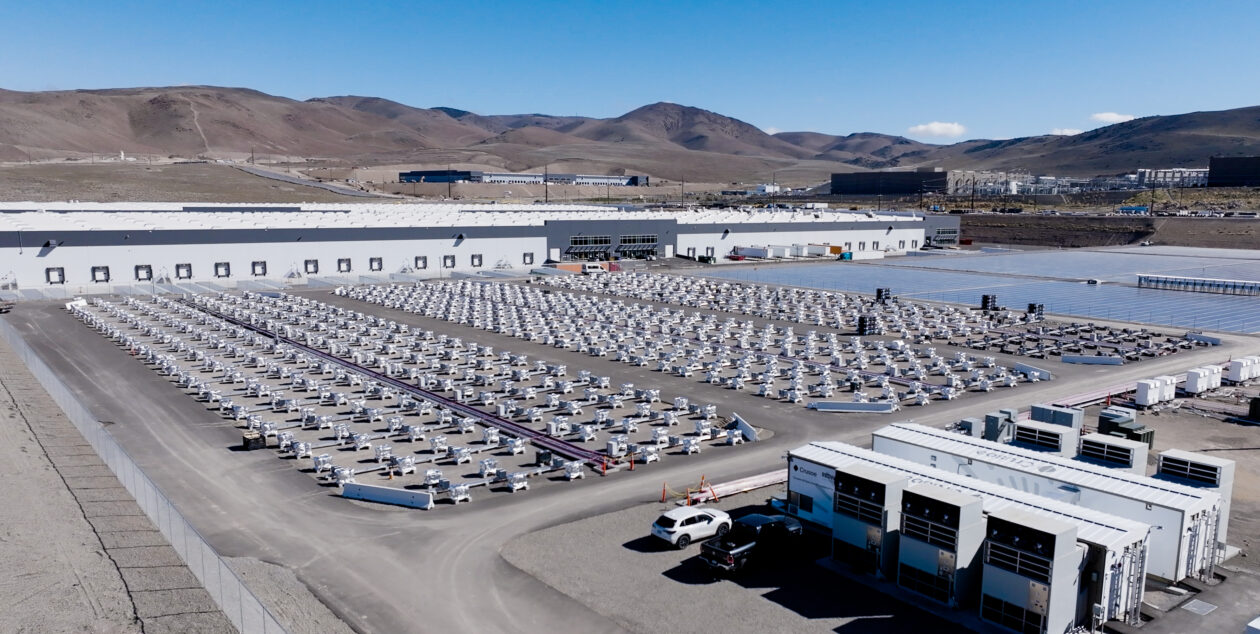
The rows of silver-wrapped cubes contain repurposed EV battery packs providing power to a Crusoe data center, which is in the bottom right of the photo, paired with solar panels to the right that are part of the microgrid. (Redwood Photo)

Redwood Materials began nearly a decade ago as a battery recycler led by former Tesla executives. But in recent years, they recognized a missed opportunity.

“We had a group of people standing around watching our recycling operation, looking at these giant battery packs that we’re going to so much effort to disassemble, and just wondering, ‘Can we do more with these before we shred them?'” said Colin Campbell, Redwood’s chief technology officer.

Now 95% of the EV batteries Redwood receives are reused rather than recycled. And despite its Tesla roots, the startup accepts batteries from any automaker and has created a “universal translator” that manages battery packs with different voltages, power and chemistry.

Campbell touts the conversion of the EV devices to stationary storage as straightforward.

In its simplest terms, Redwood’s energy storage sites are “an electric vehicle parking lot with the wheels removed,” he said. “So it’s just literally the battery that was in the car. There’s lots of them arranged in a grid together and plugged in.”

That plug-and-play approach solved major headaches for Crusoe. By pairing repurposed EV batteries with solar power for its new AI data center in Nevada, Crusoe bypassed multi-year grid-connection delays, saved money and avoided emissions from diesel generators.

Scott Williams, vice president of energy at Crusoe, said the solution has worked well for his company, which builds data centers and offers its own AI cloud services.

“We’ve signaled to Redwood that we’re going to grow with them,” Williams said, including “multiple gigawatt hours paired with our modular units, which is super exciting.”

Industry headwinds

Despite the momentum, the sector faces headwinds. Communities have resisted large battery projects due to fire concerns, sparked by high-profile incidents like California’s Moss Landing fire.

The companies emphasize that EV batteries are built to survive high-speed crashes, making them inherently safer than standard stationary battery storage. The Moss Landing fire involved older, non-EV batteries in a very different setup than the startups are using. Additionally, Moment’s systems hold extensive UL safety certifications and Redwood has passed a UL fire-safety test.

Another industry hurdle is competition. Overbuilt recycling capacity — plus U.S. and European mandates requiring recycled content in new batteries — creates competition for used EV packs.

Yet from a climate perspective, repurposing is vital. Batteries are almost always “the most carbon-intensive component” in any electronic device, said Grayson Shor, executive director of the Pacific Northwest Battery Collaborative and co-founder of the startup Buckstop.

Repurposed EV systems can extend that initial carbon investment by providing clean power for 20 to 30 years and meet urgent energy demand.

“Everybody’s like, ‘Where are we going to get electricity?'” Campbell says. “And we have a really excellent option already here.”

Sources and references

Interviews:

Additional sources:

East Texas Sits on a Goldmine of Lithium, but Questions Loom Over How the State Will Regulate Mining and Production

8/21/26
CRITICAL MINERALS
Enable IntenseDebate Comments: 
Enable IntenseDebate Comments

 When Scott Norton became president of the TexAmericas Center, he hoped the industrial park would attract employers that would bring much-needed jobs to North East Texas.

Little did he know the industrial center would sit atop one of the country’s largest and richest lithium deposits, known as the Smackover Formation, and would also become a key location for mineral production in Texas.

read more

How to Win the Battle for Critical Minerals

8/3/26
CRITICAL MINERALS
Enable IntenseDebate Comments: 
Enable IntenseDebate Comments

In the struggle with China over critical-minerals supply chains, the United States and its partners should focus efforts across three fronts: commercial, technological and allied coordination. Action is needed in each to overcome advantages that China has built over decades.

As the US, Australia and their friends invest billions, create price floors and form diplomatic networks to diversify supply, China will respond with its own countermeasures to maintain its supply chain dominance.

A focus on the three fronts gets to the heart of the problem.

read more

❌