❌

Reading view

There are new articles available, click to refresh the page.

SolidCraft is Parametric, Automation-friendly CAD for Desktop and Browser
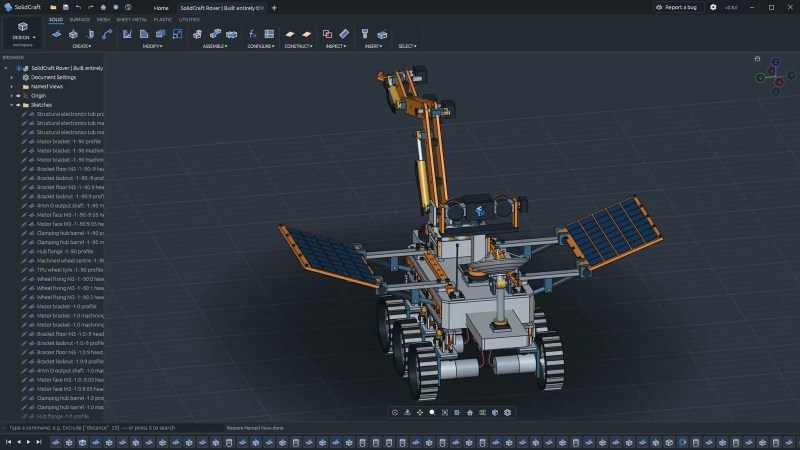
If you’re looking to try a new, open source 3D modeling CAD suite, especially one with automation-friendly interfaces, take a look at SolidCraft. It’s under development but there’s support for all the usual features like sketches, solid modeling, and constraints as well as a full parametric feature timeline.
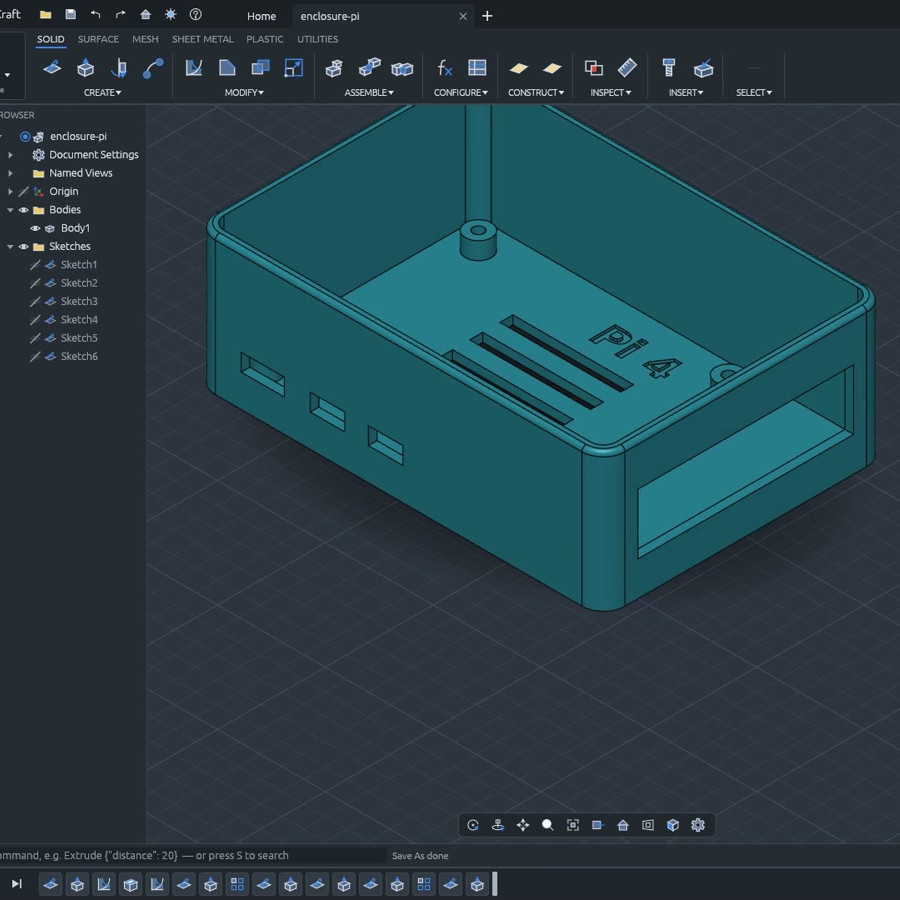
SolidCraft offers desktop, browser-based, headless CLI, and MCP interfaces.

A parametric timeline essentially means the model exists not as a single discrete object, but as the sum of a sequence of operations. One advantage of this is being able to set things up so that if one changes a value (like wall thickness), all the features that depend on that change automatically get rebuilt as a result. But there’s more!

Written entirely in Rust, SolidCraft can run as a desktop app or as a web app in a browser. Everything the user can do in SolidCraft is a command with JSON parameters, and it offers a built-in headless command line interface and even an MCP (Model Context Protocol) server built specifically to give AI agents a way to use the program, should one be interested in experimenting with that sort of thing.

SolidCraft is still in early development, but so far quite a few features seem to work as they should. Check out the development roadmap for details, and there’s a live online demo if you’re in the mood to click around and get a feel for things.

We have seen quite a few open-source, browser-based CAD efforts over the years and it’s encouraging to see developers continuing to explore fresh ideas and features in the CAD landscape.
Hack The Box: Devhub Machine Walkthrough – Medium Difficulty

Completed another Hack The Box machine: Devhub (Medium).

Devhub was a great exercise in exploring modern development tooling, service misconfigurations, and Linux privilege escalation. The journey began with web enumeration and identifying an exposed MCP Inspector service. Further investigation revealed a command injection vulnerability that provided initial access to the machine.

From there, internal service enumeration uncovered a localhost-only Jupyter instance. Accessing it through SSH port forwarding and investigating its authentication mechanism opened the path to another user. The final stage involved examining an internal operations service, understanding its exposed functionality, and identifying a weakness that ultimately led to root access.

Devhub highlights how development tools, internal services, and poorly secured administrative functionality can create unexpected attack paths when combined. Another valuable machine for practising enumeration, lateral movement between local users, and privilege escalation.

#HackTheBox #HTB #CyberSecurity #PenetrationTesting #RedTeam #OffensiveSecurity #Linux #PrivilegeEscalation #WebSecurity #MCP #InfoSec …

Learn MoreHack The Box: Devhub Machine Walkthrough – Medium Difficulty

The post Hack The Box: Devhub Machine Walkthrough – Medium Difficulty appeared first on Threatninja.net.

Tether Builds Self-Custodial Wallet Tools For AI Agents

  • Tether has expanded its Wallet Development Kit with a command-line wallet and MCP interface that can be used by AI agents.
  • The same local wallet daemon can be controlled by a human through the terminal or by compatible AI software through the Model Context Protocol.
  • The tooling is currently beta software and Tether explicitly recommends testing with limited funds.

**ID:** B25-05

**Site:** Bitcoinist

**Status:** READY

**Author:** Bitcoinist Editorial Team

**Focus Keyword:** Tether

**Image Keyword:** Wallet

**Category:** Technology

**Tags:** Tether, AI, Wallet, MCP, Payments

**Primary Source:** https://docs.wallet.tether.io/

One Wallet Can Be Controlled Through Two Interfaces

The WDK CLI gives developers a local wallet that can create named accounts, derive addresses, read balances, inspect transaction history and send supported assets.

Alongside that sits an MCP server.

MCP, or Model Context Protocol, is increasingly used to let AI assistants interact with external tools and data sources through standardized interfaces.

In Tether’s implementation, an AI agent can connect to the same local wallet daemon used by the human operator.

That means an agent can potentially inspect balances or prepare wallet actions without requiring a separate custodial service.

The underlying private keys remain within the local self-custodial setup.

Tether is positioning this around agentic payments: software that can pay for services, move funds or interact with financial protocols as part of an automated workflow.

Giving An Agent A Wallet Creates A New Security Problem

The obvious challenge is permissions.

An AI system capable of moving money needs much tighter controls than one simply generating text.

Tether’s wider WDK stack includes modular support for gasless transactions, swaps, bridges, lending and fiat ramps, creating a potentially broad range of actions an agent could eventually initiate.

That makes policy design critical.

Developers need to control which networks an agent can use, what assets it can send, how much it can move and when a human needs to approve the transaction.

The CLI is also still beta software.

Tether’s documentation currently describes version `1.0.0-beta.3` and recommends using dedicated wallets with limited funds during testing.

That caveat is important.

AI agents controlling money are still experimental infrastructure.

But the direction makes sense.

If autonomous software begins buying API access, compute and other services for itself, it will need payment rails.

Tether is trying to make a self-custodial wallet one of those rails rather than forcing every agent through a centralized account.

*This article was written by the News Desk and edited by [Samuel Rae](https://bitcoinist.com/author/samuelrae/).*

❌