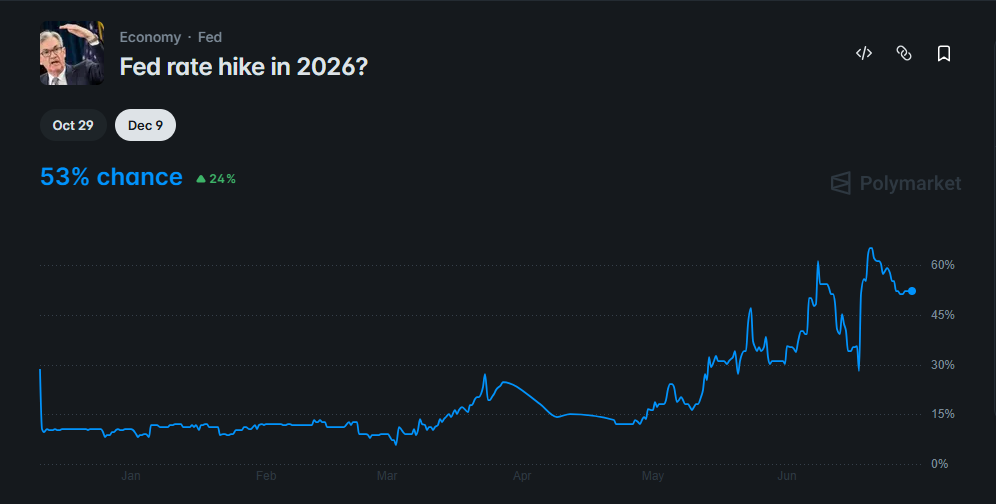
Kalshi settles bets with a rulebook and a person applying it. Polymarket settles them with a token-holder vote. World settles them with a data feed, no panel, no dispute window, nobody to call. Three live models now, and each one fails differently.
Chainlink has expanded its CCIP infrastructure across Avalanche and Polygon, adding a cross-chain token standard designed to make programmable token transfers cleaner between the two networks.
That sounds technical, and it is. But the point is simple enough: crypto still has a cross-chain problem.
Users and developers want assets to move across ecosystems without relying on fragile wrappers, one-off bridges, or awkward liquidity routes. Chainlink’s Cross-Chain Interoperability Protocol is one of the infrastructure bets trying to solve that, and this Avalanche-to-Polygon deployment gives developers another route for moving tokens between major networks.
It is not a LINK price story. It is a plumbing story. And in crypto, plumbing often matters more than the headline suggests.
For more details, visit the official Blog platform.
TL;DR
Chainlink CCIP has expanded cross-chain token infrastructure across Avalanche and Polygon.
The integration is designed around programmable token transfers.
The story is about interoperability infrastructure, not a LINK price prediction.
Why Cross-Chain Tokens Are Still Hard
Crypto is multi-chain now, whether anyone likes it or not.
Ethereum, Avalanche, Polygon, Solana, BNB Chain, Arbitrum, Optimism, Sui, and dozens of other networks all have their own liquidity, apps, users, and developer communities. That creates opportunity, but it also creates friction.
Assets do not naturally move between chains.
Historically, users have relied on bridges, wrapped assets, liquidity pools, and third-party routing systems. Some work well. Some are clunky. Some have been hacked. Some create confusing versions of the same token across different networks.
That is the mess Chainlink CCIP is trying to tidy up.
Avalanche And Polygon Are Natural Targets
Avalanche and Polygon both sit in the part of crypto where interoperability actually matters.
Avalanche has leaned into subnets, institutional deployments, and app-specific blockchain infrastructure. Polygon has built around Ethereum scaling, consumer apps, and broad EVM compatibility. If assets and messages can move more safely between networks like these, developers get more room to build products that are not trapped inside one ecosystem.
That is the real attraction.
A token does not need to live in one place forever. A user does not need to care which chain is under the hood if the experience is smooth enough. A developer does not need to choose between ecosystems if infrastructure can connect them safely.
That is the dream, anyway.
Wrapper Risk Is The Thing Everyone Remembers
Bridge risk has been one of crypto’s ugliest lessons.
Some of the largest hacks in the industry have come from cross-chain infrastructure. The reason is obvious: bridges hold or control a lot of value, and if the security model breaks, the losses can be huge.
That is why any system promising safer cross-chain token movement gets attention.
The Chainlink CCIP model is meant to reduce reliance on fragile wrapper structures and give projects a more standardized framework. That does not mean every implementation is risk-free. It means developers have another infrastructure option that is designed specifically for cross-chain transfer logic.
In a market full of custom bridges, that standardization matters.
Do Not Overread The Token Impact
It is tempting to turn every Chainlink integration into a LINK price catalyst.
That is too simple.
More integrations can support Chainlink’s infrastructure narrative, but token impact depends on usage, fees, staking design, payment flows, broader market demand, and whether developers actually build meaningful activity on top of the deployment.
The operational news is strong enough on its own.
Chainlink is continuing to push CCIP into major ecosystems. That helps keep it relevant as crypto becomes more fragmented.
The Market View
This Avalanche and Polygon integration is another sign that cross-chain infrastructure is becoming a serious battleground.
The winners may not be the loudest chains. They may be the networks and protocols that make it easier for users and developers to move without thinking too much about what is happening underneath.
That is where CCIP wants to sit.
If the standard gains traction, Chainlink could become more deeply embedded in the movement of assets across chains. For now, the update gives developers on Avalanche and Polygon another tool for building cross-chain token systems with fewer moving parts.
This article draws on Chainlink’s CCIP integration materials.
This article was written by the News Desk and edited by Samuel Rae.
This report is based on information released by Blog. at Blog
Russia's attempt to replicate SpaceX's Starlink satellite network seems to be moving as slowly as the front lines in eastern Ukraine.
The Rassvet program, often billed as Russia's answer to Starlink, started launching its first operational satellites earlier this year. Two launches, one in March and a second in July, have delivered 32 Rassvet satellites to low-Earth orbit, some 10 percent of the roughly 300 Rassvet spacecraft Russia aims to put into orbit by the end of next year to provide connectivity for military and civilian users. The company in charge of Rassvet, Bureau 1440, wants to deploy 924 satellites by 2035.
But none of the 32 satellites launched so far have reached the 500-mile (800-kilometer) orbit they were designed to operate in. The rockets that launched the first two batches of Rassvets released the satellites much closer to Earth, and the satellites were expected to use their own plasma engines to raise their orbits over the next few months.
Chainlink has recorded nine new integrations across five blockchains in its latest weekly ecosystem update, adding another set of deployments to its oracle and infrastructure network.
The update covers integrations across multiple services and chains, reinforcing Chainlink’s role as one of crypto’s main data and interoperability providers.
This is not a LINK price prediction.
It is an operational development story. More integrations show that protocols continue to use Chainlink infrastructure, but they do not automatically translate into immediate token price movement.
For more details, visit the official Blog platform.
TL;DR
Chainlink recorded nine integrations across five blockchains.
The update spans multiple services and ecosystem deployments.
The news should be framed as infrastructure adoption, not LINK price speculation.
Why Integrations Matter For Chainlink
Chainlink’s business is infrastructure.
Protocols use its services for price feeds, data, automation, proof-of-reserve, cross-chain messaging, and other functions that smart contracts cannot reliably handle alone.
That means integrations are a useful activity signal.
Each new integration shows another application or network choosing Chainlink’s infrastructure layer. One integration may be small. But repeated integration updates can show that Chainlink remains embedded across the market.
That is important in a multi-chain environment.
Five Blockchains Shows Breadth
The five-chain spread matters because crypto is no longer centered on one network.
Applications launch across Ethereum, L2s, alternative L1s, appchains, and specialized ecosystems. Infrastructure providers need to support that fragmentation.
Chainlink’s multi-chain reach is one of its main strengths.
If developers can access familiar oracle services across different environments, it lowers the friction of building across chains. That helps Chainlink remain relevant even as liquidity and users move between ecosystems.
Lending markets need asset prices. Derivatives platforms need settlement references. RWAs need off-chain valuations. Stablecoin systems may need reserve or price data. Automated strategies need triggers.
Without reliable oracles, many DeFi products cannot work safely.
That is why Chainlink’s integration updates matter even when they do not sound flashy. They show the continued buildout of the data layer that many applications rely on.
Do Not Overstate Token Impact
The market often tries to connect every integration directly to LINK.
That is too simple.
Integrations may increase usage, but token impact depends on fee models, staking design, payment flows, demand for LINK, broader market conditions, and how the services are monetized.
The operational signal is real. The immediate price conclusion is not automatic.
That is the careful way to read the update.
What Comes Next
The next question is whether these integrations drive meaningful activity.
A deployment becomes more important when it supports real liquidity, large user bases, high-value assets, or essential infrastructure. Integration count is useful, but usage depth matters more.
Still, Chainlink continues to show breadth.
Nine integrations across five blockchains is another reminder that oracle and data infrastructure remain central to crypto’s growth.
For LINK holders and DeFi builders, the signal is steady rather than explosive: Chainlink remains deeply woven into the multi-chain application stack.
This article is based on Chainlink’s latest weekly integration update.
This article was written by the News Desk and edited by Samuel Rae.
This report is based on information released by Blog. at Blog
Charles Schwab is expanding its crypto platform beyond Bitcoin and Ethereum, adding support for Solana, Avalanche, and Chainlink exposure, according to validated platform materials.
The move is notable because Schwab is not a crypto-native exchange. It is one of the largest brokerage names in US finance, and its product decisions can shape how traditional investors access digital assets.
The expansion suggests that regulated investor demand is moving beyond the two largest crypto assets.
Bitcoin and Ethereum remain the core institutional products. But Solana, Avalanche, and Chainlink are now being treated as liquid enough, recognizable enough, or strategically relevant enough to enter the next layer of brokerage crypto access.
For more details, visit the official Schwab platform.
TL;DR
Charles Schwab is expanding crypto access beyond Bitcoin and Ethereum.
Solana, Avalanche, and Chainlink are being added to the platform.
The move should not be described as a spot ETF launch or custody approval unless Schwab’s materials say so.
Why Schwab Matters
Schwab brings traditional-market credibility.
When a major brokerage expands crypto access, it can lower the barrier for investors who do not want to use offshore exchanges, self-custody, or complex wallet setups. That matters because many investors prefer familiar account infrastructure.
Schwab’s move also helps normalize crypto as a broader asset class.
Bitcoin and Ethereum were the obvious starting points. Adding more assets suggests the platform sees demand for exposure beyond BTC and ETH.
That is a meaningful shift.
Solana, Avalanche And Chainlink Offer Different Narratives
The three added assets are not interchangeable.
Solana is a high-throughput smart contract network with a large retail and DeFi ecosystem. Avalanche has focused heavily on subnets, institutional deployments, and tokenized asset infrastructure. Chainlink provides oracle and cross-chain data services used across many crypto applications.
Together, they give investors exposure to different parts of the digital asset market.
That may be the point. A broader platform can let investors express views on smart contracts, tokenization, infrastructure, and cross-chain data rather than only holding the two largest assets.
Not The Same As ETF Approval
The distinction is important.
Platform support does not mean the SEC has approved spot ETFs for all three assets. It does not necessarily mean Schwab is offering direct custody in every possible sense. The exact product structure matters.
Investors need to understand whether they are trading spot crypto, accessing exposure through a specific wrapper, or using another product type.
The headline is access expansion. The details determine what kind of access.
Brokerage Distribution Could Shape Altcoin Demand
If major brokerage platforms keep expanding crypto menus, the altcoin market could change.
Many investors currently access smaller crypto assets through exchanges. Brokerage access could bring a different kind of buyer: retirement-account investors, advisory clients, portfolio allocators, and retail traders who prefer traditional platforms.
That may increase liquidity and visibility for supported assets.
But it may also create a sharper divide. Assets supported by major brokerages could gain legitimacy, while unsupported tokens may remain more purely crypto-native.
The Clean Read
Schwab’s expansion is another sign that crypto access is moving into mainstream financial platforms.
Bitcoin and Ethereum are no longer the whole conversation. Solana, Avalanche, and Chainlink are being pulled into the next wave of brokerage-supported digital asset exposure.
The move does not settle regulatory questions. It does not guarantee demand. It does not turn every altcoin into an institutional asset.
But it does show that one of the biggest names in brokerage is willing to widen the digital asset menu.
That matters for the market’s next phase.
This article is based on Charles Schwab platform materials and related public information.
This article was written by the News Desk and edited by Samuel Rae.
This report is based on information released by Schwab. at Schwab
SpaceX made Florida's Space Coast home to the world's busiest spaceport for a decade, but that will change this year. The company is significantly cutting the number of launches from Florida until Starship arrives, a senior SpaceX official confirmed Tuesday.
The Falcon 9 rocket has been SpaceX's workhorse, routinely launching batches of satellites for the company's Starlink network, primarily from launch pads at Cape Canaveral Space Force Station and NASA's Kennedy Space Center in Florida. There were 165 Falcon 9 launches last year—about three flights per week—and about 75 percent of them carried Starlink satellites.
This year is different. SpaceX has launched more missions from its West Coast launch pad at Vandenberg Space Force Base in California since January, and this trend will amplify for the rest of the year.
NUVA has integrated Chainlink data feeds to support pricing infrastructure for real estate-backed DeFi and tokenized asset products.
The integration, announced on August 24, is designed to provide decentralized pricing data for tokenized real estate assets. That can help users trade fractional real estate exposure with on-chain oracle verification.
This is a technical infrastructure integration.
It does not mean real estate tokenization has achieved broad retail adoption. It means a platform building in the RWA category is adding Chainlink data infrastructure to support its product design.
TL;DR
NUVA integrated Chainlink data feeds for real estate-backed tokenization.
The integration supports decentralized pricing data.
The development is infrastructure-focused, not proof of mass RWA adoption.
Why Real Estate Needs Reliable Data
Real estate tokenization depends on trustworthy pricing.
Unlike liquid crypto assets, real estate does not trade continuously on public exchanges. Valuations can depend on appraisals, market comps, income streams, geography, liquidity, and legal structure.
That makes oracle infrastructure important.
If tokenized real estate assets trade on-chain, users need confidence that pricing data is reliable, timely, and resistant to manipulation. Without that, DeFi products built around real estate collateral can become fragile.
Chainlink’s role is to provide a data layer that helps support those markets.
RWA Tokenization Is Becoming More Specific
Real-world asset tokenization used to be discussed in broad terms.
Now the category is breaking into more specific product types: tokenized Treasuries, private credit, real estate, money-market funds, equities, bonds, invoices, and commodities.
Each category has different data needs.
Real estate is especially complex because assets are less liquid and less standardized than securities or Treasury bills. That makes infrastructure choices more important.
NUVA’s Chainlink integration is one piece of that stack.
Chainlink Keeps Expanding Beyond Price Feeds
Chainlink is best known for crypto price feeds, but its infrastructure is increasingly used across tokenization and off-chain data use cases.
For RWA platforms, the appeal is not only token pricing. It is the ability to connect external data to smart contracts in a way that DeFi applications can use.
That can include prices, proof of reserves, asset values, interest rates, and other reference data.
As tokenized assets grow, oracle networks become more important because they sit between real-world information and on-chain execution.
Do Not Overstate Adoption
The careful framing is important.
An oracle integration is not the same as mass adoption. It does not prove that retail users are widely trading tokenized real estate. It does not guarantee liquidity or regulatory success.
It does show that RWA builders are continuing to assemble the infrastructure needed for more usable products.
That is still worth covering.
Tokenization cannot scale without reliable pricing, compliance, custody, and settlement infrastructure. Data feeds are one part of that foundation.
What Comes Next
The next question is whether NUVA’s products attract meaningful users and liquidity.
If tokenized real estate assets begin trading actively with reliable pricing infrastructure, the integration becomes more important. If activity remains small, it stays a technical milestone.
For Chainlink, the development adds another RWA-related integration to its ecosystem.
For NUVA, it strengthens the infrastructure behind its real estate tokenization model.
The broader takeaway is that RWA tokenization is moving from narrative to plumbing. The less glamorous data layer may decide how much of the market actually works.
Chainlink has announced 12 new integrations across 10 blockchains, adding another weekly update to its growing cross-chain data and infrastructure footprint.
The integrations span DeFi, liquidity, and data services, according to Chainlink’s update. The development reinforces Chainlink’s position as one of the most widely used oracle and infrastructure networks in crypto.
That does not mean LINK’s price must move.
This is an operational development story, not a price prediction. The point is that Chainlink continues to expand its network reach across multiple ecosystems.
TL;DR
Chainlink announced 12 new integrations across 10 blockchains.
The integrations cover DeFi, liquidity, and data services.
The update should be framed as infrastructure growth, not LINK price speculation.
Why Integrations Matter
Oracle networks live or die by usage.
Chainlink’s value to developers comes from the reliability and breadth of its data, automation, cross-chain, and infrastructure services. Each new integration adds another example of a protocol depending on Chainlink infrastructure.
That matters because crypto applications need external information.
Lending markets need prices. Perpetuals need market data. RWAs need off-chain references. Cross-chain applications need messaging. Automated systems need triggers. Chainlink has spent years positioning itself as the connective layer for those needs.
A weekly integration update is not dramatic by itself, but the accumulation matters.
Multi-Chain Reach Is The Main Signal
The 10-chain spread is important.
Crypto is increasingly multi-chain. Applications no longer build only on Ethereum or one L2. Liquidity, users, and protocols are spread across many networks. Infrastructure providers need to support that reality.
Chainlink’s cross-chain presence helps it stay relevant across ecosystems.
If a new DeFi protocol launches on a newer chain, it still needs trusted data. If a tokenized asset platform expands to another network, it still needs pricing and verification. Chainlink wants to be the default provider for those needs.
DeFi Still Depends On Oracles
DeFi remains one of the clearest use cases for oracle infrastructure.
Lending protocols, derivatives platforms, synthetic assets, structured products, and automated vaults all require accurate and timely data. Bad oracle data can lead to bad liquidations, wrong pricing, and user losses.
That is why oracle reputation matters.
Protocols tend to choose infrastructure providers with track records, broad integrations, and battle-tested systems. Chainlink’s continued integration flow helps maintain that reputation.
Do Not Overstate The Market Impact
It is tempting to turn every Chainlink integration update into a token-price story.
That would be the wrong framing.
Integrations can support long-term network utility, but they do not automatically create immediate price movement for LINK. Token economics, fee capture, staking demand, market sentiment, and broader liquidity all matter.
The clean read is operational.
More protocols are using Chainlink services across more chains. That strengthens the infrastructure narrative, but it is not a guarantee of market performance.
What Comes Next
The next thing to watch is depth, not just count.
Twelve integrations sound good, but the market will want to know which ones drive meaningful usage, fees, liquidity, or developer adoption. A small integration and a major protocol integration are not equal.
Still, breadth has value.
Chainlink’s ability to keep adding integrations across many networks shows that its infrastructure remains in demand. As crypto becomes more multi-chain and data-dependent, that role may become even more important.
For now, the latest update adds another layer to Chainlink’s infrastructure story: more chains, more integrations, and continued relevance across the DeFi stack.
Nethermind has ended its role as a LayerZero Decentralized Verifier Network participant and moved its cross-chain node operations to Chainlink CCIP.
The Ethereum engineering firm will now operate as a Chainlink CCIP node operator. That makes the move significant, but it should be framed carefully.
This is not proof that LayerZero is collapsing. It is not proof that Chainlink has replaced LayerZero across the whole market. It is one major infrastructure provider choosing to align its cross-chain operations with CCIP.
Still, infrastructure decisions like this matter because cross-chain security is one of crypto’s most sensitive areas.
TL;DR
Nethermind has ceased its LayerZero DVN role.
The firm is moving cross-chain node operations to Chainlink CCIP.
The move reflects one provider’s infrastructure choice, not a full market-wide replacement of LayerZero.
Why Nethermind’s Move Matters
Nethermind is not a random validator.
It is a well-known Ethereum engineering firm with experience across client development, infrastructure, research, and protocol operations. When a firm like that changes its cross-chain infrastructure alignment, the market pays attention.
Cross-chain systems depend heavily on trust assumptions.
Users and developers need to know who is verifying messages, what security model is being used, and how failure modes are handled. Node operators and verifier networks are part of that trust stack.
Nethermind moving to Chainlink CCIP adds another recognizable name to CCIP’s operator set.
Chainlink CCIP Keeps Building Institutional Credibility
Chainlink has positioned CCIP as a cross-chain messaging and interoperability standard with a center on security and institutional use cases.
Adding Nethermind supports that pitch.
A stronger node operator set can help CCIP compete for projects that want cross-chain connectivity but are wary of bridge risks. After years of bridge hacks and cross-chain failures, security branding matters.
For Chainlink, the move is another piece of infrastructure credibility.
The more reputable operators join CCIP, the easier it becomes for protocols, enterprises, and public-sector projects to treat it as a serious option.
LayerZero Still Remains A Major Player
The market should not turn this into a winner-takes-all story.
LayerZero remains one of the most prominent cross-chain messaging protocols in crypto. Nethermind leaving its verifier role is meaningful, but it does not mean every project will follow, or that LayerZero no longer has demand.
Cross-chain infrastructure is still competitive.
Different projects may choose different systems based on security assumptions, cost, integration, governance, speed, liquidity, and ecosystem relationships.
Nethermind’s move says something about its own priorities. It does not settle the whole market.
Cross-Chain Security Is Under More Scrutiny
This shift also reflects a bigger trend.
Projects are becoming more careful about cross-chain risk. Bridges and messaging systems can become high-value targets. A failure can affect multiple chains and protocols at once. That makes verifier design, node operators, risk controls, and emergency procedures critical.
Infrastructure providers need to prove they can handle that responsibility.
Nethermind’s move toward CCIP suggests the firm sees Chainlink’s model as a better fit for its cross-chain operations.
What Comes Next
The next signal will be whether other major operators make similar moves.
If more infrastructure providers leave alternative verifier roles and join CCIP, Chainlink’s cross-chain position strengthens. If the market remains split, then this becomes one notable migration inside a broader multi-protocol landscape.
For now, the move is meaningful but not absolute.
Nethermind has chosen Chainlink CCIP for its cross-chain node operations. That gives CCIP another credibility boost, while keeping the wider interoperability race very much alive.
Aside from global access to cat videos, the presence of thousands of Starlink broadband internet access satellites in LEO has a very pleasant side effect for atmospheric researchers. Starlink publicly publishes near-real-time ephemeris data on its individual satellites. From this data you can deduce many details about the atmosphere at that altitude, including its density at specific altitudes at specific times, information which otherwise would be very hard to gather. Recently, this allowed [Mamoru Yamamoto] to determine the density of the thermosphere using tomography.
In a similar 2025 paper by [Zhuoliang Ou] et al. as published in Remote Sensing, this same data source was used to investigate details of the thermosphere. With Starlink publishing this data since 2021, this provides an invaluable dataset for studying this outermost part of the atmosphere.
Commencing just before the generally recognized transition into ‘space’ at 100 km altitude and below the Earth’s exosphere, the thermosphere‘s thickness fluctuates due to factors like solar irradiation and, with it, the exact altitude at which the exosphere begins. Generally, though, it is well above 600 km altitude. This places Starlink satellites as well as both active space stations (ISS and Tiangong) in the thermosphere.
[Zuholiang Ou] et al. established that the Starlink data matches well with that from a dedicated research satellite like SWARM-B, thus making it a useful source of scientific data.
The innovation in [Yamamoto-san]’s paper is that instead of using the typical two-line element (TLE) set, a more comprehensive tomographic approach was used, which essentially uses more data for a larger reconstruction, with the resolution claimed to be about on par with that of the SWARM satellites. This implies that although these Starlink satellites were never designed to be more than data relays, they may have accidentally become the biggest development in thermospheric research in a long time.
SharpLink reported a $394.3 million net loss for the second quarter of 2026, with the result driven largely by non-cash Ethereum revaluation losses and liquid staking token impairment charges.
The company’s filing shows $321.0 million in unrealized ETH losses and $76.1 million in impairment charges tied to liquid staking tokens. At the same time, staking operations generated $11.2 million of the company’s $11.5 million in revenue.
That creates a very particular kind of earnings story.
SharpLink’s operating activity is not the main reason for the headline loss. The loss is mainly an accounting effect from the changing value of its Ethereum-related holdings.
That distinction matters because crypto treasury earnings can look brutal on paper even when the underlying asset position is still intact.
For more details, visit the official Sec platform.
TL;DR
SharpLink reported a $394.3 million Q2 net loss.
The loss was driven largely by unrealized ETH losses and staking-token impairments.
Staking generated $11.2 million of the company’s $11.5 million in revenue.
Ethereum Treasury Accounting Can Be Harsh
Crypto accounting is often difficult for public companies.
When a company holds large amounts of ETH, quarterly results can swing sharply based on market prices. If accounting rules require revaluation or impairment recognition, a falling ETH price can produce a large net loss even without a major cash outflow.
That appears to be the core issue in SharpLink’s Q2 result.
The company’s Ethereum-related holdings created a major accounting drag, but those losses should not automatically be read as realized cash losses. Unrealized losses reflect mark-to-market movement. Impairments reflect accounting treatment. They are not the same as selling ETH at a loss.
For investors, that nuance is essential.
Staking Revenue Tells A Different Story
The revenue line looks very different from the net-loss line.
SharpLink generated $11.2 million from staking operations, out of $11.5 million in total revenue. That shows the company’s operating model is heavily tied to Ethereum staking yield.
The question is whether that revenue can scale enough to offset balance-sheet volatility.
Staking income can provide recurring revenue, but it is unlikely to fully neutralize large valuation swings when a company holds a huge ETH position. If ETH falls sharply, accounting losses can dwarf staking revenue in a single quarter.
That does not mean staking is useless. It means staking revenue and treasury revaluation operate on very different scales.
The ETH Position Still Grew
The company’s ETH holdings reportedly increased despite the headline loss.
That is important because it changes how the market should read the result. A company can report a large accounting loss while still increasing its token count. For a treasury-focused investor, token accumulation may matter more than short-term GAAP volatility.
For a traditional equity investor, the net loss may matter more.
This is one of the tensions in crypto treasury stocks.
Are investors buying earnings, asset exposure, staking yield, or a leveraged ETH strategy? The answer may differ from shareholder to shareholder.
Liquid Staking Adds Another Layer
Liquid staking tokens make the picture more complicated.
They can generate yield and improve liquidity compared with native staking, but they also introduce extra risks: smart contract risk, liquidity risk, depeg risk, custody risk, and accounting complexity.
An impairment charge tied to liquid staking tokens does not necessarily mean the staking strategy failed, but it does show that these instruments are not simple cash equivalents.
Public companies using liquid staking need to explain those risks clearly.
Investors should not treat “staked ETH” and “liquid staking token exposure” as interchangeable without understanding the mechanics.
What Investors Should Watch Next
The next useful questions are straightforward.
Did SharpLink continue increasing ETH holdings after the quarter? Are staking yields stable? How much of the asset base is in native ETH versus liquid staking tokens? How much liquidity does the company have outside its crypto holdings? How will management communicate accounting volatility to investors?
For crypto-native investors, the Q2 result may look like a volatile but expected part of running an ETH treasury. For traditional investors, a $394.3 million net loss may be harder to look through.
Both reactions are understandable.
SharpLink’s earnings show how difficult it can be to translate an Ethereum treasury strategy into public-company financial statements.
The ETH may still be there. The accounting pain is real too.
This article is based on SharpLink’s Q2 2026 Form 10-Q filing.
This article was written by the News Desk and edited by Samuel Rae.
This report is based on information released by Sec. at Sec
A Chinese startup says its brain-computer interface can be placed through a vein in as little as ten minutes, skipping the open-skull surgery Neuralink relies on. The catch is that it hasn't reached human trials yet.
John Cook studies the 2009 Puget Sound Tech Universe map while recording this week’s GeekWire Podcast, with WTIA’s 2026 Washington Tech Universe map on the table behind him. (GeekWire Photo / Todd Bishop)
This week on the GeekWire podcast: SpaceX reports its first quarter as a public company, and Elon Musk says Starlink could deliver a majority of the world’s internet within a decade, leveraging production facilities in Redmond. Musk also explains the company’s data center ambitions, calling terrestrial infrastructure a trivial problem next to reusable rockets.
Plus: we bring two Washington tech universe posters into the studio, 17 years apart. The 2009 original turns up gems including Boeing’s unlikely connection to Classmates.com, the 1990s forerunner to Facebook. It also brings back memories of Teledesic, the Craig McCaw venture backed by Bill Gates that tried to beam internet from space decades before Starlink.
Finally, the GeekWire Trivia Challenge returns with a timely question about Google’s origins.
Forescout disclosed 15 TP-Link flaws at Black Hat USA 2026 that could expose Omada credentials and VPN keys, allow internal access and affect VIGI camera feeds.
A Falcon 9 rocket arcs into the night sky during a February 2023 launch. Most of SpaceX’s launches carry Starlink satellites built at the company’s factory in Redmond, Wash. (SpaceX Photo, licensed under CC BY-NC 2.0)
The satellites rolling off the line in Redmond, Wash., are paying for Elon Musk’s AI ambitions — and he says the company’s satellite internet business is only getting started.
SpaceX’s Starlink connectivity division posted $1.7 billion in operating income for the second quarter, maintaining its status as the company’s only profitable business, according to numbers released Tuesday afternoon as part of its inaugural earnings report as a public company.
The AI division, built around the Grok model and the X social media and technology platform, lost $1.3 billion while spending $15.8 billion on capital projects. That capital spending amounted to more than three times Starlink’s quarterly revenue of $4.3 billion (up 66%).
Musk, the company’s founder and CEO, used the first SpaceX earnings call to make the case that investors are badly underestimating Starlink.
He said a new generation of satellites could increase Starlink revenue tenfold, and the network could deliver “a majority of the world’s internet” in less than 10 years. Musk said AI and robots will drive demand for bandwidth far beyond anything people generate on their own.
“I think Starlink is the only thing that can actually service that bandwidth,” he said.
Amazon is getting in the race, building its own satellite internet network at a factory in nearby Kirkland, Wash. Its Leo constellation has “close to 400 satellites in orbit, enough to begin initial satellite internet service this year,” CEO Andy Jassy told analysts last week.
Overall, SpaceX topped Wall Street expectations with revenue of $7.8 billion for the quarter, up 92% from $4.1 billion a year earlier. It also narrowed its net loss to $541 million from $1 billion.
SpaceX shares closed at $125.33, up 9.4% on the day, then fell nearly 5% in after-hours trading following the report, apparently on concerns about the company’s capital spending.
SpaceX builds its Starlink satellites at a Seattle-area factory that produced about 70 a week from December 2025 to April 2026, according to the company’s IPO filing. The output has put roughly 9,600 Starlink satellites in orbit, about 75% of all active maneuverable satellites circling the planet.
For the second quarter, SpaceX reported 12 million Starlink subscribers, double the number a year earlier and an increase of 1.7 million from the first quarter. The revenue increase in the Starlink division (officially known as “Connectivity”) was driven by a 108% jump in enterprise and government business, which now accounts for more than 40% of the segment’s sales.
The subscriber total was just under the 12.19 million Wall Street had projected, but the segment’s revenue exceeded expectations by about $460 million, more than any other part of the company.
Starlink now brings in $66 a month per subscriber, down from $85 a year ago as it expands overseas and adds cheaper plans. The good news for SpaceX: the figure stopped falling, holding flat from the first quarter, despite the company’s warning to IPO investors that it would keep sliding.
On-chain data tracked through Arkham shows a Chainlink whale moving 800,000 LINK, worth roughly $6.8 million, from Coinbase into custody on July 30.
The validated notes say the transfer brought the receiving wallet’s total holdings to 5.315 million LINK, valued at more than $44 million. Chainlink’s spot market, meanwhile, has been consolidating below the $9 level.
That makes this a classic whale story: interesting, but easy to overread.
A large LINK transfer can point to accumulation, custody management, institutional positioning, or a simple wallet reorganization. It does not automatically mean a breakout is coming.
Still, when a wallet this large adds to its holdings during consolidation, Chainlink traders pay attention.
Arkham data shows a whale moving 800,000 LINK from Coinbase to custody.
The receiving wallet reportedly holds 5.315 million LINK after the transfer.
The move is notable, but it does not guarantee price direction.
Why Exchange Withdrawals Get Attention
Crypto traders often watch exchange withdrawals because they can suggest assets are moving into longer-term custody.
If tokens leave an exchange, they may be less immediately available for sale. That can be read as a bullish signal, especially when the transfer is large and the asset is consolidating.
But the interpretation is never automatic.
A withdrawal might be internal custody. It might be a fund moving assets between accounts. It might be collateral management. It might be preparation for OTC activity. It might simply reflect security preferences.
That is why the safest framing is that the transfer shows large-holder activity, not guaranteed accumulation.
In Chainlink’s case, the size is large enough to matter, but not enough to decide the market by itself.
Chainlink’s Market Still Needs A Catalyst
LINK has long been one of crypto’s most important infrastructure tokens because Chainlink sits at the center of oracle services, data feeds, proof-of-reserve tools, cross-chain messaging, and institutional data integrations.
But infrastructure importance does not always translate neatly into token momentum.
The market still asks familiar questions: how does usage affect token demand, how much value accrues to LINK, and whether new integrations create stronger economics for holders.
A whale moving 800,000 LINK into custody can add interest, but it does not answer those questions.
For LINK to move decisively, traders usually need either stronger market-wide conditions, clear Chainlink-specific catalysts, or a technical breakout backed by volume.
The Wallet Size Is The Interesting Part
The receiving wallet’s reported total of 5.315 million LINK is what makes the story stand out.
A wallet holding more than $44 million worth of LINK is not a casual retail account. Large wallets can influence sentiment because traders assume the holder may have more information, deeper conviction, or a longer time horizon.
Sometimes that assumption is wrong.
Whales can be wrong, too. They can hedge elsewhere, rebalance, or move assets for reasons invisible to outside observers.
Still, large-holder movements are part of the market’s information layer. They do not prove the future, but they show where capital is moving.
Custody Is Becoming A Bigger Theme
The Coinbase-to-custody element is also relevant.
As crypto matures, more large holders are moving assets through institutional custody systems rather than leaving balances exposed on trading venues. That can be about security, compliance, reporting, or internal controls.
For Chainlink, a custody movement may therefore say as much about holder profile as it does about market direction.
If larger investors are holding LINK through more formal custody routes, that fits the broader institutionalization of crypto infrastructure assets. But again, one transaction is not enough to make a sweeping claim.
The move is notable because of size and timing, not because it guarantees a new trend.
A Measured Signal For LINK Traders
The correct read is simple.
A large wallet moved 800,000 LINK from Coinbase into custody while LINK was consolidating below $9. The receiving wallet is now much larger, and traders will naturally watch whether more similar movements follow.
If additional whale withdrawals appear, the accumulation narrative becomes stronger. If the market fails to respond or the wallet later moves tokens back to exchanges, the signal weakens.
For now, this is a clean on-chain event with limited but real market relevance.
Chainlink remains one of crypto’s most important infrastructure networks. Whether that turns into near-term price momentum is a separate question.
This article is based on Arkham-linked on-chain data covering the 800,000 LINK transfer from Coinbase custody channels.
This article was written by the News Desk and edited by Samuel Rae.
This report is based on information released by Arkhamintelligence. at Arkhamintelligence
A while back, we walked you through building your own hacking drone. It was a drone loaded up with tools designed to help you out during an actual pentest. That was a hands-on project in every sense of the word. If you built one, you probably learned a ton just from putting the hardware together.
This time, we’re doing something different. No soldering iron. We’re staying entirely inside your laptop working with the Damn Vulnerable Drone, which is an open-source simulator built for teaching you exactly how drones get hacked, without you ever touching a real drone.
The Damn Vulnerable Drone
The Damn Vulnerable Drone, or DVD, is a training simulator that was made for people who want to learn drone hacking without buying a drone. It recreates an entire drone system in software, including a flight controller, an onboard companion computer, a ground control station and the wireless links connecting them all. Every piece is there, and every piece runs inside Docker containers on a single computer.
The project was built by Nicholas Aleks, a security researcher and co-founder of DEF CON Toronto, and it’s aimed squarely at intermediate-level red teamers and hacking enthusiasts who want to practice with actual drone protocols and architecture. Drone hardware and radios are genuinely expensive, and a mistake on a real flight controller can be costly. You get to make your mistakes safely, over and over, until you actually understand what you’re doing. DVD runs actual ArduPilot firmware as an ordinary program and pairs ArduPilot’s SITL with Gazebo, which is a 3D robotics simulator that supplies realistic physics. Motors spin up, GPS signals drift the way they really do, and the drone actually flies through a rendered 3D world.
Under the Hood
Every Docker container gets its own address on an internal network. That’s a design choice that mirrors how a real drone’s components actually work. The first piece is the Flight Controller, which runs the ArduPilot firmware itself and talks directly to the Gazebo simulator to process virtual sensor data. The second piece is the Companion Computer, which handles Wi-Fi, camera streaming, telemetry logging, and autonomous navigation, and which also exposes its own web interface for you to interact with. The third piece is the Ground Control Station, the pilot’s side of the operation, covering mission planning, mapping, video, and joystick control, all communicating over a simulated wireless MAVLink link. And the fourth piece is the Simulator itself, the Gazebo container that models flight physics behind the scenes. The documentation specifically tells you not to attack this fourth container directly, because doing so can crash the entire lab out from under you. Everything else is fair game. That one, leave alone.
Getting Started
To install it we need to pull down containers. The project offers two configurations based on whether you have a dedicated graphics card.
If the answer is no, you need Lite Mode. It uses a simplified 2D flight model, needs no GPU at all, and runs comfortably on 4 to 8 GB of RAM, 2 CPU cores, and about 100 GB of disk space. It works on Kali Linux or most other Linux distributions, and you can run it either on bare metal or inside a virtual machine. If the answer is yes, Full Mode gives you the complete Gazebo 3D environment, but it asks more of your machine in return. You need 8 to 16 GB of RAM, 2 to 4 CPU cores, 100 GB of disk space, and a GPU with at least 2 GB of VRAM supporting OpenGL 3.0 or newer. Full Mode is Kali Linux only, and it strongly prefers bare metal, though a virtual machine with GPU passthrough will also work.
Kali Linux is the officially supported operating system either way, and both modes need Docker and Docker Compose installed as the only real software dependency you have to worry about. Once Docker is installed, the whole lab comes up with a handful of commands.
First, if Docker isn’t already on your system, you’ll want to install it:
kali > printf '%s\n' "deb https://download.docker.com/linux/debian bullseye stable" | sudo tee /etc/apt/sources.list.d/docker-ce.list

kali > curl -fsSL https://download.docker.com/linux/debian/gpg | sudo gpg --dearmor -o /etc/apt/trusted.gpg.d/docker-ce-archive-keyring.gpg

kali > sudo apt update -y
kali > sudo apt install docker-ce docker-ce-cli containerd.io -y
kali > sudo systemctl enable docker --now
kali > sudo usermod -aG docker $USER && newgrp docker
Then, clone the repository and pull down the containers. If you’re going with Lite Mode, do this:
kali > git clone https://github.com/nicholasaleks/Damn-Vulnerable-Drone.git && cd Damn-Vulnerable-Drone
kali > docker compose -f docker-compose-lite.yaml pull
From there, three small scripts manage the whole lab’s lifecycle for you:
kali > sudo ./start.sh --mode lite --Wi-Fi wpa2
kali > sudo ./status.sh
kali > sudo ./stop.sh
The start.sh script alone has quite a few options worth knowing about. The –mode full or –mode lite flag picks your simulation type, matching the two modes described above. And the –Wi-Fi wep or –Wi-Fi wpa2 flag is optional, but it’s worth turning on, because it spins up a virtual wireless network alongside everything else. That means your practice can actually include real Wi-Fi attacks as the very first step, instead of starting the exercise with network access already handed to you.
Interface and Feedback
Once everything is up and running, DVD is controlled through a browser-based management console sitting at localhost:8000
This console is really where the whole exercise plays out. A set of buttons trigger five distinct flight states: Initial Boot, Arm & Takeoff, Autopilot Flight, Emergency/Return-to-Land, and Post-Flight Data Processing. Each one simulates a different phase of a drone’s mission and opens up a different attack surface for you to explore. Triggering “Arm & Takeoff,” for instance, actually gets the simulated drone airborne, which gives GPS and navigation-based attacks something real to act on.
That mapping to real flight phases is there for a reason. A drone accepts different commands, and trusts different sources of data, depending on whether it’s sitting idle on the ground, climbing out after takeoff, cruising on autopilot, or executing an emergency fail-safe. That means exercises built around each individual state end up testing different parts of the system.
The Attack Scenario Library
This is really the heart of the whole project. It has more than 40 named attack scenarios, organized into six categories, each one with its own documentation page and a spoiler-tagged walkthrough waiting behind it. It’s a deliberately broad menu, and it’s worth noticing that some scenarios are about gathering information without being noticed, while others are about actively manipulating or outright breaking the system in front of you.
Reconnaissance scenarios are about passively fingerprinting the drone, its companion computer, and its ground station by watching Wi-Fi and MAVLink traffic go by, without touching anything yet. Protocol Tampering scenarios involve spoofing telemetry values the drone reports, things like its GPS position, battery level, or system status, to see whether the system properly checks what it’s being told. Denial of Service scenarios focus on disrupting flight through methods like Wi-Fi deauthentication or flooding the communication link until it can’t keep up. Injection scenarios involve sending forged commands directly into the MAVLink stream, ranging all the way from a simple waypoint change to a full companion-computer takeover. Exfiltration scenarios are about pulling data off the drone entirely, whether that’s flight logs, mission plans, or content from the camera feed. And Firmware Attacks focus on modifying or reverse-engineering the ArduPilot firmware itself, right down at the code level.
Battery Spoofing
Because every scenario runs against fully simulated components, you actually get to see the complete effect of an attack play out. A spoofed GPS reading really does nudge the simulated flight path off course. A flooded communication link really does degrade control, right in front of you. And you get to watch all of it happen without any of the legal or physical risk that would come with testing the same techniques on live hardware.
Wi-Fi and Non-Wi-Fi Modes
DVD can be deployed in two different ways, and which one you pick depends on which part of the attack chain you actually want to practice. Wi-Fi Mode spins up a real, functioning virtual wireless network, broadcasting an SSID called Drone_Wi-Fi on the 192.168.13.0/24 range, with your choice of weak WEP encryption or the considerably stronger WPA2. This lets the whole exercise start from the very beginning, with you playing the role of an attacker who doesn’t have network access yet and has to earn it.
Non-Wi-Fi Mode skips that entire step and simply brings the containers up directly. This is useful if you just want to focus purely on protocol-level attacks, or if you’re not running inside a Kali VM with wireless card support to begin with. In this mode, the documentation asks you to treat the situation as though initial access to the drone’s data link has already been established, so you can jump straight to the MAVLink-level work.
Summary
The Damn Vulnerable Drone takes an idea that’s already well proven in web security and applies it to a domain where practicing on the real thing tends to be expensive. By simulating a full ArduPilot and MAVLink drone stack inside Docker, right down to Wi-Fi, camera streaming, and flight physics, it hands penetration testers, students, and researchers a realistic, disposable target, backed by more than 40 documented attack scenarios and built-in walkthroughs to guide the way. It won’t teach you to fly a real drone. But it will teach you exactly how one can be hacked, and for anyone working in drone security, that’s the more useful skill anyway.
If you’re interested in drone hacking, check out our Building Your Own Hacking Drone series, where we walk you through attack scenarios targeting Bluetooth and Wi-Fi across a wide range of devices.
We also offer a Drone Hacking training course, taking place November 10-12 at 4:00 PM UTC, available to Subscriber and Subscriber Pro students.
United Stables Crosses $1B As stablecoin“>Chainlink Data Feeds Secure U Token Collateral
United Stables’ U token has crossed $1 billion in market capitalization, with Chainlink Data Feeds providing pricing and collateral data infrastructure across its deployment chains.
The milestone matters because stablecoins are becoming one of the clearest areas where oracle infrastructure is not optional. A dollar token needs users to trust its collateral, pricing, and redemption assumptions. If those data points are weak or opaque, the stablecoin becomes harder to integrate into DeFi.
Chainlink’s role here is to provide external data feeds that help support automated collateral auditing and pricing across the U stablecoin ecosystem.
That does not mean U’s growth directly creates guaranteed value for LINK holders. It does, however, show Chainlink continuing to sit close to one of crypto’s most important infrastructure categories: stablecoin collateral verification.
TL;DR
United Stables’ U token has passed $1 billion in market capitalization.
Chainlink Data Feeds are used for collateral and pricing infrastructure.
The milestone strengthens Chainlink’s stablecoin infrastructure narrative, but does not automatically imply LINK token fee growth.
Why Stablecoin Data Matters
Stablecoins are only as credible as the data behind them.
Users want to know whether a token is properly backed, whether collateral is priced correctly, and whether the system can handle market stress. DeFi protocols need that information too, especially if they accept a stablecoin as collateral or use it inside lending, trading, or liquidity pools.
A stablecoin can exist on-chain, but the value of its collateral may depend on off-chain or cross-chain information. If a protocol is using tokenized assets, reserves, or multi-chain collateral, it needs reliable data to keep the system aligned.
Chainlink has spent years building that role across DeFi.
The U token crossing $1 billion gives the market another example of stablecoin growth depending on data infrastructure rather than just issuance.
Chainlink’s Role Is Infrastructure, Not Hype
Chainlink’s strongest use case has always been infrastructure.
Price feeds, proof-of-reserve tools, cross-chain messaging, and data services are not always the loudest stories in crypto, but they are essential for serious financial applications. Stablecoins in particular need dependable data because they sit at the centre of trading and liquidity.
If a stablecoin grows quickly without strong data support, protocols may hesitate to list or integrate it.
By using Chainlink Data Feeds, United Stables is trying to provide a clearer foundation for collateral and pricing assumptions. That can make the U token easier for DeFi markets to evaluate.
The key point is that Chainlink is not making the stablecoin valuable by itself. It is providing part of the infrastructure that helps other systems interact with it more safely.
That distinction matters for readers and for LINK holders.
U’s Growth Shows Stablecoin Competition Is Widening
The stablecoin market is still dominated by the biggest names, but new issuers continue to find room.
A $1 billion market cap is not small. It suggests U has moved beyond a tiny experimental token and into a more serious liquidity category. The next question is whether that supply becomes active across DeFi, payments, or institutional flows.
Market cap alone is not enough.
A stablecoin can grow in supply but remain concentrated in a small number of wallets or protocols. The healthier signal is broad usage: trading volume, lending integrations, payment activity, and resilience during volatility.
That is what the market will watch next.
For United Stables, crossing $1 billion creates a credibility milestone. For Chainlink, the integration supports its case that stablecoin issuers need robust oracle infrastructure as they scale.
What LINK Holders Should And Should Not Read Into It
LINK holders will naturally pay attention to any stablecoin using Chainlink infrastructure.
That is reasonable. More integrations can strengthen Chainlink’s network position and reinforce its role as a default data layer for crypto finance. But the market should be careful not to overstate the direct token impact from one stablecoin milestone.
Using Chainlink Data Feeds does not automatically mean large fee accrual for LINK holders. The relationship between adoption, revenue, token economics, and price can be indirect.
The stronger takeaway is strategic.
Stablecoins are becoming more important, more regulated, and more infrastructure-dependent. Chainlink is positioning itself as a key provider for that environment. If more issuers rely on Chainlink for pricing, collateral, and reserve-related data, the network’s institutional relevance increases.
That is the real story here.
U crossing $1 billion is a stablecoin milestone. Chainlink’s role shows how much stablecoin growth now depends on reliable data infrastructure.
This article is based on Chainlink and DeFiLlama materials.
This article was written by the News Desk and edited by Samuel Rae.
This report is based on information released in official primary source disclosures at primary source documentation.
Chainlink CCIP Joins Central Bank Digital Asset Pilots
Chainlink’s Cross-Chain Interoperability Protocol is being used in central bank digital asset and tokenized settlement pilots, putting CCIP inside one of the more important institutional experiments in blockchain infrastructure.
The validated materials point to Chainlink’s role in pilots connected to Brazil’s Drex initiative and Hong Kong’s Ensemble network, as well as HKMA’s e-HKD+ work involving ANZ Bank’s A$DC. These are not commercial production systems. They are trials and experiments, but they matter because they show how public blockchain infrastructure concepts are being tested by regulated institutions.
For Chainlink, the significance is clear.
CCIP is being positioned as a cross-chain messaging and settlement layer for environments where security, interoperability, and compliance matter. Central bank pilots are exactly the kind of setting where those requirements are strict.
TL;DR
Chainlink CCIP is being used in central bank digital asset pilots.
The work involves experiments connected to Brazil’s Drex, Hong Kong’s Ensemble, and e-HKD+ initiatives.
These are trials, not full commercial production deployments.
Why Central Bank Pilots Matter
Central bank digital asset pilots are easy to dismiss because many never become full production systems.
But pilots still matter. They reveal what institutions are testing, which infrastructure models are being considered, and where the future of settlement may move.
In this case, the theme is interoperability.
A digital asset system is not very useful if it cannot interact with other networks, currencies, or settlement environments. Cross-border trade, tokenized deposits, CBDCs, stablecoins, and tokenized assets all require secure communication between systems.
That is where Chainlink CCIP enters the picture.
The protocol is designed to send messages and transfer value across chains. In institutional pilots, that capability can be used to test payment-versus-payment settlement, cross-border asset movement, and connectivity between different digital asset networks.
Drex, Ensemble, And e-HKD+
Brazil’s Drex project and Hong Kong’s Ensemble network are part of a broader institutional push to explore tokenized settlement.
Drex is Brazil’s digital real initiative, while Ensemble is Hong Kong’s tokenization sandbox. Connecting these types of systems can help test whether tokenized trade and payment flows can settle more efficiently across borders.
The e-HKD+ program adds another layer, especially with ANZ’s A$DC involvement.
Together, these pilots show that institutions are not only experimenting with isolated digital currencies. They are testing how different tokenized systems might communicate.
That is important because the future is unlikely to be one chain or one central bank system. It will probably involve many regulated networks, payment systems, asset platforms, and public or private settlement layers.
Interoperability is therefore not optional. It is core infrastructure.
Chainlink’s Institutional Push
Chainlink has spent years building beyond simple price feeds.
Oracles remain important, but the project’s broader institutional pitch now includes proof-of-reserve, cross-chain messaging, tokenized asset infrastructure, and secure data movement. CCIP is central to that push.
Central bank pilots help strengthen that positioning.
They show that Chainlink is being tested in environments where reliability and risk controls matter more than retail hype. That does not guarantee long-term adoption, but it gives the project credibility in a part of the market that moves slowly and carefully.
For LINK holders, the important question is whether these pilots eventually translate into durable usage.
Trials can generate headlines without creating sustained demand. Real production adoption is harder. It requires regulatory approval, technical integration, institutional coordination, and clear economic value.
That is why the article needs to stay measured.
Pilots Are Not Production
The biggest risk is overstating the status.
These are pilots and experiments. They do not mean central banks have adopted Chainlink for full-scale CBDC deployment. They do not mean every digital currency will use CCIP. They do not guarantee commercial revenue.
But they do matter.
Institutional blockchain adoption often begins with controlled trials. If the infrastructure performs well, it can move into deeper testing or more formal integration. If it fails, institutions move on.
Chainlink’s presence in these pilots puts it in the room for that process.
For the broader crypto market, this is another sign that tokenized settlement is becoming a serious institutional theme. The sector is moving beyond simple asset issuance toward questions of interoperability, cross-border settlement, and programmable financial infrastructure.
CCIP’s role in these pilots shows where Chainlink wants to sit in that future.
This article is based on Chainlink materials related to the Drex and digital asset pilot work.
This article was written by the News Desk and edited by Samuel Rae.
This report is based on information released by Chainlink. at Chainlink

 Login
Login