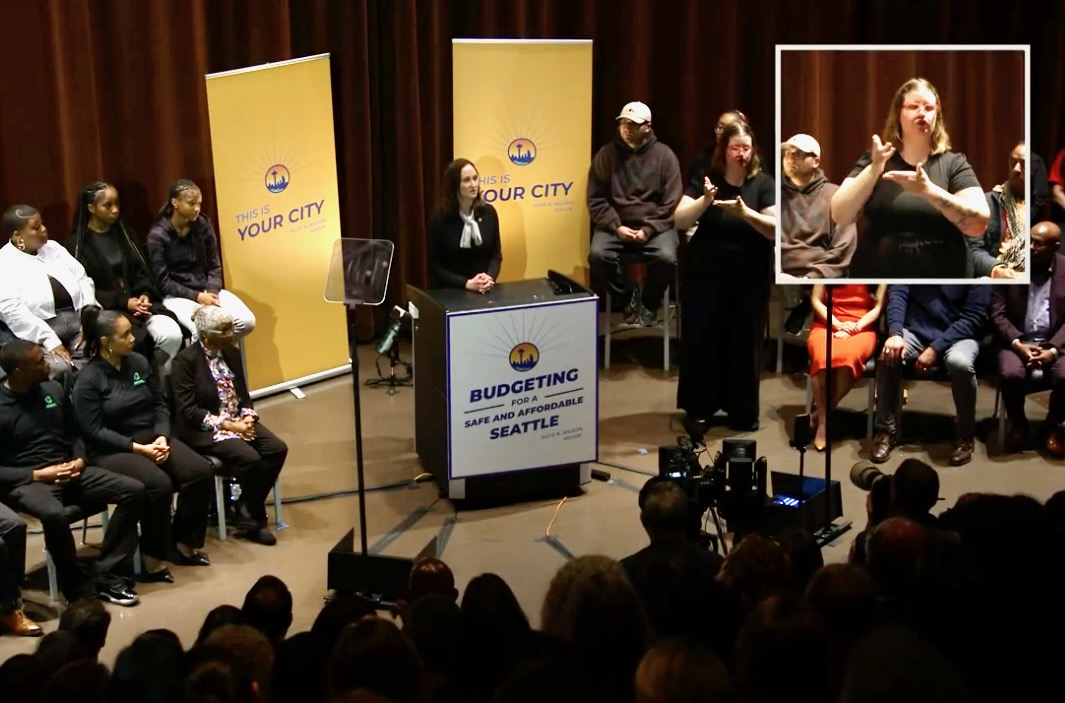
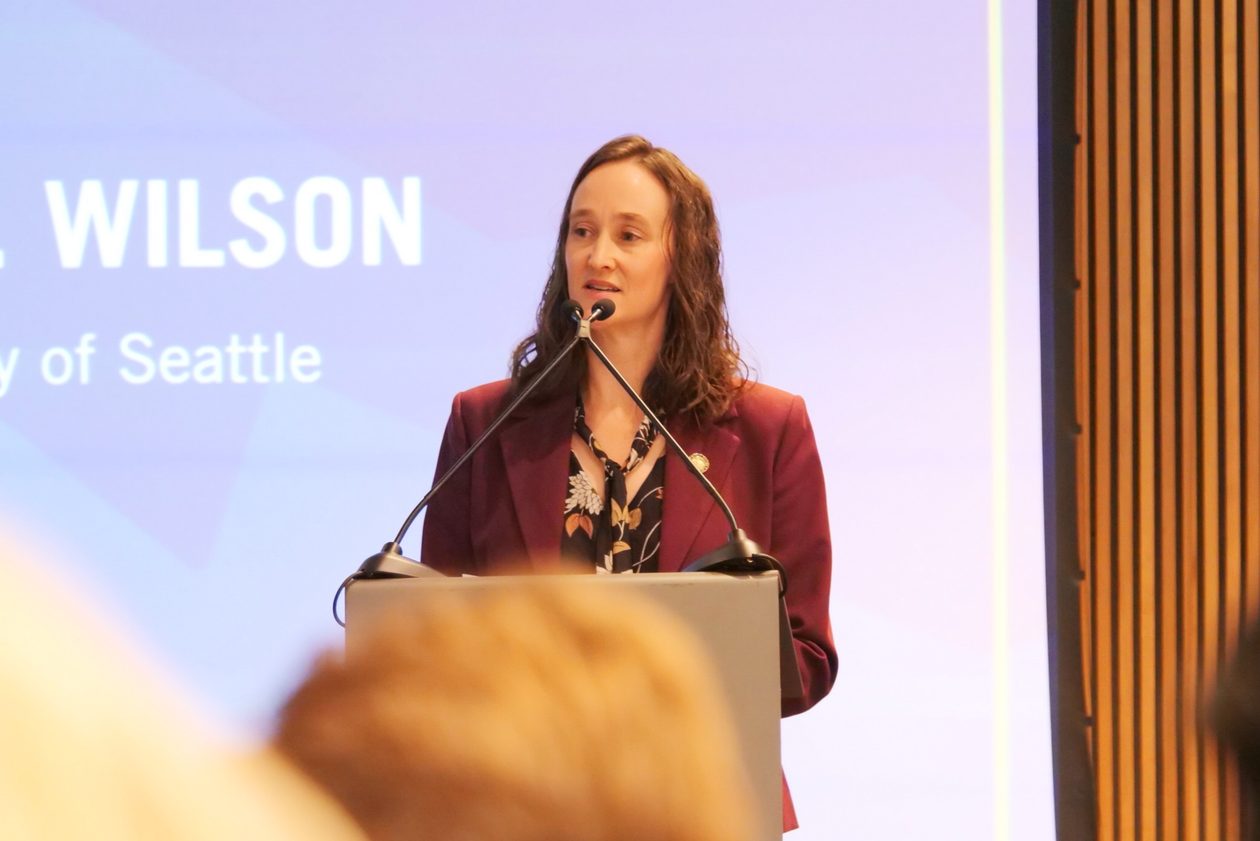
City of Seattle Mayor Katie Wilson set up a new task force to bolster the economy. (Photo via Katie Wilson for Mayor)
Seattle Mayor Katie Wilson is bringing together leaders from Amazon, Spotify, the Port of Seattle, organized labor, technology, cleantech, small business and other sectors as part of a new task force focused on rebuilding and diversifying the city’s economy.
Wilson on Wednesday announced 18 members of the Resilient Seattle Economy Task Force, which will look for ways to remove barriers to business growth, attract and retain companies and improve the process of starting and operating a business in Seattle.
“I’m charging this task force with identifying where the City can make connections, remove barriers and provide support within individual industries and across our economy,” Wilson said. “We need to diversify our economy while expanding opportunities for local entrepreneurs and young people.”
The effort builds on the city’s recently released Seawall: Building a Resilient Seattle Economy report, which called for Seattle to diversify beyond its heavy reliance on large technology companies and focus on sectors including artificial intelligence, cleantech, maritime, life sciences and space.
That report found that companies with at least 100 employees accounted for 74.5% of net job growth in the Seattle metro area from 2014 to 2023, while mid-sized companies accounted for just 16.6%.
The economic challenges have also put a spotlight on Seattle’s tax structure. As GeekWire recently reported, Seattle lost roughly 24,000 jobs between March 2020 and March 2025 even as city tax collections continued to grow, shifting more of the tax burden onto businesses.
Wilson has responded in part by freezing JumpStart tax rates in her proposed 2027 budget, citing “seismic shifts” in the technology sector.
The new task force will initially focus on downtown revitalization, business attraction and retention, cross-sector collaboration, and making it easier to open and operate a business. The task force also comes as Seattle’s business community has pressed City Hall for action on public safety, with dozens of regional CEOs recently calling for a 100-day plan with measurable goals and progress reports.
“Seattle is open for business,” said Beto Yarce, director of the Seattle Office of Economic Development.
The task force will hold industry-specific roundtables and listening sessions this year, with initial findings due in February 2027 and a final report expected in November 2027. Here’s a look at the task force members:
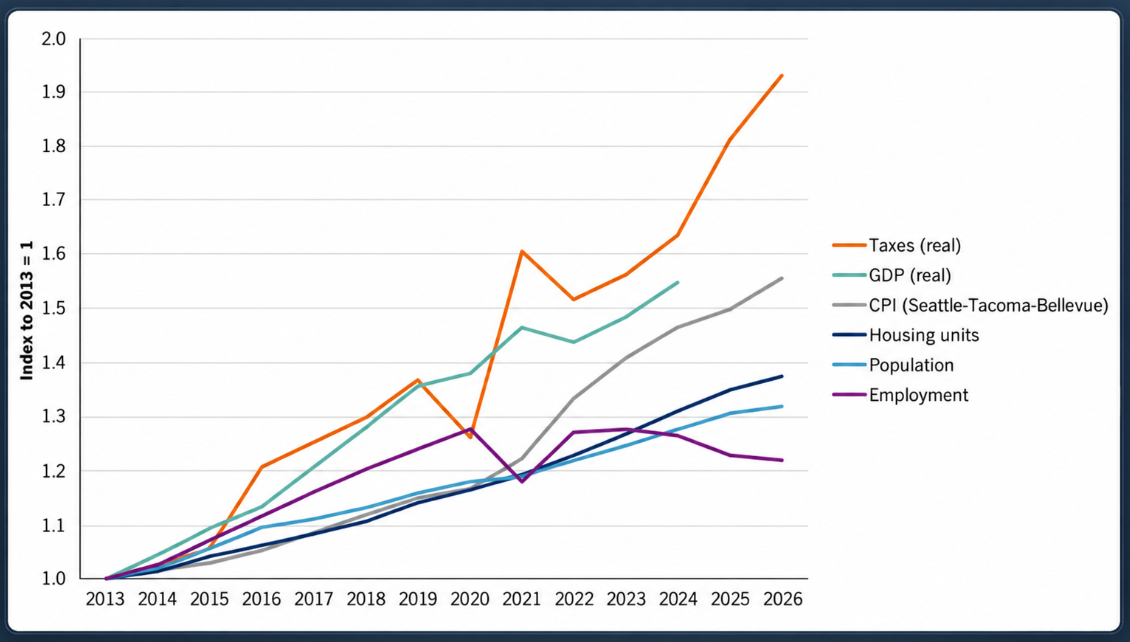
Taxes have outpaced population, employment and other other factors in Seattle (Image via ECOnorthwest)
Seattle’s tax collections have nearly tripled over the past decade, soaring from $900 million in 2013 to a projected $2.8 billion in 2026. But who pays those taxes, and how the tax revenue is collected, looks vastly different today than a decade ago.
A new report released by ECOnorthwest, commissioned jointly by the Downtown Seattle Association (DSA) and the Seattle Metropolitan Chamber of Commerce, show city tax revenues far outstripping population and job growth, driven by targeted corporate taxes on a small pool of major employers.
Between 2013 and 2025, Seattle’s tax revenues jumped 172%, outpacing population growth (31%), job growth (23%), and local inflation (50%). During that period, real tax growth grew 5.6 times faster than population and 7.5 times faster than employment.
The findings come as city leaders, major tech employers and regional business groups grapple with shifting post-pandemic work patterns and a political climate that has frequently placed large technology companies like Amazon in its sights.
According to the report, broad-based core taxes, such as property, sales, utility, and general Business & Occupation (B&O) taxes, comprised 83% of city tax collections in 2013. By 2026, those core broad taxes are projected to drop to just 52% of the total revenue.
Replacing them are narrow, targeted tax levies:
The JumpStart Payroll Expense Tax (2021): Paid by fewer than 500 companies, with the top 10 taxpayers footing 73% of the total bill.
The Social Housing Tax (2025): Paid by roughly 220 entities, with its top 10 taxpayers covering 66%.
Combined, two taxes that did not exist five years ago now account for nearly a third of all business tax dollars collected by the city. Overlap among top taxpayers means fewer than 20 companies account for roughly $356 million in annual City of Seattle revenue.
“Seattle’s tax collections are growing far faster than its population, jobs or inflation. Employers are carrying more of that burden. That trajectory is not sustainable,” said Seattle Metro Chamber president & CEO Joe Nguyen. “The question cannot always be how to collect more money. It must be how to deliver better results with the money we already have and build a tax structure that helps our economy grow.”
The heavy pivot to business revenue coincides with divergent employment trends between Seattle and its neighboring Eastside hubs.
Between March 2020 and March 2025, Seattle lost approximately 24,000 jobs, while the remainder of King County added 21,000. The report notes that Seattle lost 18,000 jobs in the single year leading up to March 2025 alone. And that figure that does not yet capture the full impact of major remote work policies and tech layoffs announced across the region.
However, in a sign that Mayor Katie Wilson is paying close attention to tech-sector headwinds and shifting job patterns, she proposed a $9.1 billion 2027 budget that would erase a $175 million general fund deficit and cut nearly $50 million in spending while freezing JumpStart tax rates.
A display at the Downtown Seattle Association’s annual event. (GeekWire Photo / Lisa Stiffler)
Seattle’s economic engine is stalling, and downtown is taking the brunt of the hit.
Between 2024 and 2025, Seattle shed 18,065 total jobs, with a staggering 70% of those losses—13,000 jobs—coming directly from the city’s downtown core, according to a new report released by the Downtown Seattle Association.
In some ways, it’s a tale of two cities.
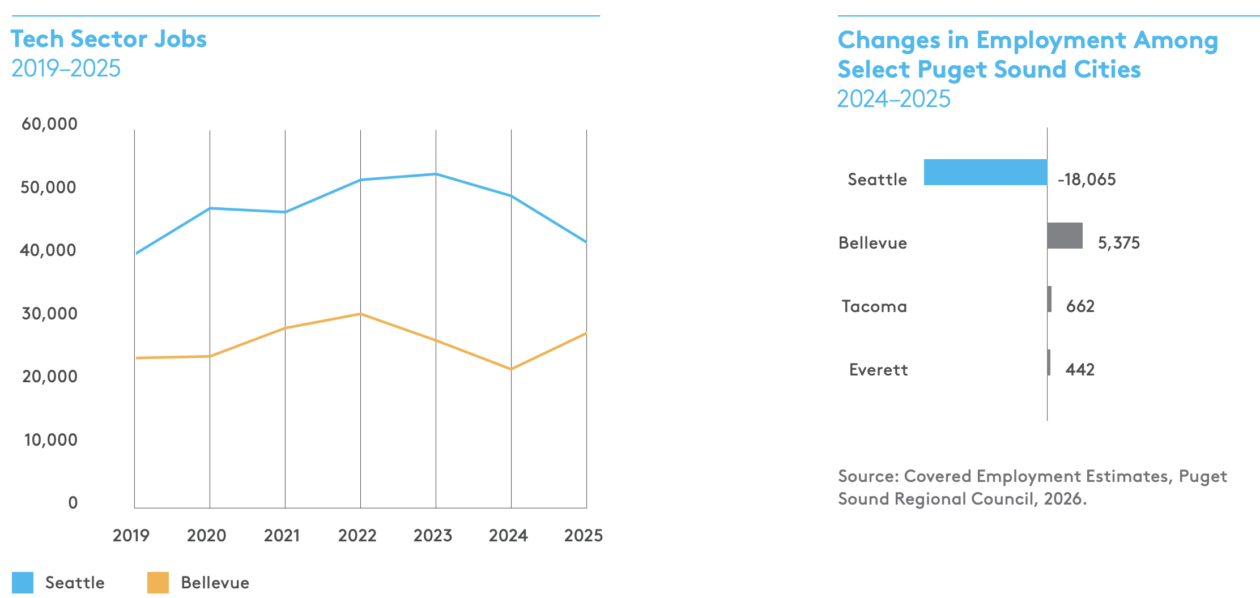
While Seattle proper shrank, neighboring Eastside tech hub Bellevue gained 5,375 jobs over the same timeframe, highlighting a shifting center of gravity within the Puget Sound region.
A lot of that growth in Bellevue, and decline in Seattle is coming from one company: Amazon.
The online retail and cloud computing powerhouse employed 15,700 workers in Bellevue at the end of 2025, making it the largest employer in Bellevue at 9.85% of the total workforce, according to the city’s Annual Comprehensive Financial Report. That’s up from just a few hundred employees in Bellevue nearly a decade ago.
Amazon employs about 49,000 people in Seattle proper, though the Puget Sound Business Journal noted this week that the company has shed office space in downtown Seattle and dramatically slowed employment in the city.
A major shift is happening in tech employment as Bellevue’s tech employment grows, while Seattle’s shrinks. (Graphic via the DSA)
Other key findings from the Downtown Seattle Association report:
Tech Leads the Drop: Seattle’s sharpest sector declines were concentrated in Information and Technology, Professional Services, and Construction.
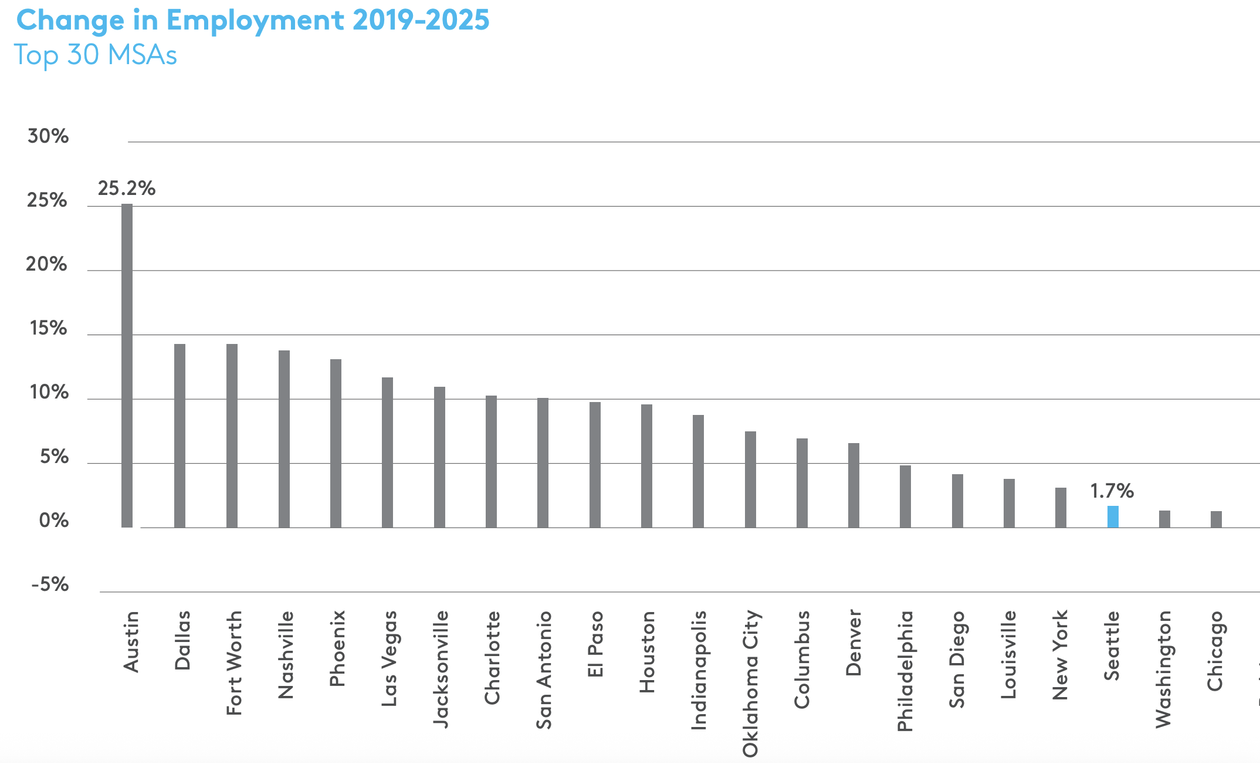
National Lag: Out of the top 30 U.S. metropolitan statistical areas, the Puget Sound region ranked 20th in job growth between 2019 and 2025. Total regional nonfarm growth rose just 1.7% over six years, vastly underperforming peer markets like Austin (25.2%), Dallas/Fort Worth (14%), and Nashville (14%).
Stagnant Commuter Foot Traffic: Inbound commuter visits to downtown Seattle remain stuck in the low 60% range compared to 2019 baselines, sliding 38% since the pandemic — a steeper loss than Bellevue (-21%), Austin (-23%), or Chicago (-32%).
Intra-Region Tech Shift: While Seattle’s tech headcount dropped from its 2023 peak, Bellevue’s tech job totals surged upward between 2024 and 2025, regaining momentum.
A new report shows weakness in Seattle’s economic growth from 2019 to 2025. (Graphic via the DSA)
The latest findings build on a growing chorus of criticism regarding the city’s fiscal climate. A June analysis by the DSA argued that Seattle’s controversial “JumpStart” payroll expense tax—passed in 2020 and targeting major employers like Amazon—is backfiring by driving business across Lake Washington.
The June report highlighted that since 2020, downtown Seattle lost roughly 30,000 jobs and saw office building values plummet 48%, while Bellevue—which levies no comparable head tax—gained jobs and expanded commercial values by 7%.
Though JumpStart projects $388 million in revenue this year, about 70% of that relies on just 10 major companies, underscoring how heavily Seattle leans on a handful of tech giants.
City of Seattle Mayor Katie Wilson has consistently pushed back against blaming downtown’s struggles on any single tax, pointing to broader post-pandemic remote-work trends, high interest rates and national tech restructurings that affect cities nationwide. She credited JumpStart with saving the city from drastic service cuts during the pandemic and noted that Seattle’s recovery remains resilient.
However, in a sign that Mayor Wilson is paying close attention to tech-sector headwinds and shifting job patterns in the region, she last week proposed a $9.1 billion 2027 budget, which would erase a $175 million general fund deficit and cut nearly $50 million in spending while freezing JumpStart tax rates.
Citing “seismic shifts” in the technology sector, the mayor’s freeze leaves the payroll tax untouched to offer big employers a period of tax stability, even as she continues directing JumpStart revenues beyond their original intent to cover core general fund operations.
“These were a set of taxes that may have provided some short-term gain to the city coffers, but are inflicting long-term pain,” DSA President and CEO Jon Scholes told GeekWire in an interview in June. “We predicted that at the time, and were sort of dismissed and ignored.”
GeekWire co-founders Todd Bishop, left, and John Cook open the GeekWire Podcast and VIP dinner, presented by Northern Trust, at Daniel’s Broiler in downtown Seattle. (Photo by Tanya Srisuthisuriya)
This week: Amazon is blocking Meta’s new Muse AI assistant from shopping on Amazon.com, saying the agent doesn’t identify itself and violates the site’s conditions of use. We explain why the standoff is an early sign of a much bigger fight over whether AI agents can use websites and apps on people’s behalf, and why Amazon has so much riding on the answer.
For the definitive word on the issue, we ask Muse what it has to say for itself, and get an impressively sophisticated and evenhanded response.
We recorded this week’s show live at Daniel’s Broiler in downtown Seattle, in front of a room of startup founders and CEOs, at a dinner hosted and sponsored by Northern Trust.
Mike Fridgen, a longtime Seattle entrepreneur and Madrona venture partner now working on a stealth startup, joins us to talk about whether Seattle is still a good place to build a company. The conversation covers the region’s talent, its history and the debate over taxes including Seattle’s JumpStart payroll tax, which Mayor Katie Wilson’s new budget holds flat.
Then we take questions from the room. Ridge AI CEO Ellie Fields asks how business leaders can engage productively in building the region, Latch CEO Stefan Kalb asks why Seattle has less venture capital than the Bay Area and ACME Brains founder Mary Jesse asks how to get past polarization.
Todd Bishop, left, and John Cook talk with Mike Fridgen during the live recording of the GeekWire Podcast at Daniel’s Broiler in downtown Seattle. (Photo by Tanya Srisuthisuriya)
We close with a satellite-themed GeekWire Trivia Challenge and an unexpected announcement from Starfish Space co-founder Austin Link.
Seattle Mayor Katie Wilson delivers her proposed budget at Seattle Central Library. (YouTube screenshot via Seattle Channel)
Seattle Mayor Katie Wilson on Tuesday proposed a budget that closes the city’s inherited deficit largely through spending cuts and rules out new taxes on big business. That includes any increase to the JumpStart payroll tax she helped create, a decision that comes amid a rocky stretch for the region’s tech industry.
The $9.1 billion proposed 2027 budget, the first year of the city’s 2027–28 biennial plan, aims to erase a $175 million General Fund deficit without new progressive revenue.
Wilson’s plan cuts nearly $50 million a year in General Fund spending and eliminates 128 full-time positions, 15 of which are currently filled. It also continues using JumpStart revenue to prop up general city services, while keeping more than 30% of the tax’s annual revenue — about $140 million — dedicated to affordable housing.
Speaking at the Seattle Central Library on Tuesday, Wilson framed the decision as a response to economic conditions.
“We are watching seismic shifts in the tech sector, which anchors so much of our regional economy,” Wilson said. Raising additional progressive revenue presents high risks while downtown remains fragile, she added, noting that expanding taxes like JumpStart is “not the right move” right now.
The stance marks a notable turn for Wilson. Before taking office, she helped design and push for JumpStart as a community activist. As recently as July, she called raising the tax an option for closing the budget gap. On Tuesday, she acknowledged she is “continuing to direct JumpStart dollars beyond the programs it was originally intended for,” and said she aims to grow the tax’s housing share in future budgets.
Passed by the City Council in July 2020 during the height of the COVID-19 pandemic, JumpStart was pitched as a way to fund affordable housing, climate initiatives, small business support, and equitable development. It applies to businesses with large Seattle payrolls and taxes the pay of employees earning roughly $194,000 or more, at rates ranging up to 2.55% depending on payroll size and salary levels.
Because of high salaries and equity-heavy compensation across major tech firms, the tax falls heavily on big tech. Just 10 top taxpayers, led by companies like Amazon, Meta, and Google, account for roughly 70% of JumpStart revenue.
JumpStart was designed with guardrails to protect spending on housing and community development, but it quickly became a lifeline for City Hall during post-pandemic revenue shortfalls. Under Wilson’s predecessors, the city routinely shifted roughly $200 million or more a year from the tax into the General Fund to patch structural deficits.
By holding rates steady, Wilson’s budget offers Seattle tech employers a period of tax stability amid growing friction over the city’s business climate. Business groups have long argued that heavy payroll taxes undermine Seattle’s competitiveness, pushing job growth and tech investment toward Eastside hubs like Bellevue and Redmond that don’t impose comparable payroll taxes.
That debate was reignited in June by a Downtown Seattle Association report examining the tax five years after its passage. The report tied JumpStart to the loss of about 30,000 downtown jobs and found that downtown Seattle office properties lost 48% of their assessed value between 2020 and 2025, while downtown Bellevue’s rose 7%.
While Wilson cautioned at the time against blaming downtown’s complex post-pandemic recovery on a single policy, her decision to hold JumpStart rates steady reflects her administration’s apparent willingness to listen to business concerns as City Hall works to revitalize the commercial core.
On Tuesday, DSA President and CEO Jon Scholes welcomed her budget, saying that not adding business taxes while employers face headwinds is “important and a helpful signal to the business community.”
Last week, during the launch of Partnership for a Competitive Puget Sound, a new regional initiative brought together by Challenge Seattle to strengthen the area’s tech strategy, Microsoft President Brad Smith referred to the tax.
As structured, the payroll tax “is really a tax on tech jobs,” Smith said, “and that’s why you’re seeing more tech jobs move from Seattle to places like Bellevue and the Eastside.” He noted that San Francisco abolished its payroll tax the same year Seattle adopted one, in 2021.
“You should tax things you want to discourage, like cigarettes, not jobs,” Smith said at the time.
On Tuesday, Amazon offered its reaction to the mayor’s budget plan.
“We appreciate Mayor Wilson putting forward a budget that focuses on making use of existing resources,” an Amazon spokesperson told GeekWire. “Like Mayor Wilson, we believe the city’s first priority should be making sure those resources are used effectively and deliver results for residents.”
Beyond payroll taxes, Wilson’s budget speech and recent executive actions touched on several tech-adjacent priorities:
Housing permitting acceleration: Following an executive order last month launching a Housing Production Task Force, the budget funds a new Affordable Housing Ombud position to help community developers navigate city permitting faster.
Algorithmic pricing transparency: The budget funds implementation of the city’s Fair and Transparent Pricing policy. The City Council was scheduled to take a final vote Tuesday on the ordinance, making Seattle the first city in the country to ban algorithmic price discrimination (also known as surveillance pricing) for groceries.
Economic diversification and AI exposure: The budget proposal follows an executive order Wilson signed earlier this month aimed at diversifying Seattle’s economy. A city-commissioned report warned that local employment is 42% more exposed to AI disruption than the national average, prompting the order’s call for targeted support to retain growing startups.
Green technology investments: The budget maintains JumpStart-funded Green New Deal programs, including building decarbonization, urban forest support, and clean energy apprenticeships.
With the proposed budget now formally submitted, the Seattle City Council begins a nine-week review process chaired by Councilmember Dan Strauss. Public hearings are scheduled for Oct. 6 and Nov. 5, and councilmembers have until Oct. 20 to submit proposed amendments before Strauss presents a revised balancing package in early November.
A final council vote to adopt the final budget is slated for Nov. 20.
Sara Nelson launched the CivicTide website Monday. (Sara Nelson Campaign Photo)
Sara Nelson, the former Seattle City Council president, is making her debut as a publisher and commentator, with an eye toward boosting civic engagement, and a little help from AI agents.
CivicTide, which Nelson launched Monday at civictide.org, tracks and reports on Seattle City Council legislation from introduction to final vote. Policy briefs — such as this one on Councilmember Dan Strauss’ plan to create RV parking permits for people living in vehicles — summarize what a bill would do, explain the stakes, and juxtapose the “spin” from backers against the site’s analysis.
Readers can use built-in tools on the site to quickly email councilmembers on specific issues or post their views on social media. CivicTide arrives one day before the council starts its budget deliberations, which Nelson said was deliberate timing.
“I’m trying to solve for the hassle of civic engagement,” Nelson said in an interview with GeekWire, describing it as an effort to help create “more accountable, accessible governance.”
Each policy brief links to the underlying ordinance and committee records. The site also aggregates and links to coverage elsewhere, and publishes opinion pieces on specific issues, such as this one calling Mayor Katie Wilson’s freeze on police hiring bonuses “downright reckless.”
Does that make CivicTide partisan? “Every piece of media, even the reporting pages, everything has a slant,” Nelson said. At the same time, she said she will aim for neutrality in describing what a bill would do, while confining her own read to the “spin vs. reality” section.
Asked whether she would be open to Mayor Wilson writing a guest column for CivicTide, Nelson didn’t hesitate. “I would welcome that,” she said.
How it works: Behind the scenes of the website, a custom AI-powered content management system ingests city legislative data hourly and gives Nelson a ranked queue of what’s worth writing about. It offers draft posts ready for her to review, edit, and rework as needed before publication.
It was built by Viet Nguyen, a veteran Seattle tech communications executive who has developed a specialty in building political and civic websites. He used AI to write the whole thing from scratch, including the public site, the backend, and the editorial workflow he calls the newsroom.
The new CivicTide site, which tracks Seattle City Council legislation and offers reporting and commentary.
Nelson acknowledged that using AI this way could raise questions among the press and general public, and said she expects to be asked about it. “My motto is, don’t get left behind,” she said. “We have to use every tool within our toolbox to actually make government more accessible.”
She approves everything the system produces: “There is always a human behind the machinery.”
Changing media landscape: The site also aggregates and links to stories from established local outlets, chosen for their connection to active legislation, from a set flagged by the AI in the backend for Nelson’s editorial consideration.
As in many media markets, Seattle has a smaller set of reporters covering City Hall than it used to. Nelson said people tend to get their information about City Hall from limited sources, and the goal is to help round out the conversation and sources of news.
For example, in addition to the Seattle Times, the site’s “In the press” section currently links to KUOW, KING 5, KOMO News, The Seattle Medium, and a post from the personal blog of Tim Burgess, the former City Council president who served as deputy mayor under Bruce Harrell.
Articles from The Stranger, Publicola, GeekWire and many other sites are among the sources served up for Nelson’s consideration in the CivicTide backend.
Meanwhile, AI has made these kinds of sites cheaper and easier to build.
GeekWire profiled a similar project in April: Next30Days, built by former Amazon product manager Julien Clayton, which pulls agendas from the same Legistar system and summarizes them to get people to attend meetings. It takes no position on the bills it covers.
Background and perspective: Nelson, who co-founded Fremont Brewing, spent four years on the council, two as its president, and was its most consistently business-friendly member, advocating for police hiring, addiction treatment and permitting changes.
She lost her seat in November to Dionne Foster and left office in January. Asked whether she plans to run for council again, and whether CivicTide is part of that, Nelson said no.
Support from business leaders: CivicTide is debuting at a time when business leaders and elected officials from outside Seattle are becoming more vocal about the city’s economic direction.
The site’s launch announcement includes testimonials from business and neighborhood leaders, including chef Ethan Stowell, SODO Business Improvement Area executive director Erin Goodman, Joyale Seafood owner Vincent Zhao, Gary Lee of the Chinatown-International District Public Safety Council, and Tina Bueche, a former president of the Pioneer Square Community Council.
In the announcement, Stowell said the restaurant industry “feels totally unrepresented in City Hall,” and that small businesses lack the time and staff to keep up with the city’s shifting proposals even though they absorb the consequences. He said CivicTide would let them track the legislation that affects them and weigh in “before it’s a done deal.”
Nonprofit status: The publisher of CivicTide is SeaFor, a 501(c)(4) social welfare nonprofit that Nelson runs, registered in Washington state. Donors to a 501(c)(4) aren’t required to be disclosed publicly in the state, and Nelson declined to name hers in the interview with GeekWire last week.
The organization does plan to contribute to an independent expenditure campaign in the District 5 race, the only council seat on the ballot this year, Nelson said. If SeaFor is among that campaign’s largest donors, its own top three contributors will be named on the mailers.
Nelson said she’s supporting Julie Kang in that race, though a formal endorsement would follow interviews with Kang and Nilu Jenks, scored against a rubric.
GeekWire profiled Nguyen in August. His recent projects include Culliton2026.org, an AI-generated guide to how state Supreme Court candidates might rule on Washington’s new millionaires’ tax. That site took a few hours and about $100 in AI tokens.
CivicTide is a bigger undertaking. Nelson said her organization’s budget is $163,000 for July through December, with $55,000 to $65,000 of that going to site development and ongoing AI tokens. The rest covers legal costs and the planned independent expenditure, she said. She isn’t paying herself.
SeaFor’s other stated purpose is recruiting and supporting candidates whom Nelson calls pragmatic — a term she defined loosely, covering everyone from a small-business owner to “a neighbor on Aurora who’s sick of seeing the mayhem every Saturday night.”
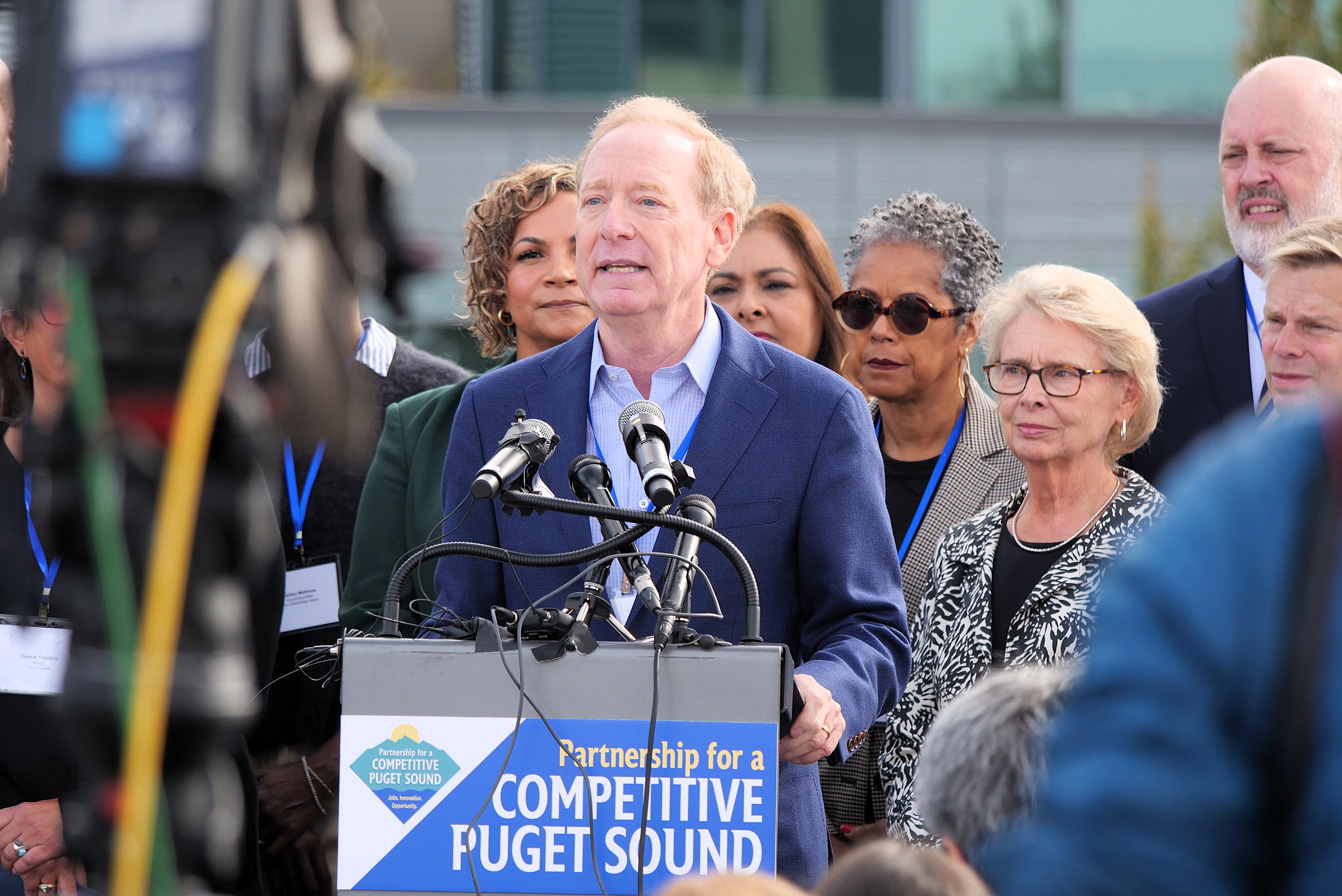
“You should tax things you want to discourage, like cigarettes, not jobs.” Microsoft’s Brad Smith at Monday’s launch of the Partnership for a Competitive Puget Sound, with former Gov. Chris Gregoire at his left. (GeekWire Photo / Todd Bishop)
Detroit, Cleveland and Pittsburgh each had their moment in the sun a century ago, Microsoft Vice Chair and President Brad Smith said Monday — and then the warning lights started flashing, and their leaders at the time failed to heed them.
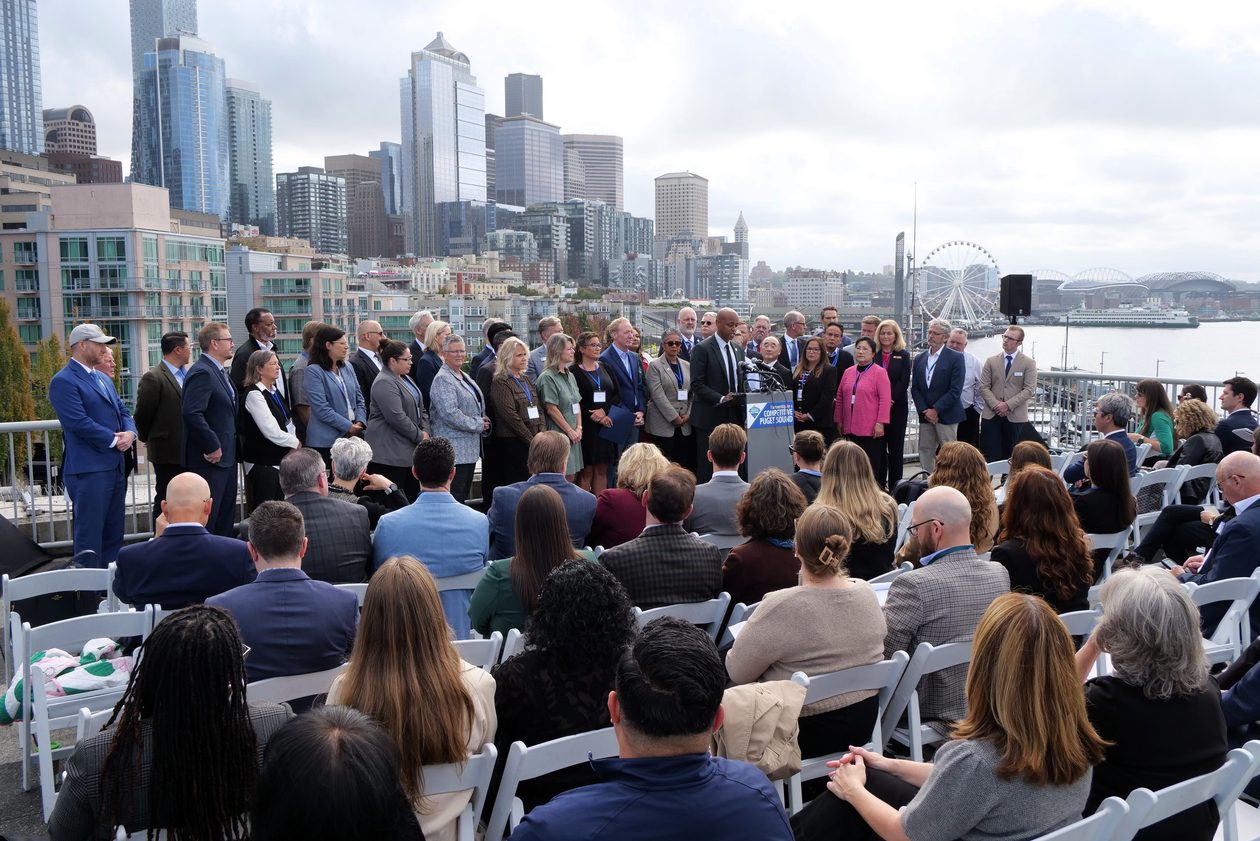
“Well, here we are. It is 2026,” Smith said at a press conference, flanked by dozens of regional leaders, with the Seattle skyline behind them. “And the warning signs are flashing on our economy.”
Smith was speaking at the launch of the Partnership for a Competitive Puget Sound, a Challenge Seattle initiative that brought together roughly 50 elected officials from King, Kitsap, Pierce and Snohomish counties — two county executives, around 20 mayors, port commissioners and about a dozen state legislators — along with labor leaders and business executives, behind a 20-point plan for reversing the region’s slide.
The region lost nearly 7,000 jobs in 2025, according to a report issued by the group, the first time in two decades outside a recession or the pandemic that Seattle-area employment growth has trailed the nation’s. Washington has fallen from 32nd to 47th in CNBC’s ranking of states by cost of doing business since 2017.
An ‘intentional’ regional tech strategy: The report makes a pointed observation about technology: aerospace has a coordinated regional agenda and tech doesn’t, despite tech accounting for nearly one in 10 regional jobs and about 24% of total payroll.
Aerospace knows what it’s working on: the next airplane, the space industry, sustainable fuels, supplier diversification. Technology, “despite being one of Puget Sound’s defining economic anchors, does not yet have an equally intentional regional strategy,” the report says.
King County Executive Girmay Zahilay addresses the crowd Monday, with the downtown Seattle skyline behind him. More than 32% of the city’s central business district office space sits vacant, according to the new regional report. (GeekWire Photo / Todd Bishop)
Without one, it adds, the region risks losing “jobs, technology investment, headquarters, talent, and company growth” to the Bay Area, New York, Boston and Austin. The goal is “not simply to promote growth, but to protect and strengthen the region’s position as a leading technology center.”
Challenge Seattle says it will write that strategy with the Puget Sound Regional Council, built around two priorities: keeping the big tech companies investing here, and making it easier for startups to scale. Related recommendations target industrial space for AI hardware startups, commercial space, and the region’s fusion cluster.
The report sets no budget or measure of success for the tech strategy, and no deadline beyond its general goal of progress within three years.
A regional wake-up call: Many of the recommendations are changes to how local government operates, not new spending: deadlines for permit decisions, a designated business contact in every city and county, and a strategy for dealing with the way taxes stack across state, county and city.
“This is, for us, a wake-up call,” said former Washington Gov. Chris Gregoire, CEO of Challenge Seattle, launching the initiative during the press conference. “We cannot resort to relying on yesterday’s success while tomorrow’s jobs go somewhere else.”
April Sims, president of the Washington State Labor Council, said businesses need predictability and enough margin to invest, innovate and take risks — but “working people need margins, too.”
King County Executive Girmay Zahilay said his office has hired an economic development team and is beginning an internal permitting audit. “AI is transforming our economy seemingly overnight,” he said, calling the 7,000 lost jobs “quite alarming.”
The group also released a playbook for Puget Sound mayors, drawn from interviews and surveys with local leaders, on building what it calls a culture of partnership with business.
Seattle as a Microsoft litmus test: Asked by GeekWire during the press conference what it would take for Microsoft to return and grow in Seattle proper, where it previously had offices in South Lake Union, Smith first pointed out that he was standing in front of Redmond Mayor Angela Birney.
“We have a great mayor, and every day we get up and we’re excited to go to work in Redmond, Washington,” he said, to laughter from the assembled officials.
Smith also pushed back on the premise: Microsoft moved to the Eastside from Albuquerque in 1979 and never had a large presence in Seattle, so he wouldn’t use the city as the point of comparison.
Then he turned to Seattle’s JumpStart payroll expense tax.
As structured, the payroll tax “is really a tax on tech jobs,” Smith said, “and that’s why you’re seeing more tech jobs move from Seattle to places like Bellevue and the Eastside.” He noted that San Francisco abolished its payroll tax the same year Seattle adopted one, in 2021.
“You should tax things you want to discourage, like cigarettes, not jobs,” he said.
He tied the issue to the larger impact of AI on jobs. “We need people to succeed to some degree in a world of AI,” Smith said. “And you don’t want to make the cost of employing people more expensive, at the same time that AI is increasingly adding its own new form of competition.”
“There’s nothing that would lead to the decline in jobs in this state faster than a replication of the JumpStart tax,” he said. “And if Seattle wanted to do one thing to increase jobs in Seattle, it ought to revisit whether a payroll tax makes any sense.”
Then he added a caveat: “That’s probably something that would impact other companies more than Microsoft.”
Amazon, which has been reported to be the largest payer of the tax, did not have a speaker at Monday’s event. Individual Amazon execs are listed in the acknowledgments in the Challenge Seattle report, though the report says participation doesn’t imply endorsement.
View from Olympia: During the press conference, Senate Majority Leader Jamie Pedersen, D-Seattle, was asked whether Washington risks becoming an outlier among states on taxes. The Legislature has been correcting course, he said, pointing to two moves from this year’s session.
One was the estate tax. Lawmakers raised the top rate to 35% in 2025, the highest in the country, and reversed themselves this March, returning it to 20% as of July.
The other was the millionaires tax — a 9.9% tax on household income above $1 million, signed by Gov. Bob Ferguson and projected to raise roughly $3 billion a year. It doesn’t take effect until 2028, and Seattle tech leaders warned it would push founders and investors out of the state.
Pedersen cast it as the fix for a different kind of outlier status: Washington’s business and sales taxes are high because it’s one of the few states with no personal income tax at all. The new tax would let Washington “join 41 other states that have a personal income tax,” he said.
Voters get the last word in November. Initiative 645, backed by Let’s Go Washington, qualified for the ballot in July and would repeal the tax. If it survives, Pedersen said, a statewide payroll tax is “vanishingly unlikely” next session.
Seattle’s mayor weighs in: Seattle Mayor Katie Wilson, who was an architect of the JumpStart tax before running for office, was not among the speakers at the press conference. She opened the regional session that followed, and said the region needs to do a better job telling its own story.
Seattle Mayor Katie Wilson opens the regional action session that followed Monday’s launch of the Partnership for a Competitive Puget Sound. (GeekWire Photo / Todd Bishop)
“There are some forces and interests that are pushing a narrative that does not want Seattle or our region to succeed,” Wilson said, “and we must counter that with a new commitment to a shared sense of destiny, because Seattle’s success is Bellevue’s success, Pierce County’s success is Snohomish County’s success.”
She called it a fragile moment and said the time to act is now, pointing to the economic actions she announced last week in conjunction with an independent report commissioned by the city and released by Seattle’s Office of Economic Development.
That report, “Seawall: Building a Resilient Seattle Economy,” found Seattle’s tax structure unique among peer cities in the way it “specifically penalizes the hiring of senior, high-compensation workers,” with the burden falling overwhelmingly on large tech employers.
Hiring a software engineer at $650,000 in total compensation costs about $17,000 more a year in Seattle than in Bellevue at JumpStart’s top rate, the researchers found.
The city report, conducted by the economic consulting firm Formation, said Seattle should bet on cleantech, the sector where the city owns the utility, writes the building codes and controls permitting and land use. It’s one place where Seattle has real leverage over its own economy, the researchers argued.
“It’s striking how much agreement we share across labor, businesses, and government,” Wilson said. “This is not a call to ignore our challenges, but to tackle them with a shared sense of possibility.”
She did not address the payroll tax in her remarks.
This week on the GeekWire Podcast: A study commissioned by the City of Seattle says the city is not in decline but is in danger — finding that 10 companies, nine of them in tech, pay three-quarters of the payroll tax on large employers, and that the tax structure uniquely penalizes the hiring of senior, high-compensation workers.
The report says Seattle should be most concerned about AI but most active in cleantech, the one industry the city can actually shape, since it owns the electric utility and controls permitting, building codes and land use.
Meanwhile, the Seattle Times and Newsday sue Microsoft and OpenAI, accusing them of copying hundreds of thousands of articles to train their AI models, putting Microsoft’s hometown paper against a company that helps fund some of its journalism.
Which leads us to a new GeekWire Trivia Challenge about the Microsoft products that Apple later turned into categories. Stick around to the final segment to see if you can figure it out.
Upcoming Event
AI meets real estate
GeekWire, in partnership with Real Estate at Work, is recording the GeekWire Podcast live at 4 p.m. Wednesday, Sept. 16, with Toby Roberts, SVP of Engineering at Zillow. John Cook and Todd Bishop host with Real Residential broker Leka Devatha at Atmosphere Seattle. Grab a ticket.

 Login