
 Login
Login
Juno Propulsion wins $1.2M grant from NSF to advance non-toxic space propulsion system
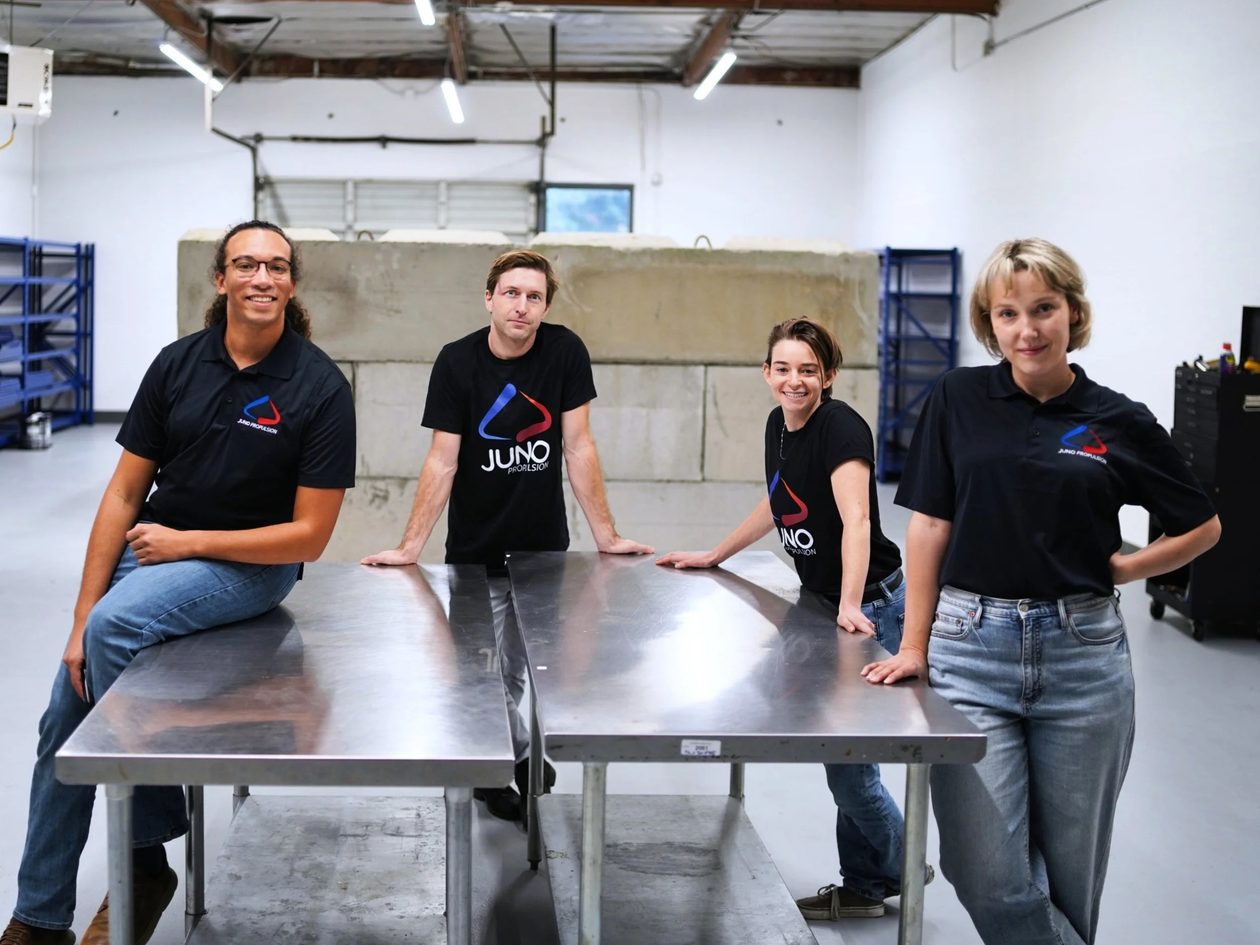
The National Science Foundation has awarded a $1.2 million grant to Tukwila, Wash.-based Juno Propulsion to support the startup’s development of a non-toxic propulsion system for in-space applications.
The two-year Phase II project, funded through NSF’s Small Business Innovation Research (SBIR) program, will be conducted in partnership with the University of Washington and UW Professor Carl Knowlen’s lab. The focus of the funding is to support work on Juno’s Product Development Unit (PDU), which uses rotating detonation rocket engine technology.
By combining high-efficiency propulsion with non-toxic propellants, Juno aims to enable spacecraft to maneuver farther and faster while reducing the risks associated with traditional toxic propellants. Work on the PDU is intended to advance Juno’s system to Technology Readiness Level 8, positioning it near production-ready status on the standard 1-to-9 TRL scale.
“This award represents an important milestone in taking our rotating detonation propulsion technology from development and flight demonstration toward a production-ready product,” Juno Propulsion CEO Alexis Harroun said in a news release. “We’re excited to continue our collaboration with the University of Washington and Professor Knowlen’s lab as we take the next step toward delivering this technology to commercial and government customers.”
The Phase II grant, announced last week, follows up on a $275,000 Phase I SBIR grant that was awarded in 2024.
Juno Propulsion’s team is getting ready for Project Iris, an on-orbit demonstration of its propulsion technology that’s due to fly aboard Momentus’ Vigoride 8 satellite platform in 2027. The lessons learned from Project Iris will feed directly into work on the PDU.
The startup was founded in 2023 by Harroun and chief technology officer Ari Martinez, who met while earning their Ph.D.s at Purdue University. Harroun received her undergraduate degree in aeronautics and astronautics from UW and interned at Blue Origin, Boeing and NASA before heading to Purdue.
In June, Juno Propulsion announced the close of a $1.4 million pre-seed financing round, led by SOSV with participation from Hypernova Fund, Leslie Ventures, Activate, Collaborative Fund, Safar Partners and Cape Fear Ventures.
