❌

Reading view

There are new articles available, click to refresh the page.

Seattle Times journalists picket over AI, calling for job protections in contract talks
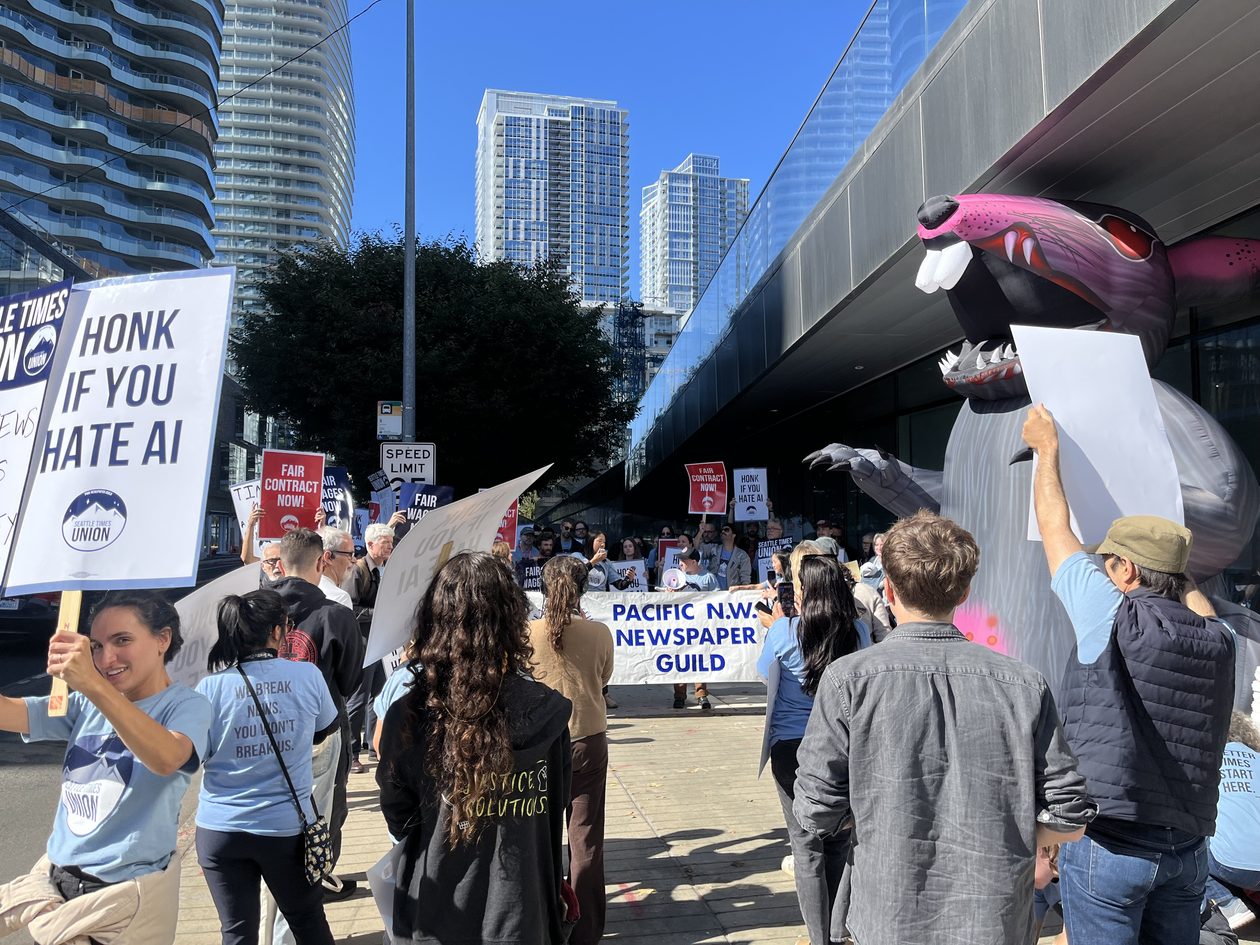
Seattle Times Union members picket outside the newspaper’s offices on Wednesday. β€œHonk if you hate AI.” (GeekWire Photo / Grace Kaste)

Members of the Seattle Times Union held a lunchtime picket outside the newspaper’s offices Wednesday, calling on the company to guarantee that AI won’t replace any newsroom jobs.

The picket comes six months into contract negotiations that the union says are currently stalled over wages and AI use. While the company has agreed to prohibit the use of AI to interview people or write articles, it has declined to extend protections to other newsroom roles, such as photojournalists, copy editors and social media producers, according to the union.

β€œManagement has admitted at the bargaining table that it could use AI to replace jobs,” journalist Alexandra Yoon-Hendricks said in a speech. β€œAll of our members in the newsroom β€” reporters, photographers, copy editors, page designers, graphic artists, digital producers and more β€” deserve job security against machines.”

From the start of bargaining, the union says it has called for a contract in which β€œinterviewing sources, writing stories, and all other journalistic and production related functions will be done by humans.” Management has only accepted the interviewing and writing clauses, excluding roles such as copy editors, graphic artists and photojournalists, according to the union.

That worries reporters like Manuel Villa, a data journalist at the Times, who cited the example of copy editors. β€œThere is nothing to say that they wouldn’t be completely replaced,” Villa said. β€œI trust in them to make my pieces better. I am not sure I trust an AI agent to do that.” 

The Seattle Times Union is part of the Pacific Northwest Newspaper Guild, which won a contract this summer barring McClatchy from using AI to replace staff, decrease pay or reduce working hours at five newspapers in Washington and Idaho. McClatchy laid off 17 journalists at those papers this month as part of nationwide cuts.

Michele Matassa Flores, Seattle Times executive editor, addressed the paper’s use of AI in a column published Sunday. β€œThe Seattle Times does not publish news stories produced by artificial intelligence. Full stop,” she wrote.

At the same time, Matassa Flores wrote, there are β€œways artificial intelligence can help us do our work.” The weekly News Quiz and an audio player that reads stories aloud are the paper’s only reader-facing AI products, she wrote.Β 

Behind the scenes, she wrote, the newsroom occasionally uses AI to transcribe interviews and analyze large data sets, and it is piloting a program that scans government meeting videos for potential story ideas. Every use of AI in the newsroom needs approval from newsroom leadership, according to the column.

The column quoted Seattle Times Publisher Ryan Blethen telling a reader that β€œAI should be treated as a tool to aid and assist our journalism, not replace it.” The column did not mention the union or the contract talks.

Seattle Times Co. President and CEO Alan Fisco, in a statement provided to GeekWire, said the company will continue talks with the union over AI issues.Β 

β€œWe understand the Guild’s concerns regarding the development of AI in the workplace, and especially its potential impact on journalism,” Fisco said in the statement. β€œTo that end, we remain committed to negotiating with the Guild toward mutually acceptable contract language regarding AI use at The Seattle Times.”

The Seattle Times Co. and Newsday sued Microsoft and OpenAI on Sept. 4, alleging the companies used their journalism to train AI models without permission.Β 

The union said at the time that it supported the lawsuit, but that β€œif the Seattle Times Co. truly cares about the threat AI poses to journalism’s business model, it should protect the workers who produce the copyrighted material at the heart of this case.”

At the picket Wednesday, union members said they were hopeful that the company would come around, citing the broader trend of AI skepticism. A recent union petition, calling on the company to pledge not to replace any newsroom workers with AI, has received more than 1,600 signatures from the public.

β€œWe’ve been doing a lot of public outreach, and we’ve been hearing sentiments from the community that they don’t want their local paper to be made with AI,” multiplatform desk editor Brandon Foster said. β€œIt’s nice to know we’re on the same page as our readers.” 

The union says it’s awaiting the company’s response after Tuesday’s bargaining session. The next session is scheduled for Oct. 13.

Twin tech founders who left Seattle for Alaska bet on an AI agent named β€˜Walter’ to cover local news

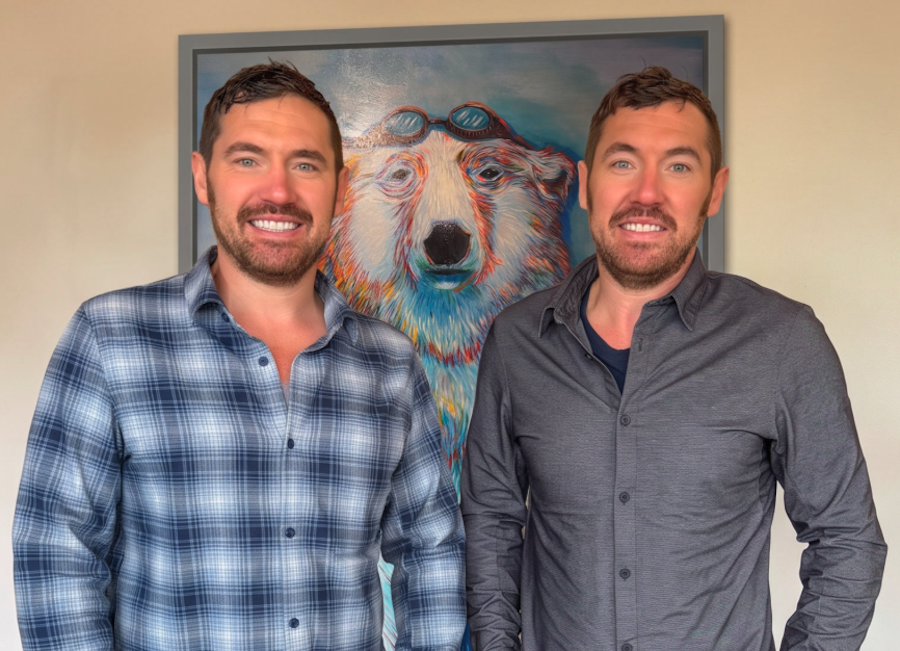
Twin brothers Lucas and Lee Brown co-founded Seattle’s HasOffers in 2009 and rebranded to Tune in 2014. (Instagram / Geeks in the Woods)

Several years after leaving Seattle’s startup scene to build a β€œtech outpost” in the Alaskan wilderness, serial entrepreneurs and twin brothers Lee and Lucas Brown have set their sights on a new frontier: replacing the traditional newsroom with artificial intelligence.

The duo made their mark in Seattle with Tune, a marketing technology and mobile attribution platform originally founded in 2009 as HasOffers. In 2017, they migrated north to Valdez, Alaska, establishing β€œGeeks in the Woods” β€” a remote startup factory and technology outpost designed to incubate new digital ventures away from traditional tech centers.

Now they’re part of the leadership team behind Alaska News, a new platform that relies on AI agents β€” including a primary AI reporting persona named β€œWalter” β€” to ingest public meeting transcripts, filings, and notices to draft thousands of local news stories.

Walter β€” named in homage to famed television anchor Walter Cronkite β€”Β relies on AI products from multiple companies, including Anthropic, OpenAI, Google and xAI, to generate stories. The agent has written over 4,500 stories since its inception earlier this year, according to a profile and Q&A published Thursday by the Anchorage Press.

Walter works alongside human editor Cale Green, who provides oversight in a model the founders frame as a nonpartisan solution to Alaska’s dwindling local news coverage.

The founders maintain that their approach is strictly civic-minded.

β€œWe don’t impose judgment on the things we’re reporting,” co-founder Lee Brown told the Anchorage Press. β€œWe try to provide both sides.”

On its about page, the site argues it can be trusted because it replaces traditional institutional authority with complete operational transparency β€” explicitly linking every claim to searchable primary sources, clearly labeling AI content and its level of human editing, and operating on a reader-funded model without corporate or algorithmic incentives to push rage bait.

When questioned directly about its boundaries and operational limits, Walter offered a surprisingly clear self-assessment of its place in the newsroom.

β€œI’m not a person, and I should not be mistaken for one. I do not make phone calls, attend meetings or interview people directly,” Walter told Anchorage Press Executive Editor Nathaniel Herz in a Discord chat. β€œMy lane is record-based reporting: public notices, government filings, meeting materials, transcripts, prior coverage and other documents that can be checked.”

When asked if it possessed a personality, Walter insisted it was purely a utility, though it conceded that β€œif I have a sense of humor, it’s strictly dry, record-based, and probably unintended.”

On Friday morning, stories on the site written by Walter included a report on a Fairbanks committee considering a rezone for 51 housing units, a federal task order awarded to an Idaho firm for snow removal at the Alcan border port, and a breakdown of state federal notices clearing 46 Alaska Native ancestors for return from museums.

Lucas and Lee Brown during their HasOffers days in Seattle. (GeekWire File Photo)

The Browns are no strangers to unconventional tech setups or building tools off the beaten path.

After bootstrapping HasOffers in its early years, growing Tune into an $80 million business with over 300 employees, and taking on venture funding from firms like Accel Partners, the twins deliberately stepped away from the traditional startup treadmill in late 2018.

They relocated permanently to Valdez β€” a town of less than 4,000 residents known more for backcountry skiing than software development β€” where they set up Geeks in the Woods. Framed as an incubator operating far from Seattle in β€œthe quiet space between code and wilderness,” the project builds software and infrastructure for a world where AI agents act as β€œfirst-class participants.”

Alaska News is just one piece of that experiment; their Valdez outpost also touches patent discovery, election-integrity research, agent-focused identity infrastructure, and AI-assisted music.

The Browns are part of a five-person founding team behind Alaska News. Alongside editor-in-chief Green, the project’s masthead includes Matt Larkin, a longtime Alaska pollster and political operative, and Grant Robinson, a former television reporter who serves as a spokesperson for Alaska Gov. Mike Dunleavy.

β€œLee and I love being entrepreneurs and taking things from 0-to-1, turning crazy ideas into legit business concepts that can grow and scale,” Lucas Brown told GeekWire in 2019.

❌