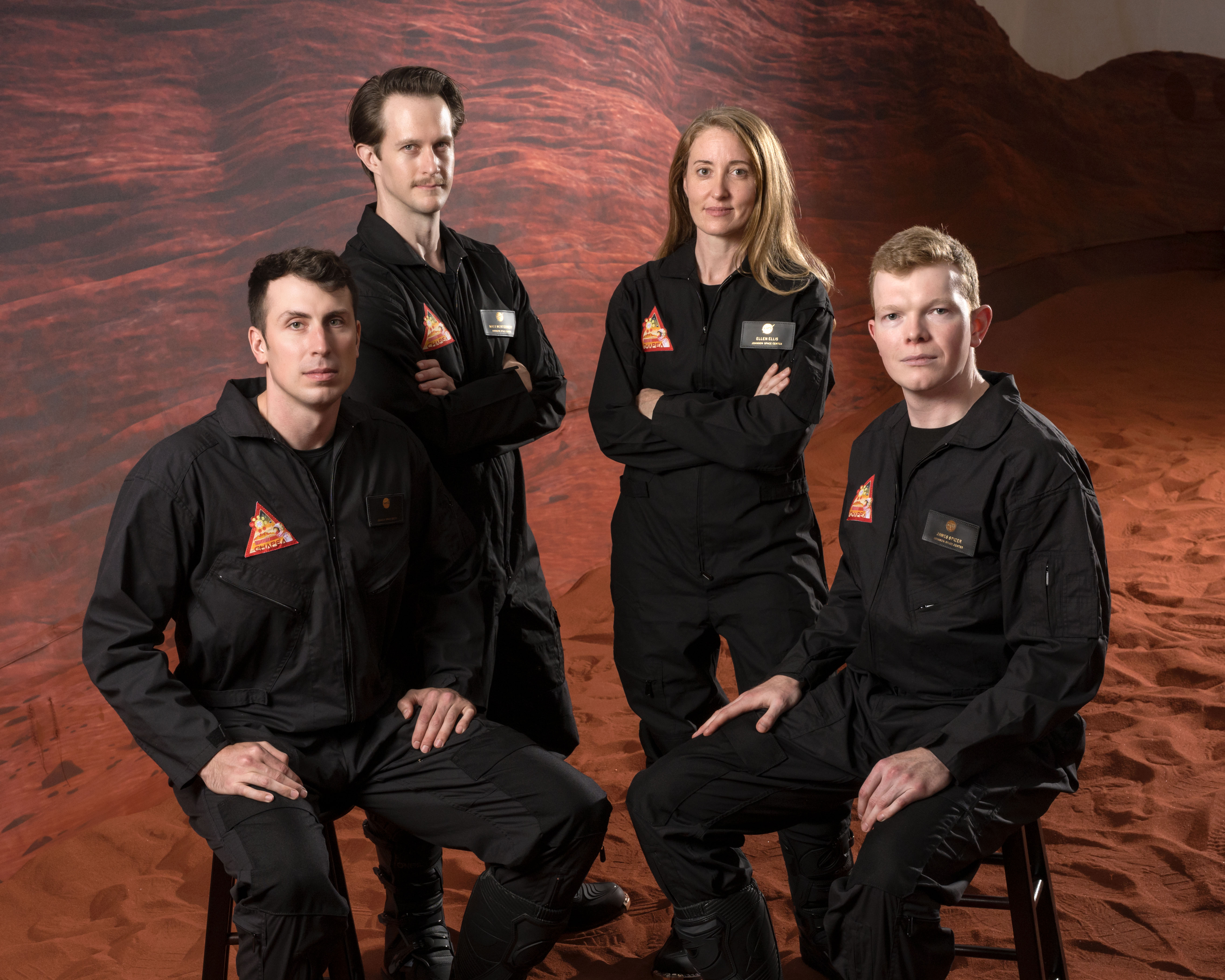
Crew Health and Performance Exploration Analog (CHAPEA) Mission 2 crew members (from left) Ross Elder, Matthew Montgomery, Ellen Ellis, and James Spicer, pose for a photo on Oct. 8, 2025.
Credit: NASA
The four volunteers who lived and worked in a simulated NASA Mars mission for more than a year will exit their habitat on Saturday, Oct. 31, after 378 days of isolation in a facility at the agency’s Johnson Space Center in Houston. Health and performance data collected from the simulation can help NASA develop methods to counter human spaceflight risks for future Artemis and Moon Base missions.
Beginning at 3 p.m. EDT, NASA will provide live coverage of the volunteers’ departure from the Crew Health and Performance Exploration Analog (CHAPEA, pronounced cha-pea’-ah) mission habitat. The exit ceremony will be streamed on NASA Johnson’s YouTube and social accounts.
Johnson Center Director Vanessa Wyche and NASA astronaut Jack Hathaway will provide remarks. The CHAPEA crew members Ross Elder, Ellen Ellis, James Spicer, and Matthew Montgomery also will provide remarks.
Media are invited to watch the CHAPEA Mission 2 ceremony live at NASA Johnson on a screen outside the hangar holding the CHAPEA facility, after which a subject matter expert will be available in person to answer questions. Media will have the opportunity to capture the moment the crew exits the building, stepping outside for the first time in more than a year.
U.S. media interested in attending the activities in person, or media interested in speaking virtually with the CHAPEA Mission 2 crew members in the days following completion of their mission, must contact the NASA Johnson newsroom no later than 2 p.m., Friday, Oct. 30, at jsc-newsroom@mail.nasa.gov.
The second CHAPEA mission began on Oct. 19, 2025. Four crew members have lived and worked inside a 3D-printed 1,700-square-foot facility, simulating Mars mission operations, conducting simulated spacewalks, exercising, performing habitat maintenance, growing plants, and more, while operating under stressors that future deep space crews will likely experience. These included communication delays, resource limitations, and isolation.
Data from the mission can aid preparation for NASA’s lunar missions by optimizing food system design, efficient use of crew time, bandwidth on NASA’s Deep Space Network, and other aspects of living in deep space. In addition, data can help flight doctors and psychologists strengthen spaceflight medical care and behavioral support practices to ensure crew readiness and performance.
Preparations for Next Moonwalk Simulations Underway (and Underwater)
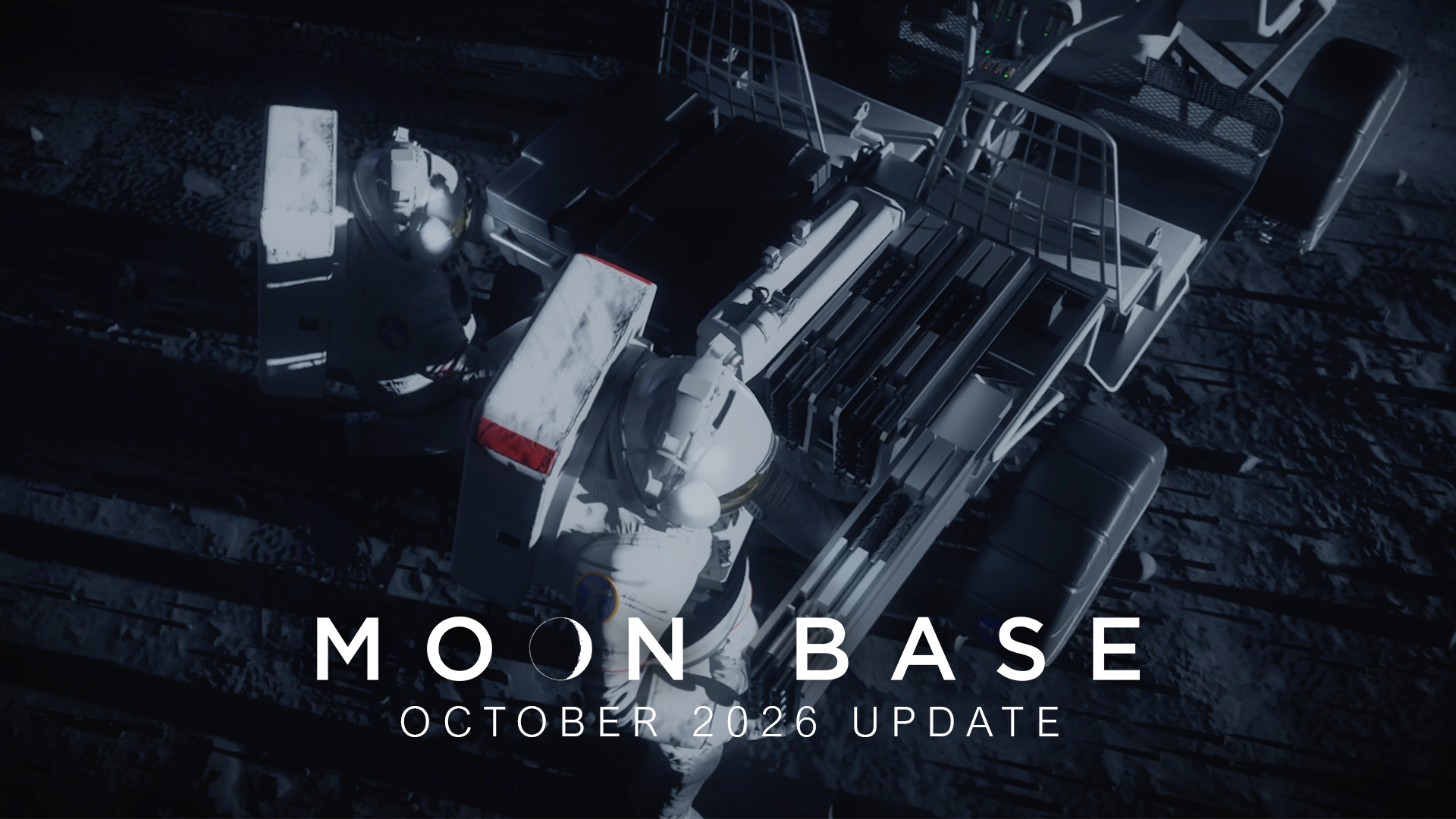
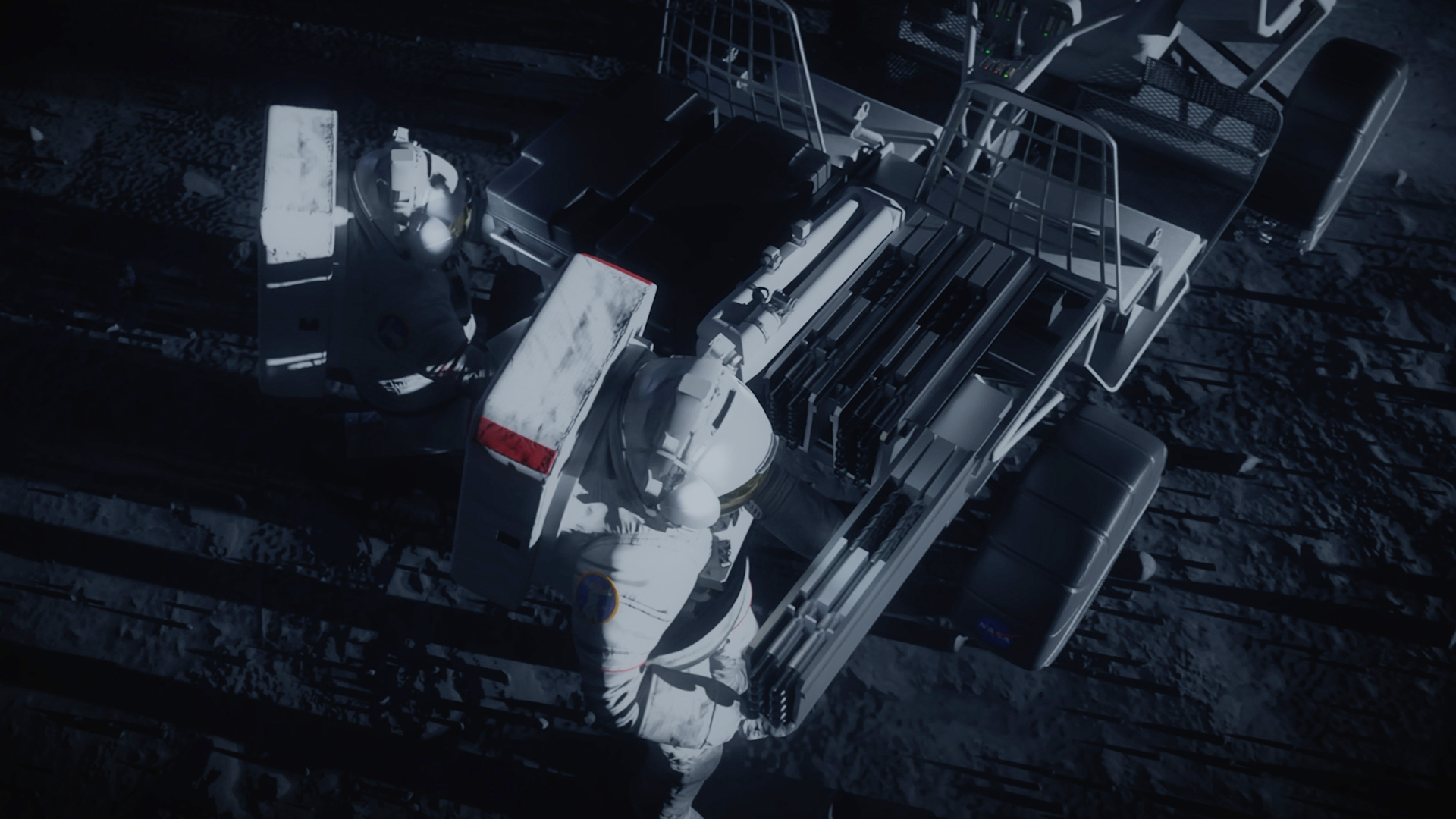
Artist’s rendering of astronauts working next to a lunar terrain vehicle on the lunar surface.
NASA
As NASA works to build the Moon Base, crewed and robotic lunar rovers will play a crucial role during early development through technology demonstrations, astronaut transport, terrain mapping, scientific investigations, and resource prospecting. Data from these early missions will inform future mobility systems and infrastructure needed for astronauts to live and work on the Moon.
On Tuesday, NASA released a Moon Base video update offering a closer look at the progress being made on the commercial lunar terrain vehicles and robotic rovers that will enable the surface mobility needed to build humanity’s first lunar outpost.
“Lunar rovers are central to our surface mobility strategy,” said Robert Pickle, director of the Surface Mobility Office within the agency’s Moon Base Program. “Their performance will lay the groundwork for the mobility systems that will define the next era of exploration and ultimately determine how effectively we can build, operate, and expand the infrastructure required for long‑duration exploration.”
Learn more about NASA’s VIPER
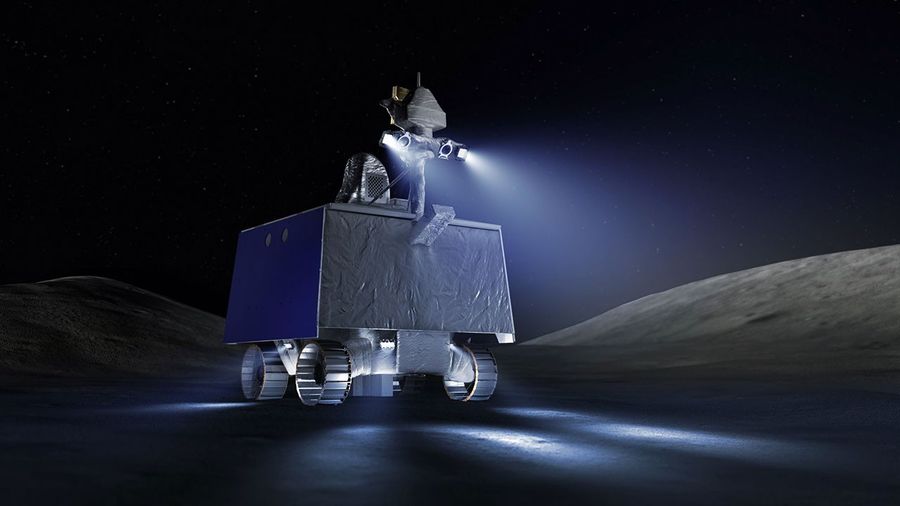
An artist’s concept of NASA’s VIPER lunar rover on the surface of the Moon.
NASA/Daniel Rutter
NASA’s VIPER (Volatiles Investigating Polar Exploration Rover) will embark on a mission to the lunar South Pole region in 2027 to venture into permanently shadowed craters looking for water and other valuable resources essential for sustainable exploration.
After delivery to the lunar surface by a Blue Moon Mark 1 lander, VIPER will travel more than 18 miles (30 kilometers), collecting information about the thermal, lighting, and terrain environment in the Moon’s South Pole region. This data could provide information about the origin and distribution of water on the Moon, help determine how lunar resources could be used for the Moon Base, as well as better understand the history of the Moon, Earth, and the processes that helped shape conditions for life.
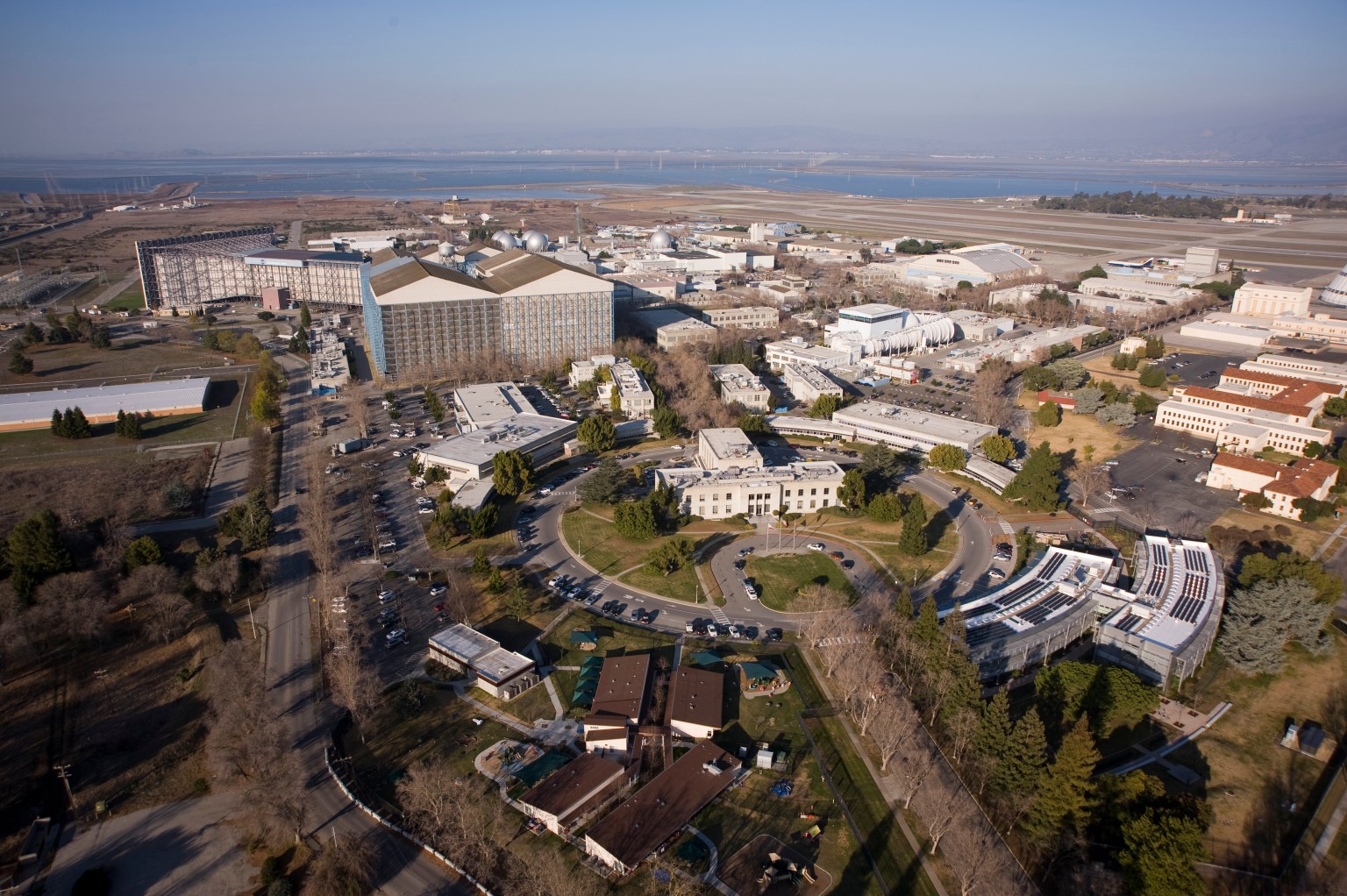
Mission operations for VIPER will be run out of NASA’s Ames Research Center in Silicon Valley where teams are simulating possible scenarios for when the rover begins its mission on the Moon.
The VIPER rover is currently at NASA’s Johnson Space Center in Houston where it is fully built and undergoing final testing before traveling to NASA’s Kennedy Space Center in Florida for launch to the Moon.
Lunar terrain vehicles
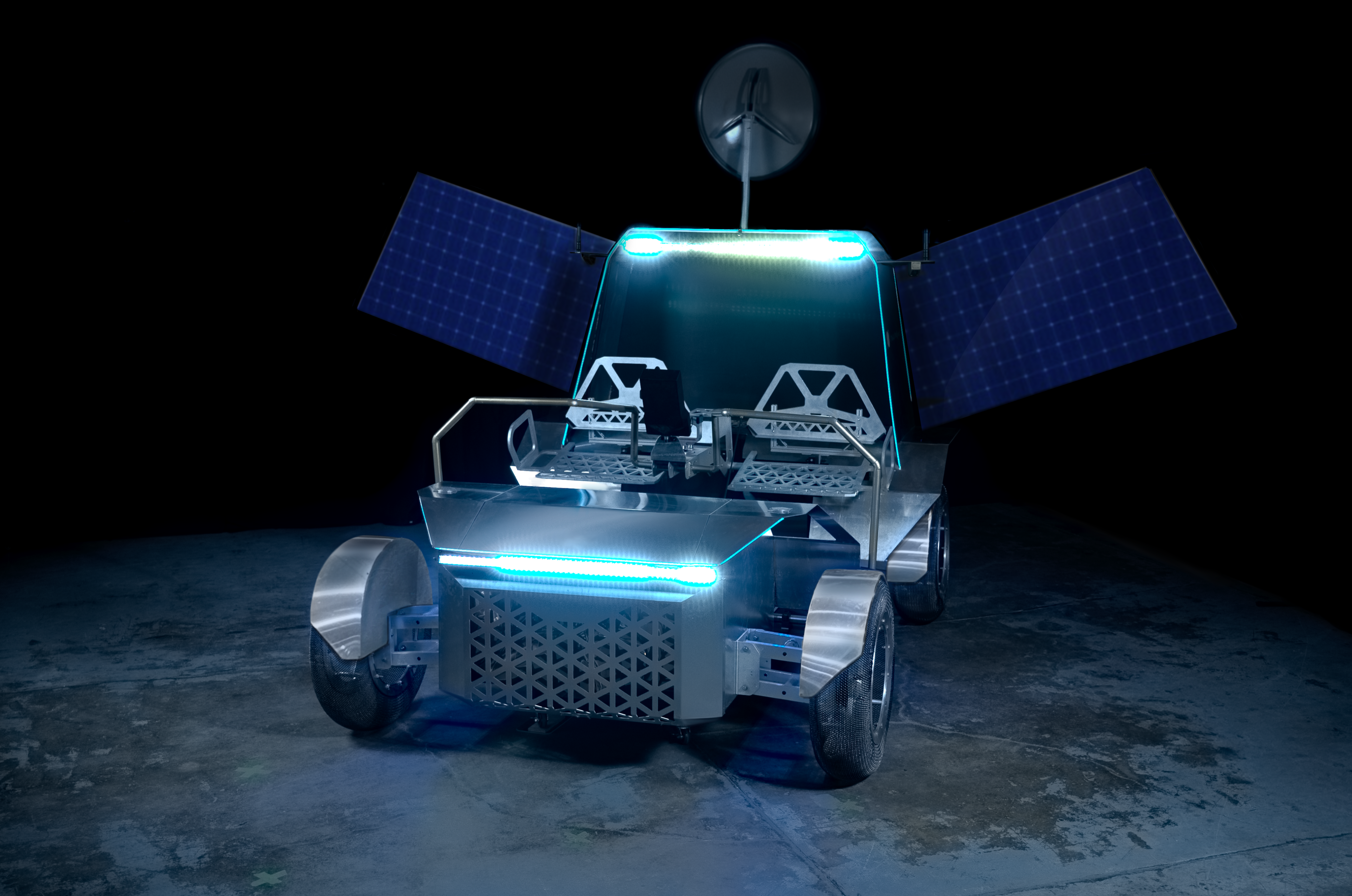
To advance surface mobility on the Moon, NASA awarded Astrolab and Lunar Outpost task orders to build the first phase of Moon Base rovers capable of carrying crew, called lunar terrain vehicles (LTVs), that will be delivered to the Moon ahead of crewed Artemis missions. NASA awarded Blue Origin a task order to deliver the LTVs to the lunar South Pole region by 2028 through the agency’s CLPS (Commercial Lunar Payload Services) initiative.
The LTVs will be remotely operated from Earth, traversing up to 3.7 miles (6 kilometers) a day, mapping the lunar surface to help scientists produce high-resolution maps of the region, prior to crew arriving on future missions. The rovers also will collect information to help NASA and its partners learn about operating in this extreme environment, such as data on lighting, navigation, and how well the LTVs preserve energy and function when driving in and out of permanently shadowed regions that can reach minus 334°F (minus 203°C). This will help inform Moon Base development and improve on design and capability for future mobility systems, hardware, and infrastructure.
During missions on the lunar surface, Artemis astronauts will drive the LTVs as they explore geologically diverse areas of the lunar South Pole region, gathering geology samples to bring back to Earth for scientists to study. The LTVs will be able to support up to three moonwalks per Artemis mission, transport up to 176 pounds (80 kilograms) of lunar samples and tools, and travel up to six miles (10 kilometers) on a single battery charge.
Astrolab
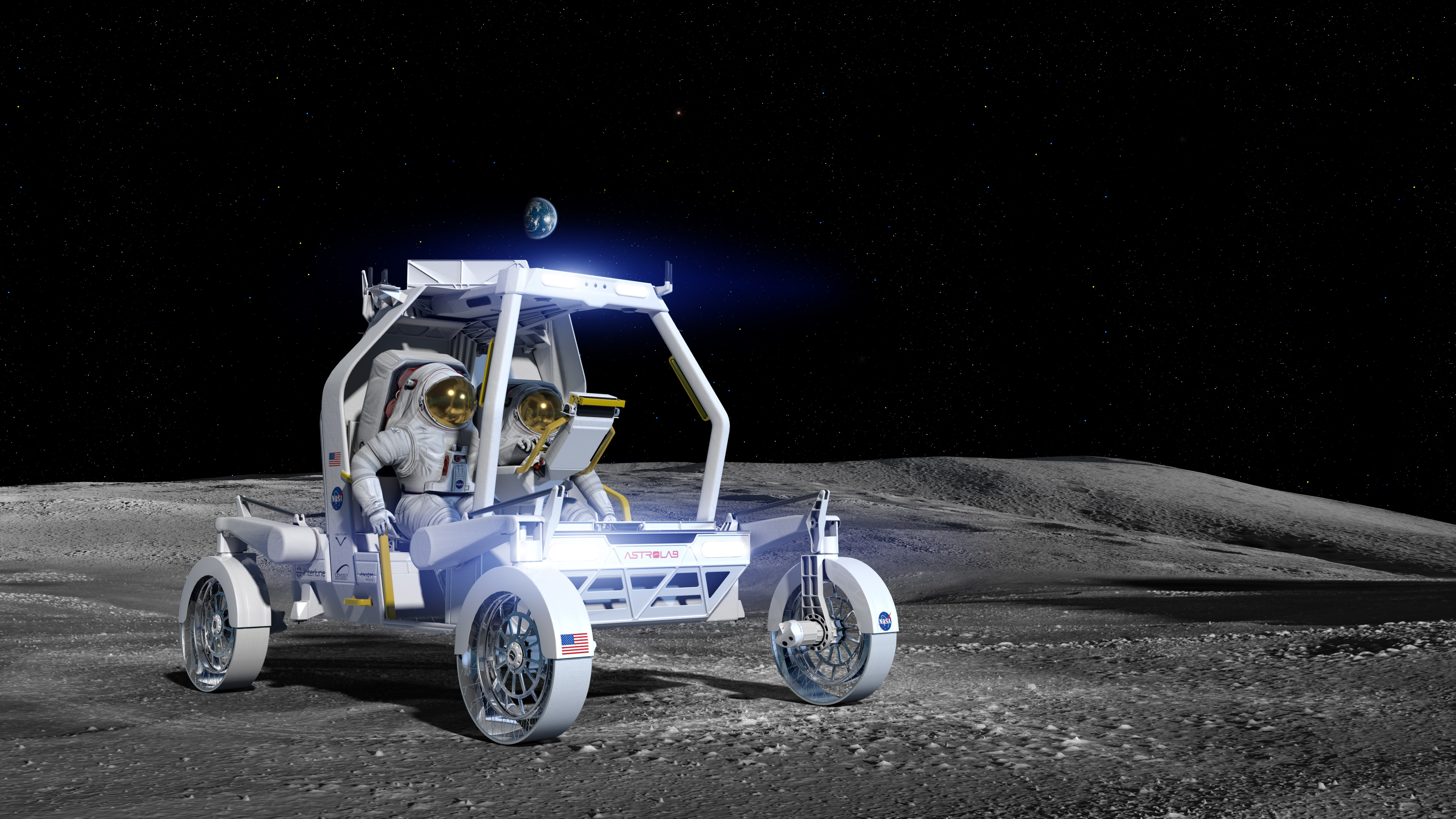
An artist’s concept of Astrolab’s Crewed Lunar Vehicle, or CLV-1, on the surface of the Moon.
Astrolab
Astrolab’s Crewed Lunar Vehicle 1, or CLV-1, is a rover adapted from the company’s FLEX (Flexible Logistics and Exploration Vehicle) LTV architecture. Astrolab recently delivered a mockup of CLV-1 to Axiom Space, where NASA astronauts wore mock-ups of the Artemis lunar spacesuit and evaluated the lunar rover’s design, crew cabin, and display interfaces.
Prior to CLV-1 arriving to the Moon, Astrolab will send its first robotic rover, FLIP (FLEX Lunar Innovation Platform), to the lunar surface as a payload on Voyager Technologies’ Griffin Mission One scheduled to launch in late 2026. FLIP will study the environment of the South Pole and serve as a testbed for critical subsystems on CLV-1, which will include similar tires, batteries, radios, and cameras.
In the next few weeks, Astrolab engineers will head to NASA’s Glenn Research Center in Cleveland where they will use the center’s Simulated Lunar Operations laboratory to evaluate the how CLV-1’s flexible, airless wheels perform while driving on a simulated lunar surface.
Lunar Outpost
A full-scale prototype of Lunar Outpost’s Pegasus lunar terrain vehicle.
Lunar Outpost
Lunar Outpost’s Pegasus crewed LTV is a lighter, mission-ready evolution of the company’s Eagle LTV. Prior to the award, Lunar Outpost built two mockups of Pegasus and recently delivered a third static mockup to NASA’s Johnson Space Center for crewed testing. During the test, NASA astronauts wore pressurized spacesuits and evaluated the rover’s design, usability, and crew comfort.
In 2025, Lunar Outpost’s robotic exploration rover MAPP (Mobile Autonomous Prospecting Platform) operated at the Moon’s South Pole. During the mission, MAPP acted as a testbed and collected data, achieving flight-proven readiness for key hardware and software subsystems, like its automatic thermal control system, navigation cameras, and mission control software that will be used to remotely operate Pegasus. With a second MAPP rover scheduled to launch in early 2027, Lunar Outpost is advancing many of the key technologies that are directly transferable to Pegasus.
In the next few weeks, Lunar Outpost teams also will head to NASA Glenn to test and evaluate the soil mechanics, traction, and mobility of Pegasus’ spring mesh tires.
In the coming months, both Astrolab and Lunar Outpost will test drivable LTV mockups with NASA crew to evaluate how the rovers drive and operate in a simulated lunar environment. Lunar Outpost is scheduled to complete the preliminary design review of their LTV in October, and Astrolab is scheduled to complete their preliminary design review by the end of December. Both companies are on schedule to deliver the flight-ready hardware to NASA at the end of 2027.
As part of a Golden Age of innovation and exploration, NASA will send Artemis astronauts on increasingly difficult missions near the lunar South Pole to explore more of the Moon than ever before. In addition to providing economic benefits and advancing scientific discovery through its Moon missions, NASA will establish an enduring human presence on the lunar surface and build on the agency’s foundation for the first crewed mission to Mars.
There's a lot of ground to cover when you're building a Moon Base. From robotic rovers exploring the rugged lunar landscape to lunar terrain vehicles carryin...
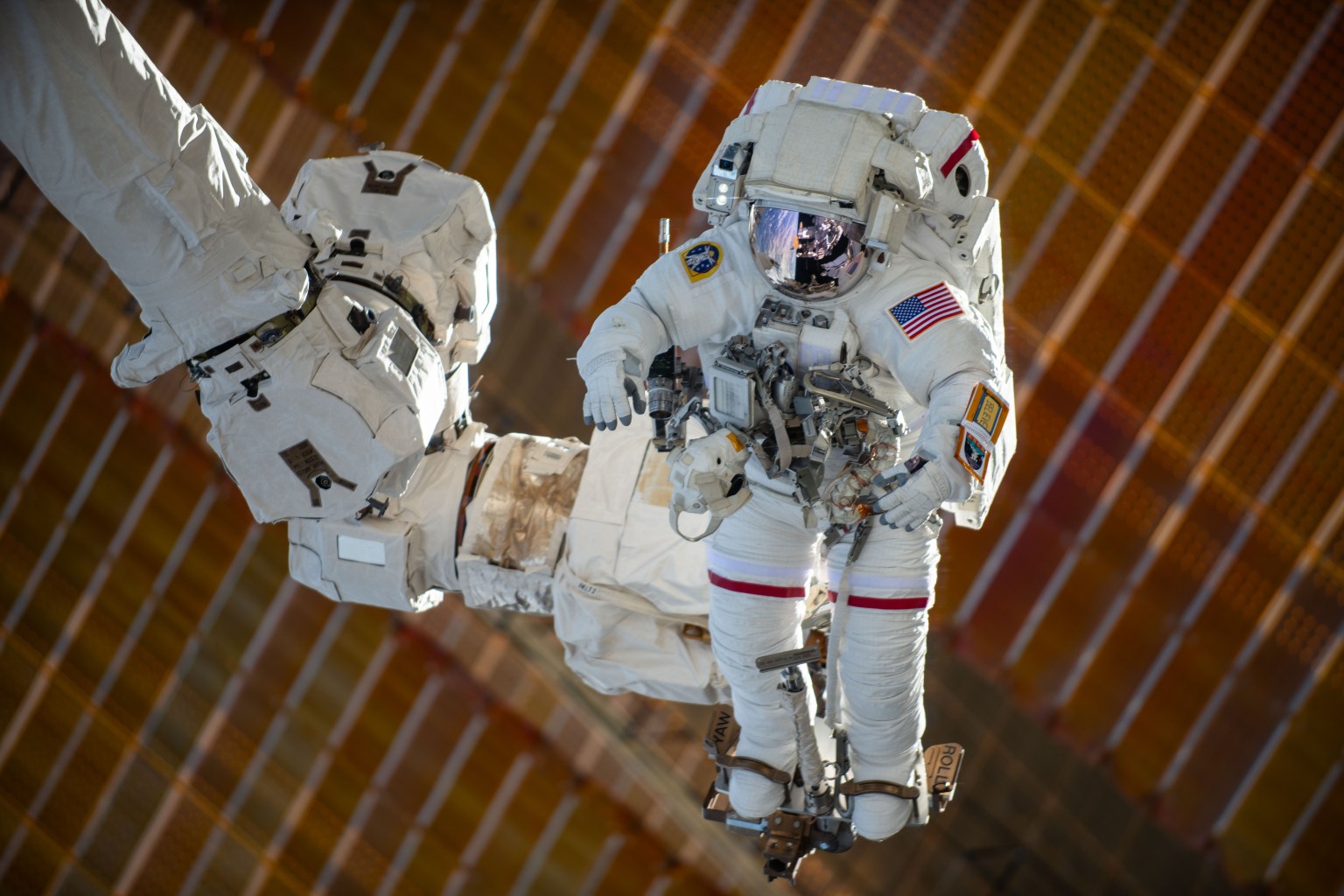
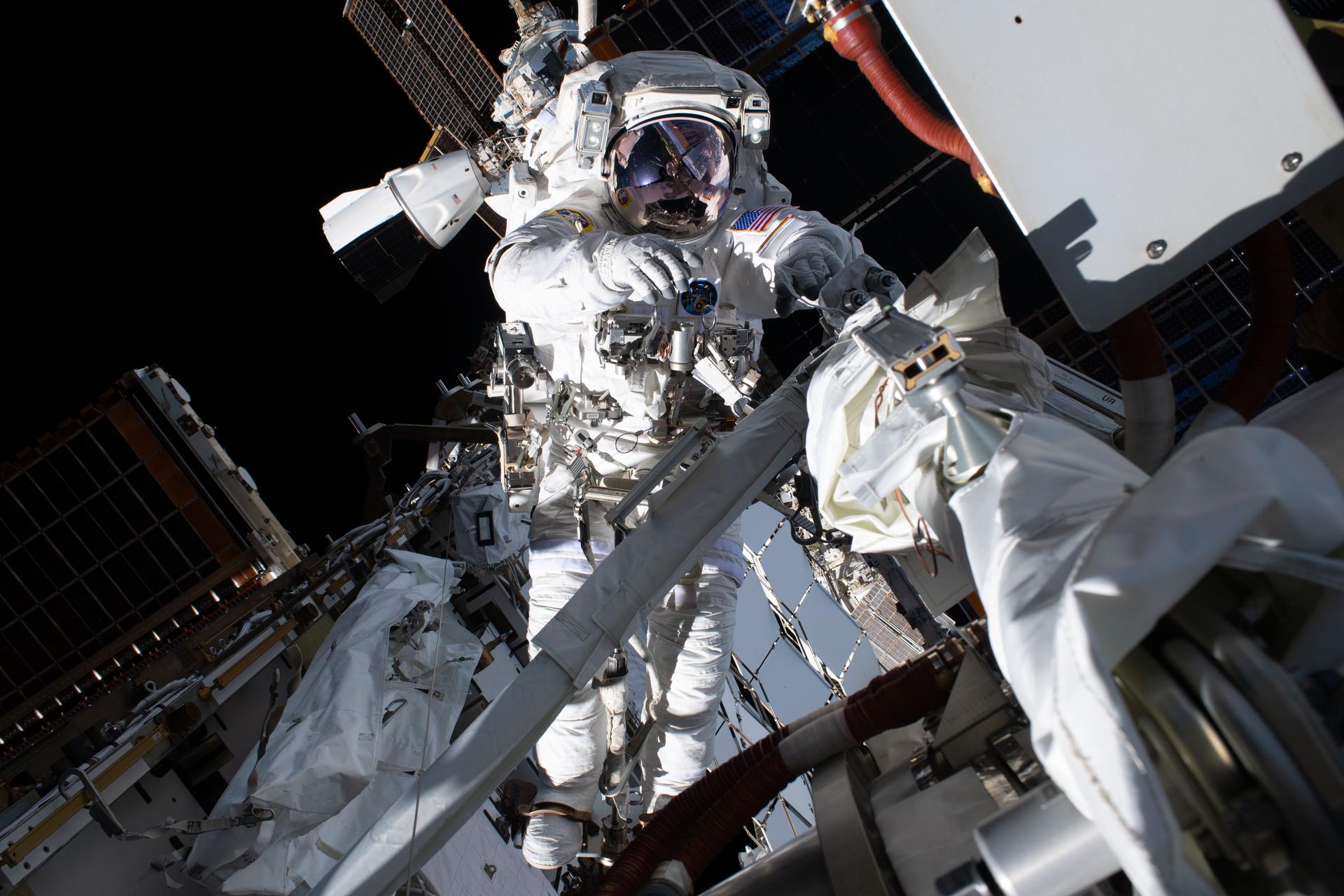
NASA astronaut Anil Menon conducts a spacewalk on Aug. 6, 2026, to prepare the International Space Station for future upgrades to its power system.
Credit: NASA
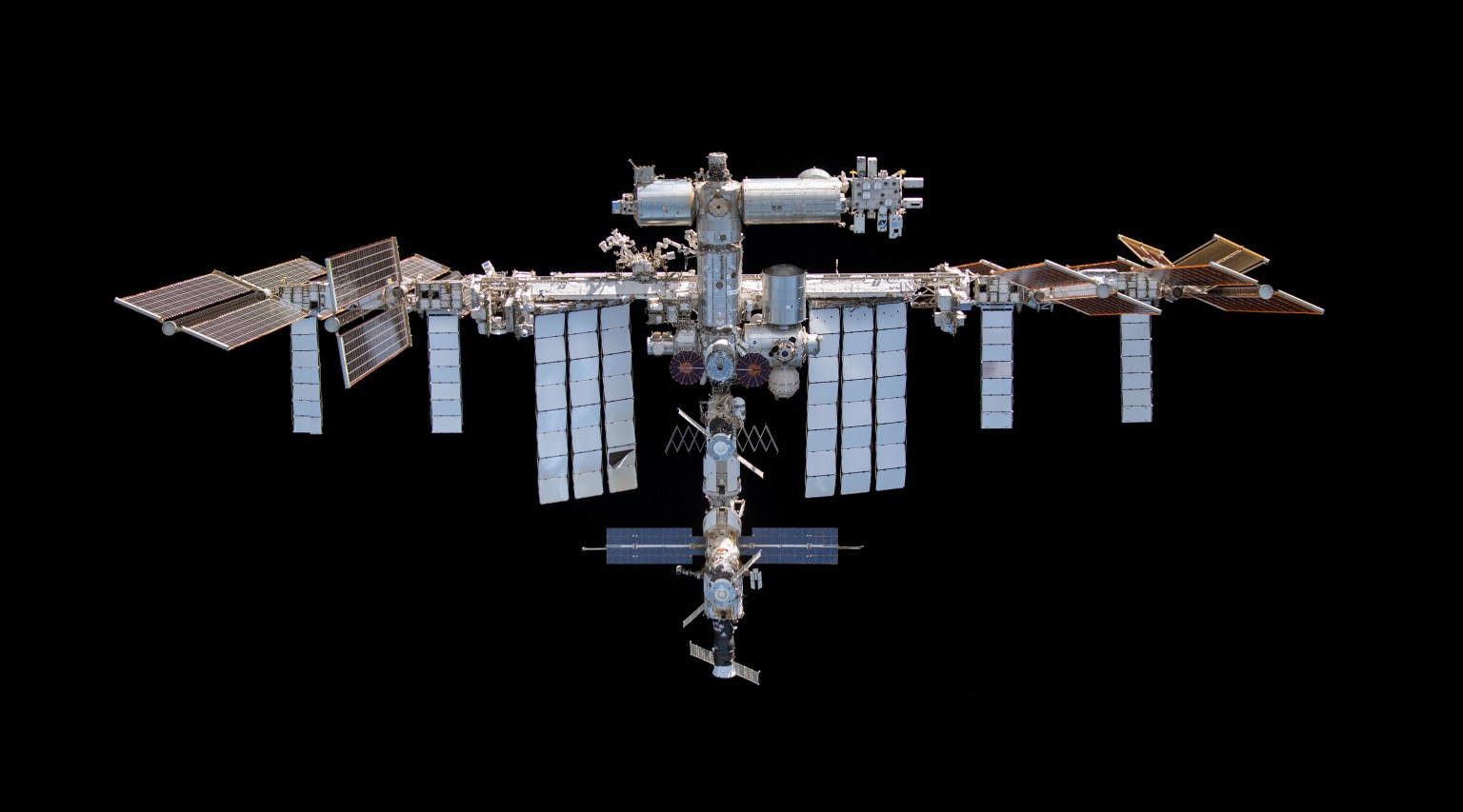
NASA will preview two upcoming spacewalks to complete solar array installation and power augmentation of the International Space Station during a news conference at 2 p.m. EDT, Tuesday, Oct. 20, from NASA’s Johnson Space Center in Houston.
NASA will stream the event through a variety of platforms. Learn where to watch online:
United States-based media interested in attending in person must contact the Johnson newsroom no later than 3 p.m., Monday, Oct. 19, at: jsccommu@mail.nasa.gov. Media joining by phone should request dial-in details by the same deadline. To ask a question, media must dial in no later than 15 minutes before the start of the news conference.
Thursday, Oct. 29
During U.S. spacewalk 100, NASA astronaut Anil Menon and CSA (Canadian Space Agency) astronaut Joshua Kutryk will exit the station’s Quest airlock to install and deploy an International Space Station Roll-Out Solar Array (IROSA) on the 2A electrical power channel. The solar array will be the seventh IROSA and will provide additional power to support critical station operations, including its safe and controlled deorbit.
Thursday, Nov. 5
During U.S. spacewalk 101, Menon and Kutryk will install and deploy the eighth and final IROSA on the 3B channel of the space station, completing the power augmentation upgrades.
The final two roll-out solar arrays will complete the space station’s power system augmentation. Together, the eight roll-out arrays will increase available power by up to 30%, boosting the station’s electric power generation capacity from 160 kilowatts to approximately 215 kilowatts.
NASA will share additional coverage details about U.S. spacewalks 100 and 101 closer to each operation on the agency’s live events web page and the space station blog. The spacewalks will be the 285th and 286th conducted in support of space station assembly, maintenance, and upgrades.
To learn more about International Space Station research, operations, and its crews, visit:
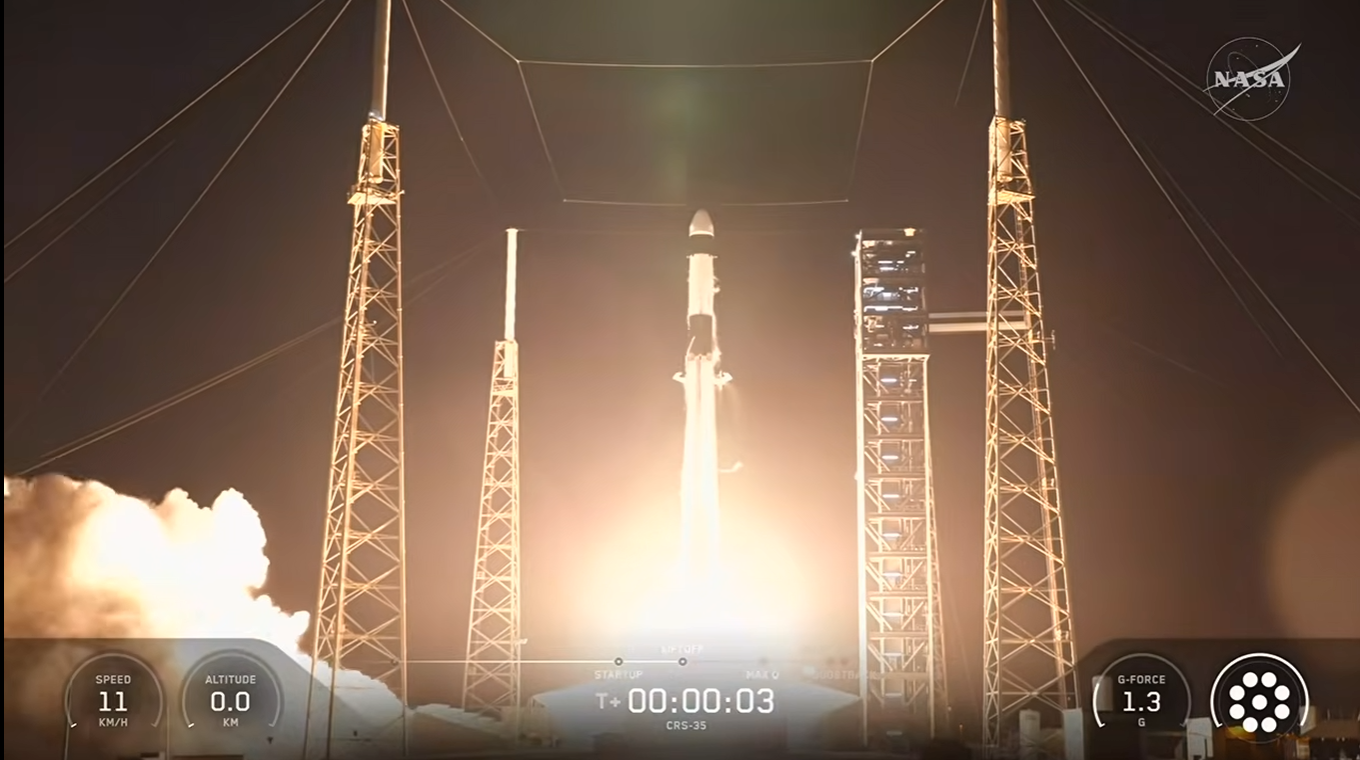
A SpaceX Falcon 9 rocket and Dragon spacecraft launched on Tuesday, Oct. 13, 2026, from Space Launch Complex 40 at Cape Canaveral Space Force Station in Florida as part of the company’s 35th Commercial Resupply Services mission to the International Space Station for NASA.
Credit: NASA
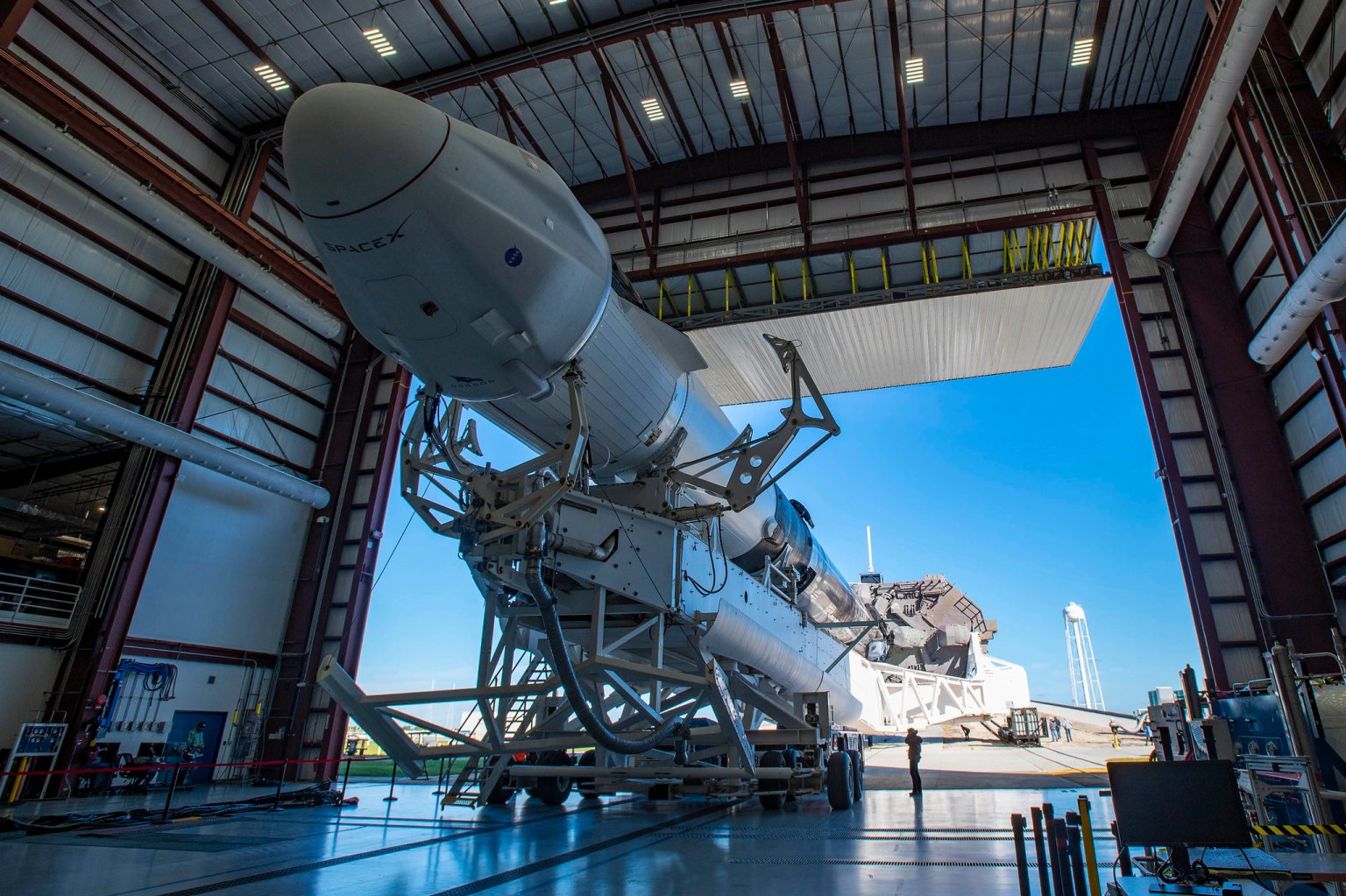
NASA’s SpaceX 35th commercial resupply mission lifted off at 6:33 a.m. EDT Tuesday aboard a Falcon 9 rocket from Space Launch Complex 40 at Cape Canaveral Space Force Station in Florida, carrying more than 6,300 pounds of supplies and hardware, bound for the International Space Station. Following its successful launch, the SpaceX Dragon spacecraft will carry new scientific experiments, cargo, and the final pair of International Space Station Roll-Out Solar Arrays to the orbiting laboratory.
Dragon is scheduled to autonomously dock at 11 a.m., Thursday, Oct. 15, to the space-facing port of the space station’s Harmony module. NASA will stream rendezvous and docking coverage beginning at 9:15 a.m., through a variety of platforms. Learn where to watch online:
The final pair of solar arrays will complete the space station’s power system augmentation, boosting available electricity for research, operations, and the station’s safe, controlled deorbit. Astronauts will install the arrays during a series of spacewalks planned for later this fall.
Dragon also is delivering several new experiments, including hardware to manufacture artificial retinas in microgravity that could help restore vision for patients on Earth and 3D heart tissue models to advance large-scale drug testing on future space missions. Dragon also will carry materials to study how a new type of glass is formed in microgravity, and brain organoids that could uncover potential treatment targets for neurodegenerative diseases like Alzheimer’s, Parkinson’s, and multiple sclerosis.
These are just a sample of the hundreds of investigations conducted aboard the orbiting laboratory in the areas of biology and biotechnology, physical sciences, and Earth and space science. Research and technology investigations taking place aboard the space station benefit people on Earth and lay the groundwork for other agency deep space missions. As part of NASA’s Artemis program, the agency will send astronauts to the Moon to prepare for future human exploration of Mars, inspiring the world through discovery in a new Golden Age of innovation and exploration.
The Dragon spacecraft is scheduled to remain at the space station until mid-November when it will depart and return to Earth with time-critical research and cargo, splashing down off the coast of California.
Learn more about the International Space Station, its research, and crew, at:
Preparations for Next Moonwalk Simulations Underway (and Underwater)
A KREPE-3 capsule floats inside the Northrup Grumman Cygnus XL 24 cargo spacecraft on October 7. Inside the capsule is a 3-D printed heat shield designed by researchers at NASA’s Johnson Space Center in Houston.
NASA
NASA is testing heat shields that can keep astronauts safe as they return from missions to the Moon and Mars in an unusual way: by taking out the trash.
When Northrop Grumman 24th cargo resupply mission for NASA undocked from the International Space Station, it carried a fleet of 12 small, experimental capsules designed to test the next generation of thermal protection materials that could serve as the foundation for future heat shields.
The experiment, called the Kentucky Reentry Probe Experiment (KREPE-3), is the third in a series of low-cost, high-impact missions that use the final moments of the cargo spacecraft’s lifespan to gather valuable data.
The experiment is a collaboration among the University of Kentucky, the state of Kentucky, NASA’s Established Program to Stimulate Competitive Research (EPSCoR), several NASA centers, and other federal and commercial partners.
“KREPE-3 is a great example of the goals of NASA’s EPSCoR program,” said David Berger, EPSCoR program manager at NASA’s Headquarters in Washington. “We are supporting the next generation of scientists and engineers as they develop unique projects that benefit their education and NASA’s mission goals.”
Trash to treasure
Before the mission’s Cygnus XL spacecraft departed the station, astronauts packed it with waste and activated the 12 small capsules carried inside. Designed by University of Kentucky students, the capsules include sensors that will measure temperature, pressure, motion, magnetic field, and light during re-entry.
As the vehicle harmlessly breaks apart in Earth’s atmosphere on its planned route, the capsules will eject and begin collecting data on how each set of experimental heat shield materials performs. Satellite signals will transfer live data to researchers, offering insights into how larger heat shields could protect future cargo or crew.
“It’s a smart way to get flight data on materials that are still in development,” said Keith Peterson, a materials engineer at NASA’s Ames Research Center in California’s Silicon Valley. “We’re essentially hitching a ride on a vehicle that’s already coming back to Earth.”
Close up of an Ames-produced thermal protection system (TPS) (heat shield) for the Kentucky Re-Entry Probe Experiment (KREPE) in the Sensors & TPS Advanced Research Laboratories (STAR Labs) N242.
NASA/Brandon Torres-Navarrete
Heating up innovation
The capsules will carry a variety of thermal protective components, including proven technology such as the ceramic tile material used on the space shuttle. Others will test new options, such as a 3D-printed heat shield from the Additive Manufacturing of Thermal Protective Systems project developed at NASA Johnson and Oak Ridge National Laboratory.
Researchers at NASA Ames are contributing several materials to KREPE-3, including two capsules that will fly a next-generation family of protective coverings known as Materials Engineered for Re-entry using Innovative Needling Operations (MERINO). Made from layers of carbon and phenolic fibers stitched together like felt, the materials are more flexible, faster to produce, and less expensive than traditional protective substances – making them promising candidates for Mars missions. Thanks to Mars’ thinner atmosphere, missions to land on the Red Planet involve lower heat loads and allow for lighter protection.
A third capsule will combine those protective coverings with other elements. The Kentucky Instrumented Conical Hypersonic Experiment will utilize a dual-cone shape. It combines a tungsten tip attached to a cone layered with carbon and hear-resistant plastic fibers, and an aft cone wrapped in MERINO. This unique design will validate computer models against real-world data.
Another capsule is shaped like the protective aeroshell that will protect NASA’s upcoming mission, Dragonfly, as it arrives at Saturn’s moon, Titan, and will test the dynamic stability of the design. It is covered in Phenolic Impregnated Carbon Ablator, a material developed at NASA Ames that has applications for commercial vehicles and flew on NASA’s Stardust, Mars Science Laboratory, and Mars 2020 missions.
One capsule will test a deployable heat shield called Adaptable Deployable Entry and Placement Technology, which is shaped like an umbrella to increase surface area and slow descent. At full scale, Adaptable Deployable Entry design could be folded, making it ideal for deploying payloads that are larger than the rockets that launch them into flight.
While some capsules are testing new materials to carry missions to Mars, others are testing new shapes and designs that will further research and understanding of computer modeling and sensor design — technologies that could open doors to another generation of re-entry design innovation.
Additional capsules developed by domestic and international partners will test a variety of known and new materials, including a heat flux sensor developed at the University of Stuttgart in Germany, that will help researchers measure how heat moves across a surface during re-entry.
“We’re pushing the boundaries of what heat shields can do,” said Peterson. “And we’re testing them in a way that’s fast, affordable, and incredibly effective.”
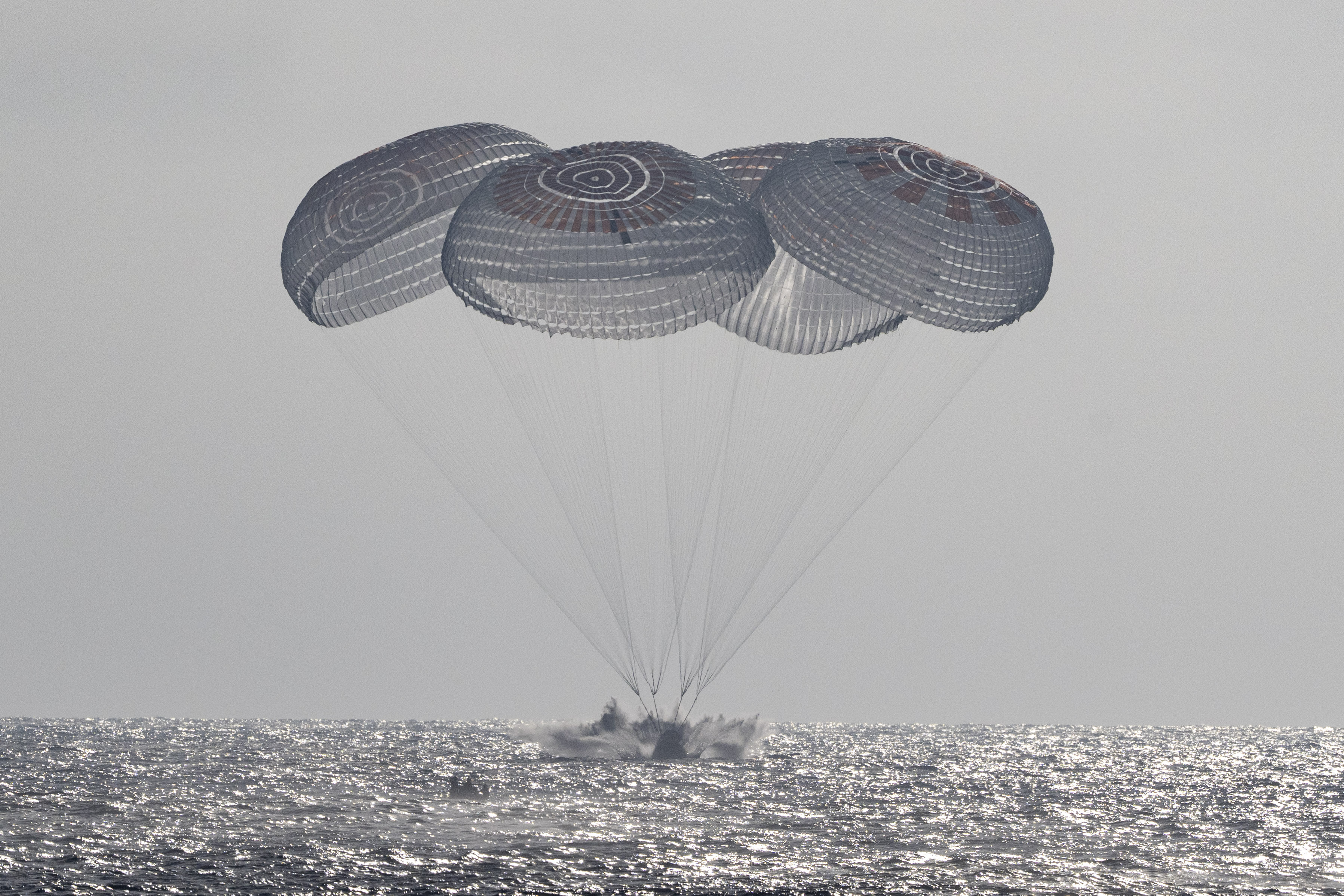
The SpaceX Crew Dragon Freedom spacecraft is seen as it lands with NASA astronauts Jessica Meir, Jack Hathaway, ESA (European Space Agency) astronaut Sophie Adenot, and Roscosmos cosmonaut Andrey Fedyaev aboard in the Pacific Ocean off the coast of Los Angeles on Oct. 8, 2026.
Credit: NASA/Keegan Barber
After more than seven months aboard the International Space Station, NASA’s SpaceX Crew-12 mission safely splashed down Thursday in the Pacific Ocean off the coast of Los Angeles. The crew members will discuss their science mission during a news conference at 3:30 p.m. EDT, Thursday, Oct. 15, at the agency’s Johnson Space Center in Houston.
“Jessica, Jack, Sophie, and Andrey spent 237 days living and working in orbit, traveled more than 100 million miles, advanced important science, and returned safely home because of the extraordinary expertise and competence of thousands across NASA, SpaceX, and our international partners,” said NASA Administrator Jared Isaacman. “Building the capability, experience, and confidence to do this repeatedly is exactly what will allow us to go farther, and I am grateful to Crew-12 and their families for their service to humanity’s greatest adventure.”
NASA astronauts Jessica Meir and Jack Hathaway, ESA (European Space Agency) astronaut Sophie Adenot, and Roscosmos cosmonaut Andrey Fedyaev returned to Earth at 8:34 a.m. PDT. Teams aboard SpaceX recovery vessels retrieved the spacecraft and its crew shortly after. Following standard postflight medical screenings, the crew will fly to shore before returning to NASA’s Johnson Space Center in Houston.
“NASA’s activities supporting the International Space Station — transporting crew, conducting impactful research, and maintaining critical national assets — enable the science, engineering, and risk‑reduction needed for future missions across the solar system,” said Dana Weigel, manager of NASA’s Low Earth Orbit Program at the agency’s Johnson Space Center. “We’re grateful for the dedication across the human spaceflight team that makes this possible, and we’re thrilled to welcome Jessica, Jack, Sophie, and Andrey home.”
During their 237-day mission, the four crew members traveled more than 100 million miles and completed more than 3,792 orbits around Earth. The mission was the second for Meir and Fedyaev and the first for Hathaway and Adenot. Crew-12 lifted off at 5:15 a.m. EST on Feb. 13 and docked to the orbiting laboratory a day later.
Crew‑12 logged hundreds of hours of scientific research to support human exploration beyond low Earth orbit and advance benefits for people on Earth. The crew members’ work included testing stem cell production for cell‑based therapies, demonstrating on‑demand IV fluid generation for future missions, and studying how the bacteria that causes pneumonia can lead to long‑term heart damage. The crew also conducted nutrition-focused research and examined how physical characteristics may affect blood flow during spaceflight to help keep astronauts safe and healthy on future missions. Research conducted aboard the space station advances knowledge and demonstrates new technologies that enable us to prepare for human exploration of the Moon and Mars.
Meir completed four spacewalks, bringing her career total to seven. That places her third all-time in total spacewalks among women at NASA, behind former agency astronauts Peggy Whitson and Suni Williams. Adenot completed three spacewalks, becoming the first French woman to venture outside the orbital outpost.
United States-based media interested in attending the crew news conference in person with Meir, Hathaway, and Fedyaev, must contact the NASA Johnson newsroom no later than 5 p.m. EDT, Tuesday, Oct. 13, at jsc-newsroom@mail.nasa.gov. Media joining by phone must request dial-in details by 9:30 a.m., Oct. 15. To ask a question, media must join no later than 15 minutes before the start of the news conference. The agency’s media credentialing policy is available online. Adenot will return to Europe and not be available during the news conference.
NASA’s Low Earth Orbit Program provides reliable access to space, maximizing the use of the International Space Station for research and development by partnering with private U.S. companies, including SpaceX, to transport astronauts to and from the space station.
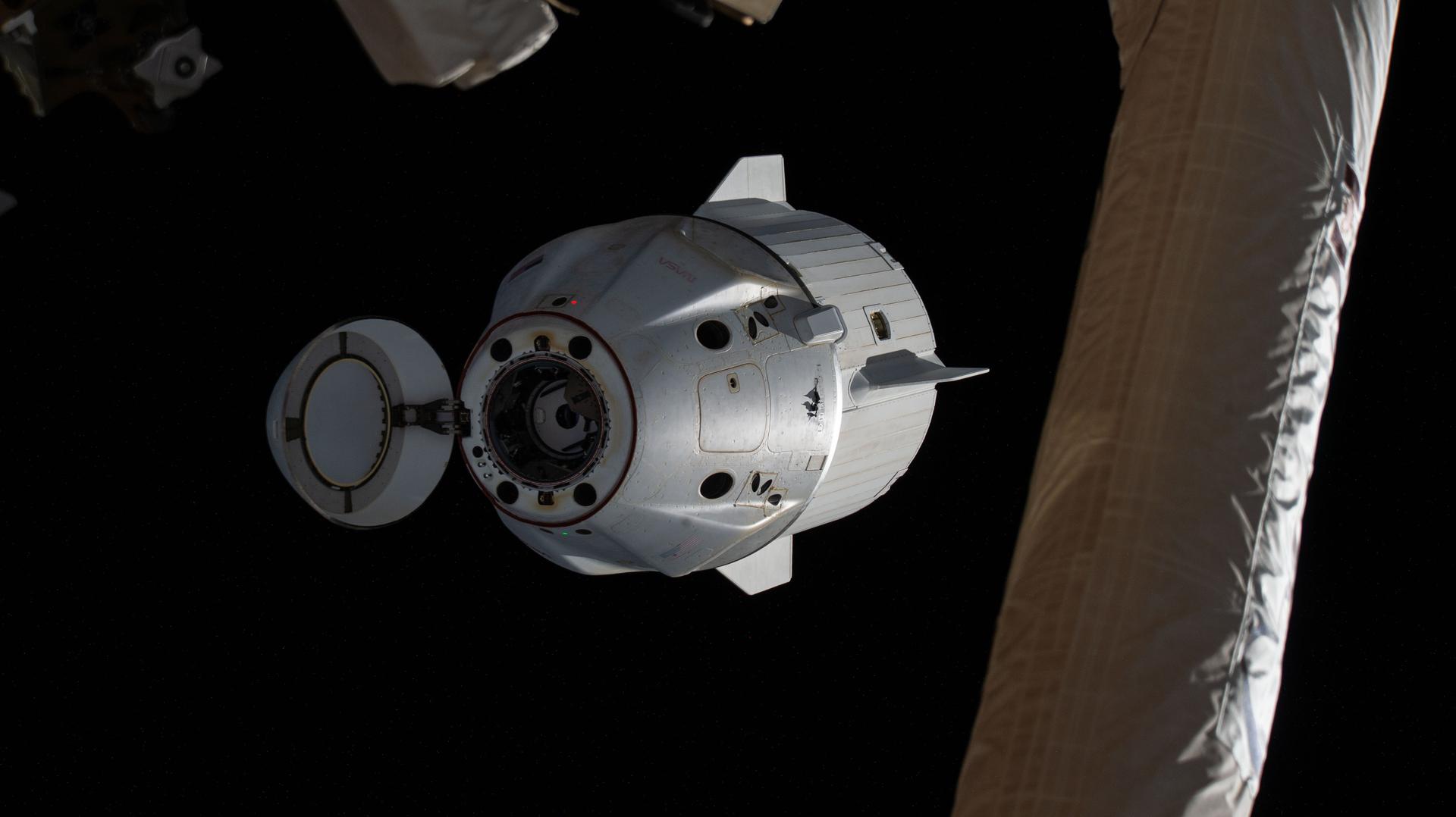
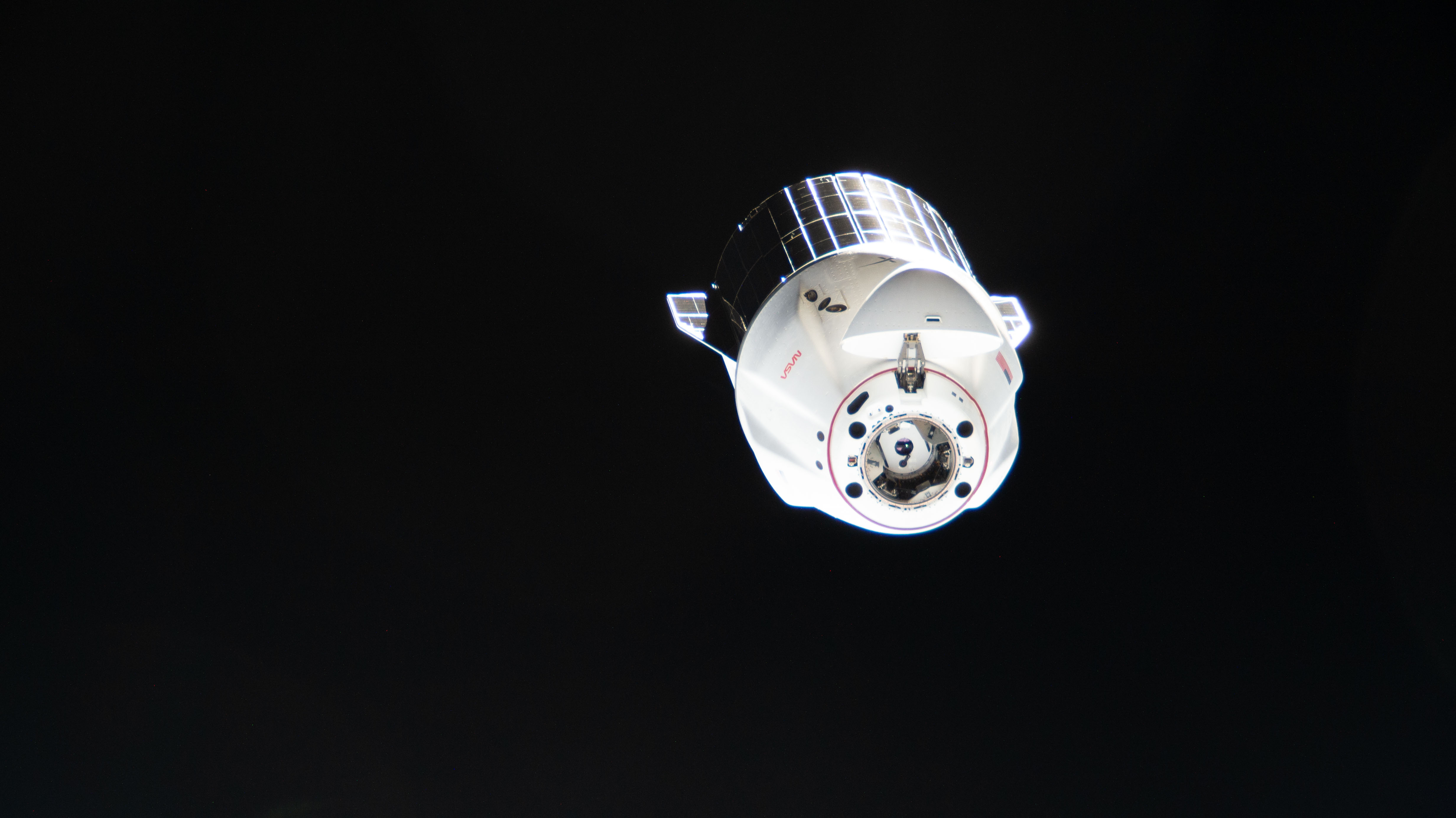
A SpaceX Dragon cargo spacecraft departs from the International Space Station on June 16 after undocking from the Harmony module’s forward port. Dragon, packed with completed science experiments and cargo for retrieval and analysis on Earth, parachuted to a splashdown off the coast of southern California the following day.
Credit: NASA
NASA and SpaceX are targeting 6:33 a.m. EDT, Tuesday, Oct. 13, for the next launch to deliver science investigations, supplies, and equipment, including the final set of International Space Station Roll-Out Solar Arrays, to the space station. This is the 35th SpaceX commercial resupply services mission to the orbital complex for NASA.
NASA also will host a media teleconference on Thursday, Oct. 8 that will preview the cargo resupply flight, as well as provide a post-splashdown update for the agency’s SpaceX Crew-12 mission, which will have returned to Earth from the space station Thursday morning.
Loaded with more than 6,300 pounds of supplies, a SpaceX Dragon spacecraft on a Falcon 9 rocket will lift off from Space Launch Complex 40 at Cape Canaveral Space Force Station in Florida. Dragon will dock autonomously around 11 a.m. on Thursday, Oct. 15, to the space-facing port of the station’s Harmony module.
NASA’s live launch and docking coverage will stream through a variety of platforms. Learn where to watch online:
In addition to the solar arrays, the Dragon spacecraft will deliver hardware to manufacture artificial retinas in microgravity to help restore vision on Earth and 3D heart tissues models to advance large‑scale drug testing on future missions. The spacecraft will carry materials to study how a new type of glass forms in microgravity and brain organoids that could reveal treatment targets for neurodegenerative diseases, such as Alzheimer’s, Parkinson’s, and multiple sclerosis.
The Dragon spacecraft is scheduled to remain at the space station until mid-November when it will depart the orbiting laboratory and return to Earth with time-critical research and cargo, splashing down off the coast of California.
NASA’s mission coverage is as follows (all times Eastern and subject to change based on real-time operations):
Thursday, Oct. 8
1:15 p.m.: International Space Station briefing for Crew-12 return, and SpaceX’s 35th Commercial Resupply Services launch with the following participants:
Bill Spetch, deputy manager of Commercial, Low Earth Orbit Program
Dr. Liz Warren, deputy chief scientist, NASA’s International Space Station Office
Lee Echerd, senior mission manager, Customer Operations and Integration, SpaceX
Andreas Mogensen, leader, Human Exploration Group, ESA (European Space Agency)
To participate in the teleconference, media must contact the NASA Johnson Space Center newsroom for call details by 12 p.m., Oct. 8, at: jsccommu@mail.nasa.gov or 281-483-5111. To ask questions, media must dial in no later than 10 minutes before the start of the call. The agency’s media credentialing policy is available online.
Tuesday, Oct. 13
6:15 a.m.: Launch coverage begins
6:33 a.m.: Launch
Thursday, Oct. 15
9:15 a.m.: Arrival coverage begins
11 a.m.: Docking
NASA website launch coverage
Launch day coverage of the mission will be available on the NASA website. Coverage will include live streaming and blog updates beginning no earlier than 6 a.m. on Oct. 13, as the countdown milestones occur. On-demand streaming video on NASA+ and photos of the launch will be available shortly after liftoff. For questions about countdown coverage, contact the NASA Kennedy Space Center newsroom at 321-867-2468. Follow countdown coverage on our International Space Station blog for updates.
Attend launch virtually
Members of the public can register to attend this launch virtually. NASA’s virtual guest program for this mission also includes curated launch resources, notifications about related opportunities or changes, and a stamp for the NASA virtual guest passport following launch.
Watch, engage on social media
Let people know you’re watching the mission on X, Facebook, and Instagram by following and tagging these accounts:
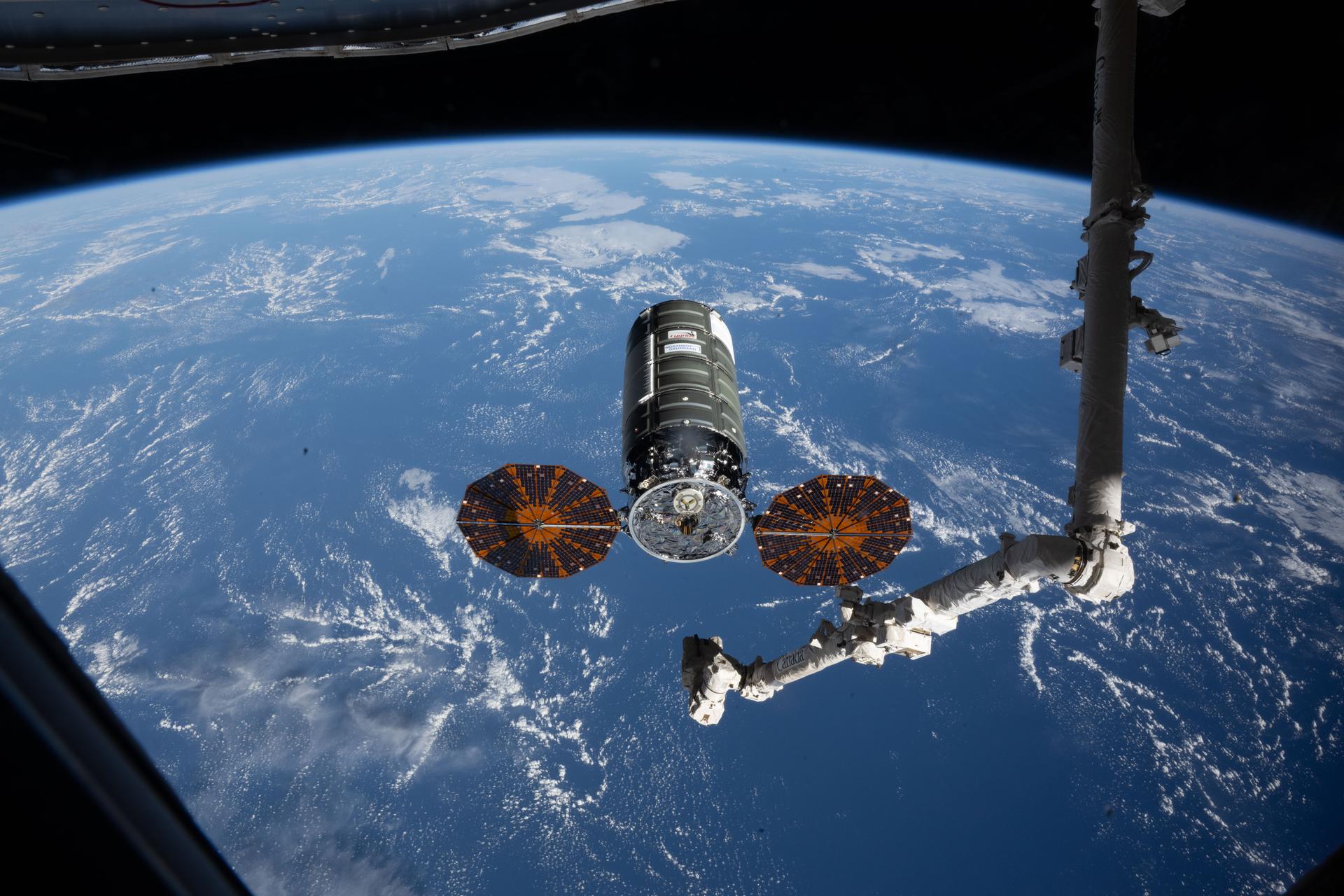
Northrop Grumman’s Cygnus XL cargo spacecraft rests at its capture point on April 13, 2026, 12 meters from the International Space Station, as the Canadarm2 robotic arm prepares to grapple the resupply ship.
Credit: NASA/Jessica Meir
After delivering more than 11,000 pounds of supplies, science experiments, and other cargo to the International Space Station for NASA, Northrop Grumman’s Cygnus XL spacecraft is scheduled to depart Friday, Oct. 9, as part of the company’s Commercial Resupply Services-24 mission, or Northrop Grumman CRS-24.
Watch NASA’s live coverage of undocking and departure beginning at 12:30 p.m. EDT through a variety of platforms. Learn where to watch online:
Flight controllers on the ground will send commands for the space station’s Canadarm2 robotic arm to detach the Cygnus XL spacecraft from the Unity module’s Earth-facing port and maneuver it into position for release at 12:45 p.m. NASA astronaut Luke Delaney will monitor the operation from aboard the orbital complex.
Loaded with thousands of pounds of disposal items and other unneeded cargo, Cygnus XL will deorbit Sunday, Oct. 11, for a destructive re-entry into Earth’s atmosphere, where it will safely burn up. NASA will not provide coverage of the spacecraft’s deorbit.
The resupply spacecraft launched on April 11 on a SpaceX Falcon 9 rocket from Space Launch Complex 40 at Cape Canaveral Space Force Station in Florida.
Learn more about this NASA commercial resupply mission at:
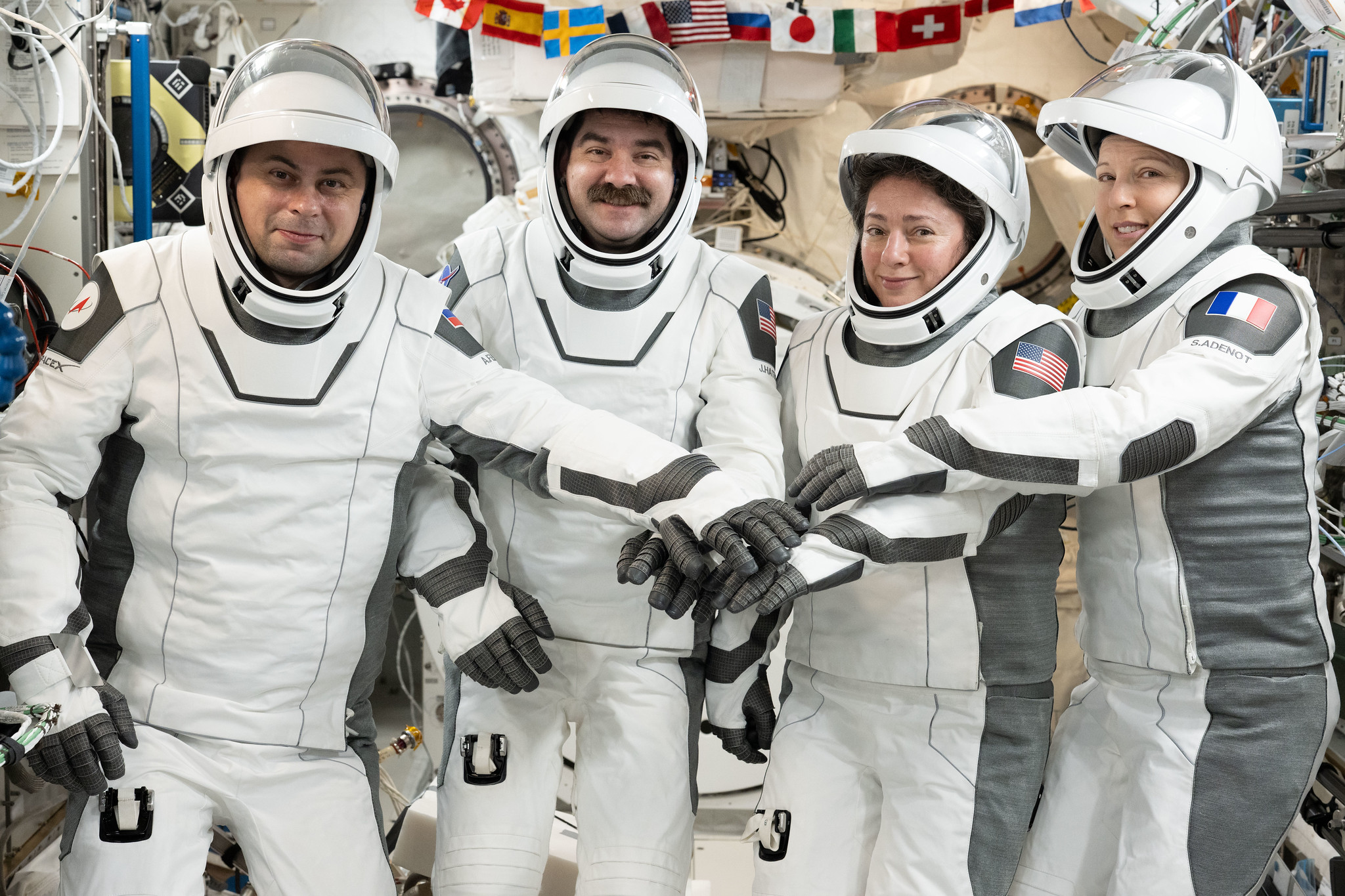
NASA’s SpaceX Crew-12 members gather for a portrait in the pressure suits they will wear when they depart the International Space Station inside the SpaceX Dragon spacecraft. From left, Roscosmos cosmonaut and mission specialist Andrey Fedyaev, NASA astronauts Jack Hathaway and Jessica Meir, Crew-12 pilot and commander respectively, and ESA (European Space Agency) astronaut and mission specialist Sophie Adenot.
Credit: NASA/Anil Menon
NASA and SpaceX are targeting no earlier than 8:05 a.m. EDT, Wednesday, Oct. 7, for the undocking of the agency’s SpaceX Crew-12 mission from the International Space Station, pending weather conditions.
An Oct. 7 undock puts NASA astronauts Jessica Meir and Jack Hathaway, ESA (European Space Agency) astronaut Sophie Adenot, and Roscosmos cosmonaut Andrey Fedyaev on schedule to splash down off the coast of California at approximately 11:34 a.m. on Thursday, Oct. 8.
NASA’s live Crew-12 return coverage will stream through a variety of platforms. Learn where to watch online:
Mission managers continue monitoring conditions in the recovery area, as undocking of the SpaceX Dragon depends on spacecraft readiness, recovery team readiness, weather conditions in the Pacific off the coast of California, and other factors.
NASA’s coverage is as follows (all times Eastern and subject to change based on real-time operations):
Wednesday, Oct. 7
6 a.m.: Hatch closure coverage begins
6:20 a.m.: Hatch closing
7:45 a.m.: Undocking coverage begins
8:05 a.m.: Undocking
Following the conclusion of undocking coverage, NASA will provide audio-only communications between Crew-12, the space station, and flight controllers during Dragon’s transit away from the orbital complex.
Bill Spetch, deputy manager of Commercial, NASA’s Low Earth Orbit Program
Dr. Liz Warren, deputy chief scientist, NASA’s Low Earth Orbit Program
Lee Echerd, senior mission manager, Customer Operations and Integration, SpaceX
Andreas Mogensen, leader, Human Exploration Group, ESA
To participate virtually in the teleconference, media must contact the NASA Johnson newsroom for call details by 12 p.m., Oct. 8, at: jsccommu@mail.nasa.gov or 281-483-5111. To ask questions, media must dial in no later than 10 minutes before the start of the call. The agency’s media credentialing policy is available online.
For more information about the Crew-12 mission, visit:
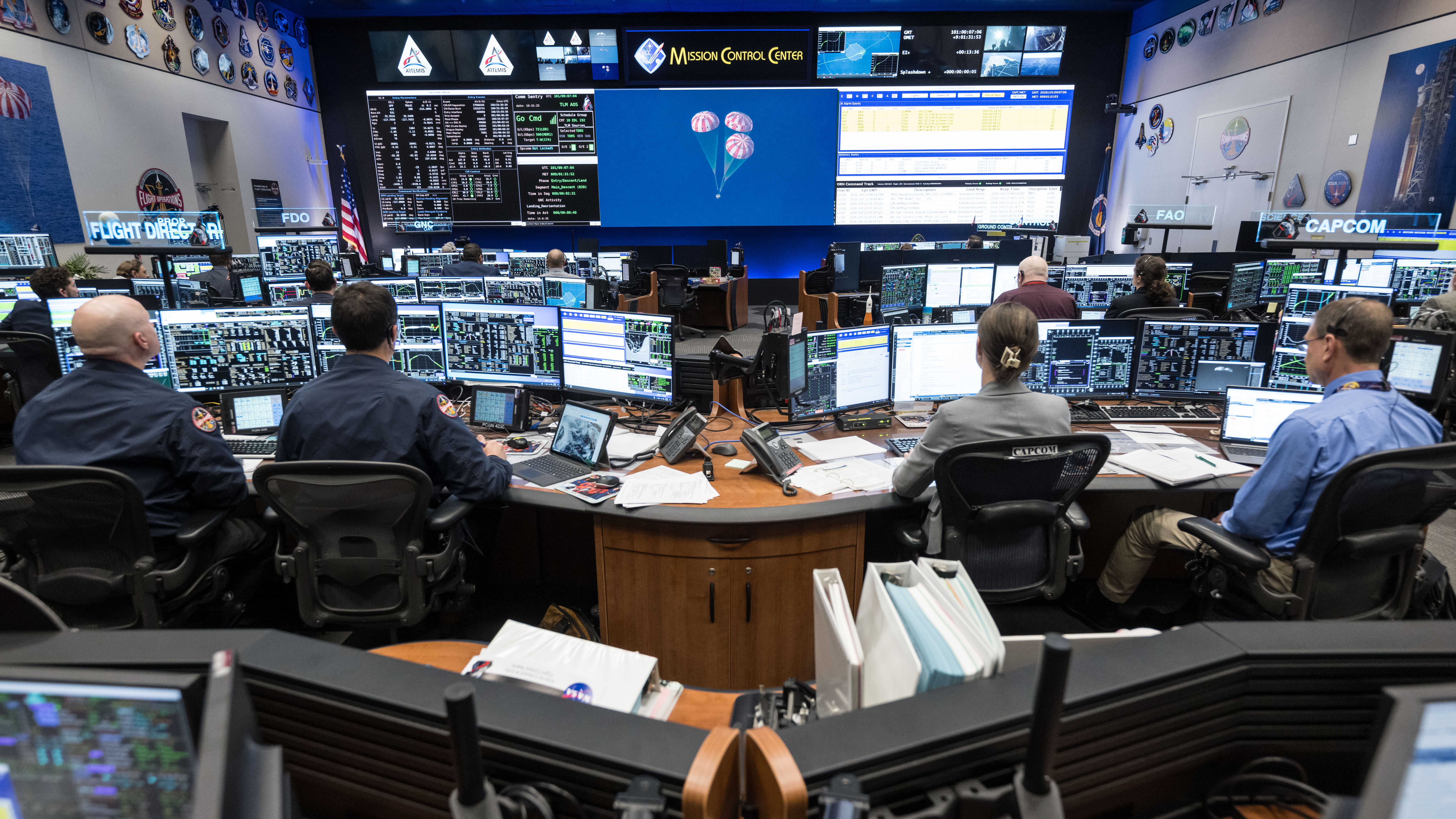
The Artemis II flight control team is pictured in the White Flight Control Room in mission control at NASA’s Johnson Space Center in Houston on April 10, 2026, for the splashdown and recovery of the Artemis II mission.
Credit: NASA/Robert Markowitz
NASA is seeking leaders for one of the most esteemed positions on Earth for human spaceflight: flight director in mission control at the agency’s Johnson Space Center in Houston. This role is critical to advancing American leadership in space exploration, as NASA paves the way for a sustained human presence on the Moon.
Applications for new flight directors are open now through Monday, Oct. 12. U.S. citizens can apply at:
Those chosen as NASA flight directors will lead human spaceflight missions to the International Space Station, Artemis missions to the Moon, and, eventually, the first human missions to Mars.
Flight directors lead teams of flight controllers, astronauts, and commercial and international partners in real-time mission execution and risk management. In preparation for a mission, flight directors collaborate with engineering, safety, and program partners to ensure operational plans align with spacecraft capabilities and mission objectives.
“We are working in an exciting, pivotal time as we continue supporting operations to the International Space Station while building the next phase of human spaceflight with Artemis and Moon Base missions, preparing to go farther than ever before,” said Emily Nelson, chief flight director at Johnson. “Accomplishing these ambitious goals requires flight directors who are expert integrators, bringing together a broad range of teams and disciplines into a clear, unified mission effort. This integral role exemplifies the best of innovation and teamwork.”
To be considered, flight director candidates must be U.S. citizens with a bachelor’s degree from an accredited institution in engineering, biological science, physical science, computer science, or mathematics. They also will need substantial related, progressively responsible professional experience, including time-critical decision-making experience in high-stress, high-risk environments. Although many NASA flight directors have previously been flight controllers working in mission control, it is not a prerequisite to apply.
NASA plans to announce selections by the end of the year. The new flight directors will receive extensive training in flight control and spacecraft systems, as well as operational leadership and risk management.
Learn more about NASA flight directors and the application process at:
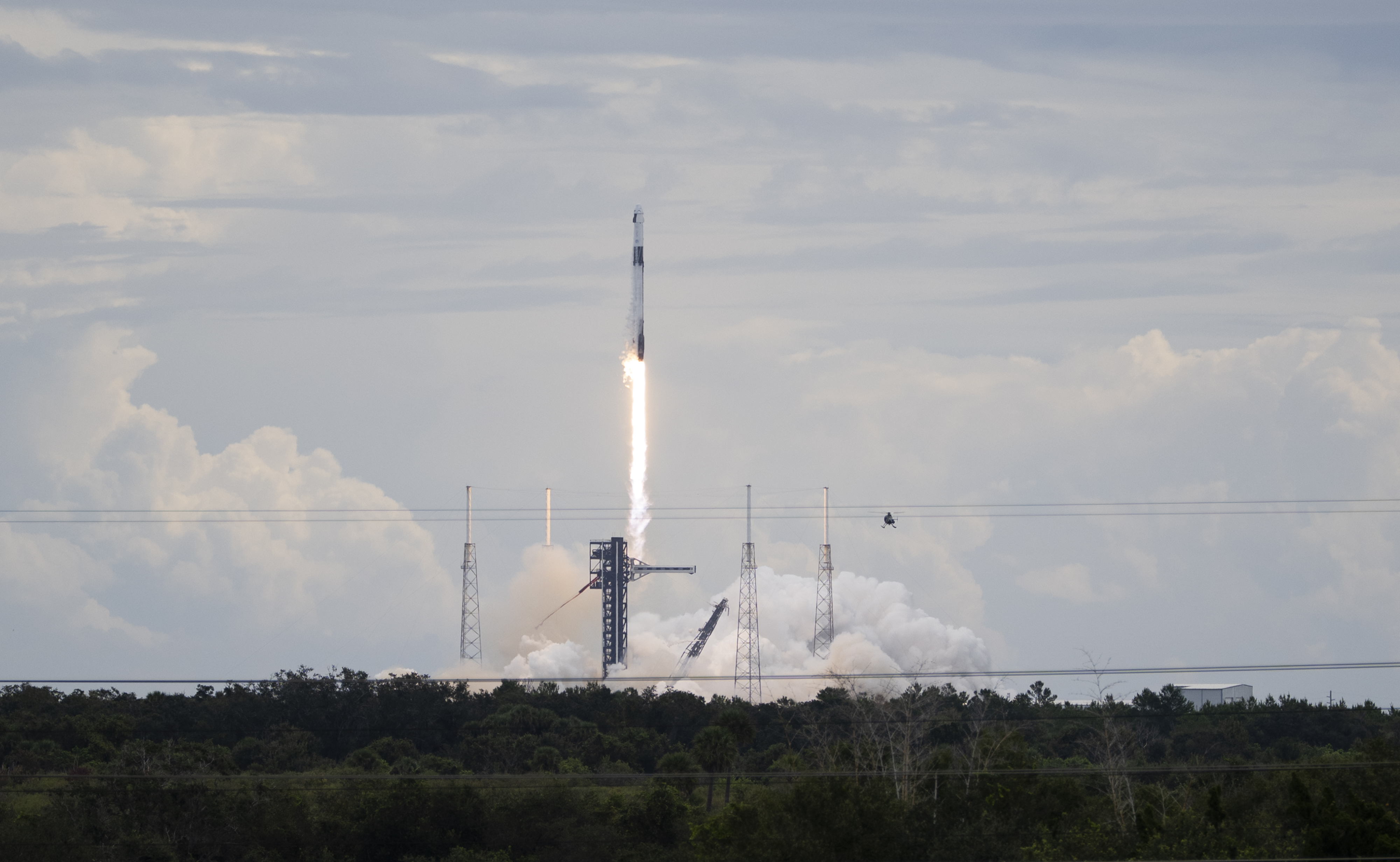
A SpaceX Falcon 9 rocket carrying the company’s Dragon spacecraft launched on NASA’s SpaceX Crew-13 mission to the International Space Station with NASA astronauts Jessica Watkins and Luke Delaney, CSA (Canadian Space Agency) astronaut Joshua Kutryk, and Roscosmos cosmonaut Sergey Teteryatnikov onboard, Thursday, Oct. 1, 2026, from Cape Canaveral Space Force Station in Florida.
Credit: NASA/Joel Kowsky
Four crew members of NASA’s SpaceX Crew-13 mission launched at 11:10 a.m. EDT Thursday from Space Launch Complex 40 at Cape Canaveral Space Force Station in Florida for a science expedition aboard the International Space Station.
“Crew-13 is another demonstration of America’s unmatched capability in human spaceflight and the strength of our commercial partnerships,” said NASA Administrator Jared Isaacman. “Jessica, Luke, Joshua, and Sergey will carry forward important work aboard the International Space Station while helping us build the experience and capabilities needed for ambitious missions to the Moon and beyond. Congratulations to the crew and the NASA and SpaceX teams who made today’s launch possible.”
A SpaceX Falcon 9 rocket propelled a Dragon spacecraft into orbit carrying NASA astronauts Jessica Watkins and Luke Delaney, CSA (Canadian Space Agency) astronaut Joshua Kutryk, and Roscosmos cosmonaut Sergey Teteryatnikov. The spacecraft will dock autonomously to the forward port of the station’s Harmony module at approximately 7 p.m., making it the fastest launch-to-docking by a U.S. spacecraft in the history of the International Space Station.
“Our steady cadence of commercial crew launches demonstrates the essential role the International Space Station plays in sustaining our presence in Earth’s orbit and sharpening the tools we’ll take forward to the Moon and Mars,” said Dr. Lori Glaze, associate administrator of NASA’s Human Spaceflight Mission Directorate at the agency’s headquarters in Washington. “Each space station mission adds to our blueprint for exploration, and the work our crews carry out guides our plans while ensuring we keep pushing the boundaries of what’s possible in human spaceflight.”
During Dragon’s approximately 7-hour, 50-minute flight, SpaceX will monitor a series of automatic spacecraft maneuvers from its mission control center in Hawthorne, California. NASA will monitor space station operations throughout the flight from the Mission Control Center at the agency’s Johnson Space Center in Houston.
NASA’s live arrival coverage begins at 5:20 p.m. for rendezvous, docking, and hatch opening. After docking, the crew members will change out of their spacesuits and prepare cargo for offload before opening the hatch to the station’s Harmony module around 8:45 p.m.
NASA will stream Crew‑13’s arrival across multiple platforms. Learn where to watch at:
Watkins, Delaney, Kutryk, and Teteryatnikov will join the Expedition 75 crew, which includes NASA astronaut Anil Menon and Roscosmos cosmonauts Pyotr Dubrov and Anna Kikina already aboard the station. After a brief handover, NASA’s SpaceX Crew‑12 mission, with agency astronauts Jessica Meir and Jack Hathaway, ESA (European Space Agency) astronaut Sophie Adenot, and Roscosmos cosmonaut Andrey Fedyaev, will return to Earth.
During its mission, Crew‑13 will help advance research aboard the orbiting laboratory by using microgravity to produce human stem cell‑derived tissues for improved personalized medicine, disease modeling, and pharmaceutical testing for conditions such as heart disease and Parkinson’s. The crew also will explore crop production through a new, mostly autonomous plant growth system and test how plants grow outside dedicated facilities. In addition, the crew members will continue human‑health studies that examine factors linked to blood-flow abnormalities in microgravity and will test a new inflight diagnostic device to monitor astronaut health.
Crew-13 is part of NASA’s Low Earth Orbit Program, which partners with private companies to provide reliable access to space, support research and development aboard the space station, and enable future missions beyond low Earth orbit.
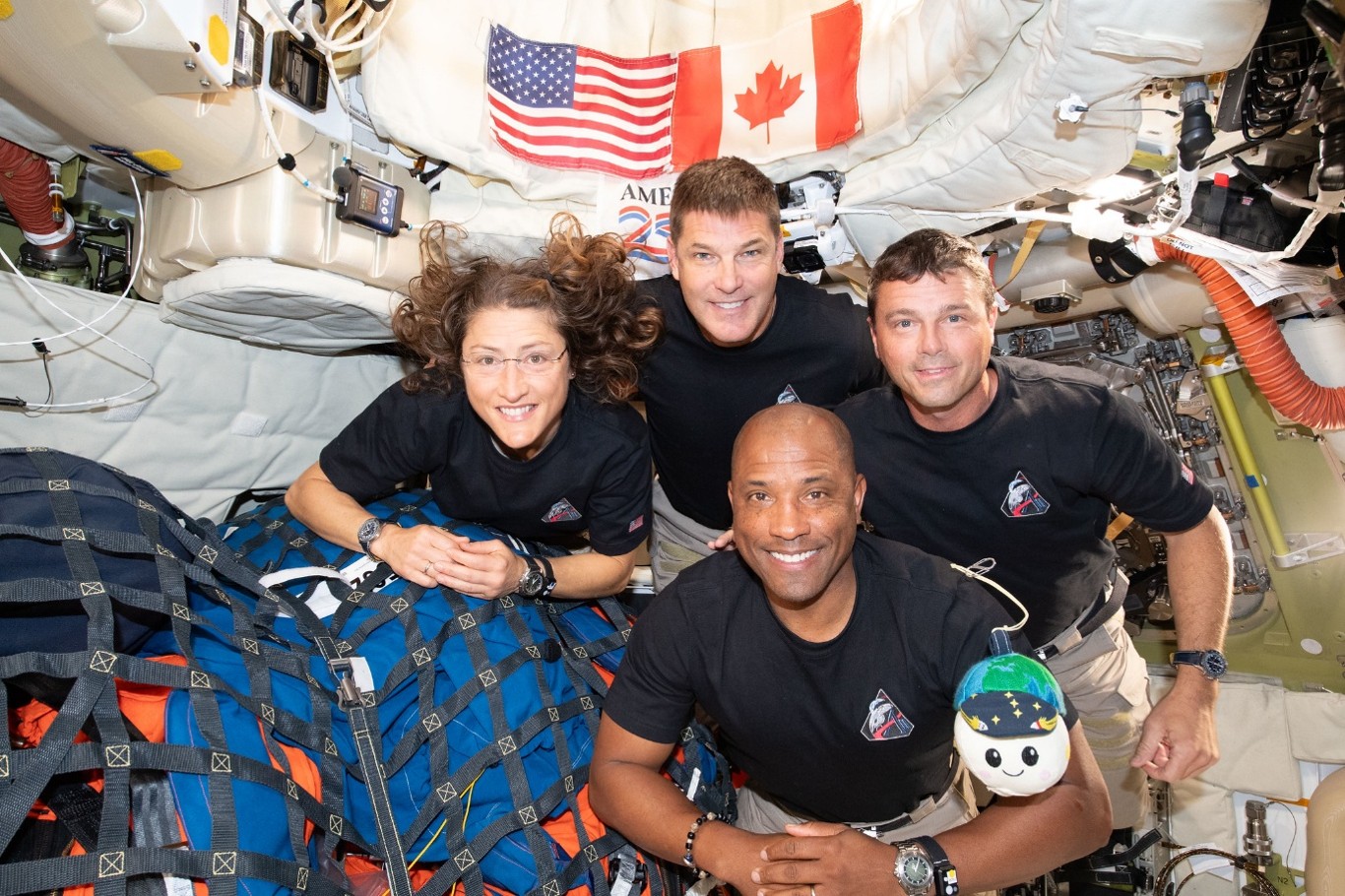
The Artemis II crew (clockwise from left) Mission Specialist Christina Koch, Mission Specialist Jeremy Hansen, Commander Reid Wiseman, and Pilot Victor Glover pause for a group photo with their zero gravity indicator “Rise,” inside the Orion spacecraft during their nearly 10-day mission around the Moon and back. Credit: NASA
Editor’s Note: This advisory was updated on Sept. 28, 2026, with ticketing information for the public.
The four astronauts of NASA’s Artemis II mission will participate in an event hosted by industry and community partners at the University of Houston to discuss their mission around the Moon aboard the Orion spacecraft. It will be the first event in Houston for the public following their lunar mission earlier this year and marks the conclusion of their post-flight campaign.
Astronauts Reid Wiseman, Victor Glover, and Christina Koch of NASA and CSA (Canadian Space Agency) astronaut Jeremy Hansen will share highlights from their mission at 7 p.m. CDT Wednesday, Sept. 30, during the free, public event at University of Houston’s Fertitta Center. Additionally, the National Aeronautic Association will recognize the crew for surpassing the record for human spaceflight’s farthest distance traveled, previously set by the Apollo 13 mission in 1970.
Media are invited to attend a brief question and answer session with the Artemis II crew at 5:45 p.m. prior to the public presentation. Media interested in attending must RSVP no later than 12 p.m. on Sept. 30 to Kenna Pell at: kenna.m.pell@nasa.gov.
A limited number of tickets to attend the event at no charge are available to the public online. Media are not required to secure a ticket before RSVPing to the event.
NASA’s historic Artemis II mission launched April 1 and splashed down in the Pacific Ocean on April 10. The crew members were the first astronauts to launch on the agency’s SLS (Space Launch System) rocket, flying aboard NASA’s Orion spacecraft. During their record-setting mission, the astronauts traveled 252,756 miles from Earth, farther than any humans have traveled before.
As part of the Golden Age of innovation and exploration, NASA will send Artemis astronauts on increasingly difficult missions to explore more of the Moon for scientific discovery, economic benefits, establish an enduring human presence on the lunar surface, and to build on our foundation for the first crewed missions to Mars.
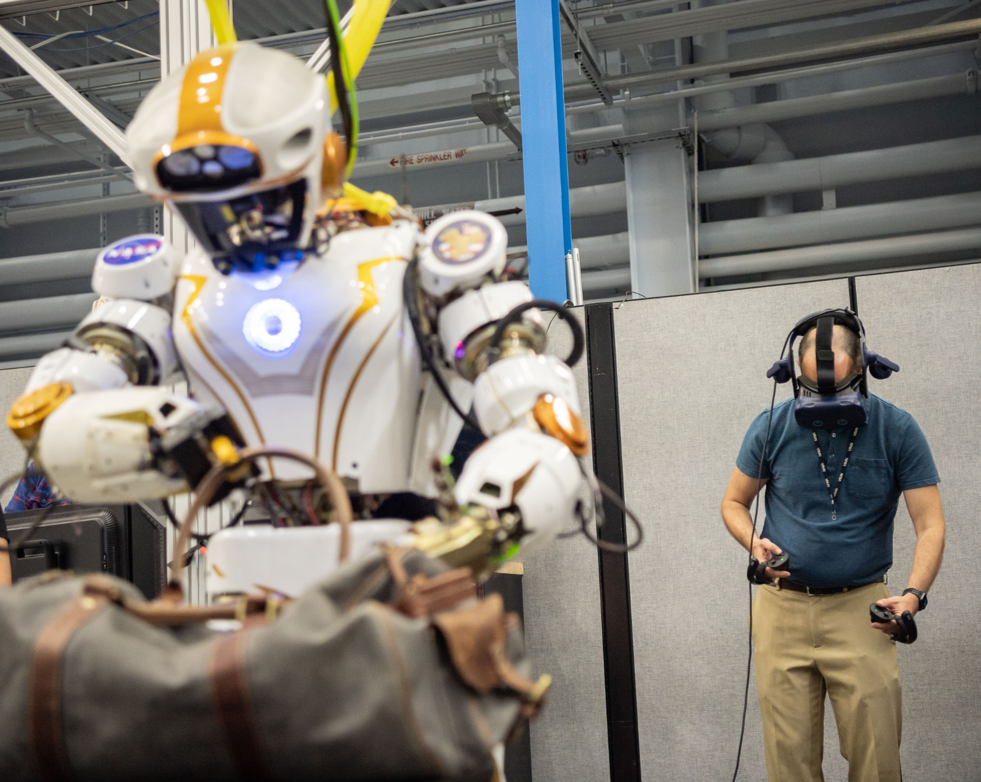
Dexterous Robotics Team lead Shaun Azimi conducts a demonstration with NASA’s Valkyrie humanoid robot.
NASA
The idea of humans and robots working side-by-side in space was once the stuff of science fiction, but with NASA launching increasingly complex missions deeper into space, human-robot collaboration could become reality.
Advanced robotic systems are critical for human spaceflight because they can enhance a crew’s performance and productivity while reducing risk and expanding the capabilities for space exploration. The Dexterous Robotics Team at NASA’s Johnson Space Center in Houston plays a key role in developing robotic hardware and software to support NASA’s bold vision for the future, with a focus on robots that can complete tasks humans do with their hands.
“Our team is not trying to replace human explorers with robots but instead make human exploration safer and more sustainable by developing highly capable, reliable, and trustworthy robots to work in extreme environments,” said Shaun Azimi, Dexterous Robotics Team lead. “If we can send more capable robots, we can reduce the risk and make people more effective in doing the things that people do best.”
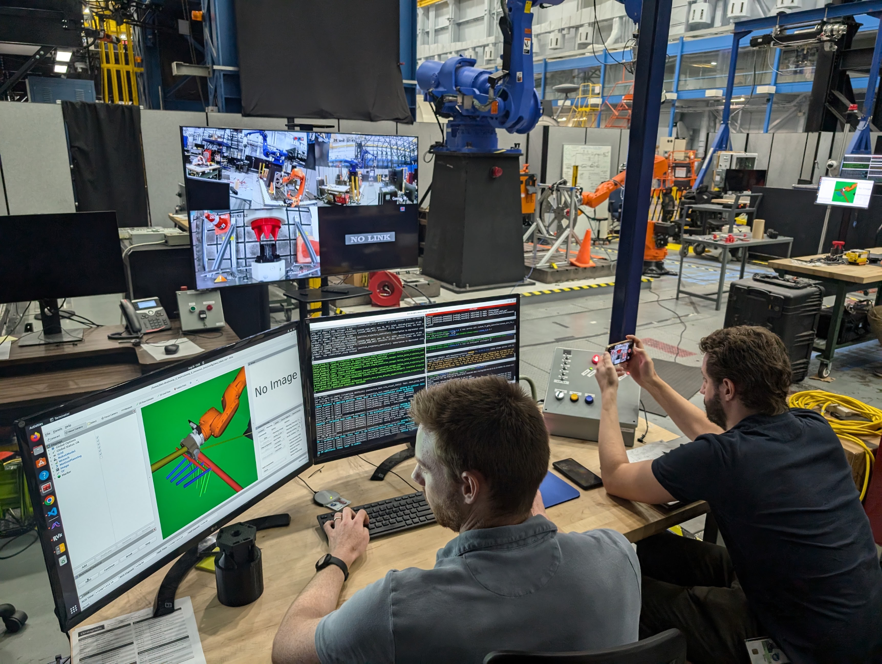
Dexterous Robotics Team members Nathan Dunkelberger (left) and Connor Rainen test the use of a robotic arm.
NASA
The 16-member team is part of NASA’s Robotic System Technology Branch, which also develops mobility systems like unmanned planetary rovers. Azimi is one of several engineers who work on both dexterity and mobility projects. There is also crossover within the Dexterous Robotics Team. While the group is generally organized into two subgroups, mechatronics and software, most team members have experience in electronics or mechanics as well as writing software for simulations or analyses.
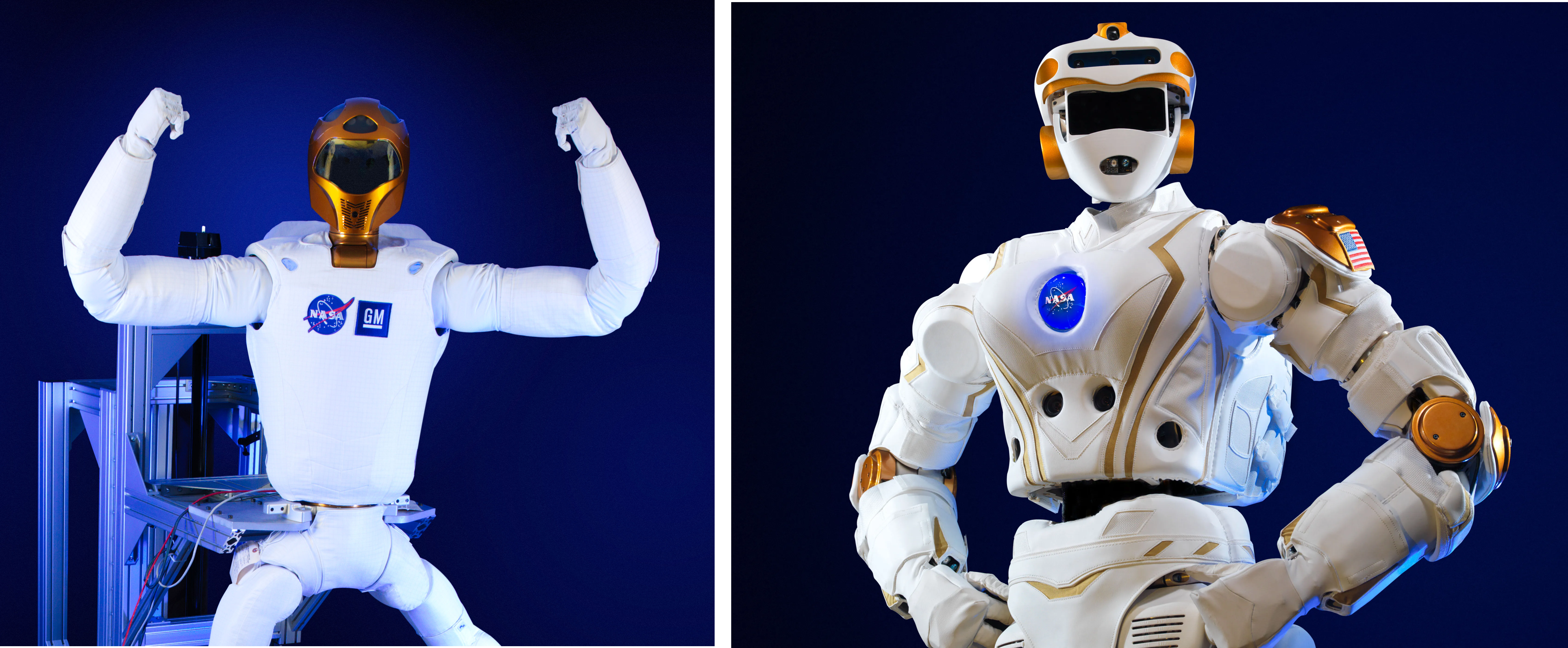
Much of that experience was gained by working on two well-known humanoid robots – the Robonaut 2, which participated in robotics technology demonstrations aboard the International Space Station for seven years, and Valkyrie, NASA’s first bipedal humanoid robot. Many of the employees who worked on those projects now make up the Dexterous Robotics Team and continue to build upon the robots’ legacy.
NASA’s Robonaut 2 (left) and Valkyrie humanoid robots.
NASA
Today the team supports a variety of agency projects and programs, some of which are exploring connections to building the Moon Base, humanity’s first lunar outpost. “Our work is a combination of technology research and development, and applied technology on the operational side,” Azimi said. The team also collaborates with private industry and other external partners that face similar challenges in their work, such as an oil and gas company seeking to leverage robotic technologies in harsh environments and for riskier tasks.
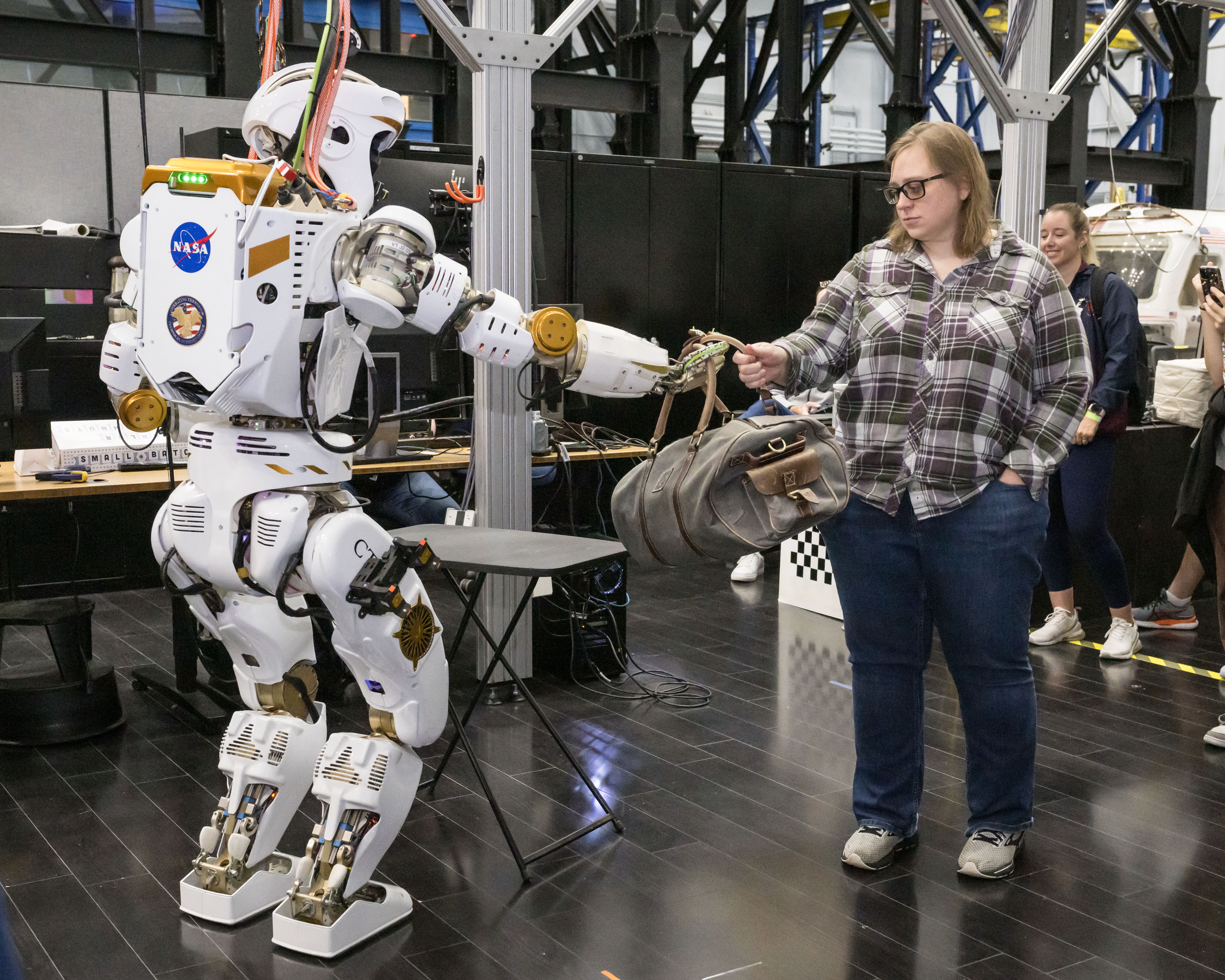
During a demonstration, Valkyrie hands Dexterous Robotics Team member Emily Sheetz a packed duffel bag.
NASA/Helen Arase Vargas
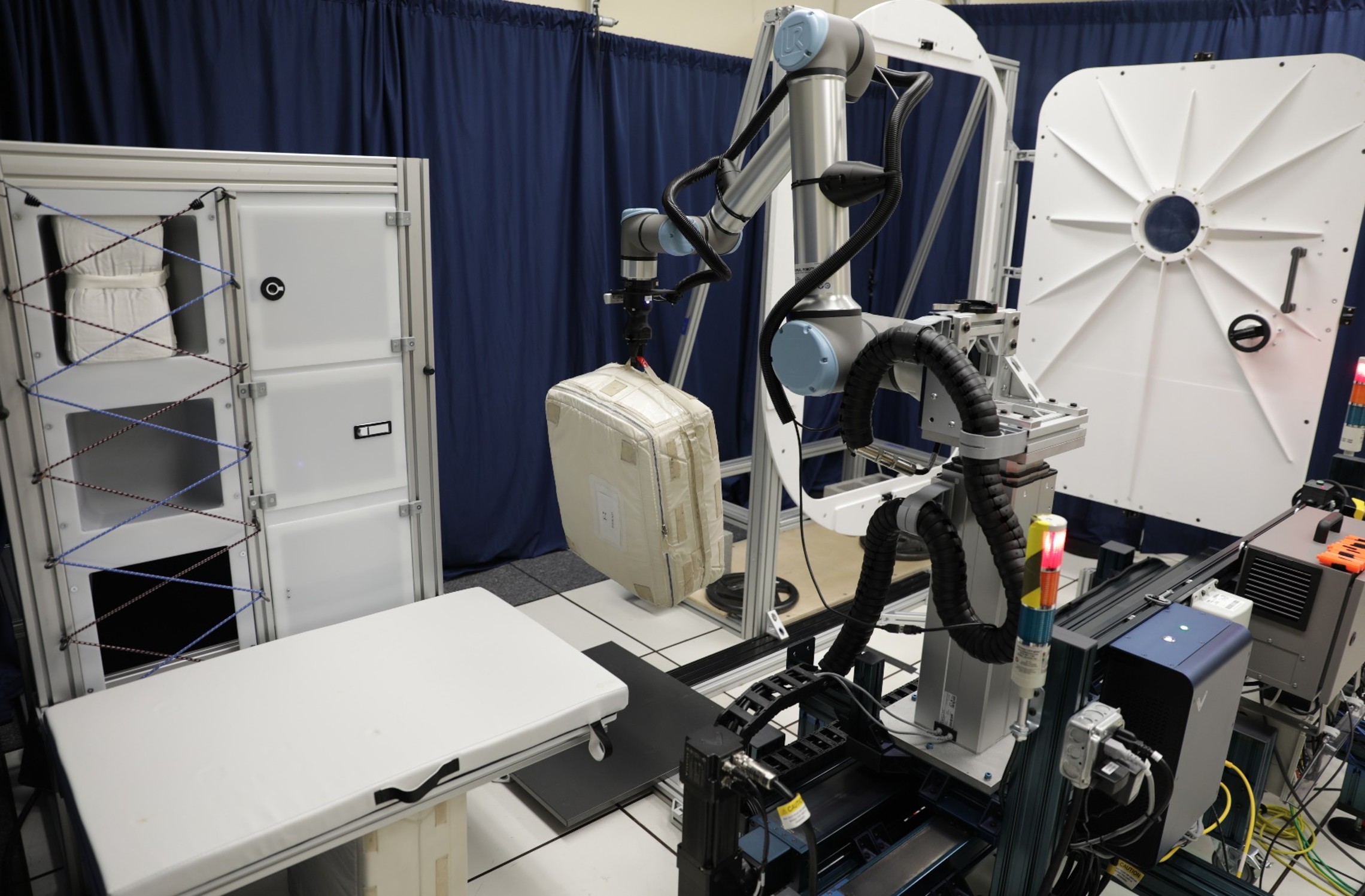
A major focus for the team has been development of the Integrated Mobile Evaluation Testbed for Robotics Operations (iMETRO) facility at Johnson. Available to NASA programs and external partners, iMETRO is designed to support the adaptation of terrestrial robotic technologies for human-supervised space exploration applications such as logistics, maintenance, and scientific research. The facility comprises open-source software and simulation assets, as well as space vehicle and habitat mockups, a selection of “house robots,” and an outdoor rock yard. Offering digital and physical facilities gives iMETRO users the flexibility to test a whole robot or a single hardware or software component.
Azimi said iMETRO helps remove the guesswork from NASA’s collaboration with external partners. “It shows them the things we actually need done so they don’t have to speculate,” he said. “We can also bring together the people who are developing the robotic technologies – hardware, software, or both – with the people who are actually designing a lunar surface habitat or rover.” This enables different teams to learn from each other: The technology providers gain a better understanding of the habitat, while the habitat designers learn what features are needed to accommodate a robot. “They can learn about how robots perceive the world and interact with objects, and what is difficult for a robot compared to a human,” Azimi said. “It’s not necessarily a totally different interface, and something like a bigger handle or better lighting might make things easier for a person as well.”
In one case, a team from PickNik Inc. used iMETRO to test software enabling a robotic arm to recognize a spacecraft hatch, then turn the latch, grasp the handle, and open the door. The arm was then able to transfer cargo bags between the hatch and a bin. The facility also supported a NASA intern’s development and testing of software that used a common commercial robotic arm and camera to inspect and maintain a cold stowage freezer like those aboard the space station.
Components of the Dexterous Robotics Team’s iMETRO facility.
NASA
Azimi acknowledged the team’s near-term emphasis on technologies that can support a sustained human presence on the lunar surface but noted those technologies also have applications for future missions to Mars. In fact, the team is collaborating with other agency organizations on a forthcoming NASA challenge that will invite the public to share their ideas for technology solutions for Mars exploration.
Azimi said he is often asked why there is a robotics team at Johnson. “It’s really about the human elements – either working in environments designed for humans or working alongside humans. That’s our niche,” he said. “We’re uniquely positioned to bring in folks who are designing the human environments.”

 Login