Preparations for Next Moonwalk Simulations Underway (and Underwater)
TThe north polar region of Jupiter’s volcanic moon Io was captured by NASA’s Juno during the spacecraft’s 57th close pass of the gas giant on Dec. 30, 2023. Data from that flyby and one on Feb. 3, 2024, is helping scientists understand Io’s interior.
Image data: NASA/JPL-Caltech/SwRI/MSSS Image processing by Gerald Eichstädt
NASA’s Juno mission has provided the first measurements of the temperature below the surface of Jupiter’s moon Io, revealing significant heating within the shallow subsurface of the most volcanically active world in the solar system. Collected during two close flybys, the data also shows that most of Io’s surface is remarkably smooth and composed of material of very low density.
Published Wednesday in the Journal of Geophysical Research: Planets, these findings break new observational ground for both fiery and icy worlds beyond our planet.
Io’s extreme volcanism is powered by tidal heating. The moon is constantly stretched and squeezed by Jupiter’s immense gravity as it travels its slightly elliptical orbit, generating internal heat output many times greater than Earth’s. Until now, virtually everything known about that heat came from infrared observations, which sense only the temperature of the top surface. The latest findings are derived from data collected by the spacecraft’s Microwave Radiometer (MWR) instrument.
“The Juno Microwave Radiometer directly observed Io’s heat output by looking below the surface,” said Scott Bolton, study coauthor and Juno’s principal investigator at Southwest Research Institute in San Antonio. “The surprising discovery that we could see below a rocky moon’s surface has important implications for studying Earth’s volcanoes. Juno has taught us that if we look with an MWR-type instrument near a volcano on Earth, we might see a similar signature in the subsurface temperature gradient, providing new information on how terrestrial volcanoes work.”
This map represents data captured by the Microwave Radiometer instrument aboard NASA’s Juno, indicating heat rising from just beneath the surface of Jupiter’s moon Io. The colors illustrate a distinct temperature gradient across the moon, with the most extreme, localized heat output in red.
NASA/JPL-Caltech/SwRI/USGS
Fire, ice
Juno’s Microwave Radiometer was designed by Bolton to peer beneath Jupiter’s cloud tops to investigate the dynamics and composition of the gas giant’s deep atmosphere. The MWR’s six microwave antennas serve as a single instrument, simultaneously detecting microwaves at a wide range of wavelengths, from about half an inch to 20 inches (1.3 to 51 centimeters). During the mission’s extended phase, the MWR instrument has provided the opportunity to observe three of the planet’s Galilean moons: Ganymede, Europa, and Io.
“The technique is novel in that each wavelength explores different depths, providing a new way to characterize the deep atmosphere of giant planets and the subsurface crusts of icy and rocky moons,” said Bolton. “At Ganymede and Europa, we explored tens of miles below the surface, assuming their ice shells were mostly pure water, but the ability to probe into the volcanic rock at Io was an unexpected discovery.”
During flybys on Dec. 30, 2023, and Feb. 3, 2024, the solar-powered Juno spacecraft came within about 930 miles (1,500 kilometers) of the moon’s surface.
“The instrument measured Io’s thermal emission at depths ranging from a few inches down to tens of feet. Everywhere we looked, we found the temperature rising by more than 40 degrees Fahrenheit just several feet into the surface — a gradient far steeper than solar heating alone can explain,” said Shannon Brown, the paper’s lead author at NASA’s Jet Propulsion Laboratory in Southern California.
The data suggests two possible explanations. First, heat could be rising steadily through a conductive crust. While this background heat flow — measured at 1 to 3 watts per square meter — is relatively gentle on a local scale (roughly equivalent to a small nightlight glowing under every square yard), across the entire moon it represents a release of energy up to 30 times Earth’s average. Alternatively, the signal could be coming from cooling lava flows, capped by roughly 30 to 35 feet (9 to 11 meters) of solidified crust, that cover about 10% of the moon’s surface at any given time.
“Io provides a unique window into learning how tidal heating works throughout the cosmos, a fundamental process that provides energy and heat to worlds that are far from their parent star,” said Bolton. “This process can not only create the most volcanic body in the solar system, in the case of Io, but also fuels the subsurface oceans on the moons of giant planets, such as Europa and Ganymede. Up until this point we could only observe the heat escaping at the surface or through eruptions. Now we can characterize how the heat is moving from the interior toward the surface.”
This graphic illustrates the areas of Io sampled by the Microwave Radiometer instrument aboard NASA’s Juno spacecraft during two close flybys of the Jovian moon.
NASA/JPL-Caltech/SwRI/USGS
Great plains of Io
Another big insight gained from the two flybys is just how smooth Io is. Prior to the recent findings, the moon was known for its tall mountains, but the MWR indicates that apart from this visible topography, the surface features expansive smooth patches that stretch for 60 miles (100 kilometers) or more. Because Juno flew by overlapping regions of Io at different angles, the team was able to map how the surface reflects microwaves, much like an airline passenger might see the ocean flash with sunlight only at specific angles.
“Away from its mountains, the surface is more like the Great Plains of North America, and even though Io is a rocky body, the surface material has a very low density — more like pumice or a fluffy volcanic ash than solid rock,” said Brown.
More about Juno
A division of Caltech in Pasadena, California, JPL manages the Juno mission for the principal investigator, Scott Bolton, of the Southwest Research Institute. Juno is part of NASA’s New Frontiers Program, which is managed at the agency’s Marshall Space Flight Center in Huntsville, Alabama, for the NASA’s Science Mission Directorate in Washington. Lockheed Martin Space in Denver built and operates the spacecraft. More information about Juno is at:
Have you ever found out that something you remember from your youth is now gone, and you didn’t even notice? If you are a certain age, you might feel that way when I deliver the news: You haven’t been able to buy International Reply Coupons (IRCs) at a US Post Office since early 2013. By the end of 2026, you won’t be able to buy them anywhere. The age of the IRC is over.
What’s an IRC?
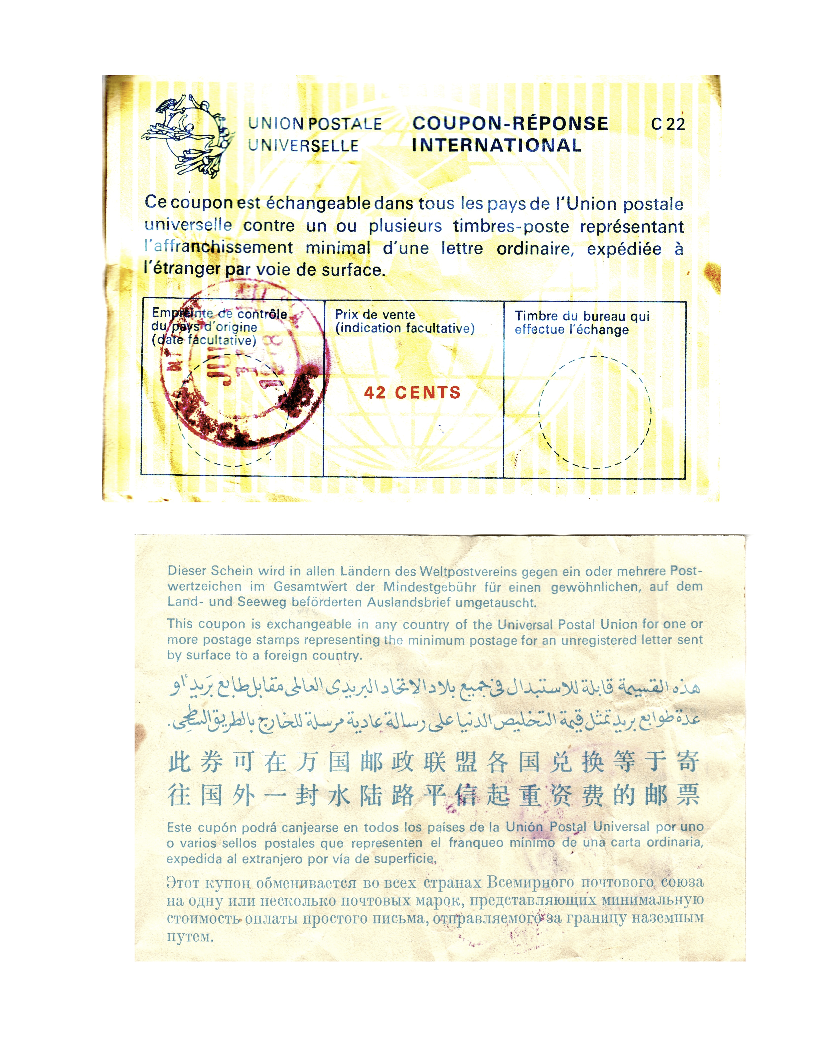
An IRC from 1978 (public domain).
If that didn’t mean anything to you, you might be too young to remember, or maybe you just weren’t into shortwave listening or ham radio. Although there were other reasons to get IRCs, a radio hobby is the most likely reason a Hackday reader would have bought an IRC.
For radio purposes, here’s the problem. You’ve worked on your station for months, and one winter night, you finally pull in that rare station from Luxembourg. They’ll send you a QSL card to verify that you heard them. You only have to send them a letter telling them what time you heard them, what frequency, and some details about the program you heard. But they probably don’t want to pay the postage required to send hundreds or thousands of cards overseas.
While this is a radio-specific problem, you might find the same issue with pen pals or when trying to buy things from an overseas company.
SASE
If everyone were in the same country, the solution would be easy. Take a stamp, put it on an envelope that has your address on it, and stuff it in with the letter. Or, you could just drop a stamp or two in the letter you sent.
The problem is, US postage won’t help Radio Luxembourg. On the other hand, the effort required for you to buy postage that works in Luxembourg would have been a nightmare.
Enter the UPU
The Universal Postal Union is a UN agency that is effectively an association of post offices in 192 countries. Their charter is to facilitate mailing things worldwide.
The IRCs date back to 1906. The idea is you buy an IRC at your post office. You send it to Radio Luxembourg, or wherever. There, the mail person at the radio station could go to their post office and trade the coupon for enough local postage to send a surface letter worldwide.
Slow Death
A more recent IRC (UPU).
As demand has dwindled, post offices worldwide have quit selling IRCs. As of last year, Australia still did. But Germany, Britain, the United States, and many other countries gave up on them long ago. In fact, Britain’s Royal Mail claimed that the average post office sold less than one IRC per year at the time it threw in the towel.
UPU decided to end IRCs altogether by December 31, 2026. The end of an era and, apparently, not just for radio hobbyists. It is telling that the UPU’s recent editions of IRCs had print runs of 1,000 or even 500. So they obviously weren’t selling very many.
IRCs Other Claim to Fame
If you’ve heard of these before and you aren’t interested in radio, then it might have been in economic history. Have you heard of the Ponzi scheme? It has become a generic term for any business scheme that relies on raising money from new investors to service debt owed to old investors.
However, the original Ponzi scheme dates back to 1920, when Charles Ponzi realized he could buy IRCs in a country where they were cheap and sell them for more in another country. He was happy to accept investors, of course.
The problem is that profits are thin, and the costs of acquiring and transporting large numbers of IRCs quickly swamp most potential profits. Fluctuations in currency exchange rates take the rest.
Goodbye!
So the end of the IRC marks a closed chapter for ham radio and swindling. There were probably other uses, too, that are now consumed by electronic mail, payment systems, and the like.
You have to wonder what adventures IRCs went on during their global travels. The video below shows one’s story.
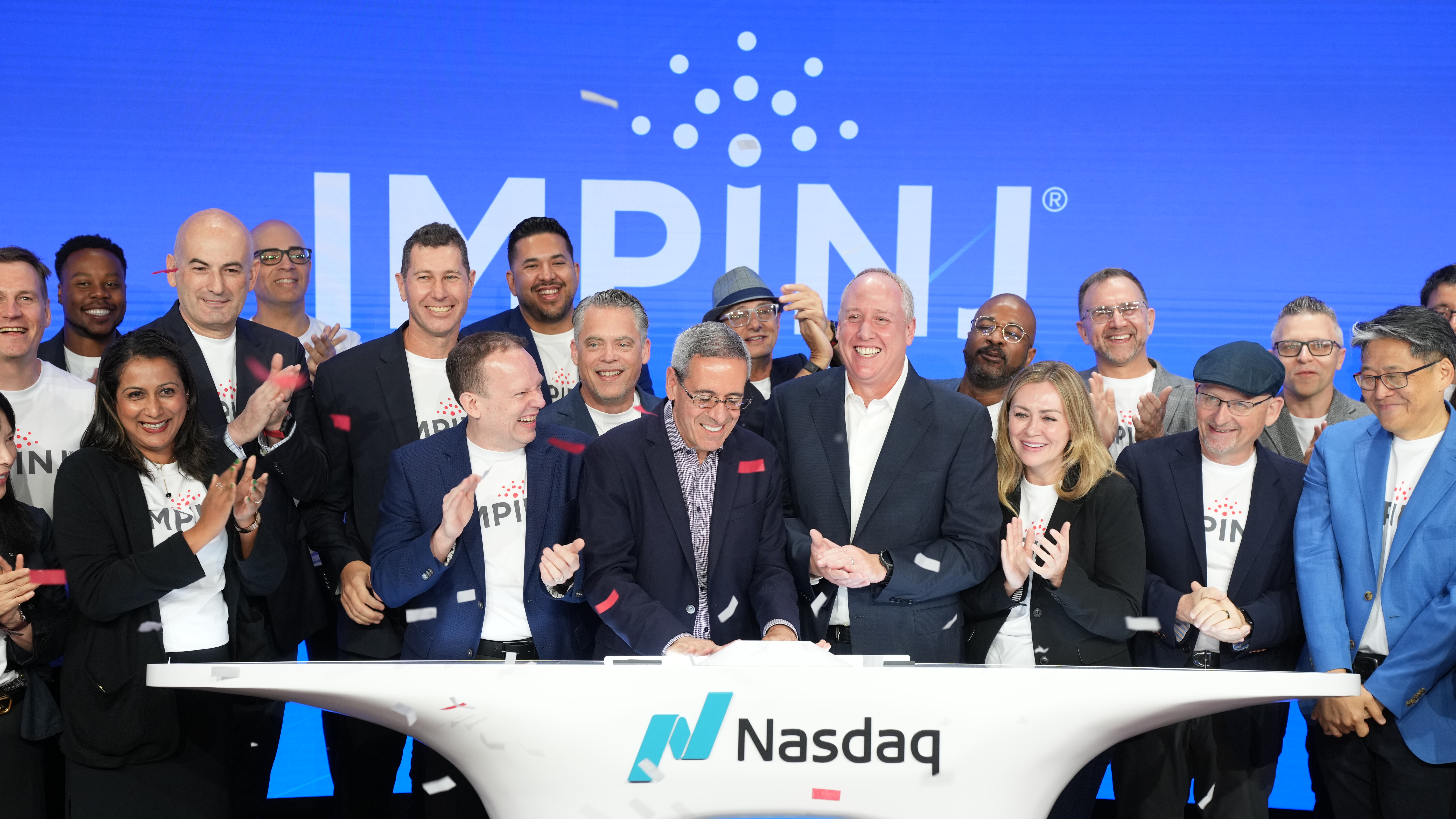
Impinj co-founder and CEO Chris Diorio, center, and members of the Impinj team at the Nasdaq opening bell ceremony in New York City on Tuesday, marking the 10th anniversary of the company’s IPO. (Nasdaq Photo)
Backstage at a Seattle tech event in the early 2000s, Chris Diorio was waiting his turn to speak. Next to him was Jeff Bezos, whose company was already becoming a household name.
Diorio, the leader of Impinj, then a tiny local startup, turned to the Amazon founder: “Jeff, you’ve got a much bigger near-term opportunity than we do,” Diorio recalls saying, “but we’ve got a much bigger long-term opportunity than you do.”
Before Bezos could respond, he was called onstage.
“The technology turned out to be way harder than I thought,” Diorio acknowledged after telling that story in a recent interview. “But that’s what I told him — and I still believe in those words. Our opportunity is to deliver physical intelligence for every item in the world.”
A quarter-century after that chance encounter, Diorio rang the Nasdaq opening bell Tuesday morning in New York City to mark the 10th anniversary of Impinj’s IPO. The company’s tiny, battery-free RFID chips — each smaller than a grain of sand — have been embedded in more than 160 billion items, including clothing, pharmaceuticals, airline luggage, and groceries.
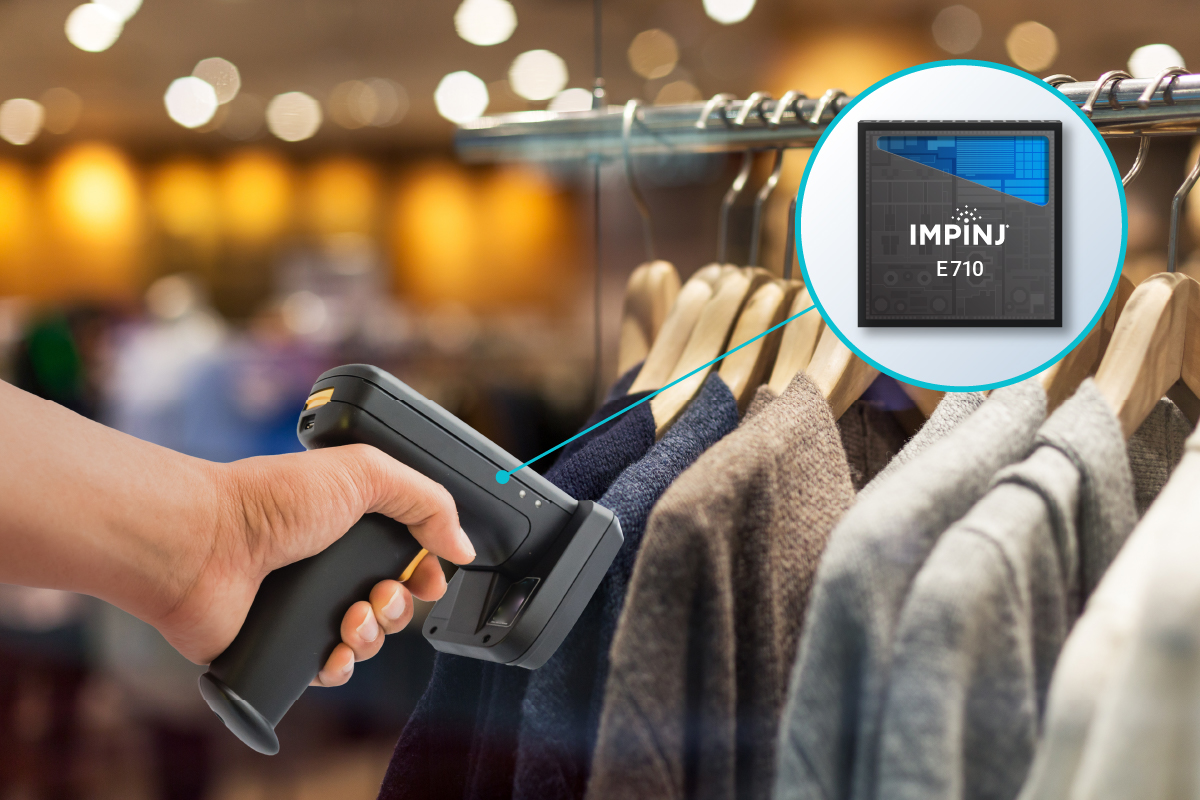
An illustration of the Impinj E710 reader chip inside a handheld RFID scanner used for retail inventory. (Impinj Photo)
Impinj commands nearly two-thirds of its market, won a patent war against a rival 15 times its size, and has grown from a $250 million IPO valuation to a market cap of more than $4.2 billion. Along the way, the company survived a billion-dollar industry hype cycle that killed nearly every competitor.
And yet, Impinj has posted exactly one profitable year since going public — thanks to a $45 million legal settlement at the time. Its accumulated deficit stands at $400 million, its financial reports show. Less than 1% of the items it envisions connecting are connected today.
To Diorio, that speaks to the potential. The company is barely scratching the surface. He cited the 1% stat in his comments before ringing the Nasdaq bell on Tuesday morning, saying the “opportunity is so gigantic that we’ll still have a huge runway ahead of us 10 years from now.”
That the company has gotten to this point is as much a Seattle story as it is a technology story. Impinj has benefitted from a network of patient local investors, academic connections and supporters who gave the company the time that Silicon Valley never would have.
But no one imagined it would take this long when they got started.
From Caltech to Seattle
The origins of Impinj were at Caltech in Pasadena, Calif., in the 1990s. Diorio was a graduate student working under Carver Mead, the physicist and engineer who helped coin the term Moore’s Law and helped lay the intellectual foundation for the modern semiconductor industry.
Carver Mead, the Caltech physicist and engineer who co-founded Impinj with Diorio. (Photo by Norman Seeff, CC BY-SA 4.0)
Together, they discovered a way to change a transistor’s electrical properties after it had been manufactured — a quantum-mechanical phenomenon called “impact-ionized hot electron injection.” That made it possible to build chips so efficient and inexpensive that they could be embedded in disposable packaging. (“Impinj” is derived from that scientific name.)
In an oral history later recorded by the Science History Institute, Mead described Diorio as “a super-bright, super-high-energy guy” who “burned up the track” at Caltech.
After finishing his PhD, Diorio was recommended by Mead to the University of Washington’s computer science department. There was resistance among the UW faculty — his research in analog circuits wasn’t an obvious fit — but professor Larry Ruzzo carried the day.
Ruzzo essentially said, “This guy is brilliant, and even if he is nothing other than our gift to the rest of the university, we should hire him,” recalled Ed Lazowska, the department chair at the time.
Diorio joined the UW faculty in 1997. Over the next few years, his research earned a string of honors, including Packard and Sloan fellowships. A couple years later, Diorio met up with Mead on a trip to California, over dinner at Fresh Cream, a long-since-closed French restaurant in Monterey. Diorio asked Mead if it was time to start a company.
“Are you up for it?” Mead asked. Diorio said yes. They started the paperwork the next day.
Impinj was incorporated in April 2000, headquartered in Seattle. It quickly got the attention of two local investment firms, with behind-the-scenes help from the everpresent Lazowska.
On April 21, 2000, the UW computer science chair emailed Bob Nelsen at Arch Venture Partners and Tom Alberg at Madrona. He explained that he was urging Diorio and Mead “to get some local $ for the connections,” and that he had pointed them to Arch and Madrona.
Impinj co-founder and CEO Chris Diorio discusses Gen2X, the company’s latest advancement in RFID chip technology. (Impinj Photo)
Patrick Ennis, then at Arch, reached out to Diorio that same day. As Ennis recalled in a recent interview, there were plenty of Silicon Valley firms that wanted in, thanks to Mead’s reputation, but Diorio and Mead decided to take Lazowska’s advice and go with Seattle investors.
Diorio, who likes to take walking meetings, negotiated the terms with Ennis as they made their way on foot through the University of Washington Arboretum one day. The investment closed that summer: $15 million, split evenly between Arch and Madrona.
Impinj at the time had patents, prototypes, and no real business plan.
“That’s how venture capital should be done,” said Ennis, who has since become a Madrona venture partner. “You make big bets on great technology and great people.”
Betting the company on RFID
Bill Colleran joined Impinj as CEO in January 2001. He and Diorio had designed satellite chips together at defense contractor TRW in the 1980s. Colleran had just sold his Bluetooth startup, gotten married, and gone on his honeymoon. He came home to a message from Diorio: he’d started a company in Seattle and wanted Colleran to join.
Bill Colleran, Impinj’s first CEO, was recently tapped to lead AI coding startup Adronite.
Colleran was soon in Seattle — one of six or eight people working out of what he warmly recalls as “a crappy little building” in the University District, several of them former TRW colleagues.
“We were kind of getting the band back together,” he said.
RFID wasn’t the original plan. Impinj’s first target was improving power efficiency for 3G wireless base stations, but the dot-com bust killed that market, and regardless, the company was too small to compete with the major chipmakers in the wireless industry.
The team spent two years exploring what to do with their technology. Cable modems required too much dependence on Intel, as Colleran recalled. Cell phone radios were dominated by players too big to compete against. GPS turned out to be a poor technical fit — Impinj’s chips excelled at low power, but GPS demanded low electrical noise, a different problem entirely.
So they eventually settled on RFID, the technology that uses tiny wireless chips to identify and track physical objects. The industry was young, the standards were still being written, and Impinj’s low-power technology seemed tailor-made for it.
As Madrona’s Ennis and Tim Porter write in a piece pegged to the IPO anniversary, “When you have a truly powerful, groundbreaking deep technology, it behooves you to wander the product-market fit wilderness for a while, even when that is unsettling and downright frightening, and even when it runs contrary to what you learn in a VC class in business school.”
Then, a stroke of luck: In June 2003, Walmart announced it would require its top suppliers to tag every pallet and case with RFID chips. The Impinj team celebrated their good fortune.
“We all high-fived,” Diorio recalled. “We did it. Eighteen months, we’re gonna IPO.”
In reality, it would be another 13 years.
Surviving the RFID hype cycle
Walmart’s announcement triggered a gold rush of venture capital investment into RFID technology startups. But there was no global spectrum allocated, no standard that worked, and no products ready to deliver on the promise. Walmart’s own January 2005 deadline came and went. Only half of its top suppliers could comply.
By 2008, the hype cycle had collapsed. Nearly every RFID startup died or got acquired.
“More than $1 billion of VC money got poured into RFID,” Diorio recalled. “Way up, crashing down, and only one company that made it out the other side. … We were lucky enough that it was us.”
The real inflection didn’t come until around 2010, when retailers began tagging individual items, not just pallets. Knowing exactly which products were where, in real time, could lift same-store sales by as much as 10%, by solving a basic problem: getting items out of back rooms and onto shelves, making them available for purchase before customers gave up looking for them.
“I didn’t know if I wanted to be a lifelong RFID guy,” he said.
An exit wasn’t in sight — the IPO window was shut, and a sale didn’t make sense because Impinj made both chips and readers, and “any of the companies that would be interested in boxes weren’t chip companies, and the chip companies weren’t interested in boxes.”
Diorio took over as CEO that November. The venture investors were 14 years in and needed a path to liquidity. He spent the next two years sorting things out and getting the company ready.
The long road to IPO
Porter, now a Madrona managing director, who had worked closely with Alberg on the Impinj investment since 2007, recalled the final stretch. One of the first target dates for trading landed on the day Britain voted to leave the European Union, sending markets into a tailspin.
“It was a little bit like, are you kidding — what next?” Porter said.
But on July 21, 2016 — some 16 years after its founding — Impinj went public on the Nasdaq at $14 a share, raising $67 million at a market cap of just over $250 million.
The late investor Tom Alberg, one of Amazon’s first investors and an early backer of Impinj, looks on as Amazon CEO Jeff Bezos speaks at a Madrona event in 2015. (Madrona Photo)
Porter called Alberg’s move “a really big signal” to the market that demonstrated his long-term belief in Impinj. It was also a smart investment, as it turned out. As noted during the Nasdaq bell-ringing Tuesday morning, Impinj’s share price has grown by nearly 900% since the IPO.
But there was one last hitch. On the night before trading began, the offering was so oversubscribed that the final allocation became a drawn-out negotiation between the board and the bankers over how many shares to issue. It dragged on so long that Diorio and CFO Evan Fein, stuck in Chicago for the roadshow, missed their flight to New York.
Fein had been one of the first people hired at Impinj, joining Colleran in the University District office in 2001 and staying through the whole ride. He was not about to miss the bell-ringing.
The CFO wanted to make a run for it, but Diorio told him there was no way — the flight departed in 30 minutes from O’Hare. Fein tried anyway. He didn’t make it. They stayed in Chicago overnight and caught a flight the next morning.
The company’s CTO at the time rang the bell in Diorio’s place.
Trial by fire
The celebration was short-lived. After the IPO, demand for RFID surged — but Impinj, thinly capitalized after years of private fundraising, didn’t have the operational capacity to fill the orders. The stock quadrupled from its $14 IPO price to more than $60. Then it all came apart.
NXP Semiconductors, a Dutch chipmaker roughly 15 times Impinj’s size, moved aggressively on pricing and took business away. Customers who had been stockpiling RFID tags pulled back on orders. Revenue declined. On Feb. 2, 2018, the stock plunged 47% in a single day.
What followed was the darkest stretch in the company’s history. The company laid off 9% of its workforce. Then a former employee complaint triggered an audit committee investigation, forcing the company to miss an SEC filing deadline and drawing a deficiency notice from Nasdaq.
For months, the outcome was uncertain. Executives couldn’t trade their stock or issue grants to employees. The investigation cost $1.4 million. NXP, sensing an opportunity, continued to press its advantage.
Diorio described the investigation as mentally draining. The company was spending millions of dollars, the outside attorneys weren’t sharing their findings along the way, following the standard practice, and there was no way to know for certain how it would end.
“You firmly believe you haven’t done anything wrong,” he said, “but who knows if somebody actually did something wrong that you don’t know about.”
The investigation ultimately cleared the company, finding “no credible evidence” of wrongdoing, and Impinj received what Diorio called a rare letter from the SEC formally closing the matter. The stock surged 35% on the news.
Diorio called 2018 a turning point. “It was the year where everything got really difficult, the team and the company rallied, and it was the strength and the persistence of the team and their dedication that pulled us out the other side,” he said. “I’ll never forget that.”
The following year, Impinj went on offense. In June 2019, the company sued NXP, alleging it had copied 26 of Impinj’s patents. NXP countersued. The litigation stretched across five years and four lawsuits. In 2023, a federal jury found NXP had willfully infringed Impinj’s patents and awarded $18.5 million in damages. NXP settled in 2024, paying $45 million upfront and agreeing to ongoing royalties of roughly $17 million a year.
Where Impinj stands today
Diorio helped coin an industry term for the technology Impinj had built: RAIN RFID, short for “RAdio-frequency IdentificatioN.” It distinguished what Impinj does (using battery-free chips to identify and track individual items at scale) from other flavors of RFID used for key cards, animal tags, and contactless payments.
Today the company employs more than 450 people, most of them based in its headquarters at 400 Fairview Ave. N. in Seattle, with a test and development lab on Beacon Hill. The workforce is a fraction of NXP’s, which has more than 32,000 employees — a reminder that Impinj has built a market-leading position with a comparatively small team.
Inside the Impinj offices in Seattle in 2018. (File Photo)
Impinj holds an estimated 64% of the global market for RAIN RFID endpoint chips, up from 51% the year before, according to ABI Research. The company first overtook rival NXP for the market lead in 2024. The industry shipped nearly 53 billion chips in 2024, roughly one for every six or seven people on Earth. Impinj has connected more than 160 billion items cumulatively.
Each chip is battery-free, costs a few pennies, can be read wirelessly from 30 feet away, and identifies individual items at a rate of up to 1,000 per second. Vision systems can’t identify individual items. QR codes require line of sight. NFC has a range of four inches. Bluetooth requires a battery.
“Name any other technology that even gets close,” Diorio said. “You won’t come up with one.”
Privacy concerns nearly killed the RFID industry in its early years, when consumer groups campaigned against the technology in the mid-2000s. Although there’s privacy innovation still to come, Diorio said those fears have largely faded. The chips carry only a number, respond only when powered by an external reader, and don’t track people.
One retailer already turns its tags invisible after the point of sale, though Diorio noted that’s “not the best solution because then that inhibits recycling.”
His longer-term goal is cryptographic security, chips that can’t be cloned, putting “a dent in global counterfeiting” while keeping consumer data protected.
Meanwhile, the competitive landscape is shifting. Diorio views NXP as the only real competitor — “everybody else in the market is a partner,” he said — but the competitor list in Impinj’s SEC filings has grown from two names at the time of the IPO to more than six, including four Chinese chipmakers. When a product costs pennies, low-cost competitors have a natural opening.
Retail apparel remains the core market. About 60% of all RAIN RFID tags go on clothing. But that reliance has made the business volatile. Three times in 10 years as a public company, demand from retailers has dropped sharply, dragging revenue and the stock with it.
Earlier this year, Impinj’s stock plunged after the company issued guidance well below expectations. Part of the challenge: the company’s top three customers account for 61% of revenue.
The financial picture reflects a company that is still proving itself. Revenue has grown from $123 million in 2018 to $361 million last year, but Impinj has posted just one profitable year since going public — a $41 million gain in 2024, boosted by the NXP settlement.
To Diorio, all of this is prelude. Apparel, he said, is “tiny” compared to the total market of every item manufactured, transported, and sold. General merchandise, supply chain logistics, pharmaceuticals, food — each is an order of magnitude larger, or more.
“We have a gigantic blue ocean,” he said. “It’s the size of the Pacific.”
Machine learning and AI
The company is also using machine learning to move beyond handheld inventory scanning. Fixed readers mounted in ceiling tiles and other locations can track items autonomously at store choke points, from receiving docks to fitting rooms to exits, replacing employees who currently walk the aisles waving handheld scanners.
More broadly, Diorio sees tagged items as a data source for AI, generating hard information at every point in a product’s journey from factory to shelf to recycling bin.
“Most of the modeling that goes on today is based on guessing,” he said. “If the models are based on hard data, it’s immensely more valuable.”
Impinj’s M800 series RAIN RFID chip, smaller than a grain of sand, is designed to be embedded in labels on individual items — including fresh groceries, one of the company’s biggest growth opportunities. (Impinj Photo)
The biggest bet ahead is food. Three of the top five U.S. grocers (Kroger, Walmart, and Albertsons/Safeway) are piloting RFID for food freshness, according to Diorio, using tags to identify items approaching their expiration dates so they can be marked down before they end up in the trash.
A European grocer is pushing toward fully automated checkout, where a basket of tagged items moves down a conveyor and is read instantly, no scanning required.
These are pilots, not deployments. The grocery market dwarfs apparel in volume, and Impinj has yet to prove it can crack it at scale. But here again, Diorio sees this as untapped potential.
“My enthusiasm is as high as it’s ever been,” he said. “We are just getting going.”
And this time, he made it to New York to ring the opening bell.
During his Nasdaq remarks on Tuesday morning, Diorio told the story of getting stuck in Chicago for the IPO a decade ago, using the anecdote to make a larger point.
“The team stepped in,” he said. “The team that was here covered everything, rang the bell, did all the process, and did it beautifully. In fact, probably better than we could have. And that is the story of Impinj. It’s the team.”
Editor’s note: This story was updated July 23, 2026, to reflect ABI Research’s 2025 market share estimate of 64% for Impinj, up from 51% in 2024 as originally reported. The spelling of former CFO Evan Fein’s name was also corrected.
Lately, we’ve covered several tools you can use with your laptop to track nearby devices and people. While they’re useful, their effectiveness depends on the strength of your Bluetooth adapter, and, of course, you need to have your laptop with you.
This time, we’re doing things differently. We want to show you a device that can automatically monitor nearby devices for extended periods, anywhere you choose to place it, and as often as you want. It doesn’t rely solely on Bluetooth, as it also uses Wi-Fi, which is far more likely to be enabled, increasing the chances of detecting someone in your area.
What is Paxcounter
Paxcounter is an open-source firmware project that takes a cheap little ESP32 development board and turns it into a sensor that can count people. Almost every smartphone in the world is constantly sending out small Wi-Fi signals, called probe requests, and Bluetooth signals too, even when the phone is not connected to anything. Paxcounter listens for these signals in the air. It counts how many different devices it hears during each scan, and from that, it can tell you a real time estimate of how many people are nearby.
The project started out as a simple way to measure how many passengers or pedestrians pass through a certain spot. But over time, it grew into something much bigger. Now it works as a general purpose IoT platform, built on hardware that usually costs somewhere between $10 and $30. Besides its main job of counting Wi-Fi and Bluetooth devices, a Paxcounter can also read environmental sensors, track its GPS position, keep accurate time, and send all of that data out through LoRaWAN, MQTT, a local serial connection, or straight onto an SD card.
How the Counting Works
The way Paxcounter counts people is simple, but it was clearly built with privacy in mind from the very start. Every scan cycle, which lasts 60 seconds by default, the device switches its Wi-Fi and Bluetooth radios into scanning mode and listens for probe requests and advertisement packets coming from nearby devices. Each of these packets carries a MAC address. Paxcounter takes just the last two bytes of that address and turns them into a short, temporary ID. This ID is only used to check for duplicates during that one scan cycle. Once the cycle ends, the count of unique IDs gets sent out, and the whole list is wiped from memory. The firmware also does not try to fingerprint any device. It never tries to figure out a phone’s brand, its operating system, or who owns it. All it wants to know is whether that device has already been counted in the current window.
This scan and clear cycle just keeps repeating, either nonstop or on a schedule if deep sleep power saving is turned on. The results, which include the Wi-Fi count, the Bluetooth count, and sometimes live sensor readings too, get packed into a small payload and sent out through whatever channel the device is set up to use. One thing worth knowing is that Wi-Fi and Bluetooth scanning actually share the same 2.4 GHz radio hardware on the ESP32. So running both scans at the same time slightly lowers the accuracy of each one. Because of that, the project’s own advice is to split Wi-Fi only counting and Bluetooth only counting across two separate devices whenever the best possible accuracy is needed for both.
One Firmware, Many Boards
Paxcounter comes with a hardware abstraction layer and its own pin mapping files for dozens of ESP32 and ESP32-S3 boards. These come from well known manufacturers like LILYGO and TTGO, Heltec, Pycom, WeMos, M5Stack, and Adafruit, and there is also a generic template ready for boards that are not officially supported yet. LILYGO even sells a ready-made board called Paxcounter LoRa, built specifically to run this firmware.
Depending on which board you pick, your device can end up supporting a LoRaWAN radio for sending data over long distances while using very little power, an OLED status screen, or a single color, RGB, or larger LED matrix light to show status. It can also support a physical button for flipping through display pages or sending an alarm message, battery voltage monitoring, GPS positioning, a real time clock chip along with IF482 or DCF77 time telegram output, and even an SD card slot for logging data locally when there is no network around.
Because the whole system was designed to be truly portable, the documentation goes into real detail about power draw, which usually sits somewhere between 450 and 1000 milliwatts depending on how the device is set up. It also makes good use of the ESP32’s deep sleep mode, so a device can keep running for a long stretch of time on just one 18650 lithium ion battery cell. Members of the community have already shared several 3D printable enclosure designs on Thingiverse for the more popular boards.
Getting the Device Up and Running
Paxcounter is built using PlatformIO instead of the plain Arduino IDE. This choice lets it work smoothly with editors like Visual Studio Code, Atom, or Eclipse, and it gives the project reproducible, script driven builds. In fact, the repository runs an automated PlatformIO build check every single time the code changes, using GitHub Actions, and there is even a CodeFactor badge that keeps an eye on ongoing code quality.
The configuration is intentionally spread across a handful of different files instead of being crammed into just one. This keeps board specific settings, behavioral settings, and personal settings nicely separated from each other. The platformio.ini file is where you select which board’s hardware profile you want to compile against. The paxcounter.conf file handles behavioral settings, things like how long a scan cycle lasts, sleep timing, and payload options. The shared lmic_config.h file sets the LoRaWAN region and frequency plan, so it matches the rules where you live. The shared loraconf.h file holds the device’s LoRaWAN join credentials, and the project recommends using OTAA rather than ABP for this. And the shared ota.conf file stores the Wi-Fi credentials the device uses for over the air firmware updates.
You can upload firmware the traditional way, over USB, or once a device has joined a LoRaWAN network, you can push updates over the air instead. A remote command tells the board to connect to Wi-Fi, check a hosted repository called PAX.express for a newer build, and then download and flash it automatically. If anything goes wrong during that process, it will roll back to the previous version on its own. Devices can also be set up to open a small local web based bootstrap menu right when they power on, which lets you upload a firmware file manually, even from a phone in tethering mode, without needing PlatformIO installed on site.
Configuration and Extensibility
Beyond just picking a board, Paxcounter gives you a long list of settings you can tune to fit your needs. It can log environmental data from sensors like the Bosch BMP180, BME280, BMP280, or BME680, read a Nova SDS011 particulate matter sensor to track dust in the air, and keep accurate time using either a DS3231 real time clock or a connected GPS module.
Display and LED
On boards that come with an OLED display, Paxcounter shows live status information you can cycle through with a short press of the button. This includes the current pax count, meaning the people count, a histogram of recent activity, GPS status, environmental sensor readings, and the time of day.
A long press of that same button sends an alarm message out over the network instead, which is a simple way to flag a problem from out in the field without needing any other kind of interface. Even on boards that do not have a display at all, a status LED still tells you what the device is doing through its blink pattern. You get a brief flash whenever a new Wi-Fi or Bluetooth device is spotted, a quick blink while the device is joining the LoRaWAN network, a short blink during data transmission, and a slow, long blink if there is a LoRaWAN stack error. Boards that have an RGB LED get a color coded version of these same signals.
How You Receive the Data
Once a Paxcounter has counted the people nearby and packed everything into a message, that data has to go somewhere so you can actually see it. How that happens depends on which output the device is using, and the good news is you can turn on more than one at the same time. If you are using LoRaWAN, which is the most common setup, the device does not send the data straight to you. Instead, a nearby LoRaWAN gateway picks up the signal first and forwards it on to a network server, usually The Things Stack. There is a small decoder script included with the project, and its job is to take that raw message and turn it into numbers you can actually read, something like a pax count of 14. From there, The Things Stack can pass the data along to your own app or dashboard using MQTT or a webhook, or you can simply watch it come in live through the built in console.
If a board does not have LoRa hardware built in, it can just skip the gateway completely and send that same kind of data straight to an MQTT service over Wi-Fi instead. You can also connect the device to a computer using a USB cable and read the numbers directly from a serial connection. This is a simple way to test things out without needing to set up a network at all. If SD card logging is turned on, everything also gets saved locally as a CSV file, so you can pull the card out later and open it up in a spreadsheet. This comes in handy in places where there is no network coverage to rely on.
Where It’s Used
Because a single Paxcounter device is cheap to build and can be left running unattended for a long time, you will find it popping up in a pretty wide range of places. Retailers and shopping centers use it to measure foot traffic without needing to install cameras. Event organizers use it to watch how crowds move around a venue in real time. Pentesters can get a passive read on how many Wi-Fi and Bluetooth devices are active in a building, or to notice unexpected devices showing up where they shouldn’t, all without needing camera access or network credentials.
Legal and Privacy Considerations
Since Paxcounter’s whole job involves listening to wireless traffic, its documentation is unusually upfront about the legal side of things. It points out that sniffing Wi-Fi and Bluetooth MAC addresses may be regulated or restricted depending on where you live, and it links to specific starting references for the US, the UK, the Netherlands and the EU, and Germany. It also makes clear that the legal responsibility for how a device is built and deployed falls on the person doing it, especially for public deployments where the results might get published somewhere. On the technical side of privacy, the project’s own design actually holds up pretty well against that legal backdrop. Identifiers are only ever built from the last two bytes of a scanned MAC address, they are kept in memory just for the length of one scan cycle, and then they are discarded completely. No MAC addresses or identifiers are ever sent out over the network, and the firmware does not do any extra tracking or fingerprinting of the devices it scans.
Summary
What really makes Paxcounter stand out is not any single feature on its own. It is the whole combination working together. One piece of open source firmware supports dozens of cheap boards, runs for a long time on a small battery, counts people without saving anything identifying about them, doubles as a general environmental sensor node, speaks LoRaWAN, MQTT, serial, and SD card all at once, and can be fully reconfigured from a distance once it is out in the field. The full source code, the complete board list, and all the documentation are available on GitHub.
If you enjoy experimenting with frequencies and trying new things, we recommend signing up for our SDR for Hackers training. With Master OTW, you’ll learn how to use your computer and inexpensive SDR hardware to explore and hack a wide range of radio signals.
Lamborghini's personalization division, Ad Personam, has been dressing up Aventadors, Huracáns, and now Temerarios since 2006, when it debuted with a limited run of Gallardos at the Paris Motor Show. Twenty years and more than 400 exterior colors later, the division did something it has never done before in a Lamborghini production car. It put wool inside one.
These days, it is easy to think you always have access to the Internet. But some wonder if — in spite of its ARPANET, nuclear-war-planning heritage — you can actually count on it to be there when things go pear-shaped. [The Tech Prepper], as you might imagine, is quite concerned with that last question, and is flogging Reticulum over high-frequency radio as a post-internet network in a video embedded below.
Reticulum is a cryptographic network stack, fully decentralized and amazing from a cyberpunk/hacker/survivalist perspective. Unfortunately for [The Tech Prepper], until the you-know-what hits the ventilation unit and the FCC and its counterparts in other countries are too busy to be concerned with such trifles, encrypted signals are banned on ham radio bands just about everywhere. That’s why his demo is using a dummy load on the Mercury HF modem instead of an antenna: the feds don’t care if the signal doesn’t leave the building. The video shows how to replicate the setup using his EmComm Tools suite on Ubuntu.
Perhaps more interesting is his vision of a Post-Internet network, be it in a disaster scenario, as he envisions, or simply because we get sick of what the internet has become. The idea of easily hooking an open-source radio modem to a PC running modem73, open-source SDR software, has a certain appeal. Reticulum isn’t your only option there: modem73 will let you run a BBS in the clear — that is, unencrypted and legal to transmit — and let’s face it, wasn’t life online more fun in BBS days?
This isn’t the first time we’ve seen the Reticulum network stack, but last time it was operating at considerably shorter ranges over LoRA.
AI chatbots are everywhere these days, and they seem to “know” about everything. But while that is a strength, it can sometimes be a weakness because it isn’t laser-focused on one topic. Not so with this Ham-radio-centric chatbot called HamGPT. The service is clearly built on another GPT engine but understands how to retrieve data from common ham radio sources, such as the FCC database, propagation reports, and the like. It didn’t, however, seem to have access to ham radio-related books, magazine articles, or other “static” data that we could tell.
You do have to sign up for an account, which includes providing your callsign and location. There is a free tier that allows a limited number of queries per day, so you can try it to see if it is useful for you without subscribing.
Here’s a typical session:
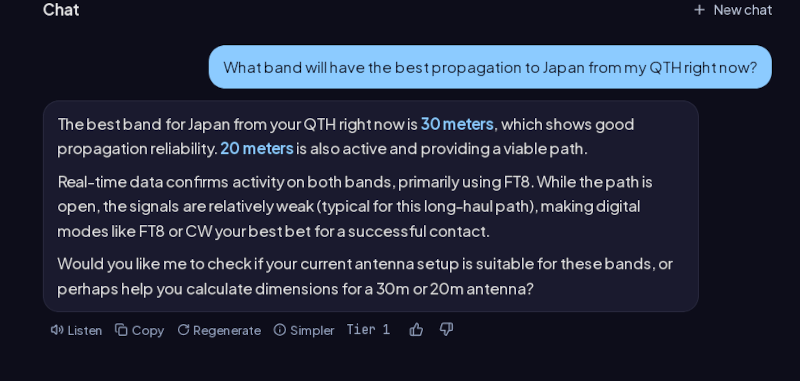
What band will have the best propagation to Japan from my QTH right now?
The best band for Japan from your QTH right now is 30 meters, which shows good propagation reliability. 20 meters is also active and providing a viable path.
Real-time data confirms activity on both bands, primarily using FT8. While the path is open, the signals are relatively weak (typical for this long-haul path), making digital modes like FT8 or CW your best bet for a successful contact.
Would you like me to check if your current antenna setup is suitable for these bands, or perhaps help you calculate dimensions for a 30m or 20m antenna?
In addition, bubbles at the bottom of the screen showed me the busiest band in my area and how many repeaters were nearby.
In all fairness, we asked ChatGPT the same question, but did say “ham radio band” just to give it some idea of scope. It gave a much more detailed answer with sources, even provided headings, and made a suggestion about another location I sometimes operate from because it remembers things from previous unrelated chats.
We understand reactions will be mixed. If you’ve been a ham for a long time, you probably could have guessed that a path from the US to Japan in the morning was likely to be on 20 or 30 meters. You probably also know how to look things up yourself.
We didn’t try any more sophisticated queries that might make it more worthwhile. For example, what if you could send it an ADIF log file and ask it what awards you qualified for? Or to process contest logs for duplicates and fill out a scoring worksheet? What would you like a ham radio-aware AI to do for you?
The Sonos app is adding clearer navigation, customizable speaker sorting, and redesigned iOS volume controls, but the phased release could take two weeks to reach every user.
This week, the Coalition for Independent Technology Research (CITR) won a key battle in its fight to reverse a visa-restriction policy that the Trump administration had used to attempt to revoke green cards and deport non-US citizens who work on misinformation, disinformation, fact-checking, content moderation, compliance, and trust and safety.
In an opinion published Tuesday, US District Judge James Boasberg granted a preliminary injunction blocking the State Department from enforcing the policy until the CITR’s lawsuit is resolved.
On its face, the policy does not require visa denials or deportations. Instead, it authorizes immigration investigations into individuals suspected of helping foreign adversaries attempt to manipulate public opinion by suppressing US speech.
Thira co-founder and executive chairman Sunny Gupta at a 2017 event. (GeekWire File Photo)
Sunny Gupta has led two prior enterprise tech companies with backing from venture capital firm Madrona in the past 20 years. iConclude sold to Opsware. Apptio sold to Vista Equity Partners, then to IBM for $4.6 billion.
Now they’re getting the band back together for the AI era. Madrona’s Matt McIlwain is calling it the biggest opportunity “by far.”
Thira co-founder Kurt Shintaffer was Apptio’s co-founder and CFO. (LinkedIn Photo)
Gupta is launching Thira, a Bellevue, Wash.-based enterprise AI startup, with Apptio co-founder Kurt Shintaffer, and leaders from companies such as Atlassian, Oracle, and Databricks. Thira announced Tuesday that it raised $21 million in seed funding led by Madrona, with participation from FUSE.
The idea: Thira is building AI to handle the behind-the-scenes tasks that keep big companies running, like setting up a new hire’s laptop, resetting a locked account, or approving a software purchase. The pitch is to enable a “back-office that runs itself,” according to the company.
It’s starting with IT support. The company is building software agents that can take an IT ticket, work it across the systems where the actual fixes happen — such as ServiceNow, Jira Service Management, Freshservice, and the identity and device-management tools that connect them — and close it out.
Finance and HR systems are also on the roadmap. Thira’s job listings describe agents built to “autonomously run the back-office work that consumes companies today, across IT, finance, HR, and beyond.”
Thira is entering a crowded market. ServiceNow closed its $2.85 billion acquisition of Moveworks last December to build autonomous IT ticket resolution into its service management platform. Startups including Aisera, Rezolve.ai, and Serval are pursuing similar territory.
Part of Thira’s bet is that Gupta and Shintaffer’s relationships with CIOs, which they built over many years at Apptio, will help to give it a foot in the door. Thira says it’s working with 10 companies as design partners ahead of a broader launch this fall.
In many ways, it’s a step beyond Apptio, which helps CIOs see where their companies spend money on technology. Thira is aiming to go past visibility to the “system of execution,” actually doing the work.
In a post on LinkedIn, Gupta said he began hearing from CIOs during Apptio tenure who wanted not only visibility into spending but also the ability to act on inefficiencies and automate work.
“In early 2026, I asked more than twenty CIO friends a simple question: has enough changed that what they’ve been asking for is finally buildable? The answer was yes, and bigger than I expected,” he wrote.
Thira’s team also includes:
Mudit Goel, previously SVP of engineering at Atlassian;
Grant Neuman, who was an AI engineer at Oracle Cloud Infrastructure;
Tarek Madkour, previously director of product management at Databricks;
Gupta has been Smartsheet’s executive chair since August 2025, when longtime CEO Mark Mader retired. He also served as acting CEO until Raj Singh was named CEO in October 2025. Shintaffer was Smartsheet’s CFO from July 2025 to May 2026.
McIlwain, the Madrona managing director, is joining Thira’s board of directors. FUSE founding partner Kellan Carter is a board observer.
In a statement, McIlwain said the founding team pairs Gupta and Shintaffer’s two decades of enterprise credibility at Apptio with what he calls “AI-native innovators.” He added, “This is my third time starting and building a company with Sunny and it is by far the largest opportunity we have pursued together.”
The latest edition of the Google Home Speaker serves a compelling mix of rewarding voice controls, surprisingly punchy audio output, and the most advanced suite of smart home features that you can get on a speaker under a $100 budget.

 Login
Login