Reading view

There are new articles available, click to refresh the page.

NASA’s Hubble Discovers First of Star Cluster’s Missing Black Holes

 
5 Min Read

NASA’s Hubble Discovers First of Star Cluster’s Missing Black Holes

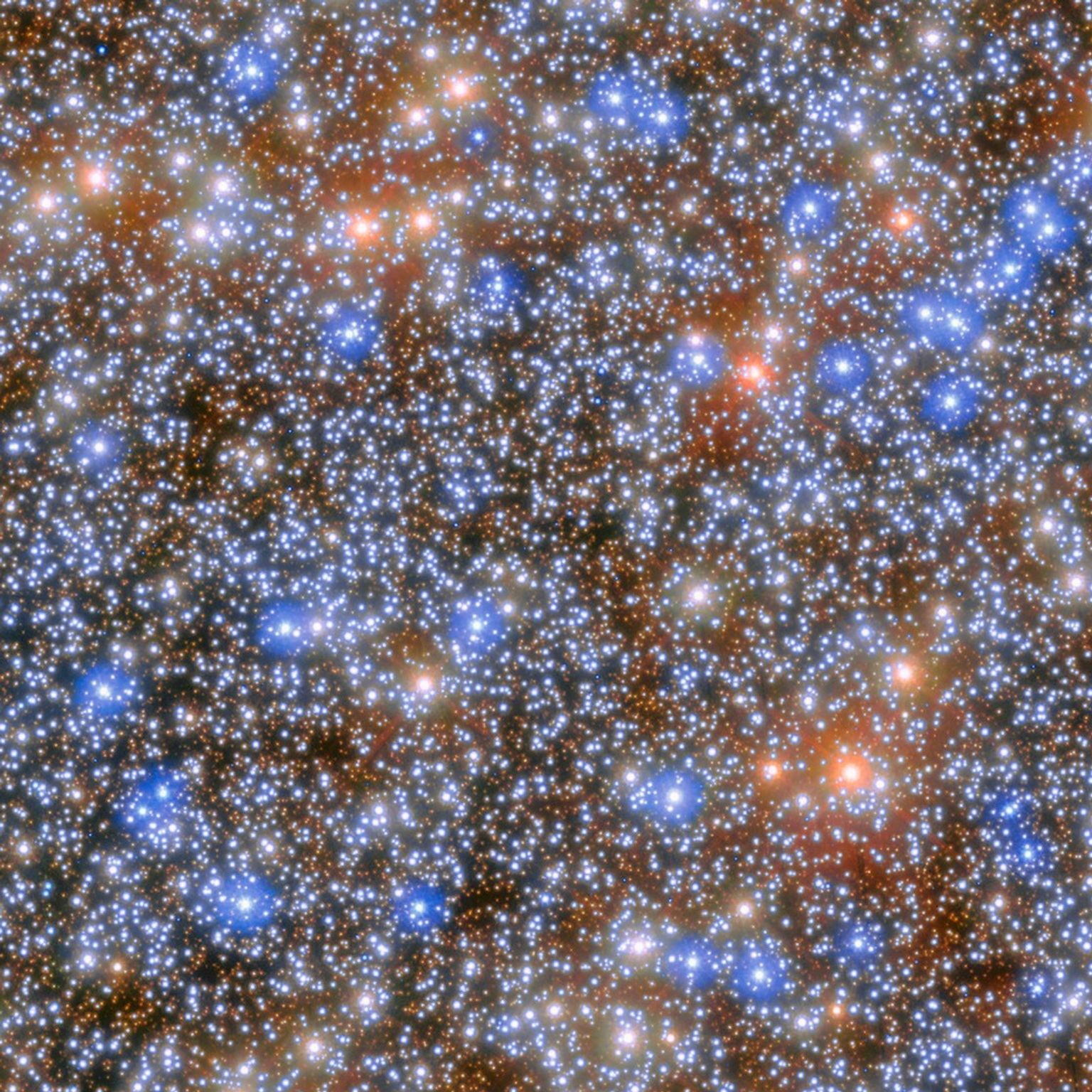
An image of the globular cluster Omega Centauri, a collection of myriad stars colored red, white, and blue on the black background of space.
Credits:
Science: Maximilian Häberle (MPIA)

The massive globular star cluster Omega Centauri has puzzled astronomers for decades. It should be filled with black holes left behind by exploding stars, yet evidence for them is scarce. Now, astronomers using archival data from NASA’s Hubble Space Telescope and supportive observations from NASA’s James Webb Space Telescope have finally located their first stellar-mass black hole in this cluster. Discovering the first of this missing black hole population will help refine current theories on black hole formation within environments such as Omega Centauri. The team’s findings published Monday in The Astrophysical Journal Letters.

Omega Centauri is composed of 10 million gravitationally bound stars. Though the astronomical community previously found evidence with Hubble that an intermediate-mass black hole lurks at its center, models suggest this star cluster should also contain about 10,000 smaller, stellar-mass black holes. This notable population of black holes evaded detection in previous observational studies, which used the radial velocity method or looked for radio and X-ray emission from material falling onto black holes.

This new discovery features a different approach, known as astrometry, to measure very small movements of stars over time. By sifting through more than 20 years of Hubble archival data and pulling in recent Webb data to further refine their astrometric measurements, the team located a star orbiting an invisible object so hefty that it has to be a black hole. Dubbed oMEGACat BH-2, it is the first stellar-mass black hole detected in Omega Centauri, and it has some surprising qualities. oMEGACat BH-2 has a lower-than-expected mass and, with its visible star companion, the black hole-star duo has the longest orbital period of any black hole binary system known to date.

“With Hubble and Webb data, we were able to see the motion of the visible main sequence star that is part of this binary, which is about 18,000 light-years away in the dense environment of Omega Centauri,” said Matthew Whitaker of the University of Utah, Salt Lake City, lead author of the paper. “The precision of these measurements is incredible, down to a fraction of a pixel on Hubble and Webb’s detectors. It would not have been possible to find this black hole without these two space telescopes.”

A Hubble image of globular star cluster Omega Centauri, which looks like a dense field of stars. Some stars appear a bit larger and brighter than others; most appear blue, orange, or yellow. The colors appear uniformly distributed, like grains of sand. Stars toward the clusteru2019s center are packed closer together, creating a more luminous area at the globular clusteru2019s core. A small red square frame is superimposed on the cluster near the imageu2019s center. It connects to a square pullout in the top-right corner, which shows the outlined area in greater detail. Among the blue- and orange-colored stars is small blue-white dot highlighted by a small red circle.
Astronomers found Omega Centauri’s first stellar-mass black hole, which has a visible star companion that is shown in greater detail. They used 20-plus years of data from NASA’s Hubble Space Telescope and recent data from NASA’s James Webb Space Telescope to make the discovery.
Image: ESA, NASA, Maximilian Häberle (MPIA), Joseph DePasquale (STScI)

The team’s findings refine a past study by a different group of scientists that suggested this binary system included a neutron star. By expanding Hubble data from the earlier investigation with archival Hubble astrometric measurements from 2002 to 2023, and pulling in Webb near-infrared data to improve precision, the University of Utah-led team was able to better constrain the mass of the visible star’s dark companion, ruling out the neutron star possibility.

“While we already knew that the star was 0.78 solar masses, we can now calculate the black hole’s mass, which is 4.46 solar masses and therefore too heavy to be a neutron star. However, its mass is much lower than would be expected in a metal-poor environment like Omega Centauri. This is surprising and exciting,” said Anil Seth of the University of Utah, a coauthor of the study. “We now know that a metal-poor star is able to form a black hole like this, and we need to figure out how that happens. This detection is providing some data to those who do that kind of modeling.”

Long time coming

Based on the precise data from Hubble and Webb, the team could chart the star’s path over 20-plus years, during its closest approach to its black hole companion when it moved the fastest across the sky. From the extensive data, the team determined that the visible star orbits oMEGACat BH-2 once every 94 years, making it the longest-period black hole binary ever known.

Its long orbital period also gives a clue to the origin of this binary system. It was probably dynamically formed, meaning the star and its black hole companion did not start out together but rather found each other in this cluster. The researchers calculated that a system like oMEGACat BH-2 will survive for less than a billion years before it is torn apart by encounters with nearby stars, a much shorter span than the age of the cluster (approximately 12 billion years old).

“It’s important to understand black hole populations in globular clusters because there’s uncertainty about their physics and formation,” said Seth. “More specifically, understanding the process of forming black holes and then dynamically forming binaries is vital, because it affects our ability to interpret and understand gravitational wave events. Environments like Omega Centauri are the primary places where we think binaries are merging and creating these waves.”

The team’s discovery of stellar-mass black hole oMEGACat BH-2 with the Hubble-Webb dataset is just the start of finding these evasive black hole populations in globular star clusters.

“With Hubble and Webb, we can continue to look at Omega Centauri and expand our search for similar systems within other clusters,” said Whitaker. “We’re also very excited for the launch of NASA’s Nancy Grace Roman Space Telescope because it will image the crowded galactic bulge, including the galactic center, very regularly with Hubble-like resolution and with a much wider field of view. We’re hoping we’ll be able to find black hole binary systems like this one because of the regular cadence of Roman’s observations.”

The Hubble Space Telescope has been operating for over three decades and continues to make ground-breaking discoveries that shape our fundamental understanding of the universe. Hubble is a project of international cooperation between NASA and ESA (European Space Agency). NASA’s Goddard Space Flight Center in Greenbelt, Maryland, manages the telescope and mission operations. Lockheed Martin Space, based in Denver, also supports mission operations at Goddard. The Space Telescope Science Institute in Baltimore, which is operated by the Association of Universities for Research in Astronomy, conducts Hubble science operations for NASA.
Facebook logo
Instagram logo

Related Images & Videos

A Hubble image of globular star cluster Omega Centauri, which looks like a dense field of stars. Some stars appear a bit larger and brighter than others; most appear blue, orange, or yellow. The colors appear uniformly distributed, like grains of sand. Stars toward the clusteru2019s center are packed closer together, creating a more luminous area at the globular clusteru2019s core. A small red square frame is superimposed on the cluster near the imageu2019s center. It connects to a square pullout in the top-right corner, which shows the outlined area in greater detail. Among the blue- and orange-colored stars is small blue-white dot highlighted by a small red circle.

Omega Centauri Context Image

Astronomers found Omega Centauri’s first stellar-mass black hole, which has a visible star companion that is shown in greater detail. They used 20-plus years of data from NASA’s Hubble Space Telescope and recent data from NASA’s James Webb Space Telescope to make the discovery.

Graphic of a star and its orbital path around a black hole against a dark background. The star is represented by an orange-yellow circle, and an X is labeled u201cBlack Hole.u201d A purple oval represents the staru2019s orbital path, which surrounds the black hole. The star is positioned near 12 ou2019clock along its orbital path, represented by a solid purple line that traces the tracked portion of the staru2019s orbit. After 12 ou2019clock the orbital path is represented by purple dashes. In the bottom right corner is the year 2025 in white text.

Star Orbiting Black Hole Animation

The precise data collected by NASA’s Hubble and James Webb space telescopes enabled a team of astronomers to chart the visible star’s orbital path over a 20 year-plus period.


Share

Details

Last Updated
Jul 13, 2026
Editor
Andrea Gianopoulos
Contact
Media

Claire Andreoli
NASA’s Goddard Space Flight Center
Greenbelt, Maryland
claire.andreoli@nasa.gov

NASA’s Hubble Spies Stellar Sparkler for July 4th

3 min read

NASA’s Hubble Spies Stellar Sparkler for July 4th

Hubble image of NGC 6426, a compact grouping of a multitude of stars shine in red, white and blue against the dark background of space. The stars are more densely collected toward the center of the cluster.
Ancient stars shine in red, white and blue from a globular cluster almost as old as the universe itself in this image from NASA’s Hubble Space Telescope.
NASA, ESA, and A. Dotter (Dartmouth College); Processing: Gladys Kober (NASA/Catholic University of America)

Red, white, and blue stars glitter like a sparkler being waved on a dark night in this new image from NASA’s Hubble Space Telescope. NASA released this image to celebrate the United States’ 250th anniversary, as the agency carries forward America’s legacy of exploration.

Located in the outer halo of our Milky Way galaxy, globular cluster NGC 6426 is a spherical collection of stars bound together by their mutual gravity, one of 150 known globular clusters in our galaxy. These groups of stars are thought to form as a unit from the same collapsing cloud of gas, and thus the stars in them typically have similar ages. The stars in globular clusters tend to be ancient. At approximately 13 billion years old, NGC 6426 is one of the Milky Way’s oldest globular clusters and almost as old as the universe itself (13.7 billion years).

In this image, blue indicates the shorter wavelengths that are visible light, while red depicts the longer wavelengths of visible light, as well as some near-infrared light. Colors in Hubble images are chosen based on standard image processing techniques to best represent the wavelengths of light that pass through the filters used in the observation. Because the color and temperature of stars are directly related, we know that the blue stars in this image are hotter and the red stars are cooler.

The stars of NGC 6426 have low metallicity, which means they have fewer elements that are heavier than hydrogen and helium. These conditions resemble those of the early universe, when matter was mostly helium and hydrogen and heavier elements were just beginning to form via nuclear fusion within massive stars.

Researchers have found evidence for two chemically distinct populations of stars in NGC 6426, indicating that the slightly younger and more metallic stars were enriched with material from the explosive deaths of the cluster’s earlier stars. Massive stars that explode as supernovae fling elements heavier than hydrogen and helium into the universe, seeding it with materials to build new stars and planets.

Hubble took this image as part of a study of globular clusters in the Milky Way’s halo intended to determine their ages and shed light on the formation and evolution of the galaxy. Over the past three decades in orbit, Hubble has fundamentally changed our understanding of the universe. Its discoveries are expanded upon and complemented by observations from other NASA missions like the infrared-detecting James Webb Space Telescope and the Nancy Grace Roman Space Telescope, scheduled to launch in late summer.

Facebook logo
Instagram logo

Explore More

Media Contact:

Claire Andreoli
NASA’s Goddard Space Flight CenterGreenbelt, MD
claire.andreoli@nasa.gov

NASA’s Hubble Spots Star-Spangled Cosmic Scene

3 min read

NASA’s Hubble Spots Star-Spangled Cosmic Scene

A packed, roughly spherical cluster of red, white and blue stars shines against the black background of space. The stars are clustered most densely toward the center of the cluster.
This image from NASA’s Hubble Space Telescope shows Messier 3, a densely packed cluster of stars whose origins may be a merger between globular clusters in the early universe.
NASA, ESA, and A. Sarajedini (Florida Atlantic University); Processing: Gladys Kober (NASA/Catholic University of America)

More than 500,000 stars blaze red, white, and blue in this image from NASA’s Hubble Space Telescope, released in celebration of the United States’ 250th anniversary. The image showcases Messier 3 (M3), one of the Milky Way galaxy’s most massive globular clusters, or spherical collections of gravitationally bound stars. Globular clusters are made up of ancient stars that formed at roughly the same time from the same cloud of gas, giving those stars similar ages. Around 150 known globular clusters are sprinkled around the outer regions of the Milky Way.

In addition to its significant mass, M3 is unusual because it lies relatively far from the galactic center and has more than 240 RR Lyrae variable stars, the most of any globular cluster in our galaxy. RR Lyrae variables are some of the galaxy’s oldest stars and are of special interest to astronomers, due to their age and because their light fluctuates over time in a way that tells us their intrinsic brightness. This true brightness can be used to measure distances in the cosmos, just as knowing the brightness of car headlights on a dark road can help estimate the distance to an oncoming vehicle.

The M3 globular cluster also contains around 70 identified “blue straggler” candidates, which are stars that shine with a bright, blue light that makes them look like younger stars than the typical, redder residents of globular clusters. This was the first cluster in which these oddball stars were located. These stars are thought to have gravitationally pulled mass from companion stars, rejuvenating them and making them appear bluer and younger despite their true age.

The unusual characteristics of M3 may arise from its origins. The globular cluster, which contains two distinct populations of stars, may be the result of a merger of two globular clusters. These two clusters were members of the same dwarf galaxy, which was later swallowed up by the Milky Way.

Hubble has taken several images of M3, also known as NGC 5272, documenting its complicated and intriguing characteristics. In this image, blue indicates the shorter wavelengths that are visible light, while red depicts the longer wavelengths of visible light, as well as some near-infrared light. Colors in Hubble images are chosen based on standard image processing techniques to best represent the wavelengths of light that pass through the filters used in the observation. Because the color and temperature of stars are directly related, we know that the blue stars in this image are hotter and the red stars are cooler.

This image is part of a Hubble Treasury program survey designed to observe approximately half of the Milky Way’s globular clusters to construct a detailed chronology of how the Milky Way galaxy formed. With over 30 years of observations, Hubble is one of NASA’s flagship observatories and works in complement with its sibling space missions, including the infrared-detecting Webb Space Telescope and the upcoming Nancy Grace Roman Space Telescope, to weave together a comprehensive picture of our vast universe.

Facebook logo
Instagram logo

Explore More

Media Contact:

Claire Andreoli
NASA’s Goddard Space Flight CenterGreenbelt, MD
claire.andreoli@nasa.gov

❌