❌

Reading view

There are new articles available, click to refresh the page.

OSINT: Monitoring World Events with God’s Eye

Welcome back, aspiring cyberwarriors!

Lately we’ve been seeing a lot of posts about God’s Eye, a spy satellite simulator that runs in your browser. It’s a great tool developed by Bilawal Sidhu, but it requires certain paid APIs. Those APIs make the experience a lot richer, but they can be hard to get or you just don’t want to pay for them. That’s fine. For that reason we want to cover a fork developed by Gh0st-mods.

God’s Eye

God’s Eye is basically a website you run on your own computer that shows the Earth as a 3D globe with live public data on top of it. You can see planes in the air, ships at sea, some satellites, earthquakes and public traffic cameras. When you select those objects on the map, it tells you everything it knows about it. This can be its identity, speed, heading and other details. It looks like a spy movie. The data is just ordinary public feeds.
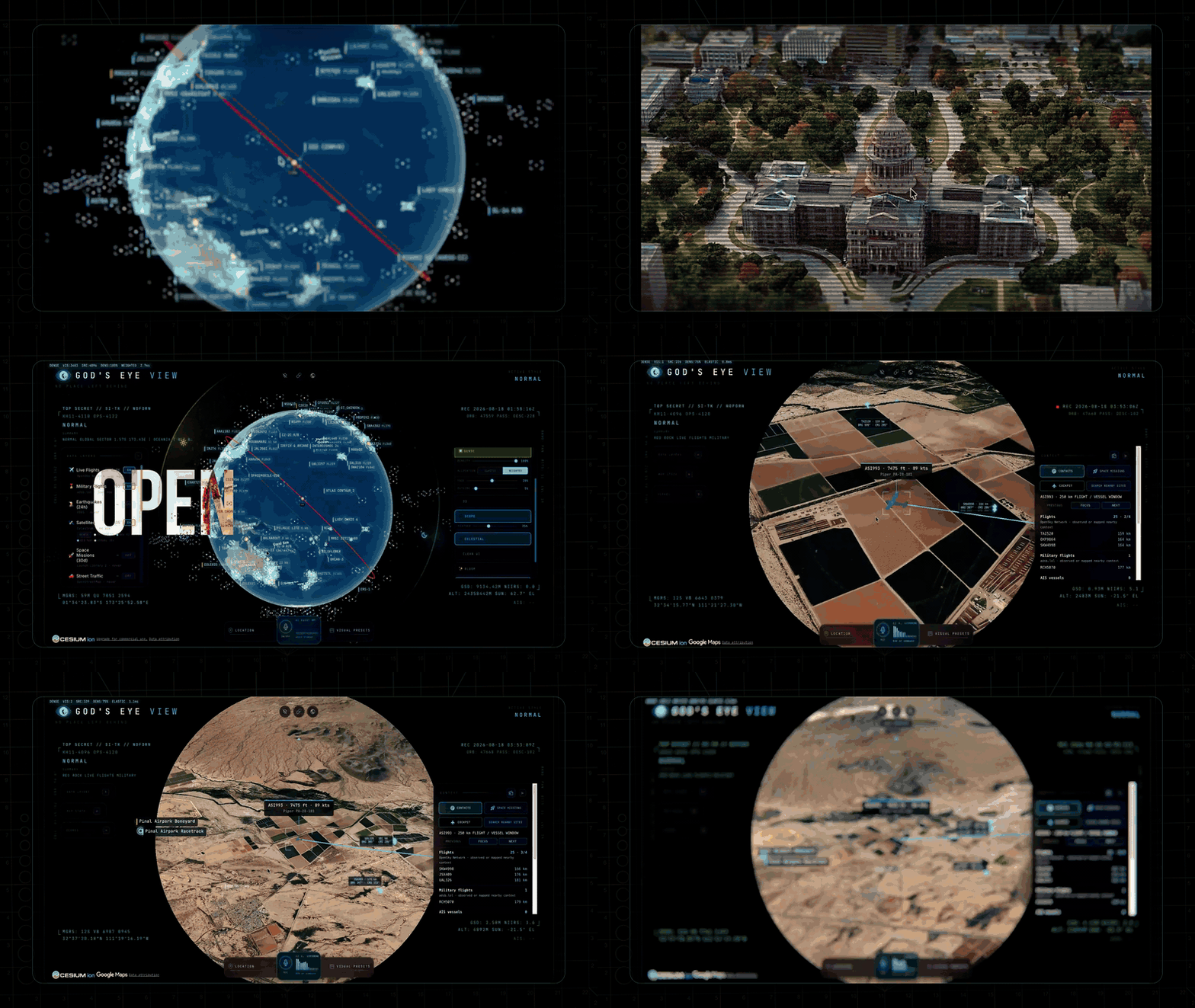
Let’s set up the fork and see how the free version works.

Setting Up

First, make sure you have all the dependencies installed.

kali > sudo apt update
kali > sudo apt install nodejs
kali > sudo apt install npm
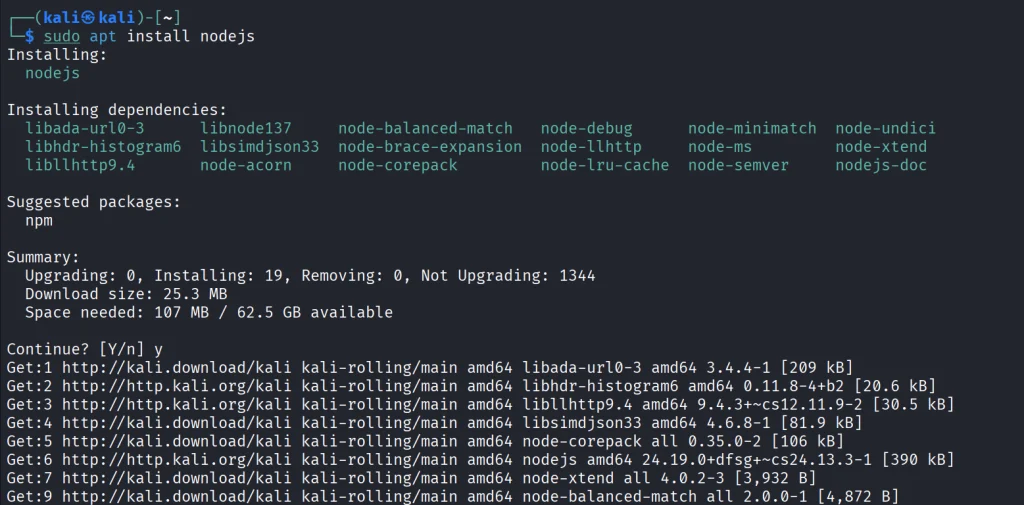
Then clone the repository and install what it needs.

kali > git clone https://github.com/Gh0st-mods/Gods-Eye-Ghost-Edition.git
kali > cd Gods-Eye-Ghost-Edition
kali > npm install
kali > npm run dev -- --host localhost --port 4173
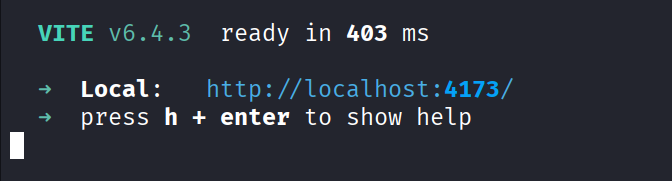
The app is available at http://localhost:4173, so we can open it in a browser.
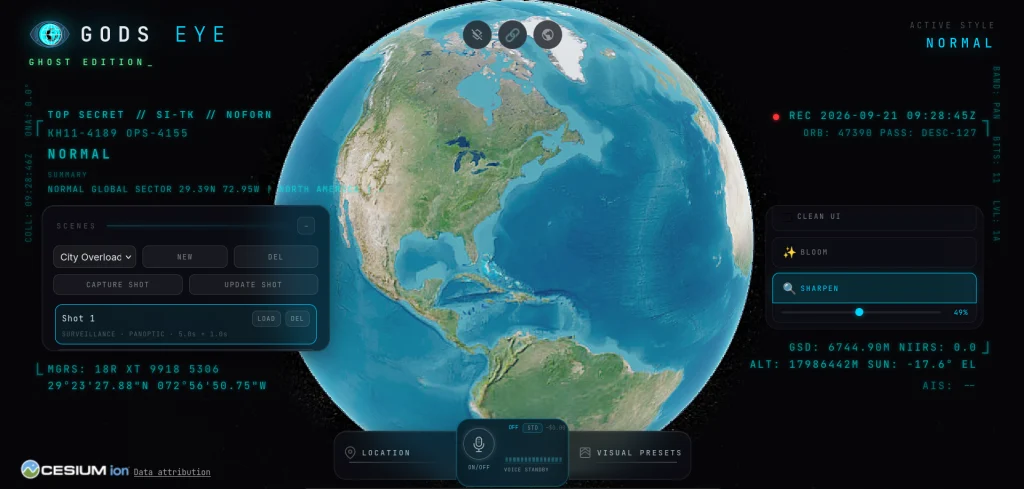
Let’s walk through some of its features.

Data Layers

There are multiple data layers and many of them work without any API key. You can always add them to the .env file if you want a richer experience.
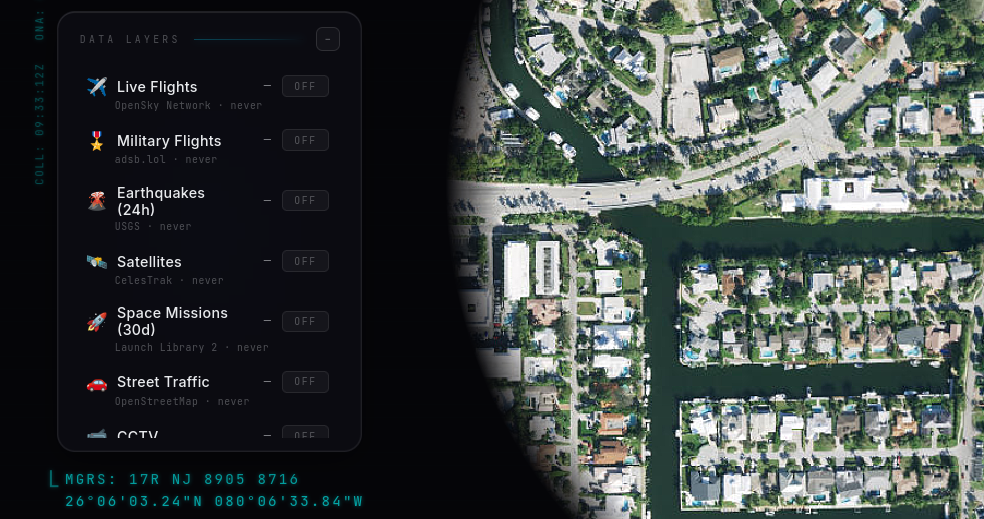
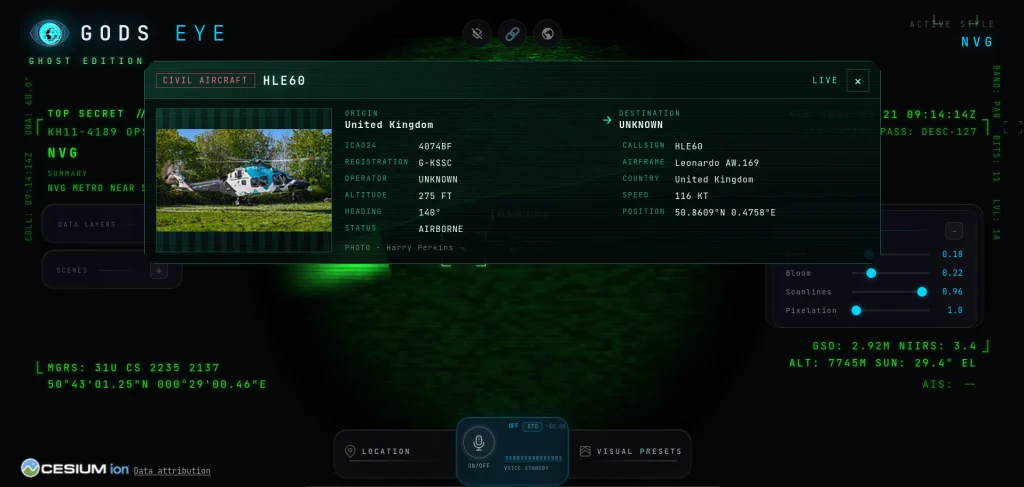
Aircraft Tracking

Each aircraft gets rendered in 3D flying over the Earth. You can switch visual presets too. Here we have a civil aircraft flying over the south of England.

Below you can see all the information on it.
Maritime Vehicles

These include transport and nontransport vessels. You’ll see plenty of them scattered across the globe. Here’s a tanker moored somewhere in Miami. Military vessels will also be shown on the map, so you can monitor their activity.
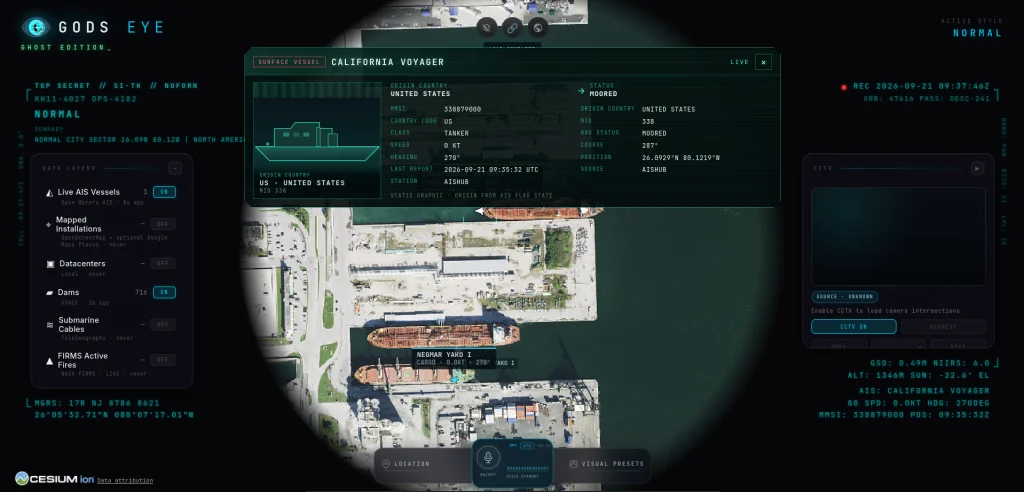
The satellite image quality looks good, since the tool sharpens it for you.

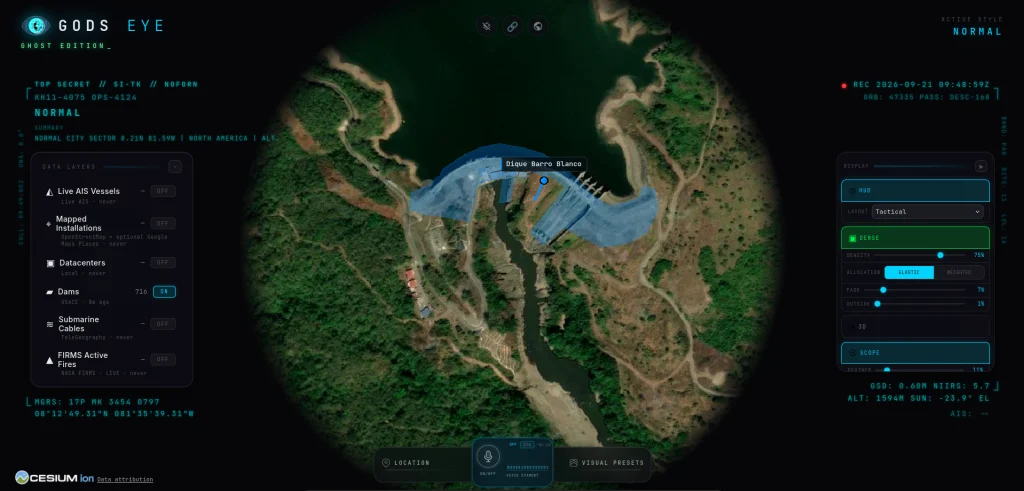
Dams

Water dams are part of critical infrastructure. Their locations are publicly available and integrated into the tool. Here is the Barro Blanco Dam in Panama. All critical facilities need good care and protection, especially during wartime, since they’re one of the things an enemy tries to attack.
Data Centers

Just like dams, data centers are important targets. If an enemy attacks data centers (drones/missiles, sabotage or cyberattacks) the result can be permanent data loss. Data centers are the physical backbone of banking, payments, logistics, government systems, AI and often military/cloud services. Hitting them will inflict economic and operational pain. The effects will cascade across almost everyone, even those who are completely offline.
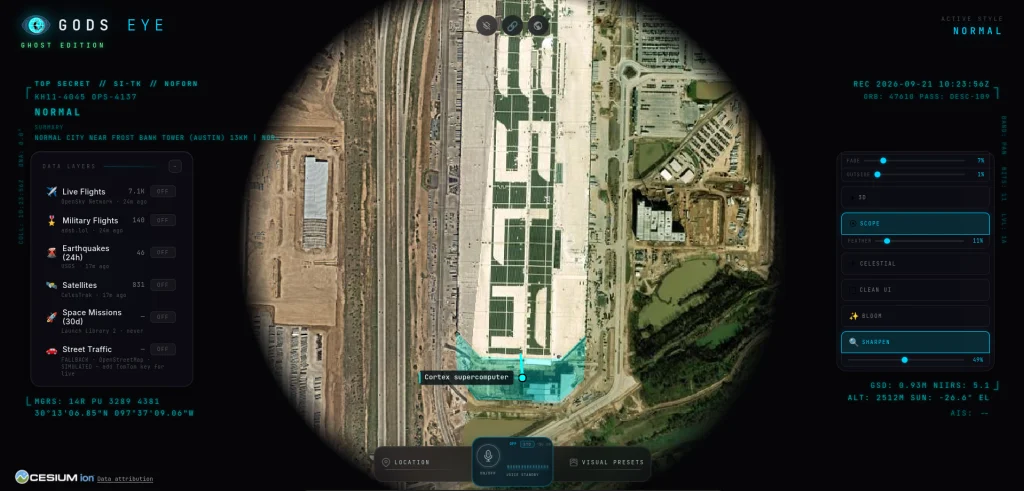
One of these attacks happened recently when Iran attacked Amazon data centers.
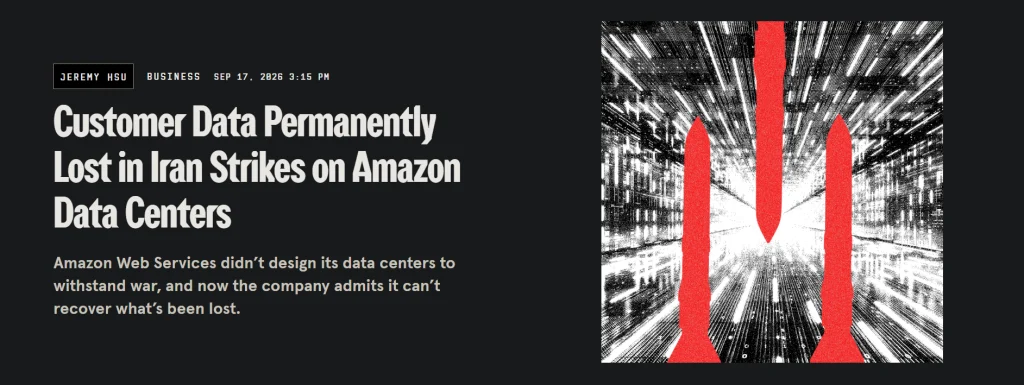
Source: Wired

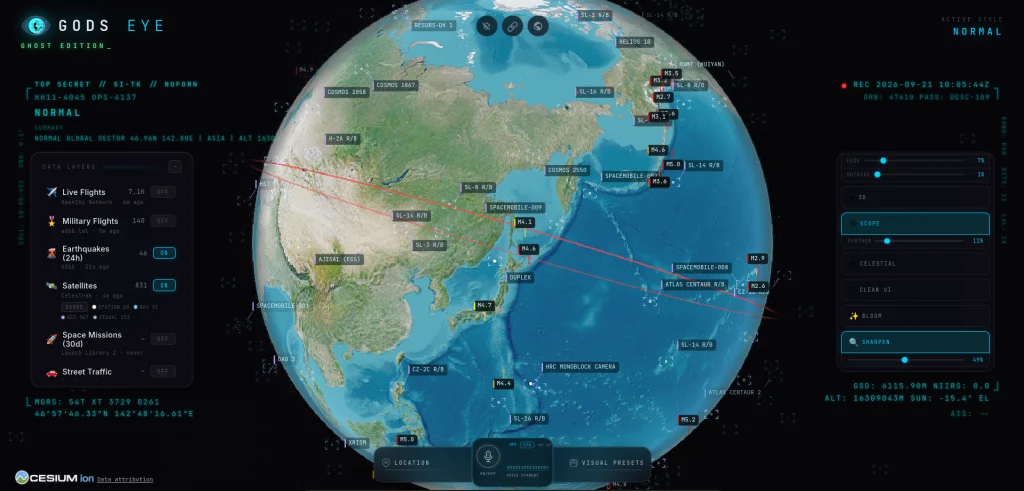
Satellites and EarthquakesΒ 

This isn’t the most notable feature on the platform, but it’s there and might be interesting to some. The data updates regularly. Below you can see several earthquakes hitting Japan in the last 24 hours. No surprise there, that region is highly seismic.
Summary

World monitoring apps are getting more popular. Some don’t even need to be installed, like Osiris. The original project by Bilawal Sidhu is great, but it still requires a paid Google API, which not everyone is comfortable with. The fork we covered today works for free out of the box. If you liked it, you might also want to check out ShadowBroker.

The post OSINT: Monitoring World Events with God’s Eye first appeared on Hackers Arise.

It’s Time to Reengage North Korea

The U.S. and South Korea have their annual joint military drills (Ulchi Freedom Shield) from August 17-27, focusing on countering the threat from North Korea of drones and cyber-attacks. President Trump said on Sunday that he had ordered the Pentagon to β€œsubstantially reduce” joint military exercises with South Korea, according to the New York Times.

North Korea said these military exercises β€œare more serious, provocative and dangerous than last year.”

Although North Korea routinely criticizes these joint military exercises, this year North Korea went on to say that the U.S. is pursuing a new nuclear strategy that lowers the threshold of using nuclear weapons that pushes global security β€œto the brink of a nuclear war.”

North Korea’s usual response to these annual joint military exercises is the launching of short-range ballistic missiles into the Sea of Japan. This year there was no surprise when North Korea launched two ballistic missiles, saying the U.S. – South Korea drills were a β€œrehearsal for an aggressive war.” What was different was North Korea’s statement that the U.S. and South Korea and Japan formed a β€œnuclear alliance” that North Korea would respond to by building a new and higher level of nuclear deterrence.

This comes at a time when North Korea is providing Russia with combat troops, artillery shells and ballistic missiles for their war with Ukraine, while enhancing their relationship with China. The money North Korea receives from Russia is in the billions, with likely Russian assistance to North Korea’s nuclear, missile, and satellite programs.

Although North Korea has refrained from a seventh nuclear test – probably at the urging of China – they are building more nuclear weapons and ballistic missiles to deliver nuclear and conventional warheads. Recently, North Korea’s leader, Kim Jong Un, displayed to the world a new uranium enrichment facility with cascades of apparent new centrifuges to enrich uranium. This was in addition to the new uranium enrichment facility at North Korea’s nuclear complex in Yongbyon.

It was the issue of North Korea’s non-declared uranium enrichment sites that led to the failure of the 2019 Hanoi Summit. When Kim Jong Un offered to halt activities at Yongbyon, in return for the lifting of sanctions imposed on and after 2016, and President Trump responded with the request that North Korea declare β€œall” nuclear sites. Mr. Kim refused and that ended the Hanoi Summit.

Prior to and after the Hanoi Summit, North Korea has threatened to use tactical nuclear weapons in any conflict with South Korea. This is reminiscent of Russia’s President Vadimir Putin threat to use nuclear weapons in its invasion of and war with Ukraine. A war that North Korea joined, as an ally of Russia, with a recent Mutual Defense Treaty.

Hopefully, Ukraine will continue to receive the military support they need from the U.S. and NATO to protect its people and country from a revanchist Russian Federation that’s receiving significant military support from North Korea.

Messrs. Kim’s and Putin’s refrain of using nuclear weapons, with North Korea’s emphasis on building even more nuclear weapons, is concerning. Any use of nuclear weapons would be tragic for the world.

South Korea’s President, Lee Jae Myung, continues to reach out to North Korea, for talks that would lead to peaceful coexistence between the two Koreas. To date, North Korea’s response has been disappointing. But President Lee persists, knowing that an emboldened North Korea, now aligned with Russia, could incite conflict on the Korean Peninsula. Conflict that could cause instability on the Korean Peninsula and Northeast Asia.

Having negotiated with North Korea for over ten years, it is apparent to me that North Korea wants a normal relationship with the U.S. A relationship that would give North Korea international legitimacy and access to financial institutions.

Now would be the time for President Trump to meet with Kim Jong Un. Such a meeting would deescalate North Korea’s tension with South Korea and the U.S. It would also give the U.S. the opportunity to move in a different direction with North Korea, with the goal of getting North Korea to halt its nuclear and missile programs, in return for the easing and lifting of sanctions and a dialogue to normalize bilateral relations.

North Korea is a defacto nuclear weapons state and recognizing them as such should not be too difficult. Getting North Korea to implement a moratorium on its nuclear and weapons programs would be progress. Sanctions relief and a path to a normal relationship with the U.S. could convince Kim Jong un that a mortarium would be in North Korea’s interest, while aligning with a revanchist and fickle Vladimir Putin is not in North Korea’s interest.

Our goal should continue to be the complete and verifiable denuclearization of the Korean Peninsula, realizing that this could take years to achieve. Getting North Korea to halt its nuclear and missile programs and refraining from fomenting conflict with South Korea are immediate goals that are achievable, assuming a willingness to be flexible on sanctions relief and a dialogue on normalizing relations.

It is in the interest of world peace that the U.S. reengage with North Korea.

The author is a former Associate Director of National Intelligence. All statements of fact, opinion or analysis expressed are those of the author and do not reflect the official positions or views of the U.S. government.

The Cipher Brief is committed to publishing a range of perspectives on national security issues submitted by deeply experienced national security professionals. Opinions expressed are those of the author and do not represent the views or opinions of The Cipher Brief.

Have a perspective to share based on your experience in the national security field? Send it to Editor@thecipherbrief.com for publication consideration.

Read more expert-driven national security insights, perspective and analysis in The Cipher Brief

❌