
❌

Reading view

There are new articles available, click to refresh the page.

Moving faster than planned, AI drug developer Accipiter Bio quietly tops up seed round with $10.5M

An illustration of a protein created by Accipiter Bio that has two active sites, shown in light and darker green, that can simultaneously bind two targets. (Accipiter Bio Image)

Less than a year after emerging from stealth operations with $12.7 million and partnerships with pharmaceutical giants, Seattle-based biotech startup Accipiter Biosciences has added $10.5 million to its funding total. The new cash will let the company move faster on promising drug candidates.

β€œWe could have stuck with the original plan and been just fine,” said Matthew Bick, Accipiter Bio’s co-founder and CEO. β€œBut we thought we’d rather capitalize on the progress we’ve made now and diversify our clinical portfolio.”

The team has grown to 22 people and includes researchers who worked at the University of Washington’s Institute for Protein Design under Nobel laureate David Baker.

The company uses artificial intelligence tools developed at the institute to engineer proteins with the unusual ability to bind multiple cellular targets at once, potentially amplifying their ability to fight illnesses.

β€œWe’re not just trying to replicate what antibodies can do,” Bick said. β€œWe’re unlocking some really interesting biology.”

Accipiter Bio has a collaboration and license agreement with Pfizer to research and engineer new molecules. The deal provides an upfront payment and the potential to earn more than $330 million through milestones and royalties. The startup has a similarly structured agreement with oncology drug company Kite Pharma, owned by Gilead Sciences, to design proteins for use in cell therapies.

The startup also runs its own in-house drug-development programs. It originally planned to advance one or two into the clinic, but the extra cash will allow it to bring three or four programs forward into clinical trials. Bick said the company is now primarily focused on immunology-related conditions, alongside its lead oncology program.

Matthew Bick, CEO and co-founder of Accipiter Biosciences. (Accipiter Bio Photo)

The company launched in March 2023, emerging from stealth in November 2025. The new funding is an addition to Accipiter Bio’s seed round and includes only existing investors. Flying Fish Partners and Takeda co-led the seed round, which included Columbus Venture Partners, Cercano Capital, WRF Capital, Alexandria Investments, Pack Ventures and Argonautic Ventures.

The new funding will help grow the team, bringing in additional scientists and reaching a headcount of about 30 people over the next six months to a year.

Interest continues to grow in AI’s potential to speed up the creation of new drugs. But Bick cautions that the process isn’t as simple as some might suggest, particularly for more complex therapeutics.

He knows this firsthand: he and two of his co-founders worked at Neoleukin, a biotech company co-founded by Baker that spun out of the UW in 2019. The startup’s lead drug candidate, an engineered protein used in cancer treatment, underperformed in a Phase 1 trial. Neoleukin laid off many of its employees before merging with another company.

β€œThere’s an impression with AI methods that you can just hit a button and you get your molecule out, but it’s not that easy β€” and certainly when you’re pushing the methods to their limits, it’s really not that easy,” Bick said.

The process still requires asking the right therapeutic questions, manual engineering and a deep understanding of the molecules, he said. β€œThere’s still protein intuition that comes into it.”
VC is changing dramatically β€” what’s a founder to do?Β 

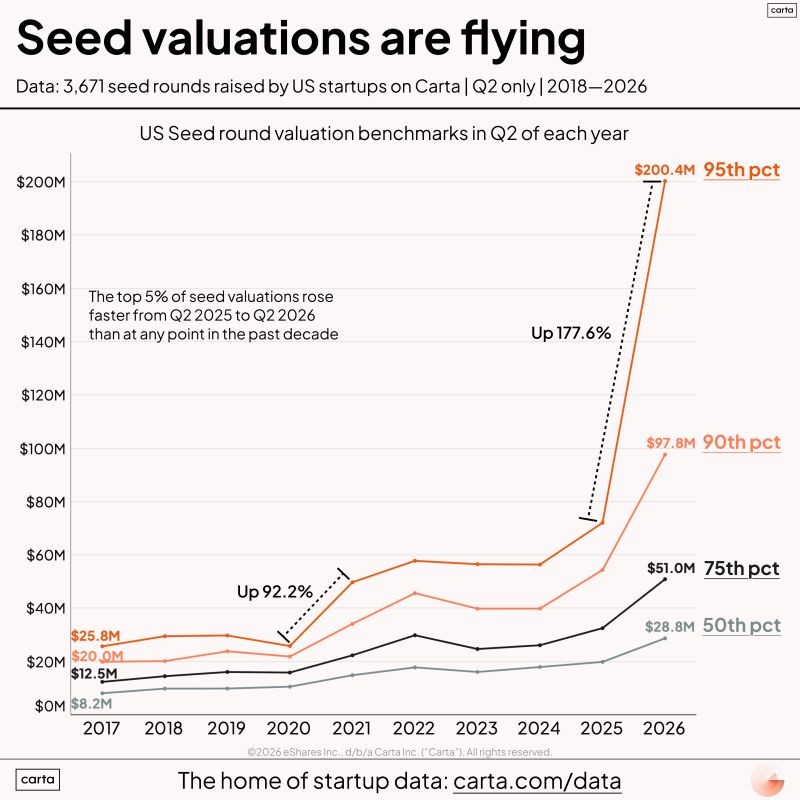
Click to enlarge. The top 5% of U.S. seed-round valuations reached $200.4 million in Q2 2026, up 177% from a year earlier, even as fewer companies were funded. (Chart: Peter Walker / Carta)

Guest Opinion: When I moved to Seattle in 2000 and started in venture capital, I read the book β€œThe Silicon Boys: And Their Valley of Dreams,” which told the story of how venture capital drove the innovation ecosystem.

Entrepreneurs toiled day and night in their garages. Venture capitalists discovered these entrepreneurs, writing β€œsmall” checks for ownership and partnering side by side to build blue-chip companies. John Doerr of Kleiner Perkins alone backed Intuit, Netscape, Amazon, and Google.Β 

More than 25 years later, venture capital is going through a dramatic evolution, chasing once-in-a-lifetime IPOs like SpaceX, Anthropic and OpenAI. There is more venture capital available than ever before, and it is harder than ever for most founders to get funded, especially if you are not working on foundational AI.Β 

Today’s founders need to think hard about alternative financing and growth strategies, rather than relying on venture capital. But before we get to those solutions and ideas, here are just a few examples of what’s happening in the market.

Anthropic envy: The Wall Street Journal covers the story of Spark Capital’s Yasmin Razavi, a former McKinsey consultant who invested $75 million in Anthropic when much of Silicon Valley passed at a $4 billion valuation in 2023. That stake is now worth about $7 billion β€” nearly 100x in three years! Silicon Valley is now chasing this pattern.Β 

More money, fewer winners: In 2025, US venture firms deployed roughly $319 billion, according to the PitchBook-NVCA Venture Monitor. In the first half of 2026 alone, they put in $412.7 billion, more than all of 2025. Capital has never been more abundant. But according to Silicon Valley Bank, 33% of all US venture dollars went to the top 1% of companies by valuation, up from 12% in 2022.Β 

Seed valuations for the β€œright company” are at an all-time high. The bar for the next round is not a little higher. It is roughly double what it was a few years ago.Β 

Peter Walker from Carta tracks seed valuations over time showing that the top 5% of seed deals are up 177% year over year, rising from about $72 million to $200 million. Carta found that 30.6% of companies that raised a seed round in early 2018 reached a Series A within two years. For the 2022 cohort, that number fell to 15.4%.Β 

The practical takeaway for founders: The median revenue you now need to raise a Series A has roughly tripled, to about $3.5 million in ARR.Β 

VC for the select few: A company that would have raised easily a few years ago now can’t get funded at all. Reid Christian from CRV argues the way to raise now is to be β€œLegible to Capital.” Two kinds of startups are getting funded, he says: β€œstupidly obvious credentialed teams with a semblance of an idea” priced at $50-200M, and later-stage rounds that β€œdon’t require any amount of thinking.” 

If the founders are the right demographic β€” β€œyoung, cracked, or repeat,” the right schools, β€œnepo, etc.” β€” capital finds them. Everyone else, he writes, is β€œjust fighting pattern recognition in a lemming industry.” 

So what should a founder do?

Go for it and raise VC: If you are building the next OpenAI, go raise VC. Recruit the best team possible and swing for the fences. Make sure you execute and your growth rates match the high expectations for a 2026 VC-backed company.Β 

Heather Redman of Flying Fish Partners says companies β€œare getting pre-seed financed at β€˜modest’ valuations and then going and executing like crazy to show dramatic growth … and raising great successive follow-on rounds.” 

Seattle’s Tin Can is a great example of a contrarian bet (landlines for kids) that is showing tremendous growth and follow-on VC funding success.Β 

Seek other sources of capital: Kirby Winfield of Ascend says, β€œIf you don’t have reasonable confidence in hitting $3M-$5M ARR within 18-24 months of your first commercial contract you probably shouldn’t raise venture in 2026.” 

If that’s not you, that’s fine β€” it just means priced venture equity may be the wrong instrument. Other sources of capital to consider:

  • Angel funding: Individual angel investors write smaller checks, move faster, and don’t carry the same growth expectations or blocking rights as institutional VCs. A round assembled from angels lets you raise less, give up less ownership, and avoid the signaling trap where a lead investor’s follow-on decision dictates your next round. The tradeoff is more relationships to manage and less firepower behind you for follow-on financing β€” but you keep control of your own timeline.
  • Venture debt: For companies with revenue and real margins, venture debt extends runway without dilution. It’s a loan taken alongside or shortly after an equity round, repaid over time with interest. The catch: it usually assumes an equity sponsor standing behind you, and it’s debt that must be paid back, so it works best as a bridge to a clear milestone.
  • Revenue-based financing: This approach, which advances capital against your recurring revenue, is one of the fastest-growing categories in startup finance. If you have predictable revenue and real margins, you have more options than a priced equity round. Providers advance a multiple of your monthly recurring revenue and get repaid as a percentage of it. It’s built for exactly the company this market has stranded: too small for a mega-round, too healthy to need one.

Get profitable fast: The cheapest capital you will ever raise is your own revenue. The best founders are not thinking about VC or chasing the next investment milestone. They’re heads-down building their businesses. AI has made this easier than at any point in history. A small team that controls its own burn controls its own destiny.Β 

Aviel Ginzburg of Foundations and Founders’ Co-op offers this parting advice for founders: β€œRecognize that venture is just as confused as they are. We aren’t gatekeepers here, we’re getting disrupted.”

❌