Reading view

There are new articles available, click to refresh the page.

Italy’s Second Biggest Bank UniCredit Is Weighting up Crypto Custody: Report

Bitcoin Magazine

Italy’s Second Biggest Bank UniCredit Is Weighting up Crypto Custody: Report

Italy’s second largest bank is considering expanding into digital asset offerings, including custody, according to reports. 

According to a Friday Bloomberg report citing people familiar with the matter, Milan-based UniCredit is selecting a technology provider that would allow it to build the infrastructure needed to hold digital assets and facilitate their buying and selling. 

Bloomberg’s reporting added that tokenized investment products and fixed-income securities, the use of stablecoins and exposure to cryptocurrencies were all on the cards. 

JUST IN: 🇮🇹 Italy’s 2nd-largest bank UniCredit is considering to offer crypto asset custody — Bloomberg 👀 pic.twitter.com/NAZKJBdcES

— Bitcoin Magazine (@BitcoinMagazine) September 11, 2026

The news comes as other banks in Europe expand crypto offerings. Spain moved first on retail, with BBVA rolling out bitcoin trading and custody to all customers via its app, using its own custody infrastructure rather than a third party; Santander’s Openbank followed with its own trading service.

Cecabank — a Spanish custodian with over €400bn under management that acts as backbone for 100+ financial institutions — went live with crypto custody in June via a partnership with Bit2Me.

And in Germany, Deutsche Bank is building custody with Bitpanda’s technology arm, while Taurus and DZ Bank got BaFin approval in January for its meinKrypto platform. 

New regulation in the European Union — Markets in Crypto-Assets Regulation (MiCA) — gives banks a legal definition, a supervisor, and a familiar set of obligations to launch crypto services. 

UniCredit is one 37 lenders across 15 European countries working together to create a company called Qivalis with the aim of issuing a euro-denominated stablecoin.

Last year, the bank said it was offering professional clients a structured product tied to BlackRock’s iShares Bitcoin Trust exchange-traded fund, with full protection against losses.

This post Italy’s Second Biggest Bank UniCredit Is Weighting up Crypto Custody: Report first appeared on Bitcoin Magazine and is written by Mathew Di Salvo.

Europe will go it alone on Venus mission after NASA yanks radar instrument

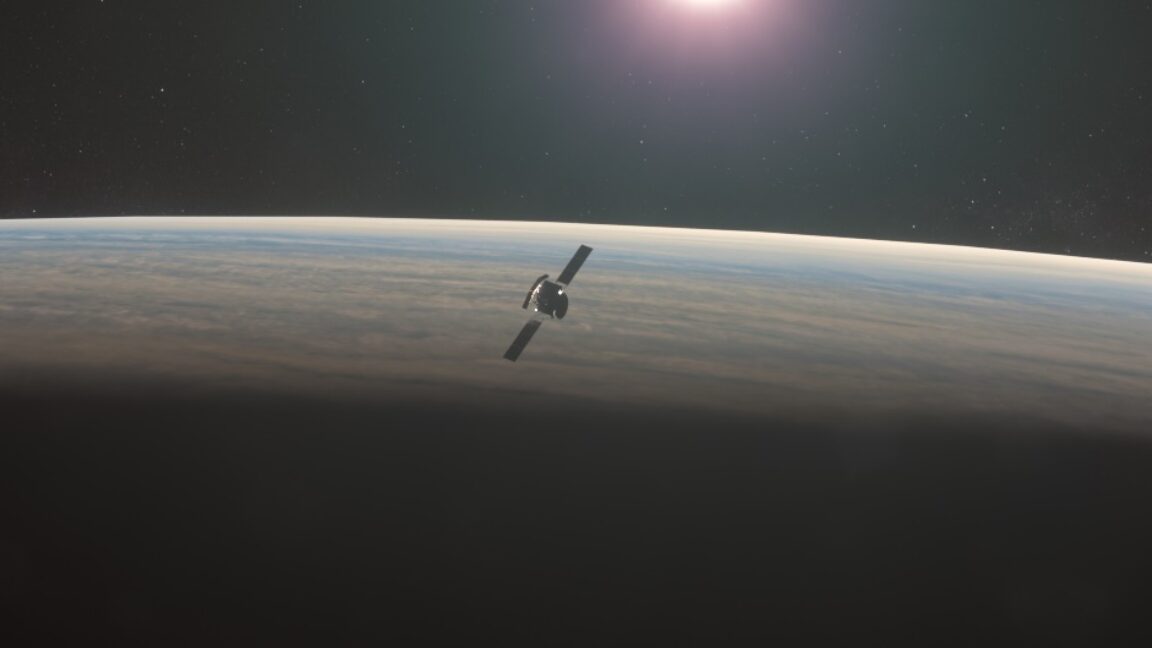
The European Space Agency is moving "full steam ahead" with development of a robotic mission to Venus after NASA officials determined they were unlikely to fulfill a commitment to provide a US-built radar instrument for the spacecraft, the mission's project scientist said.

The European orbiter, named Envision, will map the Venusian surface at 10 times higher resolution than the last radar mission sent to Venus by NASA in the 1990s. The planet is enshrouded in a blanket of thick clouds of sulfuric acid, rendering its mysterious surface unseen by optical cameras in orbit. Radar is the most effective way to penetrate the clouds of Venus to reveal the terrain below, and scientists will use Envision to look for signs of active volcanism.

NASA and ESA signed a memorandum of understanding in 2024 outlining their partnership on Envision. NASA agreed to supply a US-made synthetic aperture radar instrument, Envision's primary means of mapping the surface of Venus, along with providing tracking and communications support through NASA's Deep Space Network. In exchange, ESA would include US researchers on Envision's science team. Europe would build the Envision spacecraft and the rest of its science instruments and provide the launch on an Ariane 6 rocket.

Read full article

Comments

© ESA/Paris Observatory/VR2Planets

Google complies with EU rules for travel searches, says the new results stink

As the world's largest search engine, Google is often a target of Europe's Digital Markets Act (DMA), which seeks to rein in Big Tech. The European Commission hit Google with a hefty 460 million euro ($543 million) fine in July for preferring its own services in searches for travel and shopping. Google has now made changes in accordance with the European Union's wishes, but it claims the result is a massive reduction in search quality.

If you don't live in Europe and perform a search for, say, hotels, Google will helpfully provide myriad sponsored links, booking recommendations, and price-comparison tools in its results. The problem is that this content isn't organic—Google includes links and offers contingent on its business interests. To get to the regular search results for these types of lucrative searches, you have to scroll way down the page. Companies that partner with Google can get more exposure, but the European Commission says this creates an unlevel playing field.

"To comply with DMA requirements, we're making significant changes to Search in Europe," Google's Nick Fox told Reuters. "These changes ​degrade the user experience for ​Europeans, boosting online intermediaries ⁠at the expense of local businesses and removing helpful features people rely on every day."

Read full article

Comments

© Aurich Lawson

Hackaday Europe 2026: Outdoors with Robots

Erin Kennedy has been building robots for over a decade now, with a focus on smaller bots that interact with, or maybe even clean up, the outdoor environment. Still other bots are made to interact with people, and when the people are outside in the park, that’s where your robot needs to go.

Whatever the reason, Erin’s talk at Hackaday Europe 2026 is an invitation to take your projects out into the outdoors. But the great wide world outside of your lab is not necessarily the most friendly place for a little bot, and the other half of this talk is about practical design tips and lessons learned to help it survive.

Environments

She structures the talk around different environments, which gives her an opportunity to focus on her bot cleaning up plastic trash on the beach, but also to point out the absolute horrors that sand can work on robot motors. She goes through a number of strategies for dealing with this, including going slow, keeping the motors as high up as you can, and designing the body of the robot to be full of holes and shed sand.

Taking to the water, she demos Otter Force One, which aims to capture invasive sea urchins. But underwater means under pressure, and she gives us some good tips on how to get the cables out while keeping the water in – double-o-ring cable glands potted with marine epoxy. I especially love the Nalgene-bottle-on-a-string with a radio that can be deployed to help retrieval. Her lessons-learned section is as deep as it is understated, including underwater hazards from low visibility to accumulated silt messing up your presumed center of gravity. Over the long term, rubber leaks and barnacles accumulate. Double seals, durable hooks, tether ropes, and bright colors are your friends. Underwater bots have it hard.

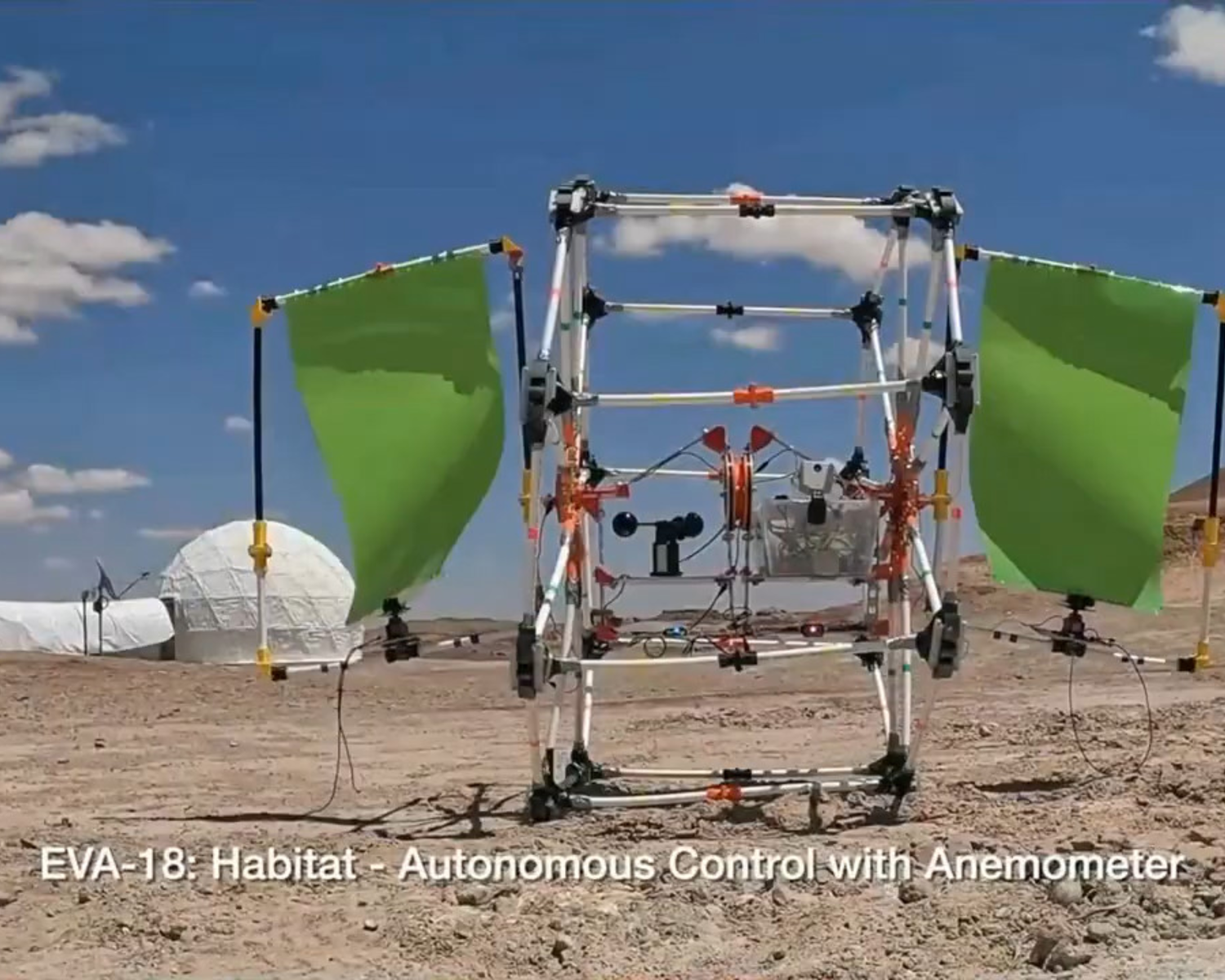
Erin’s air-inspired bots are the wildest. Some are just whimsical, like the flappy square bird, or beautiful like the butterfly bots. But her Atmosphinder bot uses the wind for actual propulsion. It’s a rolling wheel with sails that aims to explore long distances on Mars. Whether it’s going to get there or not, it’s got a bunch of great design elements for anything you have that’s going to have to roll. “Magic toboggans” make great plastic sails. But beware, while you can turn off a motor, you can’t turn off the wind. Be prepared to stake your bot down before or after its mission.

Experiences

Whatever the environmental challenges of taking your bot outside, it’s the non-laboratory environment that’s the most challenging, and rewarding. Erin tells the story of when a bird settled down in the shade cast by Bowie, or when the wind blew all of the Aruco markers away. But people and animals are just as delightful and unpredictable as the weather, and that’s an extra level of adventure. If you’re going far, bring hydration for the humans and spare batteries for the bots. Rolling with the changes seems to be the key to having a good time outside with your bots.

And of course, bringing your robot outside is a great opportunity to share what you’ve been working on with the offline world. We absolutely love the mission: normalizing robot hacks among the general public by hanging out with your bot in the park is right up our alley. She has had tremendous success with random encounters – folks just coming up and asking about what it’s doing. Making your bot seem friendly and/or beautiful seems to go a long way here. Don’t neglect the aesthetics.

Take Your Bot Outside

We left Erin’s talk absolutely inspired to build something that can make it through the rough environment that lies just outside our basement. It reminded us of our old days experimenting around with BEAM robotics, another bio-inspired practice aimed at the outdoors. With 3D printable parts and cheap geared motors, you don’t even have to break the bank to build your own Mars neighborhood rover. Watch this talk and get inspired!

German company becomes first in Europe to launch fully commercial orbital rocket

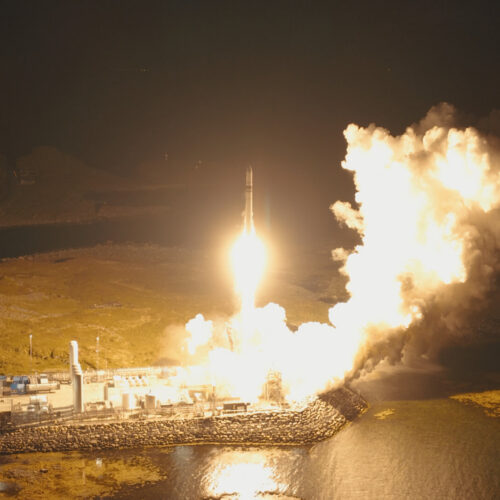
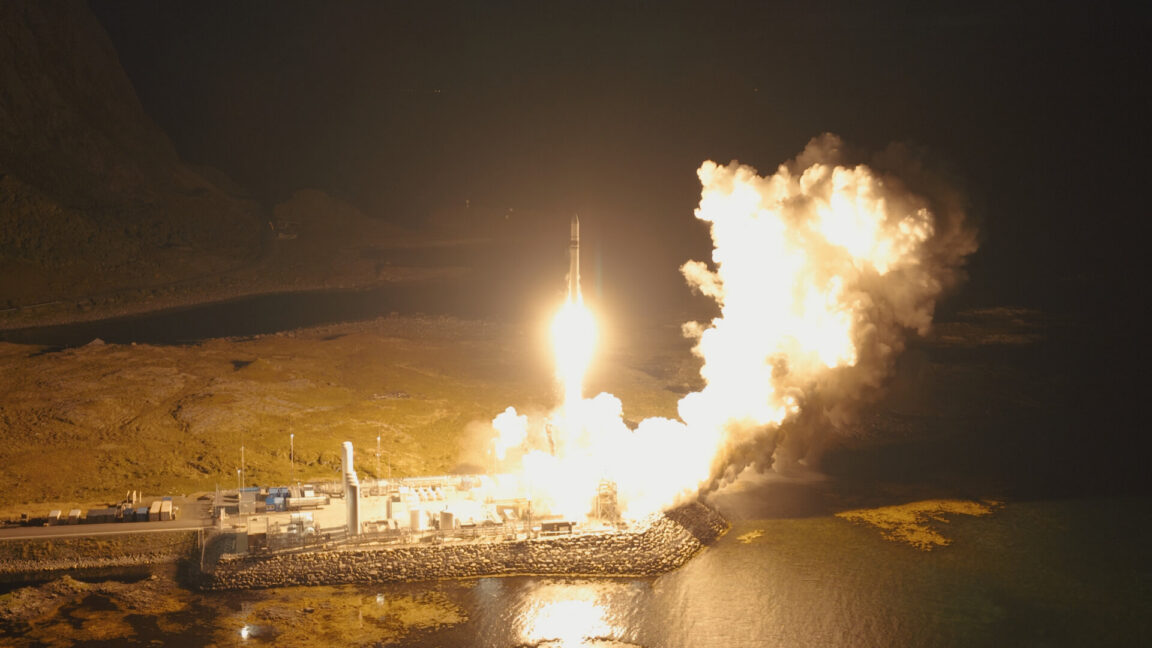
Isar Aerospace, founded in 2018 by three students at a German university, successfully launched a privately developed rocket into low-Earth orbit Saturday from a Norwegian spaceport inside the Arctic Circle.

The two-stage rocket, named Spectrum, became the first fully commercial launch vehicle in Europe to reach orbit. With Saturday's success, Isar is the clear leader among a pack of several European launch startups vying to inject some competition into Europe's stagnant launch market.

Isar's 92-foot-tall (28-meter) Spectrum rocket lifted off at 4:12 pm EST (20:12 UTC) Saturday from Andøya Spaceport in northern Norway, where it was 10:12 pm local time and the final bluish hues of daylight faded from the late summer sky. Seven minutes later, the rocket was in orbit.

Read full article

Comments

© Isar Aerospace

Trump White House just tossed a grenade into international space relations

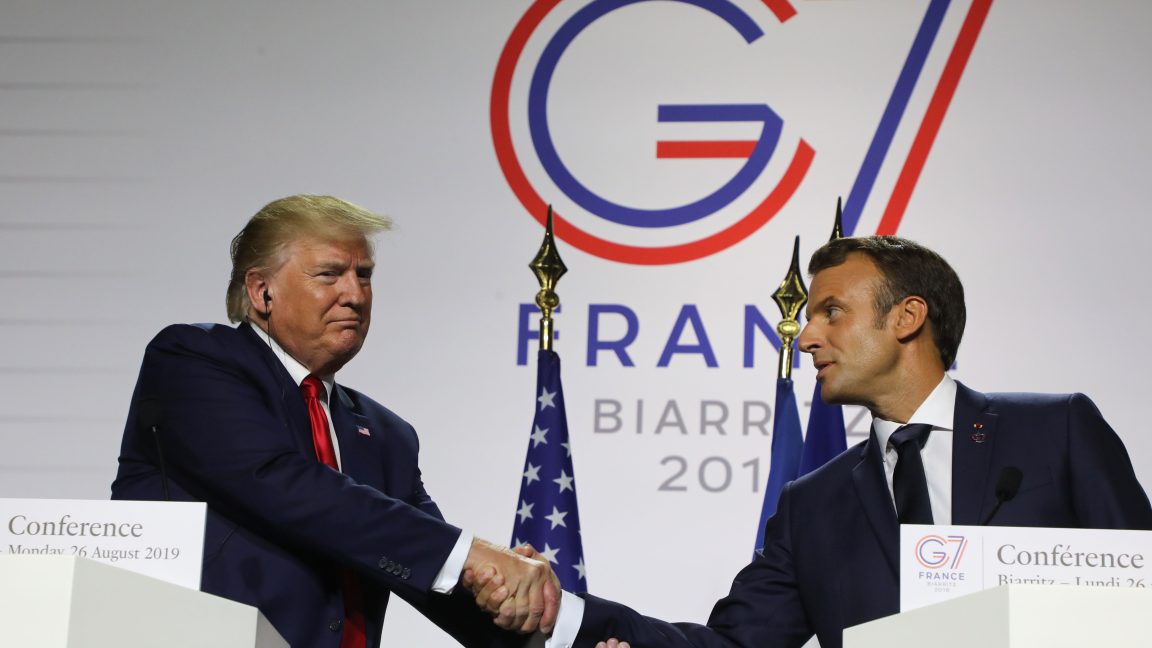
The normally genteel world of international space policy turned ugly this week as several prominent US space companies—including SpaceX, Blue Origin, Stoke Space, K2, and Starcloud—pulled out of a high-profile French space summit organized by the country's president, Emmanuel Macron.

Politico first reported the diplomatic turmoil, saying that the White House "pressured" US space companies to skip Macron's space summit in Paris next week. Since then, the companies have largely pulled out of the meeting without commenting publicly, though some US representation remains on the two-day program.

Multiple sources confirmed to Ars that an official with the White House Office of Science and Technology Policy, or OSTP, led the call with US space companies late last week. The call was convened in response to queries from US industry about the French meeting, which is not part of the traditional circuit of international space conferences.

Read full article

Comments

© LUDOVIC MARIN/AFP/Getty Images

The Vatican’s Quiet Intelligence Diplomacy

Last week all eyes were focused on the secret, first-ever trip of CIA Director John Ratcliffe to Moscow, flying on a C-17 Globemaster (the modern version of the C-141 Starlifter, which CIA Director William Casey used to travel on during his overseas trips during the Reagan administration), where he met with his Russian intelligence counterparts, and where, according to Kremlin spokesman Dmitry Peskov, “of course, President Putin [was] informed of everything.” Media reports noted that Ratcliffe discussed warnings to Russia regarding its threats toward NATO members. In this sense, Ratcliffe’s trip bore similarity to then CIA Director William Burns’ November 2021 trip to Moscow, in which he warned President Putin not to invade Ukraine. Ratcliffe’s recent trip to Moscow (as well as his trip earlier this year to Havana, where he met with senior Cuban officials) like that of his predecessor William Burns, highlights a tradition of American reliance upon ‘intelligence diplomacy,’ which can serve to reassure both allies and adversaries of America’s that today’s complex wars and conflicts – Iran, Ukraine, Gaza, and others – require the sophisticated use of professional diplomats and intelligence officers at the highest levels.

What many observers missed, and which media coverage of Ratcliffe’s trip overshadowed, was the Vatican visit to Moscow by Archbishop Paul Gallagher, the second-highest ranking Vatican diplomat and Secretary for Relations with States and International Organizations, who met with Russian Foreign Minister Lavrov, senior national security advisor Yuri Ushakov (also a former Russian Ambassador to the US), a senior representative of the Patriarchate of Russia’s Orthodox Church, and with local Catholics. At a news conference with Lavrov, Archbishop Gallagher (who bears a striking resemblance to Cardinal Kevin Kearns in the famed TV series ‘Blue Bloods’) recalled Pope Leo XIV’s appeal to end hostilities between Russia and Ukraine, and that they might begin “genuine negotiations” with the support of the Holy See and the international community. He proceeded to emphatically state (in Russia, where calling its’ ‘special military operation’ a ‘war’ can lead to a prison sentence), “to be clear, this war must end.” He also stated, “the Holy See will continue to provide strong spiritual, diplomatic, and humanitarian support by contributing to and offering a space for dialogue.” This trip followed Gallagher’s earlier trip this year to Kyiv, where he had met with Ukrainian President Zelensky, as well as other trips to Moscow – and Pope Leo IV’s three prior meetings with President Zelensky during 2025, and the dispatch of Cardinal Matteo Zuppi to Moscow to deal with humanitarian efforts.

Archbishop Gallagher’s visit to Moscow recalls past Vatican diplomatic initiatives such as the late Pope John Paul II’s ‘Holy Alliance’ during the Reagan administration to help defeat the USSR in the Cold War, as well as the late Pope Francis’ involvement in facilitating restoration of diplomatic relations between America and Cuba in 2014. The Holy See has long been an exquisite purveyor of ‘intelligence diplomacy’ for many centuries, so this is hardly new.

What is new however, is Pope Leo XIV’s recent personal involvement in Vatican diplomacy, making it a cornerstone of his papal mission and gospel of peace - even so early in his papacy - as not only the Vicar of Christ, but as a true citizen of the world (https://www.thecipherbrief.com/pope-leo-xiv-a-citizen-of-the-world). In dispatching Archbishop Gallagher to Moscow – independently of CIA Director Ratcliffe’s secret trip – Pope Leo XIV is signaling to Russia (as well as other adversaries such as Iran and Cuba), that the Holy See can be a powerful, neutral, and moral force for peace in today’s complex world. It could be said that Pope Leo XIV, in doing so, has already begin to define his (and the Holy See’s) mission and his legacy in today’s papacy. Unlike other current purveyors of track 3 and other third-party diplomacy in today’s wars and conflicts – Saudi Arabia, Pakistan, Turkey, Switzerland, Egypt, the UAE, and Oman come to mind – the Vatican is not beholden to traditional international relations or transactional interests. As was pointed out by a senior Vatican spokesperson (in response to US Ambassador Brian Burch’s NYT interview in July 2026), “any glorification or exaggeration of the Pope’s role as head of state … is therefore misleading because it comes at the expense of his one true mission as Universal Shepherd.”

The Vatican’s recent diplomacy in Moscow will be very closely watched by Iran. Pope Leo XIV has repeatedly called for peace in the Middle East, emphasizing diplomacy as the only solution to the US-Iran war. The Holy See and Iran have had close relations for decades, and during 2021, a senior Iranian cleric, Ayatollah Arafi met with the late Pope Francis in Rome. More recently, the Holy See gave a diplomatic award to Iran’s Ambassador to the Holy See, another signal of the value placed upon diplomacy. The Iranian government has surely considered Pope Leo XIV’s interest in inter-religious dialogue between Catholicism and Islam, noting that his first foreign trip was to Turkey. During the war, Iranian government officials have sent formal correspondence to Pope Leo XIV, requesting his intercession in stopping the war.

Since his return to the presidency in 2025, President Trump had hoped to – aided by his envoys Steve Witkoff and Jared Kushner – spearhead his own personal, transactional, and aspirational diplomacy to end wars and conflicts in Ukraine, Gaza, and now, Iran. Given that these efforts have stalled, proving more difficult than President Trump had imagined, even sophisticated third parties – regarding the Iran war – have faltered, and President Trump has recently stated that negotiations with Iran are no longer occurring. The situation is similar in Ukraine, where negotiations between the warring parties are non-existent, while the risks of expanding conflict and casualties have expanded. In such circumstances, The Holy See’s outreach to Russia should surprise nobody, as it, like the rest of the world, can ill afford to wait for 2029, when a new US President is inaugurated. Nor should it surprise observers if Iran were to request that Archbishop Gallagher visit Tehran soon. But whom he would meet with as interlocutors would be very intriguing.

Lastly, Ukraine’s President Zelensky has already invited Pope Leo XIV to visit Kyiv. Doing so would – given the Vatican’s role as a neutral arbiter – necessitate, due to reciprocity, the Pope’s visit to Moscow. Such ‘intelligence diplomacy’ by Pope Leo XIV could help mediate an end to that long-standing, genocidal conflict, and provide Russia’s President Putin (and Russia) a diplomatic off-ramp and solution to a war that he started but appears unable to end. It’s a beautiful irony --- that of an American-born Pope, Christ’s Vicar, and a citizen of the world, inspiring others to hope and to make peace in the world’s most kinetic, unforgiving conflicts.

The Cipher Brief is committed to publishing a range of perspectives on national security issues submitted by deeply experienced national security professionals. Opinions expressed are those of the author and do not represent the views or opinions of The Cipher Brief.

Have a perspective to share based on your experience in the national security field? Send it to Editor@thecipherbrief.com for publication consideration.

Read more expert-driven national security insights, perspective and analysis in The Cipher Brief

Fighter jets help destroy Russian drone boat near European offshore gas platform

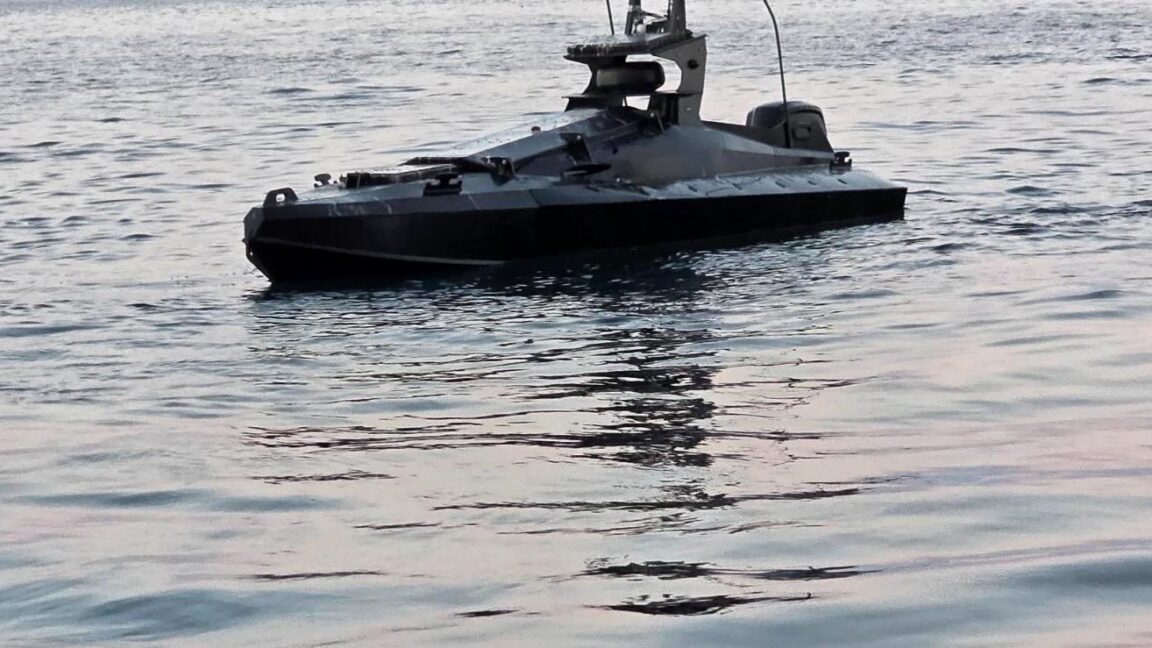
This week, Romania accused Russia of sending a drone boat loaded with explosives to a vital European natural gas platform in the Black Sea. A Romanian F-16 fighter jet used its cannons to disable the surface drone so that explosive ordnance experts could blow it up safely.

On August 20, the Romanian Coast Guard first spotted the maritime drone a few hundred meters away from the Neptun Deep project’s main drilling platform, where several hundred workers were busy with the platform’s ongoing installation, Defense Minister Radu Miruță said in a Facebook post. The offshore gas project would make Romania the largest gas producer in the European Union once it starts full production in 2027.

To protect the lives of the workers and the offshore gas infrastructure, the Romanian military scrambled two F-16 fighter jets to stop the drone with cannon fire, Miruță said. Army specialists later carried out a controlled detonation, as seen in a Facebook video shared by the defense minister.

Read full article

Comments

© Romanian Ministry of Defense

Hackaday Europe 2026: The 1-Bit CPU That Ran Factories

Powered machinery started the industrial revolution, and it was automation that kicked it up another notch in the 20th century. The ability for machines to make things by themselves spurred increased output and in turn boosted economic growth. The concept became widely popular for manufacturers to implement, as any change with serious economic benefit tends to do. Fast forward to today, and advanced robots and fancy machine vision systems running on powerful computers are the norm in modern factories which create the many wonderful products that we all purchase, use, and enjoy.

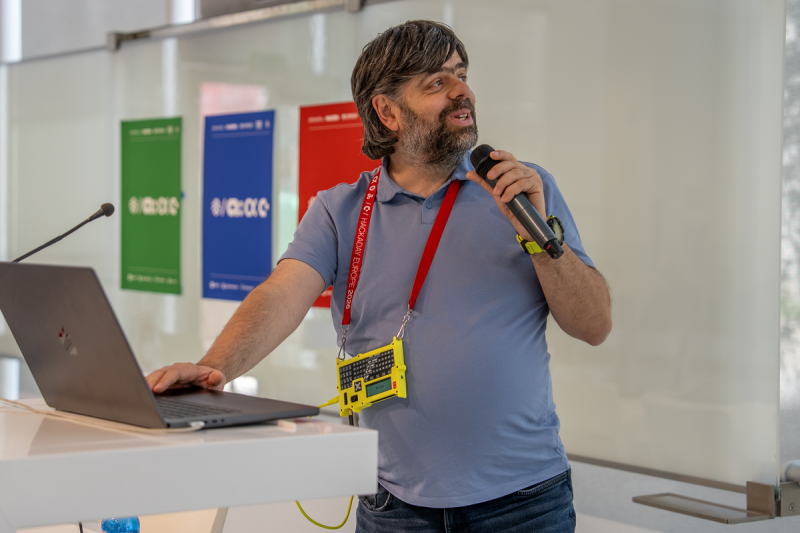
Once upon a time, though, things weren’t so sophisticated. [Nicola Cimmino] came to Hackaday Europe 2026 to tell us all about a remarkably simple 1-bit CPU that used to run factories.

Logic, But Make It Cheap!

Nicola Cimmino used to frequent a facility that used to recycle electronic waste, which sold old bits and pieces of hardware by the kilo. Many times, Nicola would pick up odd boards with an eye to repurposing components for future projects. Eventually, one unremarkable looking chip caught his attention—the Motorola MC14500B. This chip was rather unique, being a rather simple processor with just 16 instructions and a 1-bit data bus.

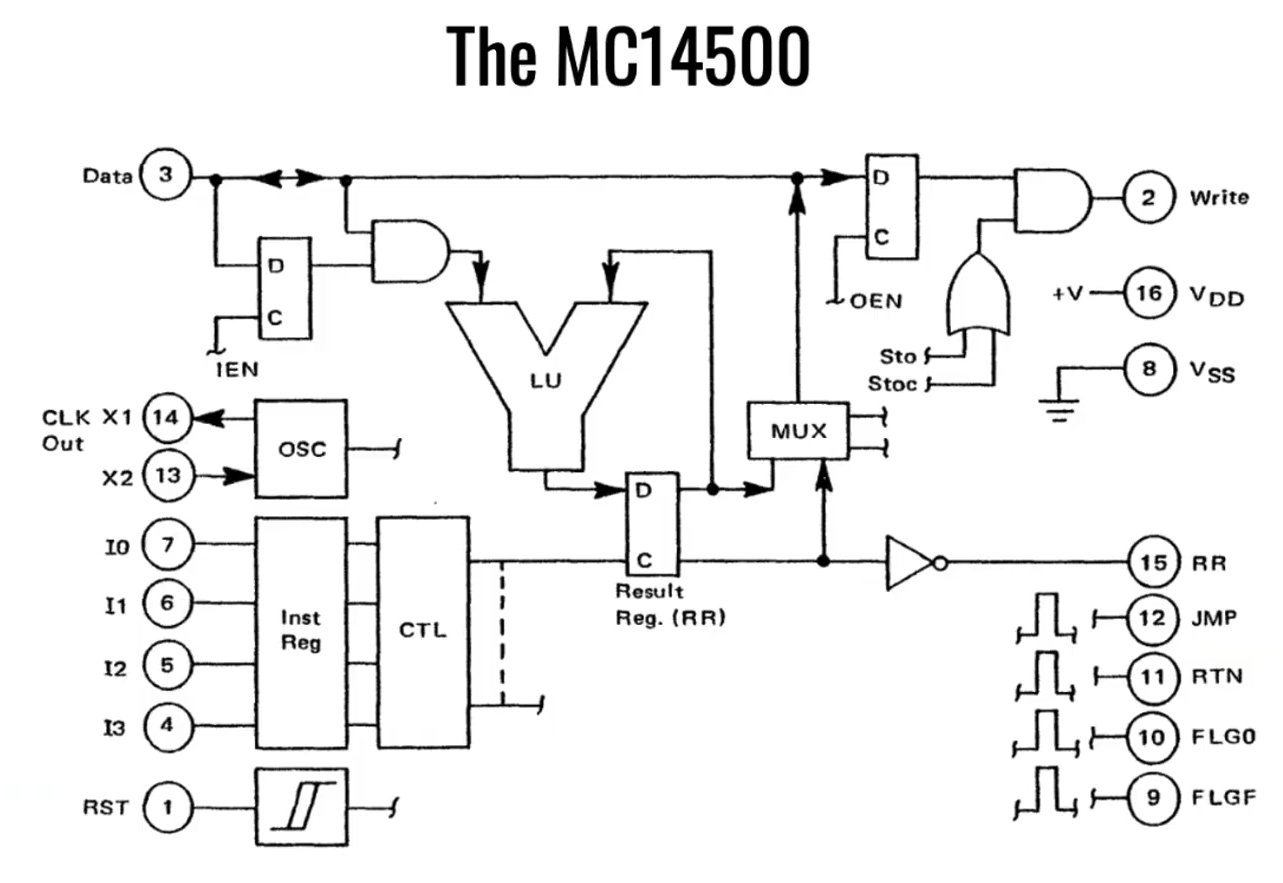
The simple architecture of Motorola’s basic 1-bit chip. Credit: talk slides

It’s worth examining the era in which this chip existed. Intel dropped the 4-bit 4004 in 1971, with the famous 8-bit 8080 landing in 1974. The Zilog Z80 came along in 1976, similarly an 8-bit design. And yet, when Motorola released the MC14500 in 1977, it landed with a rather slimline 1-bit design instead. Nicola notes that this likely came down to price, since populating a chip with more transistors cost more money quite significantly back in the 1970s. If the job could be done with less, it would make the part cheaper and thus more popular in the market. Bearing this out, Nicola explains that a 1976 Zilog Z80 used 8,500 transistors and cost around $200 USD, while an MC14500 used just 500 transistors and could be had in 1977 for the bargain price of just $5 USD.

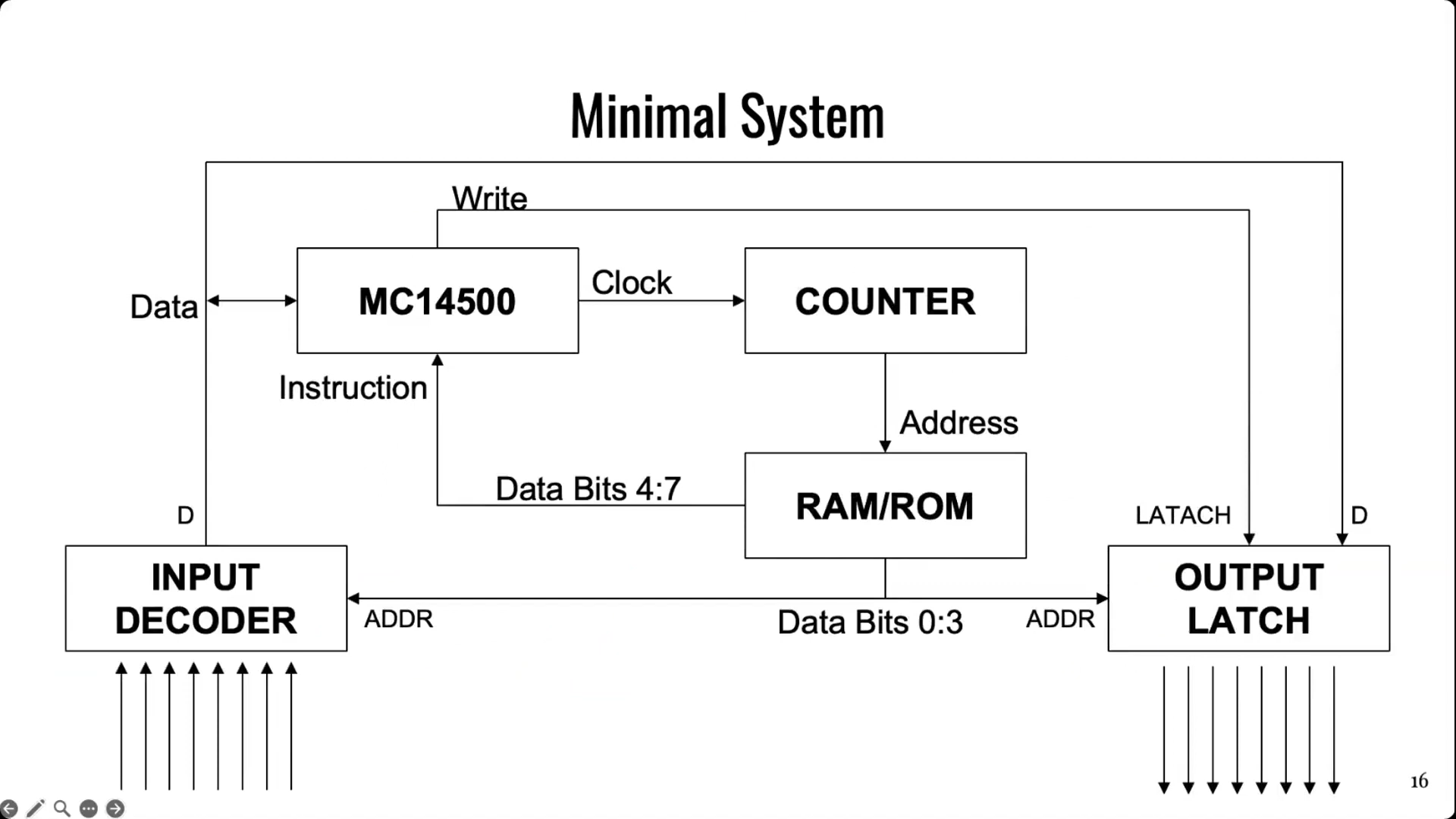
It doesn’t take much supporting hardware to get an MC14500 up and running. Notably, though, there is no memory or program counter on board, so those have to be added externally. Credit: talk slides

Back in the mid-1970s, automation in industry often consisted of simple logic that was handled by cabinets full of relays. This took plenty of bulk, required hard-wiring everything, and also involved plenty of electromechanical parts that could wear out. Changing logic required manually rewiring things which could be fussy and tedious at the best of times. In those days, the Programmable Logic Controller was just coming into use, developed to be a reprogrammable system for industrial automation tasks that was more flexible and reconfigurable just by reprogramming it.

The MC14500 sprung up as a useful tool at this time, powering a great many programable industrial systems. It was designed to offer the bare minimum requirements for its application, while leaving extraneous hardware for designers to implement if and when it was needed. The architecture is simple enough for Nicola to explain with a single slide. The chip came with a 1-bit logic unit, operating with a result register, a 1-bit accumulator and the data bus. A minimal system could be lashed up with the MC14500, a counter, some external RAM or ROM (since none was onboard), and an input decoder and output latch of 8 bits each. This setup would only allow for doing combinational logic, since there is nowhere to store the current state of the system. However, hooking some outputs back to the inputs could allow for sequential logic, since it would allow for storing the current state of the system via those outputs. Nicola then steps through various other configurational changes to addressing and system architecture that could be made to optimize the MC14500 for use in different ways.

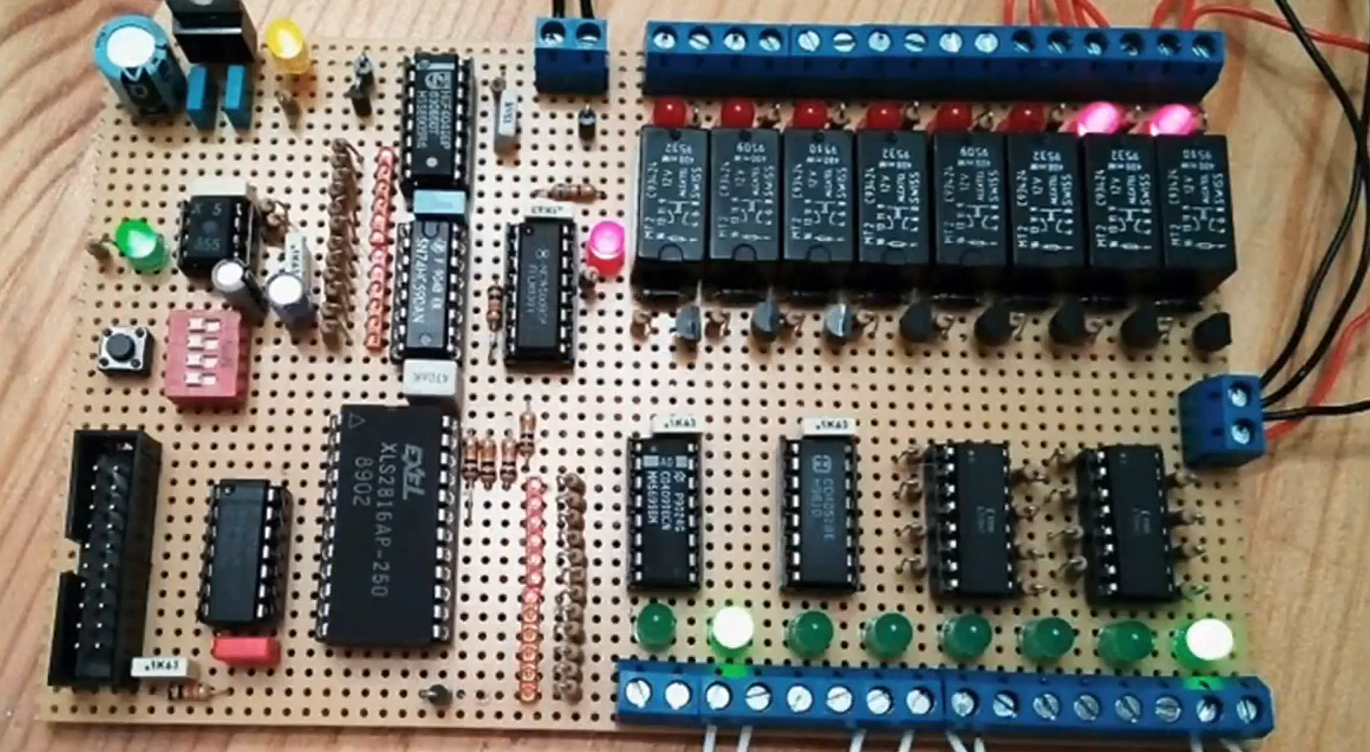
Nicola built a homebrew MC14500 system, allowing him to get to grips with the classic chip. Credit: talk slides
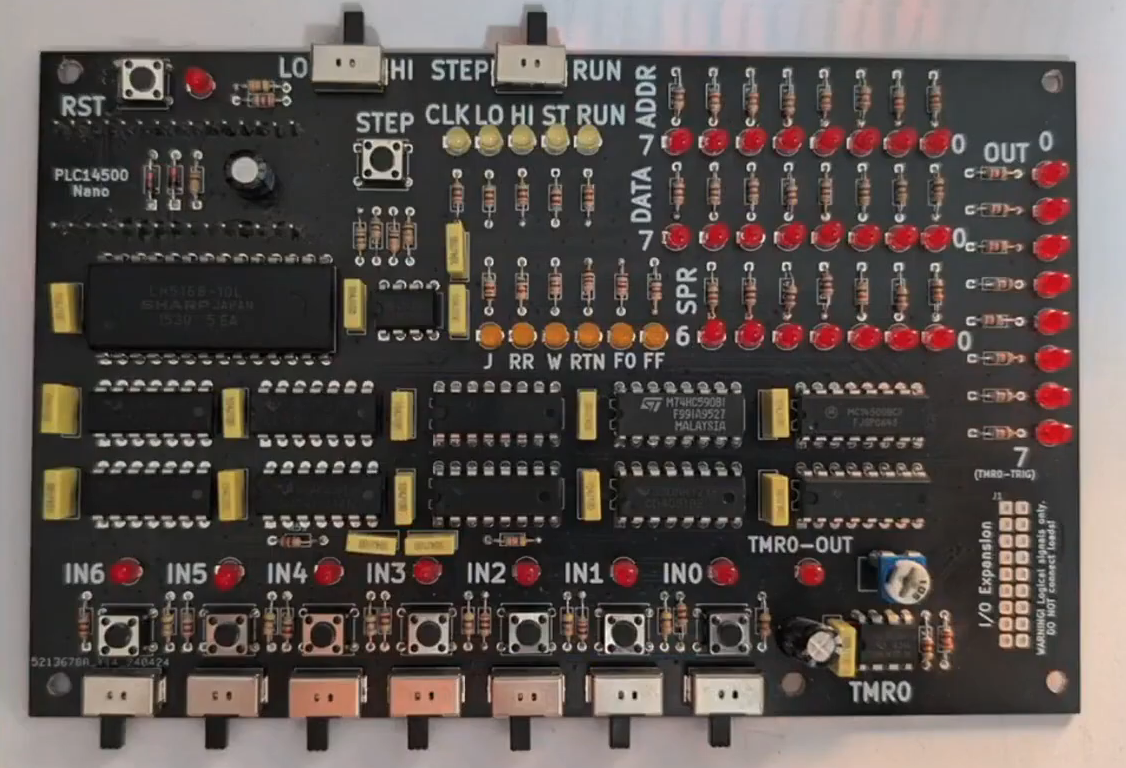
A more polished version came later, built on a custom PCB. Credit: talk slides

If you wanted to get to grips with using an MC14500 in industrial contexts, you would do well to pay attention to this talk, even if it came out some 40 years past the part’s heyday. Beyond the basic system architecture, Nicola explains how to use the limited instruction set, and how to get such a system executing simple programs in ladder logic, which remains somewhat of an industrial standard to this day. Beyond that, he steps up to more complex logic, like if/else conditionals and the use of some of the weirder instructions of the chip. He then shows off the hardware he built himself—both a breadboarded MC14500 setup built with wirewrap, and a more polished version on a custom PCB.

It’s not every day you get to learn about the nitty-gritty details of working with industrial hardware from the ground up. And yet, that’s exactly what Nicola brought to Hackaday Europe 2026. It’s an excellent primer on the topic, and also simply just good fun if you’re a fan of electronics and logic itself!

Hackaday Europe 2026: Open Source Hardware Goes Underground, Literally

These days open source is everywhere, and frankly, we couldn’t be happier about it. But even with as prevalent as open software and hardware has become, we still occasionally hear about a project that takes the concept somewhere unexpected. Which is precisely why we were so eager to hear more about the fascinating work [Phil Underwood] has been doing.

In his talk Open Source Caving: 20 Years of Making Cave Mapping Tools at Hackaday Europe 2026, [Phil] takes us through a series of progressively more advanced open hardware devices that he’s designed to increase the speed and accuracy of underground mapping efforts. Along the way, he’s learned a number of valuable lessons about designing hardware that’s robust enough to handle the uniquely challenging environment underground while still being accessible enough for a hobbyist to build and use.

Improving on the Old School

It’s not much of a stretch to assume that most Hackaday readers haven’t spent a lot of time crawling through underground passages, and as such, may not be immediately aware of how one begins to map a cave in the first place. Helpfully [Phil] starts off his talk by explaining the traditional process — which generally involves a compass, an inclinometer, a tape measure, and plenty of intricate notes.

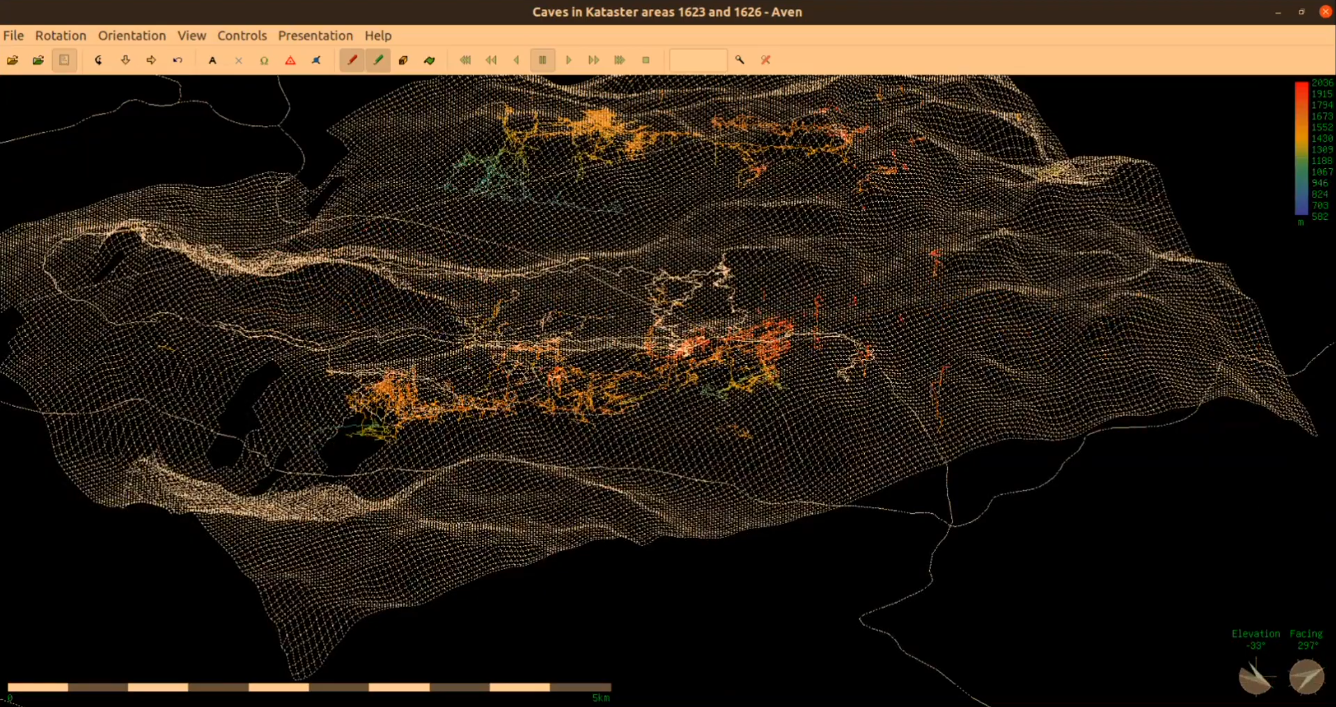
Once you’ve collected all that data and successfully returned to the surface with it, you can plug it into software and create a three dimensional map of the cave. Sprinkle in some surface topography, and you’ve got a pretty slick overview of whats above and below ground.

Like so many other cavers, [Phil] wanted a way to make that first half of the process a bit less tedious. He imagined an electronic device that could take at least some of the necessary measurements for him, but was limited by the technology and at-home production capabilities available to hobbyists in the early 2000s. There was also the cave environment to contend with: any piece of equipment used in a cave not only needs to be able to handle the dusty and cramped conditions,  but must be reasonable shock resistant. If that wasn’t tricky enough, there’s also a non-zero chance that it will need to spend some amount of time underwater.

Incremental Improvements

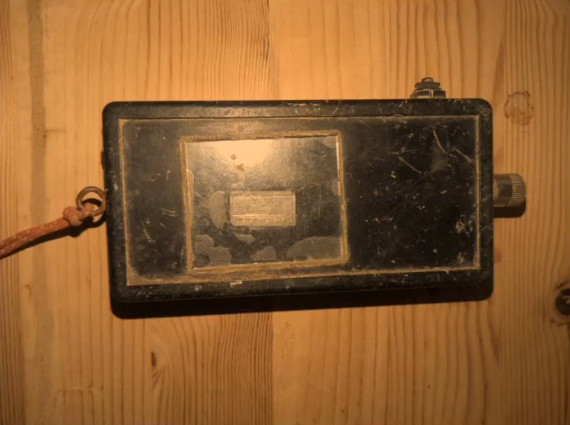
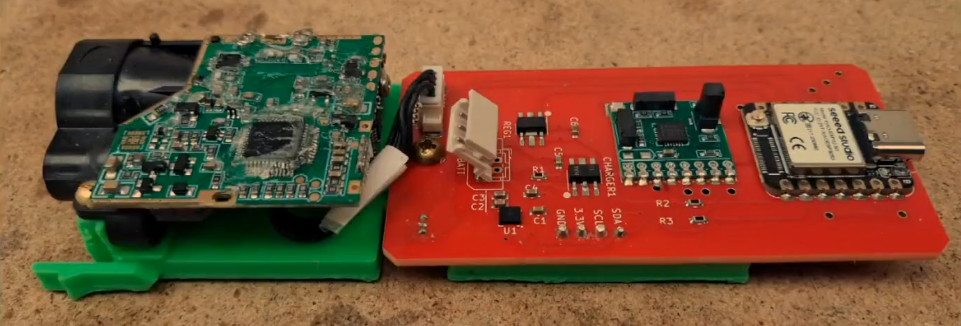
The first-generation of [Phil]’s surveying device. Undaunted, [Phil] put his first electronic caving aid together in 2008. Inside the off-the-shelf Radio Shack enclosure was an 8-bit PIC18LF2550, a dot-matrix display, an accelerometer, and a magnetometer. The data from the two sensors could be used to determine the heading and angle that the device was being held at, and while it still required the operator to manually take a distance measurement along that vector, having two-thirds of the information already computed saved considerable time and effort during surveys.

The first-generation of [Phil]’s surveying device.
The next big technological leap came in 2020 — not just in terms of the device itself, but in the tools [Phil] had access to. This new device utilized a 32-bit microcontroller, a 3D printed frame, and included a laser rangefinder.

Thanks to the the increased computational capabilities offered by the modern MCU, more of the necessary calculations could be done on the device itself, which further sped up the surveying process. But [Phil] notes that the data from the laser module wasn’t always reliable, and keeping the more complex device protected from the elements introduced new challenges.

Now evolving at a faster clip, by 2023 [Phil] had improved on the design with a better integrated 3D printed case, custom silicone buttons, and a more polished user interface. At this point, he also switched over to writing the device’s firmware in CircuitPython. The lower bar of entry compared to C seemed to better resonate with those in the community, and consequently [Phil] started seeing more code contributions from outsiders.

New Dimension, New Challenges

By this point [Phil] had a pretty solid handheld device to assist in performing cave surveys, but the end result was ultimately the same as if the measurements had been taken manually. Each successive generation of the hardware made the process of gathering spatial data faster and less cumbersome, but didn’t meaningfully improve the final product.

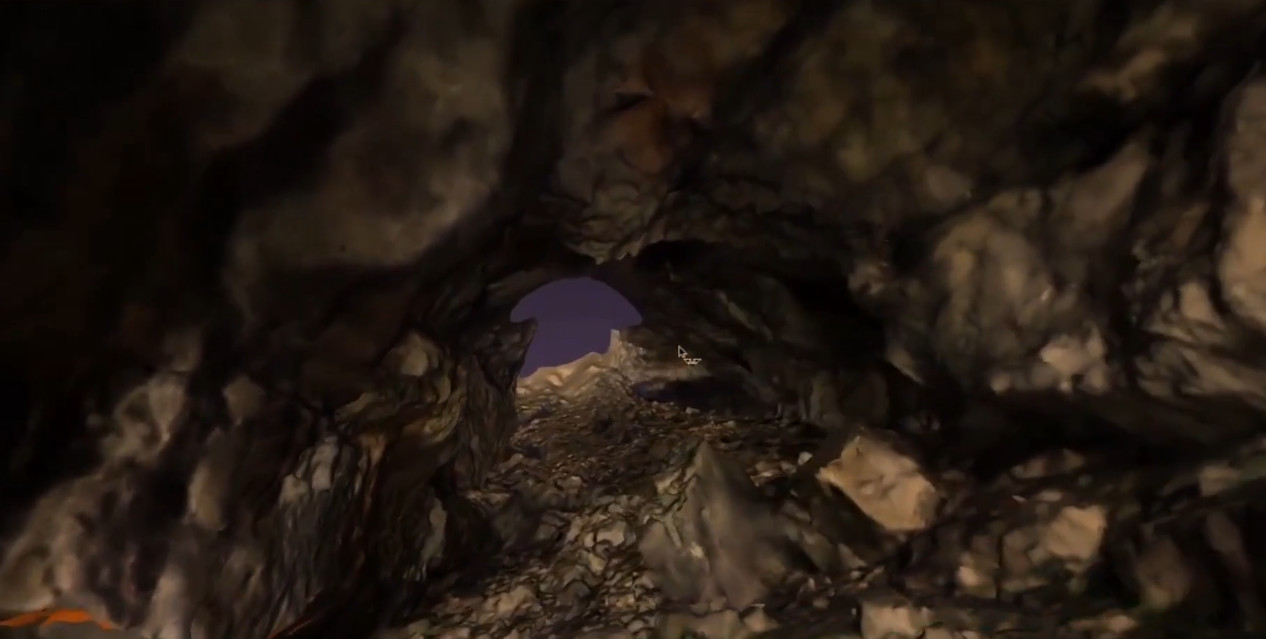
Creating higher fidelity maps would require more data and the computational power to churn through it, which is why the latest generation of [Phil]’s hardware utilizes a Raspberry Pi 5 Compute Module and a pair of low-light cameras to perform photogrammetry. When combined with the heading and angle data, this produces a textured 3D model of the inside of the cave with minimal manual effort on the part of the user.

While this latest generation of hardware is undeniably more capable than what came before it, there’s an argument to be made that it also takes a step backwards in some respects. The cameras represent a physical weak point, and [Phil] says he’s still working on an approach to more adequately handle the increased power requirements of the Pi 5 Compute Module compared to the microcontrollers used in his earlier devices. But just as with the rest of the problems faced over the last two decades, these issues will likely be resolved in time as well.

In the end, this incremental approach to hardware development may be the most valuable lesson to take away from [Phil Underwood]’s talk. It’s a safe bet that the vast majority of those who view this presentation will never find themselves exploring an underground cave system, much less mapping one. But that doesn’t mean they can’t learn from his practical and methodical approach to building the right tool for the job.

America’s Export Controls Are Becoming a Strategic Liability

Welcome to The Iron Triangle, the Cipher Brief column serving Procurement Officers tasked with buying the future, Investors funding the next generation of defense technology, and the Policy Wonks analyzing its impact on the global order.

A little over a year ago I watched a good company die. They built technology that worked. It was not a slide or a concept, but a thing that did what it was designed to do. They had European clients interested, checkbook open, at exactly the moment Europeans started opening checkbooks for real. They did not close the deal. They could not figure out how to export their product without tripping over the International Traffic in Arms Regulations (ITAR), they could not afford the lawyer who could tell them, and they ran out of runway waiting on a U.S. contract that was still three review cycles from signatures. The technology did not fail. The paperwork won.

Around the same time, I sat with a foreign team with excellent tech who wanted to build in the United States. They decided against it. Their reason was not taxes or visas. It was that the moment their intellectual property became American, it might become ITAR-controlled, and they were terrified that a regulation written in Washington would strand the hardware they were shipping to Ukraine to kill Russians. Restated, our export-control regime is so feared that talented people keep their best work out of the American ecosystem. That is not security. That is self-harm.

The $3,000 Toll to Export Nothing

Start with the cost of admission. To legally export a defense article, you first register with the State Department's Directorate of Defense Trade Controls (DDTC). As of January 2025 the base registration fee rose to $3,000 a year, and you pay it whether or not you ever ship a single item. That fee is the insult, not the injury. It’s the trivial part that buys you the right to then apply, per transaction, for a DSP-5 license, a process that consumes months, specialized counsel, and a full-time compliance officer that a nine-person startup does not have and cannot afford to hire.

For Lockheed Martin, this is a rounding error and a competitive moat all at once. The primes have entire floors of export-control lawyers; the regulation that annoys them is the regulation that buries smaller companies. The same $250,000-a-year compliance function is a nuisance on a $61 billion contract base and a death sentence on a Series A. ITAR does not have to be designed as a moat to function as one.

The See-Through Rule and the Birth of "ITAR-Free"

Here is the part that turns a domestic annoyance into a strategic own-goal. ITAR does not stop at the first sale. Every onward move, a re-export to a third country, a retransfer to a different end user, needs its own license. Control follows the item forever. Two features make this uniquely radioactive. The first is the "see-through rule": American law looks straight through a foreign-built system to control the U.S. part buried inside it. The second is that ITAR, unlike Commerce's export rules, has no de minimis threshold; there is no amount of American content small enough to escape. One controlled datalink in a drone taints the entire aircraft, permanently, and Europe cannot freely sell it onward, or keep sending it to Kyiv, without asking for permission.

So Europe did the rational thing. It started designing us out. "ITAR-free" is now a selling point, a feature you advertise the way you'd advertise waterproofing. The control regime we built to protect technology has taught our allies to build parallel supply chains that don't need us at all. We are not catching diversion. We are losing the room, one clean-sheet component at a time.

We Are Guarding a Henhouse the Fox Already Breeds

Now the objection every serious reader is forming: won't loosening the rules help China? It is the right question, and it deserves an honest answer. Post-sales diversion to Beijing is a threat, and the wall against it should stay standing.

But look at what the small companies I'm talking about actually build; let’s be precise about it. The airframe of an attritable FPV drone is commodity hardware, every component sourceable on Alibaba, and China manufactures the world's drones at a scale and price we cannot approach. Nobody in Beijing is combing American startups for quadcopter know-how. What can be genuinely sensitive is the layer you can't buy on Alibaba: the autonomy stack, the radio's waveform library, the ISR payload's processing. Control that. But applying munitions-grade export control to benign parts isn't guarding the crown jewels. It's standing armed guard over a henhouse the fox already owns, breeds, and exports. Control the narrow band that matters; stop strangling everything downstream of it with rules written for an age when a weapons system took a decade to build and stayed secret for two.

The Money Nobody Talks About

Investors should sit with the scale of the mismatch. In 2025, venture capital poured a record $49.1 billion into defense tech, up more than 80 percent over the year before. It sounds like a golden age until you notice most of it stacked into a handful of nine-figure megarounds while the Forgotten Bench, the small firms building the actual arteries of the future force, fought over grants. A typical DoD SBIR Phase I award runs about $256,000; a Phase II might reach a couple of million, if the company survives the wait. Many do not.

Now hold that against one ITAR-specific insult. On an ordinary afternoon, RTX booked $183.7 million for Patriot hardware bound for the United Arab Emirates. The prime exports to the Gulf on a Tuesday while the startup cannot work out how to ship a drone to a NATO ally. That is not a difference in risk. It is a difference in legal firepower. And the Pentagon posts these awards daily, every one above $7.5 million. The primes' budget rounding errors could fund the next generation of warfare. Instead they accrue to the incumbents while the little guys are fenced out of a market currently on fire.

What Each Corner of the Triangle Should Want

For the Procurement Officer, this is about coalition speed. You cannot field an allied force at the pace of a per-transaction license queue. Interoperability that requires a lawyer is not interoperability.

For the Investor, ITAR reform is a total-addressable-market unlock. European defense budgets have gone vertical, and right now your portfolio company is legally walled off from them. The moat you think protects your prime holdings is the same moat drowning your early-stage investments. Your small companies are not competition for the primes; there is plenty of room for both to be successful.

For the Policy Wonk, the pitch is precision. A control regime that treats a drone like an ATACM has no credibility left to spend when it actually needs to stop something dangerous. Overcontrol is how you get evasion; targeted control is how you get compliance.

The Fix Already Exists: We Just Gave It to Two Countries

We do not have to invent anything. In September 2024, the State Department stood up the AUKUS exemption, a license-free environment for defense trade, between pre-approved, vetted users, the United States, the United Kingdom, and Australia, fenced by an "Excluded Technology List" that keeps the genuinely sensitive items behind the wall. In an early three-month sample, only 18 percent of requests fell on the excluded list; the other 82 percent could move without a license. The mechanism works; State approved it six months ago.

So extend it, carefully, because this is the part the cynics should watch. AUKUS worked because State vouched for allies whose export-control systems were judged comparable to our own. Thirty-two NATO members are not thirty-two equal risks, so the honest version of this is tiered: the most-trusted governments first, each on its own comparability finding. Build a NATO Trusted Trade tier on the same architecture: license-free authorization for vetted allies on the commodity tier, a narrow excluded list. Industry's loudest complaint about AUKUS is that the list is already too broad. Then build a small-business fast lane that waives the registration toll for firms below a revenue threshold. Keep the wall. Widen the gate. Stop making a startup spend its entire budget on compliance lawyers to sell drones to Poland.

I have spent a career watching good technology lose to bad processes. This is the purest example I know. The threat is real, the fix is proven, and the only thing missing is the will to admit that a rulebook written in the era of glacial weapons development is actively kneecapping the fast, cheap, disposable systems that are winning wars right now. Europe wants viable technology. Our young innovators are starving for a customer. ITAR is standing between them, collecting a $3,000 toll, and calling it national security.

I am not naive about post-sale diversion to China. The real leak in a trusted-ally tier is not China raiding our startups; it is a vetted ally re-exporting onward. This is why truly sensitive items stay behind the wall. A trusted-ally tier is only as good as the "trusted" part: the whitelist has to be policed, the excluded list has to be honest, and end-use monitoring has to be real. I will not pretend reform fixes everything. For some European governments "ITAR-free" is industrial policy, a way to protect their own primes and their own jobs. No amount of American good behavior erases that motive. But reform removes the legitimate excuse, and keeps our companies in contention where today they are auto-excluded. The answer to a blunt instrument is a sharper one, not no instrument at all.

We wrote the words "ITAR-free" onto our allies' marketing brochures ourselves, one anachronistic rule at a time. The question is whether we notice in time to erase them, or we keep guarding the henhouse until the last American startup gives up and the last European customer stops asking. Who are we protecting, and from what?

The Cipher Brief is committed to publishing a range of perspectives on national security issues submitted by deeply experienced national security professionals. Opinions expressed are those of the author and do not represent the views or opinions of The Cipher Brief.

Have a perspective to share based on your experience in the national security field? Send it to Editor@thecipherbrief.com for publication consideration.

Read more expert-driven national security insights, perspective and analysis in The Cipher Brief

"ITAR-Free" Is Europe's Favorite Feature, We Wrote It for Them

Welcome to The Iron Triangle, the Cipher Brief column serving Procurement Officers tasked with buying the future, Investors funding the next generation of defense technology, and the Policy Wonks analyzing its impact on the global order.

A little over a year ago I watched a good company die. They built technology that worked. It was not a slide or a concept, but a thing that did what it was designed to do. They had European clients interested, checkbook open, at exactly the moment Europeans started opening checkbooks for real. They did not close the deal. They could not figure out how to export their product without tripping over the International Traffic in Arms Regulations (ITAR), they could not afford the lawyer who could tell them, and they ran out of runway waiting on a U.S. contract that was still three review cycles from signatures. The technology did not fail. The paperwork won.

Around the same time, I sat with a foreign team with excellent tech who wanted to build in the United States. They decided against it. Their reason was not taxes or visas. It was that the moment their intellectual property became American, it might become ITAR-controlled, and they were terrified that a regulation written in Washington would strand the hardware they were shipping to Ukraine to kill Russians. Restated, our export-control regime is so feared that talented people keep their best work out of the American ecosystem. That is not security. That is self-harm.

The $3,000 Toll to Export Nothing

Start with the cost of admission. To legally export a defense article, you first register with the State Department's Directorate of Defense Trade Controls (DDTC). As of January 2025 the base registration fee rose to $3,000 a year, and you pay it whether or not you ever ship a single item. That fee is the insult, not the injury. It’s the trivial part that buys you the right to then apply, per transaction, for a DSP-5 license, a process that consumes months, specialized counsel, and a full-time compliance officer that a nine-person startup does not have and cannot afford to hire.

For Lockheed Martin, this is a rounding error and a competitive moat all at once. The primes have entire floors of export-control lawyers; the regulation that annoys them is the regulation that buries smaller companies. The same $250,000-a-year compliance function is a nuisance on a $61 billion contract base and a death sentence on a Series A. ITAR does not have to be designed as a moat to function as one.

The See-Through Rule and the Birth of "ITAR-Free"

Here is the part that turns a domestic annoyance into a strategic own-goal. ITAR does not stop at the first sale. Every onward move, a re-export to a third country, a retransfer to a different end user, needs its own license. Control follows the item forever. Two features make this uniquely radioactive. The first is the "see-through rule": American law looks straight through a foreign-built system to control the U.S. part buried inside it. The second is that ITAR, unlike Commerce's export rules, has no de minimis threshold; there is no amount of American content small enough to escape. One controlled datalink in a drone taints the entire aircraft, permanently, and Europe cannot freely sell it onward, or keep sending it to Kyiv, without asking for permission.

So Europe did the rational thing. It started designing us out. "ITAR-free" is now a selling point, a feature you advertise the way you'd advertise waterproofing. The control regime we built to protect technology has taught our allies to build parallel supply chains that don't need us at all. We are not catching diversion. We are losing the room, one clean-sheet component at a time.

We Are Guarding a Henhouse the Fox Already Breeds

Now the objection every serious reader is forming: won't loosening the rules help China? It is the right question, and it deserves an honest answer. Post-sales diversion to Beijing is a threat, and the wall against it should stay standing.

But look at what the small companies I'm talking about actually build; let’s be precise about it. The airframe of an attritable FPV drone is commodity hardware, every component sourceable on Alibaba, and China manufactures the world's drones at a scale and price we cannot approach. Nobody in Beijing is combing American startups for quadcopter know-how. What can be genuinely sensitive is the layer you can't buy on Alibaba: the autonomy stack, the radio's waveform library, the ISR payload's processing. Control that. But applying munitions-grade export control to benign parts isn't guarding the crown jewels. It's standing armed guard over a henhouse the fox already owns, breeds, and exports. Control the narrow band that matters; stop strangling everything downstream of it with rules written for an age when a weapons system took a decade to build and stayed secret for two.

The Money Nobody Talks About

Investors should sit with the scale of the mismatch. In 2025, venture capital poured a record $49.1 billion into defense tech, up more than 80 percent over the year before. It sounds like a golden age until you notice most of it stacked into a handful of nine-figure megarounds while the Forgotten Bench, the small firms building the actual arteries of the future force, fought over grants. A typical DoD SBIR Phase I award runs about $256,000; a Phase II might reach a couple of million, if the company survives the wait. Many do not.

Now hold that against one ITAR-specific insult. On an ordinary afternoon, RTX booked $183.7 million for Patriot hardware bound for the United Arab Emirates. The prime exports to the Gulf on a Tuesday while the startup cannot work out how to ship a drone to a NATO ally. That is not a difference in risk. It is a difference in legal firepower. And the Pentagon posts these awards daily, every one above $7.5 million. The primes' budget rounding errors could fund the next generation of warfare. Instead they accrue to the incumbents while the little guys are fenced out of a market currently on fire.

What Each Corner of the Triangle Should Want

For the Procurement Officer, this is about coalition speed. You cannot field an allied force at the pace of a per-transaction license queue. Interoperability that requires a lawyer is not interoperability.

For the Investor, ITAR reform is a total-addressable-market unlock. European defense budgets have gone vertical, and right now your portfolio company is legally walled off from them. The moat you think protects your prime holdings is the same moat drowning your early-stage investments. Your small companies are not competition for the primes; there is plenty of room for both to be successful.

For the Policy Wonk, the pitch is precision. A control regime that treats a drone like an ATACM has no credibility left to spend when it actually needs to stop something dangerous. Overcontrol is how you get evasion; targeted control is how you get compliance.

The Fix Already Exists: We Just Gave It to Two Countries

We do not have to invent anything. In September 2024, the State Department stood up the AUKUS exemption, a license-free environment for defense trade, between pre-approved, vetted users, the United States, the United Kingdom, and Australia, fenced by an "Excluded Technology List" that keeps the genuinely sensitive items behind the wall. In an early three-month sample, only 18 percent of requests fell on the excluded list; the other 82 percent could move without a license. The mechanism works; State approved it six months ago.

So extend it, carefully, because this is the part the cynics should watch. AUKUS worked because State vouched for allies whose export-control systems were judged comparable to our own. Thirty-two NATO members are not thirty-two equal risks, so the honest version of this is tiered: the most-trusted governments first, each on its own comparability finding. Build a NATO Trusted Trade tier on the same architecture: license-free authorization for vetted allies on the commodity tier, a narrow excluded list. Industry's loudest complaint about AUKUS is that the list is already too broad. Then build a small-business fast lane that waives the registration toll for firms below a revenue threshold. Keep the wall. Widen the gate. Stop making a startup spend its entire budget on compliance lawyers to sell drones to Poland.

I have spent a career watching good technology lose to bad processes. This is the purest example I know. The threat is real, the fix is proven, and the only thing missing is the will to admit that a rulebook written in the era of glacial weapons development is actively kneecapping the fast, cheap, disposable systems that are winning wars right now. Europe wants viable technology. Our young innovators are starving for a customer. ITAR is standing between them, collecting a $3,000 toll, and calling it national security.

I am not naive about post-sale diversion to China. The real leak in a trusted-ally tier is not China raiding our startups; it is a vetted ally re-exporting onward. This is why truly sensitive items stay behind the wall. A trusted-ally tier is only as good as the "trusted" part: the whitelist has to be policed, the excluded list has to be honest, and end-use monitoring has to be real. I will not pretend reform fixes everything. For some European governments "ITAR-free" is industrial policy, a way to protect their own primes and their own jobs. No amount of American good behavior erases that motive. But reform removes the legitimate excuse, and keeps our companies in contention where today they are auto-excluded. The answer to a blunt instrument is a sharper one, not no instrument at all.

We wrote the words "ITAR-free" onto our allies' marketing brochures ourselves, one anachronistic rule at a time. The question is whether we notice in time to erase them, or we keep guarding the henhouse until the last American startup gives up and the last European customer stops asking. Who are we protecting, and from what?

The Cipher Brief is committed to publishing a range of perspectives on national security issues submitted by deeply experienced national security professionals. Opinions expressed are those of the author and do not represent the views or opinions of The Cipher Brief.

Have a perspective to share based on your experience in the national security field? Send it to Editor@thecipherbrief.com for publication consideration.

Read more expert-driven national security insights, perspective and analysis in The Cipher Brief

Drone Warfare: Ukraine’s Drone Industry, Part 3 – Export Strategy

Welcome back!

This is the final article of our Drone Warfare series on Ukraine’s rise as a drone powerhouse. But Ukraine’s success story is not one it achieved alone. The country’s drone industry was built with the support of partners from around the world who helped Ukraine during its most difficult times. Here we look at Ukraine’s export strategy and how it can serve as a way to give back by sharing hard-earned battlefield experience and technology with the nations that helped make this success possible.

Battlefield Experience

For most of the war, Ukraine’s drone sector existed on the demand side of the defense market. The country needed huge volumes of FPV drones, interceptor drones and reconnaissance systems simply to keep pace with the battlefield. By 2026, that position began to change. Ukraine started to present itself not only as a state that needed drones, but as a state that could supply them, co-produce them, and teach others how to use them. In March 2026 President Volodymyr Zelenskiy discussed joint arms production with Dutch Prime Minister Rob Jetten and said Ukraine was ready to export interceptor drones that are not needed on its own battlefield.

interceptor
Interceptor drones and the latest AI developments. Source: Ukraine’s Arm Monitor

Ukraine is not trying to sell a platform developed in peacetime and polished for foreign buyers. It is offering weapons and systems that were shaped by daily combat against a technologically capable enemy. That gives Ukrainian exports a different value proposition. They are presented as battlefield-tested tools that have already survived the hardest possible proving ground.

The Export Model

Ukraine’s export strategy depends on the fact that it is producing more than it can immediately absorb on the front line in certain categories, especially interceptor drones. In June 2026 Ukraine said it could produce 2,000 interceptor drones per day, with about half potentially available beyond domestic needs, and that it could supply at least 1,000 interceptor drones a day to allies facing Shahed attacks if investment improves. That is the logic behind the export conversation. Ukraine is not opening the floodgates on every weapon it makes. It is identifying categories where production has moved beyond immediate domestic consumption.

Business Insider also reported that Ukraine wants to protect its own security first and only share technologies that do not compromise its battlefield position. That means exports are likely to focus on systems that are already partially superseded on the Ukrainian front, or on systems that can be co-produced under controlled conditions.

Europe

Europe is the most obvious destination for Ukraine’s export strategy because the continent is already moving in Ukraine’s direction. The Netherlands are going to spend €248 million on drones for Ukraine, with production split between the Netherlands and Ukraine. On 17 June 2026 the Netherlands pledged another €500 million for drones and air defense equipment. These are signs that European governments are beginning to fund drone production as an industrial activity.

drone with a gun attached to it
The Drone Squad Fury unmanned aerial platform developed by OM Defense Systems on display at the Eurosatory defense exhibition in Paris, June 2026. Source: Militarnyi

The broader European defense picture points the same way. It was reported that G7 countries and the United States had agreed to allow Ukraine-based and European firms to produce long-range missiles and air defense systems under license. Europe is no longer only buying Ukrainian results, it wants to buy into the production model behind them.

airbus' new drone models
Source: Airbus’ drone portfolio

The broader European defense market is also moving in Ukraine’s direction. For instance, Airbus partnered with the French counter-drone startup Alta Ares. Under the June 2026 memorandum of understanding, Airbus will integrate Alta Ares’ AI-guided interceptors, including the Black Bird and X-Lock systems, both combat-tested in Ukraine since 2024, into its Fortion IBMS command-and-control platform, connecting Alta Ares’ targeting software and interceptor drones to Airbus’ battle management systems to create a sensor-to-shooter chain against drone and cruise missile threats.

Middle East

The Middle East is the second major market because it faces a different but equally urgent drone threat. In March 2026 Zelenskiy said Ukraine was ready to send instructors to the Middle East and export interceptor drones that are not needed at home. Business Insider added that Ukrainian officials see older Ukrainian counter-drone technology as still useful for allies facing Shahed attacks, even if those systems are already outdated by Ukraine’s own battlefield standards. A weapon does not need to be the newest model to be valuable if the user’s threat environment is less intense than Ukraine’s.

middle east
Ukrainian interceptor drone in open terrain (desert-like background works well for the Middle East angle)

That makes the Middle East a natural fit for Ukraine’s export model because the buyer often wants a system, not just a drone. The package includes interceptor drones, training, radar integration, and electronic warfare resilience. Zelenskiy explicitly framed the issue that way, saying that without radar coverage and software that can operate under jamming, an interceptor is not a real defender.

Production

The most interesting part of Ukraine’s export strategy is not the sale itself. It is the move toward co-production. The point of co-production is to make exports more durable and less vulnerable to disruption. It also lets allies develop industrial capacity while Ukraine keeps access to the newest combat-tested designs. The G7 agreement reported by The Guardian shows a model where production can be shifted into partner territory while still drawing on Ukrainian experience and requirements. That approach helps solve three problems at once. It spreads risk away from the battlefield. It makes procurement faster for partners. And it creates a legal framework for sharing sensitive technology without handing over full control of the most advanced systems.

The Financial Logic

The export strategy also has a budget logic. Drone exports and co-production can help bring in foreign money, expand industrial capacity, and reduce pressure on the domestic defense budget. The Netherlands’ funding would support drones and air defense equipment for Ukraine, while Ukraine’s officials see export volume as a way to unlock more production capacity. The practical idea is that external orders help keep factories busy, while revenue and investment help scale the next generation of systems.

ukraine presents its technologies
Ukraine’s Drone Industry arrives in Düsseldorf. Source: DroneXL

This logic is important in wartime because the domestic state cannot fund every possible expansion on its own. Exports make production more sustainable. They also let Ukraine distribute risk across several partners rather than relying only on its own budget and wartime aid flows. In other words, the export strategy is partly about money, but it is also about industrial resilience.

Main Constraints 

Ukraine’s export strategy is still tightly constrained by its own security needs. Ukrainian officials want to keep priority for domestic forces and treat exports as selective. That means the country is not trying to become a free-market weapons bazaar in the middle of a war. It is trying to manage surplus capacity without weakening the front line. There is also the issue of sensitivity. Not every system can be exported, and not every partner can receive the same level of access. Licensed production in allied countries solves part of that problem, but only part. The more advanced the system, the more likely it is to remain under stricter Ukrainian control. That is why the export strategy is likely to be layered. That means some hardware is going to be sold directly, while some systems will be co-produced, some software and training will be shared for integration, and some capabilities will stay in-house.

Strategic Value

Ukraine’s biggest advantage in the export market is not price alone. It is combat credibility. Allies are interested because Ukraine’s drones and counter-drone systems were developed in the harshest possible environment. A state that has spent years fighting under heavy electronic warfare pressure, missile strikes, and mass drone attacks has something to offer that many peacetime defense industries do not. That does not mean Ukraine will dominate global drone exports. Competition is still strong, and certification with production security all remain real obstacles. But the country has already crossed an important threshold, where it’s no longer only asking for help. It is now a partner that can supply systems, share production, and train others to fight the same kind of war.

Conclusion

Europe wants production. The Middle East wants interception. Ukraine wants revenue and industrial depth. That creates a new model built around selective exports and battlefield-tested expertise. Ukraine is no longer only defending itself with drones, but it is using drone expertise to build alliances. That is the meaning of its export strategy today.

The post Drone Warfare: Ukraine’s Drone Industry, Part 3 – Export Strategy first appeared on Hackers Arise.

❌