An anonymous reader quotes a report from The Guardian: France's parliament has approved a bill banning social media access for children under 15, making it the first European country to bar children from apps such as TikTok. The president, Emmanuel Macron, has championed the ban as a key reform of his final term in office and pledged to enforce it by September. "France is leading the way in Europe when it comes to protecting our children and teenagers," Macron said in a video posted on social media, hailing "a major step forward."
He thanked members of parliament for backing the legislation on Tuesday. "The Constitutional Council must now rule on it, and then it will be time to take action to make this measure a reality and protect our children online," he added on X. After approval by the Senate earlier on Tuesday, members of the National Assembly passed the bill by 279 votes to 81. A growing number of countries are taking steps to restrict social media access amid multiplying warnings over its harmful effects on children.
The ban was to be introduced in two stages, with under-15s blocked from creating new accounts from September 1. The ban would apply to existing accounts from January 2027, according to the legislation. The digital minister, Anne Le Henanff, said before the vote that the timeline was realistic, "because age-verification tools already exist" and others are still in the works, and the onus was on the platforms to impose the rule. "For four months, all of us in France will have to prove our age," she told journalists. "If someone is under 15, the account will be closed." The minister also gave assurances that users' personal data would be protected.
France's regulatory authority for licensed gambling/betting games "announced this week that it ordered ISPs to block access to Polymarket," reports Engadget. Anyone caught advertising an unauthorized betting site "could be fined up to 100,000 euros, or around $114,000." (The article notes this follows a previous regulatory action from November placing a geoblock on financial transactions from French residents on Polymarket's site.)
In May Spain blocked access to Polymarket and Kalshi while it launched a gambling license investigation.
The EU has ordered Google to open Gemini's exclusive Android access to rival AI apps by 2027. For Android users, the real payoff might not be more choices, but cheaper ones.
The EU is imposing new rules requiring Google to share anonymized search data and open up Android to rival AI companies. "Thanks to these measures, we hope to see emerging alternatives to Google Search and Google's AI services, such as Gemini, and that users in the EU can enjoy greater choice of services," Henna Virkkunen, an executive vice president at the European Commission overseeing tech, said. The Associated Press reports: In issuing the two new rules, the commission said it found that AI agents not made by Google were unable to function on Android phones at the same level as Google's Gemini. Google must now allow voice-activation of these alternative AI agents and enable them to run background tasks like booking restaurants via third-party apps. By January 2027, Google must also begin sharing anonymized search data with some rivals. The commission said the move is meant to level the playing field since Google controls a vast trove of user data that no competitor can match. Google argues the measures could weaken privacy and security by exposing user searches and reducing safeguards around third-party AI assistants. "Europeans' private searches would be exposed to unfamiliar companies, without adequate anonymization of the data and without user knowledge or consent," said Kent Walker, president of global affairs for Google and Alphabet. "This would weaken citizens' privacy, risk business trade secrets, and endanger national security."
The European Commission has exempted wearables from upcoming EU rules requiring portable-device batteries to be removable and user-replaceable. The broader Batteries Regulation still takes effect in February 2027 for many consumer products, but the exemption means companies like Apple, Google, Samsung, and Meta won't have to redesign their wearables for the EU. Thurrott reports: Yesterday, the Commission announced that new product categories would be exempted from complying with its Batteries Regulation, including wearable devices such as smartwatches, fitness trackers, and smart glasses. This will likely be good news for companies like Apple, Google, Samsung, and Meta, which won't have to redesign their devices to include user-replaceable batteries for consumers in the EU market.
The EU's Batteries Regulation will come into effect in February 2027, which is when Nintendo plans to stop selling all models of the original Nintendo Switch in the EU. While Nintendo had no choice but to redesign its handheld console to keep selling it in the EU, it probably didn't make sense for the company to put in the same effort for the OG Switch, which will celebrate its 10th anniversary in March 2027.
The UK plans a midnight-to-6 a.m. social media curfew for 16- and 17-year-olds, with autoplay and personalised feeds switched off by default from spring 2027.
The UK plans a midnight-to-6 a.m. social media curfew for 16- and 17-year-olds, with autoplay and personalised feeds switched off by default from spring 2027.
Lidl says attackers stole customer data in Germany, Belgium, and the Netherlands via a third-party provider, raising concerns about phishing and GDPR compliance.
Lidl says attackers stole customer data in Germany, Belgium, and the Netherlands via a third-party provider, raising concerns about phishing and GDPR compliance.
Vieu co-founders Simon Skaria (left) and Samir Manjure. (Vieu Photo)
Vieu, a Seattle startup aiming to replace cold outreach with warm introductions, launched what it calls the “Business Graph,” a live map of trusted relationships that drive business-to-business sales, marketing, recruiting and fundraising.
The 40-person company, which raised an $11 million seed round in October 2024, has grown to more than 100 enterprise customers including a number of well-known companies. Vieu competes with sales-intelligence tools like ZoomInfo and Outreach, and overlaps with LinkedIn’s Sales Navigator.
The company is led by CEO Samir Manjure and CTO Simon Skaria, both Microsoft alumni. Manjure went on to found KenSci, a healthcare AI startup acquired by Providence in 2021. Skaria has also founded and sold two other startups, Office365Mon and Albits.
The Business Graph, which launched Tuesday, maps relationships between people and companies based on observed signals — such as shared work history, co-authored research, board affiliations, and joint ventures — rather than the self-reported connections that populate LinkedIn.
Common use cases include finding someone who can make an introduction to a decision-maker at a target account, quietly checking references on a job candidate, and figuring out which LinkedIn connections a salesperson actually knows versus the ones they simply accepted a request from.
Vieu says the graph can be used inside its own app or queried directly by AI assistants like Anthropic’s Claude and Google’s Gemini, and it integrates with CRM, email, and Slack.
Manjure said Vieu still has the majority of its 2024 seed round in the bank and has not raised new funding. The company charges customers a platform fee for access to the Business Graph plus outcome-based pricing tied to specific use cases like sales, recruiting, and fundraising.
EU regulators preliminarily found Meta’s Facebook and Instagram design addictive, raising the prospect of app changes and a potential $12.1 billion fine.
EU regulators preliminarily found Meta’s Facebook and Instagram design addictive, raising the prospect of app changes and a potential $12.1 billion fine.
The move targeted people and entities accused of links to an online spying network that the EU claims targeted governments and carried out sabotage operations against critical infrastructure.
Apple lost its EU court challenge over iOS and the App Store, keeping both under the Digital Markets Act as another legal challenge still remains possible.
Apple lost its EU court challenge over iOS and the App Store, keeping both under the Digital Markets Act as another legal challenge still remains possible.
An anonymous reader quotes a report from Ars Technica: The European Union is ramping up pressure on Meta to make big changes to Facebook and Instagram after the European Commission preliminarily found that features like autoplay, infinite scroll, and highly personalized content recommendations were addictive. On Thursday, the EC said its investigation indicated that "Meta did not adequately assess the risks of its addictive design on the physical and mental wellbeing of users, including minors and vulnerable adults." "These features fuel the user's urge to keep scrolling and shift the brain into 'autopilot mode,' contributing to unhealthy habits and compulsive use," the commission said. Over the next few months, Meta will have an opportunity to dispute the claims, and it has already taken a defensive stance. Meta's spokesperson, Ben Walters, told Reuters that Meta disagrees with the commission's preliminary findings, which supposedly "don't accurately take into account the significant steps we've taken to protect teens."
"Since this investigation began, we rolled out Teen Accounts that automatically protect teens and put parents in control -- allowing them to block access to Instagram at night and cap daily screen time at just 15 minutes," Walters said. However, the EC emphasized that Meta's current mitigation efforts, including time management tools activated by default for teens, "failed to effectively tackle the risks stemming from its addictive design." Additionally, parental controls were deemed "only effective if parents and guardians possess adequate technical expertise" and dedicated "effort and time to understand them effectively." "This undermines the efficiency of such measures in addressing the inherent risks posed by Instagram and Facebook's addictive design," the EC said, particularly for minors.
At this stage, the EC recommended that Meta consider "disabling key addictive features such as 'autoplay' and 'infinite scroll' by default, implementing effective 'screen time breaks,' and adapting its recommender system to make it less engagement-oriented." If Meta fails to make changes to comply with the EU's Digital Services Act, the company risks fines up to 6 percent of its global annual turnover when the EC makes its final decision in the coming months. "Our starting point is that, based on our findings, this design is too addictive and changes need to be made," Henna Virkkunen, the EU's tech chief, told Reuters. "The next step is either that Meta changes its design or a non-compliance decision will follow," she said, noting in the press release that the EU's priority is "protecting the physical and mental health of Europeans." "The Digital Services Act provides a clear framework to hold platforms accountable for the addictive design and effects of their services," Virkkunen said. "We are fully committed to enforcing our legislation in Europe."
The report also notes that the EC will share findings from experts on Monday that "could help pave the way for a Europe-wide social media ban for teenagers." It's not looking much better for Meta in the U.S., either. The company faces a lawsuit from 29 states that claim Meta's platforms addict kids. "That trial begins in August, and states may seek up to $1.4 trillion in penalties if Meta is found guilty," reports Ars.
The tech giant is in breach of the Digital Services Act by focusing on features like infinite scroll, autoplay, push notifications, and the highly personalized recommendation algorithms, the European Commission said.
Europe's General Court dismissed Apple's challenge to the EU's designation of its App Stores and iOS as "gatekeepers" under the Digital Markets Act. The ruling means Apple remains subject to DMA obligations requiring it to allow alternative app stores, support interoperability with rival services, and avoid favoring its own services over competitors. MacRumors reports: Apple took its case to Luxembourg's General Court in 2024 after the European Commission designated its five App Stores -- on the iPhone, iPad, Mac, Apple TV, and Apple Watch -- as a single core platform service under the Digital Markets Act (DMA), a label that brings with it a set of strict obligations. Designated "gatekeepers" are prohibited from favoring their own services over those of rivals, and are prevented from combining personal data across different services. They also have to give users the option to use alternative app stores.
Apple also challenged the EU's designation of iOS as a gateway platform, a status that requires the operating system allows rival services to interoperate with it. The company also disputed the classification of iMessage as a number-independent interpersonal communications service, or NIICS, which would subject the app to EU telecoms rules. But the General Court said Apple's actions regarding the iMessage service are inadmissible.
Bull Bitcoin exchange, recently licensed under MiCA, is challenging the European directive in French courts that sets up a mass surveillance database, putting millions of crypto users at risk.
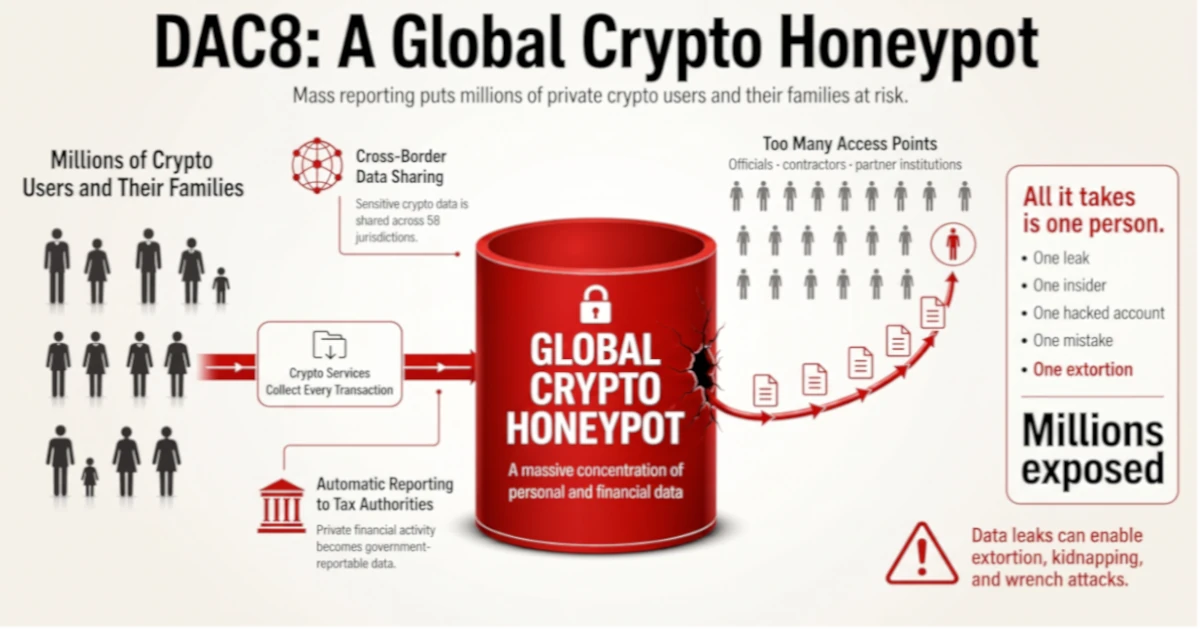
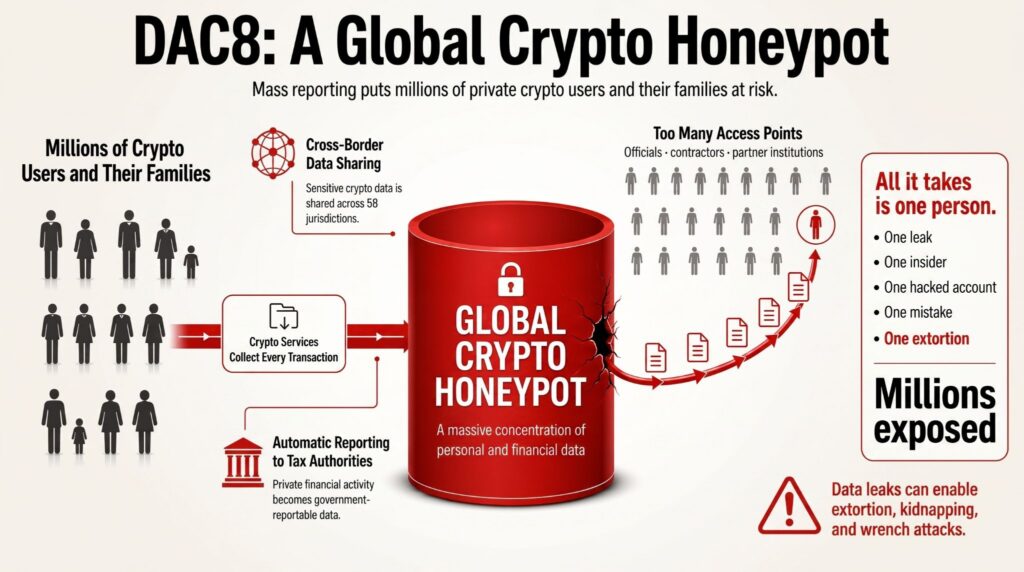
Bull Bitcoin, the world’s oldest Bitcoin-only and non-custodial exchange, recently licensed under MiCA by France’s financial markets regulator AMF, has filed a legal challenge before the Conseil d’État, France’s supreme administrative court. The challenge seeks to annul Decree No. 2025-1276, the main measure transposing the European DAC8 directive into French law, on the grounds that it creates a massive surveillance grid and database that institutions can not secure from leaks and data hacks, ultimately putting civilians at risk of kidnapping and physical harm.
Alongside the legal action, the company is making dac8.com public: “a complete, fully sourced resource for citizens, journalists and policymakers,” according to a press release shared with Bitcoin Magazine.
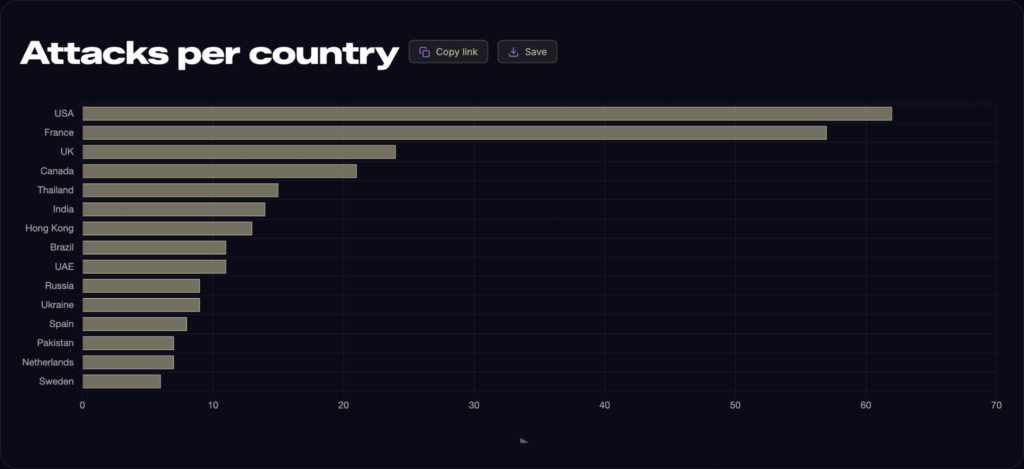
In recent years, there has been an alarming rise in kidnappings and physical attacks on crypto users, most concentrated in Europe, with France being an epicenter. Organized crime seems to be exploiting poor data reporting laws of law-abiding crypto users who, by paying their taxes, expose their ownership of crypto assets. Given that Bitcoin and other cryptocurrencies are not reversible and can be transferred internationally with ease, criminals are hunting down crypto users. France has had the second most physical attacks on crypto users after the USA, which has a much larger population, according to Gart, a company dedicated to protecting users from this rising threat.
High-profile figures in the Bitcoin and broader crypto industry have been targeted in recent years, such as Binance France CEO David Prinçay and Ledger co-founder David Balland, who lost a finger during the incident, among many others. Jameson Lopp, co-founder of Casa, a high-security Bitcoin and Ethereum wallet company, has organized ‘wrench attack’ data for years in a database on GitHub showing an accelerating trend of attacks.
Bull Bitcoin argues in its legal challenge to the DAC8 that further consolidation and sharing of crypto user data will only perpetuate this trend of physical attacks. However, they also argue that these personal security risks created by the DAC8 are also working against the stated intentions of the regulations. They argue that users will simply find legal alternatives to centralized, regulated exchanges, opting to purchase the assets off the grid via peer-to-peer exchanges, home mining or offshore unregulated alternatives, making tax collection even more difficult.
User Data Honey Pots
DAC8 turns the natural incentive a company has to protect its users’ data into a valuable multinational database with many entry points, which cybersecurity experts have for a long time called a honey pot. Bull Bitcoin points out that regulated crypto-asset service providers (CASPs) under MiCA, DORA and the GDPR are supervised, sanctionable professionals with financial incentives to protect their customers. DAC8, in turn, does the opposite: it moves data into administrative reporting networks where access is broader, and accountability is harder for users to assess. The security of the whole — Bull Bitcoin concludes — is then only as strong as its weakest link.
The history of data security over the past decades shows that amassing user data and keeping it safe over time is very difficult. Just this year, the French National Agency for Secure Credentials (ANTS, also known as France Titres) suffered a major breach detected on April 15, 2026, exposing data from up to 11.7–19 million accounts. Compromised information included login IDs, full names, email addresses, dates of birth, account identifiers, and, in some cases, postal addresses, places of birth, and phone numbers.
Months earlier, the French National Bank account registry also suffered a major hack, exposing data tied to approximately 1.2 million accounts. The compromised information included IBANs, account holder names, addresses, and, in some cases, tax identification numbers, though officials stated the attacker could not view balances or conduct transactions.
In the United States, the situation is not much better. The Equifax Data Breach in 2017 affected 147 million Americans, and the National Public Data Breach of 2024 affected over 200 million Americans, leading to leaks of social security numbers among other critical information. And back in 2015, the Office of Personal Management of the U.S. government was also breached, compromising a large number of U.S. Government officials. The data stolen included everything from social security numbers to medical records.
The list of such breaches is long, and the only logical conclusion to draw from it is that the less user information that ends up in these honeypots, the better, as ultimately all of these hacks put civilians at risk either from physical attacks or from identity-theft related fraud.
Families On the Front Lines
Of the many issues identified by Bull Bitcoin and documented on the DAC8 website, the most alarming one might be how even individuals who have not purchased crypto might end up harmed by this concentration of data, just by familial association with a Bitcoiner or crypto user.
Citing data by Certik, Bull Bitcoin highlights that more than half of the violent incidents recorded in 2026 against crypto owners targeted a family member — spouse, child, elderly parent — as a direct victim or as a pressure lever over the key holder. On the topic, Bull Bitcoin assets that “DAC8 therefore exposes not only crypto-asset holders, but their entire close family circle: between 40 and 135 million Europeans fall into a physical-risk zone, without any of them ever having consented.”
Francis Pouliot, CEO of Bull Bitcoin considers this overreach into the privacy of Euroeans to be potentially catastrophic for the prosperity of the continent, he minced no words in the press release saying that “DAC8 has transformed the concept of Know Your Customer into Kill Your Customer.” He added, “We cannot let the very foundations of civilization be shattered by this attack on privacy rights. We must draw a line in the sand and refuse to cede any more territory before we have nothing left. Someone must take a stand. It appears that no one else is willing and able to do so. Therefore, it falls to BULL to lead this fight.”
The DAC8.com is rich with facts, figures, official sources (EUR-Lex, OECD, Legifrance) and analysis, in French, English and other European languages for those interested in reviewing it and freely using it.
Regulators are in an “arms race” to keep up with the use of artificial intelligence in financial services, a senior UK official has warned, with millions of people using the technology to help them make personal finance decisions.
Sheldon Mills, an executive director at the Financial Conduct Authority, told the FT the watchdog would need greater powers to stay on top of the rapid growth of AI and urged UK authorities to review whether the use of ChatGPT, Claude, Gemini, and other large language models should be subject to their rules.
Speaking ahead of the publication on Monday of an FCA-commissioned report he has written on the impact of AI in financial services, Mills said regulators in the area would have to embrace AI themselves to keep up with the “speed, pace, and scale of change” the technology is bringing to the sector and to help “monitor, detect, and tackle the risks.”

 Login
Login