Reading view

There are new articles available, click to refresh the page.

Ethereum News: Builder Activity & Leverage Data Align, $2k Next?

In Ethereum news today, new smart contract deployments on the network have surged 192% above the 90-day baseline, with funding rates simultaneously running 220% above their 90-day norm, a combination of signals that, according to a CryptoQuant QuickTake published by analyst CryptoOnchain, rarely fires without preceding a significant directional move.

The question the data forces is whether the early leverage bid currently accumulating in derivatives markets is front-running the builder activity, or simply reacting to it.

ETH price climbed unevenly from roughly $1,770 to $1,903 over the past two weeks, a movement that reads as ordinary chop on the surface. Beneath it, three structurally distinct signals are activating in parallel for the first time in recent memory.

TOM LEE: ETHEREUM HAS MORE DEVELOPERS THAN EVERY OTHER CHAIN COMBINED

Unlike the 2022 bear market, the builder base keeps growing, and that's the tell:

– Nearly 6,000 developers work on the EVM stack, more than all other chains on the table combined
– Per Electric Capital,… pic.twitter.com/KgJCy65hiF

— Tom Lee Tracker (Not actually Tom) (@TomLeeTracker) July 20, 2026

Ethereum News: Builder Activity Spikes While Capital Stages on Binance

The sharpest signal in the CryptoQuant analysis is the developer activity reading. Smart contract deployments jumped roughly 192% versus the 90-day baseline, with nearly 57% of that increase occurring within the past week alone.

Deployment spikes of this magnitude typically indicate new protocol launches, redeployed contracts ahead of a release, or coordinated testing cycles, builder activity, not speculative noise.

Alongside that, stablecoin net flow into Binance has surged to nearly 370% above its three-month average, with daily inflows averaging over $58M. Capital staging on an exchange rather than deploying directly on-chain is a classic pre-trade positioning pattern; it suggests intent without yet confirming direction.

What complicates the read is that these two signals, which typically appear in sequence during a clean accumulation phase, are running simultaneously with a hot derivatives market. That removes the analytical comfort of a slow, cold-funding accumulation setup.

Discover: The Best Crypto to Diversify Your Portfolio

Leverage Signal Disrupts the Accumulation Script

In Ethereum news today, smart contract deployments, Binance stablecoin inflows, and elevated funding rates are firing simultaneously
SOURCE: CoinGlass

Funding rates on Binance are now running approximately 220% above their 90-day norm. That is not an ambiguous reading; it is a clear signal that leveraged traders are already positioned long and paying to hold those positions.

For anyone tracking perpetual trading dynamics, elevated funding at this level has historically preceded either a flush that resets overextension or price follow-through that validates the bet.

The problem, as CryptoOnchain’s analysis notes, is that having both stablecoin staging and hot funding rates activate together is not a clean accumulation script.

It is a setup that historically precedes more volatile, two-sided price action rather than a straightforward directional trend. Open interest building into elevated funding with a price that has not yet broken out cleanly creates the conditions for sharp moves in either direction.

The on-chain metrics that would normally anchor a bullish read are not in dispute. Staking has climbed to a fresh all-time high of 33.58%, tightening liquid float.

Median transaction fees are down by over 96% versus three months ago, not due to network abandonment. These are the readings that define the valuation gap: base-layer economics remain subdued: median transaction fees are down over 96% versus three months ago, while staking continues its steady climb to a fresh high of 33.58%.

The gap between robust on-chain metrics and ETH price performance has attracted institutional attention at these levels, and staking continues its steady climb to a new high of 33.58%, further tightening the liquid float.

Trade Ethereum on Bybit and Get a Chance to Win Our $1,000 USDT Airdrop

Three Signals Rarely This Active Simultaneously

$ETH is going sideways.

But spot demand is going up.

This looks like another accumulation before expansion. pic.twitter.com/Z2lwuH9zik

— Ted (@TedPillows) July 22, 2026

In other Ethereum news, CryptoQuant’s analysis highlights a rare convergence of three signals: elevated builder activity, capital staging in stablecoins on exchanges, and existing leverage via derivatives. Each signal has meaning individually, but their simultaneous occurrence in the absence of a price catalyst is notable.

Ethereum’s post-Dencun architecture shows lower fees, as Layer 2 activity has offloaded execution costs from the mainnet without compromising economic security or validators’ staking yield. Developer activity remains robust, with a 192% spike in deployment, indicating resilience even during downturns.

Institutional flows suggest cautious short-term behavior, but demand from cumulative inflows since the launch of the ETH ETF remains evident. This context is crucial for understanding whether the leverage bid stems from retail speculation or early institutional accumulation.

According to CryptoQuant, the outcome will either be funding rates cooling as leveraged longs are flushed out, or a price breakthrough that validates the leverage position.

The eventual dominant signal, whether from builders, exchange capital, or derivatives, will only be clear as these paths unfold. Until then, the three-signal convergence remains the primary focus.

Discover: The Best Token Presales

The post Ethereum News: Builder Activity & Leverage Data Align, $2k Next? appeared first on Cryptonews.

Ethereum News: BlackRock’s ETHA Drives ETH ETF Reversal With Back-to-Back Inflow Weeks

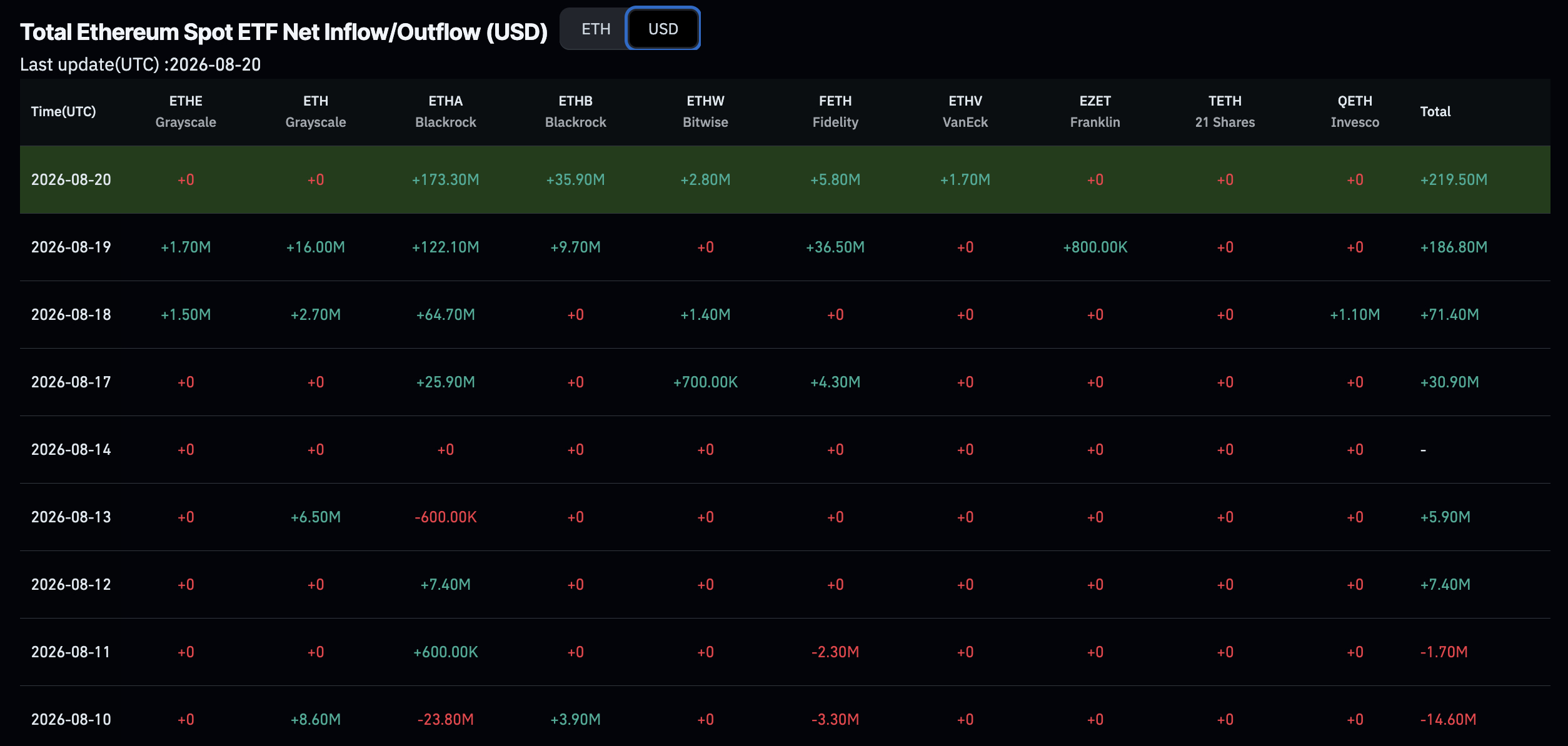
In Ethereum news today, spot ETFs recorded $105M in net inflows during the week of July 13–17, 2026, the strongest weekly figure since April and a measurable acceleration from the prior week’s $84M.

The two consecutive positive weeks end an eight-week outflow streak, raising the direct question of whether this is a durable institutional re-engagement or a short-term technical bounce that will stall at the first sign of ETH price weakness.

SOURCE: CoinGlass

Flow-tracking platforms CoinGlass and Farside Investors both confirm the reversal, with data showing renewed net creations across the Ethereum ETF complex after two months of persistent redemptions.

The prior week’s $84M was itself notable as the streak-breaker; the follow-through to $105M adds weight to the argument that the reversal has legs rather than being a single-week anomaly.

Ethereum News: BlackRock’s ETHA Is Carrying the Category

According to SoSoValue data, U.S. spot Bitcoin ETFs recorded total net inflows of USD 108 million on July 15, with BlackRock’s IBIT posting the largest single-day inflow at USD 80.82 million. Spot Ethereum ETFs drew USD 53.83 million, led by BlackRock’s ETHA with USD 45.29… pic.twitter.com/4YrMd19EDs

— Wu Blockchain (@WuBlockchain) July 16, 2026

BlackRock’s iShares Ethereum Trust, trading under the ticker ETHA, has consistently accounted for the majority of daily net positive flows across the entire Ethereum ETF landscape. On July 15 alone, in a single session during the reported week, ETHA captured a substantial share of the day’s $53.83M in complex-wide inflows, according to data from BingX.

The concentration dynamic cuts both ways. ETHA’s brand, distribution reach, and institutional trust give it a structural pull that smaller issuers cannot easily replicate, which explains why BlackRock’s ETF inflows have driven ETH price action more than any other single product in the category.

But it also means the health of the entire spot ETF complex is effectively contingent on one fund; if ETHA flows stall or reverse, the broader category tips back into net outflow territory almost immediately.

As of mid-July, cumulative complex-wide net inflows across nine issuers since the category launched in July 2024 totaled approximately $11.07Bn, with total net asset value near $10.4Bn, per BingX data. ETHA’s own cumulative net inflow reached $11.28Bn.

ETH Price at $1,845: The $1,800 Level Is the Key Variable

$ETH $1750 remains the key area to hold for the bulls.

This marked the February low but also marked the higher low & market structure shift back in 2025 before the large rally.

Above, $2.1K is the main resistance to watch. https://t.co/PAHmyFsitT pic.twitter.com/RVgmf5tMEh

— Daan Crypto Trades (@DaanCrypto) July 20, 2026

ETH price traded at approximately $1,845 during the inflow week, with the $1,800–$1,900 range serving as a critical demand zone. Buyers have consistently stepped in near the lower end of that band, and the structural logic is straightforward.

Sustained spot ETF inflows create a mechanical bid, because each new creation requires the fund to purchase actual ETH to back its shares. At $80–105M in weekly inflows, this represents consistent buy pressure absent during the eight-week redemption period.

The $1,800 level is therefore not just a technical support reading; it is partially a function of ETF flow dynamics. A breakdown below that zone would likely signal either a sharp deceleration in institutional demand or net outflow resumption, both of which would remove the mechanical bid that has been supporting prices.

The inverse is also true: sustained weekly inflows in the $80–105M range provide a floor that did not exist during the prior two-month drawdown.

Institutional Crypto Momentum and What the Data Confirms and What It Doesn’t

In other Ethereum news, the $105M weekly figure is the best since April, but it remains modest compared with the peaks the category reached during more euphoric periods in 2024 and early 2025. Calling this an institutional comeback is accurate as a directional statement; framing it as a full-scale rotation back into institutional crypto ETF allocation requires more evidence. Two consecutive positive weeks after a prolonged outflow streak is a reversal, not yet a trend.

What the data does confirm is that institutional interest in Ethereum as a strategic portfolio asset has not evaporated, despite two months of redemptions suggesting otherwise. The speed of the reversal, from outflow-heavy weeks to back-to-back inflow weeks accelerating from $84M to $105M, indicates that allocators were watching specific price and macro conditions before re-engaging, rather than abandoning the category entirely.

For context on how Ethereum’s ETF recovery compares to the broader spot ETF landscape, XRP ETF flows have shown a different pattern, which underlines that the current Ethereum inflow momentum is asset-specific rather than a broad crypto ETF tide lifting all products.

The forward scenario is binary and relatively clean. If ETHA sustains its pace of flow through late July and ETH holds the $1,800 support zone, the two-week reversal will validate the start of a genuine institutional re-accumulation phase.

If flows decelerate sharply or ETHA specifically turns negative, the outflow streak resumes and the $1,800 floor loses its structural underpinning. The next two weeks of weekly flow data from CoinGlass and Farside Investors will settle that question more definitively than any price chart reading alone.

Discover: The Best Crypto to Diversify Your Portfolio

The post Ethereum News: BlackRock’s ETHA Drives ETH ETF Reversal With Back-to-Back Inflow Weeks appeared first on Cryptonews.

Ethereum News: BlackRock, JPMorgan Builds Make ETH a Wall Street Asset, Tom Lee Argues

In the lastest Ethereum news, Fundstrat’s Tom Lee is arguing that Ethereum’s next major move has nothing to do with crypto-native speculation, and everything to do with institutional capital that is already deployed and building.

Writing in Bitmine’s July Chairman’s message, Lee pointed to BlackRock BUIDL, JPMorgan MONY, and Robinhood Chain as concrete evidence that Wall Street has moved from observation to construction on Ethereum’s rails. The ETH price currently sits near $1,880, about 60% below its 2025 peak near $5,000.

The gap between that peak and current levels is the central question Lee addresses. His read is that it reflects a regime change, not a structural ceiling, the first era of ICOs, NFTs, ETFs, and stablecoins has run its course, and the institutions now building on Ethereum represent a fundamentally different demand base with longer time horizons and larger capital pools.

eth logo
Ethereum (ETH)
24h7d30d1yAll time

Discover: The Best Token Presales

Ethereum News: BlackRock, JPMorgan, and the Tokenization Build-Out

Lee’s institutional case rests on names that move markets in traditional finance. BlackRock BUIDL, the asset manager’s tokenized Treasury fund, now holds roughly $2.6 billion and has earned Moody’s top money-market rating (Moody’s cited).

JPMorgan MONY extended the bank’s tokenization push that began with Onyx in 2020, adding another institutional-grade vehicle to the Ethereum ecosystem.

Electric Capital data cited by Lee puts nearly 6,000 developers on the EVM stack, ranking Ethereum first among all chains for new builders, a metric that matters more to institutions evaluating long-term platform risk than short-term price momentum.

🧵
1/
Bitmine released its July Chairman's Message titled
"ETH is the Cure for the Uncanny Valley of Wealth"

– Two exponential tailwinds for Ethereum
– The crypto headwinds of 2026 are ending
– Bitmine primed for next bull cycle

Linkhttps://t.co/RHYkprmhCD

— Bitmine (NYSE-BMNR) $ETH (@BitMNR) July 16, 2026

Wall Street is building on Ethereum, Lee argues in the Chairman’s message, contrasting 2022’s crypto bear-market backdrop with continued institution-led development.

In 2025 and 2026, institutional crypto infrastructure has continued to expand even as ETH price fell sharply from its cycle highs. That divergence between on-chain institutional activity and spot price is the core of his thesis. For more on how BlackRock’s ETF flows are reinforcing this dynamic, see this analysis of BlackRock ETF inflows and their ETH price implications.

Discover: The Best Crypto to Diversify Your Portfolio

Robinhood Chain: ETH as Settlement Money

Robinhood Chain, launched July 1 on Arbitrum, handed Lee one of his more striking data points. Within two weeks of going live, it ranked third among all networks by DEX volume at about $811 million daily, briefly surpassing Ethereum itself according to DefiLlama. Ethereum has since reclaimed that position, and cumulative Robinhood Chain volume has crossed $1 billion.

In the Chairman’s message news, Lee argues that Robinhood Chain’s use of ETH (as described in his discussion of the network’s fees and how it settles) makes it a meaningful Ethereum use case.

Source: Robinhood Chain TVL / DefiLlama

The counterargument is equally straightforward. Artemis CEO Jon Ma has noted that Robinhood Chain’s volume spike is predominantly meme coin-driven, not institutional flows.

And the fee economics cut against Lee’s framing, Robinhood Chain pays Ethereum’s base layer almost nothing in fees. High DEX volume on an Arbitrum-based chain does not translate 1-for-1 into ETH fee burn at the L1 level.

The Amazon Analogy, and the Conflict It Carries

Lee frames the current ETH setup through an Amazon analogy: the stock traded near a split-adjusted $6 for 12 years before climbing to $241 as its total addressable market expanded beyond what early investors could model. He also describes the psychology around sellers at depressed prices.

He also concedes the bearish read directly. ETH has failed twice at the $5,000 level, and skeptics argue that the top of the range could limit upside this cycle.

The conflict of interest embedded in Lee’s thesis deserves direct acknowledgment. Bitmine’s latest weekly disclosure shows 5.77 million ETH, about 4.8% of the 120.7 million total supply. Lee is among the biggest beneficiaries if institutional adoption confirms his thesis.

That does not make his argument wrong, but it reframes every price target he issues as coming from a holder with an extraordinary financial stake in the outcome.

The institutional infrastructure Lee cites is real. BlackRock BUIDL’s Moody’s rating, JPMorgan’s MONY fund, and Robinhood Chain’s early volume numbers are all verifiable facts, not projections.

Whether they are sufficient to drive ETH from $1,880 back through $5,000 and beyond depends on whether institutional capital deepens from product launch into sustained secondary market demand, a step that none of these programs has yet demonstrated at scale.

Trades Ethereum, and Don’t Miss Out on Our $1,000 USDT Airdrop on ByBit

The post Ethereum News: BlackRock, JPMorgan Builds Make ETH a Wall Street Asset, Tom Lee Argues appeared first on Cryptonews.

Tom Lee Says Ethereum Crypto Is Set To Outperform Bitcoin

Fundstrat co-founder Tom Lee flagged the ETH/BTC ratio as a market-wide signal on July 13, posting ahead of his WebX 2026 keynote in Tokyo that investors should watch the pair as a “signal of a revival of crypto.”

The ratio has climbed toward 0.0286 after rebounding from an early June low near 0.026, but that level has capped multiple recovery attempts and remains the immediate test for Lee’s thesis.

Lee’s July 13 post surfaced his thesis publicly at a moment when the ratio is showing its first sustained higher-low formation since the June floor. The Fundstrat founder has linked a rising ETH/BTC ratio to the mechanism through which Ethereum outperforms Bitcoin in the next leg of this cycle.

eth logo
Ethereum (ETH)
24h7d30d1yAll time

Discover: The Best Token Presales

The ETH/BTC Ratio Framework

Lee has linked Ethereum’s outlook to stablecoin growth, tokenized assets, and clearer U.S. regulatory frameworks as the fundamental drivers behind a potential ETH/BTC reversal.

Those remain forward-looking claims until the ratio itself confirms the move. The ratio currently sits near 0.0282, meaning it would need to rise substantially just to reach historically elevated levels.

Source: Tradingview

There is also a contrast worth noting. A Fundstrat document that circulated earlier in 2026 reportedly projected a meaningful first-half correction, Bitcoin to the $60,000–$65,000 range, ETH to $1,800–$2,000, a range that essentially describes where both assets are trading now.

Lee’s public ETH/BTC framework and that internal downside model are not irreconcilable, the correction could be the base from which the ratio trade launches – but traders should register the gap between the firm’s cautious internal modeling and the bullish public thesis.

Discover: The Best Crypto to Diversify Your Portfolio

Resistance at 0.0286 and What Breaks It

The ETH/BTC pair has formed higher lows since early June, but 0.0286 has acted as a ceiling through repeated tests. A clean move above that level could extend Ethereum’s relative rebound, according to the primary source analysis. A rejection at current levels puts support at 0.027 back in play, with the June floor near 0.026 as the downside reference.

The wider three-month trend still favors Bitcoin. ETH/BTC remains lower over that window despite the July bounce, reflecting dynamics that defined much of 2026: stronger Bitcoin ETF demand, weaker Ethereum fund flows, and competition from alternative layer-1 networks.

Those structural headwinds have not reversed, they have merely paused at a level where value buyers and ratio-watchers are becoming active.

On the ETF side, U.S. spot Ethereum funds returned to daily net inflows in early July after sustained pressure through June. BlackRock’s ETHA led the July 1 session with approximately $14.9 million in net inflows.

One positive day does not erase the June outflow pattern, and a sustained run of institutional demand will be required before fund flow data meaningfully reinforces Lee’s ratio thesis.

For context on Bitcoin’s current market structure and what ETH needs to overcome on a relative basis, the BTC dominance picture matters: CoinGecko placed Bitcoin’s market share near 56.2%, having eased from recent highs – a necessary but insufficient condition for broad altcoin outperformance.

Rotation Signal or Premature Call

The Altcoin Season Index has improved to around 58, below the 75 threshold conventionally used to define a full altcoin season. More large-cap altcoins have started outperforming Bitcoin over the trailing 90 days, but smaller tokens remain well below their 2025 peaks, and the index is tracking recovery, not confirmation of a broad rotation.

ETH staking has crossed 33% of supply, reducing the liquid float available for sale, a structural support factor, though not a near-term price catalyst on its own.

On the corporate side, BitMine, where Lee serves as chairman, a conflict worth flagging, reported an Ethereum treasury of 5.74 million ETH, equal to roughly 4.8% of circulating supply. Corporate accumulation at this scale removes sell-side pressure at the margin, but it also concentrates holder risk in ways the market has not fully priced.

Lee’s framing of the ETH/BTC ratio as a “signal of a revival of crypto” is precise in one important sense: if Ethereum begins outperforming Bitcoin on a sustained basis, it historically correlates with capital rotating down the risk curve into the broader crypto market. That dynamic is not yet underway.

The ratio needs to clear 0.0286 on a sustained basis before the revival narrative moves from thesis to tradeable trend. Until then, it remains a watched level on a pair that has disappointed ratio bulls for most of the past 18 months. Traders tracking the current Bitcoin and Ethereum price environment should treat Lee’s signal as a setup worth monitoring, not a confirmed entry.

Don’t Miss Out on Our $1,000 USDT Airdrop on ByBit

The post Tom Lee Says Ethereum Crypto Is Set To Outperform Bitcoin appeared first on Cryptonews.

Ethereum AI Security Agents Found Bug That Could Crash Any Node With a Single Message

Ethereum News: The Ethereum Foundation’s Protocol Security team disclosed on July 9 that coordinated AI agents scanning Ethereum’s core codebase identified CVE-2026-34219, a remotely-triggerable panic in libp2p’s gossipsub layer that allows any unauthenticated peer to crash a vulnerable node with a single crafted control message.

The bug has been patched in libp2p-gossipsub v0.49.4, and every operator running consensus clients on an older version should treat the upgrade as non-negotiable.

eth logo
Ethereum (ETH)
24h7d30d1yAll time

Discover: The Best Token Presales

Ethereum News: What the Bug Actually Does

Gossipsub is the P2P messaging layer all Ethereum consensus clients depend on to propagate blocks and attestations across the network.

CVE-2026-34219 lives in the PRUNE backoff expiry handler: when a peer sends a crafted PRUNE control message carrying a near-maximum backoff value, the implementation performs unchecked Instant + Duration arithmetic on the next heartbeat tick. That arithmetic overflows and triggers a panic, according to SentinelOne’s vulnerability database.

According to NVD’s CVE record, the vulnerability carries a CVSS v3.1 base score of 8.2 HIGH with an attack vector of network, no privileges required, and no user interaction.

The Protocol Security Team has been pointing AI agents at Ethereum’s protocol code. Our core takeaway wasn't about finding bugs, it was about triage.

Here are field notes from the work.https://t.co/HVtc8XcrJK

— Ethereum Foundation (@ethereumfndn) July 9, 2026

The attacker can reconnect and replay the message after each crash, making the denial-of-service repeatable at negligible cost. Affected scope is any validator, indexer, or sidecar tool running Rust libp2p-gossipsub below v0.49.4, the vulnerability is not confined to Ethereum deployments, as Snyk’s advisory flags it as a risk for any application using the vulnerable crate in production.

Discover: The Best Crypto to Diversify Your Portfolio

How the AI Agent Pipeline Found It

Nikos Baxevanis of the Ethereum Foundation’s Protocol Security team published the methodology behind the find.

The team ran many AI agents in parallel against Ethereum’s systems software, cryptographic code, and contracts, coordinating through a shared Git repository with no central dispatcher, a structure borrowed from Anthropic’s fleet-based compiler work.

Roles were generated dynamically as the work surfaced them: Recon converted attack surface into testable hypotheses, Hunting traced code paths and built reproducers, Gap-filling tracked coverage, and Validation independently re-checked every candidate before it counted.

The key discipline was a strict reproducibility threshold. As the EF post states: “A candidate isn’t a finding until there’s a self-contained artifact that reproduces the failure against the real code, and that runs for someone who didn’t write it.”

Source: Ethereum Foundation

That single rule filtered out the most common false-positive traps – panics that vanished in production builds, reproducers that relied on internal values no real attacker input could ever produce, and formal proofs that were trivially satisfied regardless of actual code behaviour.

The EF team’s candid framing of the triage burden is the most operationally useful part of the disclosure. “The surprise was how little of the work went into finding them, and how much went into telling the real bugs from the ones that just looked real,” Baxevanis wrote.

Most candidates were wrong, duplicate, or out of scope, and the volume AI generates means that false-positive rate compounds fast without rigorous triage infrastructure.

What This Means for Protocol Security Going Forward

CVE-2026-34219 is not an isolated incident in libp2p’s backoff handling. According to external CVE listings, a prior vulnerability, CVE-2026-33040, reportedly involved a similar PRUNE/backoff overflow fixed in v0.49.3 and carried a CVSS score of 8.7. CVE-2026-33040 and CVE-2026-34219 appear to be back-to-back high-severity bugs in the same subsystem across consecutive minor releases, suggesting a pattern of systematic hardening in libp2p’s backoff handling rather than a one-off patch, and suggesting the gossipsub control-message surface warrants continued scrutiny.

The broader implication for Ethereum infrastructure is structural. AI-assisted security work has been applied to smart contract audits for years; this disclosure marks a meaningful shift toward deploying the same capability against core networking and systems code.

The EF team’s conclusion is direct: “The bottleneck didn’t go away. It moved from finding bugs to trusting the results, which is a better place for it, because that’s where human judgment actually matters.” For Ethereum’s ongoing protocol development, that’s a durable process improvement – not just a one-time find.

Operators running consensus clients or any auxiliary tooling built on Rust libp2p should verify their gossipsub version immediately and upgrade to v0.49.4 or later. The patch adds bounds checking on backoff duration values in PRUNE messages before they enter heartbeat arithmetic, closing the overflow path entirely.

Don’t Miss Out on Our $1,000 USDT Airdrop on ByBit

The post Ethereum AI Security Agents Found Bug That Could Crash Any Node With a Single Message appeared first on Cryptonews.

Ethereum News: Grayscale’s Ethereum Staking ETF Just Had Its CFO Resign

Ethereum News: Grayscale Investments filed a Form 8-K for its Grayscale Ethereum Staking Mini ETF on July 2, 2026, disclosing the departure of CFO Edward McGee after seven years and his replacement by co-CFOs Kathryn Masci and Daniel Plourde on an interim basis, a governance shift at one of the most structurally sophisticated crypto ETF products currently listed in the U.S. market.

eth logo
Ethereum (ETH)
24h7d30d1yAll time

Discover: The Best Token Presales

Ethereum News: What the 8-K Actually Says, and What It Doesn’t

The 8-K filed with the SEC falls under the category covering departures, elections, and appointments of directors or certain officers, along with compensatory arrangements.

That category requires disclosure of the event but does not mandate full detail on circumstances, severance terms, or strategic rationale in the initial filing itself.

Kathryn Masci signed the filing as Co-Chief Financial Officer and Principal Financial and Accounting Officer of Grayscale Investments Sponsors, LLC.

Source: SEC Filing

Her background runs through Ernst & Young and Garrison Capital before she joined Grayscale in May 2020. Daniel Plourde, the second interim co-CFO, brings institutional ETF operations experience from SPDR ETF Trusts at State Street and Gabelli Funds – a combination that reads more like deliberate succession planning than an emergency scramble.

The structural significance of this governance event is modest in isolation. McGee’s exit does not appear to implicate fund strategy, staking policy, or custody operations.

What it does add to is a pattern of active corporate housekeeping at the sponsor level throughout 2025 and 2026, including the creation of a new Board of Managers for the Sponsor on May 4, 2026 – a context that makes the July filing look like a continuation of planned restructuring rather than a reactive disclosure.

Discover: The Best Crypto to Diversify Your Portfolio

The Fund Itself: Numbers That Matter More Than the Filing

The leadership change is the headline event, but the operational data behind the spot Ethereum ETF is where the real story sits.

The fund held over 861,000 Ethereum as of Q1 2026, up from roughly 734,000 ETH at the start of the year, net creations of approximately 218,500 ETH during the quarter, which translated to around $337 million in net inflows and ranked the fund as the top U.S. Ethereum ETP by Q1 inflows as reported by most news.

The staking yield mechanics are straightforward but worth quantifying precisely. Approximately 67% of the fund’s ETH is actively staked on Ethereum’s proof-of-stake network, generating a gross staking reward rate of approximately 2.88% annualized – the trailing 60-day figure Grayscale cited in January 2026.

Q1 2026 staking income came in at $8.38 million, with net investment income of $7.41 million after the fund’s 0.15% management fee. Total staking rewards generated since October 2025 have crossed $15 million.

That 2.88% gross yield against a 0.15% fee is a genuinely competitive structure. Non-staking spot ETH products capture price exposure only; holders of those funds absorb the fee drag without the partial offset that staking rewards provide.

The question for competing issuers is whether regulatory clarity on staking in registered fund structures,still evolving as of mid-2026, will allow them to match this product’s architecture or whether Grayscale’s first-mover position in staked Ethereum ETPs hardens further.

Don’t Miss Out on Our $1,000 USDT Airdrop on ByBit

The post Ethereum News: Grayscale’s Ethereum Staking ETF Just Had Its CFO Resign appeared first on Cryptonews.

Ethereum Price: Kiyosaki Forecats $95K as Ethereum Battles $1.5K

Ethereum price is holding a precarious line. ETH trades around $1,617, up roughly 3% over the past 24 hours, and the $1,500 support directly below is the number every desk is watching right now.

Robert Kiyosaki’s March forecast projecting ETH at $95,000 by mid-2027 has resurfaced across crypto social media, reigniting debate about long-term valuation at exactly the wrong moment for short-term price action.

Kiyosaki’s call is tied to a macro reset thesis: a global financial crisis triggers a sharp repricing of hard and alternative assets, sending Bitcoin to $750,000, gold to $35,000 per ounce, silver to $200, and Ethereum to $95,000 within a year of the event.

🚨 Robert Kiyosaki predicts that after a major financial crash:

🔸 Gold: $35,000
🔸 Silver: $200
🔸 Bitcoin: $750,000
🔸 Ethereum: $95,000#Bitcoin #Ethereum #Gold #Silver pic.twitter.com/Og4SaQMTrc

— Fantastic Market (@FxSadia) July 1, 2026

Corporate treasury data adds a layer of credibility to the demand narrative, Bitmine disclosed it purchased another 27,084 ETH last week, bringing its total holdings to approximately 5.7 million ETH (roughly 4.7% of circulating supply) valued at nearly $9 billion, with most staked.

SharpLink has also continued accumulating. Big buyers, weak chart. That tension is the story.

The broader market isn’t helping: total crypto market cap slipped 1% to $2.11 trillion, Bitcoin fell 1.6% amid spot ETF outflows, and altcoins traded broadly lower. Whether $1,500 holds defines the next directional move for ETH.

Can Ethereum Price Defend $1,500 and Stage a Recovery?

ETH is trading inside a descending channel, below both the 100-day and 200-day moving averages on daily and 4-hour timeframes.

The 24-hour range of $1,550 to $1,600 reflects indecision rather than accumulation. Resistance is stacking around $1,600 where price has repeatedly stalled. Weak institutional demand on Coinbase is flagged as a limiting factor, implying continued downside risk unless that dynamic shifts.

ETH reclaiming and holding above $1,600, flipping it to support, opens a path back toward $1,800 to $2,000. That requires a reversal in ETF flows and a catalyst, regulatory clarity or a macro risk-on shift would qualify.

Source: ETHUSD / Tradingview

Without that, consolidation continues between $1,500 and $1,600 with buyers defending the level but lacking the firepower to push through overhead resistance.

A daily close below $1,500 opens accelerated selling with no obvious technical floor until $1,300 to $1,350, the scenario traders are hedging against most actively right now.

Kiyosaki’s $95,000 target and Tom Lee’s ETH forecast framework are both multi-year macro calls, not trading signals. Useful for framing long-term conviction. Not useful for near-term entry timing. The current technical setup needs to clean up considerably before either longer-range thesis becomes actionable for active traders.

LiquidChain Targets Early Mover Upside as Ethereum Tests Key Levels

Ethereum grinding at $1,500 raises a fair question. If near-term upside is capped and downside risk is real, where does fresh capital find asymmetric exposure right now?

ETH at current prices offers leverage to a recovery but also full drawdown risk if support breaks. Early-stage infrastructure plays present a different risk profile entirely, with their own category of uncertainty.

LiquidChain is a Layer 3 project positioning itself as the cross-chain liquidity layer the market is missing. The architecture fuses Bitcoin, Ethereum, and Solana liquidity into a single execution environment through a Unified Liquidity Layer, Single-Step Execution, Verifiable Settlement, and a Deploy-Once model that lets developers access all 3 ecosystems without redeployment.

The L3 thesis underpinning this raise is gaining traction as cross-chain fragmentation becomes harder to ignore. The presale is currently priced at $0.01475 with $881,054 raised to date.

Execution risk is real. Tech delivery, adoption timelines, and liquidity at launch are all unproven. That is the nature of early-stage infrastructure. The question is whether the asymmetry justifies the uncertainty.

Research LiquidChain before allocating.

The post Ethereum Price: Kiyosaki Forecats $95K as Ethereum Battles $1.5K appeared first on Cryptonews.

❌