Login
Login
Madrona’s annual IA40 list shows an AI industry splitting in two
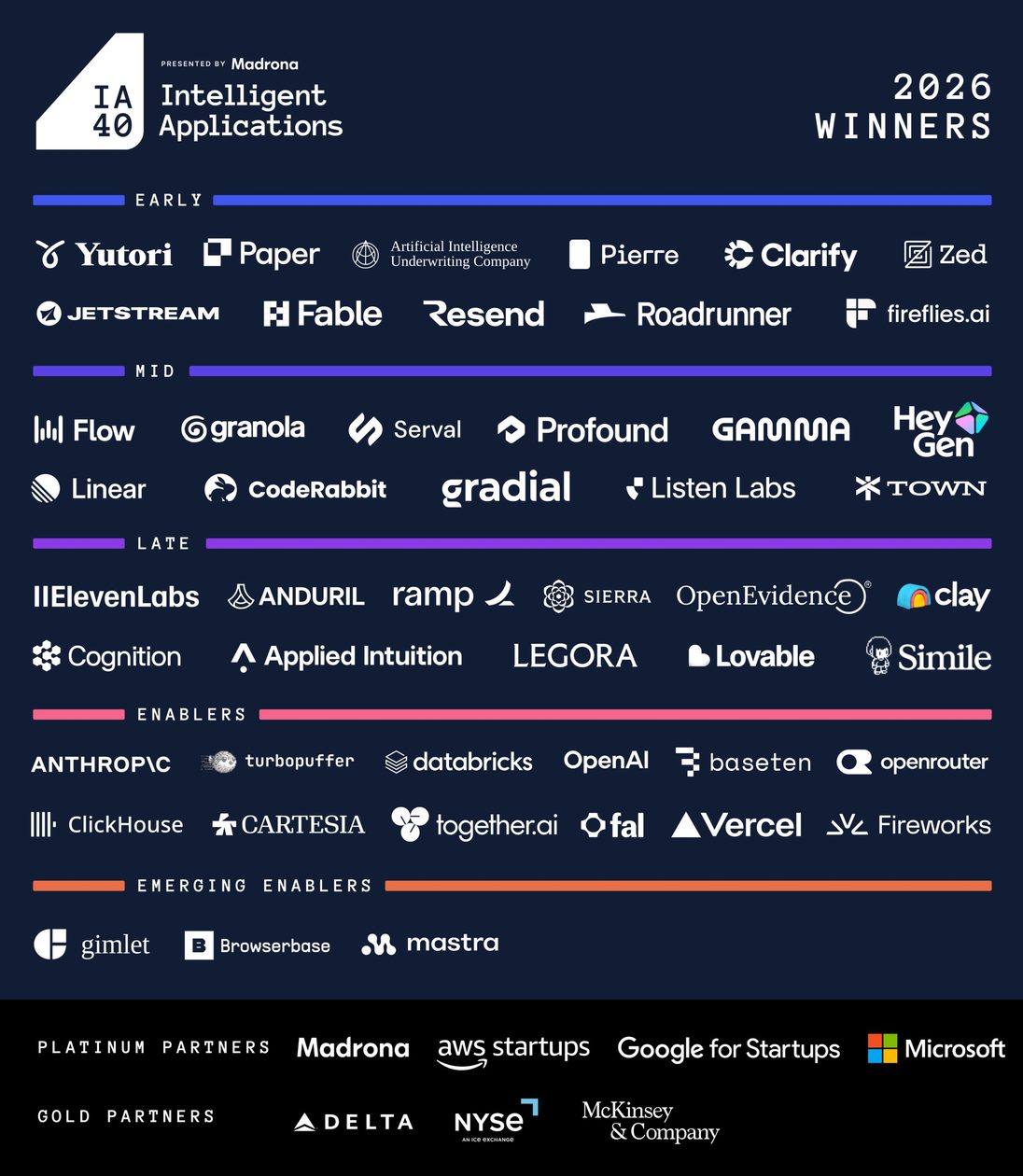
Seattle-based venture capital firm Madrona released its sixth annual Intelligent Applications 40 list this week, naming 45 private AI companies (the five extras come from ties) that have collectively raised $410 billion from investors across the industry.
Three of them — Anthropic, OpenAI and Databricks — account for 92% of that total.
The uneven distribution of funding reflects a larger split in the tech industry, as the largest AI companies make huge bets on the computing capacity needed to meet demand for their models, while almost everyone else builds businesses on top of them.
The frontier labs are “increasingly funded by strategic capital from the likes of Amazon, Google, Nvidia and SoftBank rather than traditional venture,” Madrona’s Matt McIlwain and Rolanda Fu wrote in a post accompanying the list. That scale, they added, “makes every other category on this list look capital light by comparison.”
On top of that, he said, hundreds of billions of dollars are flowing into OpenAI and Anthropic.
“And what I say to both the big tech companies and to the people funding the model companies: thank you very much,” McIlwain said on Bloomberg TV, noting that the five largest tech companies will spend an estimated $750 billion in capital expenditures this year.
But even setting those big three aside, McIlwain said, the rest of the winners have raised an average of more than $800 million each. That’s a total of $34 billion combined. Companies across the list are raising far more than they used to, enough that Madrona had to redraw its own categories.
The list sorts companies by total capital raised, and this year the ceiling for “early stage” rose to $50 million, up from the $30 million threshold that held for the previous five lists. The cutoff for “emerging enablers,” its category for smaller infrastructure companies, doubled to $100 million.
“Companies across the board are raising more money, and the definition for what ‘early’ means continues to shift higher,” McIlwain and Fu wrote.
Madrona has published the IA40 since 2021 as a roster of the private companies it considers most important in building and enabling AI applications. According to the firm, this year’s list drew on input from 72 investors representing 54 venture and corporate firms, who nominated and voted on more than 450 companies, with PitchBook data factored into the scoring.
Two Seattle-area companies made this year’s list:
- Clarify, which builds an AI-native CRM, appears in the early-stage category for the second straight year, with $23 million raised. It acquired San Francisco’s Seam AI in July.
- Gradial, which builds AI agents for enterprise marketing, is a first-time winner in the mid-stage category; it raised $65 million in June at a $675 million valuation, bringing its total to $120 million.
Last year’s list included two other Seattle-area companies in addition to Clarify.
- OpenAI acquired one of them, Bellevue-based Statsig, for $1.1 billion in September 2025, making Statsig founder Vijaye Raji its CTO of applications.
- Security startup Dropzone AI, which was on the list last year, did not repeat this year.
Madrona, one of the Seattle region’s largest and oldest venture capital firms, is an investor in all four — Clarify, Gradial, Statsig and Dropzone AI — although it also invests outside the region, and many of the companies on the IA40 are not in its portfolio.
Several of the companies on this year’s list have engineering centers in the Seattle region, including Anthropic, which leased 113,000 square feet in South Lake Union this year; OpenAI, which expanded to nearly 300,000 square feet in downtown Bellevue after the Statsig acquisition; and Anduril, which employs about 560 people in Bellevue and Seattle.
Databricks, the San Francisco-based data and AI company (which leased 142,000 square feet in Bellevue this year), is the only company to appear on all six IA40 lists. That said, 23 of last year’s 40 winners returned this year, a 58% repeat rate, up from 33% the year before.
McIlwain and Fu wrote that the biggest and most established companies on the list are holding their spots, noting that “the age of experimentation is giving way to an age of enterprise readiness,” with buyers and investors “paying premiums for companies that can demonstrate real ROI.”
Madrona will recognize the winners at its IA40 Summit in Seattle on Sept. 29 and 30.
Updated with Matt McIlwain’s comments to Bloomberg TV.