Reading view

There are new articles available, click to refresh the page.

‘You cannot fund compassion from an empty treasury’: Seattle Chamber CEO frames economic growth as a civic imperative

Seattle Metropolitan Chamber of Commerce CEO Joe Nguyen speaks at the Westin Seattle on Thursday. (GeekWire photo)

Seattle Metropolitan Chamber of Commerce CEO Joe Nguyen delivered a direct message to regional leaders at the organization’s 144th annual meeting on Thursday: Seattle’s progressive social goals cannot exist without a thriving employer base.

Nguyen, a former Washington State Senator and Microsoft manager who served as Director of the Washington State Department of Commerce before taking over the Chamber, used his inaugural annual meeting address to bridge the gap between regional business priorities and broad civic goals.

While political and business leaders often appear at odds in Seattle, Nguyen argued that the two are deeply intertwined and fundamentally interdependent. Having a healthy business community is “not up for debate; it is a requirement,” Nguyen told the audience of more than 800 civic and business leaders.

He continued:

“So I want to be very clear: the progressive values in this region depends on the economic activities and jobs created by strong employers. Housing doesn’t fund itself. Human services do not fund themselves. Public safety and parks do not fund themselves. They are made possible by people creating companies, making payroll, and hiring workers, when businesses succeed, our values get funded. Economic growth is not separate from social progress.  In fact, economic growth makes social progress possible. You cannot fund compassion from an empty treasury.” 

Nguyen framed his vision for Seattle through a personal lens, detailing his family’s journey arriving in Seattle as refugees from Vietnam with little more than “hope.” A powerful image of his family departing Vietnam on a rickety boat accompanied his remarks.

He recalled his family taking footholds in local business, operating a billiards hall in White Center, working at the Port of Seattle and his mother sewing for JanSport. Nguyen later attended Seattle University on Capitol Hill while washing dishes, went on to work at Microsoft, entered the Washington State Senate representing the 34th District, and eventually joined Governor Bob Ferguson’s administration as Commerce Director.

“The larger lesson from my family story is not about any one company or career,” Nguyen said. “It is about what’s possible when a region creates opportunity. Microsoft opened doors for me that I never knew were even possible as a kid growing up in White Center. The employer community did more than employ my family; it changed the trajectory of our lives.”

Pointing to macro-level data, Nguyen highlighted that the tri-county regional economy (King, Pierce, and Snohomish counties) generates $600 billion in annual economic activity, representing 71% of Washington State’s total economic output and ranking as the 10th largest metro economy in the United States.

Additionally, local business activity funds roughly 70% of the City of Seattle’s budget revenue.

However, Nguyen cautioned against taking the regional economy for granted amid rising operational costs, public safety challenges, and regulatory friction.

“Prosperity is not permanent. It is not part of the scenery like Mount Rainier,” Nguyen said. “It is something a region must earn, protect, and renew… When an employer leaves, we lose jobs, we lose customers for nearby small businesses, we lose charitable giving, we lose future investments, and we lose the public revenue that sustains our shared priorities.”

Nguyen pointed to recent momentum in aligning state and local government with economic development priorities.

Over the past year, state lawmakers introduced a dedicated economic development committee in the legislature, the governor formed a state business council, and the Mayor of Seattle signed an executive order establishing a local Economic Development Council.

The Chamber’s core advocacy pushes remain centered on faster permitting, housing expansion, and addressing public safety as both a quality-of-life and economic imperative.

On the latter issue, Nguyen joined other business leaders earlier Thursday in signing an open letter with executives from Microsoft, Starbucks, and dozens of regional employers demanding a 100-day public safety action plan from City Hall.

The letter, spearheaded by the Chamber, Challenge Seattle and the Washington Roundtable, urged the city to accelerate 911 response times, activate surveillance cameras, and step up foot patrols to protect workers, visitors, and foot traffic across downtown.

“We will partner when partnership produces results. We will push when pushing is necessary,” Nguyen said in his remarks at the annual meeting. “We will be constructive, but we will not be passive. And we will never apologize for standing up for the employers and workers who make this region possible.”

Looking forward, Nguyen urged the region’s tech sector, innovators and policymakers to resist complacency and bet on the future of Seattle. Nguyen concluded his remarks by asking the audience to embrace the future, and he said he’s optimistic about what’s ahead because he sees “people betting on Seattle every single day.”

“I believe that Seattle is at an inflection point. We can give in to complacency… or we can decide that our next chapter will be even more ambitious than the last… Somewhere in this region, an entrepreneur is building our next great company, a scientist is making a discovery that will save lives, and a young person in White Center is imagining a future none of us can see yet. And it is our responsibility to give them that chance.”

We’ll be breaking down Nguyen’s address, the Chamber’s 100-day public safety push and the broader debate over Seattle’s economic future on this weekend’s episode of the GeekWire Podcast. Be sure to tune in here, or wherever you get your podcasts.


As the influencer economy drives retail sales, Seattle startup raises $22M to play matchmaker

Levanta builds marketing tools so influencers and creators can connect with brands. Image via Levanta.

Influencers and online creators have become an increasingly powerful way for brands to sell products. But managing those relationships can get complicated — especially for companies selling across Amazon, Walmart, Shopify and other channels.

That’s the market Seattle startup Levanta is targeting, which today is announcing $22 million in new funding led by Volition Capital. The company provides software that helps brands find creators, send them products, set up affiliate commissions, track sales and handle payments.

The company says it now has more than 90,000 vetted creators on its platform. Brands can offer creators products to review or promote, pay commissions when their links generate sales, or arrange flat-fee partnerships. Levanta tracks the performance across Amazon, Walmart and Shopify and handles payments.

The startup originally focused on Amazon sellers but has expanded to Walmart and Shopify. Its revenue is up 80% year-over-year in 2026, according to the company.

“Every marketplace has thousands of sellers that want more customers, and there are millions of creators and affiliates capable of driving those customers,” said CEO and co-founder Ian Brodie in a press release. “The missing piece is infrastructure that connects the two, handles the economics, and accurately measures what happens.”

In 2023, Goldman Sachs estimated that the the influencer marketing category was expected to grow to $480 million by 2027.

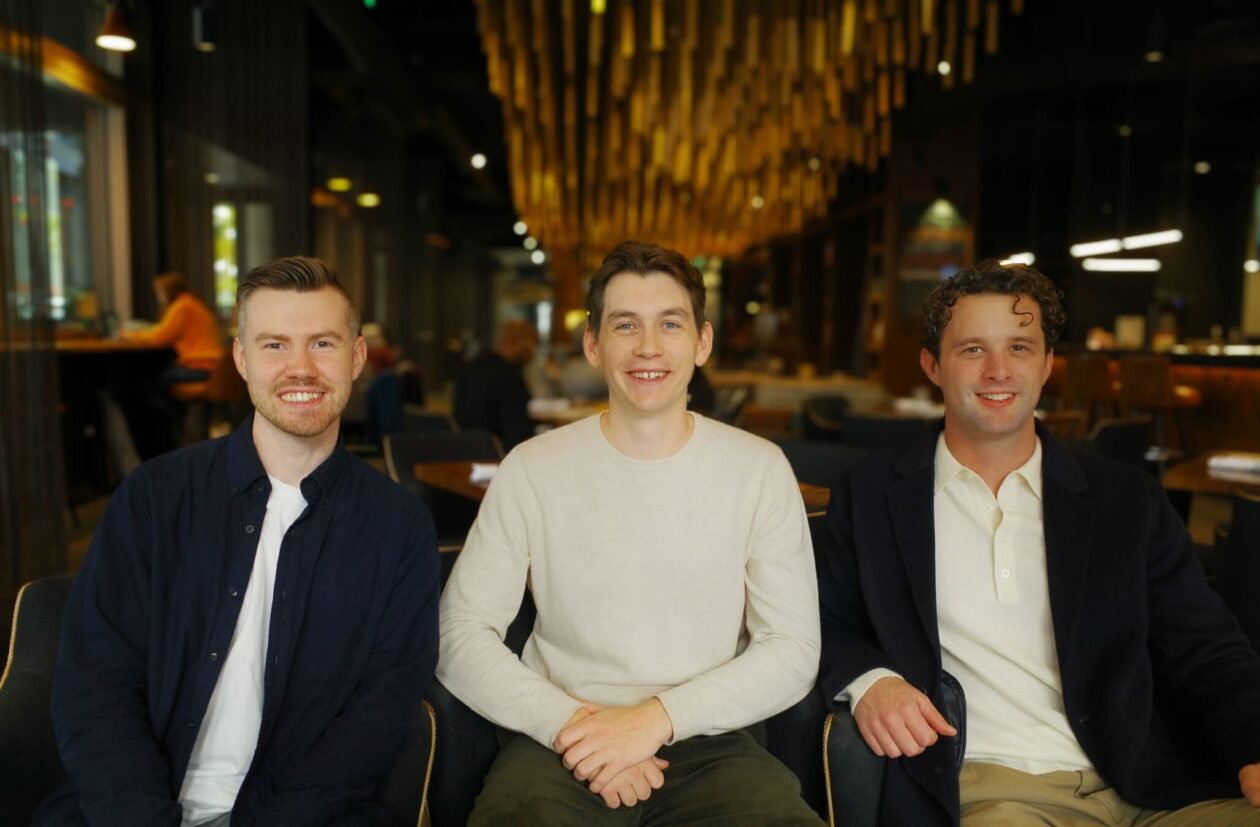
Levanta co-founders, from left: Spencer McKenney, Ian Brodie, and Rob Schab. (Levanta Photo)

Levanta was founded in 2023 by Brodie, CTO Spencer McKenney and Chief Marketplace Officer Rob Schab, all University of Washington graduates. The three previously founded Grovia.io, an affiliate marketing company that was acquired by Acceleration Partners in 2022.

With more than 100 employees, Levanta is the rare startup that has already reached profitability with Brodie telling Business Insider that it has been profitable or roughly break-even since its launch. With the new funding, it also provided cash liquidity to some eligible employees.

“This is a milestone moment for Levanta and it reflects how far the company has come and the value our team has created together,” Brodie said in the release. “At the same time, it allows us to reward the people who have been instrumental in building the foundation of the business while ensuring they remain deeply aligned with where we’re going next as we continue building Levanta for the long term.”

The new funding will support expansion to additional retail marketplaces and international growth.

Previous Levanta backers include Long Run Capital, OpenSky Ventures and Arrived Homes CEO Ryan Frazier. The latest series B round brings Levanta’s total funding to more than $43 million.

AI is hitting entry-level jobs hardest, Stanford study finds

For years, AI industry watchers of all stripes have been warning of a coming jobs apocalypse driven by ultra-intelligent AI systems that will be able to replicate most human tasks more cheaply. Now, newly updated research from Stanford University economists suggests AI seems to be causing significant entry-level job losses for younger workers in some fields, even as older workers appear largely unaffected so far.

The August 2026 edition of "Canaries in the Coal Mine? Six Facts about the Recent Employment Effects of Artificial Intelligence" updates and revises a paper of the same name published last year with fresh data and refined statistics. In that update, the Stanford researchers find the employment trends they identified for entry-level workers last year are persisting and expanding. Specifically, employment levels for workers ages 22 to 25 in the most "AI-exposed" occupations are now 19 percent below those of their peers in fields less exposed to AI disruption.

Last year, that gap measured just 13 percent.

Read full article

Comments

© Getty Images

Seattle keeps No. 2 spot in closely watched tech talent ranking, with warning signs

Seattle remains a beacon for tech talent, ranking No. 2 in CBRE’s annual report. (GeekWire File Photo / Kevin Lisota)

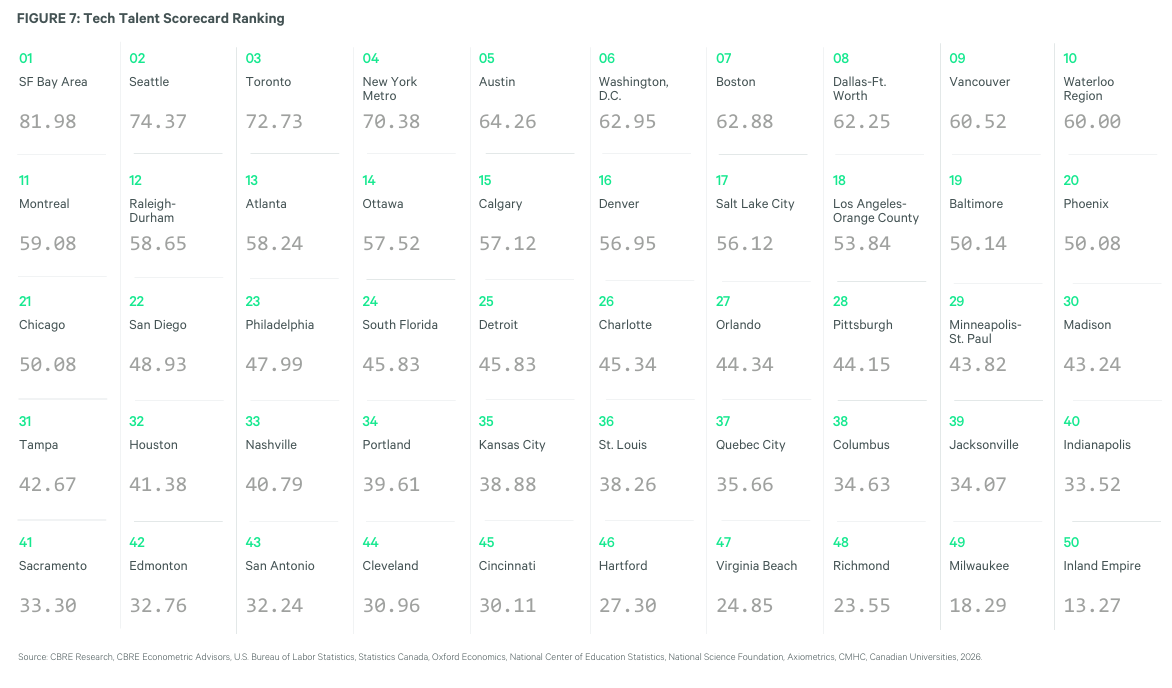
The Seattle region outranked New York, Austin, Boston and other tech hubs, trailing only the Bay Area, in an annual tech talent scorecard from commercial real estate firm CBRE that weighs factors such as tech worker concentration, wages, education levels and real estate costs.

You may have seen headlines this week that New York overtook the Bay Area for the first time in the CBRE rankings. That was based on a subset of the data: a straight head count in each market. New York’s 394,300 tech workers topped the Bay Area’s 375,730. Seattle ranks seventh on that specific list, with 213,010 tech workers across the region.

But in the broader scorecard, Seattle held onto the No. 2 spot (which it also occupied last year), thanks to the density of its tech workforce, one of the largest concentrations of AI talent in North America, and the second-highest tech wages on the continent.

CBRE’s 2026 Tech Talent Scorecard ranks 50 North American markets on 13 weighted metrics. Seattle placed second with a score of 74.37 behind the Bay Area at 81.9. (CBRE Graphic, Click to Enlarge, and see full report here.)

The market-by-market workforce figures in the report run through 2025, so this year’s layoffs aren’t reflected in the rankings. CBRE does flag the trend nationally: the tech industry accounted for a record 31% of all U.S. job cuts through June, up from 13% for all of last year.

Some of the Seattle region’s specific strengths:

The AI workforce is deep. Seattle is home to 41,591 workers with AI skills, third most in North America, behind the Bay Area and New York. One in five of the region’s tech workers now has AI skills — a higher share than anywhere except the Bay Area.

Tech is a bigger part of the economy here. Tech jobs make up 10.2% of all employment in the metro area, among the top five markets and nearly double the 5.5% average across the 50 markets studied in the CBRE report.

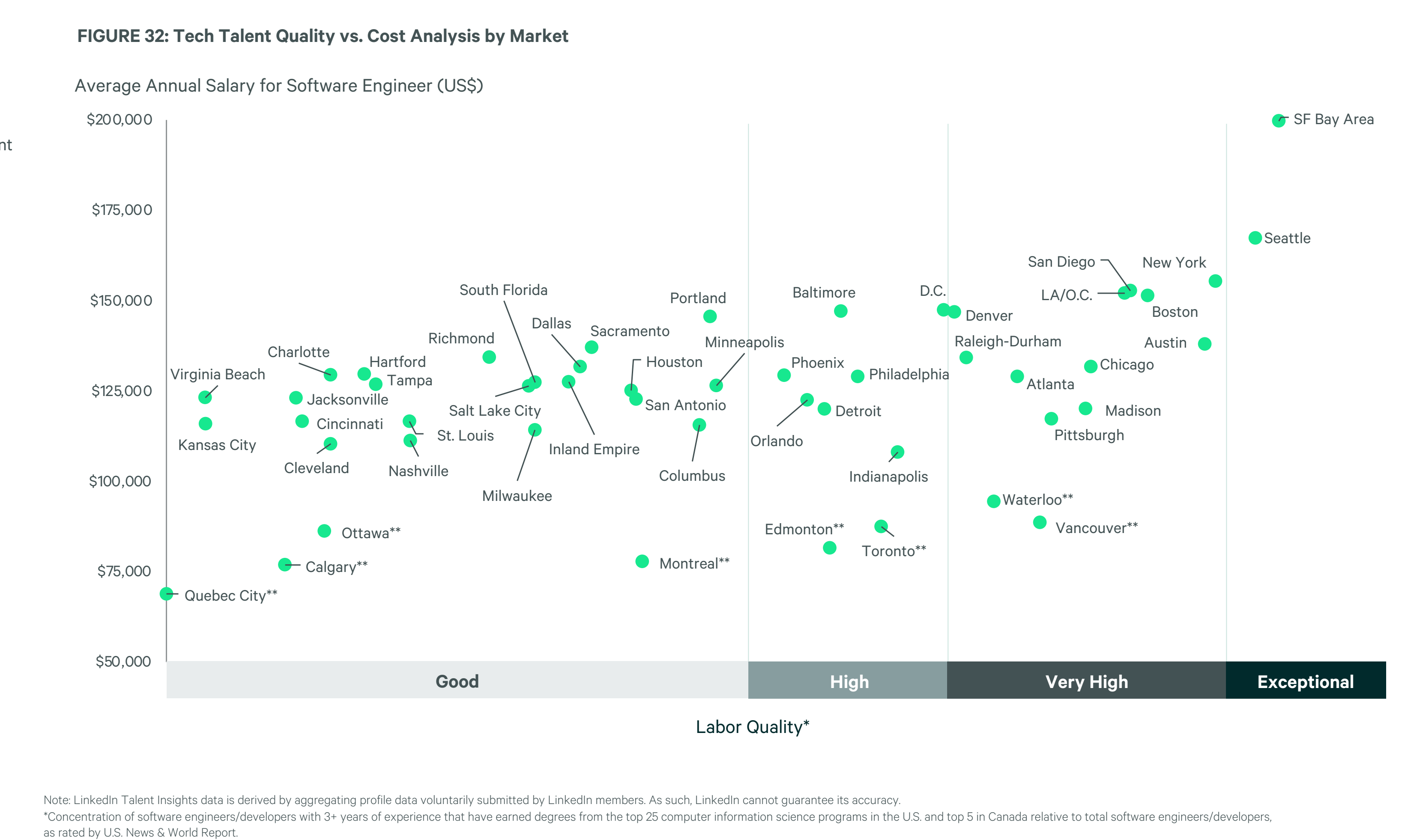
Wages are in a tier of their own. Seattle’s average wage for tech workers at tech companies was $190,050 in 2024, second to the Bay Area’s $211,048, and nearly $50,000 above third-place Boston.

The workforce grew while the Bay Area’s shrank. Seattle added 24,590 tech jobs from 2022 to 2025, a 13.1% increase and the fifth-largest gain of any market. The Bay Area lost 23,900 jobs over the same time period.

However, the report also points to warning signs:

Many offices are sitting empty. The Seattle metro area’s office vacancy rate hit 28.6% in the fourth quarter of 2025 — the highest of the 50 markets in the report. That’s despite 1.9 million square feet leased by AI companies across the region since 2023, according to CBRE.

Costs are near the top. Seattle is the third-most-expensive place to run a 500-person tech company, at $73.9 million a year in wages and office rent, behind the Bay Area at $90.6 million and slightly behind New York, which edged Seattle by about $24,000.

Seattle and the San Francisco Bay Area are the only two markets CBRE rates “exceptional” for software engineering talent. They’re also the two most expensive. (CBRE Graphic, Click to Enlarge, and see full report here.)

Young workers are going elsewhere. Seattle’s 20-something population fell between 2019 and 2024, even as its share of 30-somethings grew to the highest of any market in the report. The region is drawing mid-career but not entry-level talent, which risks creating a thinner pipeline over time.

One counterweight to the pipeline concern: the University of Washington ranks fifth among U.S. universities for its AI program, according to CBRE’s analysis of U.S. News & World Report rankings — the only school outside the Bay Area, Boston and Pittsburgh in the top five.

Access the full CBRE Scoring Tech Talent 2026 report here.

This former Amazon exec is moving his startup’s HQ to Texas, and he has a few notes for Seattle

Auger co-founders Leigh Anne Clark and Dave Clark at the company’s Bellevue, Wash., office. (GeekWire File Photo / Todd Bishop)

One of the Seattle region’s most notable tech startups is moving its headquarters to Texas.

Supply chain technology startup Auger will maintain a major engineering office in Bellevue, Wash., where it got started. But the company’s co-founder and CEO, Dave Clark, the former Amazon operations chief, is officially back in Dallas, and he took the company’s HQ with him.

Founded in 2024, Auger has raised $150 million, including a $50 million Series B round led by Eclipse in July. Its software connects the systems that companies use to run their supply chains, integrating AI to help automate them. Its customers include Meta, Fanatics and Kimberly-Clark.

Clark, in an interview with GeekWire, said the move is about talent and family, not taxes. For one thing, Texas happens to better suit him and Auger co-founder Leigh Anne Clark, his wife. They’re running toward something rather than away, he said. They both grew up in the Southeast, and they had always intended to return to Texas at some point.

“I’d rather have a really hot month of August than a really gray month of February,” he said.

Dallas is also a place where you run into supply chain specialists at the coffee shop like you do software engineers in Seattle, he said. That’s a key talent pool for Auger at this stage in its evolution. Another bonus: Texas is more central to corporate customers across the country.

The magazine D CEO in Dallas, which first reported the news of Auger’s HQ relocation this week, noted that the company did not seek state or local incentives as part of the move.

Clark confirmed in the GeekWire interview Tuesday that taxes weren’t a factor, noting that he couldn’t even quantify what the tax advantages would be. However, he said, “There’s a lot I like about the way the state of Texas manages and works with business.”

When asked what he would say to people in Seattle who might see another warning sign in a startup like Auger moving its HQ somewhere else, he didn’t shoot down the premise.

“If you’re in that position, I think you’re right to be worried, in the sense that there’s a lot of discussion about things in the state of Washington and Seattle that are not particularly friendly to business,” he said.

Washington state lawmakers approved a “millionaires tax” this year, a 9.9% levy on personal income above $1 million. Seattle Mayor Katie Wilson drew criticism from some in tech after saying of wealthy residents who leave the state, “like, bye.”

Clark didn’t point to any particular policy or issue but said he has sensed an “anti-business” sentiment that concerns him since moving back to the Seattle area from Texas to launch Auger.

“Seattle should just be careful,” he said. “It’s not preordained that they win these things. It’s not preordained that these big companies stay in town.”

The Pacific Northwest has enormous resources to compete globally, he added, and there’s no reason it shouldn’t be “a phenomenal draw to anybody and everybody coming in.”

The region has “many, many strengths, and we should leverage them to the advantage of the community,” he said. “And sometimes I think the rhetoric gets in the way of it.”

Auger has about 115 people in Bellevue — engineers and supply chain data scientists — and Clark said he expects that office to grow 20% to 30% over the next year or two. He and Leigh Anne will both be back there regularly, he said, working alongside the team.

“Nothing’s changing there,” he said.

The company’s new HQ in North Dallas occupies part of the 15th floor of One Galleria Tower, centrally located between neighborhoods north and south of the city, with a quick run to DFW International Airport, as Clark pointed out in the D CEO article.

The office currently has about 15 people, most hired in recent months for sales, go-to-market and supply chain roles. Many of them had been traveling to Bellevue until the new space opened. Clark expects to add another 20 to 30 people in Dallas by the middle of next year.


As in Bellevue, where Auger subleased its space from Microsoft and bought the furniture for $1, the Dallas office came furnished. This time the furniture cost $10. (There goes Texas’ reputation for affordability.)

“It cost me 10 times more for the furniture in Dallas,” Clark joked. “I like nice things, cheap.”

Clark spent 23 years at Amazon, rising to lead its global operations and later its worldwide consumer business, and was one of the chief architects of the logistics network behind the company’s delivery operation. He left in 2022 to become CEO of Flexport, departing the freight startup the following year, before starting Auger.

Leigh Anne Clark is Auger’s president of fashion and beauty, leading the company’s work in an industry known for waste-prone supply chains. The couple, who met in Kentucky in 2000 while Dave Clark was at Amazon, have two sons, ages 14 and 11.

With its rapid hiring and significant early funding rounds, Auger rose quickly to No. 31 on the GeekWire 200, our ranking of Pacific Northwest tech startups. Because the GeekWire 200 is limited to companies based in the region, the headquarters move puts Auger’s standing in jeopardy.

Informed of this predicament, Clark made his pitch to stay on. “We still have a lot of dev there,” he said of the Bellevue office. “I think you get grandfathered into the list in some way, right?”

Meanwhile, the business keeps growing. Clark said Auger signed two major contracts Tuesday with customers he declined to name. The Bellevue office marked them with a bell-ringing, and the two offices celebrated together over a video call. A second bell is on order for Dallas.

“We’ll have dual bells that we’ll ring together,” Clark said.

❌