❌

Reading view

There are new articles available, click to refresh the page.

Bigger than Bing or Xbox: Microsoft’s OpenAI haul reaches $10B in quarterly revenue

Sam Altman and Satya Nadella shake hands on stage in front of the OpenAI logo
OpenAI CEO Sam Altman and Microsoft CEO Satya Nadella at OpenAI’s DevDay in November 2023. (GeekWire File Photo / Todd Bishop)

OpenAI generated $10 billion in revenue for Microsoft in the quarter ended Sept. 30, about 11% of the Redmond company’s total revenue, according to its quarterly filing Wednesday.

The amount is up sharply. In the fiscal year that ended in June, Microsoft recorded $24.1 billion in revenue from its business with OpenAI, or about $6 billion a quarter on average.

That $10 billion surpasses some of Microsoft’s longest-running businesses. Xbox brought in $5.4 billion in the quarter. Search and advertising, which includes its Bing search engine, generated $6.6 billion. Windows licenses sold through PC makers, along with Surface and other Microsoft devices, brought in $3.6 billion.

The total covers revenue-sharing payments from OpenAI, as well as other business between the companies, such as OpenAI’s use of Azure to train and run its AI models. Microsoft didn’t say how much came from each, or how much of Azure’s growth came from OpenAI.

Azure revenue rose 48% to $33.2 billion in the quarter, beating Wall Street’s expectations and the company’s own forecast of 44% to 45% growth.

Microsoft has begun disclosing its revenue from OpenAI because its stake of about 24% makes OpenAI a “related party” under accounting rules, requiring it to report the business they do with each other.

Microsoft first reported the number in its annual report in July, as a full-year total. This is the first time it has given a quarterly figure.

The original AI alliance: Microsoft first invested in OpenAI in 2019, eventually committing $13 billion, and became its exclusive cloud provider. ChatGPT ran on Azure when it launched in late 2022.

The companies have loosened their ties since then. OpenAI restructured as a public benefit corporation in October 2025, and Microsoft gave up its right of first refusal to supply OpenAI’s computing capacity. OpenAI committed to buy an additional $250 billion in Azure services. An April 2026 agreement gave OpenAI broader freedom to use other cloud providers.

OpenAI has also agreed to keep sharing revenue with Microsoft through 2030.

In addition, Microsoft sells access to OpenAI’s models to business customers through its Azure OpenAI Service, and the models became the foundation for its Copilot products, putting Microsoft at the front of the generative AI boom. That revenue comes from Microsoft’s own customers, so it isn’t part of the $10 billion.

Microsoft, for its part, now builds its own AI models and offers models from Anthropic and others.

Many customers, not a few: Asked by Bernstein Research analyst Mark Moerdler whether AI growth on Azure was coming from big businesses or AI-native companies, Microsoft CEO Satya Nadella didn’t mention OpenAI.

He said he doesn’t want Azure’s AI business to depend on a few big customers, and that broad adoption by businesses is just getting started.

Nadella described it as “a decade-long thing,” and contrasted it with relying on “four customers who buy a lot of capacity from you” to show a few quarters of growth. That, he said, is “not a business as far as I’m concerned.”

He added that Microsoft has large customers who want to buy capacity, “and as long as the pricing is right, we may sell them some. If not, we will be patient.”

Later in the call, Goldman Sachs analyst Gabriela Borges brought up the fact that OpenAI made up 11% of revenue. Nadella didn’t address the number but praised OpenAI’s latest models and said customers are increasingly mixing models from different companies, or training their own.

He cited Microsoft’s tools for routing each task to whichever AI model handles it best. If you use AI coding agents, Nadella said, you want Anthropic and OpenAI “to compete for your workload, not like once a quarter, but for every task.”

New risk language: Microsoft also expanded a warning in its quarterly filing about the risks of depending on outside AI providers. The company builds products such as Copilot on AI models from outside companies, including OpenAI and Anthropic. It now says it has “limited visibility into or control over” how those models are designed, trained, secured and tested.

Without naming OpenAI or Anthropic, the same section notes that some of these AI partners are also “significant customers of Azure,” and that the benefits Microsoft expects from those relationships “may not be realized or sustained.” It says those partners could change how much they buy, and that Microsoft itself may change how it allocates scarce data center capacity or prices it.

Microsoft is an investor in both companies. According to its latest filing, it owns about 24% of OpenAI, down from about 25% in June and about 27% after OpenAI’s restructuring a year ago, and has put $12.0 billion of a promised $13.0 billion into the company.

In addition, Microsoft agreed last year to invest up to $5 billion in Anthropic, and its results for the June quarter included a $3.2 billion gain on that investment. Microsoft hasn’t disclosed the size of its Anthropic stake, and Anthropic’s IPO filing earlier this week didn’t specify it either.

Microsoft Azure revenue surges 48% to $33.2B, beating expectations as cloud and AI demand grows

A gray baseball cap embroidered with the Microsoft logo and the words Microsoft Azure.
Microsoft broke out Azure’s quarterly revenue for the first time in its new financial structure. (GeekWire File Photo / Todd Bishop)

Microsoft’s Azure cloud business brought in $33.2 billion in revenue in the September quarter, up 48% from a year earlier, blowing past the company’s own forecast and beating Wall Street’s expectations.

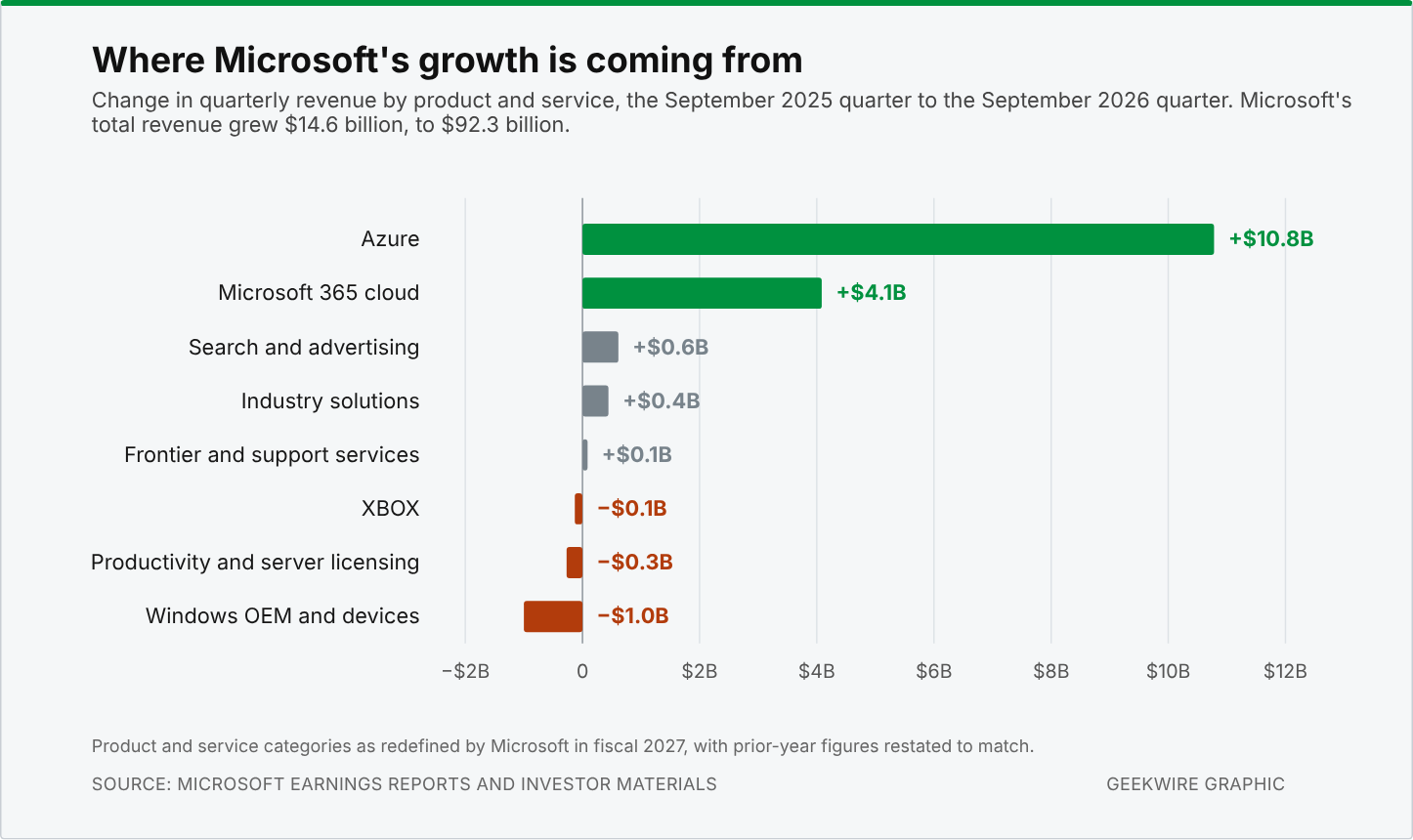
The growth suggests that Microsoft is selling cloud and AI computing about as fast as it can install it. Azure revenue rose $10.8 billion from a year earlier, driven by demand for services across the platform, Microsoft said in its quarterly filing. That came even as some new data center capacity arrived late.

For investors worried about Microsoft’s record capital spending, it’s a sign that the company’s massive AI and cloud infrastructure buildout is turning into sales. Microsoft’s shares rose nearly 4% in after-hours trading following the earnings report.

Overall, Microsoft reported revenue of $92.3 billion for the first quarter of its 2027 fiscal year, up 19% and above the $90.75 billion analysts expected, according to Yahoo Finance. Earnings were $4.89 per share excluding the impact of its OpenAI investment, compared with expectations of $4.72.

It’s the first time Microsoft has reported Azure’s quarterly revenue figure, not just its growth. The disclosure is part of a new financial structure that took effect this quarter, splitting the company into two segments: Agents and Infra, and Devices and Consumer.

  • Agents and Infra (Azure, Microsoft 365, Dynamics, LinkedIn’s recruiting and sales tools, and server and productivity licensing): Revenue rose 25% to $76.8 billion, above Microsoft’s forecast of $75.15 billion to $75.75 billion. Operating income rose 24% to $40.6 billion.
  • Devices and Consumer (Windows, Xbox, and search and advertising): Revenue fell 3% to $15.5 billion, above Microsoft’s forecast of $14.7 billion to $15.2 billion. Operating income rose 2% to $5.4 billion.

Capital spending came in below Microsoft’s forecast. The company spent $45.2 billion, including finance leases, short of the more than $50 billion it expected. Some data center capacity that third parties were supposed to deliver in the quarter was delayed, the company said.

Google Cloud, which includes Google’s Workspace productivity apps, brought in $30.7 billion in revenue in the quarter, up 103% from a year earlier, Alphabet reported Wednesday afternoon.

Amazon reports earnings Thursday afternoon, including AWS results.

Update, 3:05 p.m.:Microsoft expects Azure growth to accelerate again this quarter, to 49% to 50% excluding currency changes, CFO Amy Hood said on the earnings call. “Customer demand continues to exceed available supply,” she said.

Hood said Azure’s growth came from Foundry, Microsoft’s service for building AI apps and agents, and from engineering work that let Microsoft sell unused capacity on its existing servers. That helped make up for delays in new data center capacity that outside providers were supposed to deliver.

Those delays pushed some spending later into the fiscal year. Microsoft now expects to spend about $170 billion on capital expenditures in calendar 2026, down from about $175 billion. It expects to spend more than $50 billion this quarter, and Hood said spending will accelerate in the first half of calendar 2027.

Hood also said Microsoft may tap additional sources of financing to help pay for the buildout, “when we believe it is attractive to do so.” The company still expects to bring in more cash than it spends this fiscal year.

Microsoft’s expense forecast for the December quarter includes an estimate for the buyout offer it announced Monday, Hood said, though she didn’t give the amount.

The company expects total revenue of $96 billion to $97.1 billion for the December quarter, above the $95.7 billion analysts expected, according to Yahoo Finance.

F5 stock suffers worst day in more than a decade as AI spending shakes investors

The red F5 logo displayed behind glass above the entrance to F5 Tower in Seattle
F5’s logo at the entrance to F5 Tower in downtown Seattle. The company’s stock fell about 20% Wednesday after it forecast slower growth and lower margins, along with more spending on AI security. (GeekWire Photo / Todd Bishop)

Shares of F5 fell about 20% on Wednesday, a day after the Seattle-based company beat Wall Street’s estimates and said it would boost spending to capitalize on expected growth in the AI security market.

The application security and delivery company’s stock was trading around $368 late Wednesday morning, down from $459 at Tuesday’s close, wiping out about $5 billion in market value. That put F5 on pace for its biggest one-day drop in more than 13 years, according to Barron’s. Before the drop, F5’s shares had climbed nearly 80% this year.

F5’s revenue for its fiscal fourth quarter rose 13% to $917 million, and product revenue jumped 23%. Adjusted earnings of $4.42 a share beat estimates of about $4.30.

Slower growth ahead: Investors seem to be focused on the outlook. F5 expects revenue to grow 8% to 9% in fiscal 2027, down from 11% this year, and adjusted earnings per share to grow 3% to 5%. It’s also projecting lower margins as memory and storage components get more expensive, and as it doubles its team of AI security sellers.

F5’s hardware business is also cooling off. Systems revenue jumped 29% in the quarter as customers replaced aging equipment, but F5 Chief Financial Officer Cooper Werner said on the earnings call that those replacements will taper off in the second half of fiscal 2027.

The AI bet: F5 is spending more to go after AI security. CEO François Locoh-Donou said on the call that the company will double its team of specialist AI security sellers in fiscal 2027 and more than double its marketing in that area. It’s also adding compensation incentives for all of its field sellers to discuss AI security with customers.

F5’s adjusted operating margin fell to 33.7% in the quarter, from 37% a year earlier.

Locoh-Donou said F5’s AI-related bookings topped $100 million in fiscal 2026, up about 300%. Most of that came from AI data delivery, which moves data to and from AI systems, rather than security. More than 300 customers are using an AI-powered web application firewall that F5 launched in March.

The company estimates the AI market it sells into will grow from about $1 billion this year to $11 billion by 2030.

Wall Street reaction: Piper Sandler downgraded the stock to neutral, according to The Motley Fool. Analysts at William Blair, which rates F5 “market perform,” wrote in a research note that “the AI opportunity has yet to contribute meaningfully to the top line.”

We’ve contacted F5 for comment on the stock decline.

F5 has been building out its AI security business, including its acquisition of SurePath AI. Locoh-Donou talked about the company’s path from the early web to AI security on a GeekWire Podcast episode marking F5’s 30th anniversary. He said companies adopting AI are losing track of what those systems can access, and that juggling separate tools to manage it is a burden, which is why F5 is building a single AI security platform.

This week, F5’s board authorized an additional $1.5 billion in stock buybacks, on top of $322 million remaining in its existing program.

Amazon earnings preview: AWS is booked up, and Wall Street wants to know what comes next

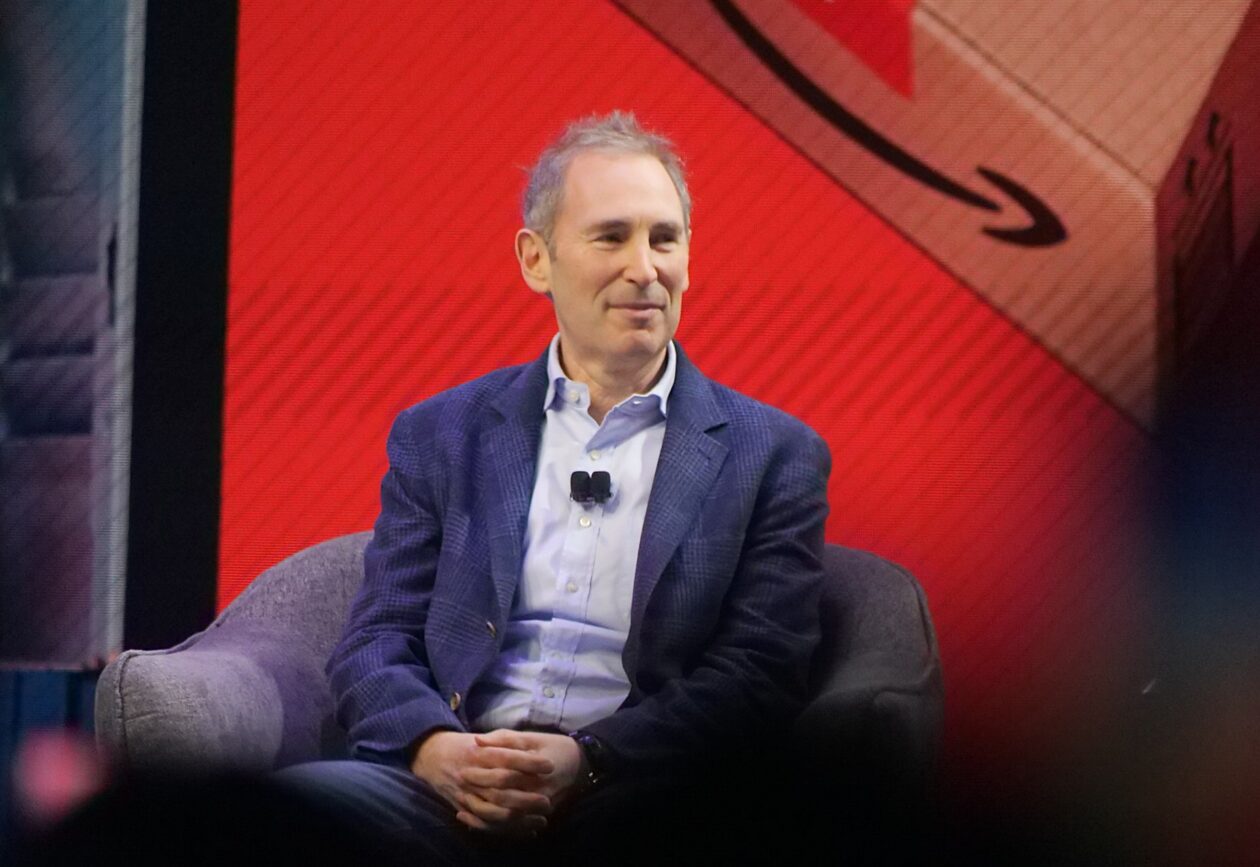
Amazon CEO Andy Jassy smiles while seated onstage in front of a red screen showing the Amazon logo.
Andy Jassy says Amazon “could invest a lot more” in AI infrastructure “and it wouldn’t be a bad use of capital.” (GeekWire File Photo / Todd Bishop)

Amazon reports third-quarter earnings Thursday afternoon with more demand for its cloud services than it can serve, driven by AI labs such as Anthropic and OpenAI along with growth in its traditional cloud business.

One big question for Wall Street going into the report is what Amazon might signal about next year’s spending as it tries to keep up with that demand.

CEO Andy Jassy said on an Andreessen Horowitz podcast last week that AWS capacity is largely booked for this year and next, along with “a good chunk of ’28.”

Amazon has said it expects to spend about $220 billion on capital expenditures this year, largely on AI and cloud infrastructure, up from its earlier plan of $200 billion. Even at that level, Jassy said, Amazon is “leaving a meaningful amount of demand on the table.”

Past spending pushed Amazon’s free cash flow to negative $7.6 billion for the 12 months ending in June, as the cost to add data centers, chips and other equipment exceeded the cash its operations brought in. Jassy gave no indication of slowing down, saying the company “could invest a lot more and it wouldn’t be a bad use of capital.”

Core numbers: Analysts expect revenue of about $202 billion, up 12% from a year ago, according to Yahoo Finance. That’s at the top of Amazon’s own forecast of $197 billion to $202 billion.

Analysts expect earnings of $1.96 per share, about the same as a year ago.

Amazon’s sales growth will likely look slower this time, about 12%, down from 20% last quarter. A big reason is timing. Prime Day, the company’s biggest sales event of the year, fell in the second quarter this year, rather than the third quarter as it did last year, so this quarter is up against a tougher comparison.

Amazon estimated in July that the shift would take nearly 4 percentage points off its growth rate this quarter. It hits online store sales hardest: analysts expect them to grow only about 3%, according to Zacks.

AWS: Amazon Web Services, the company’s cloud business, generates the majority of its operating profit. AWS revenue grew 37% to $42.2 billion in the second quarter, its fastest pace since 2021 and the fifth straight quarter of faster growth.

Analysts expect AWS revenue of about $45.4 billion this time, up 37.5%, according to Zacks. Wedbush is more optimistic, projecting growth of about 41%.

AWS had $496 billion in signed contracts it hadn’t yet delivered as of June, more than double the year before. That means its growth depends largely on how quickly Amazon can bring new data centers online.

“Capacity, not demand, is the constraint,” Yorkville Ives analyst Dan Ives wrote of the industry in a note Sunday.

Jassy said on the a16z podcast that running AI models is still “an order of magnitude too expensive” for businesses to use them widely, and that Amazon’s custom chips, including its Trainium AI processors, are a big piece of bringing that cost down. Amazon said in July that its chip business was on pace for more than $25 billion in annual revenue.

Anthropic stake: Amazon’s reported earnings could look very different. That’s because its profit fluctuates significantly depending on the value of its stake in Anthropic.

Last quarter, $53.4 billion in pre-tax gains, mostly on Anthropic, pushed Amazon’s earnings to $5.75 per share, against expectations of $1.82.

Anthropic filed paperwork Monday for a planned IPO on the Nasdaq. Amazon’s stake in the AI company was valued at about $190 billion as of June 30, according to Amazon’s latest quarterly filing. That includes about $92 billion in gains on convertible notes, a form of loan that turns into stock, which haven’t yet been counted in Amazon’s profit. Those notes would convert to Anthropic stock when it goes public.

Anthropic is also one of Amazon’s biggest cloud customers. Its IPO filing shows commitments to spend at least $110 billion on Amazon’s computing capacity into the 2030s, behind the $114.5 billion it committed to Google, as GeekWire reported Tuesday. Anthropic also said in the filing that it has asked its cloud providers for more computing power than they were willing to supply.

Shopping agents: Amazon blocked Meta’s new Muse AI agent from its store last month, escalating a fight over who controls the customer relationship when software does the buying. Amazon said Muse broke its rule requiring agents to identify themselves.

Agents that shop on a customer’s behalf could bypass Amazon’s advertising business, which depends on people browsing its pages. Ad revenue grew 26% to $19.8 billion last quarter, and analysts expect about $20.8 billion this time, up 18%, according to Zacks.

“Investor questions remain on agentic commerce risk, particularly to advertising, but we see limited risk,” Wedbush analyst Ygal Arounian wrote in an Oct. 16 note, citing Amazon’s logistics advantage and its role connecting shoppers with sellers.

Amazon is trying to give shoppers fewer reasons to look elsewhere. It now lists 250 million products sold on other retailers’ sites, about 2.5 times as many as in March, The Information reported Wednesday. On the seller side, Amazon opened its tools to outside AI agents in September, starting with Anthropic’s Claude.

Cloud rivals: Microsoft and Alphabet report quarterly results Wednesday afternoon, a day before Amazon. Microsoft’s report is its first under a new structure that breaks out Azure cloud revenue every quarter.

Check back with GeekWire on Thursday afternoon for coverage.

Microsoft earnings preview: Employee buyouts, AI spending and a new financial scorecard

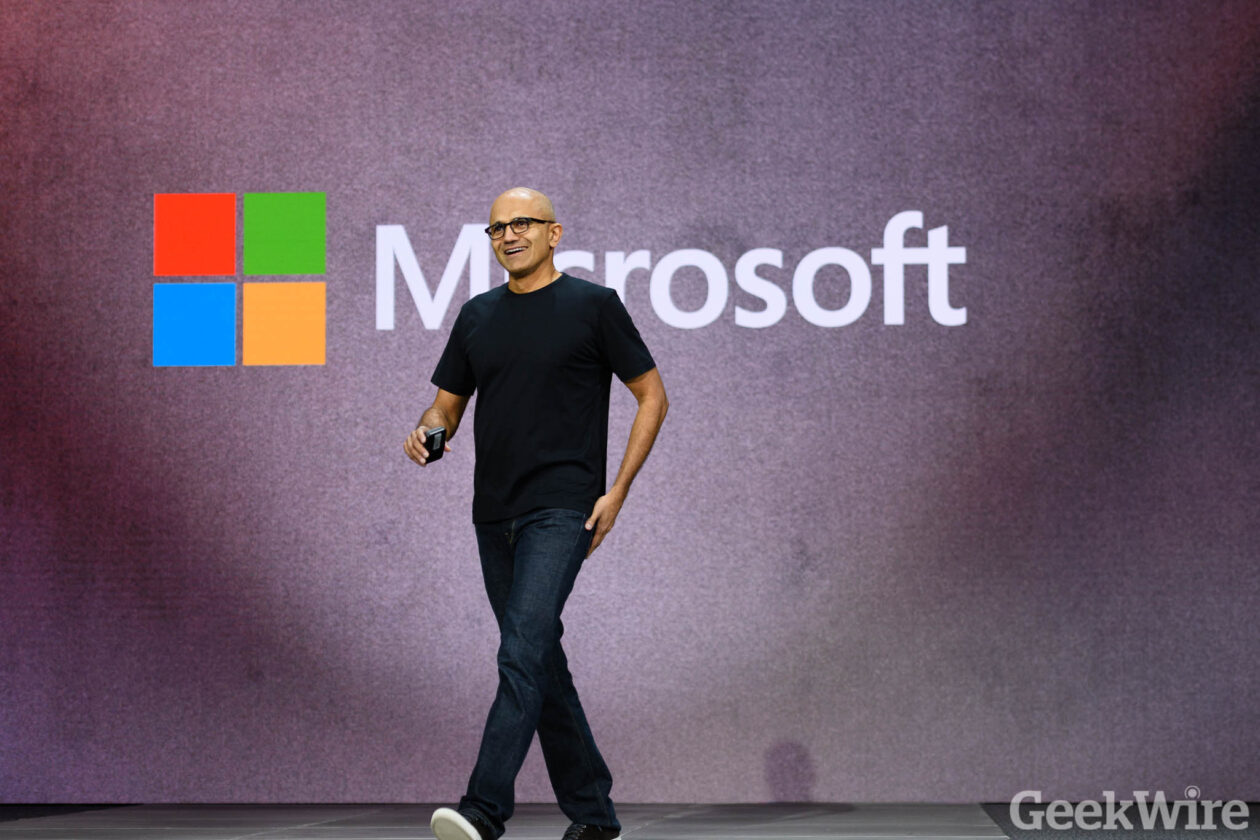
Satya Nadella walks across a stage in front of a large Microsoft logo.
Satya Nadella & Co. report quarterly earnings under a new financial structure Wednesday. (GeekWire File Photo / Kevin Lisota)

Update, 10/28: Microsoft’s Azure cloud business brought in $33.2 billion in revenue in the September quarter, up 48% from a year earlier, blowing past the company’s own forecast and beating Wall Street’s expectations. Read the full story.


Microsoft’s earnings report Wednesday will come two days after the company offered buyouts to about 60,000 people, roughly a quarter of its employees. The call gives executives their first chance to say what the offer will cost, and to explain how it fits with the company’s long-term view of its workforce.

Whether or not they go into those details, it’s one of several issues to watch in Wednesday’s report, the first under Microsoft’s new reporting structure. Anthropic’s IPO filing on Monday adds another storyline, showing how much the Claude maker has agreed to spend on Microsoft’s cloud.

Coming into the report, Microsoft’s stock is near its high. Microsoft closed Monday at $532.60, about 2% below its record close of $543.45 on Oct. 13, after gaining roughly $1.4 trillion in market value since late June.

Here are the key numbers and issues heading into Microsoft’s results for the first quarter of its 2027 fiscal year, ended Sept. 30.

Core numbers: Analysts expect revenue of $90.75 billion, up nearly 17% from a year ago, and earnings of $4.72 per share, up 14%, according to Yahoo Finance. Microsoft’s own forecast was $89.85 billion to $90.95 billion, so Wall Street is looking for a result near the top of that range.

In July, Microsoft reported $90 billion in revenue for the June quarter, well above the $87.7 billion analysts expected.

A new scorecard: Microsoft announced in September that it would sort its business into two groups instead of the three it had used since 2015. This is the first quarter under the new setup.

The first, dubbed Agents and Infra, includes Azure, Microsoft 365, Dynamics, LinkedIn’s recruiting and sales tools, and server and productivity licensing. It brought in 81% of Microsoft’s revenue and 88% of its operating income in fiscal 2026, based on figures Microsoft recast under the new structure.

Microsoft expects Agents and Infra revenue of $75.15 billion to $75.75 billion this quarter, which would be growth of about 22% to 23%, by GeekWire’s calculation.

The other group, Devices and Consumer, includes Windows, Xbox and search advertising. Microsoft expects it to bring in $14.7 billion to $15.2 billion, down 5% to 8% from a year earlier.

Azure, in dollars: Microsoft started disclosing Azure’s annual revenue last year, when it passed $75 billion, and topped $100 billion in fiscal 2026. Starting this quarter, it reports the figure every quarter. It also changed what counts as Azure: GitHub’s cloud business and Security Copilot now fall under Microsoft 365, and its healthcare cloud moved to a new industry unit.

Counted that way, Azure brought in $29.4 billion in the June quarter, up 42%. Microsoft expects growth of 44% to 45% this quarter, not counting currency fluctuations, which would put Azure at roughly $32 billion, by GeekWire’s calculation. That compares with the roughly 45% Microsoft projected in July, under the old definition.

Hitting that forecast may not be enough. Investors are looking for about 46%, BNP Paribas analyst Stefan Slowinski wrote in a note Monday. In January, Azure beat Microsoft’s own forecast and the stock still fell 10%, because investors had privately expected more.

“Azure moves the stock, but the read that matters is whether capacity is absorbed as fast as it lands,” wrote Dan Ives of Yorkville Ives in a note last week.

Capital spending: Microsoft expects capital expenditures of more than $50 billion for the quarter, which would be a record. That’s up from $41 billion in the June quarter and $34.9 billion a year earlier.

An accounting change reduces what Microsoft reports as capital spending, without reducing its planned investment. Microsoft now assumes its data center buildings will last 25 years instead of 15. As a result, more of its data center leases will be classified in a way that doesn’t count as capital spending, CFO Amy Hood said on the July earnings call.

That change alone lowered Microsoft’s capital spending estimate for calendar 2026 to about $175 billion, from the roughly $190 billion it projected in April. Hood said the company’s actual spending plans hadn’t changed.

Cloud margins: Microsoft Cloud gross margin came in at 65% last quarter, better than expected but down from a year earlier. Microsoft said it expects the figure to be relatively stable this quarter. It also expects operating margins to be roughly flat with a year ago.

Workforce: The new “voluntary exit” offer, announced Monday by Chief People Officer Amy Coleman, covers participating teams in the U.S., Canada, the U.K. and India. It has no age or tenure requirement and extends to some vice presidents. Employees have until the first week of December to decide, and Microsoft hasn’t said how much the offer will cost or when it will record the charge.

For the spring retirement program, Hood disclosed the cost on the April earnings call: about $900 million, with roughly $350 million in cost of revenue and $550 million in operating expenses. The charge showed up in the following quarter. About 30% of the 8,750 eligible employees accepted.

The new offer is less generous. It matches Microsoft’s standard severance, without the extended healthcare of the spring program, and the company expects a much smaller share of people to take it. But the pool of eligible employees is nearly seven times larger.

Microsoft says the offer doesn’t mean it needs fewer people. Coleman said in July that the company was studying whether to make voluntary exits a regular part of managing its workforce. It has told investors to expect operating margins roughly flat this quarter and down less than a point for the full fiscal year, even with record capital spending.

Nadella has addressed this before. In a July 2025 memo to employees, after Microsoft laid off about 15,000 people, he acknowledged the “uncertainty and seeming incongruence” of thriving financially while cutting jobs. “This is the enigma of success in an industry that has no franchise value,” he wrote.

In his annual shareholder letter last week, he focused on Microsoft’s spending on AI infrastructure. “Based on the demand we see and the efficiencies we are driving, I am confident in the long-term returns on our investments,” Nadella wrote. “We are building against a growing book of business tied to this secular shift.”

Microsoft had about 223,000 employees as of June 30, before it cut 4,800 jobs in July and more in September. The Information reported this month that Azure President Girish Bablani told leaders in his group to find ways to cut costs by at least 20%. Microsoft called the report inaccurate and said Azure leadership had not directed teams to develop cost-cutting plans.

Copilot: Microsoft said in July that businesses were paying for more than 30 million Microsoft 365 Copilot seats, up from 20 million in April. That’s still only about 7% of the more than 450 million commercial Microsoft 365 seats.

The bigger change is in how Microsoft charges for Copilot and its other AI tools. In July it added usage-based billing alongside per-seat pricing. It’s also pushing customers toward E7, a new premium bundle that includes Copilot. Microsoft expects Microsoft 365 commercial cloud revenue to grow about 17% this quarter, not counting currency swings, a number that now includes GitHub.

The BNP Paribas analyst Slowinski, who attended Microsoft’s Frontier Tour event in London last week, wrote that partners are seeing more customers roll out Copilot company-wide. Partners also told him that Microsoft now ties 35% of E7 sales incentives to how much customers use features like Cowork.

Anthropic and OpenAI: Anthropic’s S-1 filing shows the company has committed to spend at least $44.9 billion with Microsoft from November 2026 to May 2033, up from the $30 billion Azure commitment announced last November. That’s well below its minimum commitments to Amazon ($110 billion) and Google ($114.5 billion).

Microsoft agreed last year to invest up to $5 billion in Anthropic. Its results for the June quarter included a $3.2 billion gain on that investment.

OpenAI remains the bigger factor. Microsoft’s commercial remaining performance obligation (RPO), the measure of signed contracts it hasn’t yet delivered on, reached $678 billion last quarter, up 84% from a year earlier. Without OpenAI, the backlog grew 25%. OpenAI told investors its annualized revenue approached $50 billion at the end of September, The Information reported, lower than earlier reports of about $70 billion.

Windows: Microsoft expects revenue from Windows licenses sold to PC makers, along with its own devices, to fall a little more than 20%. Higher memory prices are making PCs more expensive, and PC makers are still working through extra inventory.

What’s next: Alphabet also reports Wednesday afternoon, and Amazon reports Thursday, setting up a side-by-side look at Azure, Google Cloud and AWS.

Anthropic is aiming to go public the week of Nov. 16, according to the Wall Street Journal.

Check back Wednesday afternoon for coverage.

CME Posts Record Q3 Revenue As Crypto Derivatives Push Continues

TL;DR: CME reported record third-quarter revenue of about $1.74 billion on October 21. The results provide a fresh look at a major crypto-derivatives operator, but they do not separately identify crypto revenue or its contribution to the increase.

CME Group’s third-quarter revenue rose approximately 13% from a year earlier, as the exchange operator reported a record Q3 for revenue and average daily trading volume.

The company’s October 21 earnings release shows revenue of $1.7373 billion, compared with $1.5376 billion a year earlier. Average daily volume was approximately 29.4 million contracts, while market-data revenue reached $243 million.

Those are company-wide figures. They span CME’s markets and should not be presented as measurements of cryptocurrency trading alone.

Crypto Expansion Sits Inside A Much Larger Business

CME has been broadening its digital-asset offering. In a September 22 product announcement, it scheduled Bitcoin Cash and Uniswap futures for October 19, subject to regulatory review, with both standard and Micro contract sizes.

That earlier release also reported first-half crypto futures and options average daily volume of 279,800 contracts, representing $8.3 billion in notional value. Those figures belong to the first half of 2026, not the quarter covered by Wednesday’s earnings announcement.

Keeping the periods separate is essential. The product announcement explains the direction of CME’s crypto strategy; the latest earnings show the performance of the broader operator. One cannot be used to manufacture a crypto-specific growth rate that the other does not disclose.

More Trading Does Not Reveal Market Direction

For an exchange, activity can rise when participants disagree sharply about prices or need to adjust hedges. A higher contract count does not establish that traders are collectively betting on a rise in the underlying asset.

Contract counts also need care when comparing products. A Micro contract and a larger contract represent different exposures, so growth in the number traded is not interchangeable with growth in notional value.

The new results show a larger revenue base and heavy use of CME’s overall markets. They give context to its expanding role in regulated crypto derivatives, while leaving the precise contribution of that business unanswered in the release reviewed here.

Related Reading

This article was written by the News Desk and edited by Samuel Rae.

Tesla profits drop 43% in Q3

Tesla published its third-quarter 2026 financial results this afternoon. Earlier in October, it reported its sales and deliveries for the three-month period, selling fewer cars than in the same quarter in 2025, yet it still beat analyst projections. Now we can see how those sales translate to the bottom line. Tesla brought in $28 billion in revenue in Q3, almost the same as in 2025.

Automotive revenues were $20.6 billion, a 3 percent decrease year over year. Perhaps more troubling is the decline in revenue from solar panels and storage batteries—this line of business had been growing, but for Q3 revenue fell 16 percent year over year to $2.9 billion. Services and other revenues, though, which include parts and Supercharger use, grew by a third to $4.6 billion.

But the company—like the rest of us—has seen its expenses go up. Operating expenses rose by 39 percent to $4.8 billion, dropping the company’s operating margin to just 2.6 percent; in Q3 2025, Tesla’s margin was 5.8 percent. Net profit fell to $787 million, down 43 percent year over year. What’s more, capital expenditures were up by 110 percent to $4.7 billion, and free cash flow was down 62 percent to $1.5 billion.

Read full article

Comments

© JIM WATSON/AFP/Getty Images/Aurich Lawson

❌