The merged CLARITY Act runs on one invented term: the ancillary asset, a token sold with a securities offering that is not itself a security. Here is where the concept came from, exactly how it works, why a16z tried to…
The CLARITY Act does not need a majority of the Senate. It needs 60 votes, twice, under a rule written in 1917, and the difference is why crypto legislation keeps dying with majority support. Here is how cloture actually works,…
Two developers went to prison-facing trials over four words in a 1970s-era framework: what counts as transmitting money. The answer decides whether writing DeFi code is a regulated financial business or protected publishing, and Section 604 of the CLARITY Act…
For a decade, a token’s legal status was whatever the SEC eventually sued it into. The CLARITY framework flips the default: projects certify their own maturity, and the government gets 60 days to object. Here is how the machinery works,…
BlackRock’s BUIDL looks like a stablecoin, pays interest like a bond fund, and is legally neither. Tokenized money market funds are the fastest-growing real-world asset in crypto, and almost nobody who talks about them can explain what you actually own.…
Crypto spent fifteen years arguing the ledger is the truth. Tokenized securities quietly reversed it. The token in your wallet is a receipt, and a company you have never heard of keeps the record that actually decides who owns what.…
A stablecoin depeg is not one event. It is two very different events that look identical on a price chart, and confusing them is how traders lose money on coins that were never actually broken. The word stablecoin contains a…
Open interest counts how many derivative positions are alive right now, not how many changed hands. It is the closest thing crypto has to a leverage gauge, and reading it alongside price tells you whether a move is built on…
This content is supported by MEXC Learn, an educational initiative covering Web3 trends, market insights, and crypto learning resources.
Google DeepMind has officially delayed Gemini 3.5 Pro to July 17, 2026, scrapping its original base model for a deeper pre-training cycle. Read the full architectural analysis.
In an unexpected shift that underscores the intense pressure mounting in the frontier AI landscape, Google DeepMind has scrapped the underlying foundation behind its highly anticipated Gemini 3.5 Pro model, pushing its official launch date out to July 17, 2026.
Initially telegraphed by Sundar Pichai during the Google I/O keynote as a “next-month” release, the model’s architecture was completely pulled back from production pipelines just days before its targeted deployment. Internal sources confirm that DeepMind elected to discard the initial 2.5 Pro base layer in favor of an extended, heavy-duty pre-training cycle on a native Gemini 3 foundation.
This last-minute delay highlights a broader industry realization: in a market suddenly dominated by OpenAI’s GPT-5.6 Sol and Anthropic’s Claude Fable 5, incremental model iterations are no longer viable for enterprise dominance.
Key Takeaways
The Delayed Timeline: The official public rollout of Gemini 3.5 Pro is reset for July 17, 2026.
The Rationale: DeepMind chose to completely abandon the 2.5 Pro base iteration due to significant performance ceilings in multi-step mathematical reasoning and SVG scene generation.
The Competitive Target: The extended pre-training run is engineered specifically to close the execution gap against GPT-5.6’s reasoning modules and Fable 5’s long-horizon autonomous workflows.
Ecosystem Resilience: While the Pro flagship stalls, the lighter Gemini 3.5 Flash model remains widely available, anchoring high-volume agent pipelines at a highly competitive $1.50/$9.00 per million tokens.
The Current Frontier AI Standing
The Catalyst: Why DeepMind Scrapped the Base Model
The decision to completely reboot a flagship pre-training run right before deployment points to significant strategic friction.
1. The Pro-to-Flash Paradox
When Google released Gemini 3.5 Flash, it surprised the developer ecosystem by outscoring the older Gemini 3.1 Pro on core terminal tasks — hitting 76.2% on Terminal-Bench 2.1 at a fraction of the operating cost. This created an immediate internal crisis: the upcoming 3.5 Pro build, if deployed on the older framework, would not offer a wide enough performance delta over its own low-cost Flash tier to justify premium enterprise token pricing.
2. The Core Reasoning Deficit
Leaked internal evaluations indicated that the scrapped base model struggled under complex, recursive tool-calling environments. While it handled standard text processing efficiently, it failed to maintain structural consistency when generating complex, multi-layered layouts and mathematical reasoning steps — areas where competing models have achieved high stability. Rather than releasing a model that would look vulnerable upon arrival, DeepMind opted to swallow a near-term PR delay to deliver a deeply upgraded foundation.
Deployment Vectors: How to Route Workflows During the Interim
With Gemini 3.5 Pro out of commission until mid-July, enterprise infrastructure managers and engineering teams must recalibrate their deployment roadmaps to avoid product bottlenecks.
Track 1: The High-Volume Agent Pipeline (Immediate Play)
Target Architecture: Gemini 3.5 Flash
Core Logic: For teams building automated workflows that require fast execution speeds and high token throughput, 3.5 Flash remains an exceptional engine. It features native support for four explicit thinking tiers (Minimal, Low, Medium, High), allowing developers to throttle inference budgets on a per-request basis. Given its $1.50/$9.00 list price and massive 1-million token context window, it serves as an excellent operational buffer while waiting for the Pro rollout.
Track 2: The Complex Refactoring Pipeline (Alternative Routing)
Target Architecture: GPT-5.6 Terra or Claude Fable 5
Core Logic: If your applications require deep, multi-file code modifications or highly sensitive risk-auditing models where error tolerances are zero, routing logic should temporarily shift to available frontier tiers. Waiting for Google’s July 17 update carries a meaningful time-to-market risk if your software relies heavily on native, un-sandboxed reasoning steps today.
What Tech Investors and Traders Usually Miss
The headlines covering this delay often lean toward a narrative of Google falling behind, but a cold calculation of the market dynamics reveals a more nuanced picture:
The TPU Compute Reallocation: Turning off a massive training run and starting a fresh one consumes an incredible amount of capital and compute cycles. This tells us that Google is maximizing the utilization of its custom TPU clusters, signaling that chip demand inside their cloud infrastructure remains at peak capacity.
The Caching Subsidy Advantage: Google’s aggressive pricing on prompt caching (a 90% reduction down to $0.15 per million tokens) means they are actively buying developer loyalty during this transition phase. Organizations that optimize their system prompts can run high-context workflows at a lower price point than competitors, keeping them tied to the Google Cloud ecosystem regardless of the Pro model’s delay.
The Risk of Pure Benchmark Engineering: The core reason for the delay is to engineer the model specifically to defeat competing architectures on paper. The true risk for Google is not being late; it is releasing a model optimized entirely for sterile benchmarks that fails to handle the messy, unscripted friction of real-world enterprise deployment.
Bottom Line
The long-term case for Google’s AI ecosystem remains credible, but the easy victories are officially over. By scrapping the base model and taking a calculated delay to July 17, DeepMind is attempting a high-stakes correction. This looks less like an institutional failure and more like a necessary tactical retreat to ensure that when Gemini 3.5 Pro lands, it represents a genuine generational leap rather than an expensive marketing rebrand.
Risk Warning
Sustained infrastructure development in the frontier AI sector is highly speculative and subject to extreme technical volatility, rapid model obsolescence, and shifting corporate capital allocations. System deployments and development strategies should incorporate strict multi-provider redundancies to mitigate localized vendor delays or architectural shifts.
Meta Takes on AWS: 5 Key Investment Themes for U.S. Stocks in Q3 2026 as the AI Landscape Reshuffles
This content is supported by MEXC Learn, an educational initiative covering Web3 trends, market insights, and crypto learning resources.
The second quarter of 2026 ended with a stunning closing signal: the Dow Jones Industrial Average broke its historical record, and the US stock market recorded its strongest quarter since 2020. However, the market has not yet recovered from the celebration. On July 1st, Meta dropped a heavy bomb — officially announcing its entry into Cloud Services and launching “Meta Compute”, directly challenging AWS, Azure, and Google Cloud.
Everything that happened this week is not just market noise, but a precursor to the upcoming structural restructuring of the AI industry ecosystem. This article will break down the core investment logic of the US stock market in the second half of 2026 from five main threads.
Main Line 1: Meta Compute — AI moves from infrastructure to platform, and large-scale manufacturers begin to sell computing power.
What is Meta Computing?
Meta Compute is a Cloud Service business officially announced by Meta Platforms on July 1, 2026, allowing external companies to purchase Meta’s AI computing resources and model API access. This means that Meta has transformed from a “pure AI computing power purchaser” to an “AI computing power seller”.
This is one of the most significant business model transformations in the AI industry in recent years.
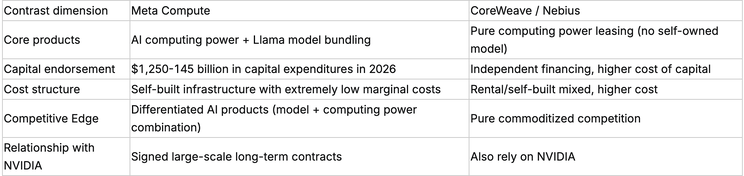
What is the essential difference between Meta Compute and CoreWeave?
The market’s initial reaction to Meta Compute is that the stock prices of independent cloud computing companies such as CoreWeave and Nebius have fallen sharply. However, upon further analysis, the competitive barriers between the two are completely different.
Key insight: Meta can bundle the Llama model with computing power, providing enterprise customers with a “one-stop AI solution” rather than a pure computing commodity. This is a differentiated advantage that independent Cloud as a Service provider cannot replicate.
Who are the real beneficiaries of Meta Compute?
NVIDIA (NVDA) : Meta Compute is built on NVIDIA’s AI infrastructure, and the demand for computing power has not only not decreased, but has expanded due to the acceleration of monetization.
Arista Networks (ANET): Leading player in hyperscale data center network switch, Meta’s new round of expansion directly drives high-speed network infrastructure orders.
CoreWeave : Short-term impact, but Meta and its 21 billion dollars long-term locked contract until 2032, short-term stock price decline or overpricing.
Main Line 2: Apple + Microsoft Price Increase — DRAM Super Cycle, Pricing Power Has Structurally Changed
Why are Apple MacBook and Microsoft Xbox significantly increasing in price?
One of the most shocking news in consumer electronics in 2026 is that Apple and Microsoft voluntarily raised the prices of their products, and the direct reason points to one word: DRAM contract prices have risen sharply .
This is not an accidental event, but an inevitable result of the AI memory battle.
The core logic of DRAM super cycle
Why can’t consumer electronics manufacturers digest it on their own this time?
In the past, every round of DRAM price increases, consumer electronics manufacturers such as Apple, Samsung, and Lenovo would usually absorb upstream cost pressures on their own to maintain product competitiveness. But this round in 2026 is different.
AI Data Center’s unprecedented demand for memory has compressed the purchasing bargaining space of consumer electronics manufacturers
The production capacity of the DRAM supply side (mainly MU, Samsung, SK Hynix) is prioritized towards HBM, and the supply of general DRAM is tight
The cost increase far exceeds any previous memory cycle and cannot be digested internally
This is a highly signaling turning point: the pricing power of storage vendors has undergone a structural shift .
Relevant stock investment logic
Micron Technology (MU) : The strongest quarter in Q3 revenue history, Q4 guidance continues to exceed expectations; HBM’s full-year capacity for 2026 has been fully sold out, and the capacity reservation for 2027 has been launched. This week’s profit correction does not change the fundamental direction.
SanDisk (SNDK) : Separated from Western Digital, it is a pure AI NAND target. The cumulative increase in NAND contract prices in 2026 is significant, and institutions generally raise their target prices. As a new spin-off company, the initial volatility is relatively large, but the fundamentals benefit from the same trend.
Main Line 3: SNDK — the new protagonist of the AI NAND era, the investment logic of spin-off listing
Why was SanDisk spun off from Western Digital?
SanDisk was officially spun off and listed independently from Western Digital (WD) in 2026, becoming a pure company focused on NAND flash memory. The spin-off logic is as follows:
The valuation logic of WD’s HDD (traditional mechanical hard disk) business is very different from that of NAND business, and the market gives HDD business a lower valuation multiple, dragging down the overall market value
After independence, SNDK can obtain a valuation premium that matches the NAND super cycle
Management can focus more on AI Data center enterprise NAND product roadmap
Why does AI Data Center need a large amount of NAND?
AI training and inference require massive data storage.
Training datasets for large language models (LLM) often reach the petabyte level
The demand for low-latency storage in AI inference scenarios has exploded (NVMe SSD replaces traditional storage).
Meta, Microsoft, Google and other large-scale Data centers continue to expand, and each new Data center requires a large number of enterprise-level NAND
This means that SNDK is in an important position in the AI infrastructure demand chain.
Main Line 4: Arista Networks — AI Data Center Invisible Beneficiary, Expanding Continuously
Why does the AI era need a better network switch?
The computing requirements of AI clusters place extremely high demands on the internal network of data centers.
GPUs require extremely low latency and ultra-high bandwidth interconnection (InfiniBand or Ethernet).
A single AI training cluster often has thousands to tens of thousands of GPUs, and the cost of network equipment accounts for a significant increase in the overall data center investment
Meta and Microsoft’s new round of hyperscale Data center expansion directly drives demand for high-performance Ethernet switches
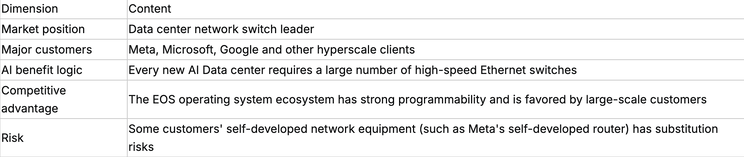
Arista Networks (ANET) is a leading global data center network switch manufacturer and one of the infrastructure targets directly benefiting from the expansion of AI computing power.
An Overview of ANETs Investment Logic
Main thread 5: June NFP and Fed path — the most important macro variables in the second half of the year
What does the June NFP employment report mean?
The June Non-Farm Payroll Report (NFP) released on July 2, 2026 is a key reference for the direction of the Federal Reserve’s Monetary Policy in the second half of the year. The market generally expects employment to be lower than the previous value. If the actual data is weak, it will send the following signals to the market.
Two core verifications in the second half of the year
Verification 1: Federal Reserve Path (July FOMC is a key node)
The July FOMC meeting will be the most important time window for the market to reprice the path of interest rate hikes. If NFP is weak and inflation data is moderate, the probability of pausing interest rate hikes will increase, and growth stocks will receive valuation support.
Verification 2: Q2 financial report season (starting from mid-July)
This is a more direct question than macro data: Can AI capital expenditures translate into actual revenue growth for Mag7?
If the Q2 financial report season is stronger than expected, the “soft landing + AI-driven growth” narrative will receive the strongest fundamental endorsement, and the expansion of growth stock valuation will be more sustainable.
If the Q2 financial report season is stronger than expected, the “soft landing + AI-driven growth” narrative will receive the strongest fundamental endorsement, and the expansion of growth stock valuation will be more sustainable.
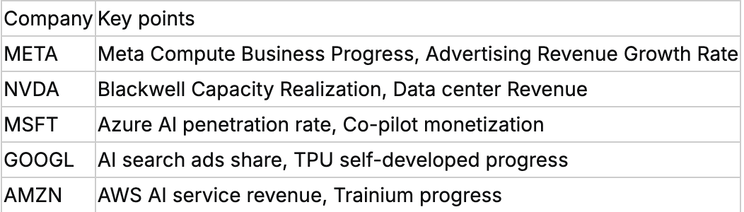
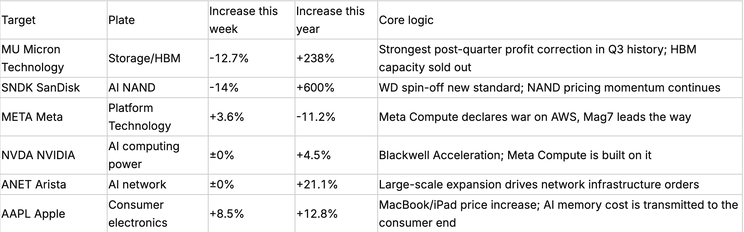
Review of the performance of core targets this week
IV. Frequently Asked Questions FAQ
Q1: Will Meta Compute damage NVDA?
No, it’s actually a benefit. Meta Compute is built on NVIDIA’s AI infrastructure. Meta’s entry into the Cloud Service market means it will continue to purchase a large number of NVIDIA GPUs. Large-scale manufacturers have shifted from “buying computing power” to “selling computing power”, expanding the scale of the entire AI computing power market. As an upstream chip supplier, NVDA is the most direct winner.
Q2: MU and SNDK fell sharply this week, can we still hold on?
This week’s decline is a profit correction, not a signal of fundamental reversal. MU’s HBM 2026 production capacity has been fully sold out, and Q4 revenue guidance has greatly exceeded expectations; SNDK’s NAND pricing trend has not changed. The core logic — AI memory super cycle — still holds. The price increases of Apple and Microsoft are precisely the most powerful evidence of this logic.
Q3: What are the risks of SNDK as a new spin-off company?
The main risks include: ① The liquidity of the new Listed Company is relatively low and volatile; ② The initial valuation discovery of the spin-off takes time; ③ If the NAND price cycle reverses, the downward trend may exceed MU. However, from the perspective of the structural growth of AI Data center demand, the medium-term logic is still clear.
Q4: Why did AAPL rise this week?
Apple’s price increase (MacBook/iPad) is actually a positive signal: it shows that its pricing power is still strong, and consumers are willing to pay for AI devices with more memory. At the same time, if the Fed’s interest rate hike path softens, Apple, as a high-free cash flow growth consumer technology stock, will also directly benefit from valuation revaluation.
Q5: What should we pay the most attention to in the second half of the year?
Two main threads: ① July FOMC decision + NFP data — determining the path of interest rate hikes, affecting the valuation of all growth stocks; ② Q2 financial report season (starting from mid-July) — the realization of AI revenue from Meta, NVDA, and MSFT is the real test question that determines whether Mag7 can maintain a high valuation.
Disclaimer: This content is based on open market information as of July 2, 2026, independently compiled by the MEXC US stock spot team, for reference only, and does not constitute investment advice. The market is risky, and investment needs to be cautious.
Robinhood’s crypto expansion is not only about launching a chain. The company is also pushing further into stablecoin yield, with an Earn structure that advertises a 7% APY tied to USDG as part of its broader product rollout.
That is a meaningful number in a market where stablecoin holders constantly compare safety, liquidity, and yield. But it also demands careful reading. Yield products are not the same as simply holding cash or a standard stablecoin balance.
For more details, visit the official GlobeNewswire platform.
TL;DR
Robinhood has introduced a 7% APY Earn structure tied to USDG.
The product forms part of the company’s wider global crypto and DeFi expansion.
Stablecoin yield can attract users, but rates are variable and depend on the structure behind the product.
Stablecoins Are Becoming A Yield Battlefield
Stablecoins used to be mainly about moving dollars around crypto markets. That is still their core use case, but the competitive layer has changed. Platforms now want users to keep stablecoin balances inside their ecosystems, and yield is one of the most direct ways to do that.
Robinhood already has a large retail user base, so adding stablecoin yield gives it another way to connect brokerage users, crypto products, and on-chain infrastructure.
The Fine Print Matters
The headline APY will get attention, but users need to understand what supports the yield, whether the rate can change, what risks apply, and how the product is treated in their jurisdiction. Stablecoins can reduce volatility compared with crypto tokens, but yield programs introduce a different set of risks.
For Bitcoinist readers, the larger takeaway is that stablecoin competition is moving beyond issuance. The next fight is distribution, yield, custody, and user trust. Robinhood wants to be part of that fight, and its Earn rollout shows how quickly traditional finance apps are moving into crypto-native territory.
Distribution Is Robinhood’s Edge
Stablecoin issuers and DeFi protocols can offer yield, but Robinhood brings something many crypto-native platforms still want: a large retail audience that already uses the app for financial products. That distribution gives its Earn product immediate visibility.
The question is whether users understand the difference between holding a stablecoin and participating in a yield program. The APY number is attractive, but the structure behind it will determine the real risk profile.
If Robinhood can explain that clearly, stablecoin yield could become a meaningful part of its crypto offering. If not, the product may face the same trust questions that have followed other yield products in the industry.
The product also shows how stablecoins are becoming part of mainstream fintech competition. Users may not care whether the yield comes from a crypto-native app or a brokerage brand. They will compare rate, trust, ease of use, and perceived safety.
The cleaner takeaway is to treat this as a specific development inside Stablecoins, not as a blanket prediction for the whole market. It gives readers a concrete data point to watch while keeping the limits of the story clear.
This article is based on information from Robinhood’s official announcement distributed via GlobeNewswire.
This article was written by the News Desk and edited by Samuel Rae.
This report is based on information from GlobeNewswire. at GlobeNewswire

 Login
Login