"That allows them to ... honor those men and women who answered the call not only on that fateful day 25 years ago, but in service," said Stephen Holley.
A flower is visible on one of the benches at the National 9/11 Pentagon Memorial outside the Pentagon in Washington, Sunday, Sept. 11, 2022, on the morning of the 21st anniversary of the 9/11 terrorist attacks. (AP Photo/Andrew Harnik)
Jay Clayton testifies during a Senate Intelligence Committee confirmation hearing to be the next Director of National Intelligence on Capitol Hill, Wednesday, July 15, 2026, in Washington. (AP Photo/Mariam Zuhaib)
Pavan Davuluri says Windows will keep serving human users while adding agentic workloads. (Microsoft Photo)
GeekWire is profiling over the next few weeks some of the people and teams that are shaping the evolution of Microsoft in what we’re calling its “Microsoft 2.5” era.
Just Don’t Call It an ‘Agentic OS.’ Given Microsoft’s one-pointed AI focus these days, it’s not surprising that the Windows organization is on the agentic train.
But Executive Vice President of Windows + Devices Pavan Davuluri has learned the hard way not to call Windows an agentic OS. He did so back in November 2025, via a tweet and blog post, and the customer backlash was quick and biting.
But Davuluri has not done a complete U-turn because of the criticism. Instead, he has changed how he talks about where Windows is going — which is still in an agentic direction.
“The user of Windows going forward will continue to be users … but it’s also going to add these agentic workloads,” the nearly 26-year Microsoft veteran Davuluri told GeekWire in a recent interview.
During his time at Microsoft, he’s held a variety of roles, from intern to General Manager of Surface, to Corporate Vice President of Windows Silicon & Systems Integration. He was appointed Executive Vice President of Windows + Devices in March 2026, reporting directly to CEO Satya Nadella.
Windows needs to evolve to support agentic workloads through new platform capabilities that the team is building under the covers, Davuluri said. These low-level capabilities, or “primitives,” affect how Windows handles security, identity, governance, observability, and performance when it comes to building and running agents natively.
These coming changes likely will affect the Windows file system, security model, PowerShell, and other foundational components.
Microsoft already is working on Windows identity and manageability to make them better able to service agents. Windows can assign agents a local ID, or a cloud-provisioned identity backed by Entra.
And it also has an early preview of technology known as Microsoft Execution Containers, meant to help secure agents by running untrusted code in sandboxes or virtual machines. It’s these system-level areas where the team is focusing first in preparation for a human+agent future, Davuluri said, rather than the UX/UI level.
Going Back to Basics. Windows has had a lot of very different leaders over the years, with very different management styles and priorities.
For his part, Davuluri said he plans to run the Windows and Surface teams with four principles in mind: Maintaining customer obsession; treating Windows as a complete end-to-end system (“full stack”); focusing on complete user experiences and workflows rather than individual features; and building Windows openly and transparently, with clearer communication about plans and priorities.
On the heels of his promotion to EVP, Davuluri committed publicly to the much-needed goals of improving Windows quality and reliability. In a blog post, he outlined some of the requested changes that his team would be making to Windows, ranging from fixing the way the Insider test program works, to more granular improvements like allowing users to reposition the Windows task bar.
And since then, the team largely has been delivering to the surprise and delight of many long-time Windows users.
Davuluri has also been working to shift the conversation from which new features are coming to a specific build to what are the outcomes Microsoft wants to enable for specific groups of Windows users.
“There is no one single sort of ring for a billion-plus users on the platform,” Davuluri said. Windows users encompass people who use the product in a variety of different ways, so “we need to get clarity in our minds on the things that we do that lift all boats that raise the entire platform — and things that we have to go do that are specific and unique to each of our sets of users based on how they primarily or typically use the device.”
Full-Stack Thinking. Is there still a role for Microsoft as a PC maker in the coming agentic future? Not surprisingly, given his heavily hardware-focused background, Davuluri insisted there is.
When Microsoft debuted its first Surface devices in 2012, officials said the company needed to build its own hardware to create reference designs and innovative form-factor examples for other Windows PC makers.
These days, most Surfaces that ship arguably are not better, spec- or design-wise, than other PCs. But Microsoft still needs to keep a hand in hardware design to understand the full stack, Davuluri claimed.
Surface plays a key role in how Microsoft develops platform abstractions, incubates support for technologies like pen, facial-recognition, and neural-processing units that later spread across Windows, and optimizes for silicon-to-cloud, he said.
While the company’s attempt to create a distinct category of “Copilot+” AI PCs fizzled, Microsoft continues to try to find AI-centric reasons to convince customers to choose Windows devices. Davuluri and others have referred to the idea of “unmetered intelligence” to attempt to make the case for running AI models locally on PCs.
This fall, Microsoft (and other Windows PC makers) plan to roll out new PCs built on the Nvidia RTX Spark platform. The coming Surface Laptop Ultra, which will be optimized for RTX Spark, is aimed at creators, developers and AI builders, all of whom — Microsoft is hoping — will be fueling the growth of its next target user category: Agents.
This week on “Uncanny Valley,” we dig into a former Anthropic researcher’s AI doomsday warning, the latest upgrades from Apple’s event, and the census report that claimed Trump won the 2020 election.
Seattle’s foundation as a hub of technology, science and innovation runs deep. Its confidence should, too. (GeekWire Photo / Kevin Lisota)
[Editor’s Note: Jacob Colker is co-founder and co-managing director of AI House.]
Seattle is one of the most talented, creative and inventive places in the world. But if we want the rest of the country to see us that way, we have to start acting like we believe it ourselves.
First, we need more pride around here.
Let’s talk about what it means to be proud.
My mother grew up in Tarnów, Poland. She escaped communism and came to the United States in 1978 looking for a better life. She found one, built a family, and has lived in America for nearly 50 years.
But my mom is still very, very Polish.
Several times a year, I get a message: “Jakub. Did you see this?”
I already know what’s coming.
Some Polish person did something. A Polish athlete won something. A Polish scientist discovered something. Some guy with a Polish grandmother finished third in a regional Nebraska chess tournament. Doesn’t matter. Poland.
“Jakub. Look at this person.”
Okay, Mom. Who is she?
“POLISH.”
That’s it. That’s the story.
And I love it, because Mom has this completely indestructible pride in where she comes from. Plenty of us know someone like this: a Greek mom, Vietnamese dad, Indian uncle or Nigerian aunt. Somebody from their corner of the world did something great, and you are going to hear about it.
There is power in that instinct. Not because your people are better, but because you believe your place matters.
Seattle could use more of that.
We are almost pathologically humble. Our response to notable achievements is often a polite nod before everybody gets back to our regularly scheduled Seattle freeze.
That humility is working against us.
Second, Seattle isawesomeand the evidence is everywhere.
I see Seattle’s potential every day working alongside dozens of entrepreneurs building startups. Some of the most ambitious and talented people in the world are already here.
We have many billion-dollar startups across the region and more than 200,000 people working across technology, science, space, health and startups. That is more than enough talent to build yet a dozen more unicorns.
Nearly 40% of the world flies every day on airplanes built here. Blue Origin and SpaceX build rockets here. Starbucks, Amazon, Costco, REI and Nordstrom reshaped how the world shops. Microsoft helped put computing into our homes. AWS and Azure helped make the cloud the infrastructure of modern life. The University of Washington ranks among the world’s best. Seattle medical breakthroughs have helped save tens of millions of lives. We are pushing forward fusion energy, aerospace and maritime innovation. And let’s not forget: we just won the darn Super Bowl.
And so, so much more.
So why, despite all the evidence, do we still seem to have a communal case of imposter syndrome?
This is not a city lacking accomplishments.
It is a city with a branding problem.
Third, we have let other people tell our story for far too long. This ends, today.
Cities have brands whether they intend to or not. Silicon Valley is where ambitious people build companies. Nashville is music. Los Angeles for film and television.
Seattle’s cultural humility mostly assumes our accomplishments speak for themselves.
They don’t.
Reputation gets built one story at a time. You hear one story and it is interesting. You hear 10 and you notice a pattern. You hear 50 and your beliefs begin to change: That’s where important science happens. That’s where talented people live. That’s where I should invest, build or work.
Those beliefs shape real decisions about where people move, where companies get built and where investors put their money.
So to fix Seattle’s branding problem, here’s what we need to do.
Step 1: Let’s tell one clear story — Seattle’s talent pool is ridiculous.
Seattle is where deep technical talent meets deep domain expertise to build consequential things: AI, aerospace, cloud computing, medicine, fusion, robotics, maritime technology and enterprise software.
We do not need 50 slogans. We do not need another consultant-led branding exercise. We need one simple idea that people outside this region can remember: Seattle’s talent pool is ridiculous.
There is a reason some of the world’s most important companies have built major engineering centers, research hubs and second headquarters here for decades. They come for the talent.
And that talent is why Seattle will not just participate in the future. We will lead in building it.
Step 2: Let’s use the megaphones we already have.
Seattle already has outlets (including this one) telling this story — publications, podcasts and social channels that document the region’s startups, breakthroughs and product launches.
Every day, startups are raising money, scientists are making breakthroughs, companies are launching products, engineers are building technology and institutions are pushing this region forward.
That is not just tech news. That is the raw material of Seattle’s reputation. So let’s use it.
When you read or hear about a Seattle startup doing something remarkable, share it. When you see a story about a breakthrough at Fred Hutch or the University of Washington, send it to someone outside the region. When a local company raises money, lands a major customer or gets acquired, don’t just scroll past it. Amplify it.
Step 3: Let’s treat every local win as Seattle’s win.
When a local robotics company ships something remarkable, that is Seattle’s story.
When a maritime startup reinvents how ports operate, that is Seattle’s story.
When our AI research labs, or hometown heroes in Amazon and Microsoft, create breakthroughs, that is Seattle’s story.
When a biotech company lands a major breakthrough, when a game studio creates a global hit, when a clean-energy company reaches a milestone, that is Seattle’s story.
Our companies, universities, hospitals, labs, investors, civic organizations and business leaders should act like an amplification network for one another. Stop treating somebody else’s success as somebody else’s news.
Their win is our collective proof.
Step 4: Let’s put Seattle on the label.
Founders need to say where they are building. “Made with ❤️in Seattle” should be on the bottom of every website. Put Seattle in the press release. Put it in the LinkedIn post. Mention it onstage. Say it in interviews. Tell investors. Tell customers.
Silicon Valley companies have spent decades attaching their success to their geography. We should do the same. If you build something extraordinary here, make sure the world knows it was built here.
Step 5: Let’s do a better job of selling Seattle.
Every venture capitalist, founder, executive and civic leader in this region should be able to explain in 60 seconds why somebody should build a company here.
Not defend Seattle. Not apologize for Seattle. Sell Seattle.
Reminder: It’s the talent.
(And also cream cheese on hot dogs.)
When investors and founders from New York, Boston or San Francisco come to town, show them the region. Introduce them to engineers, researchers and entrepreneurs. Bring them into the community. Let them see what is happening.
The best branding campaign is somebody getting on a plane home saying, I had no idea all of this was happening in Seattle.
If we’re going to succeed, we need tobelievefirst.
Insert all the Ted Lasso jokes you want, but this stuff matters.
There is no giant Seattle marketing department coming to save us. There is no national referee who will eventually review the evidence and declare that Seattle deserves more respect.
When somebody here does something extraordinary, act like it. Read the story. Share the post. Send the article to your team. Text it to your friend in New York. Put it in the group chat. Bring it up over dinner. Tell your kids.
Basically, become my Polish mother.
My mom doesn’t give a hoot that Kraków ranks No. 6 on some list or Warsaw is No. 8 on another. She doesn’t need a clickbait listicle to tell her Poland matters. She already believes it does.
We have to build our reputation ourselves. The good news is that we already have everything we need: extraordinary companies, world-class institutions, ambitious people, groundbreaking science and media documenting it all.
What we have been missing is the confidence to start being more loud. Stories become patterns, patterns become reputation, and reputation becomes gravity.
Gravity is what creates influence and respect.
Pride is not something somebody else gives you. You don’t wait until the rest of the country decides your home is important. YOU decide it is. Then you act like it.
Bitcoin-focused Block Inc. has become the latest company to apply for a U.S. banking charter.
The company, which manages Square, Cash App, and Bitkey, said Wednesday that it had submitted an application to the Office of the Comptroller of the Currency to establish Builders Bank & Trust, N.A.
Block joins a long-list of digital asset firms that have received conditional approval or are awaiting approval from the regulator to have the license. The charter would allow companies — if fully approved — to have certain banking powers, such as custody assets and move client funds.
JUST IN: Block applies to establish Builders Bank & Trust with the OCC, which would provide federally regulated custody and "fiduciary services" for Bitcoin and stablecoins. pic.twitter.com/Dkq7WIg6Wa
“Building on Block’s experience in the digital asset space, our history with Square Financial Services, and the deep banking expertise of the team we’ve assembled, we believe Builders Bank is well positioned to support Block’s broader vision of economic empowerment,” Lee Woolley, who would serve as President and CEO of Builders Bank, said in a statement.
Block said that, if approved, Builders Bank would operate as a federally regulated national trust bank under OCC supervision and provide custody and related fiduciary services, including for bitcoin and stablecoins.
A number of top crypto companies have received conditional approval, including Coinbase, Circle, Crypto.com, and Paxos.
Decentralized financial protocol World Liberty Financial, backed by U.S. President Donald Trump, also received approval this year.
Block CEO and founder Jack Dorsey, a Bitcoin maximalist, has been pushing for the biggest and oldest cryptocurrency to become everyday money.
His point-of-sale products, Square, last year rolled out bitcoin acceptance for millions of eligible U.S. small businesses, with no setup required and transactions instantly converted to dollars at checkout.
Russia spent a record 44% of its federal budget on the military in the first half of 2026, according to calculations published by Janis Kluge, a research fellow at the German Institute for International and Security Affairs, based on data from Russia’s Finance Ministry. Direct military spending totaled 10.7 trillion rubles, about $125 billion at […]
Block has applied to establish an uninsured U.S. national trust bank that would place some of its Bitcoin, stablecoin and digital asset custody operations under direct federal supervision. Block said on Tuesday that it submitted an application to the Office…
Most Web3 teams that close a raise treat the full amount as runway from day one. The money is there to fund the build, so keeping all of it liquid seems like the obvious choice.
But the money usually isn’t spent that way.
A project with six to nine months of development ahead doesn’t deploy the full raise immediately. Spending happens gradually, while a larger part of the capital may only be needed later, when the product moves into scaling.
That means part of the raise can sit untouched for months simply because its planned expense hasn’t arrived yet.
Keeping enough capital available for near-term expenses makes sense. Keeping the entire raise in the same liquid position is a different decision, especially when the project already has a rough schedule for when larger spending begins.
What Laddering Actually Means in Practice
The near-term runway stays liquid. This is the capital the team expects to use for operating expenses and other costs coming up soon.
The tranche that won’t be needed for several months can be matched to that later spending date through a term deposit. Instead of treating money needed next month and money needed in six months exactly the same way, each part of the raise follows its own timeline.
The point isn’t to lock as much capital as possible or chase the longest term. It’s to stop treating capital that won’t be used for months as though it needs to be available next week.
There is also a trade-off. If the roadmap accelerates and the project needs committed capital earlier than planned, the terms of an early exit matter. That needs to be understood before choosing where and for how long the funds are placed.
So What Does “Not Improvising” Actually Look Like?
Once the spend schedule is clear, the next step is comparing what different institutional platforms actually offer.
Zero Hash provides yield and staking infrastructure as part of a broader digital asset stack covering trading, stablecoin payments and tokenization through a single API. The platform has settled $65B+ in total volume across 7M+ end customers, with stablecoin transaction volume growing 690% year over year. In June 2026, it launched Staking-as-a-Service for brokerages and banks, with Interactive Brokers and Morgan Stanley among the initial launch partners.
WhiteBIT Yield-as-a-Service supports institutional placements starting from 600K USDT, with allocation across multiple currencies and terms ranging from 10 days to a few years. Its API can be integrated into existing settlement processes, while an early exit moves a committed tranche to the applicable flexible rate if the original schedule changes.
Coinchange Yield-as-a-Service delivers daily-priced yield portfolios across stablecoins and digital assets through a single API integration, with no minimum placement requirements and no long-term lockups. Compliance coverage spans FATF, MiCA and SEC-aligned frameworks, and the underlying allocation runs across multiple actively managed strategies rather than a single yield source. Partners including Kanga Exchange and Utila have integrated the infrastructure into their existing products.
These products address different treasury requirements. The relevant comparison depends on what assets the company holds, when the capital will be needed, and how much flexibility the treasury requires during that period.
The Assumption That Needed Updating
The issue isn’t whether the full raise counts as runway. Of course it does.
The question is whether every part of that runway needs the same level of liquidity at the same time.
If one portion covers near-term operations while another won’t be used until several months later, those two tranches don’t necessarily have to be managed in the same way. The spend schedule gives the team a way to separate what needs to remain immediately available from what has a later job.
The raise arrives at once. The expenses arrive over quarters.
Treasury planning can follow the same schedule.
Disclaimer: This is not financial or investment advice. DYOR before making any decisions. Use at your own risk.
Crypto didn’t lose its story. The story just grew up.
Crypto markets have always been driven by narratives.
A crypto narrative is a theme that tells the market where to look: what’s worth building, what’s worth buying, and what the next big opportunity is. Narratives are what turn a complicated technology into something people can actually invest in.
For years, one narrative after another has defined the market.
DeFi Summer in 2020 was built around the rapid expansion of decentralised lending, borrowing, trading, and yield farming. All of a sudden, market participants could earn interest, trade, and borrow without a bank, and token prices moved on the promise of an entirely new financial system.
Then came the NFT boom in 2021.
NFTs moved beyond a relatively narrow blockchain use case into digital art, collectibles, gaming and online communities.
During that period, buying a JPEG felt like buying into the future.
Then came a wave of newer stories:
The AI – crypto narrative that gained significant attention in 2024 focused on the potential intersection between artificial intelligence and blockchain, including decentralised computing, data, AI agents and related infrastructure.
There was also the rise of play-to-earn gaming, memecoins, restaking and numerous other themes with each one pulling in capital and attention, at least for a while.
Different assets, different years, same underlying question:
What new things can we create with crypto?
That question hasn’t gone away.
However, the market conversation appears to be changing.
From Applications to Infrastructure
Increasingly, the conversation is moving toward the infrastructure that allows digital assets to function within a broader financial system.
This does not mean speculative narratives have disappeared. Memecoins can still attract enormous attention, and crypto markets remain highly speculative.
The change is more subtle.
The conversation is increasingly extending beyond what can be built on blockchain to how blockchain-based infrastructure can perform recognisable economic and financial functions.
Stablecoins are perhaps the clearest example of this.
Stablecoins Are No Longer Just a Crypto Trading Tool
A stablecoin is a cryptocurrency pegged to a stable asset, for example, fiat currency – one coin is designed to maintain the value of the underlying asset.
Stablecoins initially became popular partly because they allowed crypto users to move between volatile digital assets without immediately converting back into fiat currency.
However, their role has expanded.
Stablecoins are now used for trading, collateral, remittances, payments, corporate treasury management, and settling transactions across on-chain markets.
The Federal Reserve reported that stablecoin market capitalisation grew substantially during 2025, alongside increased transaction activity and DeFi usage.
The significance of this development goes beyond market capitalisation. Stablecoin isn’t just another token competing for attention anymore – it’s becoming the plumbing that connects different parts of the crypto economy.
That changes the way the asset is understood.
That is also attracting traditional financial institutions.
A 2026 institutional investor survey by Coinbase and EY found that institutions were using stablecoins for activities including cash management, moving money and near-real-time settlement, while regulated products had become an important route into digital-asset exposure.
The important point is not that traditional finance has suddenly discovered crypto.
It is that some crypto-native infrastructure is becoming useful to traditional financial activity.
Institutional Capital Changes the Conversation
Institutional participation is another part of this shift.
The emergence of spot ETFs, asset managers, custodians, banks and digital-asset treasury companies has created new channels through which institutional capital can access digital assets. This does not make institutional investors inherently long-term, nor does it eliminate speculation.
It changes the environment in which digital assets are evaluated.
Once a digital asset becomes part of an institutional investment strategy, questions around custody, liquidity, market structure, regulatory compliance, counterparty risk and portfolio construction become increasingly important.
Now the question is:
Can it be held safely?
Is there enough liquidity to get in and out?
Who’s actually providing the infrastructure behind it?
What happens to it under market stress?
How does regulation apply?
What real economic activity supports its value?
Those are infrastructure questions and they matter more the more institutional money is in the room.
What Happened to DeFi?
DeFi hasn’t stopped being experimental, and it certainly hasn’t stopped being speculative.
But alongside that, it’s developed functions that look a lot like traditional finance: lending and borrowing, trading, derivatives, liquidity provision, collateral management, stablecoin settlement, on-chain credit and yield markets.
The evolution is therefore not from “speculation” to “no speculation.”
It’s a shift from an ecosystem where speculative experimentation dominated the conversation to one where the financial infrastructure itself has become part of the story.
This is an important distinction.
A lending protocol does not need to introduce a completely new concept of lending to be useful. The novelty is increasingly found in how financial functions are delivered, rather than simply in the creation of entirely new financial categories.
Tokenisation Is Part of the Same Shift
The growing interest in tokenisation reflects a similar development.
Tokenisation involves representing assets or rights digitally through blockchain or other distributed-ledger infrastructure.
The underlying asset might be a bond, fund interest, real estate interest, deposit, commodity, or another financial or real-world asset. The interesting question is whether placing these assets on the blockchain will improve their issuance, transfer, settlement, liquidity, programmability, or accessibility.
That is a different kind of narrative.
It connects blockchain technology to existing economic activity rather than creating an entirely separate digital economy.
So, What Happened to the Crypto-Native Narrative?
It did not disappear.
It fragmented, evolved and, in some cases, became infrastructure.
DeFi developed into a collection of financial functions. Stablecoins expanded from crypto trading instruments into settlement and payment infrastructure. Tokenisation began connecting blockchain infrastructure with traditional financial assets. Institutional participation created new channels through which capital could enter digital assets.
Some earlier narratives lost relevance after their speculative cycles while others continue to evolve and new narratives will undoubtedly emerge.
The difference is that the market is increasingly asking a different question.
Earlier crypto cycles often centred on:
What can blockchain enable that did not exist before?
The newer question is:
What financial functions can blockchain infrastructure perform, and does it perform them effectively?
That is a different investment narrative and it also creates a different standard for evaluating projects. A protocol promising a new financial primitive may now have to demonstrate more than technological novelty.
Investors may also look at liquidity, revenue, collateral, risk management, regulatory exposure, integration and actual economic demand. The same applies to stablecoins, tokenised assets and other forms of on-chain infrastructure.
The crypto market is still capable of producing the next meme cycle, NFT boom or speculative frenzy. However, beneath those cycles, something else is happening.
Crypto-native infrastructure is increasingly being judged by the financial functions it can perform, rather than simply by the novelty of what it can create.
Perhaps that is what happened to the crypto-native narrative.
It did not disappear.
It became part of the infrastructure.
If you enjoy analytical commentary on digital asset regulation, crypto markets, and emerging financial technologies, consider subscribing to my newsletter where I share additional research, commentary, and industry insights.
Also, if your company, startup, or publication needs clear, well-researched content on blockchain, digital assets, fintech, or emerging technology law, my inbox is always open.
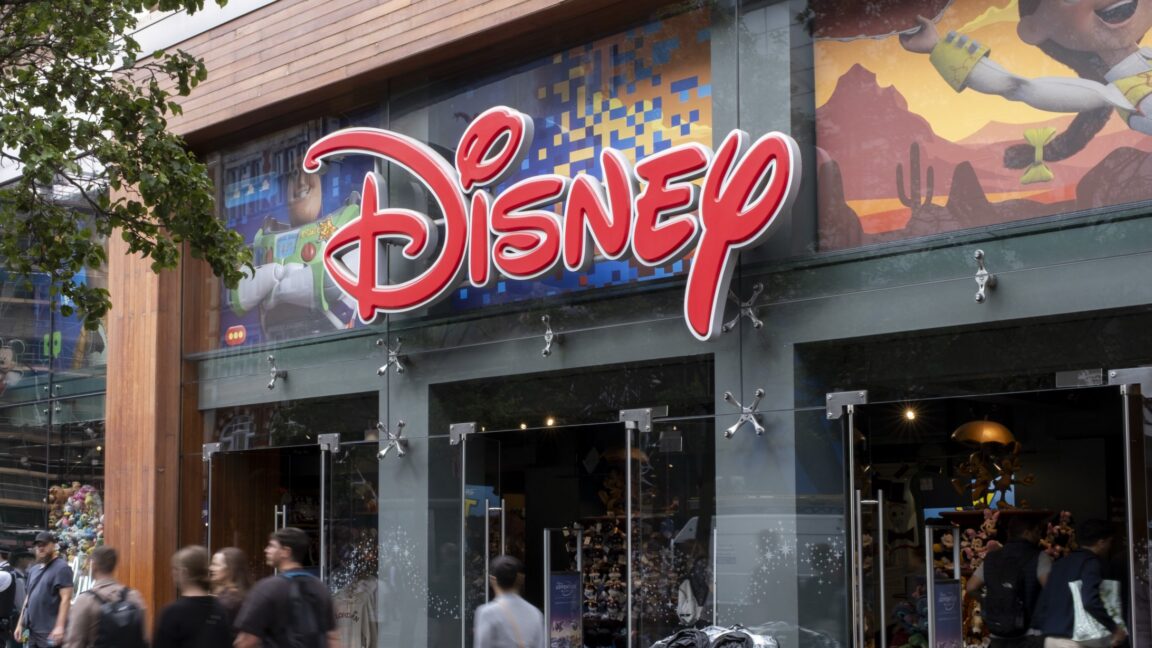
The Federal Communications Commission yesterday urged a court to dismiss a Disney lawsuit and let the FCC continue a proceeding that could end in the nonrenewal of ABC's broadcast licenses.
Meanwhile, two watchdog groups and individual viewers of ABC stations are trying to intervene in the lawsuit, saying they are worried Disney will agree to a settlement with the FCC that isn't in the public's interest. Disney opposed the motion, and a judge will have to decide whether the groups and individuals can act as intervenors in the case.
Disney sued the FCC on August 18, saying the agency is waging a “campaign of censorship” to retaliate against ABC for speech that President Trump doesn't like. As the lawsuit gets underway, Trump continued his attacks on the media last weekend by demanding that the FCC punish or rebuke an NBC journalist for saying he has “mixed results” in his election endorsements.
The articles in the pages ahead examine how government is balancing innovation, risk management, workforce readiness and operational effectiveness as AI increasingly becomes inseparable from cybersecurity itself.
Instead of using the Douglas factors, MSPB will judge whether an agency’s penalty for an employee accused of misconduct was reasonable on a case-by-case basis.
This week on Uncanny Valley, we dig into the latest prediction market buzz, Flock’s AI-powered police search tool, and how tech bros don’t know how to talk about “rouge” AI agents
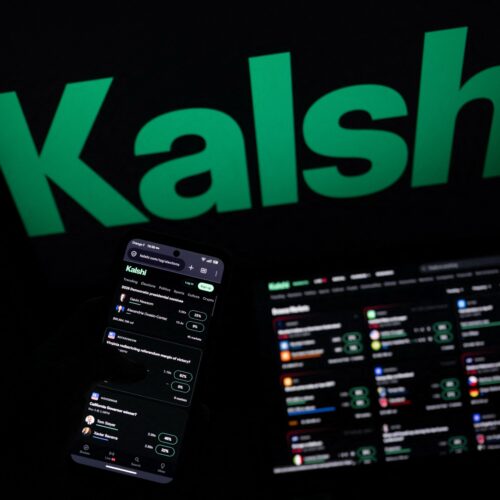
New Jersey yesterday asked the Supreme Court to rule on whether states can regulate sports betting on prediction markets such as Kalshi.
“Companies like Kalshi claim to offer legal sports betting in all 50 states, but they refuse to follow the gambling laws of any state," New Jersey Attorney General Jennifer Davenport said in a press release announcing the lawsuit.
In April, the US Court of Appeals for the 3rd Circuit ruled that New Jersey cannot regulate sports bets on prediction markets. The court determined that sports-related event contracts meet the legal definition of "swaps," giving the US Commodity Futures Trading Commission (CFTC) exclusive jurisdiction.
1Password is facing customer and internal employee backlash after pledging $300,000 to support a Linux distro created by David Heinemeier Hansson, who has regularly published racist and anti-immigrant rhetoric. "The popular password manager is now a 'distinguished corporate patron' of Omacom, the nonprofit foundation that oversees a popular Linux distribution known as Omarchy," reports The Verge. From the report: One viral blog post declared that 1Password "Supports the Ethnic Cleansing of Europe" because of the donation. Others on social media asked for suggestions for alternative password managers so they would not support the funding of a project from Heinemeier Hansson, better known as DHH. The donation has also resulted in internal pushback from employees of 1Password who are disappointed by the affiliation, The Verge has learned. 1Password CEO David Faugno and cofounder Roustem Karimov have since posted internal messages addressing what Faugno describes as "concerns, both internally and externally" that have been raised "due to the polarizing nature" of DHH.
DHH is a Danish entrepreneur best known for creating Ruby on Rails, Basecamp, and the Hey email client. Omarchy is DHH's "opinionated" version of Linux, meaning it's Linux the way he likes to use it. It's based on Arch Linux, with certain apps that install by default. It's also, apparently, one of 1Password's big customer environments. [...] In an internal Slack message obtained by The Verge, 1Password's Karimov downplayed the overtly racist comments from DHH, telling staff the following: "As I said, people have different personal opinions. You believe in your heart that DHH is evil, that you have the moral high ground, and that nothing will change your mind. However, not everyone believes that. It is not fair to claim a monopoly and ostracize team members who might disagree with you. There are people who are afraid to speak up simply because they will be personally attacked."
1Password CEO Faugno took a different approach, trying to reassure staff that "1Password does not endorse hateful, dehumanizing, or exclusionary views, including those shared publicly by DHH." Nonetheless, it seems the company has sacrificed a moral position for a "mission-driven" position. In the same message to staff, Faugno says "the scale and growth of [Omarchy's] use among our customers is significant -- Omarchy has grown to be the second most used Linux distribution among 1Password users." Faugno then tries to create distance, telling staff that its contribution is "to the Omacom Foundation, not an individual." Still, he says "we recognize that Omarchy is associated with DHH, its founder. Our donation is not in any way an endorsement of his personal views or conduct."
The housing markets in San Francisco, left, and Seattle have been diverging for the past year. Prices started falling in Seattle on an annual basis about a year ago, while prices in San Francisco have been rising since November. (BigStock, GeekWire File Photos)
While a fresh wave of AI-generated wealth is pouring fuel on San Francisco’s housing market, Seattle’s real estate scene is getting left out in the cold, stuck in a slump driven by ongoing local tech layoffs, soaring costs, and persistent worker anxiety.
A new report published Wednesday by Seattle-based Redfin illustrates just how dramatically the housing markets in the West Coast’s top two tech hubs have split.
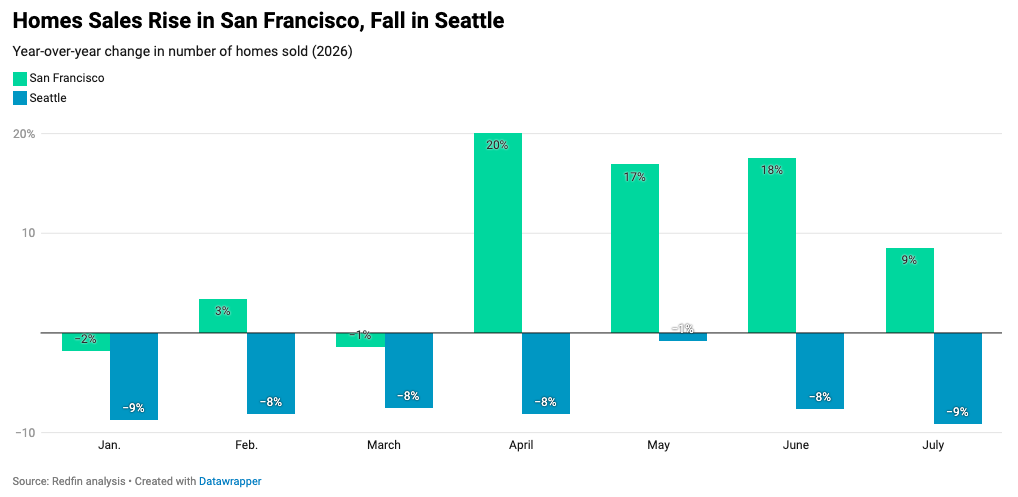
In July, San Francisco’s median home-sale price jumped 6% year-over-year to $1.6 million as home sales rose 8.5%, fueled by an 18.4% drop in active listings—the largest inventory contraction in the country.
By contrast, Seattle’s median sale price dropped 3.6% to $809,479 as home sales fell 9.1% and active listings surged 16.7%, the nation’s steepest inventory increase, leaving local sellers outnumbering buyers by 65%. Redfin detailed the drop in pending sales in the city in an earlier report.
San Francisco’s resurgence is fueled by a concentrated wave of AI wealth. Driven by big salaries, six-figure signing bonuses, and anticipation of massive IPOs for Bay Area giants OpenAI and Anthropic, affluent buyers are aggressively bidding up homes, frequently paying hundreds of thousands over asking price.
The frenzy mirrors findings from The New York Times, which reported in May that cash-flush AI startup employees and secondary stock sales are fueling hyper-concentrated bidding wars across the Bay Area.
In Seattle, the dynamic is reversed. While local tech giants pour billions into AI infrastructure, corporate belt-tightening and lingering layoff fears at companies like Amazon and Microsoft have squelched buyer confidence, leaving prospective buyers cautious, job mobility low, and listings piling up.
Click to enlarge. (Redfin Graphic)
Ground-level real estate agents in the Seattle area are feeling that buyer hesitation firsthand.
“Layoffs in the tech world are dampening homebuying demand in the entire area,” said Sheryl Wingate, a Redfin Premier agent, noting that return-to-office policies are further squeezing demand in outlying suburbs as tech workers avoid long commutes amidst job uncertainty.
Seattle-area real estate isn’t just feeling the squeeze from the heavyweights. Job cuts have hit nearly every tier of the regional tech ecosystem this year, sweeping through engineering hubs for Meta, Google, and Salesforce, consumer brands like Zillow, T-Mobile, and Starbucks, corporate divisions at Expedia and TikTok, and startups including Qualtrics and Amperity.
The chill is hitting the region’s high-end neighborhoods hardest. According to Bloomberg, pending luxury home sales in the Seattle area plummeted 15%, driven by a double hit of tech-sector layoffs and Washington state’s higher taxes on top earners. Once-frenzied markets in Eastside suburbs like Bellevue and Sammamish have stalled, with homes priced over $2 million sitting for an average of 44 days as affluent tech buyers pull back.
By comparison, high-end buyers in San Francisco are doubling their budgets as AI confidence surges. Redfin noted that luxury pending sales in the Bay Area jumped 46% year-over-year, with local agents reporting tech clients doubling their price points — in some cases expanding from $2 million budgets to nearly $4 million — and placing offers as much as $900,000 over asking price.
The shift is also severing a key migration pipeline that long fueled Seattle’s housing boom. While high-earning Bay Area transplants historically moved north to stretch their tech compensation, Redfin migration data shows the net inflow of home shoppers moving from San Francisco to Seattle plummeted to just 369 people in the first quarter — down from over 5,100 five years ago.
Looking ahead, Redfin economists expect these diverging trends to play out across other tech hubs as artificial intelligence reshapes the labor market.
“AI is reorganizing the tech labor market, with San Francisco and Seattle representing two sides of that transition,” said Chen Zhao, Redfin’s head of economics research, adding that while AI creates rapid wealth in some markets, it drives corporate restructuring and caution in others.

 Login
Login







 Russia spent a record 44% of its federal budget on the military in the first half of 2026, according to calculations published by Janis Kluge, a research fellow at the German Institute for International and Security Affairs, based on data from Russia’s Finance Ministry. Direct military spending totaled 10.7 trillion rubles, about $125 billion at […]