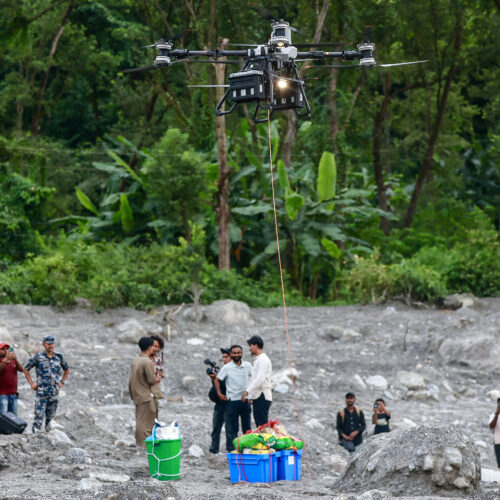
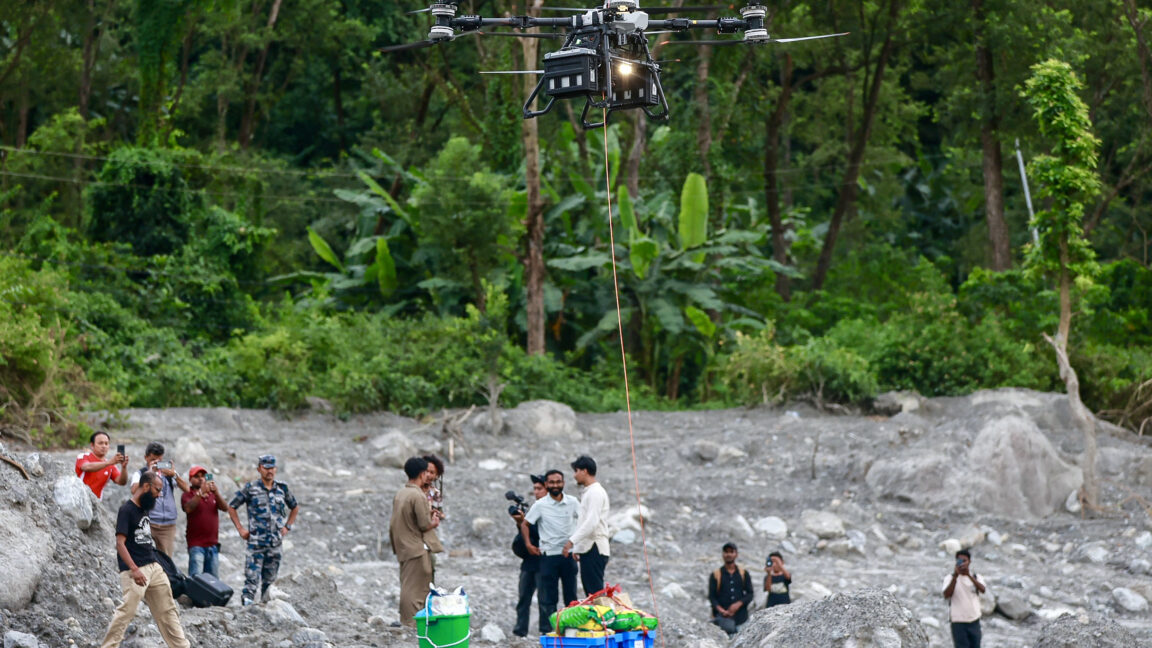
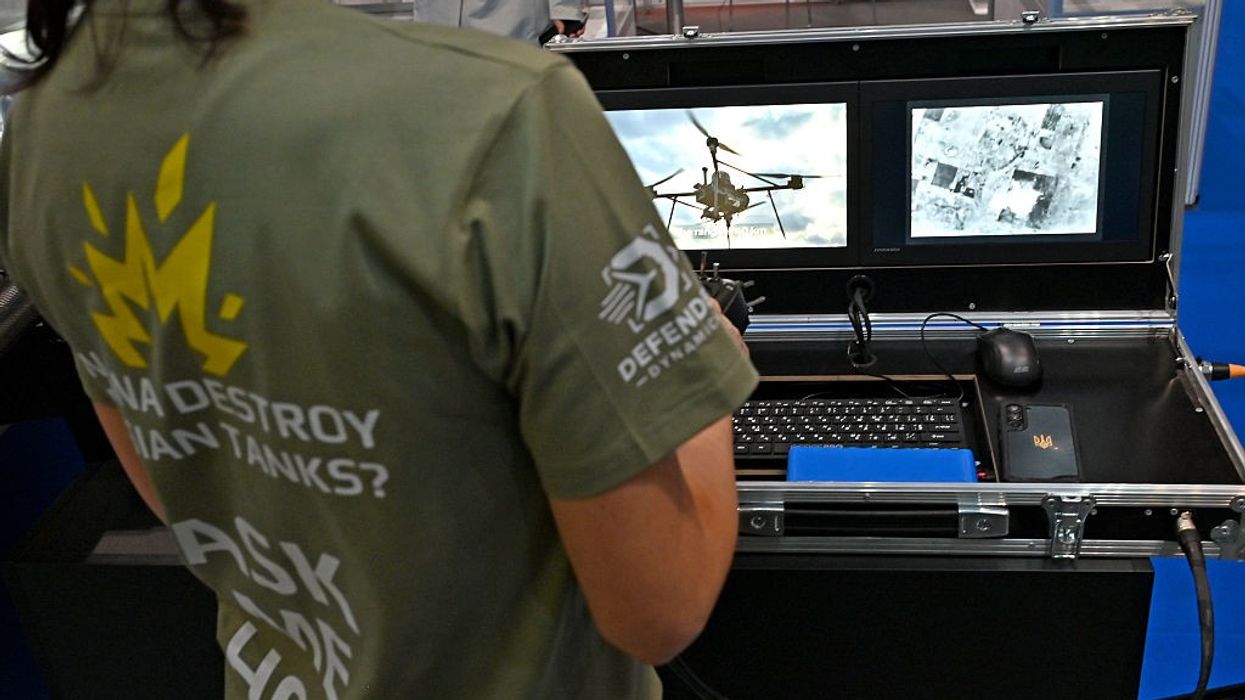
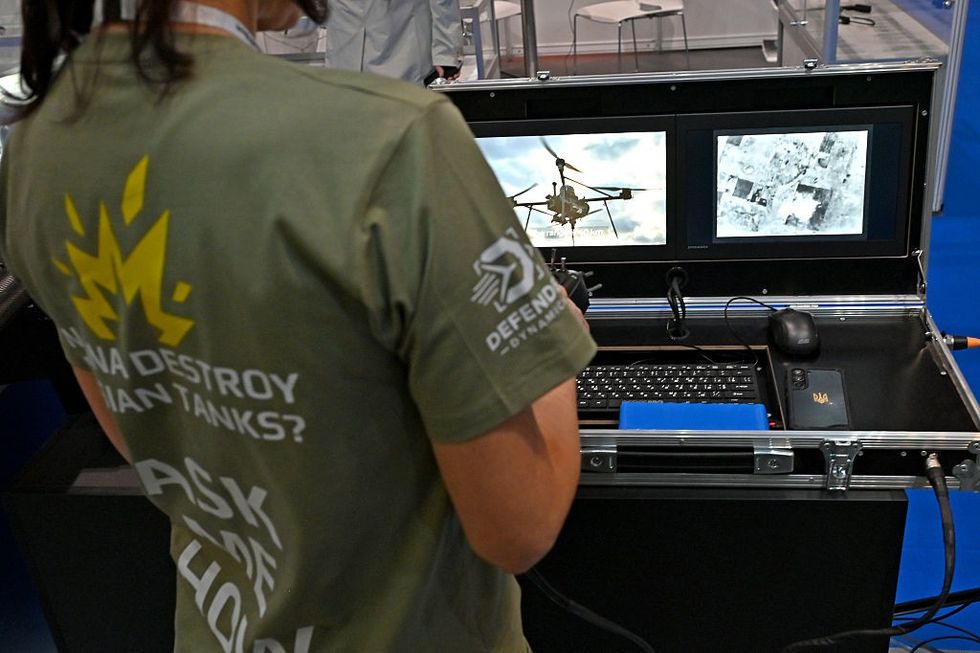
Chinese-made drones are flying out the bodies of flood victims and delivering food to survivors in the aftermath of devastating flash floods on the border of Nepal and China’s Tibetan region.
Nepal’s army has been using four DJI FlyCart 100 drones donated from China to make 10 to 16 aid deliveries each day, according to Reuters. This comes after a partial glacier collapse in the Himalayan mountains unleashed a sudden surge of water, mud, and debris that swept through border crossings, valley communities, and hydropower projects on August 26.
The DJI Flycart 100 Drones come with a 98-foot rope and winch system for picking up and dropping off heavy loads. The website of Chinese drone company DJI describes the drones as being able to carry between 187 and 220 pounds, depending on the battery configuration.
On Thursday, the Trump administration imposed a 100 percent tariff on foreign-made drones, alarming critics who warn that high tariffs would harm public safety and devastate thousands of US businesses.
Guidance posted by US Customs and Border Protection says that starting Thursday, a 100 percent tariff will apply to imported drones that use thermal imaging or weigh more than 55 pounds.
Additionally, a 25 percent tariff has been placed on smaller drones, and drones from US allies were hit with smaller but not inconsequential tariffs. There’s now a 10 percent levy on British-made drones and 15 percent levies on drones from the European Union, Japan, Liechtenstein, South Korea, Switzerland, and Taiwan. “Nonsensitive” drones without thermal imaging and their components will carry a 25 percent tariff, starting on February 9, 2027.
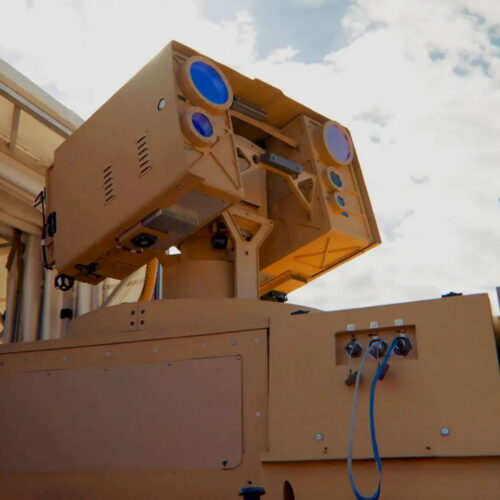
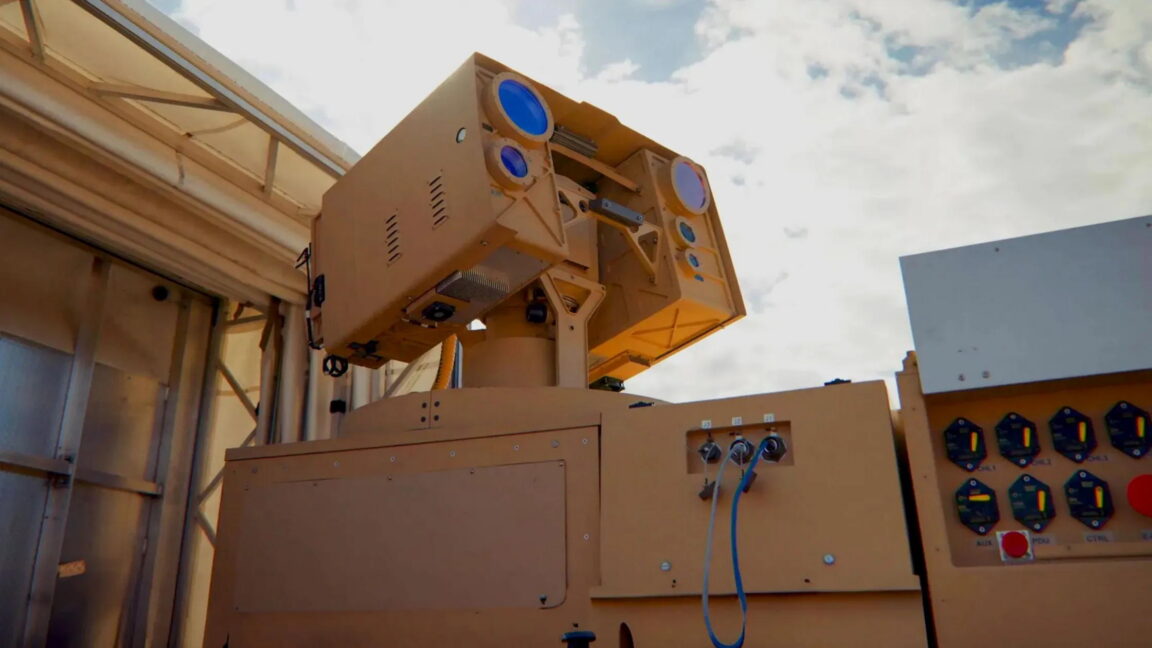
This week, the US Army used a high-energy multipurpose laser to shoot down three drones near the US-Mexico border, which official reports claimed were “posing a physical threat to US military personnel and CBP partners,” referring to Customs and Border Patrol.
The operation took place between the night of August 25 and the early morning of August 26 in the vicinity of the Rio Grande Valley in Texas and was led by the Joint Task Force Southern Border (JTF-SB), which operates under US Northern Command. Authorities confirmed that, during the operation, agents used technology derived from the Army’s High-Energy Multipurpose Laser (AMP-HEL) system, a military program focused on implementing high-energy lasers for new defense capabilities.
Available information suggests that this initiative began in September 2025, when AeroVironment, a company specializing in defense technology, delivered the first two functional prototypes of these laser-based weapons to the US Armed Forces. Two new, improved systems were delivered as the program was expanded in December of the same year. According to the manufacturer, this particular platform, called the Locust Laser Weapon System, is designed to be mounted on military vehicles, as the Army has done with the versions it has received.
The U.S. Army has committed to a million small drones by 2028. The Department of Defense has not decided who will authorize how they fire.
That is not a materiel gap. The volume is on order; Nvidia’s latest earnings guidance says the compute to run it is on the way. It is a governance gap, and it is now the single largest exposure in the American national security posture entering the fourth quarter of 2026.
Consider what landed inside a seventy-two-hour window this week. On Tuesday, Nvidia posted $96.2 billion in second-quarter revenue, with $89 billion of it in the data-center segment and guided to $108 billion in the September quarter — an annualized run rate through American hyperscalers of more than $400 billion, the largest defense-adjacent capital cycle in modern history. The same day, Boeing, Lockheed Martin, and RTX filed their responses to the Deputy Defense Secretary’s twenty-one-day production ultimatum on accelerated interceptor delivery. Nine days earlier, the Pentagon had opened the vendor portal for the $185 billion Golden Dome missile-defense program.
The chips are being funded. The primes are being pushed. The perimeter is being paid for. None of it tells you who decides when a fielded drone force pushes beyond its vendor’s safety rails during a live engagement.
That is not a hypothetical. Since March, the Department of Defense has formally designated Anthropic — the American AI lab whose Claude model is in active use within U.S. Defense environments — a “supply chain risk.” The two sides opened arguments in DC court over the blacklisting on May 19. In May, the Department expanded its classified AI work to eight companies, explicitly excluding Anthropic. On February 28, OpenAI took the other side of the same question, signing a deal to run its models on a Pentagon classified network. The day before, more than 580 Google employees, including DeepMind researchers, signed an open letter urging Google’s CEO to refuse the same kind of arrangement.
The industrial base of American artificial intelligence is not aligned on whether it will perform the classified work the drone doctrine assumes. The Pentagon’s response has been to fund compute, sign one lab, blacklist a second, and litigate.
Picture April 2027. A deployed American drone force is airborne over a contested Indo-Pacific corridor. A vendor safety guardrail on the targeting AI refuses a strike within a sixty-second window. The commander needs an override. No office at the Department of Defense — including the Chief Digital and AI Officer — holds explicit arbitration authority between the vendor’s guardrail and the commander’s judgment at operational tempo. The decision will be made ad hoc, by whichever lawyer or flag officer picks up the phone.
That is the arbitration gap. It is not the debt-service bill. It is not the interceptor shortfall. It is not even the shipbuilding backlog. It is the fact that the United States is standing up the largest defense-adjacent capital cycle in modern history — Golden Dome’s $185 billion, a million-drone target by 2028, and $1 billion for 340,000 attritable systems by 2027 — with no institutional authority designated to arbitrate how any of it fires. It is a supervisory function no institution has yet been chartered to perform, and no doctrine has yet been written to describe it.
Beijing runs the inverse problem. Paul Scharre laid out the industrial-base half of this argument in “Losing the War of the Future,” published in Foreign Affairs on June 23. What his piece understates is the demand side: even if the United States builds the drones, the doctrine and civil-military arbitration required to employ them do not yet exist at scale. The People’s Liberation Army’s answer is on the record. Three PLA researchers — Lieutenant Colonels Li Hengrui and Wang Haiyuan and Senior Colonel Cheng Jinming — published “all-domain megacity incapacitation warfare” in Military Art, the Central Military Commission’s restricted journal, in March 2025. Nathan Beauchamp-Mustafaga and Andrew Wang brought the article into the English-language conversation this summer in “Total War on Taipei,” published in War on the Rocks. The concept identifies the operational meaning of Xi Jinping’s “national total war” as an integrated arbitration architecture that fuses military, civilian, media, and party assets under a single narrative apparatus.
The PLA may struggle to execute it. The Central Military Commission, which began this term with seven members, has been reduced to two, hollowed out by disciplinary investigations. But the design is on the page. The American design is not.
Three signals will indicate by year-end whether the gap is closing or widening.
First, does the CDAO’s office designate a named override authority for wartime AI lab guardrails? Second, is the Anthropic-DoD blacklisting resolved into a joint framework for classified use, or does the litigation calcify? Third, does the FY27 defense-authorization conference name a joint force to operate Golden Dome, or fund the program without operator language? As of this week, all three are moving the wrong way.
The next war will not be lost because America bought the wrong drone. It will be lost because America bought the right one and never decided who could tell it to fire.
The Cipher Brief is committed to publishing a range of perspectives on national security issues submitted by deeply experienced national security professionals. Opinions expressed are those of the author and do not represent the views or opinions of The Cipher Brief.
Have a perspective to share based on your experience in the national security field? Send it to Editor@thecipherbrief.com for publication consideration.
Read more expert-driven national security insights, perspective and analysis in The Cipher Brief
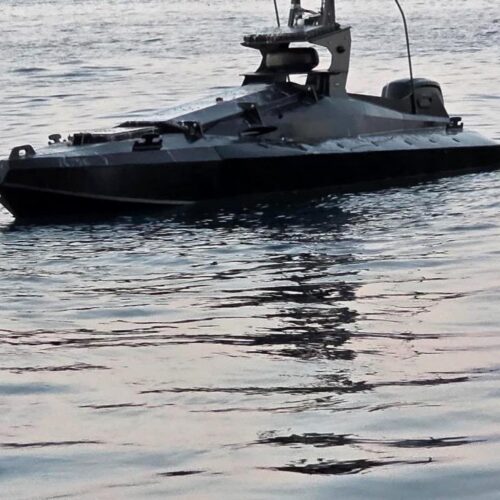
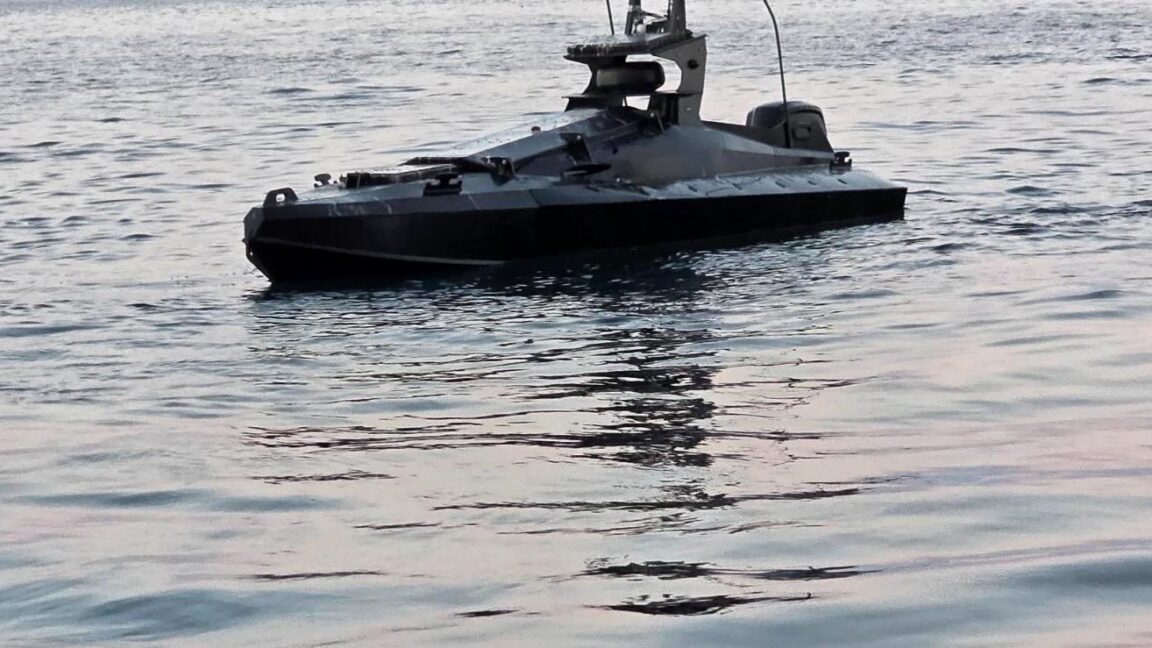
This week, Romania accused Russia of sending a drone boat loaded with explosives to a vital European natural gas platform in the Black Sea. A Romanian F-16 fighter jet used its cannons to disable the surface drone so that explosive ordnance experts could blow it up safely.
On August 20, the Romanian Coast Guard first spotted the maritime drone a few hundred meters away from the Neptun Deep project’s main drilling platform, where several hundred workers were busy with the platform’s ongoing installation, Defense Minister Radu Miruță said in a Facebook post. The offshore gas project would make Romania the largest gas producer in the European Union once it starts full production in 2027.
To protect the lives of the workers and the offshore gas infrastructure, the Romanian military scrambled two F-16 fighter jets to stop the drone with cannon fire, Miruță said. Army specialists later carried out a controlled detonation, as seen in a Facebook video shared by the defense minister.
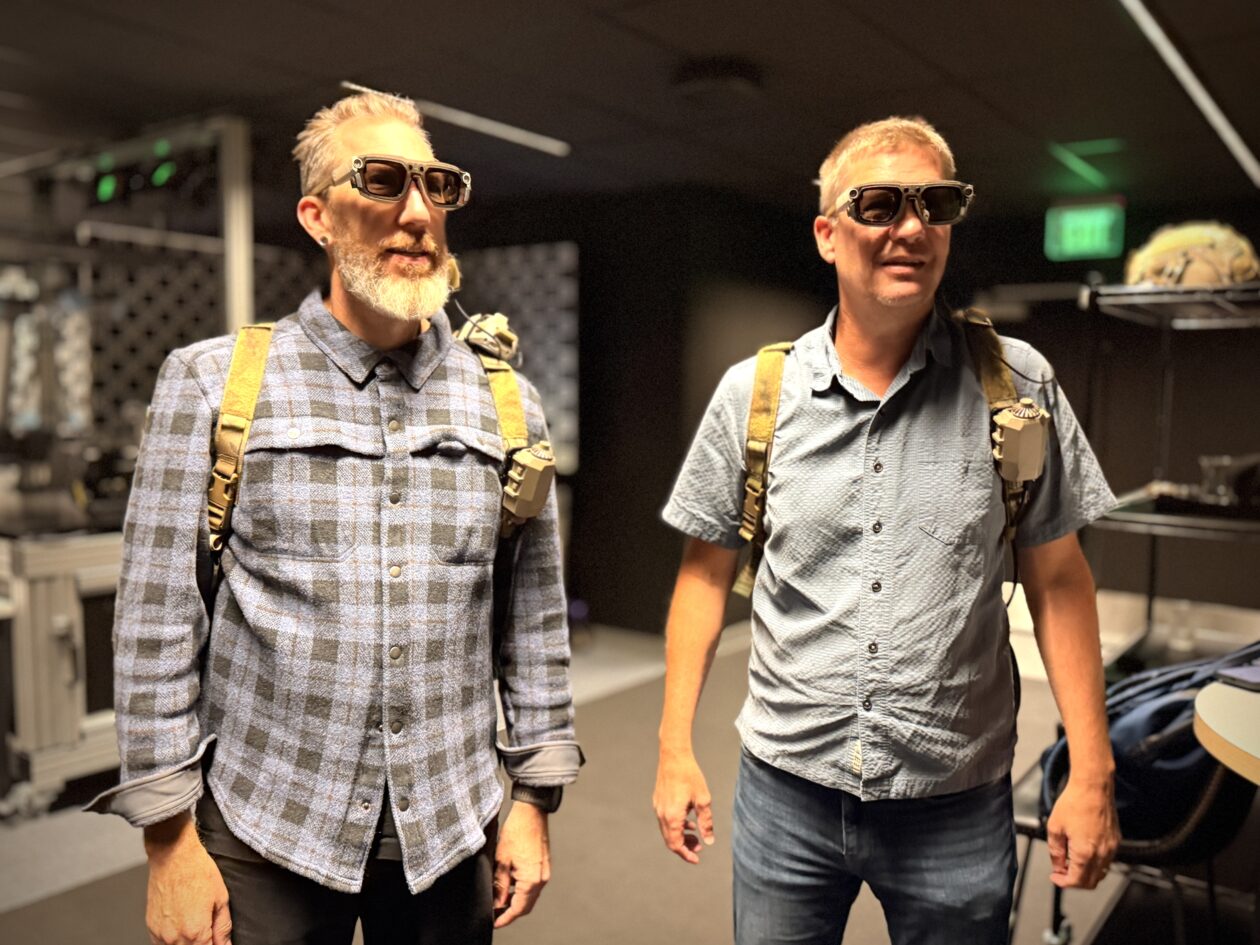
Chad Pfarr, principal design director at Anduril, at left shows GeekWire co-founder John Cook the company’s EagleEye augmented reality system at a testing lab at the company’s Bellevue offices. (Photo via Matt Mostad / Anduril)
BELLEVUE, Wash. — There is no prominent signage outside Anduril’s downtown Bellevue office. The name isn’t listed in the building directory, on the suite door, or in the lobby. That may be by design: Inside, Anduril engineers are quietly building AI-driven, autonomous technologies intended to keep the U.S. and its allies ahead in a rapidly changing military landscape.
Step through the front doors and it becomes clear that this is no ordinary tech company.
Scattered across desks, production tables, conference rooms and showroom labs are autonomous drones ranging in size from a microwave to a ping-pong table, alongside next-generation digital night-vision goggles and military-grade edge computers designed to keep soldiers connected in an increasingly data-rich battlefield.
The Costa Mesa, Calif.-based defense giant — which closed a $5 billion funding round at a $61 billion valuation earlier this year and is reportedly targeting a $100 billion valuation — is rapidly building a massive engineering footprint in the greater Seattle region. It includes modern offices in downtown Bellevue and Seattle, and a multi-acre military testing facility near Carnation, Wash.
Tom Keane, who oversees Anduril’s connected warfare group, in front of prototypes at the Bellevue offices. (GeekWire photo / John Cook)
GeekWire got a peek inside the iconoclastic company’s Seattle-area operations this week. We toured the Bellevue offices, demoed products, and sat down with senior vice president Tom Keane. The former Microsoft cloud executive leads Anduril’s local presence and oversees its connected warfare division, including mixed reality, AI and edge computing technologies.
Keane was clear about the company’s growth ambitions in the Seattle region: “I could absolutely see a world where we get to 1,000 people here in terms of engineers,” he said.
Asked when that milestone could be reached, Keane said, “It’s sort of almost as fast as you can hire people.” Realistically, that will likely occur over the next two years.
Anduril currently employs 560 people in its Bellevue and downtown Seattle offices, up from about 30 four years ago. That’s when Keane, who had interviewed with 62 companies looking for a new challenge in edge computing, joined Anduril because of what he called “world-class teams in every discipline.”
With more than 110 open positions in Washington state and a newly leased third floor in downtown Seattle coming online, Keane said the regional expansion is only accelerating.
The regional workforce was until recently slated to include a maritime manufacturing hub along the Lake Washington Ship Canal in Seattle. However, as GeekWire reported this morning, Anduril has since vacated the former Foss Maritime shipyard space after the U.S. Navy canceled the autonomous warship program the company was pursuing.
But Anduril’s maritime ambitions haven’t gone away. Alongside its autonomous aircraft, low-cost cruise missiles and counter-drone interceptors, the company continues to develop a large subsea fleet, from modular survey vehicles to the extra-large, school-bus-sized Dive-XL.
The Big Tech pipeline meets ‘grit’
The company’s Seattle-area ramp-up is a play for the region’s engineering talent — a mix of disciplines well-suited to a next-generation defense hardware company, and one Keane says is hard to find in one place. That includes distributed systems engineers, AI and machine learning specialists, and advanced optics experts.
Another advantage: proximity to major military installations including Joint Base Lewis-McChord and Naval Base Kitsap.
Tech giants such as Microsoft, Amazon, Google and Meta have long dominated local engineering hiring. But Anduril is recruiting aggressively from those companies, pitching engineers who want to move fast and see their work in the field.
Deep pockets and close ties to the U.S. defense establishment don’t hurt, either.
Anduril got a large infusion of that talent 18 months ago, when it took over Microsoft’s IVAS (Integrated Visual Augmentation System) program along with about 100 local engineers who had spent years developing augmented reality hardware for the U.S. Army.
“If you take machine learning and AI… you can look out any of these windows and see places that we can recruit from,” Keane said from a conference room overlooking downtown Bellevue. “For a lot of software engineers, this is incredibly applied.”
Keane acknowledges the company’s culture isn’t for everyone. In fact, Anduril got plenty of buzz last year with its edgy recruiting campaign, “Don’t Work at Anduril.“
Rather than plush tech perks and work-from-home flexibility, Anduril pitches what Keane calls “grit” — a willingness to take ownership of hard engineering problems and test them in the field. It’s very much an in-office culture, in part because the company builds hardware.
The company’s “grit” translates directly into how Anduril tests its gear.
In rural Carnation, Wash., about 20 miles east of Bellevue, Anduril operates a testing range with a built-out “shoot house” for low-light tactical work. It gives engineers a place to iterate on code and hardware in the mud and rain alongside active-duty warfighters.
Among them: members of the Army’s 75th Ranger Regiment from nearby Joint Base Lewis-McChord, who recently put Anduril’s EagleEye mixed-reality system through its paces on the firing range and obstacle course.
Hands-On with ‘EagleEye’ and Lattice
During a walkthrough of the Bellevue facility, Anduril’s team showed us a wide range of hardware being designed, tested, and calibrated on site.
The centerpiece was EagleEye, the company’s heads-up hardware and software suite built for warfighters. Historically, soldiers have had to lug 3 to 5 pounds of glass and electronics on their helmets, paired with fragmented radios, specialized batteries and thick cables.
Anduril’s system strips that down to a 115-gram pair of augmented reality glasses — about four ounces — built in collaboration with Meta (for waveguides), Canon (for sensors), Qualcomm (for custom silicon) and Oakley (for ballistic protection).
I tried on the lightweight camouflage backpack and glasses — no helmet in this case — in a demo in the Bellevue testing lab. It ran through three operational “vignettes” driven by Anduril’s core Lattice software:
Tactical HUD: A heads-up display projecting friendly force markers, compass headings, and mini-maps into the user’s field of view so troops don’t have to look down at a handheld screen while moving.
Threat Detection: Real-time alerts from external AI sensors — such as a tower camera or an overhead drone — highlighting incoming aerial threats directly in the display.
Command & Control (C2): The ability to assign tasks to autonomous technology. Using a small handheld controller, an operator can send a virtual Ghost drone to a location, pull up a live video feed and execute a simulated strike.
In each case, the user controls the system — navigating between maps and text — with a click of a button on a small device connected to the front of the backpack.
The team also previewed its upcoming digital night vision system. Instead of the narrow “toilet paper roll” view of traditional analog goggles, Anduril’s VR-style digital displays offer an 84-degree field of view. That’s more than double the 40 degrees warfighters get in devices today.
Anduril’s Tom Keane shows off the company’s light-weight night vision goggles, being developed at the company’s Bellevue office.
Using machine learning models, the system fuses thermal imagery and low-light camera feeds in real time, making heat signatures leap out in pitch-black environments.
To ensure every pixel lands accurately without causing motion sickness, Anduril’s engineers use custom robotic arms to run geometric calibration on each lens distortion map before it leaves the facility. An engineer running the testing equipment politely asked GeekWire not to photograph the system.
The night vision system has not yet been deployed but will be part of the Soldier Borne Mission Command prototype delivery to the U.S. Army next year, said Stephanie Davis, communications manager for Anduril’s connected warfare group.
Protests, hiring and hardware
Operating a high-profile defense company in the Seattle area doesn’t come without friction. Activist groups recently staged protests outside Anduril’s downtown Seattle offices, targeting the company’s autonomous weapons development and military contracts.
At the time, Anduril issued a statement to GeekWire saying that it respects the right to free speech. “That said, it is perplexing when people choose to protest a company dedicated to supporting the very military that safeguards those rights,” the company added.
When asked about the pushback, Keane said critics don’t affect Anduril’s hiring. “There’s protests at every company, frankly.”
Anduril’s hiring reaches well beyond Big Tech. Drew Swanson, a lead architect, spent 13 years in the military working in communications supporting special operations units in the field. He described an Anduril technology called Squad-A, which helps squad leaders pick the best network connections to stitch together incoming intelligence feeds.
Swanson said the draw of Anduril is the chance to escape corporate bureaucracy and tackle high-stakes physical problems, reflected in comments he gets from others in Seattle tech.
“One of the biggest things that I always hear is: ‘I want to come over there because you guys are going after really hard problems,'” Swanson said of conversations with tech colleagues around Seattle.
Solving those problems often comes down to fundamental hardware redesigns, like combining a soldier’s ballistic vest, battery and edge computing device into a single body plate. Keane showed off a prototype as the tour wrapped up — an example of Anduril’s broader approach.
“Batteries are such a huge thing,” he said, pointing to the body armor. “If you put the three of them together… you can start to get rid of stuff. You take what was historically three separate heavy things and turn it into one software-enabled platform.”
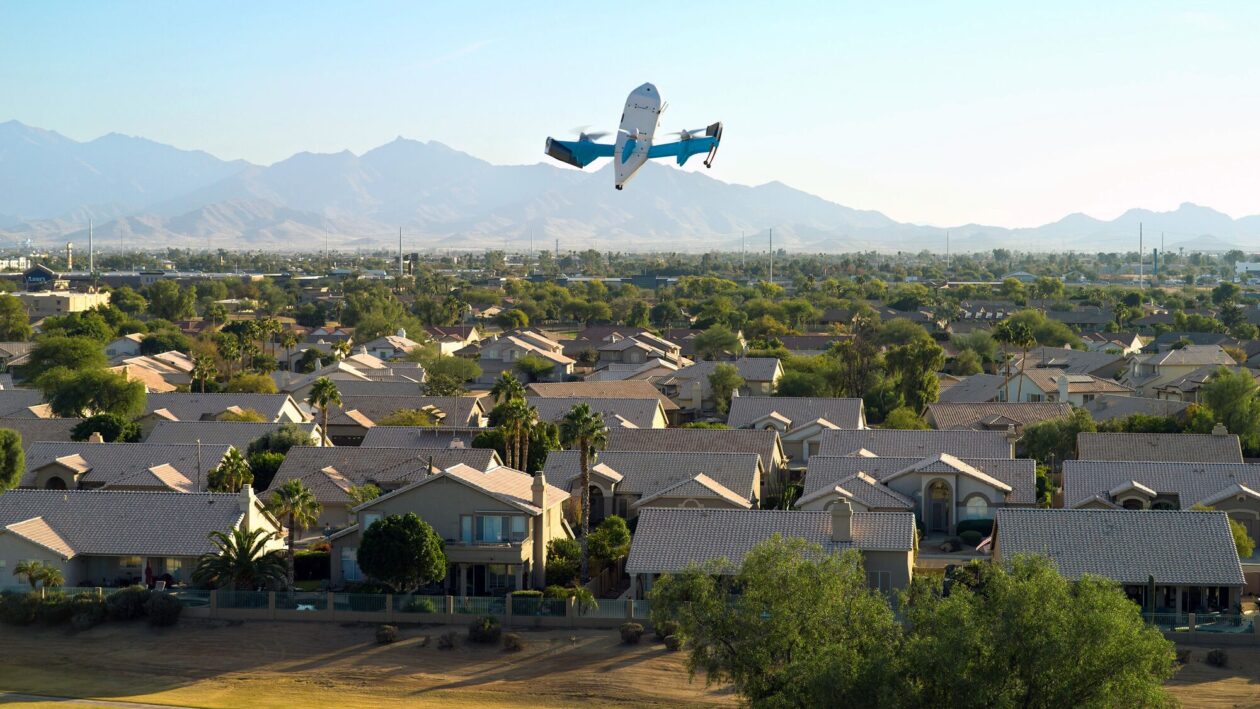
An Amazon Prime Air delivery drone flies over a suburban neighborhood in Arizona. (Amazon Photo)
Amazon’s drones are finally going national.
The company’s autonomous aerial vehicles are set to deliver packages to nearly 500 cities and towns across the country by the end of this year, zipping items through the air to drop them in backyards and driveways as quickly as 30 minutes after ordering.
Amazon announced the plan Wednesday, describing it as a sixfold increase in its Prime Air footprint, reaching communities collectively representing tens of millions of customers.
“I know this looks like science fiction — it’s not,” the Amazon founder said at the time.
Bezos acknowledged that it would take at least four or five years, optimistically, and that convincing the FAA the drones were safe would be one of the biggest hurdles. Amazon’s FAQ that night said it hoped the agency would have rules in place “as early as sometime in 2015.”
Both the technology and the regulations took far longer than the company expected.
Amazon said Wednesday morning that Prime Air will launch soon in the Chicago, Syracuse, Cleveland, Atlanta and Boise metro areas, with more communities to come later this year. The drones fly primarily over suburban areas, which allows them to avoid the tall buildings and crowded airspace that complicate flights over dense urban areas.
There’s no word yet on when or whether drone delivery will come to the Seattle area.
Amazon said the drones launch from two types of facilities: smaller same-day delivery sites and its larger robotic fulfillment centers. The mix is what lets Prime Air offer anywhere from tens of thousands to millions of items depending on the location, according to the company.
Nearly any item weighing 5 pounds or less and small enough to fit in a large shoebox is eligible for drone delivery. That translates into millions of products, as noted by Amazon CEO Andy Jassy in his annual letter to shareholders earlier this year. He wrote that Prime Air would carry “a much larger selection of items inside a half hour” than Amazon’s other fast-delivery options.
Drone delivery will be free for Prime members on orders of $50 or more. Prime orders below that carry a $2.99 fee, and customers without a membership pay $4.99.
Amazon’s reference to expanding to 500 cities and towns does not reflect the number of planned Amazon drone launch locations, but rather the number of municipalities that fall within delivery range of the planned hubs, each of which covers roughly 175 square miles.
The 30-minute delivery scenario is a best case. Most orders arrive around 60 minutes after checkout, Amazon said in its announcement.
Amazon isn’t the only company betting on drones. Amazon retail rival Walmart and Google parent Alphabet’s Wing have been building what they call the largest drone delivery network in the U.S., adding seven new markets in June including Phoenix, Philadelphia and the Bay Area. They plan to reach 270 stores and more than 40 million people by next year.
Local approvals remain a hurdle for delivery drones. Noise has been a recurring concern for residents near drone operations. Amazon says its drones are quieter than an idling delivery truck during drop-off and comparable to a window fan while in flight. A proposed federal rule that would more broadly allow flights beyond the pilot’s line of sight has not been finalized.
The Associated Press first reported on the expansion Tuesday afternoon in what appears to have been an inadvertent break of a news embargo, to which GeekWire had not agreed. Post updated Wednesday morning with details from the official announcement.
During the week of March 9, drones came overBarksdale Air Force Base in waves. Barksdale is the home of the 2nd Bomb Wing, one of the places this country keeps its nuclear-capable bombers. The base issued a shelter-in-place order and stopped flight-line operations, and the Air Force has declined to say precisely how many aircraft were up there or who was flying them. NORTHCOM's counter-drone fly-away kit, the good one, the one that worked over a strategic installation in the opening hours of Operation Epic Fury on February 28, was somewhere else. There is only one of them.
Then General Gregory Guillottold Congress the number that should have ended the conversation about whether we have this handled. "About a quarter of the ones that we detect, we're able to defeat." He offered it as good news, and by the standard of the previous year he was right: in 2025, he said, "almost every one that was detected was not defeated."
Welcome to The Iron Triangle, a dedicated column serving the procurement officers who are asked with buying the future, Investors funding the next generation of defense technology, and the policy wonks analyzing impact on the global order.
Hold that in your head. The federal government with every authority Congress can write, the entire electromagnetic spectrum at its disposal, and a defense budget larger than the next nine countries combined, stops one drone in four over its own bomber bases.
Now we are handing the same problem to a sheriff's department in Talladega, and we have written them a rule that is worse.
A Rule That Anticipates Everything Except the Answer
On July 6, the Departments of Justice and Homeland Security published theinterim final rule implementing the SAFER SKIES Act, effective July 1, and for the first time extended real counter-drone authority to state, local, tribal, and territorial law enforcement, and, critically, to correctional agencies. This is overdue, it was built fast, and the people who wrote it deserve credit for standing up a certification and oversight architecture on a compressed timeline.
Then you get to the Authorized Technologies List, which is the part that decides what a certified agency may actually field. The Departments expect the initial list to contain three categories: radio-frequency detection with command-and-control signal interception, RF disruption (broadband and protocol-specific jamming), and RF protocol manipulation, meaning command injection and cyber takeover. All three are radio-frequency categories. There is no fourth.
This would be an unremarkable sequencing decision except that the rest of the rule plainly contemplates bringing an aircraft down by physical means. The statute authorizes certified agencies to use reasonable force to "disable, damage, or destroy" an unmanned aircraft. The rule requires air-traffic notification for mitigation that emits no radio frequency, and the preamble explains why in language that leaves nothing to interpretation: such an action can affect the airspace "for example by bringing an unmanned aircraft down or creating falling debris." The rule requires Mitigation Certification for personnel who physically intercept a drone in flight.
So the rule trains an agency to do it. Certifies the officer to do it. Writes the falling-debris notification procedure for when they do it. And then hands them a list with nothing on it they can do it with. Plainly spoken, the rule does not include kinetic interceptors, something that knocks a drone out of the sky.
That is what happens when a list gets populated by whatever already had the deepest federal deployment history, which is exactly what the Departments said they were doing. The RF categories had the paperwork. So the RF categories got the boxes. The list has nothing to do with what works. It is a fossil record of what has already been bought.
Three Categories, One Point of Failure
Here is why this is a safety problem and not a paperwork problem. The three listed categories are functionally distinct and they share a single dependency: every one of them requires the target aircraft to present an exploitable radio link. Where there is no link, interception has nothing to intercept, jamming has nothing to jam, and cyber takeover has no protocol to take over. They do not degrade independently. They fail together, at the same instant, against the same threats.
Three classes of aircraft now routinely present no such link. A drone flying a stored waypoint route with its control link severed emits nothing and listens to nothing; this is a checkbox on consumer airframes. A protocol-hardened or custom-built airframe falls outside the signature libraries that detection-and-takeover systems depend on. And then there is fiber optic, which is the one that should be keeping planners awake. They manage control and video via physical filament. There is no radio link at all. Fiber optic drones are immune to jamming as a matter of physics rather than engineering. Russia is turning out more than fifty thousand fiber-optic FPV drones a month at a single facility in Veliky Novgorod. The technique defeated RF countermeasures at Kharkiv. It defeated them over Victory Base Complex in Baghdad, where there was no visible intercept attempt at all.
None of this is exotic. It is three years old, it is cheap, and it is documented in open sources that any competent adversary reads on the same afternoon you do.
An agency limited to the three RF categories is superbly equipped against a careless hobbyist with a stock quadcopter and defenseless against anyone who has been paying attention. That is precisely the inverse of the risk profile the rule exists to address.
The Recent Events Are Not Ambiguous
On June 24, just twelve days before the rule was published, theJustice Department indicted twelve defendants in what it called the largest federal prosecution to date involving coordinated drone operations to smuggle contraband into prisons. Ten federal facilities across eight states. Thirty-eight documented drops using six aircraft, running from September 2023 through May 2026. Methamphetamine, K-2, Suboxone, cell phones, tobacco, and saw blades.
Two and a half years of flights. Thirty-eight of them are documented. That is not a hobbyist wandering into restricted airspace. That is a logistics operation with route planning, aircraft attrition, and a customer base. Organizations at that level of sophistication adapt to countermeasures. The adaptation most cheaply available to them is the one the initial Technologies List cannot answer.
Compare the coverage. Five days later a JetBlue crew reported striking a drone on approach to JFK, and it led the news for a week before a preliminary investigation found no physical evidence that it happened at all. The collision that may have been nothing got the cameras. The thirty-eight drops that certainly happened got a press release from the Middle District of Georgia.
The Part That Should Embarrass Us
Now for the contrast that makes this a column instead of a comment.
On January 28, Brigadier General Matt Ross, who directs Joint Inter-Agency Task Force 401, told reporters: "I see us using low-collateral kinetic interceptors at all installations in the homeland." The Deputy Secretary of Defense had directed JIATF-401 to ensure kinetic capability at every location. Two days later thetask force awarded $5.2 million for the Bumblebee V2, a kinetic interceptor, with deliveries beginning in March. Asked about squeamishness over kinetic engagement inside the United States, Ross said he "fundamentally disagrees."
Same airspace. Same threat. Same country, in the same calendar year. The Department of War calls low-collateral kinetic interception essential and is buying it for every installation in the homeland. The Departments of Justice and Homeland Security published a list on which that category does not exist.
What Each Corner of the Triangle Should Take From This
For the Procurement Officer, understand what you are budgeting against. You can be accredited, certified, trained, and funded, and still have nothing to buy, because the box your requirement lives in has not been created. The rule as published does not tell you plainly that kinetic capability is unavailable to you. State and local agencies are writing fiscal-year plans and grant subaward requests against it right now, and some of them are going to buy capability they are not authorized to employ.
For the Investor, this is the diligence question you are not asking. You have been asking whether the technology works and whether there is a customer. Start asking a third question: what category does this go in, and does that category exist yet? A company can be technically excellent, combat-proven, and commercially validated, and still be unsellable because a list has no line for it. Listing risk is not a footnote in the regulatory section of the deck. In this sector it is the whole thesis, and it is currently unpriced.
For the Policy Wonk, notice what just happened to the locus of policy. Congress debated the SAFER SKIES Act in public. The interim final rule went through interagency review and took comment. But the Authorized Technologies List, the instrument that actually determines what a certified American police department may deploy against a drone over a school, is an administrative artifact updated through a coordination portal. No one voted on it. Most people affected by it do not know it exists.
I have spent years watching good capability lose to bad process, and I thought I had seen the full catalogue. I had not. The Valley of Death I have been writing about is a money problem: you have the technology, you cannot get the contract. This is something else. This is a company that has the technology, the customer, the certification, the training pipeline, and the federal deployment history, and cannot sell, because the taxonomy has no word for what it built. Call them the Unlisted. They are the Forgotten Bench's stranger cousin, and they lose more quietly, because there is no rejection letter. There is just a list that does not mention them.
The fix is small and it is already scheduled. The Departments said they would run a sixty-day sprint to revise the list after publication. Add a fourth category, low-collateral kinetic interception, defined narrowly enough to exclude firearms, unguided ballistic means, directed energy, and anything heavy enough to be its own hazard. Write objective listing criteria the way the RF categories already have them: bounded interceptor mass, bounded terminal energy, demonstrated fail-safe behavior on loss of lock, a modeled and test-validated debris footprint, a declared engagement envelope. Then say plainly, in one sentence, that until such a category exists, kinetic mitigation is unavailable so that nobody spends a grant on a capability they cannot lawfully employ.
The Risk
I am not going to pretend this one is free, because it is not, and the people who will be nervous about it are right to be. Radio-frequency mitigation that fails harmlessly drops a link. Kinetic mitigation that fails drops an object, and it drops it over a stadium concourse, a prison yard at count time, an interstate at rush hour. The rule's own falling-debris notification requirement exists because somebody thought that through, and a two-kilogram interceptor over a crowd is not a spreadsheet exercise. Widening this list carelessly buys us a very bad Tuesday.
There is a second risk, and I have written this column before from the other direction. A category written narrowly enough becomes a moat for whoever helped write it, which is how well-intended technical criteria turn into incumbency by another name. That is the ITAR story wearing a domestic uniform, and anyone advocating for a new category, including me, should be watched for it.
And a third: certification is not proficiency. A deputy with forty hours of classroom time and a kinetic interceptor is a genuinely different risk than an operator who has done it a thousand times. Recurrency has to be tied to the effector an agency actually fields, not to one undifferentiated certificate, because competence with a jammer transfers to a kinetic interceptor exactly not at all.
None of that argues for keeping the category empty. It argues for writing it carefully, on a clock, with real criteria, which is a harder job than leaving the box blank, and the reason the box is blank.
We have built a system in which the most consequential procurement decision in American counter-drone policy is not made by a program office, a contracting officer, or a member of Congress. It is made by whoever maintains a list. Comments on the rule close on September 4. After that, the question stops being what we should have listed and becomes what we have to explain. The honest version of that question is this: when a drone that does not answer a radio comes over the wire at a federal prison, and the certified, trained, funded officer standing under it has nothing on the list to use, whose signature is on that?
Disclosure: Atlas Special Projects prepared a public comment on the rule discussed below on behalf of a counter-UAS manufacturer. The argument here is that of the author, and it applies to a category of technology rather than to any one company's product.
Editor’s note- Russia's war in Ukraine has fundamentally changed the character of warfare, proving that autonomous and attritable drones are no longer supporting tools but have become a decisive instrument of combat. In this provocative essay, co-authors Xen & Matthew Creedican argue that the United States must abandon legacy assumptions and adopt an entirely new military doctrine, force structure, and industrial strategy built for the age of autonomous warfare. (Xen is a former US Special Operations veteran with experience fighting alongside Ukrainian forces. We have granted his request for anonymity).
This paper is written expressly for the policy and decision makers across the military and public and private sectors who are bound to translate national strategy into reality. We will withhold for another day the arguments for convincing those who have yet to concede that the rifleman’s day is over or that drone warfare in Ukraine generalizes. Instead, we are making a series of recommendations to those already on board with direction from the Department of War (DoW) that “we are pivoting the Pentagon and industrial base to awartime footing”, as manifested in a$50B+ modernization program to ensure that “every warfighter must have access to low-cost/attritable sUAS [small drones] to conduct missions.” To help leaders meet such a steep challenge, we will describe how the force should be structured, how doctrine should be written, and how the industrial base must be re-engineered to match present scaling by our adversaries.
What a Modern Drone Force Should Look Like, For Now
If we could snap our fingers now and summon an army well-trained and well-equipped according to the latest understanding of modern drone warfare, it might be composed of battalions fielding approximately fifty to a hundred mixed-role unmanned systems deployable simultaneously, with stocks of thousands more unmanned vehicles and spare parts (antennas, ground stations) ready to replace those attrited. The force tailoring would have to include both rotary and fixed-wing drones performing reconnaissance, mothership, electronic warfare, one-way attack (OWA), bomber, and multi-role tasks. Such a battalion should be able to organically find, fix, and finish targets at ranges up to300km.
Presently in Ukraine, formations tend to specialize by range. Tactical or “infantry” battalions deploy quadcopters controlled by direct radio link or fiber optic from positions 3-10km from the absolute front, flirting with the danger zone, with the better teams now fielding glide-kit quads reaching out to 50+km, doubling their effective range from last year. Ground drone units are increasingly critical as well, performing the vast majority of evacuation and logistics within the 9-15km+ “gray zone” where manned vehicles are not worth the risk to employ. Dedicated drone battalions overwatch these units from 10-20km from no man’s land, operating typically out to 80km but at times out to 300km thanks to proliferating autonomy and redundant communications (direct, meshing, repeating, satellite, LTE, etc.). This upper end for the “mid-range” or “operational” level of warfare has also at least doubled since last year. Finally, specialized deep strike teams are now conducting strikes out tobeyond 1500km against strategic targets, with high-volume, low-cost, independent, adaptable platforms quite different from expensive legacy US drones.
At every level of the above structure, it is understood that even the non-OWA platforms must be attritable, since they rarely accomplish more than several missions without being rendered inoperable. Particularly cheap systems are evendeliberately used as decoys. And of course, seeping down into these echelons is autonomy enabled by AI, and the beginnings ofswarming protocols. It must be understood that what the aircraft carrier once did to naval gunnery is what the drone is doing to the rifleman. The fundamental unit of combat power is now the small drone team, and it is an over-the-horizon asset.
Saving Combined Arms Maneuver
Drones employed properly in such formations could execute combined arms maneuver warfare rather than the attrition warfare we currently see. After reconnoitering the enemy and making contact, unmanned battalions could use air platforms in both expendable and regenerative loitering waves to degrade air defenses, electronic warfare systems, logistics, and command structures, after which successive waves could suppress and attrite ground forces in preparation for ground drones to take, hold, and shape ground. Only then would humans move forward to effectively deepen the range of their systems. All this implies an in-depth rewriting and reapplication to unmanned warfare of manuals and doctrine guides such as FM 3-0 Operations, FM 3-90 Tactics, and FM 3-96 Brigade Combat Team. Current revisions have relegated the drone to asupporting role at best. Another example: given that a legacy US Army Corps of tens of thousands of personnel has multiple days to make decisions across approximately the same operational striking depth as that of one of the aforementioned Ukrainian drone battalions of a few hundred personnel, clearly we must revise our echeloned depths of responsibility . The existing disparity has practical consequences, as Ukrainians not only handily defeat NATO forces in joint exercises, but they do it with comparatively tiny forces, striking larger formations and assets in areas thought to be “safe”.
As such, it should be clear to those familiar with the actual contestants in programs likeDrone Dominance that we are staging to mostly procure platforms that are too expensive for the requested operational ranges. Although the DoW has set a target of roughly half a million drones per year for procurement, it will actually need at least fifty million to meet the lofty goal of training and equipping a ~500,000-1,000,000 man force with attritable systems. If we look to the rest of the world, we will see that Ukraine and Russia this year are each likely to utilize aroundtwenty million drones, while China, as the manufacturer of most of the world’s drone components, will likely build the equivalent of a hundred million drones.
Predictive Doctrine for a Moving Target
But even this, unfortunately, is not the real crux of the issue with respect to the development of future requirements. Doctrine must not only be prescriptive of the present, but also of the near future. The fact is, we cannot just snap our fingers to summon a drone army. It will take years to build it out, and by then things will look even more “sci-fi”. That is, we are chasing a moving target three to ten years out, and so we had best engage in some imagination to meet that challenge.
We are conscious of how radical this is going to sound, but our goal with such provocation is indeed to shift the Overton window, so, we believe that the future will look like something out of Ender’s Game, and it’s going to happen well before those now entering the military reach retirement eligibility.
Man, Train, and Equip for the Sci-Fi Near Future
Individual drone controllers will become tactical commanders (so let’s call them “tacticians”) remotely running squadrons of individually autonomous drones,point-and-clicking their way through a 3D interactive, AI-mediated, sensor-fusion digital twin of the battlefield. The base layer is already here in the digital panopticon emerging from cloud-native Common Operating Picture (COP) software like Ukraine’sDelta merging with military AI suites. Palantir’s Maven already suggests courses of action at the command level, and there’s no reason this couldn’t be extended down to the lowest tactical levels, controllable by voice, touch, or text. In a few more years the tacticians themselves will be inside somethingNeuralink-shaped, performing at the speed of AI-enhanced thought and striking at the links in the chain that enable adversarial tacticians. Under those conditions the adaptation cycle, too, will move at a speed that cognitively unenhanced humans cannot keep up with, and intelligence becomes the runaway comparative advantage at every level. There is no telling where such cognitive selection pressure combined with the ability to remotely control drone swarms will end. Will individual soldiers control dozens of drones simultaneously – or thousands? How many drones should a “battalion” have?
Decentralization is a factor too. Everything we are seeing develop now is scaling in Ukraine down to the individual operator, as it must. The over-the-horizon warrior needs personal access tolivestreamed tactical radar to check if the skies are clear before he exposes himself by making movement. He needs edge compute not just onboard his drones, but for local offline AI to analyze the battlefield and make decisions even in a communications blackout. Already we see backpack portable drone interceptor systems for personal defense; I’m aware of contracts under consideration for such systems to miniaturize to automated shoulder-launch, like a personal version of the tank-mounted Trophy system. The current estimate is that a soldier has one to four seconds to defend himself against a visual drone contact vectoring on him, and soon that timeline will compress enough to exceed human reaction times.
Asking what exactly the mass of conventional soldiers will do under such a radical restructuring is much like asking whether or not Large Language Models (LLMs) are going to have the net effect of creating or destroying jobs in the civilian workforce. We may see the formation of a tiny military class, or perhaps warfare will become even more industrial in human scale. Certainly, humans will be pushed farther and farther back in the logistical chain that ultimately delivers kinetic effects upon an adversary. Currently, there is a need for people to physically emplace, operate, and recover antennas, ground stations, and drones. Once robots are more commonly executing these tasks (already, some aerial drones are launched viamulti-domain mothership drones), people will work on those robots, and so forth. Eventually, it’s hard to see what anyone will need to do physically, as robots will be building, repairing, improving, and employing each other. The only real foreseeable tasks left at the tactical echelon will be those of the tactician and the true engineer, who innovates and integrates locally. Whoever best automates tasks end-to-end will win the tempo fight. The transportation of weapons and sensors has to be contemplated as one mass-manufactured logistical animal.
Going further, the tactician need not position himself relative to any front at all, because he can fly remotely and because he would be sensible to reduce his threat profile from direct action threats to intelligence-driven threats only. That is, he should position himself to strike with impunity. Already in Ukraine, Sting pilots have flown their interceptors remotely500km away from where they were launched. Midrange teams outside the gray zone already drive to position in unmarked civilian vehicles, wear their uniforms only for the minimal time needed to deploy their systems, and then fade back into the population. And the naval drones striking the Russian fleet are not generally controlled from the sea, but ultimatelyfrom bases on land. If trends hold, the smallest independent tactical elements may be able to cheaply strike anywhere on Earth within a decade.
Branching Futures: eVTOLs, Smart Dust, and Beyond
But this is merely one vision of the future. There are branching pathways, perhaps some of which may coexist. Weaponized human-optional eVTOLs like the Chinese prototypeZR-300 could become a new air cavalry paradigm unto themselves if employed en masse in shock fashion, sweeping aside whole nations in a day the way Central Asian hordes did in the Medieval period, or the way Islamist insurgents swept across the Sahel inToyotas. Microscopic drone “clouds” also known as smart dust could penetrate any conventional barrier, performing reconnaissance or even coalescing explosively or penetrating air ducts and lungs. Does this seem one step too far, straining credulity? Remember that “any sufficiently advanced technology is indistinguishable from magic” from the perspective of the old guard, and that all these technologies are already real, just not fully scaled and integrated. In fact, micro drones were feasible decades ago, technically if not economically – timing is everything. We already have a leading indicator in the German army’s very real purchase of cyborg insect swarms fromSwarm Biotactics. Against such dizzying possibilities, we will advocate further on below for a rapidly adapting structure that ingrains real-world feedback and extrapolates from it.
Economies of Scale for Drone Production
First, let’s deal with how we produce enough useful drones to simply match our adversaries. The necessary industrial base to deliver manufacturing on the required scale simply does not exist anywhere in the West currently, whereas China has quietly captured the drone market and the sub-component supply chains over decades and is integrating such technology down to their lowest tactical echelons at a hundred times our volume. Much has already been written about the need to innovate and iterate on a scale of weeks rather than decades, and while true such a need potentially comes with the steep requirement of continuous retooling of factories and endless R&D. Ironically, funding this effort at the scale needed will require a vision across a much longer (generational) timeline, in opposition to the quarterly results that drive Western business strategy. Currently, the US buys primarily the end-product rather than engendering the component markets directly. From a cost-savings standpoint, we would do well to preemptively build adaptable systems, and also to stop trying to update legacy programs (we will never need a new sniper rifle). The DoW budget has to fund the domestic mass production of production itself, with an eye towards dual-use sub-components and machine tools, since commercial R&D and production can fund itself to an extent. Vehicles, phones, and drones sold into civilian markets pay for their own scaled production, and volume buys down cost. As it stands now with our current component outsourcing, we are paying our enemies to equip us, tying the rope with which they intend to hang us.
Pillars of a Sovereign Drone Industry
The pillars of industry to be funded include locomotion, actuation, energy, storage, compute, sensing, and communications. The component-level specifics, meaning motor sizes, magnet chemistries, cell formats, and the rest, belong in a technical paper. What’s important here is that the government has to guarantee the market for base components as much as scale requirements dictate and raw materials allow, while simultaneously finding the alternatives that bypass adversarial chains entirely.
Shallow or single-sourced chains halt on the first disruption, so volume has to be distributed across multiple domestic entities in order to create redundant paths. That means accounting for the physical bottleneck of factory siting, the legal bottleneck of restrictive radio frequency and flight-test regimes, and the social bottleneck of technical workforce recruitment, which in practice means a nationwide push for engineers with the education pipelines to match. We should fixate less on the static stockpile and more on the velocity at which the economy can replace a lost or outdated asset. Eventually, this may look like self-assembling factories, but for now we should see a dramatic increase in industrial jobs, not a reduction.
Guaranteed Requirements and Manufacturer Caps
The Departments of War and Commerce must jointly establish requirements and guarantee purchase of components at massive volumes, over multi-year timescales, according to stringent standards for minimum viable products meeting or exceeding foreign equivalents, with caps set on what portion of the total any one manufacturer can source. Subcontracting and manufacturer caps will encourage competition inside our own secure ecosystem rather than across national borders, where we are frequently undercut by adversaries. As needed, the government can resell unused inventory back to industry at or below the cost of subsidized foreign imports, letting American companies build with cheap secure inputs.
We have a realistic precedent for all this, as described in the book Freedom’s Forge: In anticipation of US entry into WW2, President Roosevelt brought together former of heads of industry in order to align military requirements, government funding, and civilian production capacity so that goals could be revised upward continuously, and the resulting volume forced a dynamic of subcontracting to keep up with demand. American industry responded, not only producing hundreds of thousands of complex war machines, but also rapidly retrofitting them as needed based on frontline feedback, on much the same timescales that we today see in Ukraine.
Innovation on the Machine Timescale
In the near future, however, we will have to go even further, with innovation necessarily occurring on the machine timescale. The same digital twin in which soldiers will virtually train and fight will also let us simulate hardware, factories, and logistics before steel is ever cut. The panopticon in which the end product’s edge sensors feed data into will be the same in which an arbitrary number of tests under variable conditions may be run before the more refined next generation of product is built. Supply chains from base-component assembly through fuel and battery pathways can be estimated and stressed the same way. Data streams from around the globe and from local instrumentation can all compartmentalize or cohere as needed for efficiency or breadth of understanding, all of it parseable by ever-increasing machine intelligence, at worst bounded in growth only by Moore’s Law. As an aside regarding encouraging a martial culture amongst the youth who will one day fill the tactician ranks, our military should release realtime strategy wargames involving drone swarming, initially as standalone games but eventually living inside the kind of digital twin explained above. And as earlier mentioned, all of this will eventually be experienced in breathtaking detail in virtual reality and via brain-machine interface. This is not so distasteful a task on a wartime footing, especially considering even in peacetime the military has releasedfirst-person shooter games and simulations.
Massive integrated training areas, in which units, contractors, and manufacturers co-locate to live-fire and iterate together, belong on the near-term build list. The mandate inside such an area should be inverted from current practice, so that the burden shifts from justifying permission for a given action to justifying why any given action cannot happen. The FAA, the FCC, and the rest of the regulatory apparatus should be effectively kicked out of the perimeter, and legislation should extend a good-faith liability shield covering crashes and honest mistakes. Dedicated integration units, which can be thought of asTransition in Contact supercharged, should be created. The core skill of these new units would not be warfighting but rather adapting to and assembling whatever technology is available. Every unit, not just dedicated ones, should additionally have at least some innovation budget and personnel, so that they are not merely customers but also integrators. Specifically, this means the military needs to be mass recruiting engineers to fill out dedicated innovation units and also sprinkle across the wider force. And lastly, the soldiers who will become the drone tacticians must be allowed to train for that role full-time, studying meteorology, radio theory, and other topics and skills currently regarded as arcane among warfighters.
A Permanent Feedback Loop from the Front
None of the above works without a permanent structured feedback loop that connects requirements to what is actually happening in a live conflict. Local units cannot generate requirements for now let alone five years out if there is no frontline feedback, no rotating instructor cycle, and no living link to platforms that do not yet exist in Western inventories. A peacetime force generating peacetime requirements will buy peacetime equipment no matter how decentralized the process is. Instead, we need a much greater scale of personnel who are aggressively forward deployed to conflict zones, visiting tactical operations centers and doing ridealongs on relatively low-risk mid- and deep-strike operations. Our partners will gladly place them there if they provide as much as they take. Directly in this role we can put our incredible all-volunteer special operators, who want nothing more than to get close to the fire. Adjacent to it, in lower intensity areas, we can forward deploy conventional troops as well to learn from partners, including by attending their own schoolhouses.
What we are suggesting here is deploying thousands of troops, not merely small cells of elite military and intelligence agency operators whose reporting does not reach the wider military. Much like the technical innovation measures described in the previous paragraph, these warriors should be distributed both into new dedicated units for the express purpose of doctrine, tactics, techniques, and procedures innovation, as well as across the wider force, to supercharge change and acquire what Clausewitz called a “fingertip feel” for the present state of war. If there is really no political appetite for this, then the only other option is to accomplish the same via other methods, such as by inviting large numbers of military instructors from partner nations currently involved in active conflict or by rotating civilian contractors more discreetly through conflict areas, as suggested by former Green BeretBryan Pickens.
Piping Frontline Signal Directly to Doctrine Writers
Regardless of how it is done, the core part of whatever structure is created should report directly to the senior military leadership responsible for the development of force-wide doctrine and requirements, so that they cannot ignore reality and hide in dead paradigms. Various new offices are being created, such asDRPM-UxS, and our hope is that with direct signal they can utilize sweeping - even disruptive - authorities to continually remake the military; for, as Napoleon said, “unhappy the general who comes on the field of battle with a system”. Given the enemy’s endless adaptation, the best meta-doctrine is to accept no particular doctrine as certain or permanent, and even to assume that it is likely wrong if it has not been overhauled lately. Official doctrine documents would be better written and accessed as living Google docs rather than year-dated static PDFs.
This applies down to the nitty-gritty of institutional knowledge as well. The train-the-trainer model informed by forward-deployed reporting must fuel change in our own programs of instruction and battle drills, so that we actually know how to employ the unmanned weapon systems we are scaling, a capability which further feeds into local units understanding the requirements for the next round of equipment purchases.
A sharedrive with compartmentalized access is not enough; we need our whole force separated at most by just one degree from someone who has seen modern war up close. And if the military is that close to the combat demand signal, then by extension the manufacturers who visit the units they are equipping will be that much closer.
The Transition Engine and Treating Ukraine as a Peer
Joseph Gagnard of Atlas Special Projects calls the sum total of all these joint efforts the “transition engine”, meaning operators, builders, contracting specialists, and investors institutionalized together, because no single one of them fields capability alone. That transition engine has to be paired with a treatment of Ukraine that most of the current western defense industry still resists. Treat the Ukrainians peer to peer, at least as well as Taiwan or South Korea, and better than either, because they are in an existential fight we cannot afford for them to lose. I suggest bringing thousands of Ukrainian engineers, managers, and operators into the United States to help build the drone industry. Regarding AI, America holds the architecture, the compute capacity, the models, and the global reach. But Ukraine holds the live-fire scaffolding for how that data actually gets generated, labeled, fused, and fed back into the iteration cycle; they have the premier Common Operating Picture software,Delta, to facilitate collection; and they are best positioned to evaluate the battlefield effectiveness of each successive generation of combat AI.
Furthermore, Ukraine is waging a global hybrid war on the West’s behalf, which we hardly engage in except via the most deniable means. China, Russia, and their proxies and allies ruthlessly exploit neutral ground with a vast array of tools, strangling us of resources, allies, and positioning. As political will allows, we suggest unleashing our special operators and intelligence officers in nearly-overt ways, in partnership with Ukrainians, who willingly perform more risky action and have a history of cooperation with our intel services, to operate across the globe responding in kind to theAxis arrayed against us. Drones, of course, are the perfect semi-deniable weapon for this. And the signal we receive back by more heavily involving our forces in low-intensity conflicts will feed back into the plan regarding getting a “fingertip feel” back for war.
The Vulnerable Homefront
The homefront, meanwhile, is ripe for a crippling preemptive strike against us. Our infrastructure is vulnerable, and drones as stated are a perfect scalable weapon that can be employed by deniable proxies. A strike could produce economically disastrous effects, and in response to such an attack of ostensibly deniable origin and limited death toll we would certainly not seek to launch, say, a nuclear retaliatory strike. Containerized long-range drones could be lurking on civilian ships off our coast right now. DHS testified to the Senate that in 2025 there were an average of 10,000 foreign drone flights per month near the southern border. Particularly at risk to such a looming threat is our AI infrastructure. Whatever one’s thoughts on the supposed “AI bubble” (the dot-com bubble didn’t stop the triumphant march of internet adoption, did it?), it is undeniable that both the previous and current administrations have regarded the AI race as existential, and our enemies clearly feel the same way.
We saw from arecent strike by Iran on data centers in the UAE providing Amazon Web Services that such centers are vulnerable, going down for several months at a minimum due to spreading fires and long lead time for repair parts. A few hundred drones striking data centers or upstream links in the chain could easily set us back in the AI race which could provide our adversary an opportunity to surge permanently ahead, a situation which, again, our bipartisan leadership regards as an existential threat.
A Decentralized, Always-On CONUS Defense
The right posture for CONUS defense is one that is always on and autonomous-capable, able to intercept without waiting for the chain of command. In addition, such efforts must take the form of a whole-nation decentralized effort. In Ukraine, a nationwide cheap network of mobile phones acoustically tracks hostile long-range drones swarming their country, and recent legislation approved the use of electronic warfare and interceptor drones by businesses to protect their own assets. New manufacturing and power facilities tend to be built in a distributed, resilient, redundant manner, with cheap hardening available for obvious targets (like anti-drone “cages”). Our recommendation, like elsewhere, is to empower everything local. We would even go so far as to suggest that the Second Amendment needs to extend to counter-drone equipment, and any U.S. person or institution should be able to engage perceived threats up to certain altitudes above their own land.
AI as Sovereign Terrain
We can extend the Second Amendment and drones argument to the First Amendment and AI; that is, to digital and not just physical terrain. Across the information domain, China steals from us and undercuts us, releasing open LLMs to erase Western software margins. Intellectual property in this context is a burden more than a benefit by now, perhaps functioning somewhat to promote internal competition but leaving us wide open for external exploitation. The best way to stay ahead of our enemy in the face of their undermining of our brittle centralized systems is to fight fire with fire. We need policy and funding to shy away from the current big LLM players and instead encourage open models, local compute, and data sovereignty, which offer numerous long-term advantages across the board that mirror the kind of resiliency and initiative-encouraging effects we will get by distributing compute and AI models down to the lowest levels of our military.
Encryption code, for example, was previously ruled to fall under free speech protections. There is an argument against allowing centralizing and censorship of digital spaces as well, regarding them as a kind of common space since there is a barrier to entry in networking at the level of Internet Service Provider infrastructure. We need a diverse market of competing open AI models, local compute, social networks, etc. A centralized internet and centralized AI have severe risks within the domains of psychological and information warfare, which play out across the public digital arena, but to go further in that discussion we would have to depart from the scope of the kinetic warfare focus of this article. Suffice to say, the most dystopian and existentially risky outcomes are plausible if centralized AI should win, whether by our own hand or the hand of the enemy, who will surely centralize control over their models as soon as they gain an advantage.
Deterrence via Force Projection
Another point worth addressing when discussing CONUS defense is the idea that“the bomber always gets through”, which is probably true regarding drone swarms. However, regarding the homefront, Ukraine has shown first that the effects of long-range drone attacks can at least be mitigated significantly, and that it is economically optimal to do so. Furthermore, the striking arm we are also building alongside the defenses will serve as a deterrent, since nuclear doctrine of Mutually Assured Destruction is insufficient for the aforementioned reasons. If we can threaten to do unto our enemies as they wish to do unto us, and indeed if we actually regularly exercise this capacity in the global low-intensity ongoing war, then we will make them think twice before hitting us.
The Core Principle: Endless Distributed Adaptation Capacity
The single principle of this piece is this- Stop buying end products and start buying the ability to produce them, at scale, sovereignly, and forever – doctrine here being one of those end products. The victor that emerges from the next several years will have built the meaningfully decentralized version of what we have described here, meaning distributed compute, sensors, swarms, command, cognition, industry, and authority, with the standards and alliances to match. The rallying cry, in the end, is the architecture. In the last great war, we firebombed cities, preemptively invaded neutral countries, and of course ultimately resorted to nuclear weapons. The political license for a national revitalization as a form of deterrence seems, by comparison, an easy pill to swallow.
Note from author (Xen)- For those who wish to understand not merely the how but the why, or who have comments, or who desire greater breadth or depth of understanding: Over the coming weeks I will be sharing additional information to my personalSubstack andwebsite. As for my co-author, Matthew A. Creedican, you can find him onLinkedIn.
The Cipher Brief is committed to publishing a range of perspectives on national security issues submitted by deeply experienced national security professionals. Opinions expressed are those of the author and do not represent the views or opinions of The Cipher Brief.
Have a perspective to share based on your experience in the national security field? Send it to Editor@thecipherbrief.com for publication consideration.
Editor’s note- Russia's war in Ukraine has fundamentally changed the character of warfare, proving that autonomous and attritable drones are no longer supporting tools but have become a decisive instrument of combat. In this provocative essay, co-authors Xen & Matthew Creedican argue that the United States must abandon legacy assumptions and adopt an entirely new military doctrine, force structure, and industrial strategy built for the age of autonomous warfare. (Xen is a former US Special Operations veteran with experience fighting alongside Ukrainian forces. We have granted his request for anonymity).
This paper is written expressly for the policy and decision makers across the military and public and private sectors who are bound to translate national strategy into reality. We will withhold for another day the arguments for convincing those who have yet to concede that the rifleman’s day is over or that drone warfare in Ukraine generalizes. Instead, we are making a series of recommendations to those already on board with direction from the Department of War (DoW) that “we are pivoting the Pentagon and industrial base to awartime footing”, as manifested in a$50B+ modernization program to ensure that “every warfighter must have access to low-cost/attritable sUAS [small drones] to conduct missions.” To help leaders meet such a steep challenge, we will describe how the force should be structured, how doctrine should be written, and how the industrial base must be re-engineered to match present scaling by our adversaries.
What a Modern Drone Force Should Look Like, For Now
If we could snap our fingers now and summon an army well-trained and well-equipped according to the latest understanding of modern drone warfare, it might be composed of battalions fielding approximately fifty to a hundred mixed-role unmanned systems deployable simultaneously, with stocks of thousands more unmanned vehicles and spare parts (antennas, ground stations) ready to replace those attrited. The force tailoring would have to include both rotary and fixed-wing drones performing reconnaissance, mothership, electronic warfare, one-way attack (OWA), bomber, and multi-role tasks. Such a battalion should be able to organically find, fix, and finish targets at ranges up to300km.
Presently in Ukraine, formations tend to specialize by range. Tactical or “infantry” battalions deploy quadcopters controlled by direct radio link or fiber optic from positions 3-10km from the absolute front, flirting with the danger zone, with the better teams now fielding glide-kit quads reaching out to 50+km, doubling their effective range from last year. Ground drone units are increasingly critical as well, performing the vast majority of evacuation and logistics within the 9-15km+ “gray zone” where manned vehicles are not worth the risk to employ. Dedicated drone battalions overwatch these units from 10-20km from no man’s land, operating typically out to 80km but at times out to 300km thanks to proliferating autonomy and redundant communications (direct, meshing, repeating, satellite, LTE, etc.). This upper end for the “mid-range” or “operational” level of warfare has also at least doubled since last year. Finally, specialized deep strike teams are now conducting strikes out tobeyond 1500km against strategic targets, with high-volume, low-cost, independent, adaptable platforms quite different from expensive legacy US drones.
At every level of the above structure, it is understood that even the non-OWA platforms must be attritable, since they rarely accomplish more than several missions without being rendered inoperable. Particularly cheap systems are evendeliberately used as decoys. And of course, seeping down into these echelons is autonomy enabled by AI, and the beginnings ofswarming protocols. It must be understood that what the aircraft carrier once did to naval gunnery is what the drone is doing to the rifleman. The fundamental unit of combat power is now the small drone team, and it is an over-the-horizon asset.
Saving Combined Arms Maneuver
Drones employed properly in such formations could execute combined arms maneuver warfare rather than the attrition warfare we currently see. After reconnoitering the enemy and making contact, unmanned battalions could use air platforms in both expendable and regenerative loitering waves to degrade air defenses, electronic warfare systems, logistics, and command structures, after which successive waves could suppress and attrite ground forces in preparation for ground drones to take, hold, and shape ground. Only then would humans move forward to effectively deepen the range of their systems. All this implies an in-depth rewriting and reapplication to unmanned warfare of manuals and doctrine guides such as FM 3-0 Operations, FM 3-90 Tactics, and FM 3-96 Brigade Combat Team. Current revisions have relegated the drone to asupporting role at best. Another example: given that a legacy US Army Corps of tens of thousands of personnel has multiple days to make decisions across approximately the same operational striking depth as that of one of the aforementioned Ukrainian drone battalions of a few hundred personnel, clearly we must revise our echeloned depths of responsibility . The existing disparity has practical consequences, as Ukrainians not only handily defeat NATO forces in joint exercises, but they do it with comparatively tiny forces, striking larger formations and assets in areas thought to be “safe”.
As such, it should be clear to those familiar with the actual contestants in programs likeDrone Dominance that we are staging to mostly procure platforms that are too expensive for the requested operational ranges. Although the DoW has set a target of roughly half a million drones per year for procurement, it will actually need at least fifty million to meet the lofty goal of training and equipping a ~500,000-1,000,000 man force with attritable systems. If we look to the rest of the world, we will see that Ukraine and Russia this year are each likely to utilize aroundtwenty million drones, while China, as the manufacturer of most of the world’s drone components, will likely build the equivalent of a hundred million drones.
Predictive Doctrine for a Moving Target
But even this, unfortunately, is not the real crux of the issue with respect to the development of future requirements. Doctrine must not only be prescriptive of the present, but also of the near future. The fact is, we cannot just snap our fingers to summon a drone army. It will take years to build it out, and by then things will look even more “sci-fi”. That is, we are chasing a moving target three to ten years out, and so we had best engage in some imagination to meet that challenge.
We are conscious of how radical this is going to sound, but our goal with such provocation is indeed to shift the Overton window, so, we believe that the future will look like something out of Ender’s Game, and it’s going to happen well before those now entering the military reach retirement eligibility.
Man, Train, and Equip for the Sci-Fi Near Future
Individual drone controllers will become tactical commanders (so let’s call them “tacticians”) remotely running squadrons of individually autonomous drones,point-and-clicking their way through a 3D interactive, AI-mediated, sensor-fusion digital twin of the battlefield. The base layer is already here in the digital panopticon emerging from cloud-native Common Operating Picture (COP) software like Ukraine’sDelta merging with military AI suites. Palantir’s Maven already suggests courses of action at the command level, and there’s no reason this couldn’t be extended down to the lowest tactical levels, controllable by voice, touch, or text. In a few more years the tacticians themselves will be inside somethingNeuralink-shaped, performing at the speed of AI-enhanced thought and striking at the links in the chain that enable adversarial tacticians. Under those conditions the adaptation cycle, too, will move at a speed that cognitively unenhanced humans cannot keep up with, and intelligence becomes the runaway comparative advantage at every level. There is no telling where such cognitive selection pressure combined with the ability to remotely control drone swarms will end. Will individual soldiers control dozens of drones simultaneously – or thousands? How many drones should a “battalion” have?
Decentralization is a factor too. Everything we are seeing develop now is scaling in Ukraine down to the individual operator, as it must. The over-the-horizon warrior needs personal access tolivestreamed tactical radar to check if the skies are clear before he exposes himself by making movement. He needs edge compute not just onboard his drones, but for local offline AI to analyze the battlefield and make decisions even in a communications blackout. Already we see backpack portable drone interceptor systems for personal defense; I’m aware of contracts under consideration for such systems to miniaturize to automated shoulder-launch, like a personal version of the tank-mounted Trophy system. The current estimate is that a soldier has one to four seconds to defend himself against a visual drone contact vectoring on him, and soon that timeline will compress enough to exceed human reaction times.
Asking what exactly the mass of conventional soldiers will do under such a radical restructuring is much like asking whether or not Large Language Models (LLMs) are going to have the net effect of creating or destroying jobs in the civilian workforce. We may see the formation of a tiny military class, or perhaps warfare will become even more industrial in human scale. Certainly, humans will be pushed farther and farther back in the logistical chain that ultimately delivers kinetic effects upon an adversary. Currently, there is a need for people to physically emplace, operate, and recover antennas, ground stations, and drones. Once robots are more commonly executing these tasks (already, some aerial drones are launched viamulti-domain mothership drones), people will work on those robots, and so forth. Eventually, it’s hard to see what anyone will need to do physically, as robots will be building, repairing, improving, and employing each other. The only real foreseeable tasks left at the tactical echelon will be those of the tactician and the true engineer, who innovates and integrates locally. Whoever best automates tasks end-to-end will win the tempo fight. The transportation of weapons and sensors has to be contemplated as one mass-manufactured logistical animal.
Going further, the tactician need not position himself relative to any front at all, because he can fly remotely and because he would be sensible to reduce his threat profile from direct action threats to intelligence-driven threats only. That is, he should position himself to strike with impunity. Already in Ukraine, Sting pilots have flown their interceptors remotely500km away from where they were launched. Midrange teams outside the gray zone already drive to position in unmarked civilian vehicles, wear their uniforms only for the minimal time needed to deploy their systems, and then fade back into the population. And the naval drones striking the Russian fleet are not generally controlled from the sea, but ultimatelyfrom bases on land. If trends hold, the smallest independent tactical elements may be able to cheaply strike anywhere on Earth within a decade.
Branching Futures: eVTOLs, Smart Dust, and Beyond
But this is merely one vision of the future. There are branching pathways, perhaps some of which may coexist. Weaponized human-optional eVTOLs like the Chinese prototypeZR-300 could become a new air cavalry paradigm unto themselves if employed en masse in shock fashion, sweeping aside whole nations in a day the way Central Asian hordes did in the Medieval period, or the way Islamist insurgents swept across the Sahel inToyotas. Microscopic drone “clouds” also known as smart dust could penetrate any conventional barrier, performing reconnaissance or even coalescing explosively or penetrating air ducts and lungs. Does this seem one step too far, straining credulity? Remember that “any sufficiently advanced technology is indistinguishable from magic” from the perspective of the old guard, and that all these technologies are already real, just not fully scaled and integrated. In fact, micro drones were feasible decades ago, technically if not economically – timing is everything. We already have a leading indicator in the German army’s very real purchase of cyborg insect swarms fromSwarm Biotactics. Against such dizzying possibilities, we will advocate further on below for a rapidly adapting structure that ingrains real-world feedback and extrapolates from it.
Economies of Scale for Drone Production
First, let’s deal with how we produce enough useful drones to simply match our adversaries. The necessary industrial base to deliver manufacturing on the required scale simply does not exist anywhere in the West currently, whereas China has quietly captured the drone market and the sub-component supply chains over decades and is integrating such technology down to their lowest tactical echelons at a hundred times our volume. Much has already been written about the need to innovate and iterate on a scale of weeks rather than decades, and while true such a need potentially comes with the steep requirement of continuous retooling of factories and endless R&D. Ironically, funding this effort at the scale needed will require a vision across a much longer (generational) timeline, in opposition to the quarterly results that drive Western business strategy. Currently, the US buys primarily the end-product rather than engendering the component markets directly. From a cost-savings standpoint, we would do well to preemptively build adaptable systems, and also to stop trying to update legacy programs (we will never need a new sniper rifle). The DoW budget has to fund the domestic mass production of production itself, with an eye towards dual-use sub-components and machine tools, since commercial R&D and production can fund itself to an extent. Vehicles, phones, and drones sold into civilian markets pay for their own scaled production, and volume buys down cost. As it stands now with our current component outsourcing, we are paying our enemies to equip us, tying the rope with which they intend to hang us.
Pillars of a Sovereign Drone Industry
The pillars of industry to be funded include locomotion, actuation, energy, storage, compute, sensing, and communications. The component-level specifics, meaning motor sizes, magnet chemistries, cell formats, and the rest, belong in a technical paper. What’s important here is that the government has to guarantee the market for base components as much as scale requirements dictate and raw materials allow, while simultaneously finding the alternatives that bypass adversarial chains entirely.
Shallow or single-sourced chains halt on the first disruption, so volume has to be distributed across multiple domestic entities in order to create redundant paths. That means accounting for the physical bottleneck of factory siting, the legal bottleneck of restrictive radio frequency and flight-test regimes, and the social bottleneck of technical workforce recruitment, which in practice means a nationwide push for engineers with the education pipelines to match. We should fixate less on the static stockpile and more on the velocity at which the economy can replace a lost or outdated asset. Eventually, this may look like self-assembling factories, but for now we should see a dramatic increase in industrial jobs, not a reduction.
Guaranteed Requirements and Manufacturer Caps
The Departments of War and Commerce must jointly establish requirements and guarantee purchase of components at massive volumes, over multi-year timescales, according to stringent standards for minimum viable products meeting or exceeding foreign equivalents, with caps set on what portion of the total any one manufacturer can source. Subcontracting and manufacturer caps will encourage competition inside our own secure ecosystem rather than across national borders, where we are frequently undercut by adversaries. As needed, the government can resell unused inventory back to industry at or below the cost of subsidized foreign imports, letting American companies build with cheap secure inputs.
We have a realistic precedent for all this, as described in the book Freedom’s Forge: In anticipation of US entry into WW2, President Roosevelt brought together former of heads of industry in order to align military requirements, government funding, and civilian production capacity so that goals could be revised upward continuously, and the resulting volume forced a dynamic of subcontracting to keep up with demand. American industry responded, not only producing hundreds of thousands of complex war machines, but also rapidly retrofitting them as needed based on frontline feedback, on much the same timescales that we today see in Ukraine.
Innovation on the Machine Timescale
In the near future, however, we will have to go even further, with innovation necessarily occurring on the machine timescale. The same digital twin in which soldiers will virtually train and fight will also let us simulate hardware, factories, and logistics before steel is ever cut. The panopticon in which the end product’s edge sensors feed data into will be the same in which an arbitrary number of tests under variable conditions may be run before the more refined next generation of product is built. Supply chains from base-component assembly through fuel and battery pathways can be estimated and stressed the same way. Data streams from around the globe and from local instrumentation can all compartmentalize or cohere as needed for efficiency or breadth of understanding, all of it parseable by ever-increasing machine intelligence, at worst bounded in growth only by Moore’s Law. As an aside regarding encouraging a martial culture amongst the youth who will one day fill the tactician ranks, our military should release realtime strategy wargames involving drone swarming, initially as standalone games but eventually living inside the kind of digital twin explained above. And as earlier mentioned, all of this will eventually be experienced in breathtaking detail in virtual reality and via brain-machine interface. This is not so distasteful a task on a wartime footing, especially considering even in peacetime the military has releasedfirst-person shooter games and simulations.
Massive integrated training areas, in which units, contractors, and manufacturers co-locate to live-fire and iterate together, belong on the near-term build list. The mandate inside such an area should be inverted from current practice, so that the burden shifts from justifying permission for a given action to justifying why any given action cannot happen. The FAA, the FCC, and the rest of the regulatory apparatus should be effectively kicked out of the perimeter, and legislation should extend a good-faith liability shield covering crashes and honest mistakes. Dedicated integration units, which can be thought of asTransition in Contact supercharged, should be created. The core skill of these new units would not be warfighting but rather adapting to and assembling whatever technology is available. Every unit, not just dedicated ones, should additionally have at least some innovation budget and personnel, so that they are not merely customers but also integrators. Specifically, this means the military needs to be mass recruiting engineers to fill out dedicated innovation units and also sprinkle across the wider force. And lastly, the soldiers who will become the drone tacticians must be allowed to train for that role full-time, studying meteorology, radio theory, and other topics and skills currently regarded as arcane among warfighters.
A Permanent Feedback Loop from the Front
None of the above works without a permanent structured feedback loop that connects requirements to what is actually happening in a live conflict. Local units cannot generate requirements for now let alone five years out if there is no frontline feedback, no rotating instructor cycle, and no living link to platforms that do not yet exist in Western inventories. A peacetime force generating peacetime requirements will buy peacetime equipment no matter how decentralized the process is. Instead, we need a much greater scale of personnel who are aggressively forward deployed to conflict zones, visiting tactical operations centers and doing ridealongs on relatively low-risk mid- and deep-strike operations. Our partners will gladly place them there if they provide as much as they take. Directly in this role we can put our incredible all-volunteer special operators, who want nothing more than to get close to the fire. Adjacent to it, in lower intensity areas, we can forward deploy conventional troops as well to learn from partners, including by attending their own schoolhouses.
What we are suggesting here is deploying thousands of troops, not merely small cells of elite military and intelligence agency operators whose reporting does not reach the wider military. Much like the technical innovation measures described in the previous paragraph, these warriors should be distributed both into new dedicated units for the express purpose of doctrine, tactics, techniques, and procedures innovation, as well as across the wider force, to supercharge change and acquire what Clausewitz called a “fingertip feel” for the present state of war. If there is really no political appetite for this, then the only other option is to accomplish the same via other methods, such as by inviting large numbers of military instructors from partner nations currently involved in active conflict or by rotating civilian contractors more discreetly through conflict areas, as suggested by former Green BeretBryan Pickens.
Piping Frontline Signal Directly to Doctrine Writers
Regardless of how it is done, the core part of whatever structure is created should report directly to the senior military leadership responsible for the development of force-wide doctrine and requirements, so that they cannot ignore reality and hide in dead paradigms. Various new offices are being created, such asDRPM-UxS, and our hope is that with direct signal they can utilize sweeping - even disruptive - authorities to continually remake the military; for, as Napoleon said, “unhappy the general who comes on the field of battle with a system”. Given the enemy’s endless adaptation, the best meta-doctrine is to accept no particular doctrine as certain or permanent, and even to assume that it is likely wrong if it has not been overhauled lately. Official doctrine documents would be better written and accessed as living Google docs rather than year-dated static PDFs.
This applies down to the nitty-gritty of institutional knowledge as well. The train-the-trainer model informed by forward-deployed reporting must fuel change in our own programs of instruction and battle drills, so that we actually know how to employ the unmanned weapon systems we are scaling, a capability which further feeds into local units understanding the requirements for the next round of equipment purchases.
A sharedrive with compartmentalized access is not enough; we need our whole force separated at most by just one degree from someone who has seen modern war up close. And if the military is that close to the combat demand signal, then by extension the manufacturers who visit the units they are equipping will be that much closer.
The Transition Engine and Treating Ukraine as a Peer
Joseph Gagnard of Atlas Special Projects calls the sum total of all these joint efforts the “transition engine”, meaning operators, builders, contracting specialists, and investors institutionalized together, because no single one of them fields capability alone. That transition engine has to be paired with a treatment of Ukraine that most of the current western defense industry still resists. Treat the Ukrainians peer to peer, at least as well as Taiwan or South Korea, and better than either, because they are in an existential fight we cannot afford for them to lose. I suggest bringing thousands of Ukrainian engineers, managers, and operators into the United States to help build the drone industry. Regarding AI, America holds the architecture, the compute capacity, the models, and the global reach. But Ukraine holds the live-fire scaffolding for how that data actually gets generated, labeled, fused, and fed back into the iteration cycle; they have the premier Common Operating Picture software,Delta, to facilitate collection; and they are best positioned to evaluate the battlefield effectiveness of each successive generation of combat AI.
Furthermore, Ukraine is waging a global hybrid war on the West’s behalf, which we hardly engage in except via the most deniable means. China, Russia, and their proxies and allies ruthlessly exploit neutral ground with a vast array of tools, strangling us of resources, allies, and positioning. As political will allows, we suggest unleashing our special operators and intelligence officers in nearly-overt ways, in partnership with Ukrainians, who willingly perform more risky action and have a history of cooperation with our intel services, to operate across the globe responding in kind to theAxis arrayed against us. Drones, of course, are the perfect semi-deniable weapon for this. And the signal we receive back by more heavily involving our forces in low-intensity conflicts will feed back into the plan regarding getting a “fingertip feel” back for war.
The Vulnerable Homefront
The homefront, meanwhile, is ripe for a crippling preemptive strike against us. Our infrastructure is vulnerable, and drones as stated are a perfect scalable weapon that can be employed by deniable proxies. A strike could produce economically disastrous effects, and in response to such an attack of ostensibly deniable origin and limited death toll we would certainly not seek to launch, say, a nuclear retaliatory strike. Containerized long-range drones could be lurking on civilian ships off our coast right now. DHS testified to the Senate that in 2025 there were an average of 10,000 foreign drone flights per month near the southern border. Particularly at risk to such a looming threat is our AI infrastructure. Whatever one’s thoughts on the supposed “AI bubble” (the dot-com bubble didn’t stop the triumphant march of internet adoption, did it?), it is undeniable that both the previous and current administrations have regarded the AI race as existential, and our enemies clearly feel the same way.
We saw from arecent strike by Iran on data centers in the UAE providing Amazon Web Services that such centers are vulnerable, going down for several months at a minimum due to spreading fires and long lead time for repair parts. A few hundred drones striking data centers or upstream links in the chain could easily set us back in the AI race which could provide our adversary an opportunity to surge permanently ahead, a situation which, again, our bipartisan leadership regards as an existential threat.
A Decentralized, Always-On CONUS Defense
The right posture for CONUS defense is one that is always on and autonomous-capable, able to intercept without waiting for the chain of command. In addition, such efforts must take the form of a whole-nation decentralized effort. In Ukraine, a nationwide cheap network of mobile phones acoustically tracks hostile long-range drones swarming their country, and recent legislation approved the use of electronic warfare and interceptor drones by businesses to protect their own assets. New manufacturing and power facilities tend to be built in a distributed, resilient, redundant manner, with cheap hardening available for obvious targets (like anti-drone “cages”). Our recommendation, like elsewhere, is to empower everything local. We would even go so far as to suggest that the Second Amendment needs to extend to counter-drone equipment, and any U.S. person or institution should be able to engage perceived threats up to certain altitudes above their own land.
AI as Sovereign Terrain
We can extend the Second Amendment and drones argument to the First Amendment and AI; that is, to digital and not just physical terrain. Across the information domain, China steals from us and undercuts us, releasing open LLMs to erase Western software margins. Intellectual property in this context is a burden more than a benefit by now, perhaps functioning somewhat to promote internal competition but leaving us wide open for external exploitation. The best way to stay ahead of our enemy in the face of their undermining of our brittle centralized systems is to fight fire with fire. We need policy and funding to shy away from the current big LLM players and instead encourage open models, local compute, and data sovereignty, which offer numerous long-term advantages across the board that mirror the kind of resiliency and initiative-encouraging effects we will get by distributing compute and AI models down to the lowest levels of our military.
Encryption code, for example, was previously ruled to fall under free speech protections. There is an argument against allowing centralizing and censorship of digital spaces as well, regarding them as a kind of common space since there is a barrier to entry in networking at the level of Internet Service Provider infrastructure. We need a diverse market of competing open AI models, local compute, social networks, etc. A centralized internet and centralized AI have severe risks within the domains of psychological and information warfare, which play out across the public digital arena, but to go further in that discussion we would have to depart from the scope of the kinetic warfare focus of this article. Suffice to say, the most dystopian and existentially risky outcomes are plausible if centralized AI should win, whether by our own hand or the hand of the enemy, who will surely centralize control over their models as soon as they gain an advantage.
Deterrence via Force Projection
Another point worth addressing when discussing CONUS defense is the idea that“the bomber always gets through”, which is probably true regarding drone swarms. However, regarding the homefront, Ukraine has shown first that the effects of long-range drone attacks can at least be mitigated significantly, and that it is economically optimal to do so. Furthermore, the striking arm we are also building alongside the defenses will serve as a deterrent, since nuclear doctrine of Mutually Assured Destruction is insufficient for the aforementioned reasons. If we can threaten to do unto our enemies as they wish to do unto us, and indeed if we actually regularly exercise this capacity in the global low-intensity ongoing war, then we will make them think twice before hitting us.
The Core Principle: Endless Distributed Adaptation Capacity
The single principle of this piece is this- Stop buying end products and start buying the ability to produce them, at scale, sovereignly, and forever – doctrine here being one of those end products. The victor that emerges from the next several years will have built the meaningfully decentralized version of what we have described here, meaning distributed compute, sensors, swarms, command, cognition, industry, and authority, with the standards and alliances to match. The rallying cry, in the end, is the architecture. In the last great war, we firebombed cities, preemptively invaded neutral countries, and of course ultimately resorted to nuclear weapons. The political license for a national revitalization as a form of deterrence seems, by comparison, an easy pill to swallow.
Note from author (Xen)- For those who wish to understand not merely the how but the why, or who have comments, or who desire greater breadth or depth of understanding: Over the coming weeks I will be sharing additional information to my personalSubstack andwebsite. As for my co-author, Matthew A. Creedican, you can find him onLinkedIn.
The Cipher Brief is committed to publishing a range of perspectives on national security issues submitted by deeply experienced national security professionals. Opinions expressed are those of the author and do not represent the views or opinions of The Cipher Brief.
Have a perspective to share based on your experience in the national security field? Send it to Editor@thecipherbrief.com for publication consideration.
This is the final article of our Drone Warfare series on Ukraine’s rise as a drone powerhouse. But Ukraine’s success story is not one it achieved alone. The country’s drone industry was built with the support of partners from around the world who helped Ukraine during its most difficult times. Here we look at Ukraine’s export strategy and how it can serve as a way to give back by sharing hard-earned battlefield experience and technology with the nations that helped make this success possible.
Battlefield Experience
For most of the war, Ukraine’s drone sector existed on the demand side of the defense market. The country needed huge volumes of FPV drones, interceptor drones and reconnaissance systems simply to keep pace with the battlefield. By 2026, that position began to change. Ukraine started to present itself not only as a state that needed drones, but as a state that could supply them, co-produce them, and teach others how to use them. In March 2026 President Volodymyr Zelenskiy discussed joint arms production with Dutch Prime Minister Rob Jetten and said Ukraine was ready to export interceptor drones that are not needed on its own battlefield.
Interceptor drones and the latest AI developments. Source: Ukraine’s Arm Monitor
Ukraine is not trying to sell a platform developed in peacetime and polished for foreign buyers. It is offering weapons and systems that were shaped by daily combat against a technologically capable enemy. That gives Ukrainian exports a different value proposition. They are presented as battlefield-tested tools that have already survived the hardest possible proving ground.
The Export Model
Ukraine’s export strategy depends on the fact that it is producing more than it can immediately absorb on the front line in certain categories, especially interceptor drones. In June 2026 Ukraine said it could produce 2,000 interceptor drones per day, with about half potentially available beyond domestic needs, and that it could supply at least 1,000 interceptor drones a day to allies facing Shahed attacks if investment improves. That is the logic behind the export conversation. Ukraine is not opening the floodgates on every weapon it makes. It is identifying categories where production has moved beyond immediate domestic consumption.
Business Insider also reported that Ukraine wants to protect its own security first and only share technologies that do not compromise its battlefield position. That means exports are likely to focus on systems that are already partially superseded on the Ukrainian front, or on systems that can be co-produced under controlled conditions.
Europe
Europe is the most obvious destination for Ukraine’s export strategy because the continent is already moving in Ukraine’s direction. The Netherlands are going to spend €248 million on drones for Ukraine, with production split between the Netherlands and Ukraine. On 17 June 2026 the Netherlands pledged another €500 million for drones and air defense equipment. These are signs that European governments are beginning to fund drone production as an industrial activity.
The Drone Squad Fury unmanned aerial platform developed by OM Defense Systems on display at the Eurosatory defense exhibition in Paris, June 2026. Source: Militarnyi
The broader European defense picture points the same way. It was reported that G7 countries and the United States had agreed to allow Ukraine-based and European firms to produce long-range missiles and air defense systems under license. Europe is no longer only buying Ukrainian results, it wants to buy into the production model behind them.
Source: Airbus’ drone portfolio
The broader European defense market is also moving in Ukraine’s direction. For instance, Airbus partnered with the French counter-drone startup Alta Ares. Under the June 2026 memorandum of understanding, Airbus will integrate Alta Ares’ AI-guided interceptors, including the Black Bird and X-Lock systems, both combat-tested in Ukraine since 2024, into its Fortion IBMS command-and-control platform, connecting Alta Ares’ targeting software and interceptor drones to Airbus’ battle management systems to create a sensor-to-shooter chain against drone and cruise missile threats.
Middle East
The Middle East is the second major market because it faces a different but equally urgent drone threat. In March 2026 Zelenskiy said Ukraine was ready to send instructors to the Middle East and export interceptor drones that are not needed at home. Business Insider added that Ukrainian officials see older Ukrainian counter-drone technology as still useful for allies facing Shahed attacks, even if those systems are already outdated by Ukraine’s own battlefield standards. A weapon does not need to be the newest model to be valuable if the user’s threat environment is less intense than Ukraine’s.
Ukrainian interceptor drone in open terrain (desert-like background works well for the Middle East angle)
That makes the Middle East a natural fit for Ukraine’s export model because the buyer often wants a system, not just a drone. The package includes interceptor drones, training, radar integration, and electronic warfare resilience. Zelenskiy explicitly framed the issue that way, saying that without radar coverage and software that can operate under jamming, an interceptor is not a real defender.
Production
The most interesting part of Ukraine’s export strategy is not the sale itself. It is the move toward co-production. The point of co-production is to make exports more durable and less vulnerable to disruption. It also lets allies develop industrial capacity while Ukraine keeps access to the newest combat-tested designs. The G7 agreement reported by The Guardian shows a model where production can be shifted into partner territory while still drawing on Ukrainian experience and requirements. That approach helps solve three problems at once. It spreads risk away from the battlefield. It makes procurement faster for partners. And it creates a legal framework for sharing sensitive technology without handing over full control of the most advanced systems.
The Financial Logic
The export strategy also has a budget logic. Drone exports and co-production can help bring in foreign money, expand industrial capacity, and reduce pressure on the domestic defense budget. The Netherlands’ funding would support drones and air defense equipment for Ukraine, while Ukraine’s officials see export volume as a way to unlock more production capacity. The practical idea is that external orders help keep factories busy, while revenue and investment help scale the next generation of systems.
Ukraine’s Drone Industry arrives in Düsseldorf. Source: DroneXL
This logic is important in wartime because the domestic state cannot fund every possible expansion on its own. Exports make production more sustainable. They also let Ukraine distribute risk across several partners rather than relying only on its own budget and wartime aid flows. In other words, the export strategy is partly about money, but it is also about industrial resilience.
Main Constraints
Ukraine’s export strategy is still tightly constrained by its own security needs. Ukrainian officials want to keep priority for domestic forces and treat exports as selective. That means the country is not trying to become a free-market weapons bazaar in the middle of a war. It is trying to manage surplus capacity without weakening the front line. There is also the issue of sensitivity. Not every system can be exported, and not every partner can receive the same level of access. Licensed production in allied countries solves part of that problem, but only part. The more advanced the system, the more likely it is to remain under stricter Ukrainian control. That is why the export strategy is likely to be layered. That means some hardware is going to be sold directly, while some systems will be co-produced, some software and training will be shared for integration, and some capabilities will stay in-house.
Strategic Value
Ukraine’s biggest advantage in the export market is not price alone. It is combat credibility. Allies are interested because Ukraine’s drones and counter-drone systems were developed in the harshest possible environment. A state that has spent years fighting under heavy electronic warfare pressure, missile strikes, and mass drone attacks has something to offer that many peacetime defense industries do not. That does not mean Ukraine will dominate global drone exports. Competition is still strong, and certification with production security all remain real obstacles. But the country has already crossed an important threshold, where it’s no longer only asking for help. It is now a partner that can supply systems, share production, and train others to fight the same kind of war.
Conclusion
Europe wants production. The Middle East wants interception. Ukraine wants revenue and industrial depth. That creates a new model built around selective exports and battlefield-tested expertise. Ukraine is no longer only defending itself with drones, but it is using drone expertise to build alliances. That is the meaning of its export strategy today.

 Login
Login