❌

Reading view

There are new articles available, click to refresh the page.

A Tale of Two Africas in Maps, And How It Affects the United States

As an Africa watcher, I have long told the story of two continents, juxtaposing the region’s plight with its opportunities, often arguing that the West should prepare for the continent's strategic risks and opportunities. This is a decades-old mantra from across the Africa-watcher community. Alas, repeating these arguments over decades suggests we must work to deliver our message in a more compelling way. So, this is my attempt to tell the story of African issues more visually, with the hope that experts in geopolitics will gain a greater appreciation for the stories from the continent that carry compelling US implications.

The Effectiveness of Maps

For nearly three decades, I have grappled with the most compelling way to hook a reader, whether at the CIA, the Department of Defense, the State Department, in the university classroom, or working with industry partners. One consistent reality is that a good graphic is optimal for making a story stick. And in my experience, the map is the king of graphics. Indeed, in the countless briefings I delivered as an intelligence officer, I brought one or more maps along every time. Similarly, I have used at least one map in every class meeting with my students. Maps orient the reader geographically, grant easy visual context, and ground a story in scale.

Orientation: A reader can best relate to a story when they can see where it is taking place

Context: A map can provide a reader with helpful, visual facts, whether through data or comparison

Scale: The size and value of a specific trait are easily observable on a map

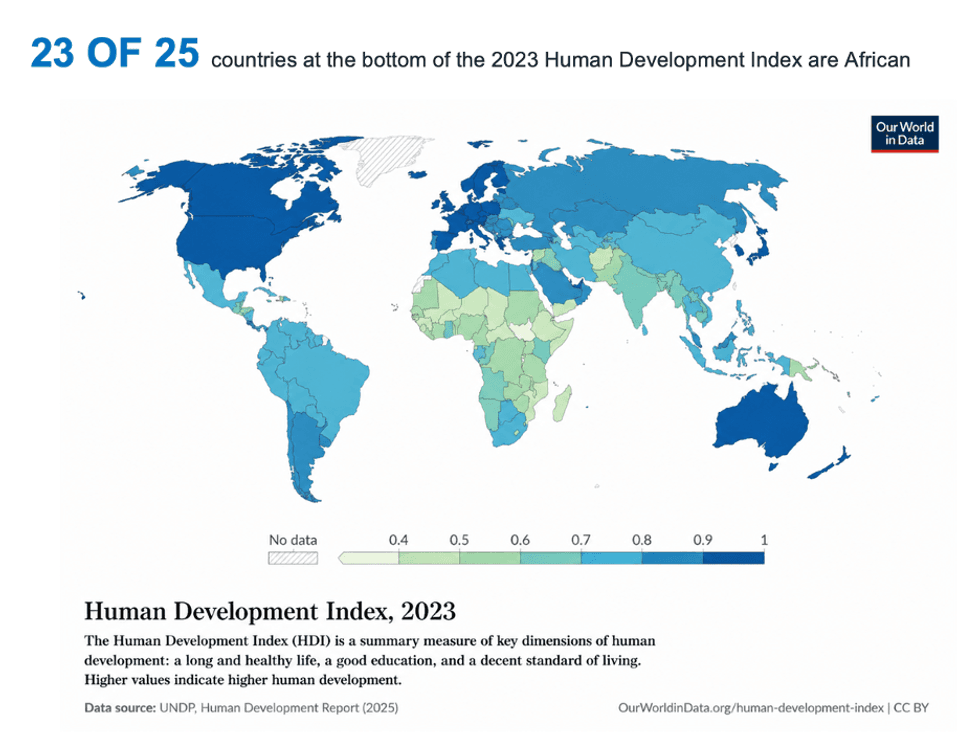
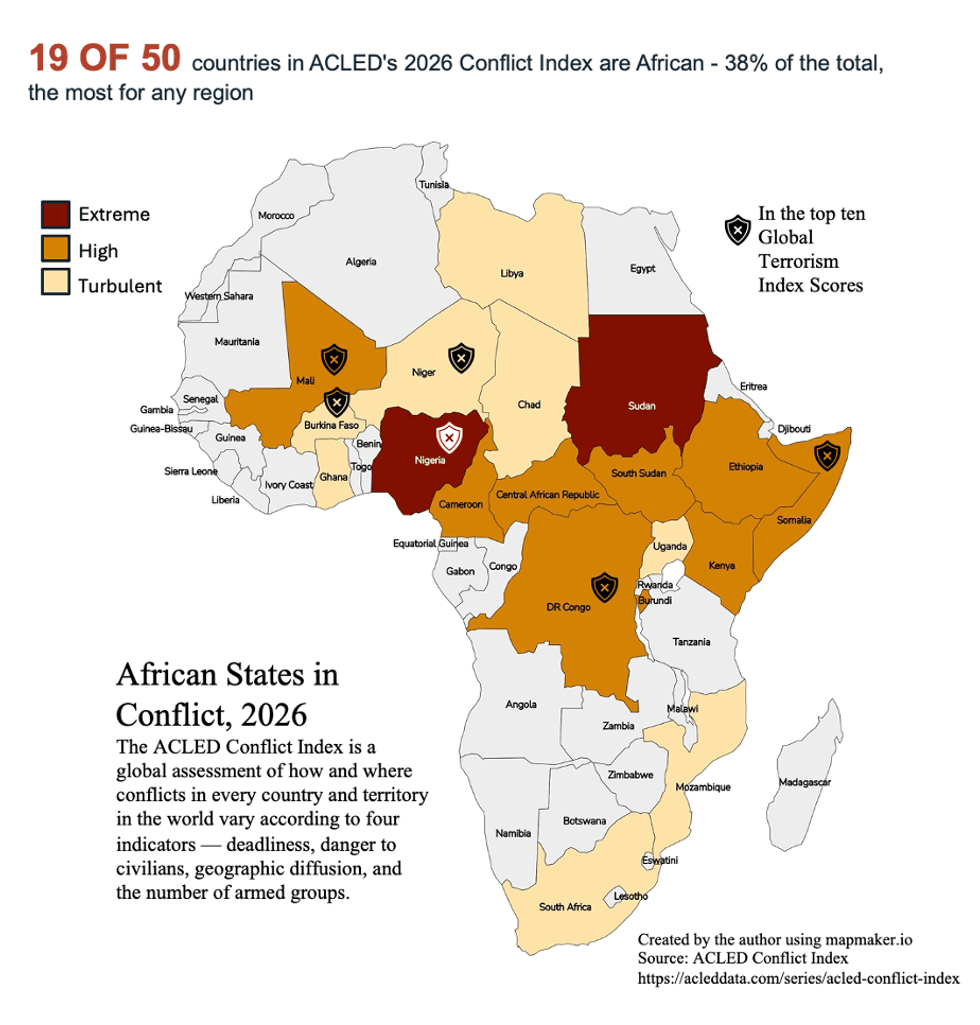
The Risk Side: Development Gaps and Conflict Reinforce Each Other


CRITICAL CONTEXT

Health

Poor healthcare infrastructure exacerbates communicable disease outbreaks, like Ebola in Congo in 2026 and West Africa in 2014, challenging global aid capacity.

Security

Lax development creates an environment ripe for extremism, creating a cycle where insecurity exacerbates underdevelopment that in turn fosters insecurity.

Geopolitics

Conflicts attract outside actors, creating a hotbed of geopolitical competition devoid of local interests and reducing African agency.

Why It Matters to Washington

Africa is the last entry in Washington’s National Security Strategy, reflecting a plan to allocate fewer resources to the continent, but Africa's crises often force unforeseen commitments. The Ebola outbreak in Congo underscores that weak health systems can turn outbreaks into global threats, compelling a US response. Insecurity due to extremist violence has prompted new and expanded US military action in Nigeria and Somalia, respectively. The continent leads the world in terrorist-related casualties, with more than half of global fatalities occurring in the Sahel, posing an enduring threat to greater African stability and attracting renewed US focus. This deepening malaise and Sudan’s civil war have become a magnet for regional and global competition, including increased intervention from Russia and China and adversarial action between US allies Saudi Arabia and the UAE.

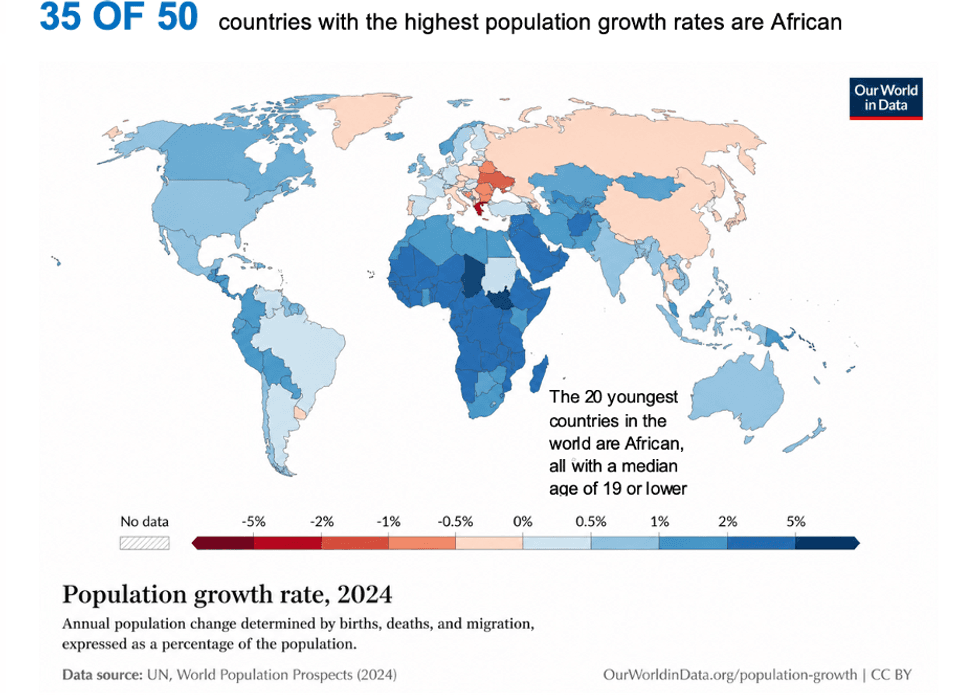
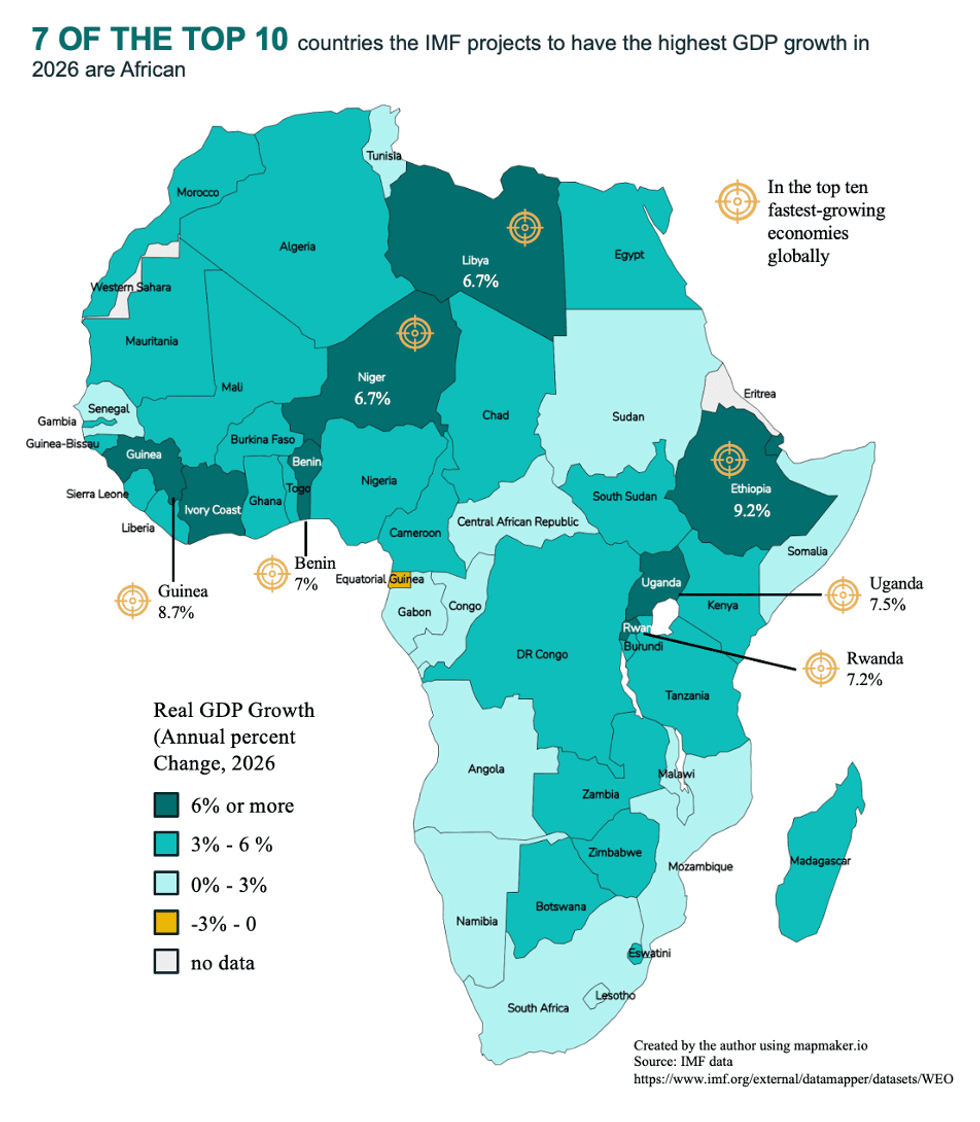
The Opportunity Side: Economic Growth and Demographics Are Standout

Strengths

CRITICAL CONTEXT

Growth Potential

Less developed countries have more room for economic growth. Africa has outperformed global growth by approximately 0.5 to 1.5 percentage points since 2000.

Imports

As economies and populations grow, so do imports. Africa is on track to outpace the rest of the world in merchandise import growth during 2026.

Workforce

Africans are the world’s future workforce. The OECD estimates that the continent’s working-age population (15-64 years old) will rise from about 850 million today to more than 1.5 billion in 2050, accounting for 85% of the global workforce increase.

Why It Matters to Washington

Africa’s GDP growth represents the high upside potential of the continent’s many comparatively less developed countries. Because African economies are not saturated, they have greater room to grow, making them attractive for investment gains. This coincides with the world's youngest population, which presents a range of reasons for outside nations to work with Africa, including circular migration deals for labor to sustain growth and to find markets for exportsβ€”60 countries are set to shrink in population this year alone, including economic juggernauts China, Germany, Japan, Italy, Russia, Spain, and South Korea.

- More pointedly for US implications, the country has been below the replacement fertility rate of 2.1 children per woman for nearly two decades (1.6 in 2024). Mexico, the top provider of immigrant workers to the US, has been below replacement fertility for about a decade (1.9 in 2024), suggesting Africa is positioned to serve as a sought-after source of workers.

- For example, Washington could leverage Kenya’s plan to broker agreements for 1 million of its citizens to work abroad annually. Nigeria is on track to surpass the US as the world’s third-largest country by population within the next three decades and will almost certainly have to find foreign destinations for its workforce.

- Canada stands out as having conspicuously higher population growth in North America, the result of purposeful legal migration, which is 3 times that of the US as a percentage of the overall population.

All statements of fact, opinion, or analysis expressed are those of the author and do not reflect the official positions or views of the U.S. Government. Nothing in the contents should be construed as asserting or implying U.S. Government authentication of information or endorsement of the author's views.

The Cipher Brief is committed to publishing a range of perspectives on national security issues submitted by deeply experienced national security professionals. Opinions expressed are those of the author and do not represent the views or opinions of The Cipher Brief.

Have a perspective to share based on your experience in the national security field? Send it to Editor@thecipherbrief.com for publication consideration.

Read more expert-driven national security insights, perspective and analysis in The Cipher Brief
How to Get the Venezuela Response Right

When the two earthquakes struck Venezuela last week, killing more than 1,400 people and leaving tens of thousands missing, there was a silent pause in Washington with everyone wondering: with no USAID, how will the U.S. respond to this disaster?

Following the 2010 Haiti earthquake, USAID surged resources, with urban search-and-rescue teams wheels-up within hours. Naval vessels steamed to Haiti’s capital. President Obama placed USAID as the lead agency. The machinery of American humanitarian response was moving. The Trump Administration has now responded: multiple USAR teams from Fairfax County, Los Angeles, and Miami-Dade are on the ground, the State Department has pledged $300 million in assistance, with more promised, and the Department β€œof War” is providing C-17 airlift and Marine Osprey support. This is deja vu all over again.

Now the question is whether we have learned anything since Haiti.

I've seen this machinery up close. I coordinated the U.S. response to the 2010 Haiti earthquake from Washington β€” the then largest American humanitarian mobilization in a single country. We had genuine resources, genuine commitment, and genuine failures. Fifteen years later, as Venezuela's crisis unfolds, the lessons we learned are likely to be repeated again.

The most effective humanitarian tool is also the least glamorous: cash. It lets organizations buy exactly what is needed immediately, spurs local markets rather than undercutting them, and reaches beneficiaries faster. The new Trump Administration partnership with Walmart and Global Empowerment Mission to collect in-kind donations β€” clothing, toys, household goods - will be a time-consuming logistical mess.

We saw NGOs with more experience than GEM make the same mistake in Haiti. Those items filled valuable warehouse space while people went without shelter; sorting and distribution consumed staff time and resources. In Venezuela, that same supply chain runs directly into CLAP β€” the Bolivarian food distribution network that conditions assistance on political loyalty. Cash allows organizations and individuals to purchase locally what they need, building up the local markets.

The U.S. military performed heroic and essential functions in the early days of the Haiti response. But it performed them at defense-budget rates, and they continued humanitarian tasks long past the point where cheaper civilian alternatives were available. The USS Comfort hospital ship sat in Port-au-Prince harbor for months at approximately $1 million per day β€” with no patients on board. The full cost of the military response was obscured across multiple budget authorities, making honest accounting impossible. In addition, with 23,000 personnel on the ground, it made coordination impossible across all the other actors on the ground.

USAID formally recommended transitioning military operations out after 8 weeks. Political leadership pushed back, and the military footprint persisted until summer, costing more money and crowding out the civilian and longer-term programming that should have taken its place.

Within days, USAID surged experienced officers to Haiti with decades of technical expertise in civilian response to humanitarian crisis, honed after the Asian tsunami, the Pakistan earthquakes, and other relief efforts. Without USAID’s experienced coordination and personnel, the default to military logistics in Venezuela will be even stronger. And with Venezuela's acute sovereignty sensitivities β€” a country where 25 years of Bolivarian politics have institutionalized resistance to U.S. military presence as a founding national narrative β€” a visible American military footprint isn't just expensive, it is politically combustible. The Delcy Rodriquez government is already unpopular, and such a presence could further delegitimize the very transitional government it is meant to bolster.

The Trump Administration has starved the UN of resources, and ironically is now relying almost entirely on the UN for relief efforts in Venezuela. Of the U.S.’s $300 million commitment, $200 million flows directly through OCHA’s Venezuela pooled fund β€” an institution the Administration has simultaneously been defunding.

In Haiti, within weeks of the earthquake, political pressure prioritized permanent housing construction over temporary shelter. The reasoning was politically driven β€” the donor community wanted houses built. There was a concern that anything less than permanent wasn’t good enough. The consequence was catastrophic - hundreds of thousands of displaced Haitians remained in tent cities for years, because the "permanent" programs moved slowly through land disputes and contractor delays while the temporary shelter that could have housed them in months went underfunded.

The simple missing answer we neglected was to surge supplies – plywood, lumber, cinderblock corrugated metals, plastic sheeting – to affected areas and provide support to local entities who could rebuild structures to last two to three years. Supplies should be purchased on the local market to further spur the local markets.

The failure to prioritize the removal of rubble was a strategic miscalculation. The Haiti earthquake generated an estimated 10 million cubic meters of debris. Rather than treating its removal as a strategic prerequisite β€” clear the roads, open the sites, enable everything else β€” it was treated as a logistics afterthought. No single agency owned it. Only one disposal site was identified, requiring trucking rubble through the broken downtown on narrow urban roads. Dump trucks spent 8-10 hours on each load of rubble. The bottleneck cascaded across the entire response for years.

Venezuela's cities, particularly Caracas and the coastal communities near the epicenter, face similar dynamics. The pressure to show reconstruction will arrive before the rubble is cleared. The pressure to build permanent housing will arrive before anyone has mapped who owns the land β€” a question made vastly more complicated by 25 years of Chavista-era property redistributions. Permanent housing takes years to complete even when the land is easily available; people will need shelter good enough to live in while a permanent solution is created.

Corruption is a cancer that will bring down governments and create long-term instability (just look at Haiti), and establishing mechanisms at the outset is a core design requirement for any response. Corruption in Venezuela is categorically harder. The Bolivarian state has spent 25 years building sophisticated infrastructure for capturing and redirecting resource flows. The CLAP food distribution system β€” the government's commodity network β€” is a documented political control tool, conditioning food on political loyalty.

The same sanctions-evasion architecture that moves Venezuelan oil revenue through front companies and cryptocurrency channels is fully available to divert humanitarian cash.A response that doesn't build independent financial oversight, beneficiary verification, and distribution channels explicitly designed to bypass state capture mechanisms before the first dollar is obligated will hemorrhage resources.

The window to get the architecture right is now. That is the lesson Haiti burned into everyone who was there: the cameras arrive before the coordination does, and decisions made in the first two weeks shape outcomes for the next ten years.

Venezuela is not Haiti. It is more complex and more fraught diplomatically β€” and this time, the agency built to apply these lessons no longer exists to apply them. Haiti was not a failure; lives were saved, a devastated capital came back to life, and a generation of practitioners learned hard truths about sequencing, cost, and corruption. The risk now is that we forget it and make the same mistakes again, because the institution that absorbed those lessons is gone, and no one has rebuilt the muscle memory to apply them.

The people of Venezuela deserve the benefit of what we learned in Haiti, not a response built from scratch. So does American credibility.

The Cipher Brief is committed to publishing a range of perspectives on national security issues submitted by deeply experienced national security professionals. Opinions expressed are those of the author and do not represent the views or opinions of The Cipher Brief.

Have a perspective to share based on your experience in the national security field? Send it to Editor@thecipherbrief.com for publication consideration.

Read more expert-driven national security insights, perspective and analysis in The Cipher Brief
America's Empty Counterterrorism Chair

The world's counterterrorism chiefs are meeting in New York this week. We brought a list of demands and not much else.

A plot hatched in a chat room in one country, funded from a second, carried out by a man walking into a crowd in a third – that's the shape of terrorism now. It doesn't stop at borders. It never agreed to.

That's the problem sitting in front of the world's counterterrorism chiefs this week. They're at the U.N. for the first time since 2023, and on Wednesday the General Assembly reopens the global strategy that's held this fight together for twenty years. The question on the table is simple and ugly: who's actually going to do the work?

Washington's answer lately is everyone but us. The new U.S. strategy tells allies to carry more of the load and barely bothers to dress it up – the era of America as the world's cop is over, pick up the slack. There's a fair point buried in there. Allies should pay more and do more in their own backyards.

But you can't order everyone else to step up while you're sliding toward the door. The federal center built to connect the dots between agencies has had no permanent boss since March. Homeland Security hasn't issued a national threat warning since last September. State shut down its CVE and GEC teams – the shops that countered extremist recruiting and foreign propaganda – over the past year. The FBI and Justice Department teams that chase these cases are thinner than they've been in two decades. We're lecturing the world about leadership while quietly dismantling our own.

And the chair we're vacating doesn't stay empty. The U.N.'s counterterrorism work runs almost entirely on donated money, most of it from a few Gulf states. Cut our funding and our attention, and we don't shut the operation down – we hand the pen to whoever's still paying. Their threats become the priorities. Their enemies become the targets. That swap is already underway, one budget cycle at a time.

The timing couldn't be worse, because the threat is spreading, not shrinking – splitting into more groups, in more places, every year. ISIS-K runs plots out of South Asia. Al-Qaeda's Sahel franchise has turned that region into the deadliest killing ground on the planet. Newer names – the Resistance Front in Kashmir, the Majeed Brigade in Balochistan – show how fast a local grudge now becomes an outfit with cash, recruits, and a slick media shop. You don't beat a threat like that by going it alone – and you definitely don't beat it while eyeing the exit.

So where should the allies in that room actually put their weight this week?

Start with the people nobody wants to claim: the captured fighters and their families still languishing in camps years after the caliphate fell. Bring them home, try them, rehabilitate them. It's slow, ugly, and a political grenade – and every year we dodge it, we let the next generation steep in the same poison that made the last one.

Less visible and more useful is the plumbing: shared watchlists, fingerprints, traveler data, the systems that flag a wanted man before he boards a plane. Most countries still can't run it well, and helping them will stop more attacks than any speech from a podium.

None of that touches the cheapest counterterrorism there is – the kid who never gets recruited in the first place. You can't arrest your way out of this, and the prevention programs that reach that kid early are always the first thing cut and the last thing anyone takes credit for.

And the new front: machines. Cheap drones in the hands of groups that used to throw rocks. AI that spits out propaganda in forty languages and finds a lonely teenager faster than any human ever could. The side that masters these tools first wins. Nothing says it'll be us.

Twenty years ago the world decided this fight couldn't be run one country at a time – not out of idealism, but because the math demanded it. Threats cross borders faster than any single government can chase them. The strategy up for review this week has outlived four presidents for one reason: the work got shared instead of dumped.

Walking away now, with the threat splintering and the tools getting sharper, isn't strength – it's a bet that the next attack will be polite enough to stay in someone else's country. It won't. It never has.

The allies are in the room this week. The only question left is whether we lead the table or leave it.

Dexter Ingram is a former senior national security executive who led the State Department's office for Countering Violent Extremism and served as acting director of the 89-nation Global Coalition to Defeat ISIS. He writes the newsletter Dexter Ingram: Declassified.

The Cipher Brief is committed to publishing a range of perspectives on national security issues submitted by deeply experienced national security professionals. Opinions expressed are those of the author and do not represent the views or opinions of The Cipher Brief.

Have a perspective to share based on your experience in the national security field? Send it to Editor@thecipherbrief.com for publication consideration.

Read more expert-driven national security insights, perspective and analysis in The Cipher Brief
❌