Reading view

There are new articles available, click to refresh the page.

Amazon drones go national, inside Anduril’s Seattle buildup, and AirTag leads to secret book-scanning site

This week on the GeekWire Podcast: Amazon’s delivery drones are going national, nearly 13 years after Jeff Bezos unveiled them on 60 Minutes. We listen back and discuss what’s next.

Plus: We go inside Anduril’s unmarked Bellevue office as the defense company builds toward 1,000 Seattle-area engineers; a reporter hides an AirTag in a rare book and tracks it to a secret Amazon book-scanning facility in Las Vegas; and an Anduril-themed trivia challenge.

Audio editing and production by Curt Milton.

Related stories and links

Mentioned at the top

Amazon drone delivery

The AirTag and the book-scanning facility

Anduril in the Seattle region

Subscribe to GeekWire in Apple Podcasts, Spotify, or wherever you listen.
Amazon drone delivery set to expand nationally, reaching nearly 500 U.S. cities and towns this year

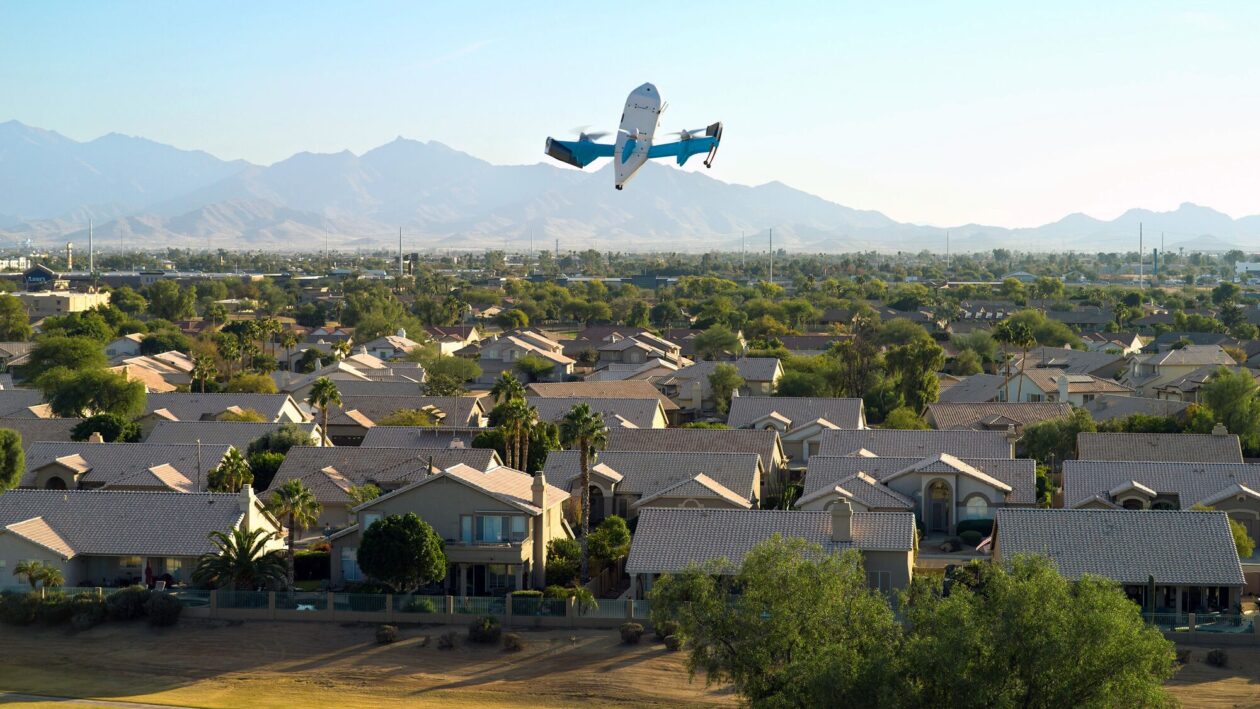
An Amazon Prime Air delivery drone flies over a suburban neighborhood in Arizona. (Amazon Photo)

Amazon’s drones are finally going national.

The company’s autonomous aerial vehicles are set to deliver packages to nearly 500 cities and towns across the country by the end of this year, zipping items through the air to drop them in backyards and driveways as quickly as 30 minutes after ordering.

Amazon announced the plan Wednesday, describing it as a sixfold increase in its Prime Air footprint, reaching communities collectively representing tens of millions of customers.

It’s a milestone nearly 13 years in the making. Jeff Bezos unveiled Prime Air on 60 Minutes in December 2013, showing off a prototype to an astonished Charlie Rose and a skeptical public.

“I know this looks like science fiction — it’s not,” the Amazon founder said at the time.

Bezos acknowledged that it would take at least four or five years, optimistically, and that convincing the FAA the drones were safe would be one of the biggest hurdles. Amazon’s FAQ that night said it hoped the agency would have rules in place “as early as sometime in 2015.”

Both the technology and the regulations took far longer than the company expected.

Amazon said Wednesday morning that Prime Air will launch soon in the Chicago, Syracuse, Cleveland, Atlanta and Boise metro areas, with more communities to come later this year. The drones fly primarily over suburban areas, which allows them to avoid the tall buildings and crowded airspace that complicate flights over dense urban areas.

There’s no word yet on when or whether drone delivery will come to the Seattle area.

Amazon said the drones launch from two types of facilities: smaller same-day delivery sites and its larger robotic fulfillment centers. The mix is what lets Prime Air offer anywhere from tens of thousands to millions of items depending on the location, according to the company.

Nearly any item weighing 5 pounds or less and small enough to fit in a large shoebox is eligible for drone delivery. That translates into millions of products, as noted by Amazon CEO Andy Jassy in his annual letter to shareholders earlier this year. He wrote that Prime Air would carry “a much larger selection of items inside a half hour” than Amazon’s other fast-delivery options.

Drone delivery will be free for Prime members on orders of $50 or more. Prime orders below that carry a $2.99 fee, and customers without a membership pay $4.99.

Amazon’s reference to expanding to 500 cities and towns does not reflect the number of planned Amazon drone launch locations, but rather the number of municipalities that fall within delivery range of the planned hubs, each of which covers roughly 175 square miles.

The 30-minute delivery scenario is a best case. Most orders arrive around 60 minutes after checkout, Amazon said in its announcement.

Amazon isn’t the only company betting on drones. Amazon retail rival Walmart and Google parent Alphabet’s Wing have been building what they call the largest drone delivery network in the U.S., adding seven new markets in June including Phoenix, Philadelphia and the Bay Area. They plan to reach 270 stores and more than 40 million people by next year.

Local approvals remain a hurdle for delivery drones. Noise has been a recurring concern for residents near drone operations. Amazon says its drones are quieter than an idling delivery truck during drop-off and comparable to a window fan while in flight. A proposed federal rule that would more broadly allow flights beyond the pilot’s line of sight has not been finalized.

The Associated Press first reported on the expansion Tuesday afternoon in what appears to have been an inadvertent break of a news embargo, to which GeekWire had not agreed. Post updated Wednesday morning with details from the official announcement.

Amazon expands Locker package pickup to more than 750 U.S. college locations

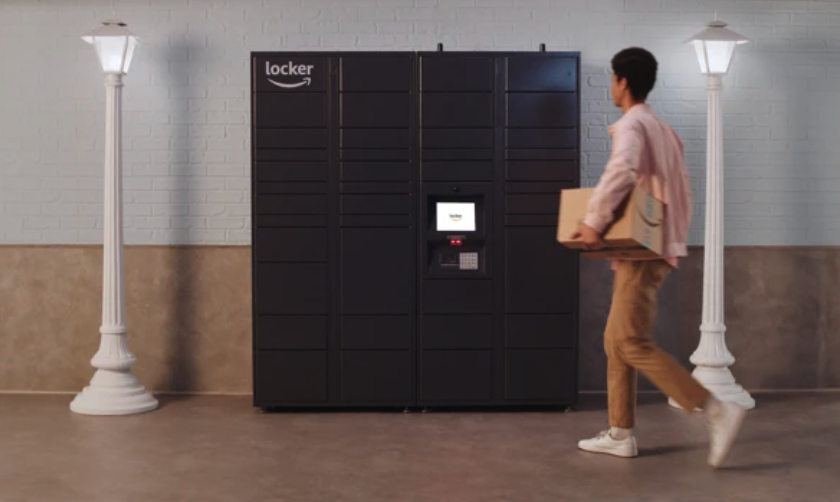
(Amazon Photo)

Amazon is scaling up for back-to-school season, expanding its network of Locker package pickup points to more than 750 locations across 500 U.S. colleges and universities.

The expanded footprint — part of Amazon’s broader network of more than 25,000 delivery hubs nationwide — is designed to integrate directly into students’ daily routines without adding additional costs, the tech giant said in a release Tuesday.

Students can select a campus Locker at checkout, track their order via the Amazon app, and collect packages within a three-day window using a barcode or code, with uncollected items automatically returned and refunded.

The campus expansion marks another major evolution for a program that GeekWire first reported on in October 2011, when Amazon quietly launched its delivery lockers as a pilot program in Seattle-area convenience stores.

Amazon is betting that placing secure, 24/7-accessible Lockers directly on campus will eliminate friction for on-the-go students juggling classes and extracurriculars.

“College students are constantly on the move, and picking up a package should fit into their day — not the other way around,” Viraj Chatterjee, vice president of Amazon Transportation, said in a statement.

Amazon’s physical campus push coincides with a broader subscription strategy targeting young consumers. The company announced that higher education students and young adults ages 18 to 24 can sign up for “Prime for Young Adults” at a 50% discount ($7.49 a month or $69 annually), which includes full Prime shipping and streaming benefits, a six-month trial, and 5% cash-back perks.

Less Amazon, more profit: UPS raises forecast after cutting millions of lower-yield deliveries

A UPS truck makes its way through downtown Seattle. (GeekWire File Photo / Kurt Schlosser)

Handling fewer packages for Amazon is boosting the financial outlook for UPS, as CEO Carol Tomé said Tuesday that the delivery giant has successfully completed its planned volume pullback and is pivoting toward higher-margin shipments.

“I want to thank all UPSers for their extraordinary work over the past 18 months as we successfully completed our Amazon glide-down and related network reconfiguration initiatives as designed,” Tomé said in the company’s second quarter earnings release.

The “glide-down” caps an 18-month UPS strategy initiated in early 2025 to scale back low-margin e-commerce shipments for Amazon. During the pandemic peak, Amazon generated over 13% of UPS’s total revenue, but executives repeatedly pointed to that low-yielding volume as “extraordinarily dilutive” to profit margins.

Last year, Tomé addressed UPS’s 30-year relationship with Amazon, saying, “They are our largest customer, but they’re not our most profitable customer.”

Speaking on CNBC on Tuesday, Tomé confirmed that Amazon now accounts for roughly 9% of UPS’s business, marking the completion of the planned pullback.

Asked about Amazon’s growing footprint as a direct logistics rival through Amazon Shipping, Tomé dismissed concerns that the e-commerce giant was poaching core customers, drawing a sharp distinction between network strengths.

While Amazon thrives in lightweight, short-distance urban deliveries, Tomé emphasized that UPS maintains an edge across “every other place” — from complex B2B routes to time-sensitive cold chain logistics. By shedding roughly 2 million lower-margin Amazon packages per day, UPS says it freed up critical capacity across its ground and air networks.

UPS posted second-quarter revenue of $22.8 billion — a 7.6% increase year-over-year that topped Wall Street estimates. The courier raised its full-year 2026 revenue forecast to approximately $91.2 billion (up from $89.7 billion).

Despite the earnings beat and raised guidance, UPS shares dropped nearly 5% in early trading as investors weighed transformation costs and broader consumer spending concerns.

Amazon reports its second-quarter earnings on Thursday.

❌