Apple's $2,899 touchscreen MacBook Pro might be a tough sell, but a clever Xcode demonstration shows how its touch display could make testing iPhone apps considerably more intuitive.
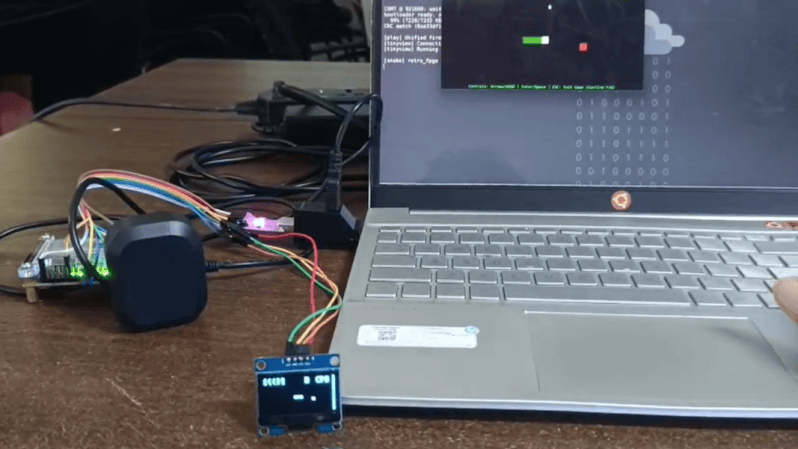
Although once little more than an academic endeavor, the RISC-V architecture is slowly supplanting applications that would have normally gone to ARM. Even a few microcontrollers have chips running this open-source instruction set now, and we expect it to grow in the future since it doesn’t require the licensing of an ARM or x86 chip. [M_Jagadeesh97] is getting ahead of the curve with this retro gaming system built on a custom-designed RISC-V system.
Most of us, presumably including [M_Jagadeesh97], don’t have access to chip fabrication tools, but what we can get is any of various FPGAs. This RISC-V CPU is built on a Terasic DE0-Nano board with 32 MB of RAM available to it, and boots to a launcher with 32 games available. There are a few limitations with this low-power system which was largely solved by limiting the display to 64×32, which lets it maintain the same aspect ratio as the original DOOM as well as the same aspect ratio for many of the older games, while still maintaining 45 FPS.
The project writeup goes deep into the design of a system like this, from the bare metal, the CPU design, the timing of the video signals, and how to implement a Wolfenstein-like raycaster. After adding a small display it looks to be fairly portable as well and is an excellent demonstration of how powerful inexpensive boards like this FPGA can be with the proper amount of effort.
Google's Gemini app now offers Immersive Explorations, an interactive learning feature that lets you explore subjects like ancient trade routes, jet engines, and lightning through layered visual explanations.
OpenAI is bringing ChatGPT Dot to iMessage and Android's RCS, letting Pro subscribers text their AI agent, send photos and voice messages, assign tasks, and receive proactive updates.
Microsoft broke out Azure’s quarterly revenue for the first time in its new financial structure. (GeekWire File Photo / Todd Bishop)
Microsoft’s Azure cloud business brought in $33.2 billion in revenue in the September quarter, up 48% from a year earlier, blowing past the company’s own forecast and beating Wall Street’s expectations.
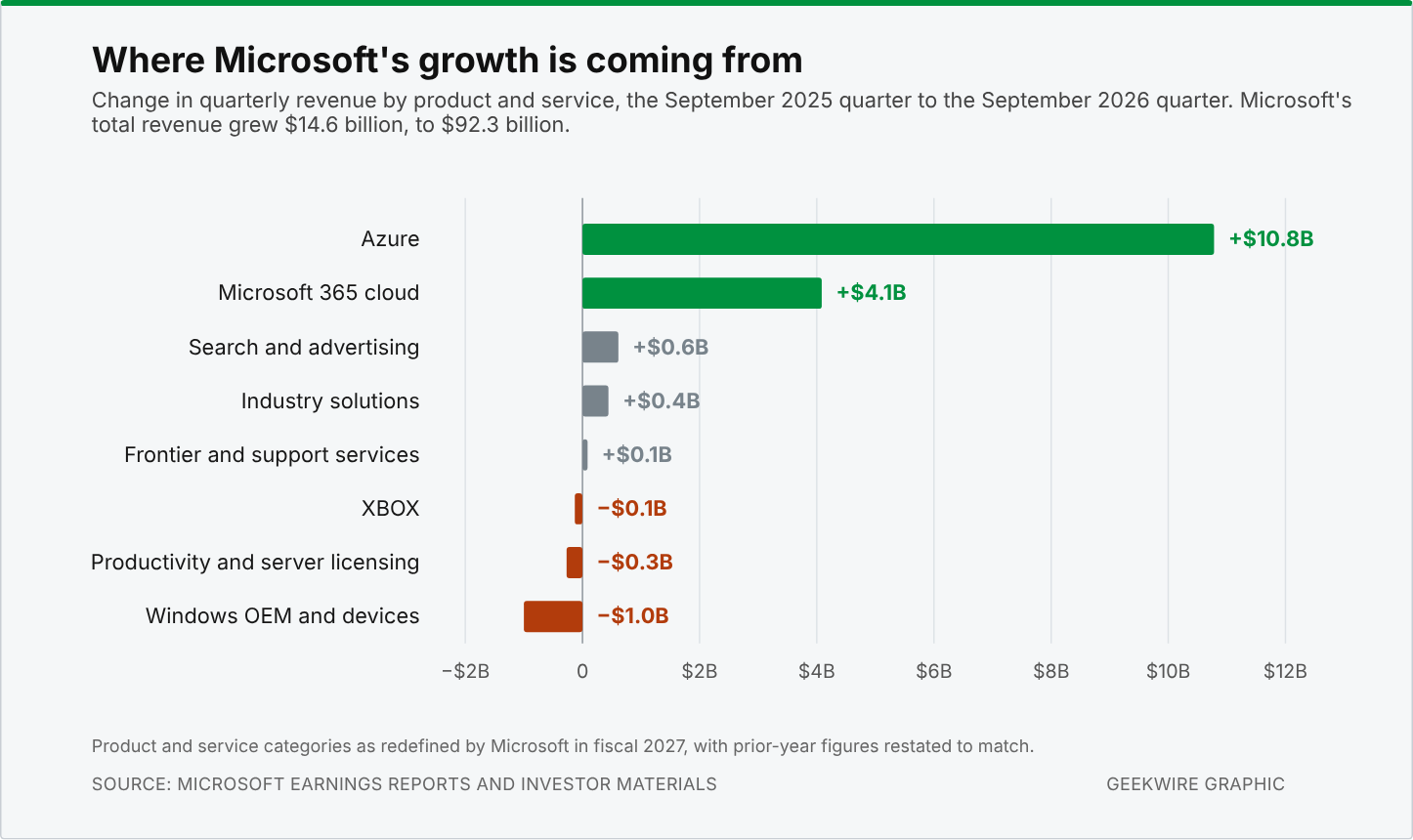
The growth suggests that Microsoft is selling cloud and AI computing about as fast as it can install it. Azure revenue rose $10.8 billion from a year earlier, driven by demand for services across the platform, Microsoft said in its quarterly filing. That came even as some new data center capacity arrived late.
For investors worried about Microsoft’s record capital spending, it’s a sign that the company’s massive AI and cloud infrastructure buildout is turning into sales. Microsoft’s shares rose nearly 4% in after-hours trading following the earnings report.
Overall, Microsoft reported revenue of $92.3 billion for the first quarter of its 2027 fiscal year, up 19% and above the $90.75 billion analysts expected, according to Yahoo Finance. Earnings were $4.89 per share excluding the impact of its OpenAI investment, compared with expectations of $4.72.
It’s the first time Microsoft has reported Azure’s quarterly revenue figure, not just its growth. The disclosure is part of a new financial structure that took effect this quarter, splitting the company into two segments: Agents and Infra, and Devices and Consumer.
Agents and Infra (Azure, Microsoft 365, Dynamics, LinkedIn’s recruiting and sales tools, and server and productivity licensing): Revenue rose 25% to $76.8 billion, above Microsoft’s forecast of $75.15 billion to $75.75 billion. Operating income rose 24% to $40.6 billion.
Devices and Consumer (Windows, Xbox, and search and advertising): Revenue fell 3% to $15.5 billion, above Microsoft’s forecast of $14.7 billion to $15.2 billion. Operating income rose 2% to $5.4 billion.
Capital spending came in below Microsoft’s forecast. The company spent $45.2 billion, including finance leases, short of the more than $50 billion it expected. Some data center capacity that third parties were supposed to deliver in the quarter was delayed, the company said.
Google Cloud, which includes Google’s Workspace productivity apps, brought in $30.7 billion in revenue in the quarter, up 103% from a year earlier, Alphabet reported Wednesday afternoon.
Update, 3:05 p.m.:Microsoft expects Azure growth to accelerate again this quarter, to 49% to 50% excluding currency changes, CFO Amy Hood said on the earnings call. “Customer demand continues to exceed available supply,” she said.
Hood said Azure’s growth came from Foundry, Microsoft’s service for building AI apps and agents, and from engineering work that let Microsoft sell unused capacity on its existing servers. That helped make up for delays in new data center capacity that outside providers were supposed to deliver.
Those delays pushed some spending later into the fiscal year. Microsoft now expects to spend about $170 billion on capital expenditures in calendar 2026, down from about $175 billion. It expects to spend more than $50 billion this quarter, and Hood said spending will accelerate in the first half of calendar 2027.
Hood also said Microsoft may tap additional sources of financing to help pay for the buildout, “when we believe it is attractive to do so.” The company still expects to bring in more cash than it spends this fiscal year.
Microsoft’s expense forecast for the December quarter includes an estimate for the buyout offer it announced Monday, Hood said, though she didn’t give the amount.
The company expects total revenue of $96 billion to $97.1 billion for the December quarter, above the $95.7 billion analysts expected, according to Yahoo Finance.
Google's Gemini 4 Carbon targets complex coding and cybersecurity tasks, with the company touting stronger secure coding, fewer AI mistakes, and impressive benchmark results.
For nearly $15,000, you can get the 16-inch version of the laptop with a nano-texture glass layer on the screen to reduce reflections and glare, 16TB storage, 128GB RAM, and M5 Max chip.
Apple’s touchscreen MacBook Pro brings tandem OLED, brighter visuals, lighter designs, and upgraded M5 chips. Here’s how it compares with the standard model.
Apple’s new 14-inch and 16-inch MacBook Pro models start at $2,899 in the U.S. Here’s how M5 Pro and M5 Max pricing compares, when orders arrive, and how education discounts and trade-ins can help you save.
Apple has just released its touchscreen MacBook Pro, and there’s plenty to get excited about. It’s the first MacBook with an OLED display, powered by the M5 Pro and M5 Max chips, and even gets the Dynamic Island from the iPhone. We’ve heard plenty about these upgrades through leaks and rumors over the past few […]
After years of rumors and anticipation, Apple finally unveiled the touchscreen MacBook Pro, or as it likes to call it, the MacBook Pro with PROLED XDR display. There’s no new chip, so the focus is entirely on the touchscreen. Apple has used tandem OLED technology (first debuted on the iPad Pro), which rates the display […]
Xreal’s new Aura glasses bring Android XR, Gemini AI, and Snapdragon power to your eyes, delivering immersive digital experiences without the bulky headset.
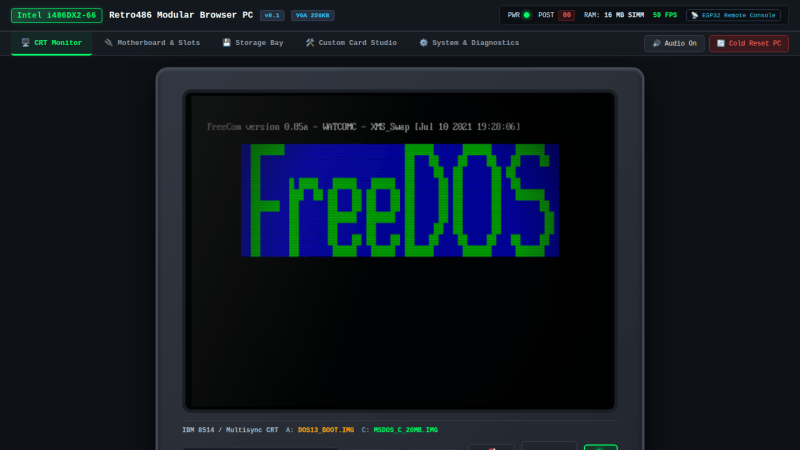
What [Jan] has built is a 100% browser-based emulator for an Intel 80486DX2-66 PC. Obviously, it’s not just a CPU that’s being emulated here—[Jan] has gone so far as to throw in the motherboard and ISA/VLB adapter card emulation necessary to make this a real and functioning computer that runs inside a solitary browser tab.
It’s all written in ES6 JavaScript. It will happily run SeaBIOS, VGA BIOS, FreeDOS 1.3, and a whole bunch of classic games, like Wolfenstein 3D, Duke Nukem, and DOOM. There’s even a control panel where you can configure the PC how you like, from storage to expansion cards and all the rest.
Once upon a time an emulator was an application you had to download and run, hoping all the while that your new machine had enough grunt to emulate the classic hardware of your desires. These days, we have endless piles of CPU cycles to throw at everything and you can do it all within a browser. Or even on a tiny microcontroller, if you feel like it!
Gemini Notebook’s mobile app now has a built-in recorder for capturing lectures and meetings as sources. You can record directly where you’ll use the material, skipping the separate recording app and the file upload afterward. Google announced the feature on X, highlighting classroom lectures and team meetings as potential uses. It also works for capturing […]
Researchers tested seven AI chatbots to see if they could distinguish humans from AI. The bots identified just three AI participants across 98 tests, highlighting how difficult AI detection can be.
Firefox Smart Window can now fill out online forms using information from your open tabs and monitor websites for updates, thanks to two new AI features.

 Login