Preparations for Next Moonwalk Simulations Underway (and Underwater)
The Quantum-Enabled Predictive Preclinical NAMs for Toxicity and Safety (QuSAFE) Challenge, a collaboration between the National Institutes of Health (NIH) and NASA, advances quantum-enabled sensing for in vitro NAMs, such as organoids and microphysiological systems (MPS), to improve drug safety while reducing animal use.
In vitro NAMs, such as organoids and microphysiological systems (MPS), can generate human-relevant data for drug development and safety evaluation. However, conventional assays and imaging are often noisy, invasive, and not sensitive enough. As a result, weak, early, and low-abundance biological signals can go undetected, and destructive measurements make it hard to monitor dynamic processes over time. Quantum-enabled sensing approaches can offer ultra-high sensitivity, improved signal-to-noise performance, and nanoscale resolution, overcoming detection and measurement limitations that today’s approaches can’t reach.
The NIH-NASA QuSAFE Challenge directly supports NASA’s Biological and Physical Sciences Division, addressing the need for advanced detection methods that work beyond traditional labs.
By leveraging recent advances in sensor-development research communities, the challenge enhances NASA’s space exploration capabilities and benefits science both in space and on Earth.
Preparations for Next Moonwalk Simulations Underway (and Underwater)
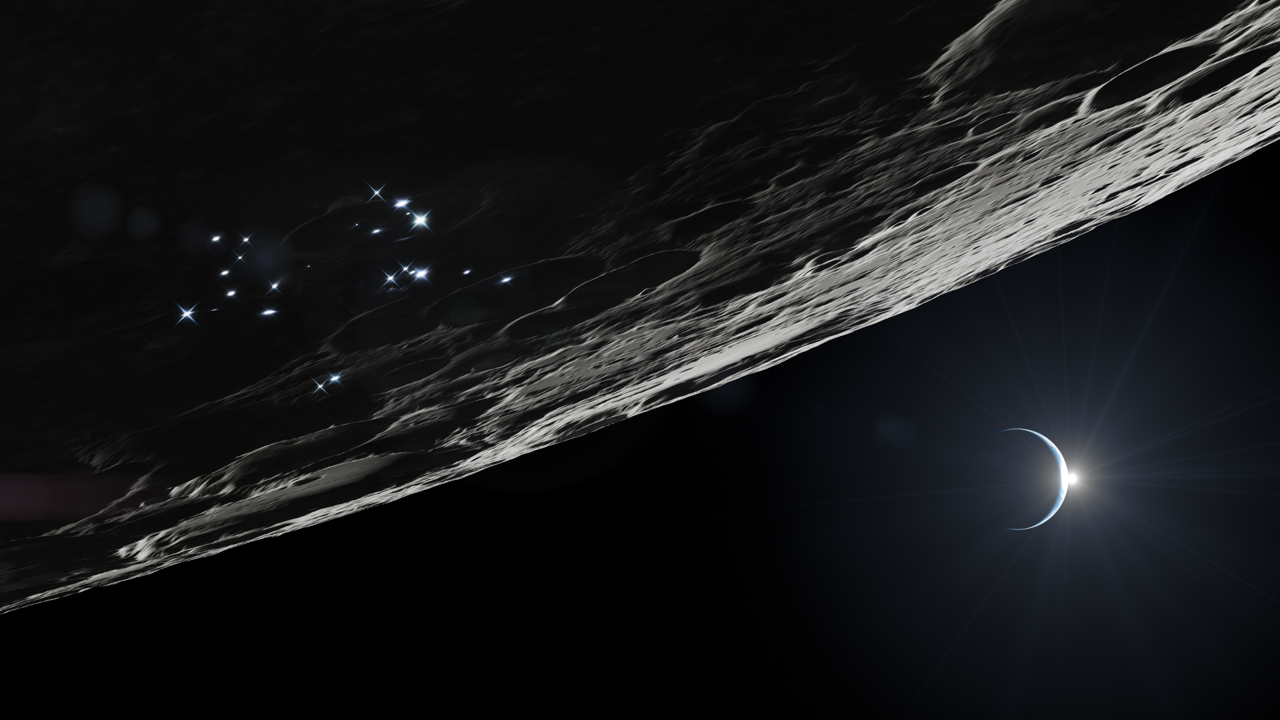
Artist’s rendering of the lunar South Pole region. Glowing points of light scattered across the lunar surface represent surface assets supporting sustained human and robotic operations near the South Pole.
NASA
As an astronaut traverses the lunar South Pole, tribocharging from walking on the lunar surface and plasma charging from the ambient plasma generate electric charge on the spacesuit. This problem is severely compounded when entering lunar shadows and Permanently Shadowed Regions (PSRs). In these dark zones, the spacesuit can buildup a substantial negative potential due to a lack of ambient ion flux and the absence of photoelectron emission to balance ambient electron collection.
The risk occurs when an astronaut returns to the spacecraft. Because the lunar surface lacks a natural environmental mechanism to bleed the charge accumulated on spacesuit away, the astronaut may become a walking, high voltage capacitor.
In the sunlit region, the stationary lander will hold slightly positive electrical potential. When a highly negatively-charged astronaut approaches the vehicle, the extreme voltage differential can trigger electrostatic discharge (an instantaneous electrical arc, or a spark) during physical contact. A rapid discharge from the astronaut to the lander risks degrading vital suit layers, damaging sensitive suit electronics, threatening the oxygen-rich environment inside the suit, and delivering dangerous electrical shocks to the crew.
Through the Lunar Grounding Challenge, NASA is seeking innovative designs and operational solutions to bring a lunar equilibrium capability to safely discharge a suited astronaut from high triboelectric charge buildup during lunar surface EVAs in the South Pole. This challenge seeks innovative concepts for an Electrostatic Discharge (ESD) mitigation solution to neutralize the astronaut in a safe and timely manner under this extreme charge differential before astronauts directly interact with the lander.
Preparations for Next Moonwalk Simulations Underway (and Underwater)
Banner image for 2027 Human Lander Challenge.
NASA
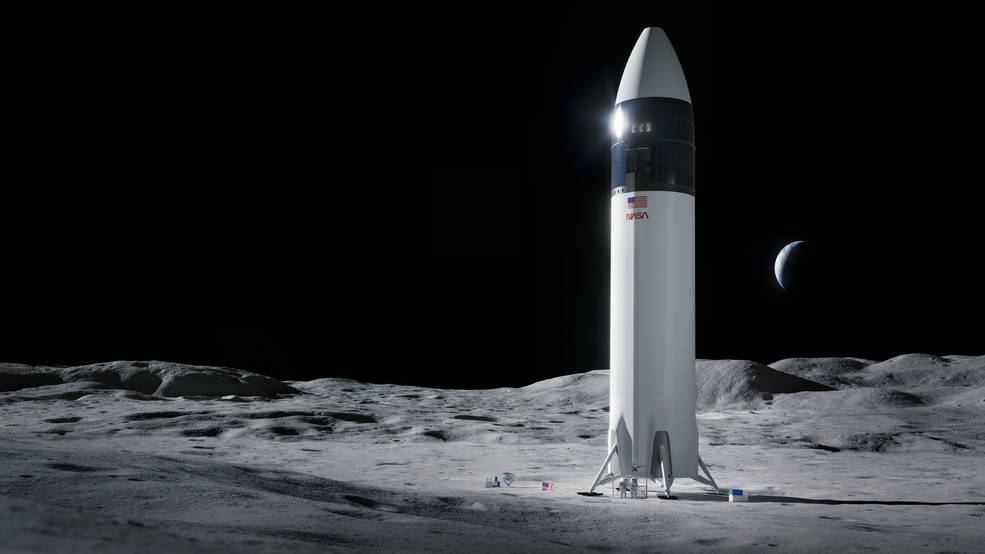
NASA’s 2027 Human Lander Challenge is seeking ideas from college and university students to help address one of the most critical needs for sustained lunar exploration: reliable communications.
As NASA prepares for long-term human presence on the Moon through the Artemis and Moon Base programs, communications systems will be just as important as spacecraft and rockets. A resilient communications system will connect astronauts, rovers, habitats, landers, mission support teams on Earth, and more. Reliable communications are essential for ensuring safety, coordinating complex operations, and enabling timely decision-making in the harsh and remote lunar environment.
“Reliable communications will be at the heart of our ability to explore and operate on the Moon,” said Jeremy Del Greco, Human Landing System program communications integration lead at NASA’s Marshall Space Flight Center in Huntsville, Alabama. “As Artemis and Moon Base missions expand our presence beyond Earth, we will need dependable connections across the lunar surface and beyond. The 2027 Human Lander Challenge gives students the opportunity to help shape the communications capabilities of tomorrow and support future lunar exploration.”
The 2027 competition invites United States-based collegiate teams and their faculty advisers to develop innovative, systems-level solutions to better understand, establish, and optimize lunar communications for landers and surface operations that can be implemented within three to five years.
Teams should submit a non-binding notice of intent by Thursday, Oct. 15, if they would like to participate. Proposal packages, including a five to seven-page proposal and a two-minute video, are due March 4, 2027.
While teams may propose solutions outside of the focus areas, NASA has identified three main categories to advance future lunar communications capabilities:
Hardware:
Space-rated wireless networks and electronics
Antenna signal propagation, modeling, and environmental mitigation
Software:
Data efficiency and link optimization
Network management and scheduling
Architecture
Surface communications system architecture
Orbital communications system architecture
Based on proposal package evaluations in phase 1, up to 12 finalist teams will be selected to receive $9,000 and advance to phase 2 of the competition, which includes a final design review in Huntsville, Alabama, home of NASA’s Marshall Space Flight Center, June 21–24, 2027. The top three teams from phase 2 will share a total prize of $18,000.
The Human Lander Challenge is administered by the National Institute of Aerospace on behalf of the agency and supports NASA’s efforts to foster innovative solutions to a variety of areas for long-duration human spaceflight plans at the Moon. The Human Lander Challenge is sponsored by the agency’s Human Spaceflight Mission Directorate’s Human Landing System Program Office.
Through the Artemis program, NASA will send astronauts to explore the Moon for scientific discovery, economic benefits, and to build the foundation for the first crewed missions to Mars – for the benefit of all.
For more information on NASA’s Human Lander Challenge and how to participate, visit:
Preparations for Next Moonwalk Simulations Underway (and Underwater)
The NASA ORBIT (Opportunities in Research, Business, Innovation, and Technology for the Workforce) Challenge invites university and community college students nationwide to work with real NASA intellectual property and mission challenges.
Choose your path: develop commercial applications of NASA patents that solve problems here on Earth (ORBIT Earth), or design next-generation technologies for space exploration (ORBIT Space). The most ambitious teams can pursue both through the optional Integration Bonus.
Award: Up to $500,000 in prizes, receive mentorship from NASA experts, and present your work at an in-person showcase. Finalists gain access to an exclusive accelerator program designed to launch careers in STEM and entrepreneurship.

 Login