❌

Reading view

There are new articles available, click to refresh the page.

CQURE Hacks #85: CQUSNDeepAnalyzer: Turn the USN Journal into a Forensic Timeline

The USN Journal is one of the most useful forensic artifacts on an NTFS volume, but it can also be extremely noisy.

From Raw Data to Actionable Findings

CQUSNDeepAnalyzer processes the raw $J stream and can optionally use the MFT for full path reconstruction.

It also includes built-in YARA rules, behavioral detection, and enrichment from EVTX and Prefetch data.

In the demo, we run the tool against a real journal dump and immediately uncover several interesting findings:

1. More than 1,500 rename records in a burst.

2. Nearly 50,000 file deletions.

3. Fifteen new file extensions appearing only in the last part of the timeline.

4. Search for known cryptominer binaries.

5. Nearly 400 related events across 53 files.

    The combination of mass renames, mass deletes, and newly appearing extensions is especially interesting because it can be associated with early-stage ransomware activity.

    Interactive Forensic Analysis

    The tool deals with huge amounts of records and presents the findings in an interactive HTML report.

    Instead of manually reviewing thousands of raw entries, investigators can explore:

    1. An activity timeline.

    2. Severity-ranked findings.

    3. Reason flags over time.

    4. An hour-by-day heatmap.

    5. A Sankey diagram connecting reasons, file extensions, and paths.

    6. File extension statistics.

    7. A path treemap showing where suspicious activity occurred.

      Every underlying record remains searchable and filterable, and the results can be exported to CSV for further analysis.

      Why It Matters

      During investigation, the biggest challenge is often not collecting forensic data, but finding the important activity hidden inside it.

      CQUSNDeepAnalyzer helps transform a raw USN Journal into a structured timeline that makes suspicious file operations, malware indicators, and behavioral patterns much easier to investigate. From a raw journal blob to an investigation-ready timeline.Β That is CQUSNDeepAnalyzer.

      If you’re reading this article, use the discount code CQBLOG_AMSC27_HACKS85 at checkout – a special offer created exclusively for readers of this article. The code applies to our flagship course Advanced Microsoft Security Course, which takes place only once a year, and is valid until October 25, 2026. Take advantage of this exclusive opportunity and secure your spot.
      Want a sneak peek at our AMSC course?

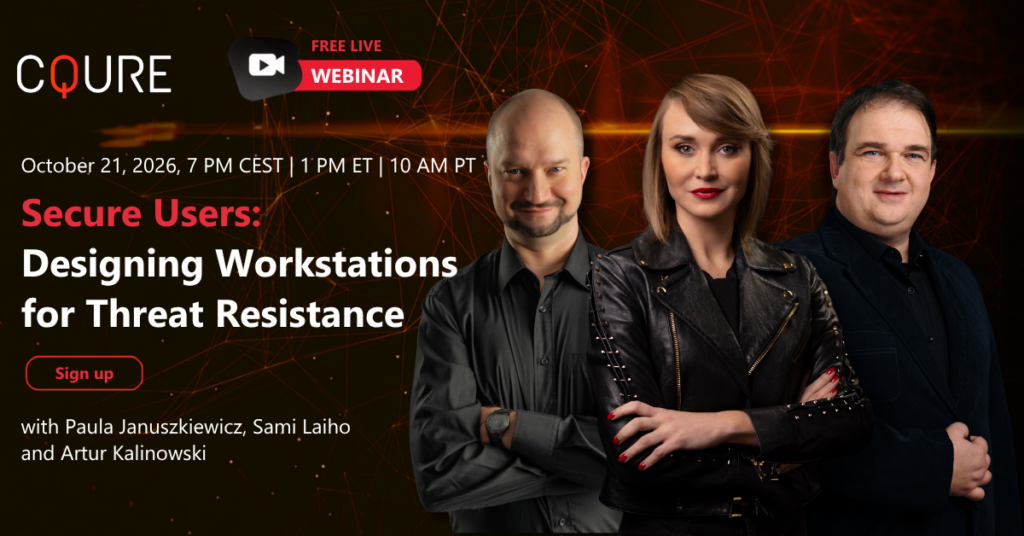
      Join our FREE live webinar:

      Secure Users: Designing Workstations for Threat Resistance

      Workstation security depends on how privileged access, authentication, endpoint configuration, and monitoring work together.

      Join Paula Januszkiewicz, Sami Laiho, and Artur Kalinowski for a practical session on designing and deploying Privileged Access Workstations (PAWs), implementing passkeys securely, and identifying workstation and identity misconfigurations that weaken security.

      Through practical demonstrations, discover how to strengthen workstation defenses, identify the authentication events and security changes that matter, and connect endpoint and identity activity to actionable detections. You will also learn how to validate that security evidence is collected and alerts trigger as expected.

      Leave with an actionable checklist for PAW design, passkey deployment, workstation hardening, configuration reviews, and monitoring validation.

      Register for free:
      πŸ‘‰ https://luma.com/SecureUsers

      Want to know more?

      The post CQURE Hacks #85: CQUSNDeepAnalyzer: Turn the USN Journal into a Forensic Timeline appeared first on CQURE Academy.
      CQURE Hacks #84: Understanding Event ID 4624 in Action

      Event ID 4624 is one of the most important Windows events for monitoring successful logons.

      We start by enabling detailed logon auditing on the Domain Controller and then generate several different logon scenarios, including:

      1. Workstation unlocks, Logon Type 7

      2. Local interactive logons, Type 2

      3. Network authentication, Type 3

      4. New logon session with alternate credentials for network connections, Type 9

      5. RDP sessions, Types 7 and 10

      6. Service logons, Type 5

      We also demonstrate how SMB activity from Kali Linux appears on the Domain Controller and which fields are most useful during analysis, including:

      1. Logon Type

      2. Logon Process

      3. Authentication Package

      4. Source Network Address

        The key takeaway is that Event ID 4624 becomes most valuable when you correlate its fields and understand the context behind the logon.

        A single Type 3, Type 7, or Type 9 event may be completely legitimate. But when you combine the logon type with the account used, source IP address, authentication package, and surrounding activity, it becomes much easier to distinguish normal behavior from activity worth investigating. That is why Event ID 4624 is such a valuable source for Windows authentication analysis, threat hunting, and lateral movement investigations.

        After restoring Bob’s original UPN, the certificate is used for authentication and is mapped by the KDC to the real Administrator account. This allows us to obtain an Administrator TGT and recover the Administrator NT hash.

        With Domain Admin privileges, the demonstration concludes with DCSync, retrieving the krbtgt account hash.

        The attack highlights why AD CS configuration, certificate mapping settings, and permissions to modify identity attributes such as userPrincipalName should all be carefully reviewed. A seemingly small certificate configuration issue can become part of a complete domain compromise.

        Want to learn more?

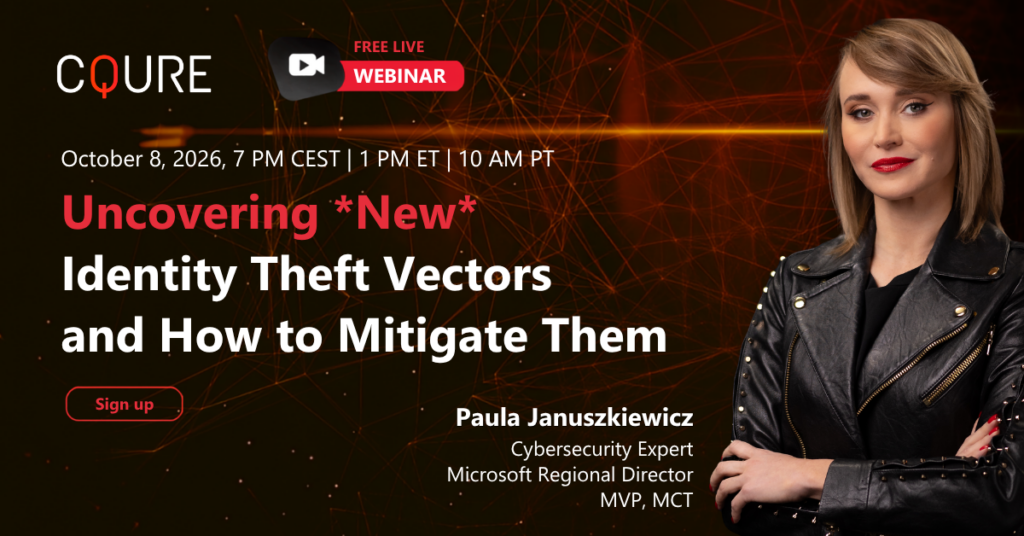
        Join our FREE live webinar:

        Uncovering New Identity Theft Vectors and How to Mitigate Them

        Discover how identity theft no longer begins and ends with a stolen password.

        Paula Januszkiewicz (CEO of CQURE and CQURE Academy, Cybersecurity Expert & Red Teamer, Microsoft Regional Director, MVP, and MCT) will unveil new identity attack paths, including original research from the CQURE Team demonstrating how an attacker can move from endpoint access to cloud identity takeover, compromise sensitive user secrets, gain access to protected resources such as KeePass, and evade traditional EDR/XDR visibility.

        Register for free:
        πŸ‘‰ https://luma.com/TheftVectors

        Want to know more?

        The post CQURE Hacks #84: Understanding Event ID 4624 in Action appeared first on CQURE Academy.

        CQURE Hacks #83: Attack on Active Directory Certificate Services (AD CS) – ESC16

        ESC16 occurs when a Certificate Authority is configured not to include the SID security extension in issued certificates. This extension provides a strong binding between a certificate and the Active Directory account for which it was issued. If the extension is absent and the Domain Controller permits weak certificate mapping, certificate identities such as the UPN can potentially be used to map the certificate to another account.

        In the demonstration, a low-privileged user named bob is able to modify his userPrincipalName. We temporarily change his UPN to Administrator and request a standard user certificate. Because the CA does not add the SID security extension, the issued certificate contains the Administrator UPN without being strongly bound to Bob’s SID.

        After restoring Bob’s original UPN, the certificate is used for authentication and is mapped by the KDC to the real Administrator account. This allows us to obtain an Administrator TGT and recover the Administrator NT hash.

        With Domain Admin privileges, the demonstration concludes with DCSync, retrieving the krbtgt account hash.

        The attack highlights why AD CS configuration, certificate mapping settings, and permissions to modify identity attributes such as userPrincipalName should all be carefully reviewed. A seemingly small certificate configuration issue can become part of a complete domain compromise.

        Want to learn more?

        Join our FREE live webinar:

        Uncovering New Identity Theft Vectors and How to Mitigate Them

        Discover how identity theft no longer begins and ends with a stolen password.

        Paula Januszkiewicz (CEO of CQURE and CQURE Academy, Cybersecurity Expert & Red Teamer, Microsoft Regional Director, MVP, and MCT) will unveil new identity attack paths, including original research from the CQURE Team demonstrating how an attacker can move from endpoint access to cloud identity takeover, compromise sensitive user secrets, gain access to protected resources such as KeePass, and evade traditional EDR/XDR visibility.

        Register for free:
        πŸ‘‰ https://luma.com/TheftVectors

        Want to know more?

        The post CQURE Hacks #83: Attack on Active Directory Certificate Services (AD CS) – ESC16 appeared first on CQURE Academy.

        CQURE Hacks #82: Microsoft Entra ID Conditional Access Bypass via User-Agent Policy Gap

        Conditional Access decides which device platforms it trusts based on the User-Agent, a value the client controls. Windows, Linux, iPhone all get blocked. So, we try something the policy never accounted for: Xbox Series X. The result is a Microsoft Graph access token, issued without ever triggering MFA.

        With that token we go straight to Graph, enumerating users, groups and roles with GraphRunner, completely bypassing the portal restrictions. A custom script then scans directory objects for secrets and finds a clear-text password sitting in a group description. It belongs to a break-glass account with Global Administrator.

        One policy gap and one badly stored secret, chained into a full tenant compromise.

        Blocking the admin portal is not enough. Conditional Access has to cover the underlying APIs and token acquisition paths, security decisions must not rely on client-controlled signals like the User-Agent, MFA belongs on every sensitive path, and secrets must never live in directory attributes a standard user can read.

        Want to learn more about Attack Reconstruction & Defense Evasion?

        Join our FREE live webinar:

        Close the Attack Visibility Gap: Detecting Defense Evasion and Reconstructing Attacks in Microsoft Environments

        Discover how attackers create gaps in security visibility and how defenders can reconstruct what happened from fragmented evidence across Microsoft environments.

        Paula Januszkiewicz and Amr Thabet will look at the challenge from both sides, from reconstructing attacks and finding the evidence attackers leave behind to understanding how modern defense evasion techniques can make malicious activity harder to detect.

        Register for free:
        πŸ‘‰ https://luma.com/uylurofs

        Want to know more?

        The post CQURE Hacks #82: Microsoft Entra ID Conditional Access Bypass via User-Agent Policy Gap appeared first on CQURE Academy.

        ❌