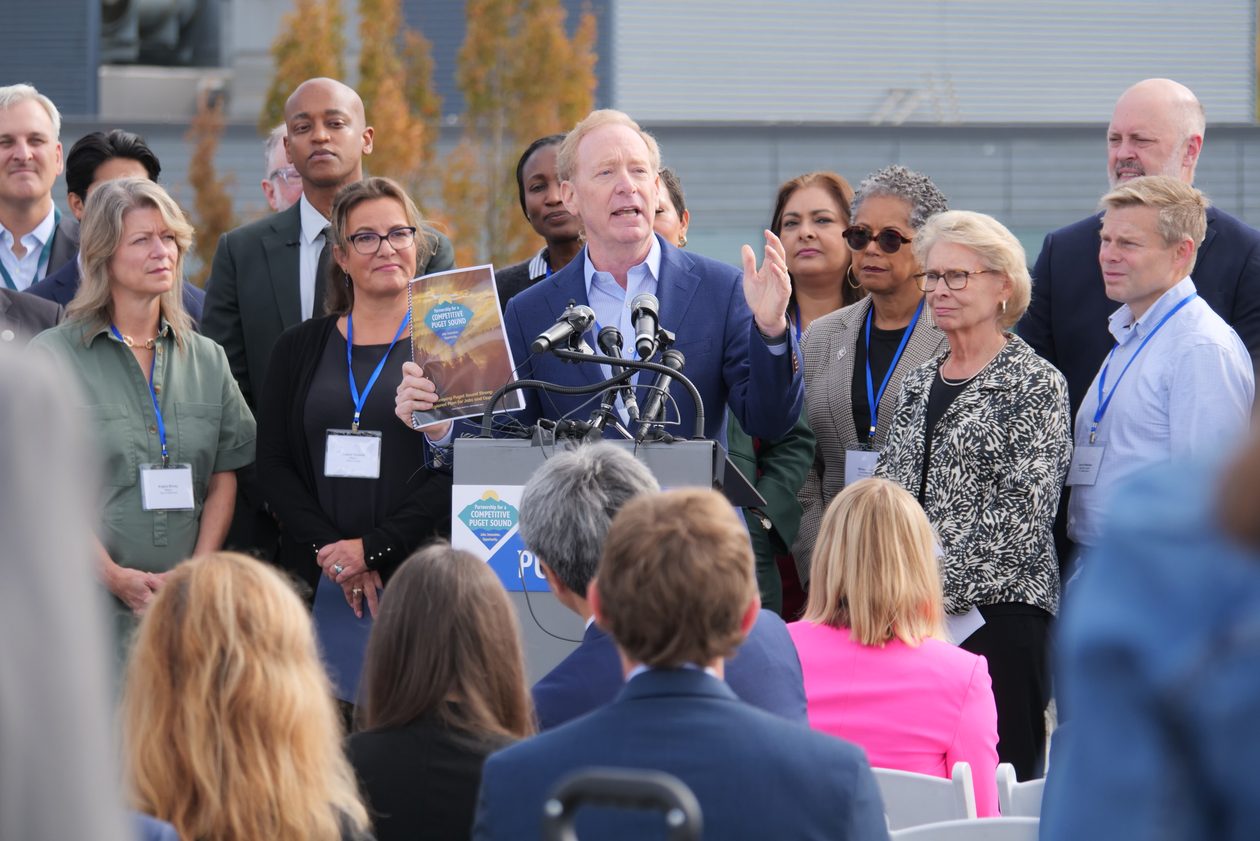
Microsoft President Brad Smith, shown speaking at a Microsoft event last year, told Politico this week that the Trump administration’s claims about the company’s foreign workers were “completely off base.” (GeekWire File Photo / Todd Bishop)
Microsoft President Brad Smith says someone apparently “failed to inform the vice president accurately about our numbers” before the Trump administration cut off the company’s ability to sponsor foreign workers for permanent residency.
In an interview with Politico, published Thursday, Smith rejected Vice President JD Vance’s accusations of fraud and called his claim that Microsoft replaced laid-off Americans with foreign workers “completely off base.” He said Microsoft has “always been committed to a high integrity and high compliance” approach to immigration.
“We will stand by our record,” Smith said. “And I hope that folks at the White House might look again and look at what we think is a more accurate picture.”
At a White House news conference last week, Vance said Microsoft laid off 6,000 American workers last year while receiving 6,300 H-1B visas and nearly 3,000 green cards.
“If you do the math, for every worker that Microsoft laid off, they replaced that worker with one and a half foreign indentured servants,” Vance said, after asserting that there “has been no company in the United States, unfortunately, that has abused the system more than Microsoft.”
Critics of the visa programs say tech companies have used them to displace U.S. workers, and that the job ads companies must run before sponsoring workers for green cards often appear in places few American job seekers will see. Labor Department records show Microsoft’s required print ads ran mostly in The Seattle Times.
Smith said most of Microsoft’s recent visa and green card applications were for people already working at the company, many of them for years, because of long green card backlogs. He also said Microsoft hired 9,200 American workers in its last fiscal year, a number he said was “left out of the narrative.”
The Microsoft executive also rejected the idea that the company pays visa holders less. “It doesn’t matter whether you came on a visa or you’re an American worker,” he said. “Everybody has the same compensation system.”
He warned that the crackdown could send “the most talented next wave” of engineers to other countries. Five of the six tech leaders President Trump honored with national medals last week, including Microsoft CEO Satya Nadella, came to the U.S. as immigrants, Smith noted, and their companies together account for more than 25% of the value of the S&P 500.
“Let’s not put that at risk,” he said.
The suspension doesn’t stop Microsoft from hiring foreign workers on H-1B visas. Those are temporary work visas, typically granted for three years at a time and generally limited to six.
Amazon led in H-1B approvals for new employment in fiscal 2025, with 4,644, followed by Meta with 1,555 and Microsoft with 1,394, according to an analysis of USCIS data by the National Foundation for American Policy.
What Microsoft lost is access to a key step toward permanent residency. The program, known as PERM, is run by the Labor Department. Companies use it to sponsor foreign employees for permanent residency, also known as a green card. The employer has to advertise the job and show the department that no qualified, available U.S. worker can fill it.
PERM is commonly used for employees already working in the U.S. on temporary visas, including H-1Bs.
The interview didn’t address Microsoft’s outsized use of PERM. The company had more PERM cases decided than any other employer in fiscal 2025 and the first nine months of fiscal 2026, according to a GeekWire analysis of Labor Department data. Other big tech companies, including Amazon and Google, sharply reduced their PERM filings after early 2023.
Microsoft Chairman and CEO Satya Nadella speaks onstage at Microsoft Build 2026 in San Francisco. (Photo by Dan DeLong for Microsoft)
Microsoft is moving its communications function out of its marketing group and into the corporate, external and legal affairs organization led by Brad Smith, its vice chair and president, according to internal emails Thursday from Smith and Microsoft CEO Satya Nadella.
Brent Colburn, Microsoft’s VP of global public affairs, was named interim communications leader, effective next week, reporting to Smith. Colburn announced this month that he was leaving the company in mid-October. He will now stay through December and is not a candidate for the permanent role.
Frank X. Shaw, the longtime Microsoft communications chief who announced earlier this month that he would leave the company at the end of the year, will step away from his current responsibilities and serve as an advisor to Smith and Colburn during the transition, according to the memos.
Building in public: Nadella’s memo described the change in the organizational structure as a response to a shifting media environment, and said the larger plan is to make employees a bigger part of Microsoft’s public voice.
He said Microsoft needs to “find new ways to connect directly with all of our constituencies” in a media environment he called “increasingly fragmented and noisier than ever.”
“In many ways, the people closest to the work have the best opportunity to shape how Microsoft is understood,” Nadella wrote. He said he wants to help engineers, sellers, partners and others “closest to our products and customers” become “an even bigger part of how we tell our story, all connected by a shared strategy and set of principles.”
The approach Nadella described is closer to how AI labs and startups operate. OpenAI and Anthropic tend to be more fluid with their blogs and livestreams, and AI researchers and leaders are more likely to post directly and informally in their own voices.
Microsoft has been working to make more of a mark of its own in AI, building in-house models under Mustafa Suleyman’s Microsoft AI group, while Copilot trails ChatGPT and Google’s Gemini in consumer adoption. In recent weeks, Meta has made a splash with its Muse AI assistant and a new device called Muse Charm, a palm-sized gadget it previewed Wednesday.
Nadella and the company’s engineering leadership have been pushing to modernize Microsoft’s communications, moving toward a more direct approach and building in public, according to a person familiar with the situation.
“We will learn, we will experiment, and we will evolve,” Nadella wrote. “There is a fundamentally new way to think about communications, and this team will be central to building it.”
Smith echoed the point, writing that Microsoft will “likely have more employees and executives acting as part of Microsoft’s public voice, including on social media.”
The timing: Shaw’s shift to an advisory role surprised some inside the company. Announcing his exit two weeks ago, he said he would be at Microsoft “through the end of the calendar year.” Microsoft said at the time that it would take “the coming months” to determine its future communications leadership.
Contacted via phone, Shaw described this as the formalization of the plan that was announced. He will still be at Microsoft through the end of the year in an advisory role.
In a statement, Microsoft said Shaw “has been a trusted counselor and leader at Microsoft for more than two decades, and we’re grateful he will continue to act as an advisor during the transition.”
Nadella thanked Shaw in his memo, saying he has “made tremendous contributions to the company and to our communications function over the last 17+ years” and has been “a great source of counsel to our leadership team and to me personally, across the company’s biggest moments.”
In his memo, Smith wrote of Shaw that he has “worked as closely with him as almost anyone” over those years, and that Shaw’s “enduring impact on Microsoft and this team will be felt for years to come. I will miss him.”
Smith said Microsoft has launched a search for a new chief communications officer that includes internal and external candidates. He will work on the selection with Takeshi Numoto, Microsoft’s chief marketing officer, and Amy Coleman, its chief people officer.
The next chief communications officer is also expected to report to Smith, which indicates the change is permanent and not just for the interim period.
The new structure: Nadella called Smith one of the few leaders who “embody Microsoft’s voice” authentically, citing his “rare ability to communicate complex ideas with clarity, conviction, and trust.”
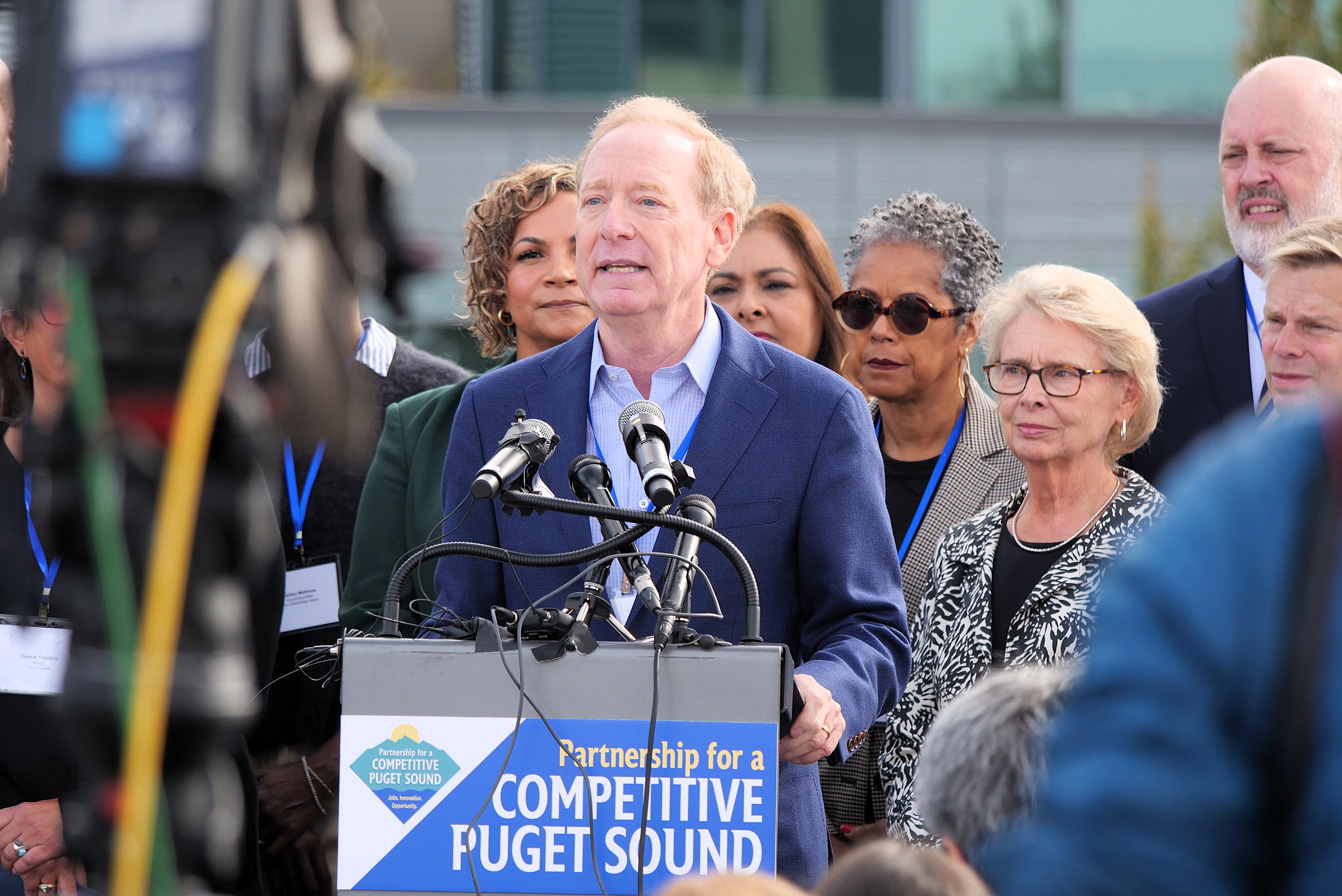
Microsoft Vice Chair and President Brad Smith, who will now oversee the company’s communications team, at the Sept. 14 launch of the Partnership for a Competitive Puget Sound in Seattle. (GeekWire Photo / Todd Bishop)
Smith’s organization handles Microsoft’s legal, regulatory and public policy work, including antitrust matters, litigation and government relations. Communications will now sit alongside those functions rather than with marketing and product, although both memos emphasize continued coordination between the two.
The communications leadership team will expand to include Caitlin McCabe, Carol Ann Browne and Dave Imperiale, according to Smith’s memo, citing the communications roles they play for Nadella, Smith and Judson Althoff, CEO of Microsoft’s commercial business. Kate Frischmann will also join the team, reflecting her role on the public affairs side of Smith’s organization. In his interim role, Colburn will join Numoto’s leadership team in addition to Smith’s.
Nadella wrote that Microsoft’s upcoming fall events present “a real opportunity to bring together our product story, our marketing, and our communications in new ways.”
“You should tax things you want to discourage, like cigarettes, not jobs.” Microsoft’s Brad Smith at Monday’s launch of the Partnership for a Competitive Puget Sound, with former Gov. Chris Gregoire at his left. (GeekWire Photo / Todd Bishop)
Detroit, Cleveland and Pittsburgh each had their moment in the sun a century ago, Microsoft Vice Chair and President Brad Smith said Monday — and then the warning lights started flashing, and their leaders at the time failed to heed them.
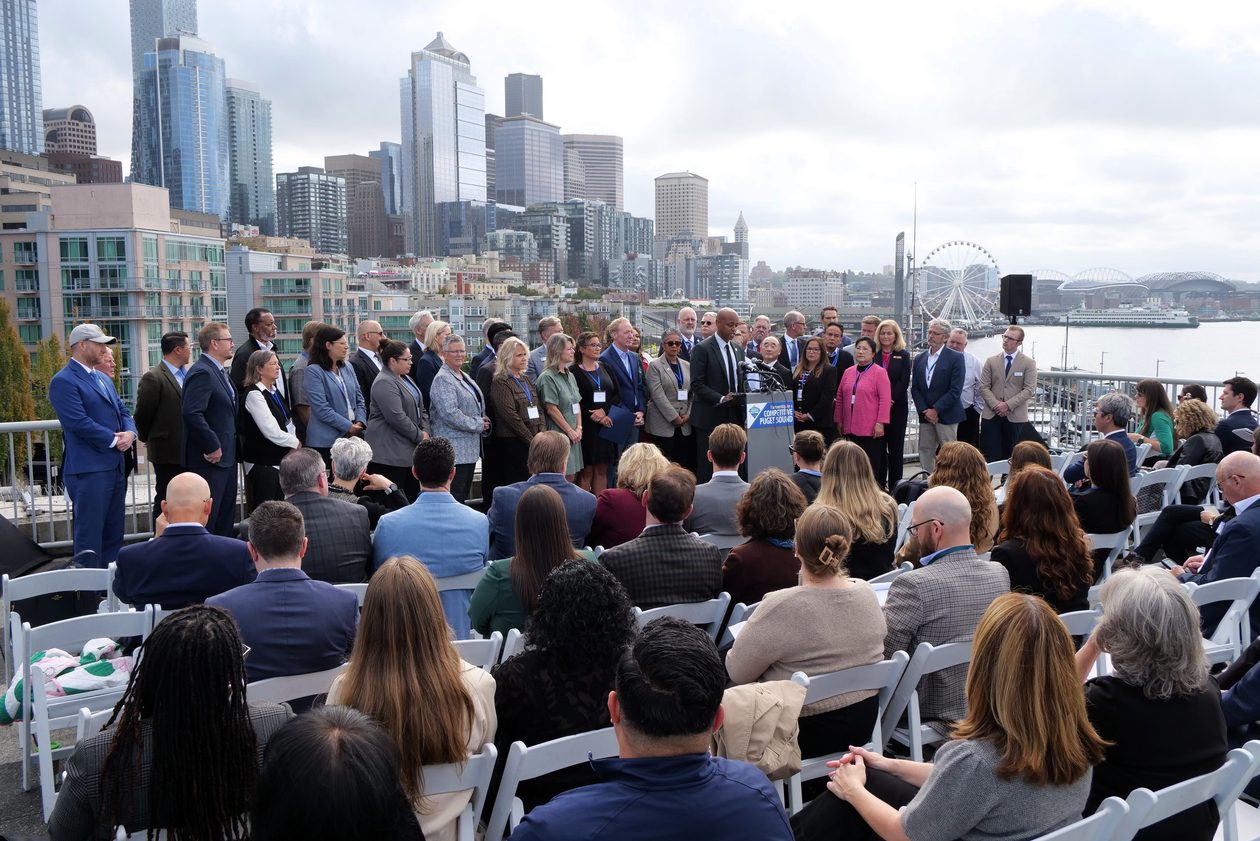
“Well, here we are. It is 2026,” Smith said at a press conference, flanked by dozens of regional leaders, with the Seattle skyline behind them. “And the warning signs are flashing on our economy.”
Smith was speaking at the launch of the Partnership for a Competitive Puget Sound, a Challenge Seattle initiative that brought together roughly 50 elected officials from King, Kitsap, Pierce and Snohomish counties — two county executives, around 20 mayors, port commissioners and about a dozen state legislators — along with labor leaders and business executives, behind a 20-point plan for reversing the region’s slide.
The region lost nearly 7,000 jobs in 2025, according to a report issued by the group, the first time in two decades outside a recession or the pandemic that Seattle-area employment growth has trailed the nation’s. Washington has fallen from 32nd to 47th in CNBC’s ranking of states by cost of doing business since 2017.
An ‘intentional’ regional tech strategy: The report makes a pointed observation about technology: aerospace has a coordinated regional agenda and tech doesn’t, despite tech accounting for nearly one in 10 regional jobs and about 24% of total payroll.
Aerospace knows what it’s working on: the next airplane, the space industry, sustainable fuels, supplier diversification. Technology, “despite being one of Puget Sound’s defining economic anchors, does not yet have an equally intentional regional strategy,” the report says.
King County Executive Girmay Zahilay addresses the crowd Monday, with the downtown Seattle skyline behind him. More than 32% of the city’s central business district office space sits vacant, according to the new regional report. (GeekWire Photo / Todd Bishop)
Without one, it adds, the region risks losing “jobs, technology investment, headquarters, talent, and company growth” to the Bay Area, New York, Boston and Austin. The goal is “not simply to promote growth, but to protect and strengthen the region’s position as a leading technology center.”
Challenge Seattle says it will write that strategy with the Puget Sound Regional Council, built around two priorities: keeping the big tech companies investing here, and making it easier for startups to scale. Related recommendations target industrial space for AI hardware startups, commercial space, and the region’s fusion cluster.
The report sets no budget or measure of success for the tech strategy, and no deadline beyond its general goal of progress within three years.
A regional wake-up call: Many of the recommendations are changes to how local government operates, not new spending: deadlines for permit decisions, a designated business contact in every city and county, and a strategy for dealing with the way taxes stack across state, county and city.
“This is, for us, a wake-up call,” said former Washington Gov. Chris Gregoire, CEO of Challenge Seattle, launching the initiative during the press conference. “We cannot resort to relying on yesterday’s success while tomorrow’s jobs go somewhere else.”
April Sims, president of the Washington State Labor Council, said businesses need predictability and enough margin to invest, innovate and take risks — but “working people need margins, too.”
King County Executive Girmay Zahilay said his office has hired an economic development team and is beginning an internal permitting audit. “AI is transforming our economy seemingly overnight,” he said, calling the 7,000 lost jobs “quite alarming.”
The group also released a playbook for Puget Sound mayors, drawn from interviews and surveys with local leaders, on building what it calls a culture of partnership with business.
Seattle as a Microsoft litmus test: Asked by GeekWire during the press conference what it would take for Microsoft to return and grow in Seattle proper, where it previously had offices in South Lake Union, Smith first pointed out that he was standing in front of Redmond Mayor Angela Birney.
“We have a great mayor, and every day we get up and we’re excited to go to work in Redmond, Washington,” he said, to laughter from the assembled officials.
Smith also pushed back on the premise: Microsoft moved to the Eastside from Albuquerque in 1979 and never had a large presence in Seattle, so he wouldn’t use the city as the point of comparison.
Then he turned to Seattle’s JumpStart payroll expense tax.
As structured, the payroll tax “is really a tax on tech jobs,” Smith said, “and that’s why you’re seeing more tech jobs move from Seattle to places like Bellevue and the Eastside.” He noted that San Francisco abolished its payroll tax the same year Seattle adopted one, in 2021.
“You should tax things you want to discourage, like cigarettes, not jobs,” he said.
He tied the issue to the larger impact of AI on jobs. “We need people to succeed to some degree in a world of AI,” Smith said. “And you don’t want to make the cost of employing people more expensive, at the same time that AI is increasingly adding its own new form of competition.”
“There’s nothing that would lead to the decline in jobs in this state faster than a replication of the JumpStart tax,” he said. “And if Seattle wanted to do one thing to increase jobs in Seattle, it ought to revisit whether a payroll tax makes any sense.”
Then he added a caveat: “That’s probably something that would impact other companies more than Microsoft.”
Amazon, which has been reported to be the largest payer of the tax, did not have a speaker at Monday’s event. Individual Amazon execs are listed in the acknowledgments in the Challenge Seattle report, though the report says participation doesn’t imply endorsement.
View from Olympia: During the press conference, Senate Majority Leader Jamie Pedersen, D-Seattle, was asked whether Washington risks becoming an outlier among states on taxes. The Legislature has been correcting course, he said, pointing to two moves from this year’s session.
One was the estate tax. Lawmakers raised the top rate to 35% in 2025, the highest in the country, and reversed themselves this March, returning it to 20% as of July.
The other was the millionaires tax — a 9.9% tax on household income above $1 million, signed by Gov. Bob Ferguson and projected to raise roughly $3 billion a year. It doesn’t take effect until 2028, and Seattle tech leaders warned it would push founders and investors out of the state.
Pedersen cast it as the fix for a different kind of outlier status: Washington’s business and sales taxes are high because it’s one of the few states with no personal income tax at all. The new tax would let Washington “join 41 other states that have a personal income tax,” he said.
Voters get the last word in November. Initiative 645, backed by Let’s Go Washington, qualified for the ballot in July and would repeal the tax. If it survives, Pedersen said, a statewide payroll tax is “vanishingly unlikely” next session.
Seattle’s mayor weighs in: Seattle Mayor Katie Wilson, who was an architect of the JumpStart tax before running for office, was not among the speakers at the press conference. She opened the regional session that followed, and said the region needs to do a better job telling its own story.
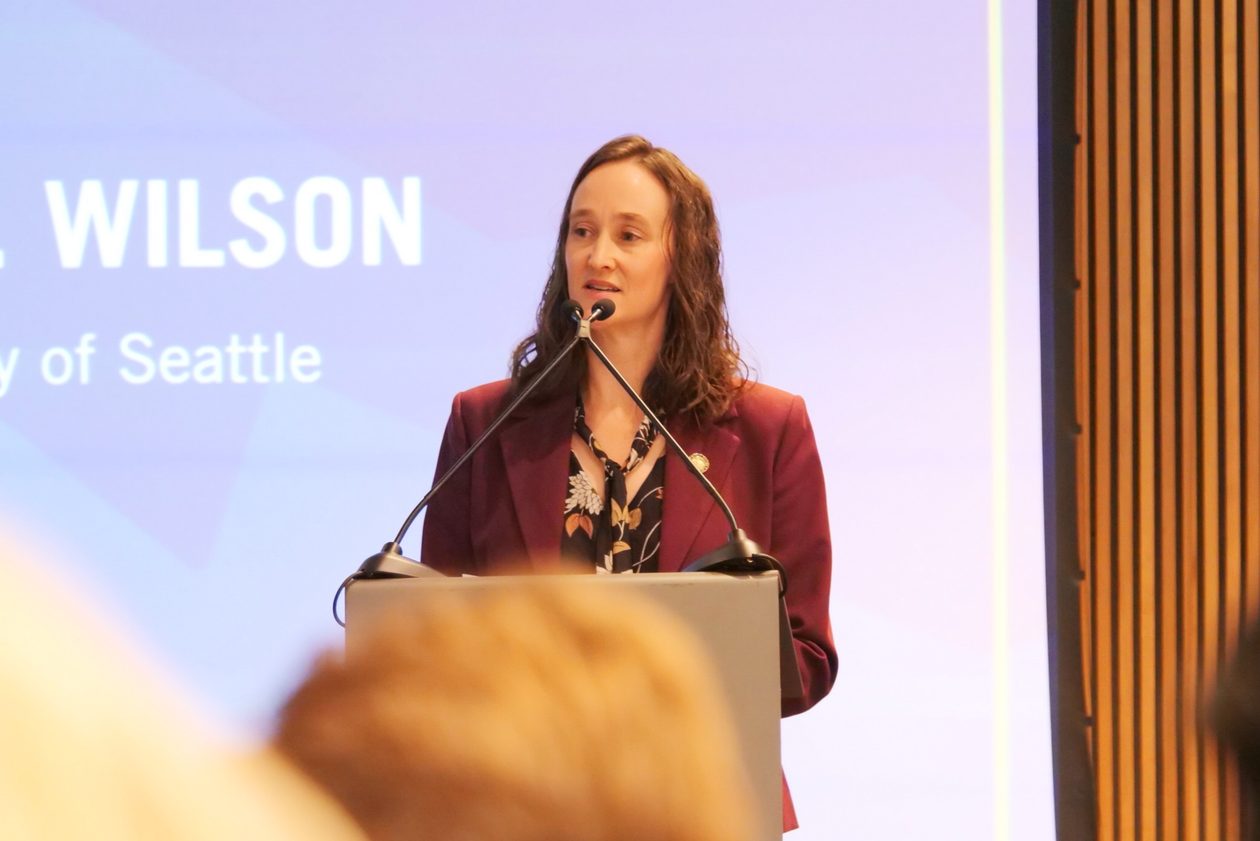
Seattle Mayor Katie Wilson opens the regional action session that followed Monday’s launch of the Partnership for a Competitive Puget Sound. (GeekWire Photo / Todd Bishop)
“There are some forces and interests that are pushing a narrative that does not want Seattle or our region to succeed,” Wilson said, “and we must counter that with a new commitment to a shared sense of destiny, because Seattle’s success is Bellevue’s success, Pierce County’s success is Snohomish County’s success.”
She called it a fragile moment and said the time to act is now, pointing to the economic actions she announced last week in conjunction with an independent report commissioned by the city and released by Seattle’s Office of Economic Development.
That report, “Seawall: Building a Resilient Seattle Economy,” found Seattle’s tax structure unique among peer cities in the way it “specifically penalizes the hiring of senior, high-compensation workers,” with the burden falling overwhelmingly on large tech employers.
Hiring a software engineer at $650,000 in total compensation costs about $17,000 more a year in Seattle than in Bellevue at JumpStart’s top rate, the researchers found.
The city report, conducted by the economic consulting firm Formation, said Seattle should bet on cleantech, the sector where the city owns the utility, writes the building codes and controls permitting and land use. It’s one place where Seattle has real leverage over its own economy, the researchers argued.
“It’s striking how much agreement we share across labor, businesses, and government,” Wilson said. “This is not a call to ignore our challenges, but to tackle them with a shared sense of possibility.”
She did not address the payroll tax in her remarks.

 Login