Reading view

There are new articles available, click to refresh the page.

Blockstream Tells Hackers To Return Remaining Bitcoin Stolen in Liquid Theft

Bitcoin Magazine

Blockstream Tells Hackers To Return Remaining Bitcoin Stolen in Liquid Theft

Bitcoin infrastructure firm Blockstream has refused to negotiate further with hackers who last week stole 4,000 bitcoins from its Liquid network. 

Writing on X Friday, Blockstream said that the hackers still had time to return the funds before the company would work with law enforcement. 

White-hat hackers on Sunday withdrew about $320 million from the federation wallet that backs Liquid, a sidechain by Blockstream. After negotiating with Blockstream, they returned most of the funds but kept 598.5 coins worth over $46 million — demanding it as ransom. 

“Blockstream will not pay a ransom for the return of stolen funds,” the post read. “Taking assets without authorization and withholding their return is a crime, not responsible disclosure. It is not white-hat activity. It is theft.”

To those responsible for the theft of bitcoin from the Liquid Network:

Blockstream will not pay a ransom for the return of stolen funds. Taking assets without authorization and withholding their return is a crime, not responsible disclosure. It is not white-hat activity. It is…

— Blockstream (@Blockstream) September 11, 2026

It added: “We will work with law enforcement, exchanges, service providers, forensic specialists, and other relevant parties to trace and recover the assets and identify those responsible.”

“We will not pay for the return of stolen property. We will not abandon our users. The Bitcoin community will not stop pursuing the funds.”

Liquid, or L-BTC, is a layer-2 created by Blockstream that allows users to fast move assets backed 1:1 with bitcoin. One of the assets, LBTC, is a token backed by bitcoin that allows for quick settlement — a bit like the Lightning Network. 

Hackers were able to get the funds by exploiting an inflation bug on the Liquid sidechain to create over 4,000 LBTC that did not exist before and cash them out for real, on-chain bitcoins. 

The hackers then had an exchange with Blockstream via messages written into Bitcoin blocks. 

In one message, the white hats wrote: “Please fix the bug first. The chain is under risk at latest commit right now. Make sure every node is patched. Then we will transfer the money back safely after confirming the fix.”

In the latest message, the hackers slammed Blocksteam as “delusional, greedy, and arrogant,” and threatened to reveal all of Blockstream’s encrypted messages in the exchange unless the company allowed thieves to keep 10% of the bitcoins. 

“You SHALL pay 10% using your own money as bug bounty or you will cause all your holders a 15% loss for your irresponsibility and stinginess,” the message read. 

The Bitcoin community is still reeling after hackers in July were able to steal over 1,800 bitcoins worth close to $140 million from Coldcard wallet holders. 

Users of the popular hardware wallet, created by Coinkite, were targeted because the product’s manufacturer did not use a true random number generator, allowing hackers to essentially guess investor seedphrases. 

This post Blockstream Tells Hackers To Return Remaining Bitcoin Stolen in Liquid Theft first appeared on Bitcoin Magazine and is written by Mathew Di Salvo.

Liquid Gets 3,400 BTC Back After On-Chain Talks; White Hats Keep 598.5 BTC

Bitcoin Magazine

Liquid Gets 3,400 BTC Back After On-Chain Talks; White Hats Keep 598.5 BTC

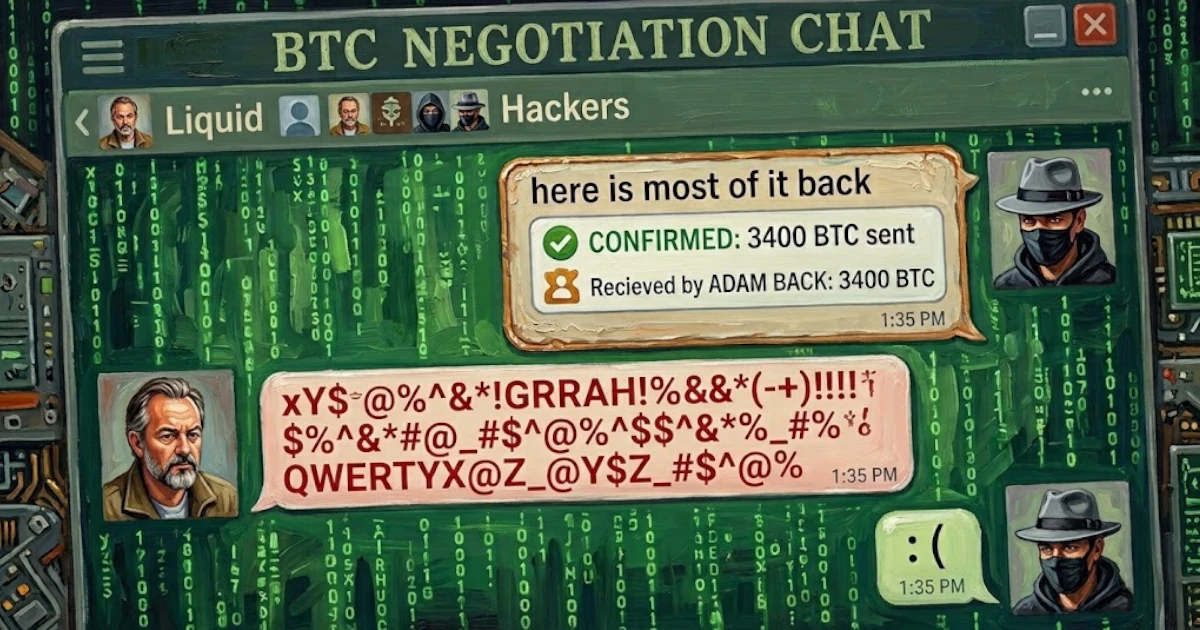
The “White hat” party that withdrew nearly 4,000 bitcoin from the Liquid Network federation wallet on Sunday returned 3,400 BTC to the wallet on Monday. About 598 BTC, or 15% of the consolidated pile, stayed at the same holder address as an implied bounty fee worth 48 million dollars.

The return transaction (bc49a46d), confirmed at 16:09 UTC on September 7. It returned exactly 3,400 BTC to the labeled Liquid peg script address and sent the 598.5 BTC change back to the “White hat” hacker address as change. 

The transfer followed a day of messages written into Bitcoin blocks. The White hats first published transaction on chain with a message in the OP_RETURN arbitrary data field “contact us on chain”; the message came from the address holding the 4000 BTC taken from the Liquid Network. 

A Blockstream-linked address answered with “Please contact security@blockstream.com”. Later notes from that sender carried Electrum-encrypted payloads and PGP signatures that can be verified against Blockstream’s published security key.

In block 965869, the White hats asked in the clear text whether sending “most” back to the federation script was acceptable. The 1,000-sat output on that transaction was only a message carrier. 

Soon after, the White hats wrote “Please fix the bug first. The chain is under risk at latest commit right now. Make sure every node is patched. Then we will transfer the money back safely after confirming the fix.” followed by an encrypted blurb of text to Blockstream’s PGP key

In the same block, a clear-signed reply from the Blockstream sender said “Yes, thank you.” Hours later, the same Blockstream posted another clear-text note: “Bridge nodes are patched, safe to return the funds”. 

Minutes after the 3,400 BTC landed. The white hats sent back 85% of the funds, keeping 15% as an implied finder’s fee. The choice was celebrated by some on X as ‘better than keeping 100%’ while others were a bit shocked at the amount. While 15% might sound reasonable, the total sum is so large that it nears $50 million at today’s prices. Blockstream was clearly not happy about the finder’s fee, as four encrypted messages followed onchain a few hours later, likely after the main fires had been put out at the office and the lawyers had a chance to have a say in the matter. An hour later, one more encrypted message was posted from Blockstream.

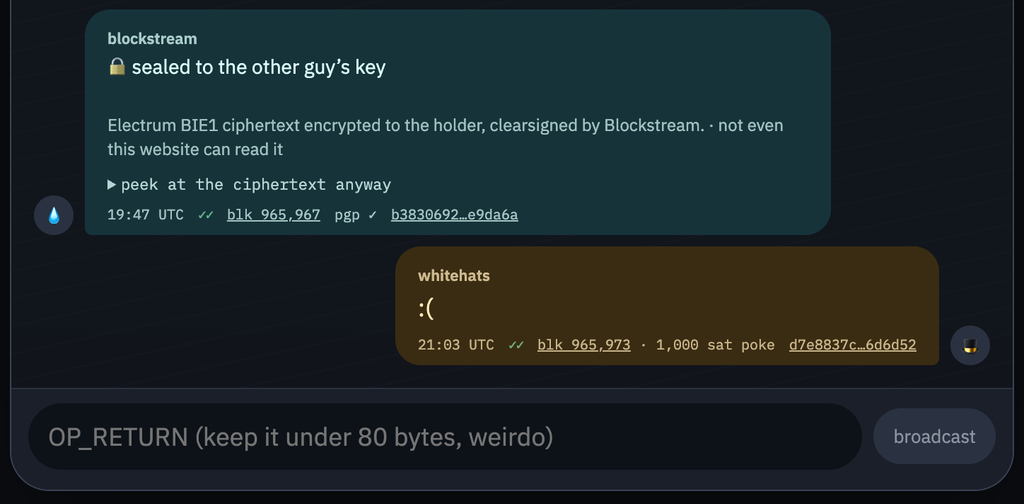
The White hats replied with two encrypted messages. Blockstream replied once an hour later. Then the White hats published a simple yet meaningful “ 🙁 ” sad face emoji. This emoji does a lot of work. It suggests that negotiations did not go well over reducing the size of the bounty. Blockstream wizards are clearly ‘big mad’ about the size of that finder’s fee. What exactly was said in those encrypted messages is not known and Blockstream has made no public statements on the matter. But we can only assume the saga is not over.

The full chat can be easily followed on this vibe-coded site (by yours truly). A couple of other researchers are keeping tabs on the conversation and on-chain data, such as Sjors’s GitHub gist and Alex Thorn from Galaxy Research

Liquid’s Sunday statement is still the network’s last official account post: purported whitehats withdrew about 4,000 BTC through the SideSwap peg-out path, the PAK itself was not compromised, other issued assets were unaffected, and the sidechain was paused. Liquid and Blockstream had not posted a new statement on the 3,400 BTC return as of this writing. SideSwap had said the L-BTC in the original peg-out “came from an Elements bug.” 

This post Liquid Gets 3,400 BTC Back After On-Chain Talks; White Hats Keep 598.5 BTC first appeared on Bitcoin Magazine and is written by Juan Galt.

Alleged White-Hat Hackers Withdraw 4,000 bitcoin from Blockstream’s Liquid Network Federation Reserves

Bitcoin Magazine

Alleged White-Hat Hackers Withdraw 4,000 bitcoin from Blockstream’s Liquid Network Federation Reserves

The Liquid Network said Sunday that purported white-hat hackers withdrew about 4,000 bitcoin, worth about $320 million, from the federation wallet that backs L-BTC. Bridge nodes were disabled, and the sidechain was paused. Other issued assets, including USDT, DePix and RWAs, were unaffected, the official account said on X.

The Liquid Network is a federated sidechain of Bitcoin, founded by Adam Back’s Blockstream. The Liquid chain issues a variety of assets such as LBTC, which it backs with BTC on the Bitcoin main chain, held in a large multisig of 15 corporate and known members. 11 of the 15 members need to sign a valid multi-signature transaction to move coins from the treasury. Before the hack, the treasury held over 4200 BTC; after the hack, Blockstream’s proof of reserves page reports a little over 207 BTC left. 

The hackers withdrew 4,019.4 BTC from the reserve address in a peg-out transaction using the SideSwap Peg-out Authorization Key. SideWap is a bridge exchange and a member of the Liquid Federation. While details on the mechanism of the hack are not confirmed yet, it appears an inflation bug on the LBTC side chain was exploited by the hackers to create over 4,000 LBTC that did not exist before, and cash them out for on-chain bitcoin from the federation. Because the transaction appeared as valid, given the consensus bug, the federation members’ HSM security servers signed the BTC withdrawal transaction, worth roughly 320 million at the time. 

The hacker moved the funds to an address ending in 6gyqjlte, from which they quickly signed a new transaction with a message on the OP_RETURN arbitrary data field saying “we are whitehats. contact us on chain.” Those coins were still at that address at the time of writing.

A small mainnet transaction to the hacker address followed by an OP_RETURN saying “Please contact security@blockstream.com”, presumably from a Blockstream public address, though that remains unconfirmed. A later OP_RETURN spend from the hacker address carried “Please contact us on Signal @m671aw.70”, however, this may be spam and does not share a link to the address with the stolen funds.

In response to the breach, exchanges were told to pause L-BTC deposits and withdrawals. Bridge nodes on the Liquid Network have been paused, limiting access to the side chain, which continues to produce blocks. 

JAN3 CEO Samson Mow said Aqua’s Liquid features were affected and that on-chain bitcoin still worked. Other wallets in the industry that use the Liquid Network are expected to be affected. Users holding LBTC now effectively have their savings at risk, since the underlying BTC is currently not redeemable. Given the private nature of the Liquid chain, user onchain analytics are scarce and not much public information is known about how much LBTC is held by retail users versus corporations of Blockstream itself. Nevertheless, should the funds not be returned, it would be a heavy blow to the Liquid Network’s user base.

Users of LBTC don’t have many options but to wait for conversations with the hackers to resolve. Given the size of the hack, it would be difficult for the hackers to get away with stealing all that bitcoin, though perhaps not impossible. What may happen is that the hackers ask for a finder’s fee and return the majority of the funds. 

This post Alleged White-Hat Hackers Withdraw 4,000 bitcoin from Blockstream’s Liquid Network Federation Reserves first appeared on Bitcoin Magazine and is written by Juan Galt.

Blockstream Debuts Swaps, Allowing Bitcoiners to Move Between Lightning and Main Network With Ease 

Bitcoin Magazine

Blockstream Debuts Swaps, Allowing Bitcoiners to Move Between Lightning and Main Network With Ease 

Bitcoin infrastructure company Blockstream has announced a new feature allowing users to make trustless swaps. 

Dubbed Blockstream Swaps, the idea is that Bitcoiners will be able to quickly move between the main chain and Lightning network. 

It comes after non-custodial Bitcoin swap provider Boltz suspended its service after it said attackers were finding vulnerabilities faster than its team could fix using AI. 

“In support of the broader Bitcoin and Liquid ecosystem, Blockstream is launching Blockstream Swaps,” Blockstream said

“This initiative was already under development to ensure a resilient suite of utility for the ecosystem, and it complements the providers already doing this work rather than replacing any one of them.”

The idea, added Blockstream, is users can move funds across layers while never losing full control over their funds.

To use Lightning, users will not need to run a node or channel — as is normally needed with Lightning — and can simply hold a Bitcoin or LBTC balance and let a swap convert at the moment of payment.

LBTC is the native asset of the Liquid Network, a Bitcoin layer-2 sidechain created by Blockstream. 

“This initiative was already under development to ensure a resilient suite of utility for the ecosystem, and it complements the providers already doing this work rather than replacing any one of them,” added Blocksteam’s announcement. 

Boltz this month suspended its Bitcoin swap service. It said that a surge in AI-assisted attacks left it unable to continue operating safely.

Crypto hacks have surged, with security experts warning that cybercriminals are using AI to search for bugs in crypto projects and then take advantage of errors auditors may have missed.

This post Blockstream Debuts Swaps, Allowing Bitcoiners to Move Between Lightning and Main Network With Ease  first appeared on Bitcoin Magazine and is written by Mathew Di Salvo.

❌