Reading view

There are new articles available, click to refresh the page.

NASA’s Roman Telescope Will Spot Distant Black Holes That Shred Stars

Lee esta nota de prensa en español aquí.

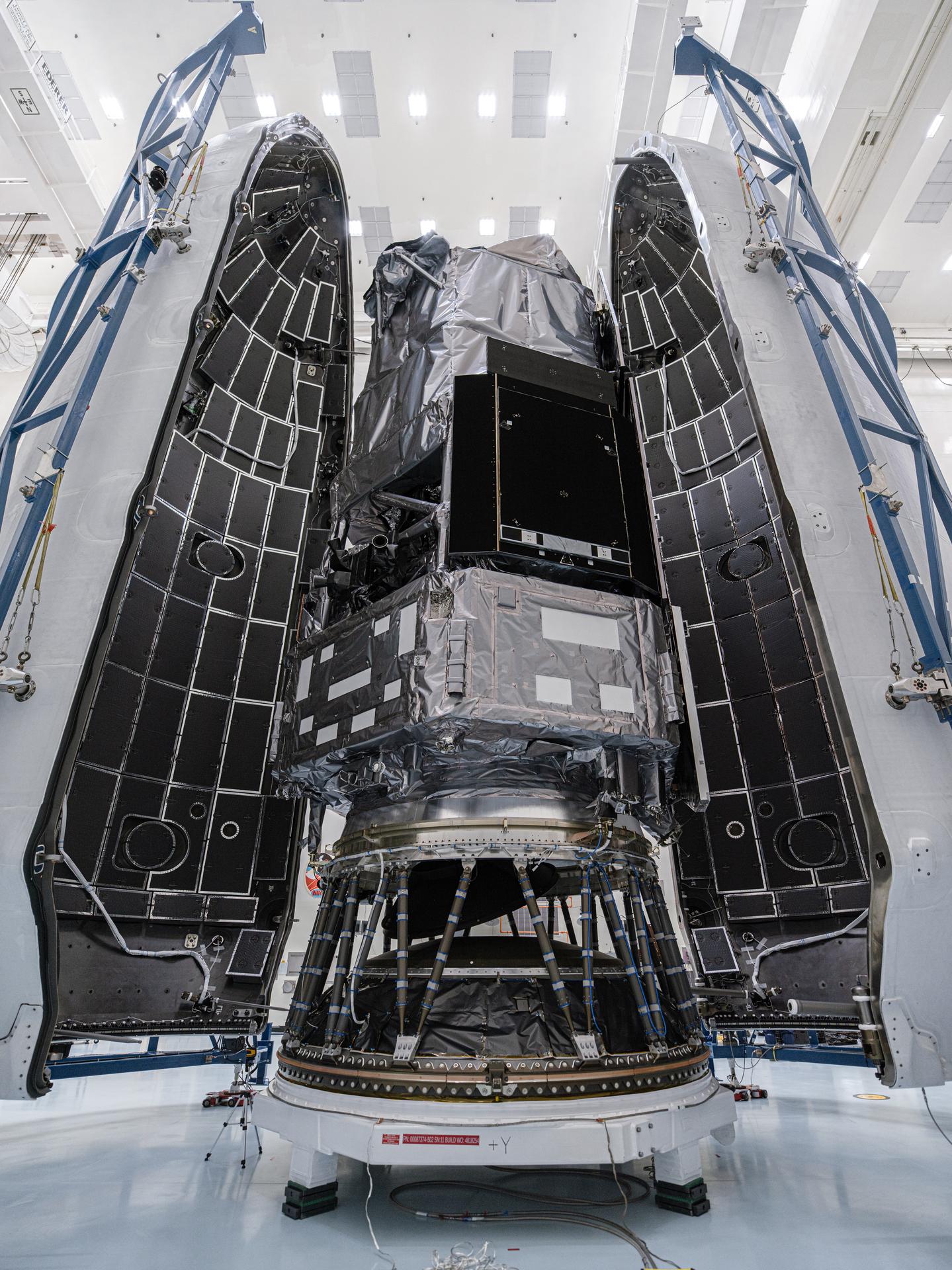
How do black holes at the center of galaxies form and grow over time? To answer this question, scientists need to detect and study supermassive black holes at great distances, which existed much earlier in the universe’s history. New research suggests NASA’s Nancy Grace Roman Space Telescope, which is on track to launch Aug. 30, 2026, will be able to detect these distant, ancient black holes that existed up to 11 billion years ago.

Artist's concept of a tidal disruption event
This artist’s concept portrays a Sun-like star being shredded by a supermassive black hole — a phenomenon known as a tidal disruption event. During these events, the region around a black hole can brighten and become visible across great distances. NASA’s Nancy Grace Roman Space Telescope will be able to spot and study tidal disruption events that occurred early in the universe’s history. By characterizing an earlier population of supermassive black holes, astronomers can learn about their origins.
NASA, Ralf Crawford (STScI)

Black holes are best studied by looking for the light emitted from their accretion disk — the matter that swirls around them before being consumed. Lighter supermassive black holes are challenging to observe because they tend to be less luminous due to less accretion. But occasionally, they shred and consume an entire star, brightening to outshine their entire host galaxy — known as a tidal disruption event (TDE). By characterizing that population of early supermassive black holes and how they evolve and grow for billions of years, Roman will provide clues to the ultimate origin of these behemoths.

“The Roman Space Telescope is going to be transformative for transient science,” said lead author Mitchell Karmen of the Johns Hopkins University, a graduate student and National Science Foundation Graduate Research Fellow. “Thanks to Roman’s high sensitivity, we can find multiple tidal disruption events out to greater distances and earlier cosmic times than ever before.”

A paper about this research published Tuesday in The Astrophysical Journal.

Shredding Stars

Roman’s High-Latitude Time-Doman Survey, one of three core community surveys, is particularly well suited to find and study TDEs in the early universe. This survey will cover about 18 square degrees on the sky, an area equivalent to 90 full moons, at a regular cadence. By revisiting the same regions repeatedly, astronomers can find large numbers of transient events like TDEs.

Tidal disruption events are phenomena unique to lighter supermassive black holes. Heftier black holes weighing more than 1 billion Suns will swallow incoming stars whole. But lighter black holes of about 100,000 to 100 million Suns can shred a star before consuming it, creating a beacon that brightens over a couple of weeks before gradually fading away.

The rate of TDEs fluctuates over cosmic time. Previous work predicted that the rate of TDEs would decrease with increasing distance because most young black holes were too light to generate a TDE. However, this new research takes into account numerous factors that evolve over time, like the frequency of galaxy (and hence black hole) mergers as well as the number of stars within the core of each galaxy and how closely packed they are.

Karmen and his colleagues modeled these and other effects to predict how many tidal disruption events Roman could observe, as well as other observatories like the ground-based National Science Foundation-Department of Energy Vera C. Rubin Observatory and NASA’s James Webb Space Telescope. The team forecasts that astronomers will see the rate of TDEs increase as Roman probes greater distances and earlier times until “cosmic noon,” about 11 to 12 billion years ago when star formation peaked throughout the universe, before decreasing again.

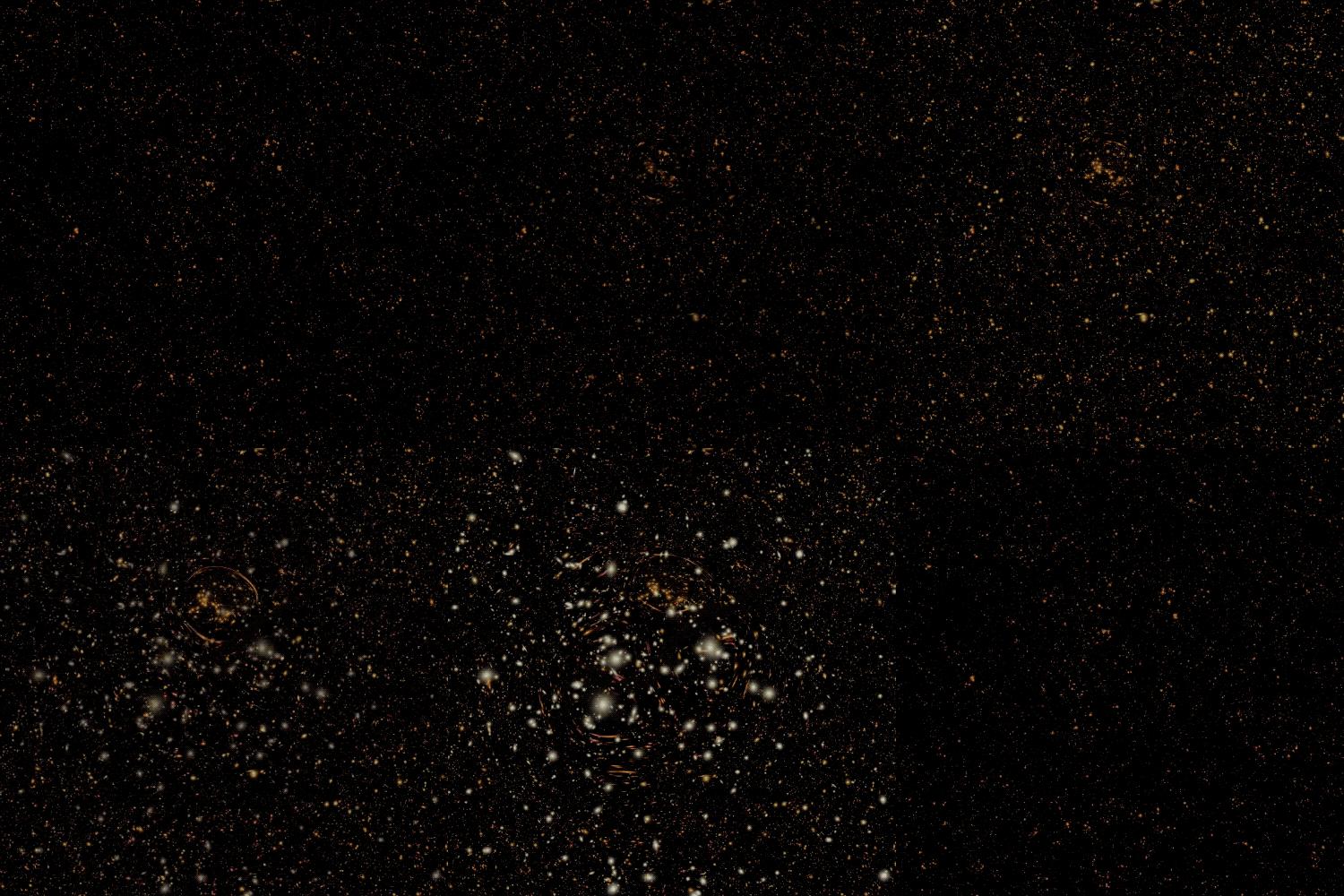
This visualization shows the average number of tidal disruption events NASA’s Nancy Grace Roman Space Telescope is predicted to detect in a year, based on simulations. Roman is expected to record about 100 such events in a year.
Video: NASA, STScI. Visualization: Christian Nieves (STScI). Sound: Christian Nieves (STScI). Designer: Dani Player (STScI). Animation: Greg Bacon (STScI)

Complementary Observations

Roman will observe near-infrared wavelengths of light. Light from distant TDEs becomes stretched to longer wavelengths by the expansion of the universe, a phenomenon known as cosmological redshift. As a result, Roman is inherently optimized to detect TDEs whose light traveled anywhere from 8 billion to 11 billion years to reach us.

The Rubin Observatory also will scan large swaths of the sky and pick up many new TDEs. However, it will observe visible light, which limits it to closer TDEs than Roman.

The research by Karmen’s team finds that Rubin will detect thousands to tens of thousands of TDEs per year. While Roman is expected to find up to 100 TDEs per year, those black holes will be much more distant, within the realm of cosmic history that is most important for distinguishing among black hole origin scenarios.

“Just by counting the number of TDEs as a function of redshift, you can put meaningful constraints on the population of million-solar-mass black holes,” said co-author Suvi Gezari, an associate professor of astronomy at the University of Maryland. “Roman will be transformative in that it can probe tidal disruption events out to greater distances, so you can look at how the rate of TDEs evolves over time.”

Origins of supermassive black holes

Astronomers have observed truly gargantuan black holes very early in the history of the universe — so early that theories struggle to explain how they could have become so large, so quickly. They must have started smaller and grown over time, but how much smaller?

One theory, known as “light seeds,” begins with black holes that are created from the deaths of massive stars. Such black holes might weigh up to a few hundred times our Sun. These black holes then would merge over time, as well as consume surrounding gas at an astonishing rate. In this scenario, every young galaxy would be expected to have a massive black hole at its center.

A second theory, known as “heavy seeds,” suggests that a black hole could be born with a much higher mass, up to a million times our Sun, through a process such as the direct collapse of a gas cloud. This process should be less common, though, which would result in supermassive black holes being much rarer in early galaxies.

“Tidal disruption events help us probe the population of light supermassive black holes, which can help us discriminate between these models,” Karmen said.

Ultimately, Roman’s tally of tidal disruption events will help researchers trace global effects that impact the black hole population over time.

Once Roman and Rubin begin regular science operations, the team looks forward to comparing their forecasts to the actual detections those observatories make.

“Just like Webb has transformed our understanding of distant, high-redshift galaxies, Roman is poised to transform our understanding of high-redshift transients,” Gezari said.

The Nancy Grace Roman Space Telescope is managed at NASA’s Goddard Space Flight Center in Greenbelt, Maryland, with participation by NASA’s Jet Propulsion Laboratory in Southern California; Caltech/IPAC in Pasadena, California; the Space Telescope Science Institute in Baltimore; and a science team comprising scientists from various research institutions. The primary industrial partners are BAE Systems, Inc. in Boulder, Colorado; L3Harris Technologies in Melbourne, Florida; and Teledyne Scientific & Imaging in Thousand Oaks, California.

By Christine Pulliam
Space Telescope Science Institute, Baltimore, Md.

Media Contact:

Claire Andreoli
NASA’s Goddard Space Flight Center, Greenbelt, Md.
301-286-1940

NASA’s Hubble Discovers First of Star Cluster’s Missing Black Holes

 
5 Min Read

NASA’s Hubble Discovers First of Star Cluster’s Missing Black Holes

An image of the globular cluster Omega Centauri, a collection of myriad stars colored red, white, and blue on the black background of space.
Credits:
Science: Maximilian Häberle (MPIA)

The massive globular star cluster Omega Centauri has puzzled astronomers for decades. It should be filled with black holes left behind by exploding stars, yet evidence for them is scarce. Now, astronomers using archival data from NASA’s Hubble Space Telescope and supportive observations from NASA’s James Webb Space Telescope have finally located their first stellar-mass black hole in this cluster. Discovering the first of this missing black hole population will help refine current theories on black hole formation within environments such as Omega Centauri. The team’s findings published Monday in The Astrophysical Journal Letters.

Omega Centauri is composed of 10 million gravitationally bound stars. Though the astronomical community previously found evidence with Hubble that an intermediate-mass black hole lurks at its center, models suggest this star cluster should also contain about 10,000 smaller, stellar-mass black holes. This notable population of black holes evaded detection in previous observational studies, which used the radial velocity method or looked for radio and X-ray emission from material falling onto black holes.

This new discovery features a different approach, known as astrometry, to measure very small movements of stars over time. By sifting through more than 20 years of Hubble archival data and pulling in recent Webb data to further refine their astrometric measurements, the team located a star orbiting an invisible object so hefty that it has to be a black hole. Dubbed oMEGACat BH-2, it is the first stellar-mass black hole detected in Omega Centauri, and it has some surprising qualities. oMEGACat BH-2 has a lower-than-expected mass and, with its visible star companion, the black hole-star duo has the longest orbital period of any black hole binary system known to date.

“With Hubble and Webb data, we were able to see the motion of the visible main sequence star that is part of this binary, which is about 18,000 light-years away in the dense environment of Omega Centauri,” said Matthew Whitaker of the University of Utah, Salt Lake City, lead author of the paper. “The precision of these measurements is incredible, down to a fraction of a pixel on Hubble and Webb’s detectors. It would not have been possible to find this black hole without these two space telescopes.”

A Hubble image of globular star cluster Omega Centauri, which looks like a dense field of stars. Some stars appear a bit larger and brighter than others; most appear blue, orange, or yellow. The colors appear uniformly distributed, like grains of sand. Stars toward the clusteru2019s center are packed closer together, creating a more luminous area at the globular clusteru2019s core. A small red square frame is superimposed on the cluster near the imageu2019s center. It connects to a square pullout in the top-right corner, which shows the outlined area in greater detail. Among the blue- and orange-colored stars is small blue-white dot highlighted by a small red circle.
Astronomers found Omega Centauri’s first stellar-mass black hole, which has a visible star companion that is shown in greater detail. They used 20-plus years of data from NASA’s Hubble Space Telescope and recent data from NASA’s James Webb Space Telescope to make the discovery.
Image: ESA, NASA, Maximilian Häberle (MPIA), Joseph DePasquale (STScI)

The team’s findings refine a past study by a different group of scientists that suggested this binary system included a neutron star. By expanding Hubble data from the earlier investigation with archival Hubble astrometric measurements from 2002 to 2023, and pulling in Webb near-infrared data to improve precision, the University of Utah-led team was able to better constrain the mass of the visible star’s dark companion, ruling out the neutron star possibility.

“While we already knew that the star was 0.78 solar masses, we can now calculate the black hole’s mass, which is 4.46 solar masses and therefore too heavy to be a neutron star. However, its mass is much lower than would be expected in a metal-poor environment like Omega Centauri. This is surprising and exciting,” said Anil Seth of the University of Utah, a coauthor of the study. “We now know that a metal-poor star is able to form a black hole like this, and we need to figure out how that happens. This detection is providing some data to those who do that kind of modeling.”

Long time coming

Based on the precise data from Hubble and Webb, the team could chart the star’s path over 20-plus years, during its closest approach to its black hole companion when it moved the fastest across the sky. From the extensive data, the team determined that the visible star orbits oMEGACat BH-2 once every 94 years, making it the longest-period black hole binary ever known.

Its long orbital period also gives a clue to the origin of this binary system. It was probably dynamically formed, meaning the star and its black hole companion did not start out together but rather found each other in this cluster. The researchers calculated that a system like oMEGACat BH-2 will survive for less than a billion years before it is torn apart by encounters with nearby stars, a much shorter span than the age of the cluster (approximately 12 billion years old).

“It’s important to understand black hole populations in globular clusters because there’s uncertainty about their physics and formation,” said Seth. “More specifically, understanding the process of forming black holes and then dynamically forming binaries is vital, because it affects our ability to interpret and understand gravitational wave events. Environments like Omega Centauri are the primary places where we think binaries are merging and creating these waves.”

The team’s discovery of stellar-mass black hole oMEGACat BH-2 with the Hubble-Webb dataset is just the start of finding these evasive black hole populations in globular star clusters.

“With Hubble and Webb, we can continue to look at Omega Centauri and expand our search for similar systems within other clusters,” said Whitaker. “We’re also very excited for the launch of NASA’s Nancy Grace Roman Space Telescope because it will image the crowded galactic bulge, including the galactic center, very regularly with Hubble-like resolution and with a much wider field of view. We’re hoping we’ll be able to find black hole binary systems like this one because of the regular cadence of Roman’s observations.”

The Hubble Space Telescope has been operating for over three decades and continues to make ground-breaking discoveries that shape our fundamental understanding of the universe. Hubble is a project of international cooperation between NASA and ESA (European Space Agency). NASA’s Goddard Space Flight Center in Greenbelt, Maryland, manages the telescope and mission operations. Lockheed Martin Space, based in Denver, also supports mission operations at Goddard. The Space Telescope Science Institute in Baltimore, which is operated by the Association of Universities for Research in Astronomy, conducts Hubble science operations for NASA.

Facebook logo
Instagram logo

Related Images & Videos

A Hubble image of globular star cluster Omega Centauri, which looks like a dense field of stars. Some stars appear a bit larger and brighter than others; most appear blue, orange, or yellow. The colors appear uniformly distributed, like grains of sand. Stars toward the clusteru2019s center are packed closer together, creating a more luminous area at the globular clusteru2019s core. A small red square frame is superimposed on the cluster near the imageu2019s center. It connects to a square pullout in the top-right corner, which shows the outlined area in greater detail. Among the blue- and orange-colored stars is small blue-white dot highlighted by a small red circle.

Omega Centauri Context Image

Astronomers found Omega Centauri’s first stellar-mass black hole, which has a visible star companion that is shown in greater detail. They used 20-plus years of data from NASA’s Hubble Space Telescope and recent data from NASA’s James Webb Space Telescope to make the discovery.

Graphic of a star and its orbital path around a black hole against a dark background. The star is represented by an orange-yellow circle, and an X is labeled u201cBlack Hole.u201d A purple oval represents the staru2019s orbital path, which surrounds the black hole. The star is positioned near 12 ou2019clock along its orbital path, represented by a solid purple line that traces the tracked portion of the staru2019s orbit. After 12 ou2019clock the orbital path is represented by purple dashes. In the bottom right corner is the year 2025 in white text.

Star Orbiting Black Hole Animation

The precise data collected by NASA’s Hubble and James Webb space telescopes enabled a team of astronomers to chart the visible star’s orbital path over a 20 year-plus period.


Share

Details

Last Updated
Jul 13, 2026
Editor
Andrea Gianopoulos
Contact
Media

Claire Andreoli
NASA’s Goddard Space Flight Center
Greenbelt, Maryland
claire.andreoli@nasa.gov

NASA’s Chandra Reveals ‘Red, White, Blue’ Universe for US 250th

7 Min Read

NASA’s Chandra Reveals ‘Red, White, Blue’ Universe for US 250th

This image shows the galaxy NGC 4736, also known as Messier 94 or M94. X-rays of different wavelengths from Chandra are included along with a striking visible light image from astrophotographers Brian Brennan and Remi Lacasse using their telescopes on the ground. M94 is a spiral galaxy with a bright inner ring around it where new stars are forming called a starburst ring, perhaps fueled by gas driven in from its unique bar-like oval structure. It also has a remarkable outer ring of spiral arms.

In celebration of the 250th birthday of the United States, NASA has unveiled four cosmic images from its Chandra X-ray Observatory rendered in red, white, and blue that represent the wonders of the universe the agency explores. The images are accompanied by a trio of new sonifications – a technique that translates astronomical data into sounds.

In celebration of the 250th birthday of the United States, NASA’s Chandra X-ray Observatory has unveiled four cosmic images rendered in red, white, and blue that represent the wonders of the universe that NASA explores.
NASA/CXC/SAO

The image set begins with Cassiopeia A in the top panel, where X-rays from Chandra (represented in blue and purple) have been combined with an infrared image from NASA’s James Webb Space Telescope (red and white). Chandra’s X-ray vision reveals the blast wave that tore through the star, as well as elements in the debris field like iron, calcium, and oxygen. Webb’s infrared data also shows the expanding shell of material from the explosion and cosmic dust throughout the remnant.

 In the bottom row, the first image on the left is the nebula NGC 3603, which contains a massive cluster of stars and is located in the Milky Way Galaxy. This new composite image contains Chandra’s X-ray data (red and white) and shows diffuse emissions near the galaxy’s center along with point-like X-ray sources throughout the middle of the image. Optical, infrared, and ultraviolet light from NASA’s Hubble Space Telescope (red-orange, green, blue, and yellow) reveal stars in the center of the image and dust and gas toward the bottom. The combined layering of the colors makes this nebula and the stars forming within it appear primarily red, white, and blue, with X-rays showing the sparkling lights of young stars.

The middle panel of the bottom row is a new look at the galaxy NGC 4736, also known as Messier 94. In this image, X-rays of different wavelengths from Chandra (red, orange, and blue) are layered with a visible light image from astrophotographers using their telescopes on the ground (red, green, and blue). Messier 94 is a spiral galaxy with a bright inner ring around it, called a starburst ring, where new stars are forming, perhaps fueled by gas driven in the unique oval-shaped structure seen here.

The final image in this red, white, and blue quartet features ZwCl 0024+1652. This is a distant galaxy cluster in which astronomers have found evidence for dark matter by using specially processed data from Hubble (blue). Another image from Hubble reveals the individual galaxies in the cluster (appearing as yellow and white). X-ray data from Chandra shows the enormous reservoir of superheated gas that pervades this galaxy cluster (red) with much more mass than all the galaxies taken together.

New sonifications of the three images along the bottom row of this mosaic are also available, allowing listeners to experience data through sound.

The translation of NGC 3603 into sound begins with a left to right scan, where the brightnesses of the sources once again dictate volume. Chandra’s observations of compact sources sprinkled throughout the galaxy are heard as piano notes, while the diffuse X-ray emission is mapped to a range of audio frequencies. The Hubble optical data is played as sustained tones and acoustic guitar harmonics.

In the sonification of NGC 4736, the radar-like scan moves clockwise, and the brightness of the sources dictates the volume of the sounds. X-rays from Chandra have been turned into wind-like sounds that follow the shape of the X-ray emission. Neutron stars and stellar-mass black holes (known as “compact sources”) detected by Chandra are mapped to pitched tones on a glass marimba. Optical data from ground-based observations is mapped to musically pitched tones, creating a low drone, while stars and background galaxies are heard as a soft piano.

For ZwCl 0024+1652, the sonification begins as a circle on the outside of the image and moves inward. The volume is linked to the brightness of the data, reaching one peak as the circle passes over the dark matter detected by inference from Hubble optical observations and another as it reaches the core. The background stars are heard as a swelling glockenspiel-like sound, and the galaxies are played on a piano. Chandra’s X-rays, which dominate the center of the galaxy cluster and reveal superheated gas, are represented by airy synthesizer notes.

The sonification program is led by the Chandra X-ray Center (CXC) and included as part of NASA’s Universe of Learning program. The collaboration was driven by visualization scientist Kimberly Arcand, (CXC), Matt Russo, astrophysicist; and Andrew Santaguida, musician, SYSTEM Sounds project; along with Christine Malec, consultant. Previously released sonifications of data from Cassiopeia A can be found at chandra.si.edu/sound.

NASA’s Marshall Space Flight Center in Huntsville, Alabama, manages the Chandra program. The Smithsonian Astrophysical Observatory’s Chandra X-ray Center controls science operations from Cambridge, Massachusetts, and flight operations from Burlington, Massachusetts.

To learn more about NASA’s Chandra mission, visit:

https://nasa.gov/chandra

Visual Description

In celebration of the 250th birthday of the United States, this release includes a series of images featuring four wonders of the universe, rendered in red, white, and blue. The images contain X-ray data from the Chandra X-ray Observatory, optical and infrared data from the Hubble Space Telescope and the James Webb Space Telescope, as well as ground-based telescopes.

The main image set features composite images of the four individual objects; Cassiopeia A, NGC 3603, M94/NGC 4736, and ZwCl 0024+1652.

Cassiopeia A occupies the top panel of the frame, significantly larger than the other images in the set. The cloudy blast-wave of the supernova remnant is ring-like in shape, streaked with veins of iron, calcium, and oxygen. Here, presented in red, white, and blue, the remnant resembles an electrified donut, crackling with marbled veins of strawberry and blueberry icing.

At our lower left of the image set is the nebula NCG 3603, which contains a massive cluster of stars on the other side of the Milky Way galaxy. Here, a tight cluster of neon red and white stars packs the center of the image, dissipating as it reaches the outer edges of the panel. Sweeping in at the lower corners of the image are hazy blue clouds resembling sheets of gauze.

Centered at the bottom of the image set is the galaxy NGC 4736, also known as Messier 94 (M94). Here, the spiral galaxy is seen face on, with concentric pale violet cloud rings flecked with scores of stars in white, pale blue, soft red, and golden yellow. The inner ring of the galaxy is bright, and rosy yellow in color. This is a starburst ring, where new stars are forming.

At our bottom right of the image set is the distant galaxy cluster ZwCl 0024+1652. The image is packed with streaks and specks in golden yellow and brilliant white. Upon close inspection, each streak and speck is revealed to be an individual galaxy, some with discernible spiral shapes. At the center of the image is a round pool of bright red light, surrounded by royal blue haze. The red light represents X-ray observations by Chandra, which reveal an enormous reservoir of superheated gas pervading the cluster. The blue haze represents specially-processed data from Hubble, suggesting evidence of dark matter.

This release also includes new sonifications of the three images presented in the bottom row of this data set, allowing listeners to experience the data through sound.

Read more from NASA’s Chandra X-ray Observatory

News Media Contact

Megan Watzke
Chandra X-ray Center
Cambridge, Mass.
617-496-7998
mwatzke@cfa.harvard.edu

Joel Wallace
Marshall Space Flight Center, Huntsville, Alabama
256-544-0034
joel.w.wallace@nasa.gov

Share

Details

Last Updated
Jun 30, 2026
Editor
Lee Mohon
Contact
Joel Wallace
Location
Marshall Space Flight Center
❌