In this week’s edition of the weekly recap, a withdrawal of nearly 4,000 BTC forced Liquid Network to suspend transactions before operators began a limited restart. The U.S. CLARITY Act faced fresh doubts ahead of a Sep. 15 Senate vote,…
U.S. spot Bitcoin ETFs have lost $462.7 million during the September 8–11 trading week, while Ethereum funds have gained $196.9 million and Solana funds have drawn a smaller $9.7 million inflow. Farside Investors’ Bitcoin ETF data shows that the funds…
Metaplanet has cut the potential shares tied to its Series 10 stock acquisition rights by 41.1%, reducing the pool from 319.46 million shares to 188.19 million while imposing new exercise restrictions through 2031. Metaplanet said in a Sept. 11 Tokyo…
Ripple’s stablecoin has grown 1,278% this year while XRP shed more than a quarter of its value. The network is busier than ever, but the token capturing that activity has a dollar sign and a peg. The numbers tell two…
BlackRock’s iShares Bitcoin Trust exchange-traded fund has delivered better returns since its 2024 launch than Vanguard’s popular S&P 500 fund.
That’s according to Bloomberg data highlighted by the firm’s senior ETF analyst, Eric Balchunas, who said that the BlackRock product’s cumulative percentage return was only slightly ahead of Vanguard’s in the time period.
BlackRock’s bitcoin ETF is up 71% since its January 2024 debut, while Vanguard’s S&P 500 ETF up 66% on a total-return basis.
Hard to believe $IBIT is beating $VOO since inception but it's true..altho it's close. And to be fair, IBIT's path to 70% looks like the El Toro roller coaster at Great Adventure (i needed two Advil last time I rode that thing) while $VOO was a walk in the park in comparison.… pic.twitter.com/vpOgI7JZKL
The iShares Bitcoin Trust — IBIT — started trading in 2024 after the Securities and Exchange Commission gave the green light to 11 spot bitcoin ETFs following a decade of denials.
“IBIT’s path to 70% looks like the El Toro roller coaster at Great Adventure (I needed two Advil last time I rode that thing) while $VOO was a walk in the park in comparison,” wrote Balchunas on Tuesday.
U.S. investors now have several funds to choose from to buy shares that track the price of bitcoin managed by the likes of Fidelity, Grayscale and Morgan Stanley. But BlackRock’s product is the most successful: It currently manages $61.4 billion in assets, according to its website.
By comparison, the second biggest bitcoin ETF, the Fidelity Wise Origin Bitcoin Fund, manages nearly $11 billion.
BlackRock, which manages over $15 trillion in assets, sent shockwaves through the crypto space after it applied for a spot bitcoin ETF in 2023. Its fund now allows more traditional investors to get exposure to bitcoin; its product also experiences more day-to-day trading action than the other ETFs.
Investors piled back into ETFs in August, which has also helped bitcoin’s price. From August 17 to 27, investors threw over $2.8 billion at the vehicles — the most since October, when the coin hit a new all-time high.
Bitcoin reached as high as $81,281 last week before sliding again on Friday.
Bitcoin’s roughly 50% decline from its October 2025 high has created a useful test for the institutional investment thesis. It is relatively easy to make the case for a new asset while prices are rising, correlations are favorable and capital is flowing into the market. The more revealing exercise comes after a major drawdown, when investors can revisit the original assumptions and determine which were structural and which were simply products of the preceding cycle.
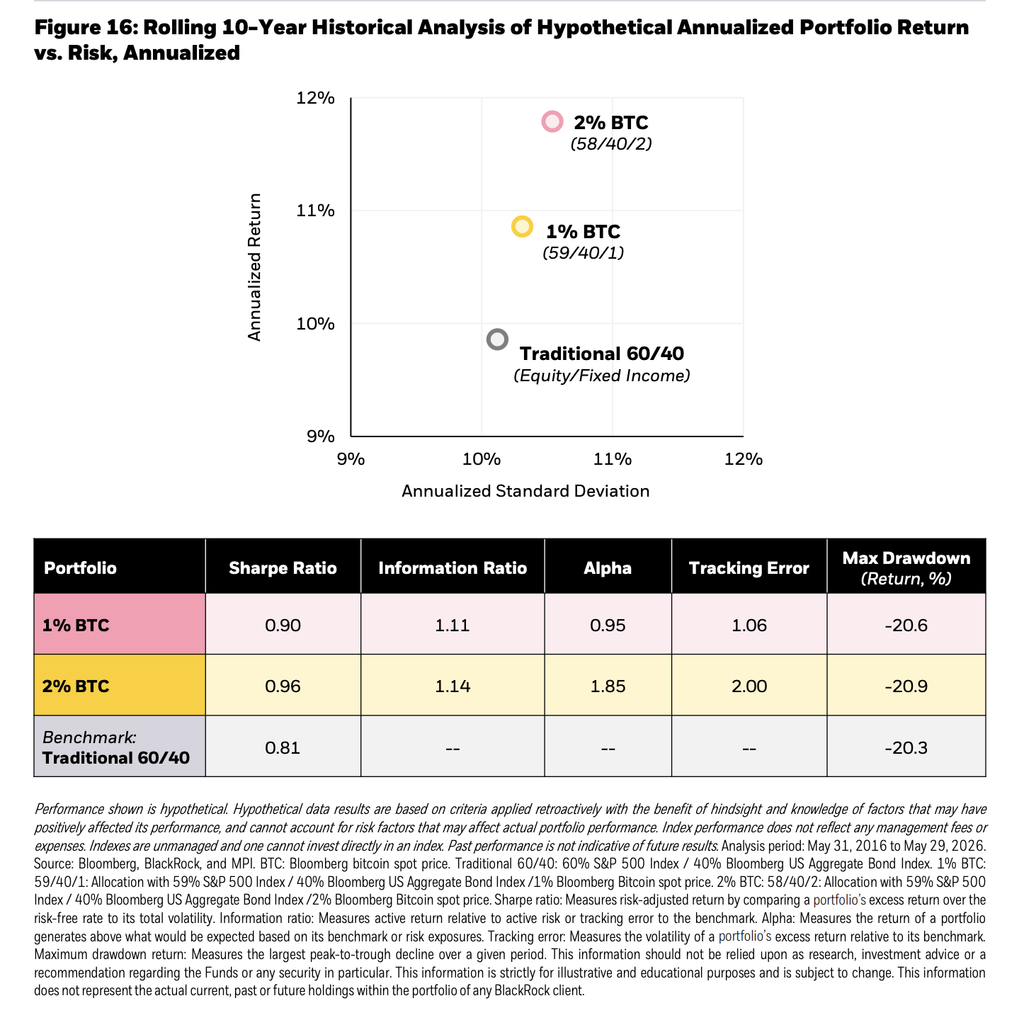
That is effectively what BlackRock has done in its latest research, Re-Underwriting Bitcoin: Still a Portfolio Diversifier. Rather than treating the recent drawdown as evidence for or against Bitcoin in isolation, the firm returns to the question most relevant to an allocator: how has Bitcoin actually affected the risk and return characteristics of a diversified portfolio?
The results are more consequential than the headline return figures suggest. In BlackRock’s rolling 10-year analysis through May 29, 2026, a traditional 60/40 equity and fixed-income portfolio generated an annualized return of approximately 9.9% with annualized standard deviation of roughly 10.1%. Introducing a 1% Bitcoin allocation increased annualized return to approximately 10.9%, while volatility moved only modestly higher to roughly 10.3%. At a 2% allocation, annualized return reached approximately 11.8%, with standard deviation of about 10.6%.
Put differently, the 2% allocation added roughly 190 basis points of annualized return relative to the traditional portfolio while increasing annualized volatility by approximately 50 basis points. The portfolio’s Sharpe ratio improved from 0.81 to 0.96, while maximum drawdown changed from -20.3% to -20.9%. Those figures are hypothetical and backward-looking, but they illustrate why judging Bitcoin primarily by its standalone volatility can produce an incomplete assessment of its portfolio impact.
The more relevant question is how that volatility interacts with everything else an investor already owns. BlackRock continues to characterize Bitcoin as having risk and return drivers that are fundamentally different from traditional assets, rooted in its fixed supply, decentralized structure and independence from any sovereign issuer. Those characteristics do not prevent Bitcoin from trading alongside risk assets during periods of deleveraging, but BlackRock’s research suggests those correlations have historically been episodic rather than permanent.
That distinction helps explain the portfolio results. A modest allocation does not import Bitcoin’s standalone volatility into a portfolio on a one-for-one basis. What matters is the marginal contribution of that allocation to total portfolio risk relative to the return it has historically generated. In BlackRock’s analysis, that trade-off remained favorable at 1% and 2%, even after incorporating one of Bitcoin’s most significant recent drawdowns.
Why 1–2% keeps appearing in BlackRock’s work
This is not the first time BlackRock has arrived at this range. Its earlier portfolio research approached Bitcoin sizing through risk contribution, concluding that a 1–2% allocation could represent a reasonable range for investors willing and able to accept Bitcoin’s risk. At those weights, BlackRock found that Bitcoin could contribute a similar share of overall portfolio risk as an individual mega-cap technology holding in a conventional 60/40 portfolio. Beyond 2%, however, Bitcoin’s contribution to total portfolio risk begins to increase disproportionately.
The new analysis approaches the same question from the opposite direction. Rather than asking how much risk Bitcoin contributes, it examines what investors historically received for assuming that additional risk. The improvement in Sharpe ratio from 0.81 for the traditional portfolio to 0.90 with 1% Bitcoin and 0.96 with 2% Bitcoin suggests that the incremental return historically more than compensated for the additional portfolio-level volatility.
This does not establish 1% or 2% as an optimal allocation, and BlackRock does not present it that way. The appropriate exposure will depend on liquidity requirements, investment horizon, governance constraints and risk tolerance. What the analysis does provide is a more rigorous framework for the discussion. The allocation question can increasingly be evaluated in terms of marginal risk, correlation, drawdown and portfolio efficiency rather than through a binary debate over whether Bitcoin itself is too volatile to own.
BlackRock has also seen the demand firsthand
There is another dimension to BlackRock’s latest analysis that is difficult to separate from the firm’s experience in the market.
BlackRock launched the iShares Bitcoin Trust, IBIT, in January 2024. Less than a year later, it had accumulated more than $50 billion in assets, making it what BlackRock itself has described as the largest exchange-traded product launch in history. It reached that milestone roughly five times faster than the previous record holder.
Its significance has only grown since then. BlackRock now describes IBIT as the world’s largest and most traded Bitcoin ETP, and the fund became the firm’s highest-revenue ETF in 2025 despite competing within a global BlackRock lineup of more than 1,000 products.
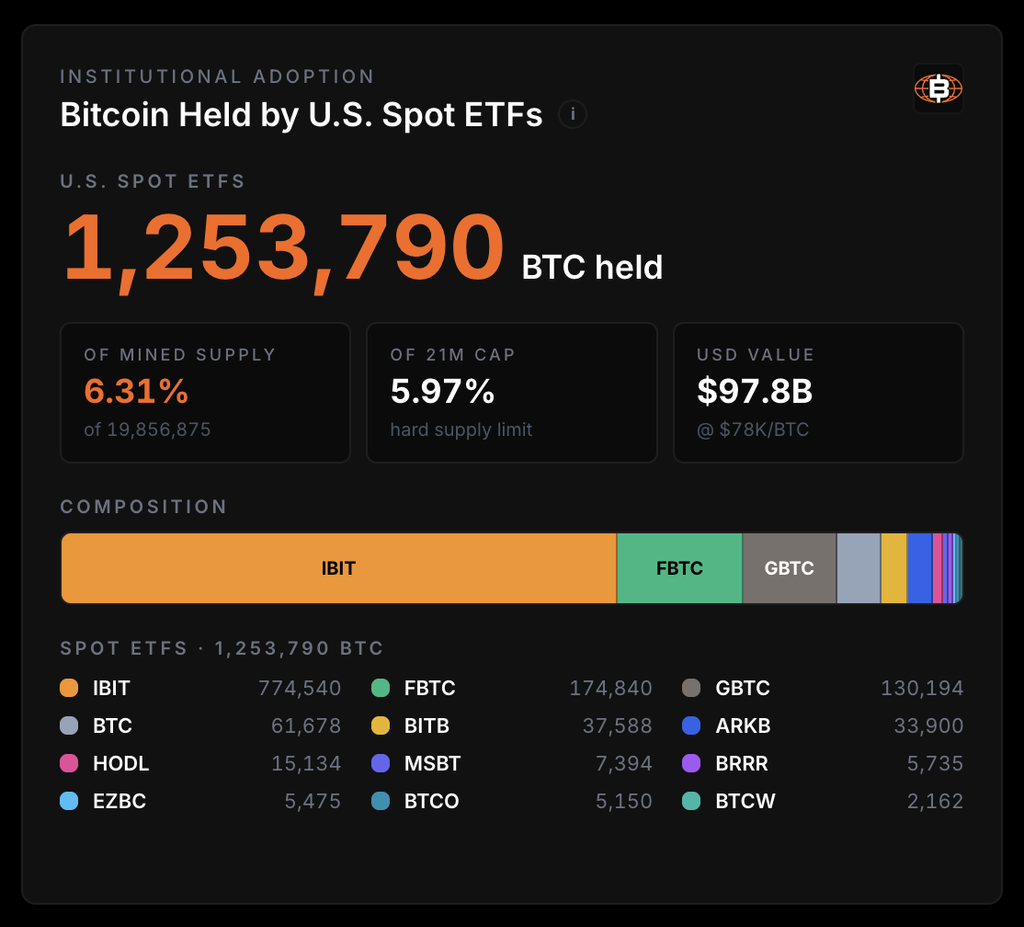
The concentration within the U.S. spot Bitcoin ETF market is equally notable. According to current ETF holdings data tracked by Bitcoin For Corporations, U.S. spot Bitcoin ETFs collectively hold approximately 1.25 million BTC, representing nearly 6% of Bitcoin’s fixed 21 million supply. IBIT alone accounts for roughly 775,000 BTC, or more than 60% of the Bitcoin held across the U.S. spot ETF complex.
That does not make BlackRock’s research independent of commercial context; IBIT is an important and increasingly valuable BlackRock product. That context should be understood rather than ignored. But it also means the firm’s reassessment is occurring alongside more than two years of observing how investors actually use Bitcoin exposure at scale.
The distinction is useful. The theoretical case for Bitcoin as a portfolio asset is increasingly being accompanied by observable allocation behavior. Investors have now had access to Bitcoin through familiar brokerage, advisory and institutional infrastructure across multiple market regimes, including periods of rapid appreciation and severe drawdowns. IBIT’s growth suggests that demand has persisted well beyond its initial launch window.
A drawdown is precisely when a thesis should be re-underwritten
The timing of BlackRock’s report may ultimately be more informative than the portfolio simulation itself.
Bitcoin is not being reassessed at an all-time high. BlackRock published the analysis after an approximately 50% drawdown from Bitcoin’s October 2025 peak, a period the firm associates with leveraged positioning being unwound, slowing ETP flows and weaker demand from companies accumulating Bitcoin. Its conclusion is that these forces represented a positioning correction rather than a fundamental change in Bitcoin’s investment case.
That is what re-underwriting is supposed to accomplish. An investment thesis should not survive because investors are attached to it; it should survive because its underlying assumptions continue to hold when conditions change.
For Bitcoin, those assumptions extend beyond historical returns. The asset remains scarce by design, globally liquid, independent of a sovereign issuer and structurally different from the liabilities that dominate traditional portfolios. BlackRock argues that concerns around fiscal sustainability, monetary stability and geopolitical risk may therefore become increasingly relevant to Bitcoin’s long-term adoption.
The portfolio evidence does not prove what Bitcoin will return over the next decade, nor does IBIT’s success establish what an appropriate allocation should be. What the two developments show together is that the institutional conversation has advanced considerably. Bitcoin is no longer being evaluated solely as an unconventional asset that institutions may or may not choose to own. It is increasingly being evaluated through the same disciplines applied elsewhere in capital allocation: sizing, risk contribution, correlation, liquidity, drawdown and expected return.
What this means for corporate leaders
For CFOs, boards and corporate operators, that evolution may be the most important takeaway from BlackRock’s work.
The relevant decision is not whether Bitcoin is volatile; that is already known. Nor does a corporate allocation need to resemble the concentrated Bitcoin strategies pursued by companies that have explicitly built their capital structures around the asset. Between zero exposure and a Bitcoin-centric balance sheet sits a much broader spectrum of possible allocations.
BlackRock’s research provides a useful framework for thinking about that spectrum. A relatively small allocation was sufficient to materially alter the historical return characteristics of a conventional portfolio without producing a comparable increase in portfolio-level risk. At 2%, approximately 190 basis points of additional annualized return came with roughly 50 basis points of additional annualized volatility in the period studied. The allocation was small; its effect was not.
For corporate leaders, the implication is less about adopting BlackRock’s specific allocation range than adopting the discipline behind the analysis. Bitcoin can be underwritten like any other strategic allocation: define its purpose, determine an acceptable risk contribution, establish liquidity and governance requirements, size the position accordingly and periodically revisit the assumptions.
That is a considerably more mature question than whether a company should simply “buy Bitcoin.”
BlackRock has now re-underwritten that question after another full market cycle and a roughly 50% drawdown. Its historical portfolio math still makes the case that, in measured amounts, Bitcoin can improve the equation. For corporate decision-makers, that is the takeaway worth bringing into the boardroom.
Disclaimer: This content was prepared on behalf of Bitcoin For Corporations for informational purposes only. It reflects the author’s own analysis and opinion and should not be relied upon as investment advice. Nothing in this article constitutes an offer, invitation, or solicitation to purchase, sell, or subscribe for any security or financial product.
Bitcoin is out of its bear market. But expect a possible pullback.
That’s according to analysts at crypto research firm CryptoQuant, who say the coin is behaving like it has done in the past. CryptoQuant founder, Ki Young Ju, wrote on X Tuesday that the asset had “entered into the early bull phase.”
Ju Pointed to movements bitcoin made in its last cycle before entering a bull market, and said the coin was currently doing the same thing.
JUST IN: Bitcoin is currently having its 3rd best August EVER, currently up 25% this month pic.twitter.com/q45AHHpK4e
CryptoQuant research shows that bitcoin flows to derivative exchanges have started again, confirming that traders have entered “risk-on” mode, which “has marked the start of a new bull cycle” in the past.
And another analyst at the firm, Theophiluspep, wrote that while the coin was entering a bull market, “spot demand, ETF flows, and market momentum have turned decisively bullish, but elevated profit-taking, exchange inflows, and overbought conditions suggest a potential near-term cooldown.”
He added: “This looks increasingly like a genuine regime shift into the early phase of a new bull market, driven more by improving spot demand and institutional ETF buying than by excessive leverage.”
Bitcoin started surging last week. It is currently up 22% over a seven-day period and was recently priced at $78,716. It briefly touched $81,160 on Monday.
Its rise comes after a sluggish June and July when it mostly traded below $65,000.
U.S. investors last week reversed course and bought up shares in the bitcoin exchange-traded funds, which had their best week since October — the same time bitcoin notched its record of $126,080.
Data from Farside Investors shows that the funds — managed by the likes of BlackRock, Fidelity, Grayscale, and Morgan Stanley — received $1.9 billion in new cash.
The change in sentiment comes after the Treasury Department’s announcement last week to at least double the size of its long-dated bond buybacks.
Since the Treasury made the announcement, yields have gone down, while bitcoin and gold have shot up. The dollar last week was trading at a three-month low and on track for its worst week of August. Bitcoin, on the other hand, had its best week since 2023.
Positive regulatory news coming out of the White House also helped: President Donald Trump held a meeting with crypto executives earlier last week, and urged lawmakers to get the Clarity Act over the line.
Bitcoin is no longer oversold but there’s still time to buy, according to Fairlead Strategies’ Katie Stockton.
Speaking on Tuesday to CNBC, the financial research firm’s managing partner said that Bitcoin cleared its 200-day moving average back in May, meaning that a potential breakout could be coming.
Bitcoin started rallying last week on news that the Treasury would at least double the size of its liquidity-support buyback operations. It’s up over 22% over a seven-day period, and was recently trading for $78,915. The coin traded above $81,000 on Monday.
JUST IN: Fairlead Strategies founder tells CNBC Bitcoin is "not over bought yet, so that's the good thing."
"We're looking for more upside from gold…maybe it won't be quite as long lived as what we expect from Bitcoin" pic.twitter.com/lXly8WRO3Y
“It’s not overbought yet, so that’s the good thing,” said Stockton.
“Whenever you see a breakout above a resistance level, it’s always better to have that immediate follow-through to essentially confirm the breakout.”
Bitcoin was trading under $65,000 for most of June and July and experiencing its lowest volatility in its 17-year history.
Its recent rally has some analysts saying that the so-called debasement trade could be hot again. The debasement trade is when investors buy assets when they think fiat money is losing value.
And losing value it is: The dollar slid following the Treasury’s announcement last week. Gold and bitcoin have since rallied.
Bitcoiners have long argued that the biggest cryptocurrency can work as a hedge against government printing, along with precious metals.
U.S. investors last week piled back into Bitcoin exchange-traded funds; the investment vehicles had their best week since October, with nearly $2 billion in inflows.
Bitcoin’s price was also helped after President Trump last week gathered with crypto executives at the White House and said that getting the Clarity Act over the line would keep the U.S. ahead of China.
Lawmakers were hoping to get a vote on the crypto market structure bill, or Clarity Act, in August. A vote will now go ahead in September. The bill will establish a framework for distinguishing between digital assets that are securities, commodities or payment stablecoins.
Bitcoin has been sitting still recently, and the coin’s volatility is now lower than 98.5% of all days in its 17-year history, according to asset manager Fidelity.
Writing on X, the firm’s digital asset arm said that spot trading volume was also at its lowest level since 2019.
Bitcoin’s price is virtually unmoved over a 30-day period, with some analysts saying the bottom is likely in. The coin was recently trading for $65,329, nearly 50% lower than the all-time high it notched in October 2025.
Update: BTC volatility is now lower than ~98.5% of all days in its history.
Meanwhile, spot trading volume has fallen to its lowest level since 2019.
Think of it like a coiled spring: The longer volatility remains compressed, the greater the potential for a meaningful move… https://t.co/8ZXosxXFd5
“Think of it like a coiled spring: The longer volatility remains compressed, the greater the potential for a meaningful move once it breaks,” Fidelity Digital Assets wrote.
The asset manager pointed to a post from earlier this month, where it noted that while volatility was down, such “periods of compression don’t tend to last forever.”
Investment manager VanEck on Tuesday said that bitcoin’s thirty-day realized volatility had fallen to 27.2% annualized, down from 30.4% the prior month and less than half bitcoin’s long-run average of roughly 80%.
It added that based on the length of prior cycles, the firm sees a bottom potentially forming anywhere between September and November of this year.
Bitcoin’s wild price swings have dampened — and 2025 was the least volatile year for Bitcoin, according to a K33 Research report from December.
The firm predicted that 2026 would see the biggest and oldest digital asset beat both gold and equities in terms of gains.
Following the approval of spot Bitcoin exchange-traded funds in 2024, bitcoin has become available to a whole new class of investors.
Now, more cautious retail investors — previously put off by cold storage — can buy the asset via brokerage accounts.
Institutional investors like sovereign wealth funds and banks are also able to buy bitcoin exposure via the ETFs.
As bitcoin’s market cap has grown, the asset’s volatility has come down significantly, and now experienced less wild price swings than in the past.
So far, bitcoin’s bear market is the shallowest it’s had in its 16-year history.
Bitcoin is deep into its bear market, though it’s doing something it doesn’t typically do: sit still.
That’s according to a new report by VanEck, which noted that thirty-day realized volatility has fallen to 27.2% annualized, down from 30.4% the prior month and less than half bitcoin’s long-run average of roughly 80%.
For an asset known for double-digit daily swings, that’s an unusually still market.
The calm comes as bitcoin claws back from a June low near $58,500, holding inside a tight $62,265-to-$66,509 band through most of July.
— matthew sigel, recovering CFA (@matthew_sigel) August 18, 2026
Bitcoin remains about 9% below its 200-day moving average — a narrower gap than the 14% discount seen a month ago — and still sits roughly 49% below its all-time high.
Trading activity tells a similar story of a market on pause. Spot volume over the trailing 30 days is down 27% from the prior month, landing in just the 10th percentile of its own history, VanEck noted.
Analysts at investment firm note the summer slowdown is deeper than in either 2024 or 2025, pushing spot volumes down toward levels last seen in the 2023 bear market.
At the same time, longtime holders have started letting go of coins, VanEck said. Bitcoin held for more than a year fell by about 356,000 BTC (-2.9%) over the month, pushing the long-term holder share of total supply below 60% for the first time in months.
The selling was concentrated in coins held one to three years, while the oldest holders — those sitting on coins for more than a decade — barely moved, down just 0.1%.
Coming into a period historically associated with bitcoin’s four-year boom-and-bust cycle, VanEck’s research points to 8 of 12 tracked capitulation signals currently flashing, consistent with the later stages of a drawdown.
Based on the length of prior cycles, the firm sees a bottom potentially forming anywhere between September and November of this year — though it cautions that the historical record of returns following similar signal clusters is mixed, and only shows a clear edge over a full one-year horizon.
For now, bitcoin’s story is less about direction and more about the unusual stillness of a market that, by its own history, rarely stays this quiet for long.
Bitcoin’s price is down nearly 50% since its October record. But investors shouldn’t worry, the world’s largest asset manager has said, and the cryptocurrency still plays a role as “a global monetary alternative.”
In a report Monday, Robert Mitchnick, global head of digital assets at the firm, said that the ongoing rise in U.S. and global government debt and deficits hasn’t slowed.
BlackRock has argued alongside other Bitcoin proponents that the oldest and biggest cryptocurrency can be a hedge against governments printing money.
JUST IN: $15 trillion BlackRock reports they're still bullish on Bitcoin despite the -50% decline from its all time high
"bitcoin’s core investment case as an important emerging global monetary alternative and unique portfolio diversifier remains unchanged." pic.twitter.com/lL2tWQ6iZr
Noting that there was seemingly no way governments could not debase their currencies, the report added: “With no credible path for consolidation on the horizon, these fiscal dynamics reinforce the strategic case for assets with supply constraints beyond the discretion of central banks, governed by geology in the case of gold and mathematics and code in the case of bitcoin.”
The Wall Street titan added that bitcoin’s price has consistently been volatile during its 17-year history, but investors shouldn’t be put off.
“And while bitcoin remains inherently volatile, its volatility has trended lower over the past decade as market structure has matured, supported by the growth of derivatives markets and the expansion of and exchange-traded products,” the report noted.
The report continued by saying that the asset still deserves a spot in investors’ portfolios for uncorrelated returns.
Wall Street’s top regulator, the SEC, approved BlackRock’s iShares Bitcoin Trust in January 2024.
Of all the Bitcoin ETFs, BlackRock’s product has been the most successful, attracting the most investment and trading volume.
BlackRock has previously said that Bitcoin is in an asset class of its own, and that investors are buying it to hedge against any potential debt crises.
Bitcoin’s price recently stood at $64,713, up by nearly 2% over the past day but flat over a 30-day period. Year-to-date, the asset is down 27% and has shed nearly half of its value since its all-time high last year of $126,080.
Quantitative trading firm and liquidity provider Jane Street has a nearly $1 billion bitcoin position — or 15,394 BTC at today’s prices.
But the position is not held in the form of digital coins: According to a regulatory filing with the Securities and Exchange Commission, the Wall Street giant holds $990 million in Bitcoin exchange-traded funds, spread across major ETFs like BlackRock’s iShares Bitcoin Trust, Fidelity’s Wise Origin Bitcoin Fund, and Grayscale’s Bitcoin Trust.
The lion’s share of the firm’s holdings are in BlackRock’s fund, with $828 million solely invested in the fund, according to the filing.
JUST IN: Wall Street giant Jane Street dropped a bombshell SEC filing:
BlackRock’s fund is the biggest and most popular of the spot Bitcoin ETFs, which were approved and started trading at the beginning of 2024. The fund has received more cash than any other crypto ETF and currently has $47.3 billion in assets under management.
Major firms have been able to buy exposure to the asset via shares of the regulated vehicles that trade on stock exchanges.
Pension funds and U.S. states have all bought exposure to Bitcoin via the ETFs, along with more traditional investments like tech stocks and other U.S. equities.
Jane Street on Monday posted its first losing month in about a decade, revealing roughly $15 billion in July losses.
The loss was driven mainly by its stake in AI-focused hedge fund Situational Awareness, which stumbled badly amid AI bet losses and margin calls, and by bad bets in Asian equity markets.
Despite the loss, Jane Street has made over $40 billion in net trading revenue year-to-date, according to Bloomberg. That’s already more than all of 2025, when it set a Wall Street record with $39.6 billion, beating Goldman Sachs and JPMorgan.
Wall Street titans Edelman Financial and Tudor Investment Corporation last week also revealed significant Bitcoin positions, along with Abu Dhabi’s sovereign wealth funds.
American investors have reversed course, cashing out of spot Bitcoin exchange-traded funds after a hot run at the beginning of August.
Data from Farside Investors shows that investors pulled over $385 million from the U.S. funds last week. The week before, the funds had received fresh cash every day, bringing in more than $865 million in investment — their biggest inflows since April.
The turn in sentiment comes as the price of the biggest cryptocurrency remains flat: Bitcoin was recently trading for $64,066, unmoved over the past week and last 30 days.
Investors initially seemed unfazed by the huge Coldcard hack on July 31, when cybercriminals stole over $115 in Bitcoin after discovering a vulnerability in the popular product’s software.
Bitcoin investors also shrugged off a delay in a vote on the long-awaited crypto Clarity Act, continuing to buy into the funds despite negative regulatory news.
But things last week changed, with investors pulling cash out of the major investment vehicles as tensions in the Middle East started to escalate again.
BlackRock’s iShares Bitcoin Trust and Fidelity’s Wise Origin Bitcoin Fund experienced the biggest outflows last week, while Morgan Stanley’s fund, which debuted in April, received net inflows.
Current macroeconomic headwinds, such as the U.S. war with Iran and rising oil prices, could see inflation go up again. The price of Bitcoin has typically done well on news that inflation is cooling because investors expect interest rates to come down.
Bitcoin — along with stocks — has experienced price bumps when President Trump has hinted that a deal with Iran was imminent, but the current war appears to have no end in sight.
While the price of Bitcoin has been relatively stable — it hasn’t budged over the past month — a July report from NYDIG said that the asset’s year-to-date performance makes it the worst-performing asset, losing out against U.S. treasuries, silver, and currencies like the Swiss Franc.
It added that if Bitcoin’s price action were to match other drawdowns — like the bear market of 2022 — a “potential cycle low near $38k-$39k” was possible.
Bitcoin is the most important asset in two of Abu Dhabi sovereign wealth funds, according to regulatory filings.
Abu Dhabi’s Mubadala Investment Company disclosed Friday that it held a $490 million stake in BlackRock’s iShares Bitcoin Trust — the second-largest single holding across its entire 13F portfolio.
And a Thursday filing from the Abu Dhabi Investment Council, another state-run fund, revealed a $273.6 million position in the popular Bitcoin exchange-traded fund. The stake is the biggest position in its portfolio.
JUST IN: UAE sovereign wealth funds Mubadala and Abu Dhabi Investment Council report owning a combined $763.7 million of BlackRocks Bitcoin ETF pic.twitter.com/OOnptHhlTA
Both wealth funds’ position in Bitcoin is unchanged since last quarter.
Earlier this year, blockchain analytics firm Arkham Intelligence attributed approximately 6,782 Bitcoins — worth roughly $453.6 million at the time of its analysis — to wallets connected to Bitcoin mining activity linked to the UAE’s Royal Group.
The findings highlight a distinction between how the UAE has built its bitcoin position compared with other governments known to hold large amounts of the asset. Countries such as the United States hold substantial Bitcoin reserves that largely originated from law enforcement seizures.
The UAE’s holdings, by contrast, stem primarily from domestic mining activity rather than confiscated assets.
Since the SEC approved a slew of Bitcoin funds in January 2024, major firms have been able to buy exposure to the asset via shares of the regulated vehicles that trade on stock exchanges.
BlackRock’s IBIT is the most successful crypto ETF: The fund has received more cash than any other crypto ETF and currently has $47.3 billion in assets under management.
Pension funds and U.S. states have all bought exposure to Bitcoin via the ETFs, along with more traditional investments like tech stocks and other U.S. equities.
Switzerland’s largest bank has upped its exposure to Bitcoin, according to regulatory filings.
UBS bought more shares in BlackRock’s iShares Bitcoin Trust, bringing its total position to over $83 million across 2.5 million shares, according to a filing with the U.S. Securities and Exchange Commission.
The bank has slowly upped its exposure to the biggest cryptocurrency by market cap since BlackRock’s top fund got approved back in 2024.
JUST IN: Switzerland's largest bank UBS discloses owning $83.2 million of BlackRock's Bitcoin ETF pic.twitter.com/Nq9AU4GwdX
The filings are the latest examples of traditional institutions seeking exposure to Bitcoin. ETFs like BlackRock’s Bitcoin Trust — which trades as IBIT — allow investors to buy exposure to the leading cryptocurrency without having to store the digital coin directly.
Since the SEC approved a slew of Bitcoin funds in January 2024, major firms have been able to buy exposure to the asset via shares of the regulated vehicles that trade on stock exchanges.
BlackRock’s IBIT is the most successful crypto ETF: The fund has received more cash than any other crypto ETF and currently has $47.3 billion in assets under management.
Pension funds and U.S. states have all bought exposure to Bitcoin via the ETFs, along with more traditional investments like tech stocks and other U.S. equities.
The shares in IBIT aren’t the only Bitcoin investment UBS has, either: the filing shows that the bank also has exposure to other premium income and other Bitcoin-related ETFs, bringing its ETF holdings in the cryptocurrency to around $90 million.
The bank also has invested in American Bitcoin Corp., the Bitcoin mining company backed by U.S. President Donald Trump’s sons, Eric and Donald, Jr., with a position worth a little under $1.5 million.
News dropped earlier this year that the Swiss bank was planning to offer Bitcoin trading to a select group of private clients in the country.
Spain’s largest bank, Banco Santander, has revealed a $4.3 million investment in Bitcoin.
According to a Securities and Exchange Commission filing, the Madrid-based bank bought the exposure via BlackRock’s iShares Bitcoin Trust — a total of 129,615 shares.
The filing is the latest example of a traditional institution seeking exposure to the biggest cryptocurrency by market cap.
JUST IN: Spain's largest bank, Banco Santander, reports owning $4.3 million in spot Bitcoin ETFs pic.twitter.com/HfbuaTc3Fh
Over the past year, Santander’s digital bank, Openbank, has allowed customers to buy Bitcoin and other cryptocurrencies and began a more friendly approach to marketing digital assets to customers.
BlackRock’s Bitcoin Trust (IBIT) allows investors to buy exposure to Bitcoin without having to own and store the digital coin directly.
The shares trade on a stock exchange and can be bought quickly and easily via a brokerage account.
BlackRock’s IBIT is the most successful crypto ETF: The fund has received more inflows than any other crypto ETF, currently holding $46.9 billion in assets under management, according to its website.
Other major institutions have bought exposure to Bitcoin via the ETFs after their 2024 approval. A large number of investors were previously put off by having to deal with things like storage and private keys but once the SEC approved a slew of ETFs in 2024, new capital entered the space.
The crypto ETF market is already a crowded one, with popular products by top asset managers BlackRock, Fidelity, and bank Morgan Stanley already on the market.
U.S. Bitcoin funds currently manage over $83 billion in assets, according to CoinGlass data.

 Login
Login









 Update: BTC volatility is now lower than ~98.5% of all days in its history.





 UAE sovereign wealth funds Mubadala and Abu Dhabi Investment Council report owning a combined $763.7 million of BlackRocks Bitcoin ETF
 Switzerland's largest bank UBS discloses owning $83.2 million of BlackRock's Bitcoin ETF
 Spain's largest bank, Banco Santander, reports owning $4.3 million in spot Bitcoin ETFs