❌

Reading view

There are new articles available, click to refresh the page.

Fast-growing AI startup Nscale doubles Bellevue office footprint to 46K square feet

AI infrastructure startup Nscale is doubling down on its new Seattle-area presence before even opening the doors.

After initially leasing a single floor at The Eight tower in downtown Bellevue earlier this year, the London-based company has expanded by an additional floor, bringing its total footprint in the new development to approximately 46,000 rentable square feet, according to a report from The Broderick Group.

The expansion signals an aggressive ramp-up for Nscale’s primary U.S. engineering hub, slated to open in January 2027. While the initial 24,000-square-foot lease was pegged to accommodate up to 250 employees, the added space gives the fast-growing cloud provider room to scale its local team even further beyond its current 50 Seattle-area workers.

Founded in 2024, Nscale is riding a massive wave of capital and growth.

It raised a $2 billion Series C round at a $14.6 billion valuation earlier this year, backed by Nvidia, Dell, Citadel, Jane Street, and Point72, alongside a $900 million credit line.

The company also earlier this year hired Nidhi Chappell, the former Microsoft corporate vice president who led Azure AI and high-performance computing infrastructure, including the supercomputers that power ChatGPT. As Nscale’s new president of AI infrastructure, based in the Seattle area, Chappell will oversee the company’s global engineering and data center operations.

“I’ve had a front-row seat to some of the biggest moments in AI over the past several years, but one thing has always stood out: the world remembers the breakthroughs, but it’s the people building the infrastructure behind the scenes who make them possible,” Chappell wrote in a LinkedIn post earlier this year announcing the company’s first “onboarding” event in Seattle.

Nscale’s new office is set to open in January, with the second floor slated to open in June, reports The Puget Sound Business Journal.

The company’s growth underscores Bellevue’s growing magnetism for out-of-town AI players. The company joins a dense ecosystem of AI infrastructure and application hubs establishing outposts on the Eastside, including xAI, OpenAI, Databricks, CoreWeave, Armada, and Anduril.

Report: Downtown Seattle lost 13,000 jobs in a year, while Bellevue’s tech hub boomed

A display at the Downtown Seattle Association’s annual event. (GeekWire Photo / Lisa Stiffler)

Seattle’s economic engine is stalling, and downtown is taking the brunt of the hit.

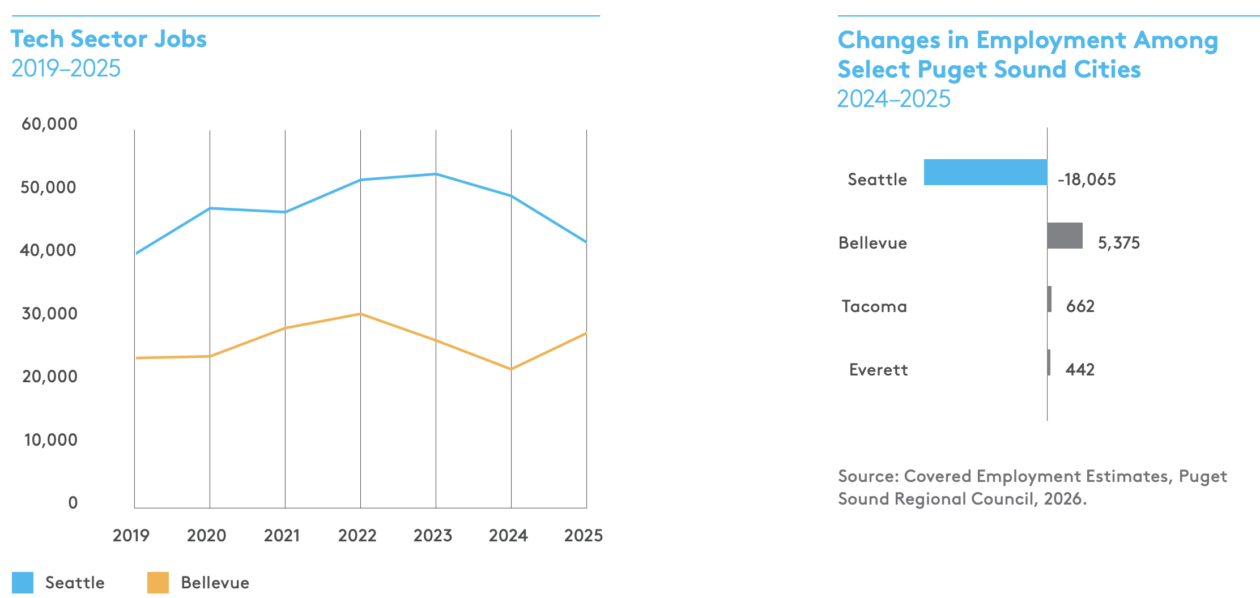
Between 2024 and 2025, Seattle shed 18,065 total jobs, with a staggering 70% of those losses—13,000 jobs—coming directly from the city’s downtown core, according to a new report released by the Downtown Seattle Association.

In some ways, it’s a tale of two cities.

While Seattle proper shrank, neighboring Eastside tech hub Bellevue gained 5,375 jobs over the same timeframe, highlighting a shifting center of gravity within the Puget Sound region.

A lot of that growth in Bellevue, and decline in Seattle is coming from one company: Amazon.

The online retail and cloud computing powerhouse employed 15,700 workers in Bellevue at the end of 2025, making it the largest employer in Bellevue at 9.85% of the total workforce, according to the city’s Annual Comprehensive Financial Report. That’s up from just a few hundred employees in Bellevue nearly a decade ago.

Amazon employs about 49,000 people in Seattle proper, though the Puget Sound Business Journal noted this week that the company has shed office space in downtown Seattle and dramatically slowed employment in the city.

A major shift is happening in tech employment as Bellevue’s tech employment grows, while Seattle’s shrinks. (Graphic via the DSA)

Other key findings from the Downtown Seattle Association report:

  • Tech Leads the Drop: Seattle’s sharpest sector declines were concentrated in Information and Technology, Professional Services, and Construction.
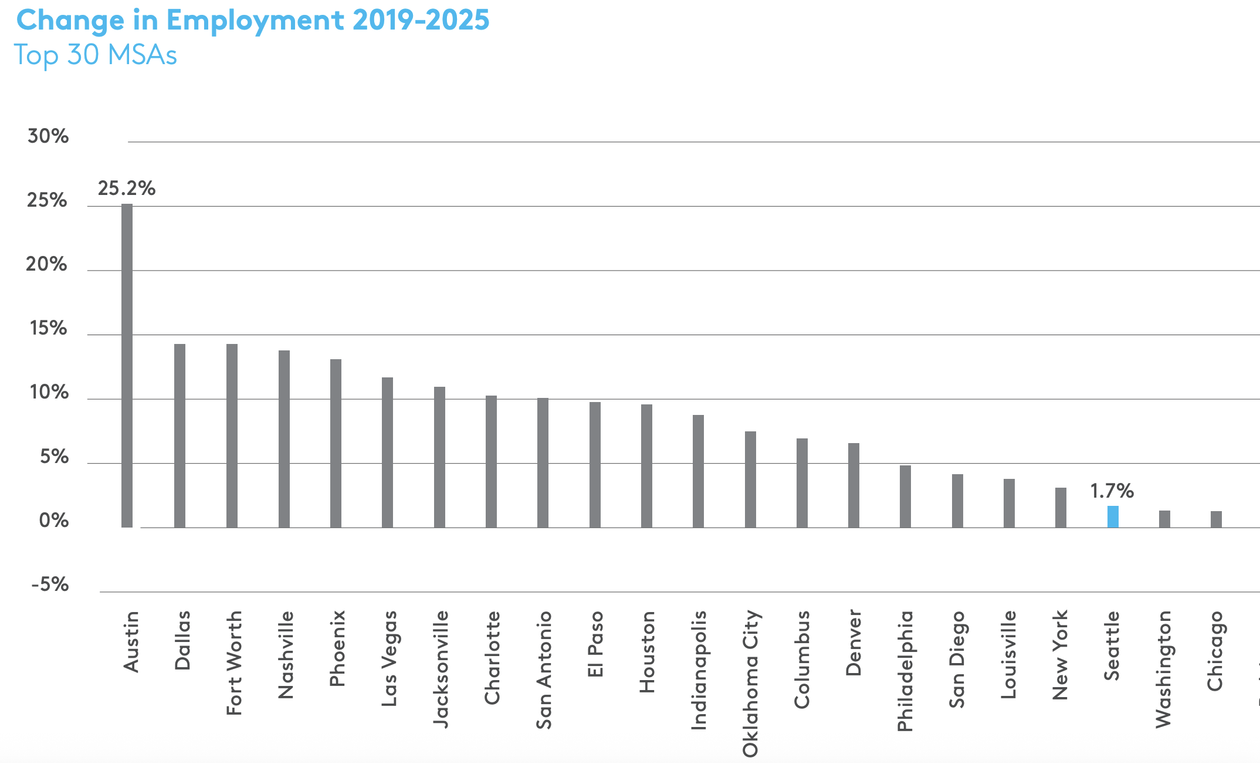
  • National Lag: Out of the top 30 U.S. metropolitan statistical areas, the Puget Sound region ranked 20th in job growth between 2019 and 2025. Total regional nonfarm growth rose just 1.7% over six years, vastly underperforming peer markets like Austin (25.2%), Dallas/Fort Worth (14%), and Nashville (14%).
  • Stagnant Commuter Foot Traffic: Inbound commuter visits to downtown Seattle remain stuck in the low 60% range compared to 2019 baselines, sliding 38% since the pandemic — a steeper loss than Bellevue (-21%), Austin (-23%), or Chicago (-32%).
  • Intra-Region Tech Shift: While Seattle’s tech headcount dropped from its 2023 peak, Bellevue’s tech job totals surged upward between 2024 and 2025, regaining momentum.
A new report shows weakness in Seattle’s economic growth from 2019 to 2025. (Graphic via the DSA)

The latest findings build on a growing chorus of criticism regarding the city’s fiscal climate. A June analysis by the DSA argued that Seattle’s controversial “JumpStart” payroll expense tax—passed in 2020 and targeting major employers like Amazon—is backfiring by driving business across Lake Washington.

The June report highlighted that since 2020, downtown Seattle lost roughly 30,000 jobs and saw office building values plummet 48%, while Bellevue—which levies no comparable head tax—gained jobs and expanded commercial values by 7%.

Though JumpStart projects $388 million in revenue this year, about 70% of that relies on just 10 major companies, underscoring how heavily Seattle leans on a handful of tech giants.

City of Seattle Mayor Katie Wilson has consistently pushed back against blaming downtown’s struggles on any single tax, pointing to broader post-pandemic remote-work trends, high interest rates and national tech restructurings that affect cities nationwide. She credited JumpStart with saving the city from drastic service cuts during the pandemic and noted that Seattle’s recovery remains resilient.

However, in a sign that Mayor Wilson is paying close attention to tech-sector headwinds and shifting job patterns in the region, she last week proposed a $9.1 billion 2027 budget, which would erase a $175 million general fund deficit and cut nearly $50 million in spending while freezing JumpStart tax rates.

Citing “seismic shifts” in the technology sector, the mayor’s freeze leaves the payroll tax untouched to offer big employers a period of tax stability, even as she continues directing JumpStart revenues beyond their original intent to cover core general fund operations.

“These were a set of taxes that may have provided some short-term gain to the city coffers, but are inflicting long-term pain,” DSA President and CEO Jon Scholes told GeekWire in an interview in June. “We predicted that at the time, and were sort of dismissed and ignored.” 

Goldman Sachs plants flag in Bellevue, opening hub for more than 125 AI and cloud engineers

Goldman Sachs CEO David Solomon

Goldman Sachs is expanding its technology presence in the Seattle region, opening a new Bellevue engineering center that will accommodate more than 125 employees focused on artificial intelligence and cloud transformation.

The New York-based financial giant held a ribbon-cutting ceremony this month for the new office, its first dedicated space for engineers in the Pacific Northwest.

The Bellevue location adds to Goldman Sachs’ existing presence in downtown Seattle, where the company has maintained an office since 2001 for its banking and wealth management divisions.

“We are in a period of rapid technological change, but we know our people are still this firm’s greatest asset,” Goldman Sachs Chairman and CEO David Solomon said in a statement. “Hiring exceptional talent is central to how we adapt and grow.”

Goldman Sachs employs more than 12,000 engineers globally, about one-quarter of its workforce. The company said the Bellevue office will give it access to the region’s deep pool of engineering talent and graduates from local universities.

The move also puts Goldman Sachs in the company of a growing list of financial and technology companies that have established engineering operations in the Seattle area. GeekWire maintains a list of nearly 150 engineering hubs in the Seattle region here.

JPMorgan Chase established its Seattle Tech Center in 2018 and has steadily expanded it. The engineering hub has grown to about 400 employees and is now anchoring a new AI infrastructure team focused on controlling how the bank runs AI across its own data centers and outside cloud providers.

Goldman Sachs said its new Bellevue location comes amid growth at other facilities in Dallas, Salt Lake City and Warsaw. Earlier this month, the company hired Dinesh Keswani — a former Microsoft and GoDaddy engineering leader — to co-lead its core engineering team alongside Gopi Parameswaran. Keswani will also serve as chief technology officer of The Core Engineering. 

❌