
❌

Reading view

There are new articles available, click to refresh the page.

Amazon accused of rigging ad auctions to inflate prices in new suit filed by FTC and 22 states
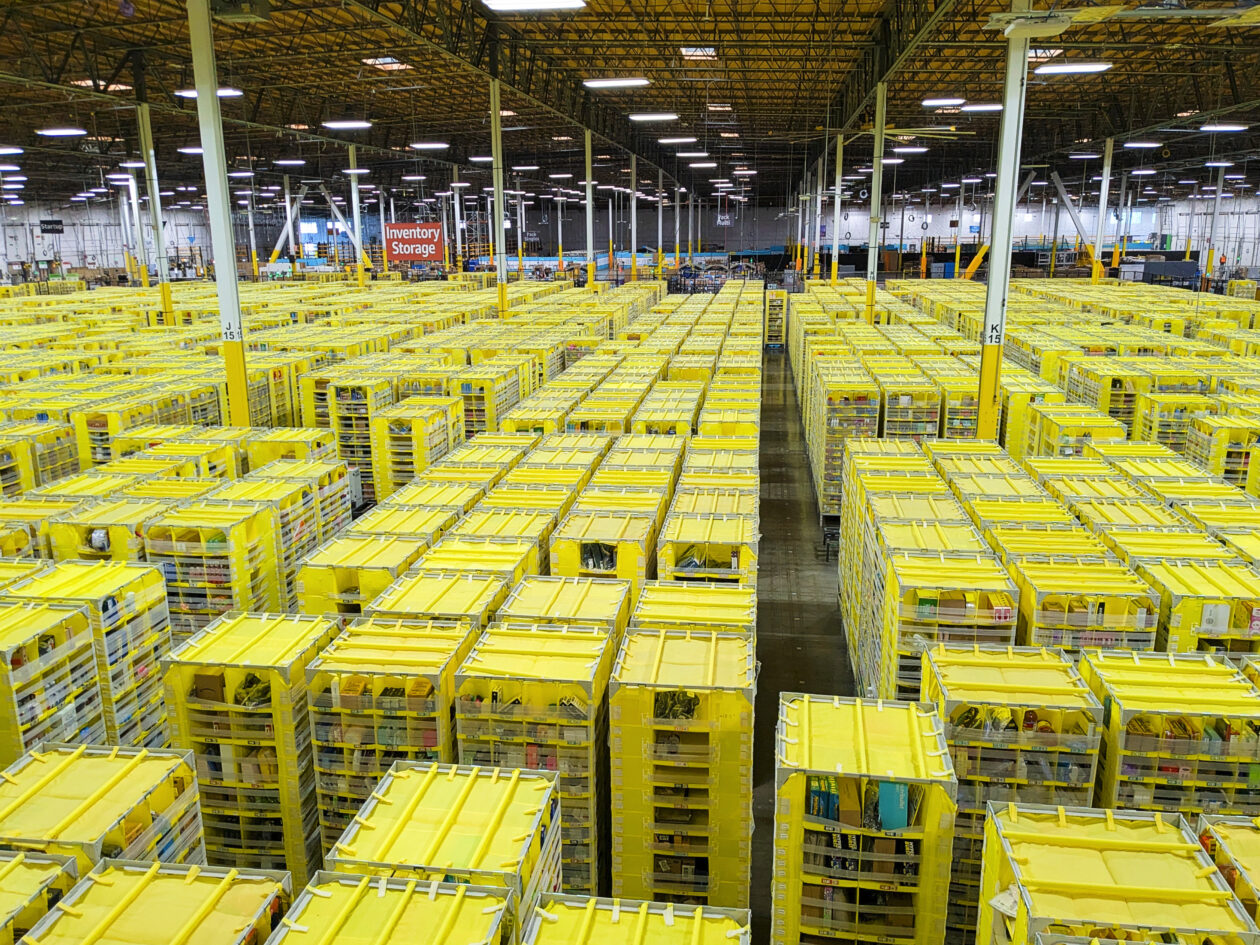
Movable shelving towers that hold items that are autonomously moved to Amazon employees who pack them for shipping. (GeekWire Photo / Lisa Stiffler)

Amazon is accused of artificially inflating the ad prices on its e-commerce site in a lawsuit filed Monday by Washington’s attorney general, the Federal Trade Commission (FTC) and 21 other states.

Amazon denies the allegations, saying its ad pricing has not harmed advertisers or shoppers and that the FTC’s claims mischaracterize how its system works.

Ads are sold on Amazon’s platform through so-called β€œsecond-price” auctions, in which businesses set a maximum price they’re willing to pay for an ad. If they’re the highest bidder, they pay only one cent more than the second-highest bid, and the auctions do not allow advertisers to see other bids.

Plaintiffs allege that beginning in late 2018, Amazon started adding surcharges to the prices, despite claims that it was still using a second-price system.

The lawsuit, filed in U.S. District Court for the Western District of Washington in Seattle, alleges the tech giant overcharged roughly 1.2 million ad customers by overriding and replacing auction results with β€œhigher prices set by Amazon to increase its profits.” The amount collected through the allegedly deceptive pricing scheme totals $20 billion, according to the suit.

β€œMany small business owners in Washington rely on Amazon for their livelihoods, and our office is committed to making sure Amazon treats them fairly, transparently, and in accordance with the law,” said Nick Brown, Washington’s attorney general, in a statement.

Amazon posted an online response to the allegations. β€œThe FTC’s claim fundamentally misunderstands how advertisers operate,” the company stated. β€œAdvertisers adjust bids based on real-world performance, not descriptions of auction mechanics.”

The company said it prioritizes the relevance of an ad to the shoppers being targeted over bid price alone. As a result, Amazon said, 92% of winning ads in recent years were not given to the highest bidder, and ad performance has improved. Conversion rates β€” the percentage of shoppers who take a desired action after interacting with an ad β€” rose 24% from 2021 to 2025, according to Amazon.

The company also said that from 2019 to 2024, the average cost-per-click for sponsored product search ads was flat when adjusted for inflation.

Amazon acknowledged it has changed its ad pricing approach over time, saying that as the system prioritized ad relevance, winning bids increasingly fell below market value. As a result, the company now sets minimum prices, or β€œreserves,” for participating in an auction and for the minimum market value of the ad.

β€œReserves like these,” it said, β€œare common across the industry.” The company said it does not charge advertisers more than their bid.

Amazon said it clearly explains its pricing process to advertisers. Plaintiffs dispute that, citing company employees who described creating fake auction participants.

The suit states that an Amazon senior scientist said that to increase auction prices, the company inserts β€œan invented auction participant representing how much Amazon thinks that particular ad slot is worth.”

The lawsuit is being led by the FTC and also includes the attorneys general of Alaska, Arizona, California, Colorado, Florida, Idaho, Illinois, Indiana, Iowa, Kentucky, Louisiana, Maryland, Nebraska, New Jersey, New York, North Carolina, Oklahoma, Pennsylvania, Rhode Island, South Carolina and Vermont.

The company is also in the FTC’s crosshairs in a separate, broader antitrust case accusing Amazon of maintaining an illegal monopoly in online retail, which is scheduled for trial next year.

Plaintiffs in the case announced Monday are asking the court to order Amazon to reform its practices, pay restitution and civil penalties for each violation, and cover attorneys’ fees.

Washington to receive up to $339M in landmark $17B settlement over Meta social media addiction claims

Meta must overhaul Instagram and Facebook for young users by enforcing daily time limits, turning off push notifications during school hours, and blocking access late at night. (BigStock Photo)

Washington state will receive up to $339 million as part of a historic $17.1 billion multistate settlement with Meta, resolving allegations that the tech giant intentionally designed Facebook and Instagram with addictive features that harmed youth mental health.

Attorney General Nick Brown said Wednesday that the landmark agreement delivers on core youth-safety product changes β€” including hard caps on daily time limits, late-night scrolling blocks, and disabled push notifications during school hours β€” that state lawmakers failed to pass through legislation over the past two years.

β€œLet me say to the young people of Washington state: This agreement shows that your health and safety is more important than Meta’s profits,” Brown said in a news release.

Under the deal, Meta must overhaul Instagram and Facebook for young users by enforcing a two-hour combined daily time limit, turning off push notifications during school hours (8 a.m. to 3 p.m.), and blocking access late at night between midnight and 6 a.m. Teen users will also get the option to switch off algorithmic feeds in favor of a chronological timeline.

The agreement resolves claims brought by a coalition of 47 states, Washington, D.C., and three territories. While Meta acknowledged the settlement could cost up to $18 billion total over 10 years, it marked a rare legal resolution for a major platform facing nationwide youth safety litigation.

Outside the landmark Big Tobacco agreements of the late 1990s, the $17.1 billion deal represents the largest state consumer protection settlement in U.S. history. State officials and tech policy experts are framing the enforcement action as a similar watershed moment for regulating algorithmic harms and digital product design.

Washington state will receive a guaranteed baseline of $237 million from the core youth-safety agreement, with its payout potentially scaling up to nearly $339 million over the next decade if other major platforms like TikTok and Snapchat adopt comparable terms.

The Attorney General’s Office plans to use the funds to cover legal costs, bolster ongoing consumer protection enforcement, and directly fund state programs tackling the youth mental health crisis driven by social media use.

The settlement also mandates an independent third-party auditor to evaluate and report Meta’s technical compliance directly to state regulators annually over the next five years. Beyond usage limits, Meta must restrict social comparison features such as targeted beauty filters, hide public β€œlike” counts for younger users, and implement stricter age verification to prevent children under 13 from creating accounts.

In addition to the core youth-safety agreement, Washington will receive a separate $10.2 million payment resolving long-standing state claims against Meta for sharing nonpublic user data with third parties like Cambridge Analytica during the 2016 election cycle.

Oregon Attorney General Dan Rayfield announced that his state’s share will total more than $125 million over 10 years.Β 

In a public statement, Meta praised the agreement as setting a new benchmark for youth safety, while emphasizing that the restrictions should apply across the entire industry.

β€œWhile this is an important step, these protections will only be truly effective if our peers β€” TikTok and YouTube β€” put the same measures in place,” a Meta spokesperson said.

The agreement remains subject to final judicial approval in federal district court.

❌