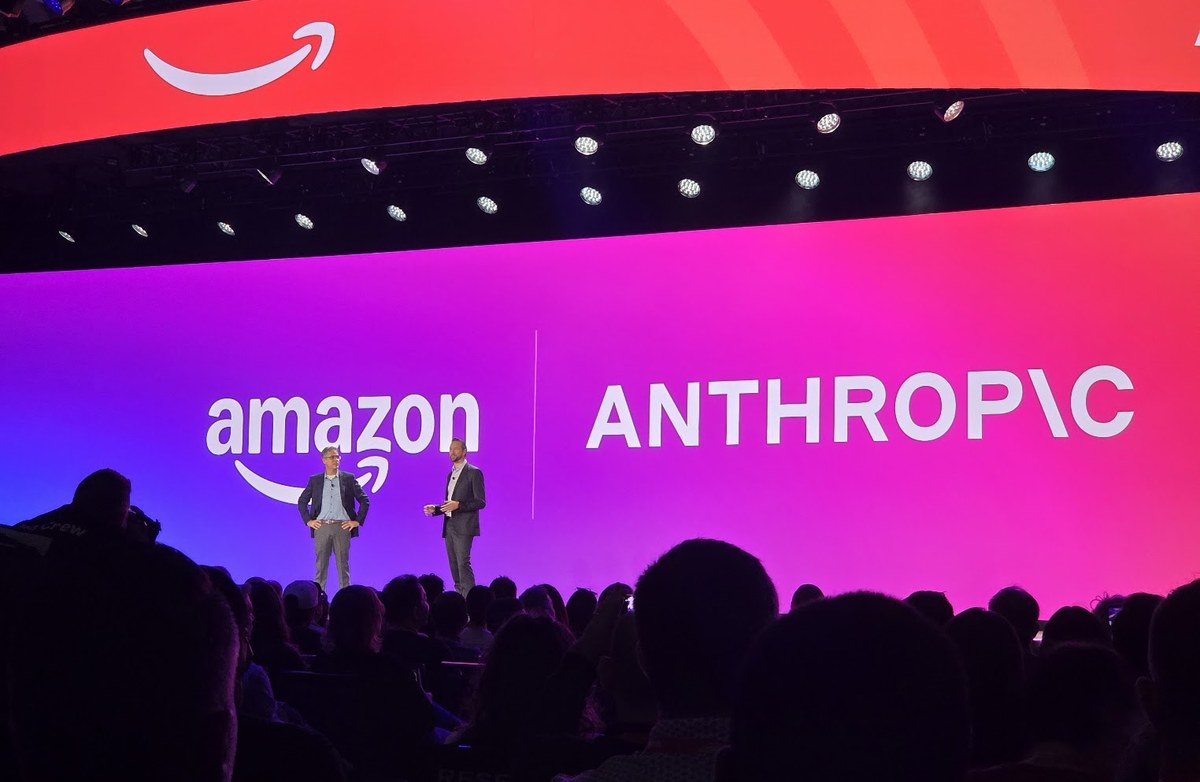
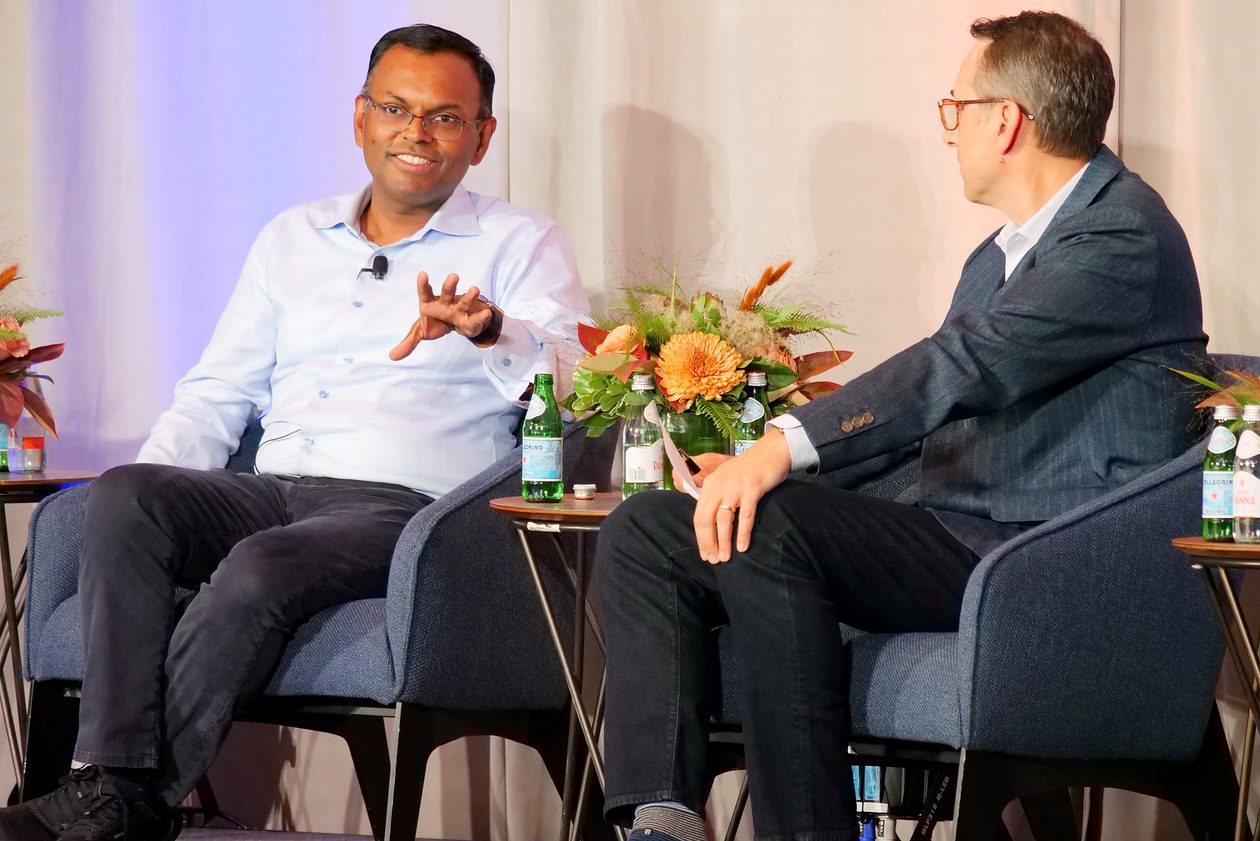
Chris Jones, director of Seller Assistant at Amazon, left, and Eric Burns of Anthropic’s Applied AI team on stage at Amazon Accelerate in Seattle in September. Anthropic’s IPO filing shows Google getting a bigger share of the AI company’s computing spending than Amazon, one of its largest investors. (GeekWire Photo / Todd Bishop)
Anthropic’s IPO filing reads like a ledger of who’s getting paid in the AI boom. The Seattle region’s tech giants are on the list, but they aren’t at the top.
The prospectus, filed Monday with the Securities and Exchange Commission, details more than $750 billion in computing deals, including firm commitments and estimated future spending, and offers clues about what its founders and biggest investors stand to gain ahead of the company’s planned Nasdaq listing under the ticker ANT.
Amazon and Microsoft have invested billions in Anthropic and won high-profile spending commitments from the Claude maker. But both trail Google, chipmaker Broadcom and Elon Musk’s SpaceX in their shares of Anthropic’s planned spending on computing power, the filing shows.
Following the compute money: Google’s chips are the biggest winner. Anthropic has lined up roughly $400 billion in computing capacity, mostly over the next seven years, based on Google-designed AI chips, known as tensor processing units or TPUs.
That total includes $114.5 billion to Google directly through July 2033, $161.2 billion in equipment leases with chipmaker Broadcom, and an estimated $125 billion to $150 billion in additional TPU capacity from 2028 to 2031.
Broadcom’s leases are the largest single arrangement in the filing. The five-year leases provide TPU-based hardware for data centers operated by other companies on Anthropic’s behalf.
Elon Musk’s SpaceX is next. Anthropic agreed to spend up to $120.5 billion through 2029 for computing capacity from SpaceX’s AI subsidiary, formerly known as xAI, which runs a rival AI lab.
The filing says payments will reach about $3.1 billion a month once all the capacity is delivered, which Anthropic expects in December. The agreements run into 2029, though either side can cancel on 90 days’ notice after early 2027.
Amazon is still a big winner. Anthropic committed in April to spend at least $110 billion with Amazon Web Services over 10 years, through April 2036, and AWS Trainium is one of four chip families that Anthropic uses to train and run its models.
Anthropic has committed to spend at least $44.9 billion on Microsoft’s Azure cloud from November 2026 through May 2033, the filing shows. That’s up from the $30 billion Azure deal announced in November 2025. The deal has been amended twice since, most recently this month.
Claude is built into Microsoft 365, and former Microsoft CFO Chris Liddell joined Anthropic’s board in February.
Two smaller providers have deals in the same range as Microsoft’s. Anthropic agreed to spend up to about $44.6 billion with Nscale, a U.K.-based AI infrastructure company, and about $41.3 billion with GPU cloud provider Lambda, both for capacity powered by Nvidia chips, according to the filing.
Will Anthropic need it all? Most of the commitments can’t be canceled, and the deals with Microsoft, Google and Amazon require Anthropic to pay “regardless of actual usage,” according to the filing.
So far, the demand is there. Anthropic’s revenue hit $11.6 billion in the second quarter, up from $787 million a year earlier, and the company posted its first operating profit, $974 million. It still had a $66.3 billion net loss, mostly from accounting charges tied to its soaring valuation.
The company says it has “consistently operated in a compute-constrained environment where customer demand exceeds available compute.”
Its compute commitments assume that demand keeps growing. Anthropic spent less than $2 billion a month on compute and infrastructure in the second quarter. The SpaceX deal alone is expected to cost about $3.1 billion a month at full capacity.
Paper fortunes: Amazon’s biggest payoff is its stake, which it valued at $190.4 billion as of June 30 in its quarterly SEC filing. That includes convertible notes with $6.2 billion in principal that Amazon valued at $97.9 billion. The notes would convert into stock, subject to a 12% ownership cap that Amazon can waive.
Amazon is scheduled to report third-quarter results Thursday, its first earnings report since Anthropic’s filing. The Seattle-based company has updated the value of its Anthropic holdings in each of its quarterly filings this year, so a new number could come this week.
Google put $10 billion into Anthropic’s latest funding round and can invest up to $20 billion more under a March financing deal. The filing doesn’t give ownership percentages for Amazon, Google or Microsoft. It says only that the three companies have each made “significant equity investments” in Anthropic.
Anthropic’s seven co-founders hold roughly 230 million to 245 million shares each, worth about $14 billion apiece at the latest private funding price. The company also gave its own Public Benefit Fund about 847 million shares, or 5% of its fully diluted stock as of June 30, worth about $50 billion at that price.
Anthropic could begin formally marketing its IPO to investors as soon as the week of Nov. 9, Bloomberg reported, citing people familiar with the matter. It is aiming to go public the following week, according to the Wall Street Journal. The company expects the offering to match or beat the size of SpaceX’s IPO, according to Bloomberg. SpaceX raised $75 billion in June, the largest IPO on record.
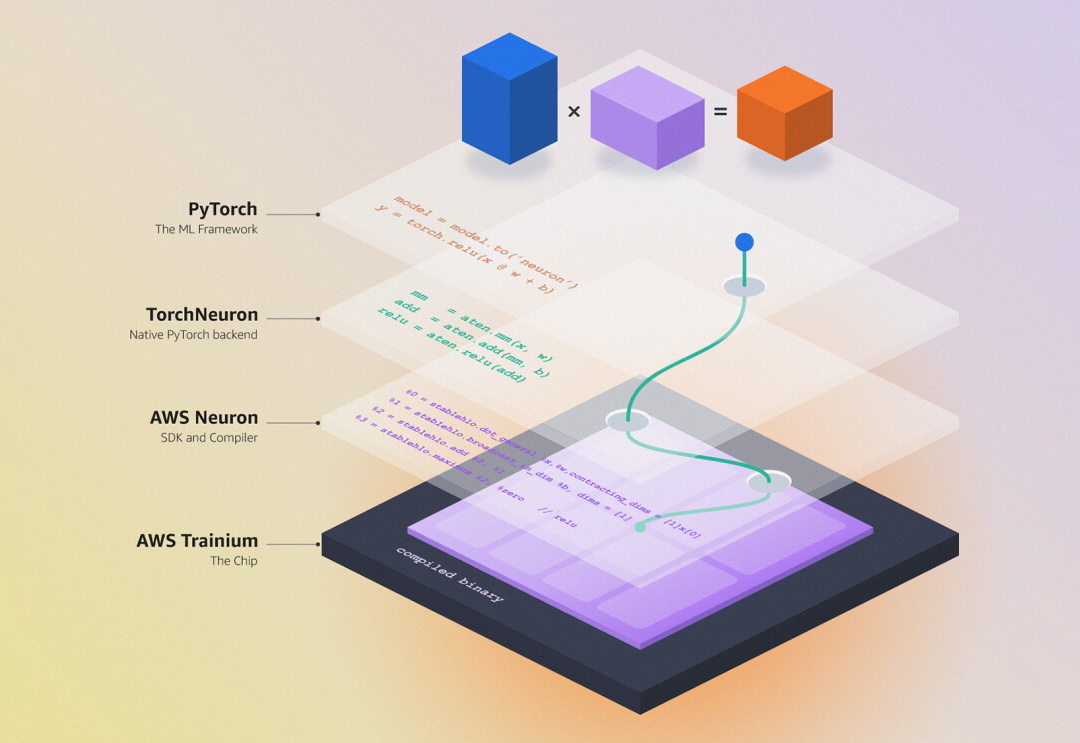
Amazon’s TorchNeuron sits between PyTorch and the company’s Trainium chips, supporting developers’ existing code. (Amazon Image)
A new software tool from Amazon aims to make switching from Nvidia to the company’s own AI chips about as simple as changing a setting.
The software, dubbed TorchNeuron, runs code written in PyTorch, the open-source framework used by many AI developers, on Amazon’s Trainium chips. It has been in private beta since late last year, and Amazon said Monday that it’s opening the software to all developers as a public beta.
Until now, developers who wanted to run PyTorch code on Trainium had to modify it to call programming interfaces specific to Amazon’s chips, said Colin Brace, vice president of technology software at Annapurna Labs, Amazon’s chip-design unit. With TorchNeuron, the same code runs after a basic configuration change.
“If you know PyTorch, then you know Trainium,” Brace said in an interview.
Nvidia dominates the market for AI chips, partly because much of the industry’s AI software was built around its CUDA platform. Adapting that code to other hardware can take months of engineering work. That has made many companies reluctant to switch, even as Amazon, Google and others have developed their own chips.
TorchNeuron is part of a broader push by tech giants to loosen Nvidia’s grip on AI computing, even as they remain among its biggest customers.
Google, which has started selling its TPU chips directly to some outside customers, is working on TorchTPU, a similar project to run PyTorch natively on those chips. Google detailed the effort in April, saying the goal is to let developers move existing PyTorch code to TPUs with minimal changes.
Microsoft said last week that it plans to run most of its AI services on its homegrown Maia chips rather than Nvidia hardware.
Amazon is reportedly in talks to acquire Decart, a startup that makes software to help developers move AI models built for Nvidia chips to alternatives such as Trainium, in a deal that could value it at about $7 billion. Decart already runs its own AI models on Trainium, and Nvidia is an investor in the startup.
Asked about Amazon’s relationship with Nvidia, Brace said the company has “always been about choice,” pointing to another high-profile example: AWS offers Intel processors alongside its own Graviton chips.
Amazon plans to release TorchNeuron as open-source software on Tuesday in conjunction with the PyTorch Conference in San Jose, Calif.
Trainium’s biggest users so far are AI labs with close financial ties to Amazon. Anthropic, in which Amazon has invested billions, uses the chips to train and run its Claude models. OpenAI agreed in February to use 2 gigawatts of Trainium capacity as part of a deal in which Amazon is investing $50 billion in the company.
Brace said Amazon’s goal has always been wide use of the chips, calling TorchNeuron “an accelerant” along those lines.
Amazon’s chip business traces back to its 2015 acquisition of Annapurna Labs, an Israeli chipmaker, for a reported $350 million. The Annapurna team went on to design Trainium as well as Amazon’s Graviton processors.
In his annual shareholder letter in April, Amazon CEO Andy Jassy wrote that the company’s chip business, including Trainium and Graviton, had an annual revenue run rate of more than $20 billion. He estimated that figure would be about $50 billion if the chips were sold to AWS and other customers by a standalone chip business.
“There’s so much demand for our chips that it’s quite possible we’ll sell racks of them to third parties in the future,” he wrote.
More than 30 companies and internal Amazon teams have been using TorchNeuron during the private beta. Deepgram, a San Francisco startup that makes speech AI, says its benchmarks showed Trainium processing about 60% more audio per dollar than its existing GPU setup. The company now runs Trainium in production, Brace said.
Inside Amazon, the Prime Video team used TorchNeuron to build Prime 360, an AI system that reconstructs NBA plays in 3D so viewers can watch replays from angles a traditional camera can’t capture. The feature, which runs on Trainium, will appear on select Prime Video broadcasts this NBA season.
To make sure TorchNeuron works with the huge variety of AI models that developers build, Amazon tests it every night against more than 100,000 models from Hugging Face, the popular online hub for open-source AI, Brace said.
Brace said the timing of the project reflects changes in PyTorch itself. The framework has matured, and its maintainers have been working to make it less dependent on any one kind of hardware.
Amazon has contributed to that effort, removing code that tied PyTorch to specific chips. Newer versions of PyTorch can detect which hardware they’re running on, he said, so in some cases developers don’t need to change their code at all.
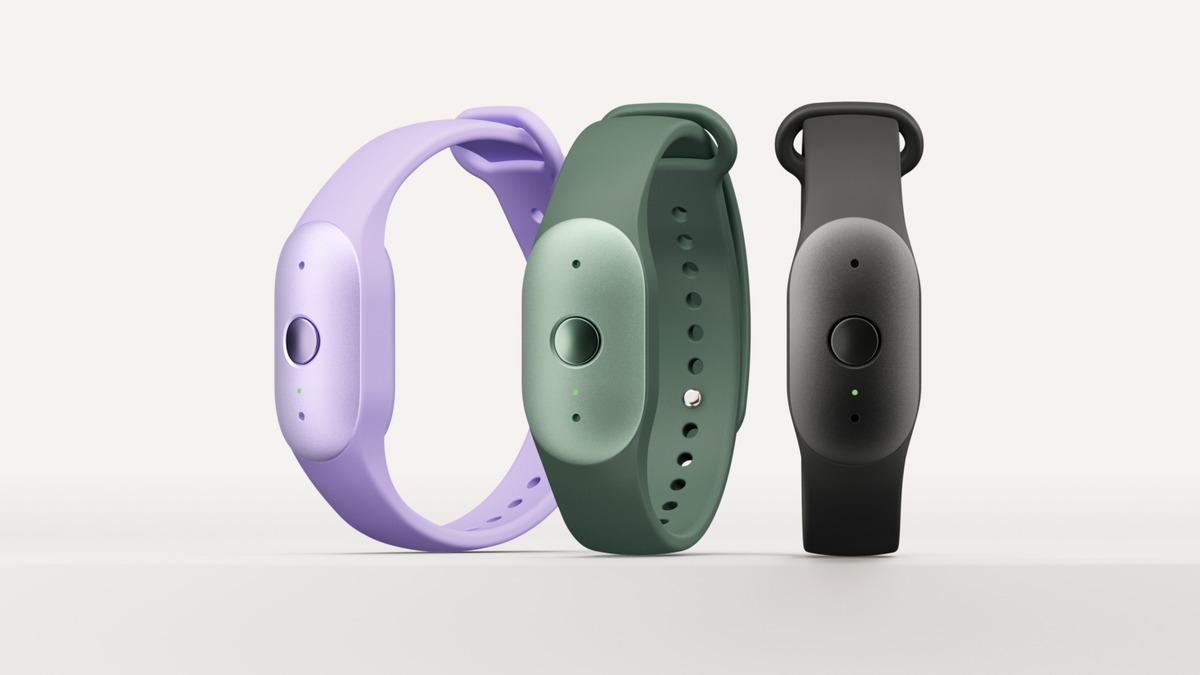
Amazon Bee’s recording light is easy to miss, says a former AWS security engineer. (Amazon Image)
Amazon’s new Bee AI devices ask the wrong person for consent, according to a privacy and security veteran who previously worked as a senior principal security engineer at Amazon Web Services.
In a LinkedIn article, Jeff Williams writes that Bee’s consent safeguards are aimed at the wearer, while the people being recorded have no practical way to say no.
Both turn conversations into summaries and to-do lists, with connections to Amazon.com and Alexa+ for paid subscribers.
How Bee handles consent: Amazon says users are prompted to get permission from call participants each time they start a recording, and the devices show an indicator light while in use.
The problem, Williams says, is that neither one reliably tells the other people in a conversation that they’re being recorded. He writes that the prompt appears only on the wearer’s phone, and nothing enforces it.
“A prompt instructing the user to obtain permission is a liability allocation,” he wrote, arguing that Amazon is shifting responsibility for obtaining consent onto the wearer.
The light is easy to hide under a sleeve or in a pocket, he notes, and a device on the wrist or phone sits outside the frame on a video call.
Williams points to Meta’s Ray-Ban glasses as an example. In September, the data protection authority in Hamburg, Germany, found the glasses’ recording light hard to see outdoors and concluded that a recording indicator alone doesn’t establish informed consent under Europe’s GDPR.
In the U.S., about a dozen states, including Washington state and California, generally require consent from everyone before a private conversation can be recorded.
Whose data is protected: Williams gives Amazon credit for Bee Private Compute, which processes audio in an isolated, encrypted environment built on AWS Nitro and then deletes it. Amazon says only the customer can access the resulting data, not Amazon or Bee.
But that protects the wearer. The words of the people around the wearer still end up in transcripts and summaries they can’t see or remove. Amazon says those speakers aren’t identified by name unless they complete a voice training exercise with the device’s owner.
Williams notes that Amazon has changed comparable privacy commitments before, such as ending the “Do Not Send Voice Recordings” option on some Echo devices last year.
Williams also advises companies to keep the devices out of client meetings and privileged discussions, since the transcripts end up in an employee’s personal account, where the company can’t see or manage them.
A proposed fix: Williams says Bee should leave other people’s voices out of transcripts by default, unless they’ve enrolled their voices and agreed to be recorded. Before the acquisition, Bee indicated plans to record only the voices of people who had verbally consented, according to TechCrunch.
“I know first-hand that Amazon has the engineering talent to ship it,” he wrote.
Amazon’s response: The company didn’t comment directly on the critique but pointed to safeguards built into the devices.
One is an automatic shutoff: the devices turn off if they don’t detect the owner’s voice for 5, 15, 30 or 60 minutes, depending on the user’s setting. Amazon says that reinforces that Bee is “a personal AI assistant, not a device designed to passively pick up audio throughout the day.”
The company says it educates customers about responsible use in the Bee app, and that Eclipse will send push notifications encouraging users to let people around them know they’re using Bee and to ask for permission.
Williams, now chief information security officer at Sigma360, worked at AWS from 2023 to 2025 and spent more than 12 years at Microsoft before that, including as a privacy officer for its services business. Read his full article on LinkedIn. Read his full article on LinkedIn.
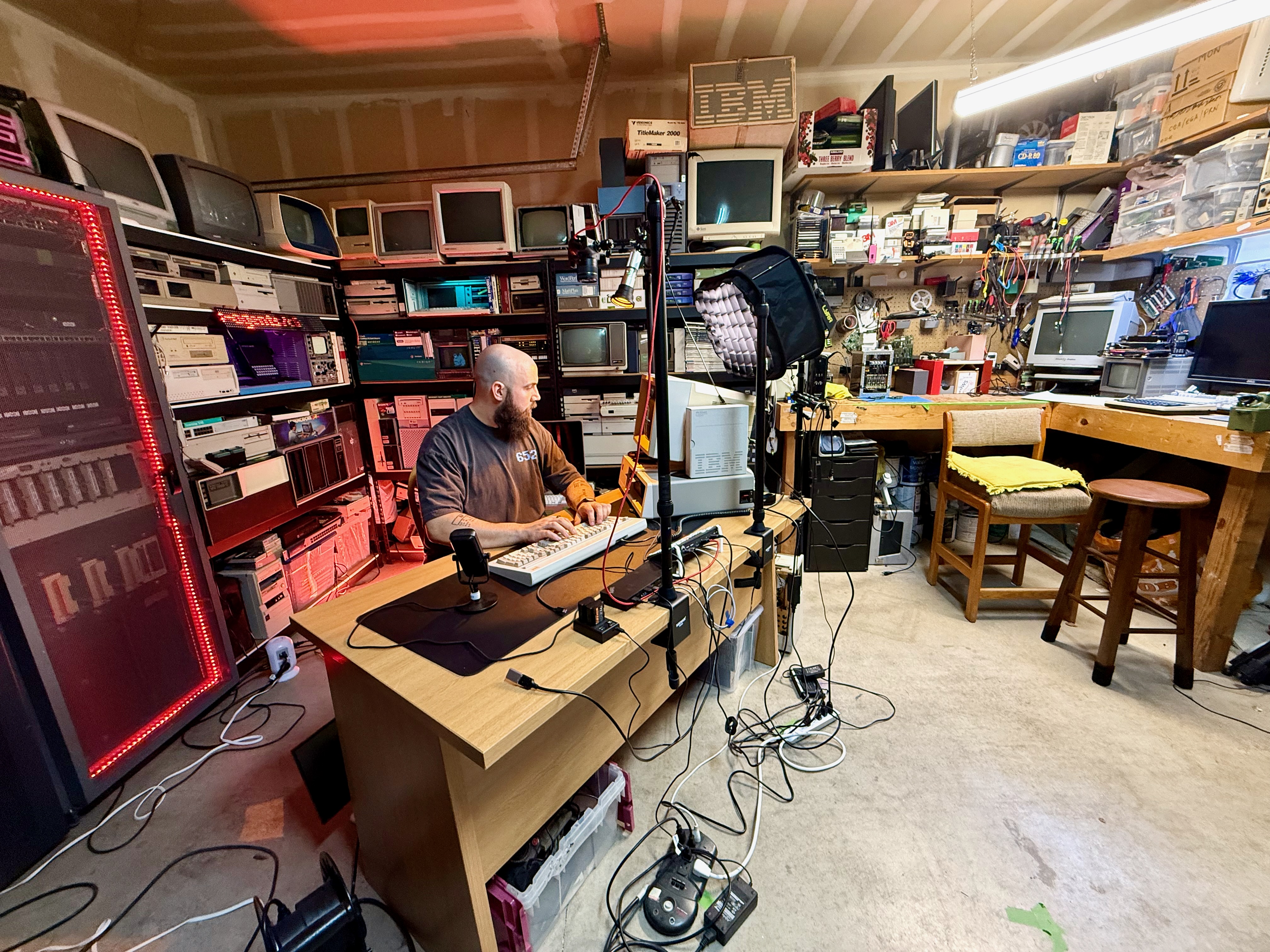
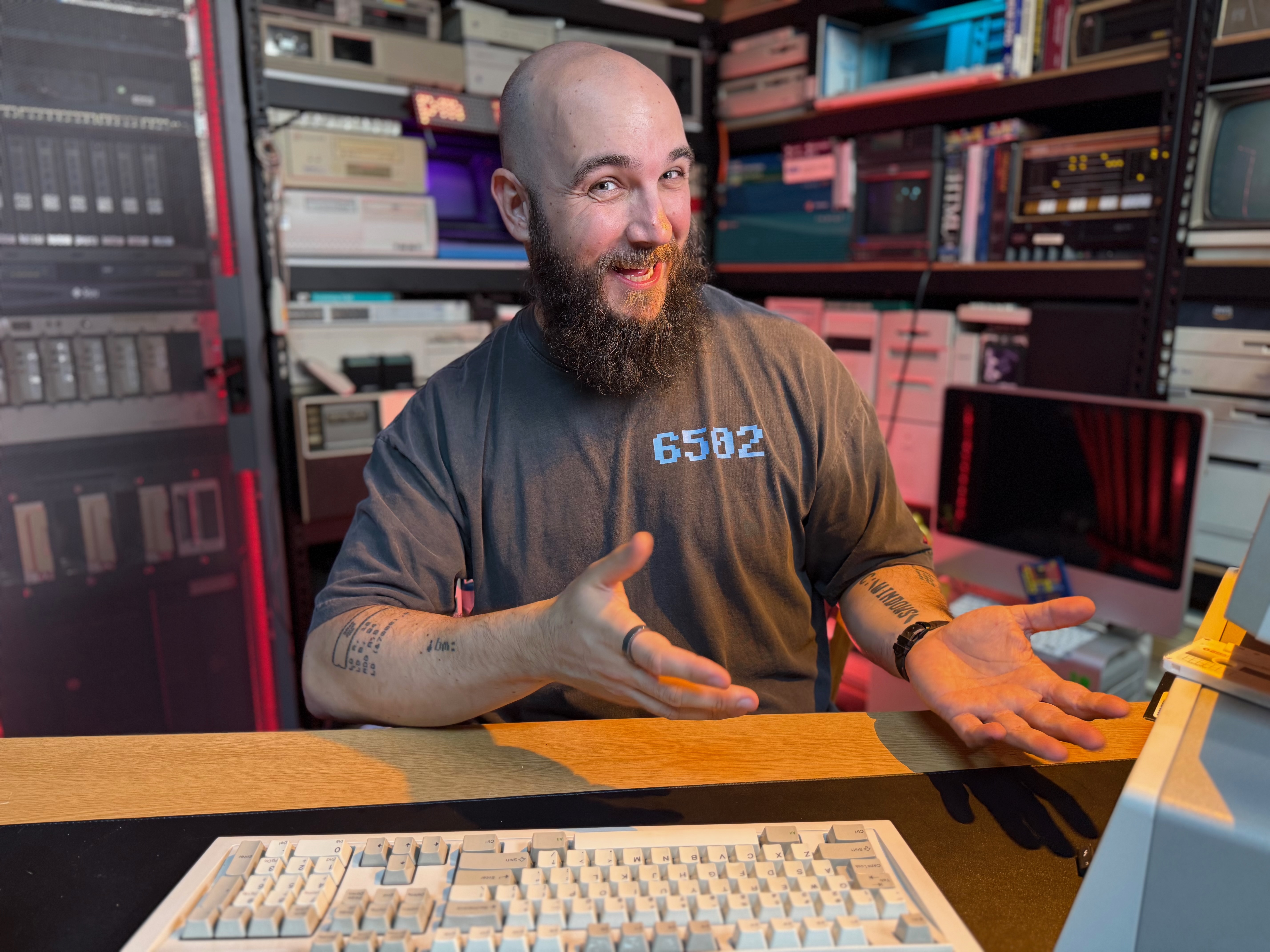
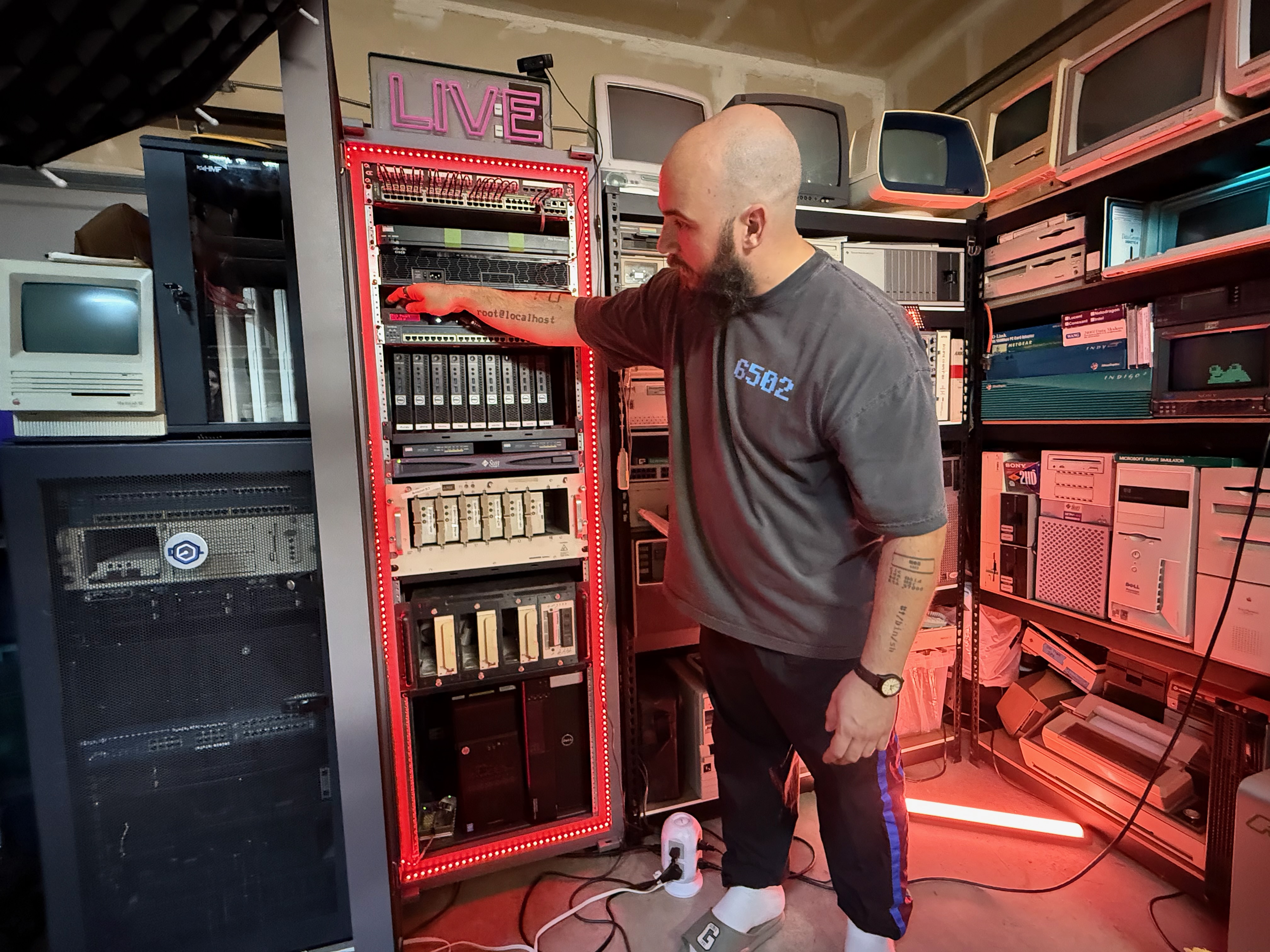
Darko Mesaros, a distinguished developer advocate for Amazon Web Services, is surrounded by vintage computer equipment in the garage of his Maple Valley, Wash., home. (GeekWire Photo / Kurt Schlosser)
Darko Mesaros used to park a car in the garage of his Maple Valley, Wash., home. These days, it’s wall-to-wall computers.
A towering server rack glows with red LEDs. CRT monitors are stacked beside vintage workstations, and a workbench overflows with tools, cables, and half-repaired components.
“I started getting stuff, and then … it just kind of snowballed to a point I actually had to slow down because I legitimately don’t have space for it anymore,” Mesaros told GeekWire during a recent tour of his retro hardware labyrinth.
The lore of tech innovation is full of suburban garages where visionary founders tinkered their way to world-changing companies. Mesaros, a distinguished developer advocate at Amazon Web Services, isn’t launching a startup out of his. Instead, he’s using it as a living museum to rescue, repair, and resurrect the discarded digital ghosts of computing history — and then daring them to run modern artificial intelligence.
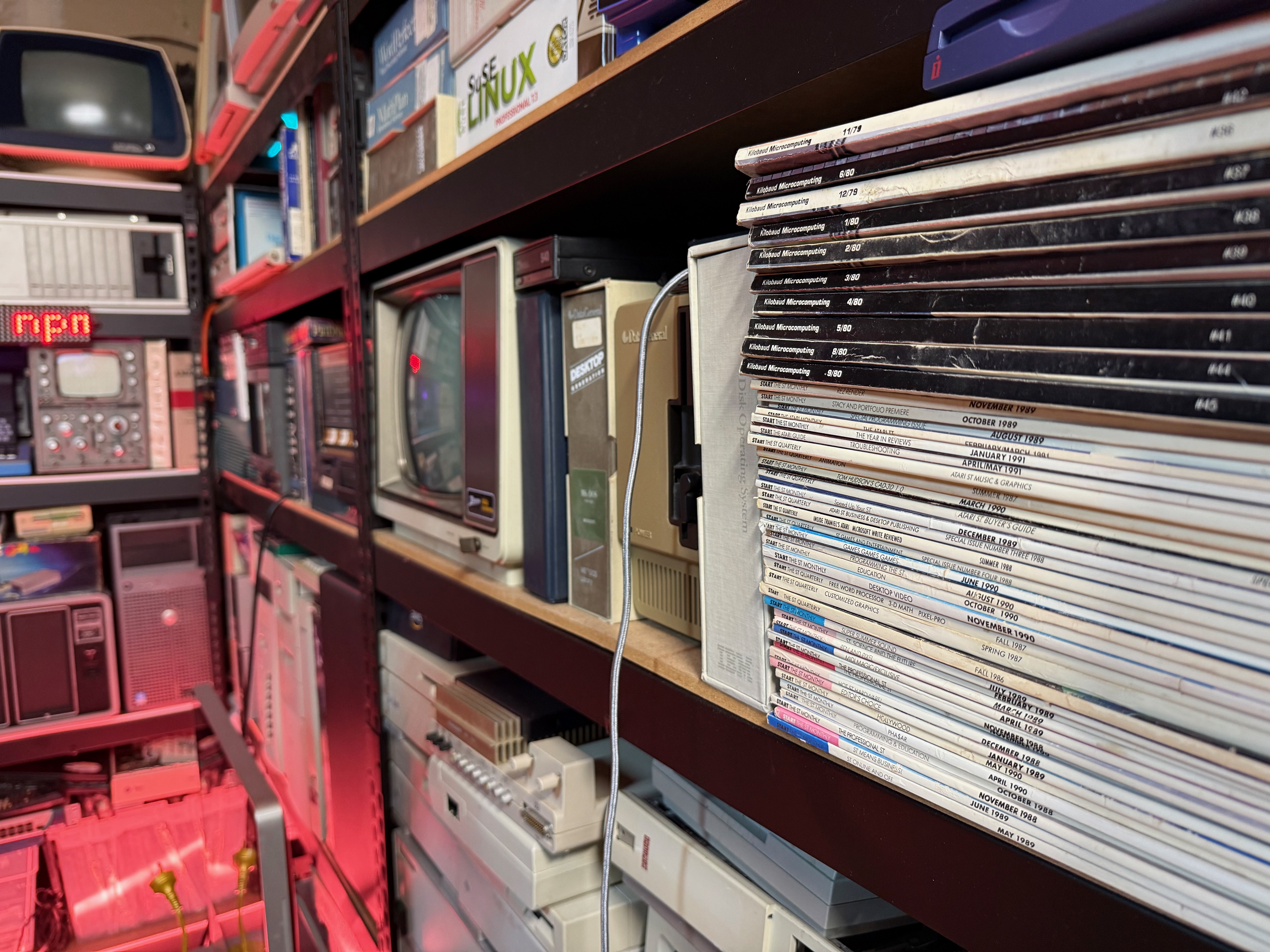
The collection has spilled into an upstairs office and now spans more than 100 full computers, from an early-1970s minicomputer to Silicon Graphics workstations from the ’90s and HP workstations from the 2000s. Add roughly 25 vintage video game consoles, rescued software, peripherals, a leather-bound TRS-80 owner’s manual, and nearly a decade of 1980s Byte magazines, and the total tops 1,000 items.
Most of it arrives broken, and that’s the point.
“Buying a mint old system is not fun,” he said. “Buying something that’s broken and then having that excitement of fixing it is just fantastic.”
He finds gear at Goodwill, through local Facebook Marketplace groups, and through Seattle’s large retro computing community. Sometimes it takes a rescue mission: when a man in Washington, D.C., was about to throw away a pallet of 1980s computers, Mesaros had a friend there grab it, then paid to ship the whole load to Seattle.
At one point, he had seven Commodore 64s. He gives extras to other collectors, and he’s never sold a single piece.
“That’s been my little pride,” he said.
From a Commodore 64 in Serbia to the AWS cloud
Darko Mesaros wears a shirt that is a nod to the MOS 6502, the iconic 8-bit microprocessor that powered classic computers like the Commodore 64 and Apple II. (GeekWire Photo / Kurt Schlosser)
Mesaros’ fascination with vintage hardware goes beyond nostalgia; it’s the foundation of a lifelong obsession with how things work under the hood.
Growing up in Serbia, he faced an economic reality where cutting-edge tech was out of reach. From 1991 to 2003, his only computer was a Commodore 64 — a machine released in 1982. While the rest of the computing world sped through the 1990s and early 2000s, Mesaros skipped straight to modern PCs.
“I feel like I missed that whole thing,” he said. “I missed the whole, you know, Sun workstation, Silicon Graphics, HP 9000, all of those things … and I just wanted to explore how that was.”
So he bought a couple of Sun workstations to see what he’d missed. Then he kept going.
“It’s a hobby, but it’s also a problem,” he said with a laugh.
If the garage caught fire, the one machine he’d grab? A bright blue Silicon Graphics Indy, the 1990s workstation from the very era he missed growing up. It was the first SGI he bought.
“It showed me how this amazing workstation worked!” he said. He still fires it up from time to time just to enjoy its IRIX operating system.
Still on his wish list: a DEC VT520 terminal with an amber screen. Working units only seem to turn up on the East Coast, and he won’t risk shipping a fragile CRT across the country.
Before joining Amazon nearly a decade ago, he held system administration and engineering roles at companies including AT&T and Tipico. Now at AWS, his day job involves leveraging his experience to help developers and customers adopt and use AWS services via blogs, webinars, code, and technical advocacy. The garage doubles as his set: he records AWS videos and live streams there.
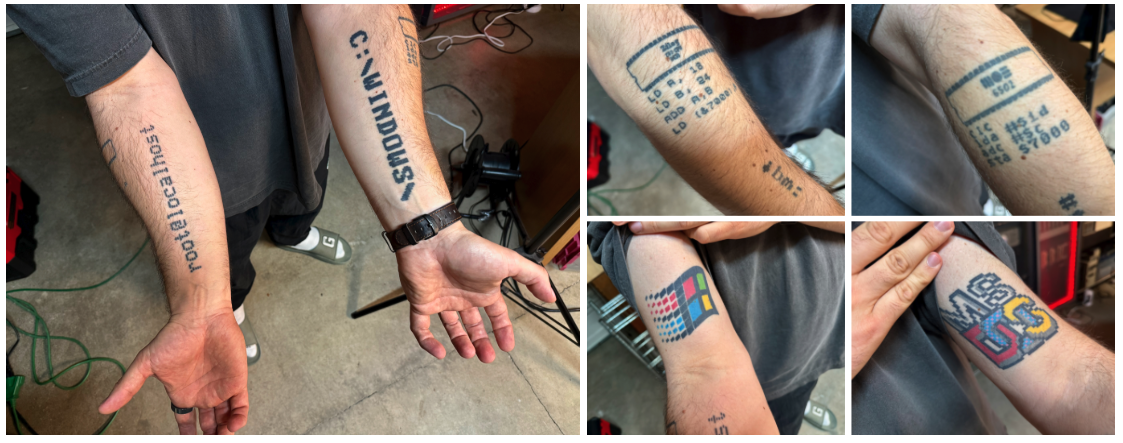
Tattoos on Darko Mesaros’ arms trace his appreciation for vintage tech. (GeekWire Photo / Kurt Schlosser)
Mesaros moved to the Seattle area around the start of the pandemic, arriving with a couple of workstations, a monitor, and a handful of laptops before his collection expanded. He soon realized gear was far cheaper here than in Europe.
“Most of these things are older than me. Especially older than my tech career,” the 38-year-old noted. “Actually, all of these things are older than my career. However, again, I find it fascinating how computer history has evolved.”
His arrival timing meant he narrowly missed the chance to visit Seattle’s beloved Living Computers: Museum + Labs before it permanently closed its doors. But in his own home, he’s essentially built a private version of the late Microsoft co-founder Paul Allen’s former institution.
Beyond the vintage hardware, Mesaros’ appreciation for computing history is permanently etched onto his body.
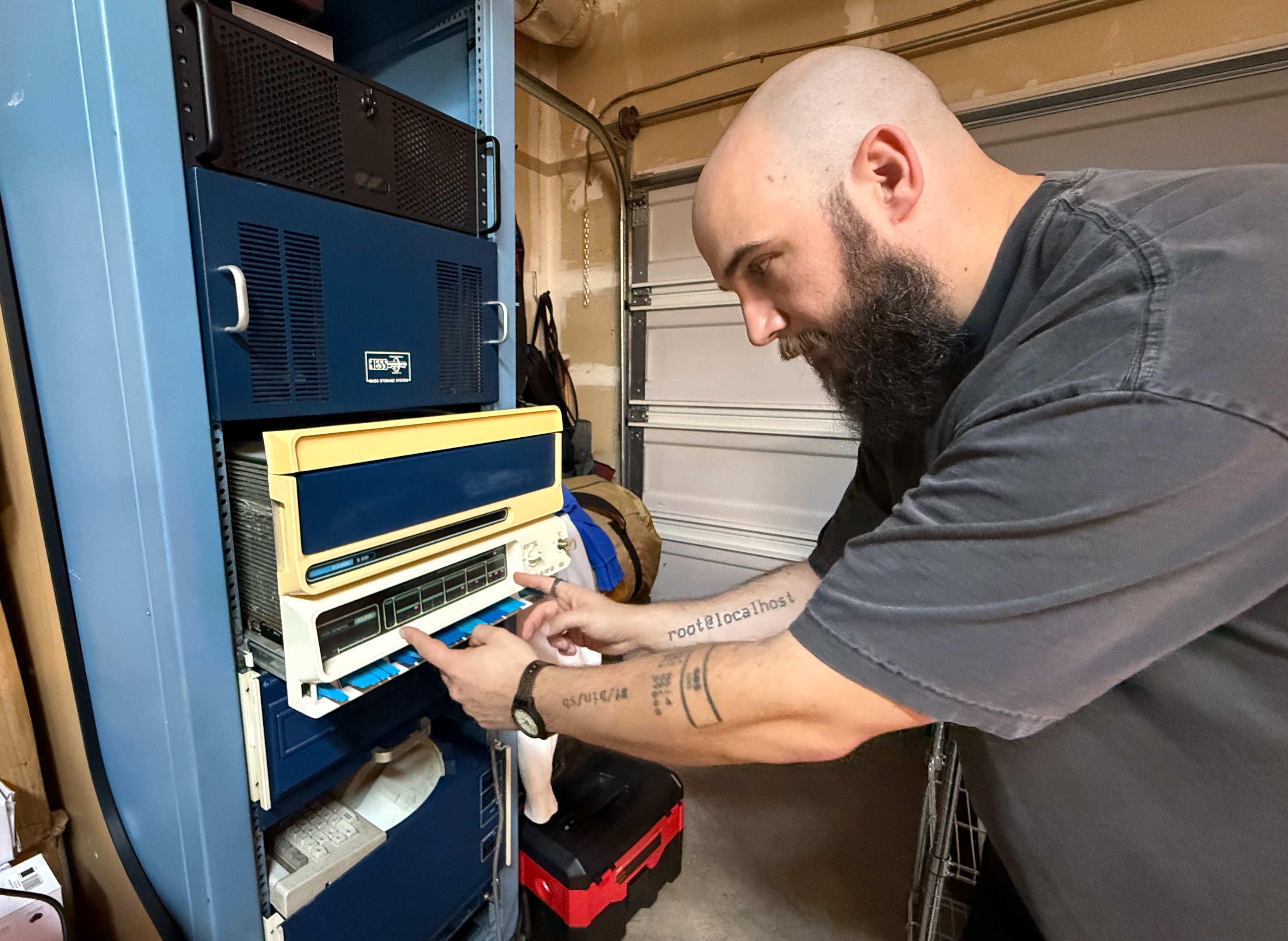
He sports a collection of retro tech tattoos on his arms, including symmetrical DOS and Linux terminal prompts (C:\WINDOWS> and root@localhost), a classic Windows 95 logo, MS-DOS branding, a shebang and a quit command that mark the start and end of a script, and detailed microprocessors like the Zilog Z80 and MOS 6502 paired with assembly code — a setup he jokingly calls his literal “ARM CPUs.” He’s still waiting, he said, on his check from Microsoft.
“I only tattoo ancient technology on myself,” Mesaros said, noting that people frequently stop him at airports to take pictures. “Old technology will stay with me … I feel like this is an investment in my career.”
He has plans for more ink during his next trip home to Serbia.
Wiring vintage hardware to modern AI
For Mesaros, collecting vintage computers is about more than admiring silent plastic shells on a shelf; it’s about making them talk across the digital chasm. In his garage and upstairs office, he routinely bends ancient hardware to modern purposes — proving that an 8-bit machine or a mechanical teletype can still interface with the cutting-edge cloud.
Mesaros has chatted with an AI coding agent from a Commodore 64 and deployed Kubernetes via a 1986 Tandy 102 portable computer. He wired a 1984 DEC DECwriter IV teletype to Amazon’s Kiro coding agent, explaining in a blog post how he talks to Kiro through the clacking machine — and he’s even deployed AWS infrastructure from it.
“Should this be done? Probably not,” he said. “But is it fun? Absolutely.”
In a demo for GeekWire, we watched the teletype clatter out the agent’s answer to his query, “What is GeekWire?” After a few seconds of hammering, it printed: “Seattle-based tech news site covering Pacific Northwest startups, Amazon, Microsoft and the broader tech industry.”
Not bad for a machine older than its operator.
Mesaros also spent a weekend trying to get stuck in 1999, using a Windows 98 machine as his only computer and documenting it on a VHS camcorder.
“The only window into the future was Kiro,” he said.
While these stunts might sound like elaborate practical jokes, Mesaros believes they serve a vital purpose in the age of AI. In a modern development landscape where tools let programmers “build a to-do app and walk away,” he argues that developers are losing the art of paying attention.
He likes to point out that a 2017 Google paper titled “Attention Is All You Need” helped kick off today’s LLM boom. “Now in 2026, to be a really successful developer,” he said, “attention is all you need.”
“I think being curious and paying attention are the two most important skills for a developer these days because it is so easy not to do those things,” Mesaros said. “And if you want to be relevant, if you want to be good at your job, especially with AI, I think those are the two important things that are critical.”
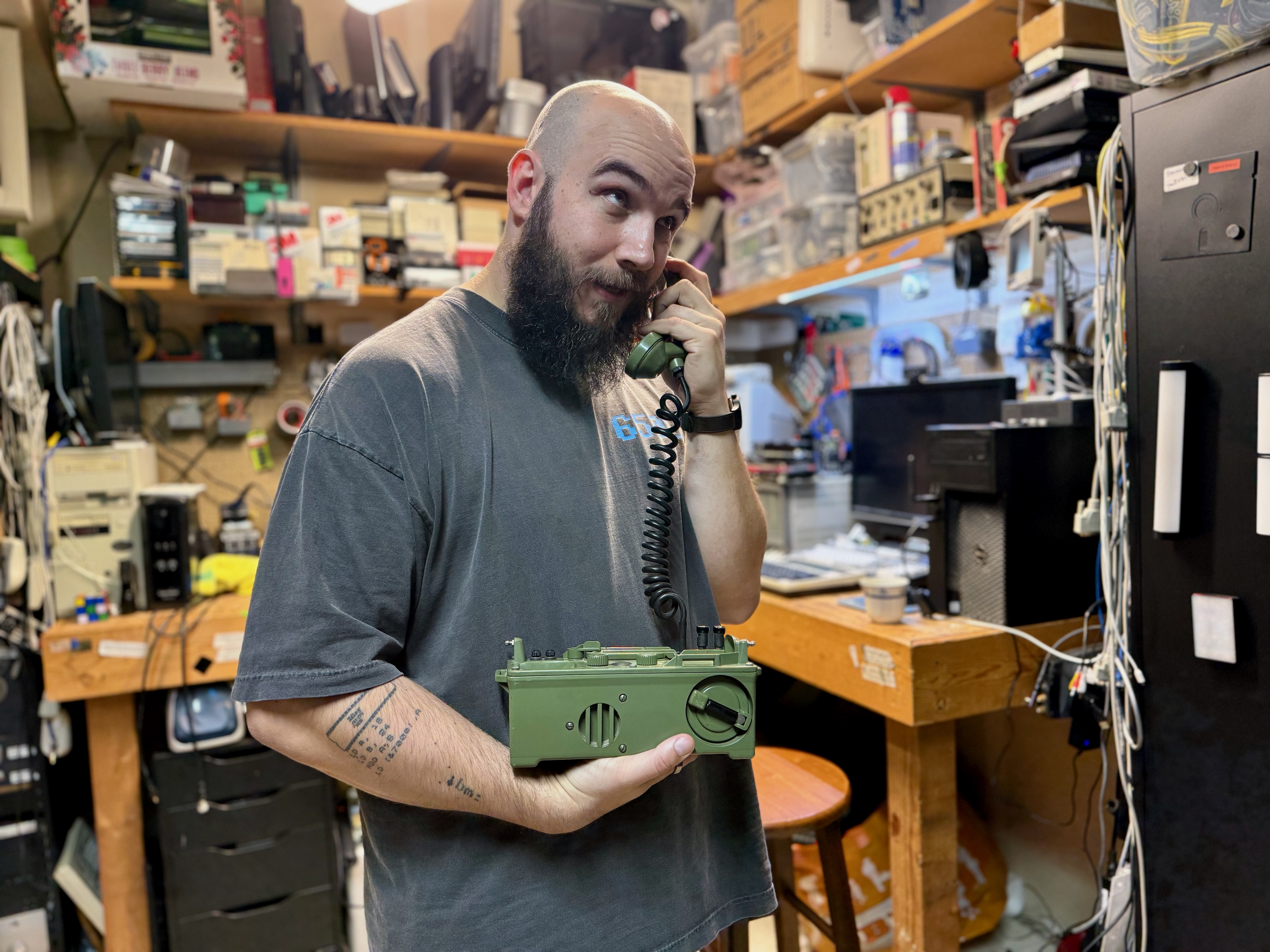
Calling the cloud: Darko Mesaros holds a vintage military field phone, another of his experimental hardware projects aimed at bridging analog gear with modern AI. (GeekWire Photo / Kurt Schlosser)
When he isn’t troubleshooting an obscure serial card data-ready pin or attempting to hook up a military field phone from his native Serbia to an LLM, he balances his digital obsession with analog pursuits. He wrenches on an old Jeep TJ — parked in the driveway because there’s no room in the garage.
He’s not the only tinkerer in the house. His wife is a fashion designer who 3D prints clothing and purses on a farm of printers in one of the upstairs rooms.
“She’s more creative than I am,” he said. “I get to tinker with old things that don’t want to work, and she uses technology to actually make new things.”
When it comes to the tech he lets into his own life, Mesaros is choosy. He wears a classic analog Timex and bought Meta’s smart glasses when they came out — then sold them within a month. “I don’t like the camera on my face,” he said. (He does use a camera-free pair that can display real-time translated subtitles when he travels abroad.)
That same instinct is why he doesn’t see screens going away, even as AI agents take on more work. “We still have the need for control,” he said. “Being able to observe and see, visualize what’s happening is still important.”
Old tech offers something else modern tech rarely does: a slower pace. Computer manuals once took months to produce because they’d stay accurate for years. “Today, if you create a manual that’s printed, it’s going to be valid for a week,” he said.
That’s what makes his garage an antidote to the endless scroll, a place anchored to the glowing screens and clacking keys of computing’s past. The hobby is his “computer away from a computer.”
“I spend my days in the email factory … and then in the afternoon, I just come here and tinker with something ancient that shouldn’t work anymore,” Mesaros said.
Keep scrolling for more GeekWire photos:
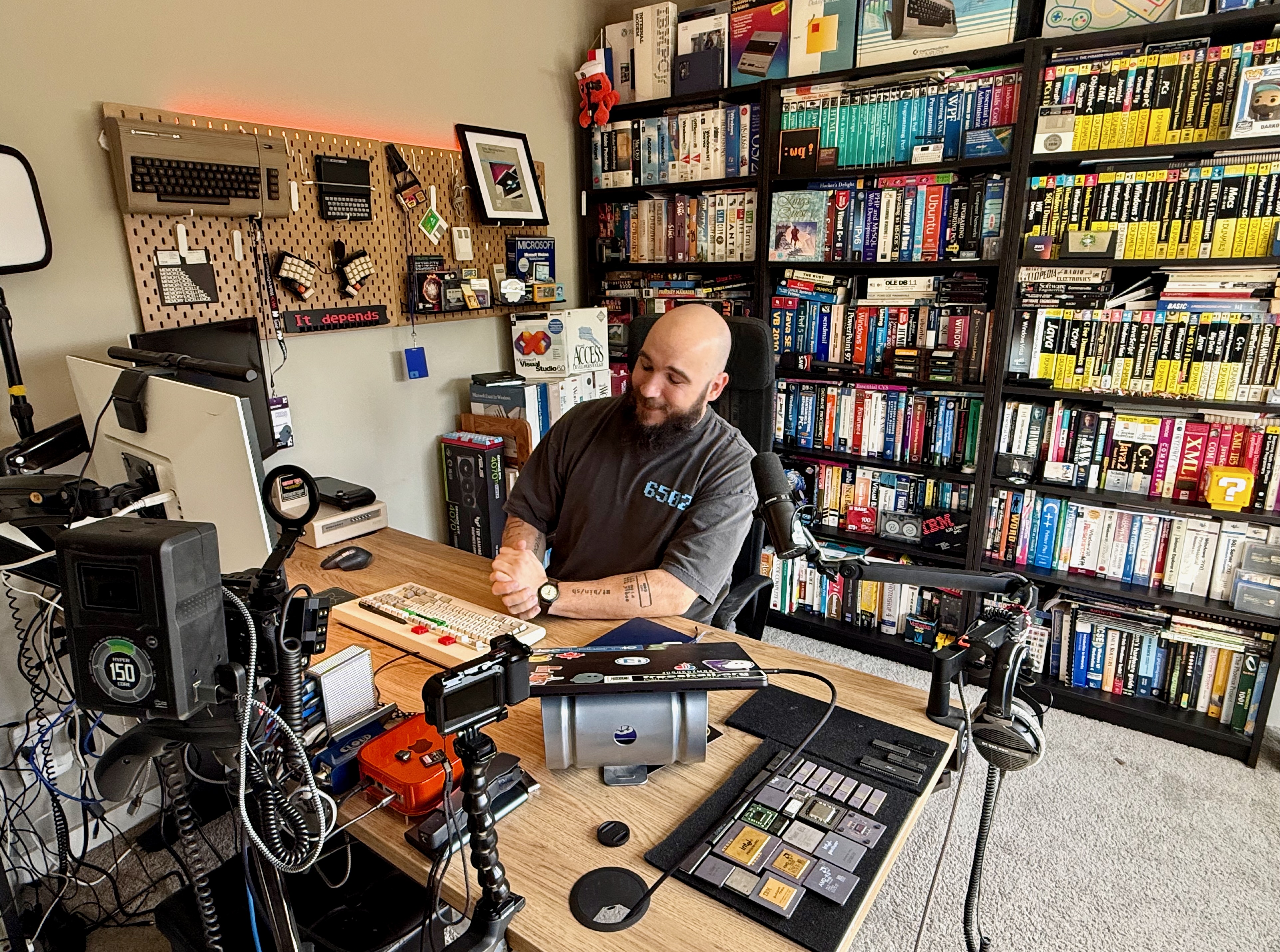
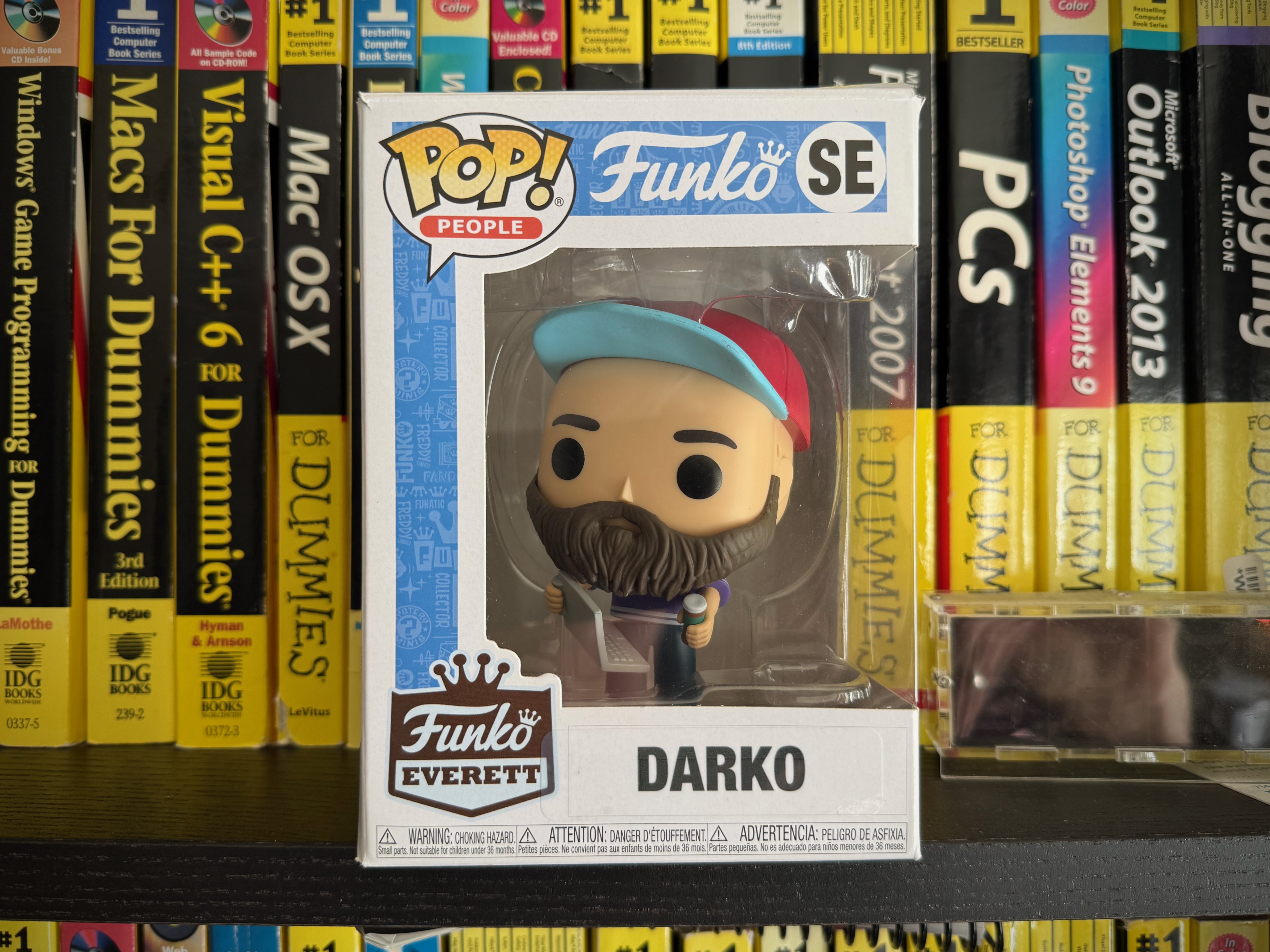
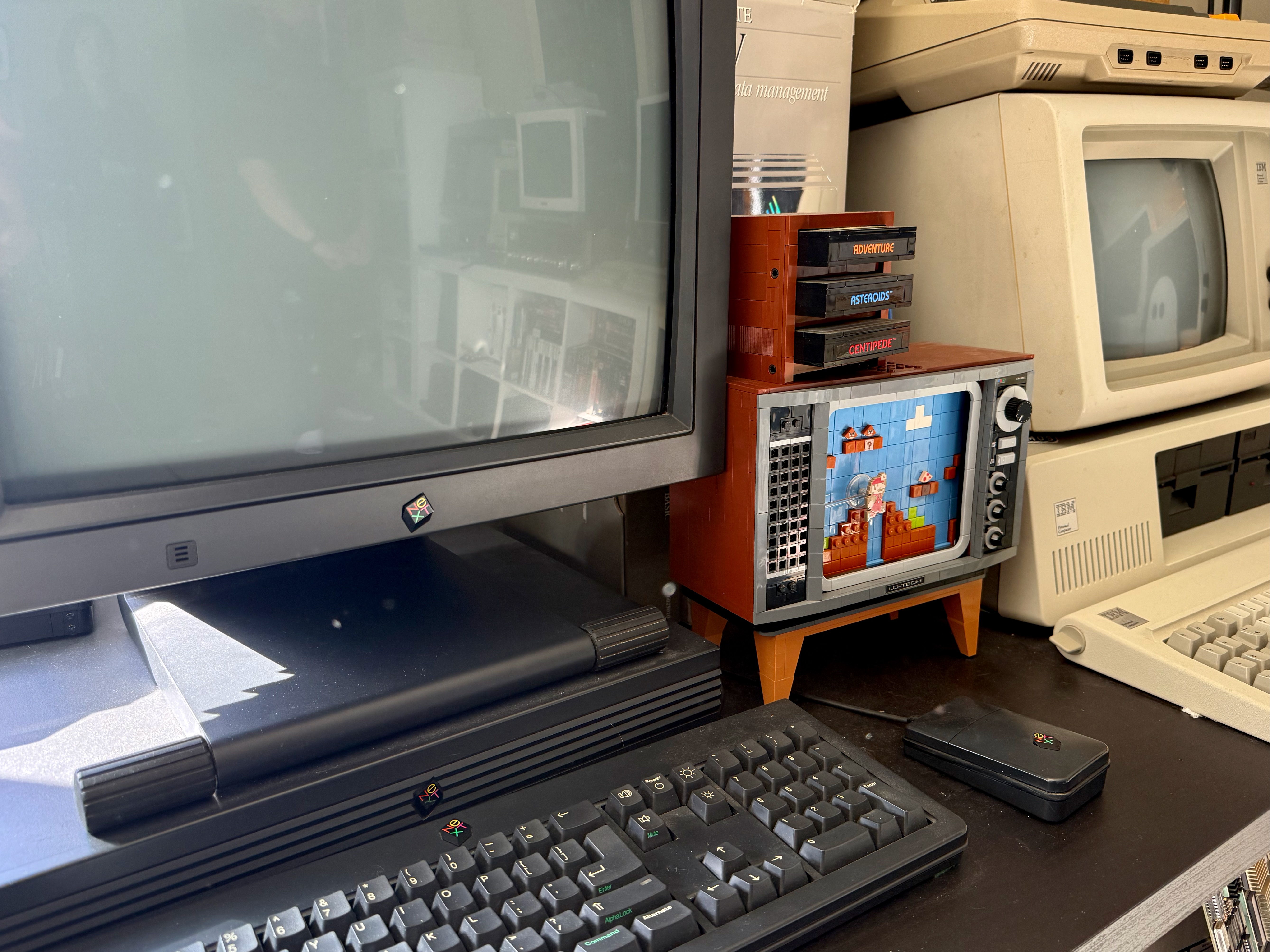
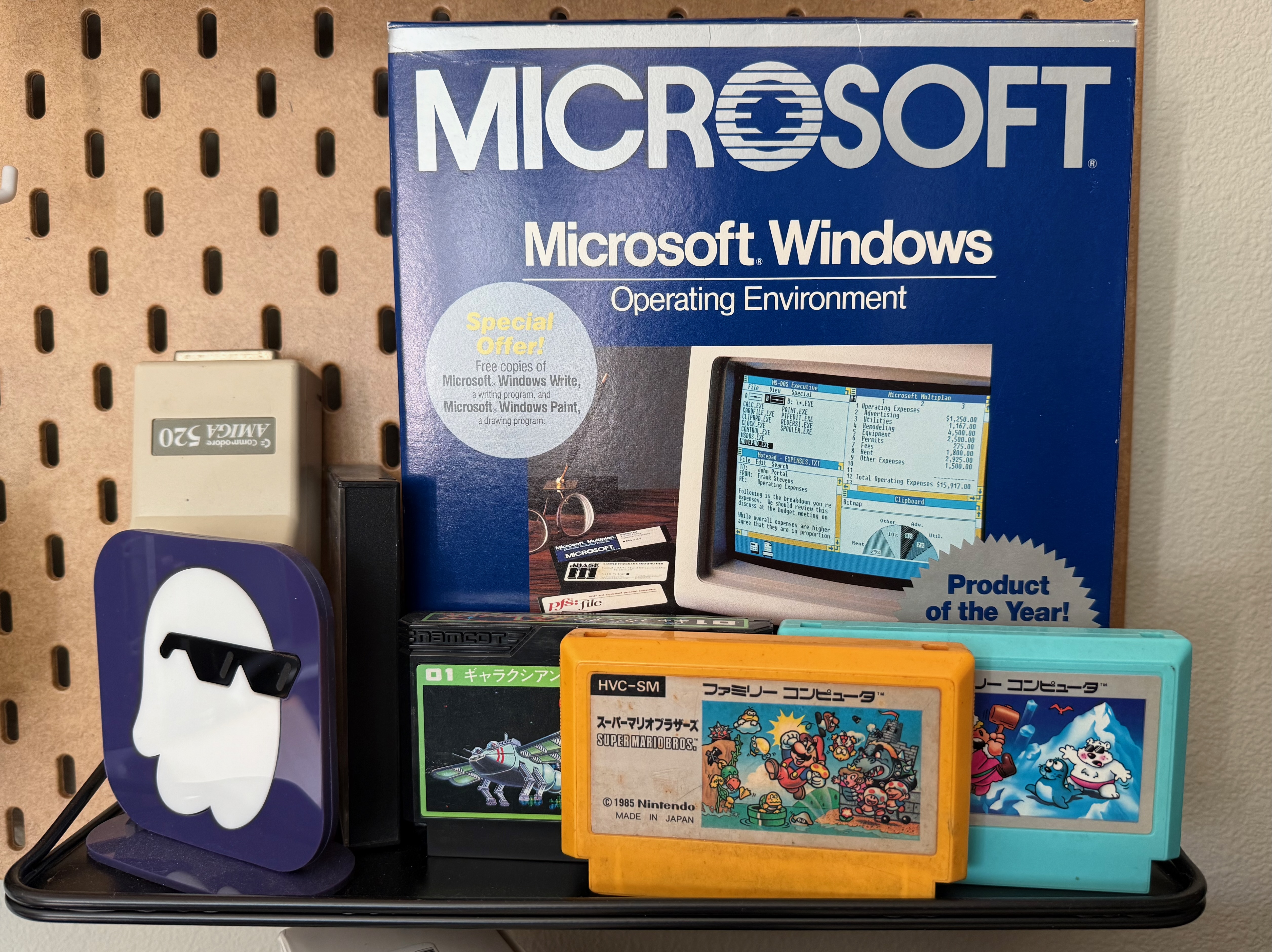
In his upstairs home office, Dark Mesaros is surrounded by more vintage computing materials, including books, software, manuals, games and more. (GeekWire Photo / Kurt Schlosser)A Funko Pop! figurine of Dark Mesaros, gifted to him by a friend. (GeekWire Photo / Kurt Schlosser)Among the hundreds of machines in Darko Mesaros’ collection sits a black NeXTstation workstation — designed by Steve Jobs’ post-Apple — displayed alongside a Lego NES set, right, with a retro brick TV showing “Super Mario Bros.” (GeekWire Photo / Kurt Schlosser)Vintage software and gaming artifacts on display, featuring a boxed copy of original 1980s Microsoft Windows 1.0, classic Japanese Nintendo Famicom cartridges, and a Commodore Amiga component. (GeekWire Photo / Kurt Schlosser)Darko Mesaros toggles the switches on a vintage Data General Eclipse S/230 minicomputer in his garage. (GeekWire Photo / Kurt Schlosser)At about $1,000, a server rack is the most expensive piece in Darko Mesaros’ garage collection. (GeekWire Photo / Kurt Schlosser)Vintage computer magazines and machinery on the shelves in Darko Mesaros’ garage. (GeekWire Photo / Kurt Schlosser)
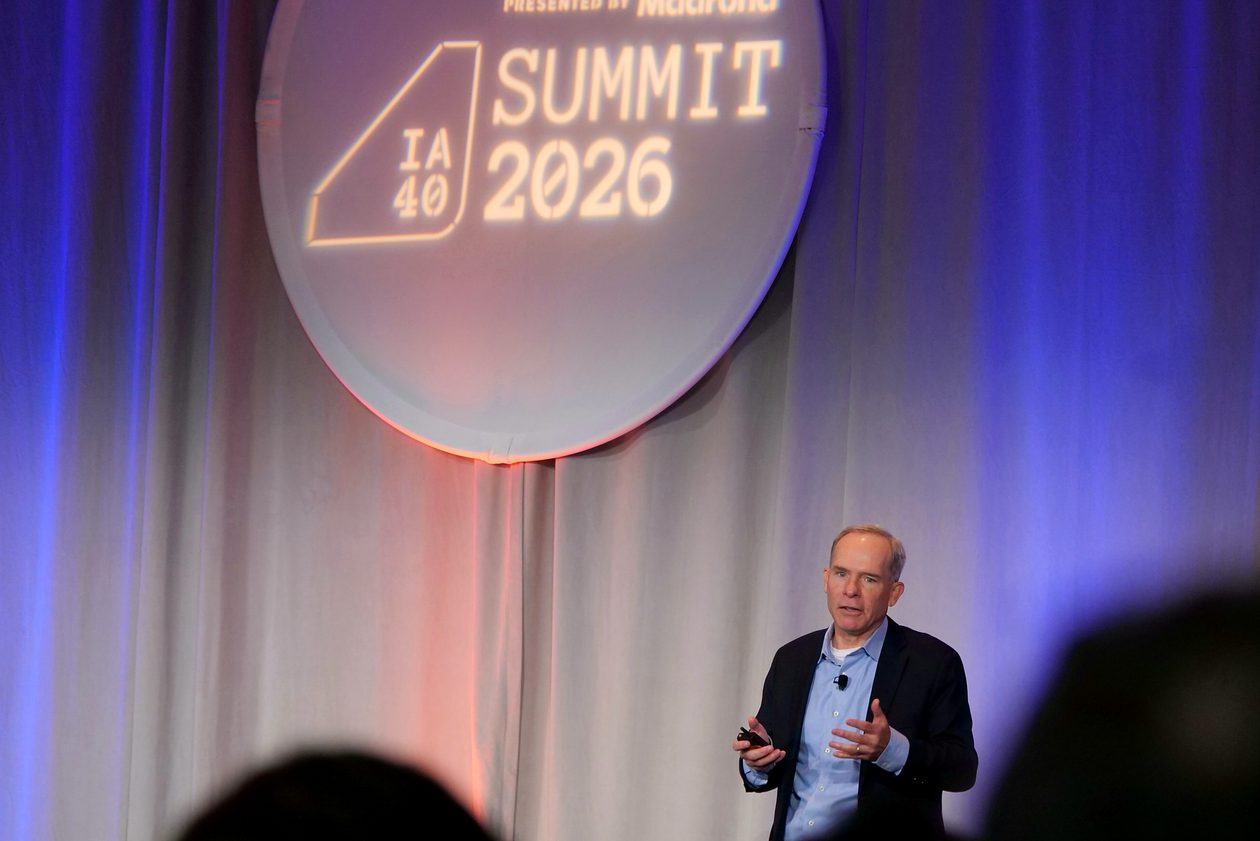
Madrona Managing Director Matt McIlwain speaks at the IA40 Summit in Seattle on Wednesday. (GeekWire Photo / Todd Bishop)
Executives from companies such as Microsoft, Amazon, Anthropic and Stripe agreed on a lot this week about where AI is headed. But one big question was left unresolved: who keeps the relationship with the customer, and the data that comes from it, once an AI agent is in the middle?
That question was a recurring theme at Madrona’s IA40 Summit, the venture capital firm’s annual gathering of AI startups, investors and tech executives, held Wednesday at the Four Seasons Hotel on the downtown Seattle waterfront.
As Madrona Managing Director Matt McIlwain said in his closing remarks, the question of who gets to use the data that comes from people’s engagement with AI systems came up “over and over and over again” during the day.
GeekWire attended the entire day and came up with these takeaways, reducing our own human bottleneck (see below) with lots of back-and-forth with Anthropic’s Claude and other AI tools.
AI agents are coming between companies and their customers:Charles Lamanna, the Microsoft executive vice president who oversees Microsoft 365 and the platform behind Copilot, predicted most business software will end up being used by AI assistants on a person’s behalf, leaving software makers with less power to set prices.
Jean-Denis Greze, CEO of Town, a startup that makes an AI assistant for work, went further. Since about July, he said, AI has been able to operate a browser or a computer almost as well as a person, at a reasonable cost. That means an AI assistant can work through an app’s user interface the way a person does, without needing an API from the software maker, he said.
“Everything is going to become a thin app because the better the AI gets at using the computer, the less the app matters as a unit of software,” Greze said, echoing the term Lamanna had used that morning for software that people open only briefly.
The same shift is under way in retail. Maia Josebachvili, Stripe’s chief revenue officer for AI, said commerce by AI agents on Stripe was roughly flat for eight or nine months and then rose sharply in the past six weeks.
Many merchants make their money by getting shoppers to add to their orders at checkout and by showing them ads, she said, and they lose those chances when an agent does the buying. That won’t work over the long term, Josebachvili said.
The data side of the question came up in a session with Anthropic Chief Technology Officer Rahul Patil. Moderator Raphaëlle d’Ornano asked who owns the record of an AI agent’s work, including its mistakes and corrections, and whether it belongs to the customer. She said she has never gotten a clear answer.
Patil didn’t answer directly. He said each company that supplies the software for running agents will work to improve them, and “will use every data that’s available to them to make it better.”
“It’s good for the ecosystem if the agents actually improve,” he said.
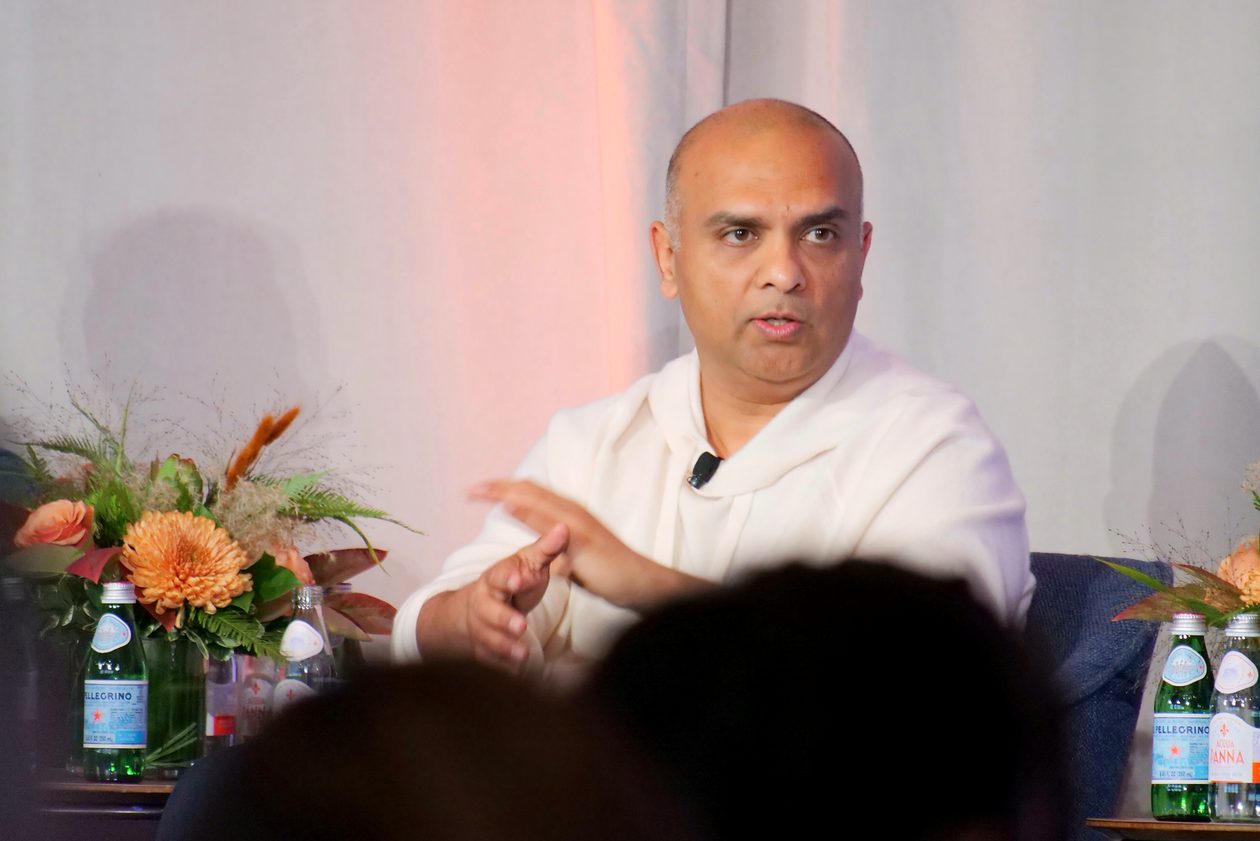
Swami Sivasubramanian, Amazon Web Services’ vice president of Agentic AI and Emerging Technologies, said one of the least appreciated parts of making AI agents work is getting them the right company data for the task.
AWS in June announced a service for that purpose, called AWS Context, which maps the relationships in a company’s data for agents to use. Sivasubramanian said it’s meant to work across platforms and cloud providers, and he expects this kind of service to be a basic building block for the next 20 years, as cloud storage and databases were two decades ago.
Swami Sivasubramanian, left, Amazon Web Services’ vice president of Agentic AI and Emerging Technologies, with Madrona Managing Director Tim Porter. (GeekWire Photo / Todd Bishop)
Most companies aren’t keeping up with the technology: Patil said Anthropic writes about 200 times as much code as it did 18 months ago. Some customers have doubled or tripled their output, he said, but almost none have seen gains like Anthropic’s.
“The bottleneck is actually not AI. The bottleneck is human,” said Archana Vemulapalli, global head of AI product management at Goldman Sachs. A company’s roles and processes were built before AI, she said.
Archana Vemulapalli, global head of AI product management at Goldman Sachs, speaks at Madrona’s IA40 Summit in Seattle on Wednesday. (GeekWire Photo / Todd Bishop)
Sivasubramanian said teams inside Amazon were showing him impressive AI agents they had built in two or three weeks. When he asked when the agents could be rolled out, he said, almost every team told him it still had to work out security, identity and monitoring.
McKinsey senior partner Lari Hamalainen said about 40% of companies say AI has increased their profits, but only 6% describe the increase as substantial.
Even as AI becomes more and more capable, there’s still lots of work to do to close the gap between “the goals, the capabilities, and what we all are aspiring to do,” McIlwain said.
Companies are split on depending on a single AI provider: Anthropic’s Patil, notably, argued that large companies are spending too much effort preserving the ability to switch between AI providers. To keep that option open, he said, they end up building for the least common denominator, limiting themselves to the features every AI model shares. That effort also takes their engineers away from the work that sets their own company apart.
Carlos Guestrin, co-CEO of the AI startup Noeri, offered an alternative take on the same panel. Intelligence shouldn’t be controlled by one or two companies that own the models, he said, and every company should be able to build and own its own AI systems.
Carlos Guestrin, co-CEO of Noeri and a Stanford computer science professor, at Madrona’s IA40 Summit. (GeekWire Photo / Todd Bishop)
Guestrin is a Stanford computer science professor and former University of Washington professor who founded the Seattle machine learning startup Turi, which Apple acquired in 2016.
Eno Reyes, co-founder and chief technology officer of Factory, a startup that makes AI coding tools, said on a later panel that many businesses don’t see a way to build their future without ceding control to one AI lab. Thomas Dohmke, the former GitHub CEO who now leads the startup Entire, said developers always want choice.
Amazon also sells its own product for running AI agents, AgentCore, which overlaps with Anthropic’s Managed Agents.
Companies don’t yet trust AI with important decisions:Zico Kolter, the Carnegie Mellon professor who chairs the safety and security committee of OpenAI’s board, said the ability to control AI systems has to keep pace with their capabilities, which might mean developing them more slowly than is possible.
Sivasubramanian said executives worry about whether an AI agent will always follow their company’s rules and regulations. Companies can keep the creativity of AI models, he said, by pairing them with separate systems that check a model’s work against the company’s rules and catch violations.
The money is concentrated in a few companies: The companies on this year’s IA40 list have raised $410 billion since they were founded, according to Madrona’s data. OpenAI, Anthropic and Databricks account for 92% of it.
Anthropic raised $143 billion of its $161 billion total in the 12 months ending Aug. 15, a figure that includes debt. The company has filed confidentially for an initial public offering and is seeking a valuation of about $2 trillion, Reuters reported this week. Bloomberg reported that it could go public as early as mid-November.
Capital spending by Amazon, Alphabet, Microsoft, Meta and Apple is projected to rise 74% this year to about $742 billion, according to PitchBook figures Madrona presented.
Lamanna said Microsoft’s heaviest AI users among its software developers are each on track to spend more than $1 million a year on AI usage, even with the company’s internal discount.
Madrona’s closing slide said returns on AI are still early for most of the companies using it but look inevitable based on what the earliest adopters are seeing.
— Silvia Candianihas been named corporate vice president of Worldwide Telco & Media within the Microsoft Frontier Company, a $2.5 billion initiative launched by the tech giant in July to embed engineers inside customers to build and run AI systems. In her new role, Candiani will lead Microsoft Frontier Company’s work with some of the largest telecommunications operators and media conglomerates.
“The momentum across our industry is extraordinary, and I believe we are only at the beginning of what AI can make possible,” said Candiani, who is based in Milan.
Before joining Microsoft in 2010 as a general manager, Candiani was a marketing director for Vodafone in Italy for more than a decade.
Kevin Frey. (LinkedIn Photo)
— Kevin Frey has been appointed vice president and chief impact officer of Microsoft Elevate, the company’s philanthropic effort providing technology support, donations, sales and AI training for educational organizations and nonprofits. Frey joined from UNICEF, where he was the first CEO of Generation Unlimited, the organization’s skills and employment initiative.
Frey said he was joining Microsoft because it’s “one of the only organizations in the world with the scale, scope and influence to bend the arc of the AI-powered future we are entering.”
“I will be spending my time and energy trying to ensure that the benefits of AI are shared broadly and safely across society — by every teacher, every student and every worker — regardless of their postal code,” he added.
— And while we’re on Microsoft, Anne Linge has been promoted to director of communications for commercial and consumer experiences after nearly 10 years with the company. She previously worked in communications at Weber Shandwick and Waggener Edstrom Worldwide, which has since rebranded as We.
Alexis Bateman. (LinkedIn Photo)
— Alexis Bateman has been promoted to director of global sustainability at Amazon Web Services after more than five years with the company. She was director of the MIT Center for Transportation & Logistics for 14 years before coming to Amazon.
Her work with AWS has given her the chance to help “shape sustainability at enormous scale,” Bateman said. “AI and cloud are transforming technology and society at an unprecedented pace, creating both enormous challenges and incredible opportunities for sustainability.”
Lynn Girotto. (LinkedIn Photo)
— Gradial has appointed Lynn Girottoas chief marketing officer. In June, the Seattle startup announced $65 million in new funding for its agentic AI platform that automates enterprise marketing. The company is No. 127 on the GeekWire 200, a ranked index of the Pacific Northwest’s top startups.
Girotto joins from Qualtrics, where she was CMO for two years. She has previously led marketing teams at companies including Vimeo, Tableau and Getty Images, and was a senior director at Microsoft for nine years earlier in her career.
“The best marketers I know want to build ideas and customer relationships, not manage processes,” Girotto said. “Gradial is the first company I’ve seen that’s built to give them that time back.”
Kam Ghaffarian. (LinkedIn Photo)
— A Seattle-area nonprofit group known as the Fermi Explorer Mission announced that Kam Ghaffarian has joined as co-founder. Earlier this month, the organization shared its plans to send a spacecraft on an 80,000-year trip to the nearest alien star system, Alpha Centauri.
Ghaffarian is a billionaire who helped launch companies including X-energy, Axiom and Intuitive Machines. “By committing to launching a spacecraft to Alpha Centauri by 2029, we are not just pushing the boundaries of current technology; we are inspiring a new generation to look up and dream of interstellar exploration,” Ghaffarian said.
Philip Johnston, co-founder and CEO of the Fermi Explorer Mission, also leads Redmond, Wash.-based Starcloud, a startup aiming to launch up to 88,000 satellites to serve as AI data centers.
Rachel Cougan. (LinkedIn Photo)
— Yoodli, the Seattle-based AI roleplay platform for enterprise training, has named Rachel Couganvice president of human resources. Cougan previously served as a fractional HR leader through her consultancy, Possible HR. Before that, she was VP of people for Logixboard and Hiya, and also served as VP of talent for Textio.
Yoodli, which launched in 2021, has grown to more than 100 employees. The company is No. 17 on the GeekWire 200.
Daniel Finney. (LinkedIn Photo)
— Kestra Medical Technologies has promoted Daniel Finney to vice president of research and development. The Kirkland, Wash.-based company sells cardiac monitoring and therapeutic devices. It raised $202 million in its IPO in March 2025 and was nominated for Deal of the Year at this year’s GeekWire Awards.
Finney has been with Kestra since 2019. CEO Brian Webster praised his role in developing the company’s FDA-approved monitoring device, adding that his “technical depth, product experience, and demonstrated leadership positions him to guide our next phase of innovation.”
Finney succeeds Phillip Foshee, Jr., who recently retired after leading Kestra’s R&D organization for nearly a decade.
— PATH has named Dr. Jeremy Farrar chief of its Asia, Middle East and Europe regional division. Farrar, a globally recognized leader in public health and clinical medicine, will join PATH effective Oct. 1 and be based in Geneva. His past roles include assistant director-general at the World Health Organization and director of the Wellcome Trust.
PATH CEO Nikolaj Gilbert praised the appointment, and noted that Farrar “possesses deep knowledge of the realities that prevent access, the people that make health care possible, and the need for PATH’s mission of ensuring breakthrough innovations reach all who need them.”
Emily Levesque. (AAS Photo)
— American Astronomical Society (AAS) announced that University of Washington scientist Emily Levesque is the next editor in chief of the AAS journals. She will succeed Ethan Vishniac, who is stepping down from the role at the end of summer 2027 after 12 years.
“In the writing and publishing landscape we’re facing today, sharing information has never been easier, but trusting information has never been harder — which makes the AAS journals’ combination of rigorous peer review and accessible science more valuable than ever,” Levesque said.
Levesque has been an assistant astronomy professor at the UW for 11 years. She leads the massive stars research group, which studies the evolution and death of the largest and “most extreme” stars in the universe.
— The Seattle Metropolitan Chamber has added eight members to its board of trustees:
Deniz Anders, Nordstrom’s executive vice president and chief marketing officer
Reuven Carlyle, founder of Earth Finance and former state senator
Carl Gipson, vice president of government and community affairs for Comcast
Trevor Gooby, executive vice president and chief operating officer for the Seattle Mariners
Daniel Huber, BNBuilders’ vice president of operations for the Northwest and Colorado
A security researcher writing under the name tokay0 disclosed a flaw that could allow an attacker to access and control more than 600,000 deployed Shark model robot vacuums.

 Login