Reading view

There are new articles available, click to refresh the page.

Why ForgeLayer’s Pay-as-You-Go Model Could Accelerate Crypto Infrastructure Adoption in Africa

  • ForgeLayer has replaced its fixed monthly subscription with a pay-as-you-go pricing model after receiving customer feedback.
  • The company says businesses were hesitant to commit to recurring fees before proving the product’s value.
  • The change reflects a broader trend in B2B fintech, where reducing adoption friction can be more important than maximising short-term revenue.
  • The move raises an interesting question: should more African crypto infrastructure startups adopt usage-based pricing?

ForgeLayer announced that it’s taking customer feedback and offering a pay-as-you-go alternative to its previous subscription model. One must consider the cost implications for the industry and not just its customers, and the potential ripple effects.

ForgeLayer provides non-custodial crypto payment infrastructure for businesses looking to integrate crypto products without spending time and resources building blockchain infrastructure from scratch.

ForgeLayer Is Rethinking How Crypto Infrastructure Is Sold

The new model charges a flat 0.3% per successful transaction, rather than the flat recurring monthly charge businesses would incur regardless of the volume processed. Companies that process sufficient volume and aren’t as concerned about cost can still opt to pay for the subscription plan, which removes per-transaction fees.

ForgeLayer’s infrastructure provides plugins for WordPress, WooCommerce, Magento, OpenCart, PHP, React, and Node JS to accelerate dev adoption.

For smaller businesses, this new pricing system reduces the barrier to entry and allows them to try out this new product without committing a large amount. According to the community manager for ForgeLayer, Lilian Jessica,

Customers were saying they wanted to implement our platform, but having to pay without any guarantee that they’d make that amount back in a month was difficult. We went back to the drawing board and looked at our mission, which is making it easier for businesses that want to go global.

Pricing is Part of Product-Market Fit

Infrastructure product providers, especially in Africa, must consider this: if you want your business to scale, you must understand your customers’ pain points. If this customer base consists of African businesses and startups, you should ideally be aware of and ready to accommodate their cost-related challenges.

Infrastructure products compete on more than technical features. They compete on API pricing, onboarding friction, implementation time, and developer experience. Your API could be great, but adoption will still stall if businesses have to pay high fees to see any value.

In that sense, pricing is not separate from the product because it shapes who is willing to try it and determines how quickly they can.

Why Pay-as-You-Go Makes Sense for African Businesses

In the first quarter of 2026, companies in the USA and Canada secured over $250 billion in funding. In comparison, African startups raised $705 million in the same time period. The general idea most people have about tech companies, regardless of industry, is that if the idea and your plan are good, the funding will come. African entrepreneurs know this is not always true.

Many small and medium enterprises across Africa operate with limited cash flow. What some might consider too cautious or frugal is standard practice. When you secure funding, you need to use it diligently. When you spend, the spending must be justified.

A Usage-Based Model Aligns Costs with Business Growth

African businesses need the option of experimenting with the product before making any long-term commitments. Offering usage-based billing ties what a business pays to what it earns, making the cost easier to justify.

If a merchant processes zero crypto transactions, then they do not have to pay. This is especially ideal for African fintechs, online businesses, and SaaS platforms that are testing crypto for the first time.

Stablecoin adoption across the continent is on the rise, with Sub-Saharan Africa leading the world and the region at a 9.3% adoption rate. Stablecoins accounted for 43% of total cryptocurrency transaction volume in the region in 2024, with strong use for retail and cross-border payments. Businesses will want to tap into this. Of course, this doesn’t guarantee that crypto payments will take off for any business. However, this model lowers the cost of finding out.

Could Other African Crypto Infrastructure Companies Follow?

Reducing adoption friction has become a major competitive advantage in fintech. Other crypto infrastructure firms in Africa could increase their adoption rate by offering usage-based models. Whether you’re offering stablecoin payment APIs, wallet infrastructure, or compliance tools, this is worth considering.

Yellow Card recently discontinued their retail arm and has spent time repositioning itself around B2B and institutional clients. Its widespread regulatory credibility is its competitive advantage. Opera’s Mini Pay has embedded a stablecoin wallet directly into a browser that millions of Africans already use, stripping out friction.

Across the continent, Fintechs are exploring ways to reduce the hurdles to adoption for their clients. Flutterwave has spent its year improving and deepening its stablecoin integration. Paga, via partnerships with SUI and TBook, has also explored stablecoin accounts and tokenized assets this year.

While the mechanisms for reducing adoption across these businesses have differed from ForgeLayer’s pricing change, the instinct is similar. The point is not for other crypto infrastructure providers to unthinkingly copy ForgeLayer. The goal, however, is to recognize the various pain points and barriers that could delay integration and to work with that in mind.

Reducing friction is a competitive axis for African crypto infrastructure.

African Infrastructure Companies are Selling Trust, Not Just Technology

In the African market, earning trust is just as important as building the right product. It doesn’t matter if the product is B2B or B2C; you need to build trust. How do you get businesses to trust you in a market typically considered “low trust?”

For most businesses, choosing an infrastructure provider is a big deal. That infrastructure will be part of your business’s foundation. You need to ask yourself certain questions about reliability and about cost. Will this provider be here in two or three years? Is the service they are offering me worth the money? Will the eventual transaction volume justify the cost?

All these questions can be condensed into one question. Is it worth it?

Companies like Lazerpay, a Nigerian crypto payments startup once pitched as the “Stripe for crypto,” shut down in 2023 after failing to raise much-needed funding. Lazerpay is an example that crypto infrastructure on the continent has a genuine mortality rate.

Usage-based billing reduces perceived risk for cautious executives. If the provider’s earnings are tied to the merchant’s earnings, it increases trust. Businesses are more inclined to believe you will do right by them, as your success is intertwined with theirs. In a market with so many uncertainties, commercial empathy and lower financial friction could ultimately create higher long-term adoption.

Lessons Crypto Infrastructure Could Learn From Saas And Cloud Computing

Traditional technology giants popularised consumption-based billing long ago. Amazon Web Services, Twilio, and Stripe built empires using this framework. OpenAI also prices its AI models based on direct usage.

​These companies rarely demanded massive upfront financial commitments from early adopters. Instead, customers paid per API call or per transaction. They paid per compute hour or per message sent. Crypto infrastructure is moving in this same direction globally. ForgeLayer is adapting a proven software model to African digital finance.

As blockchain tools become commoditized, technical features look identical. Providers must find new ways to stand out in a crowded market. Business model innovation is becoming the new frontier for enterprise software.

​Why This Matters

​The pricing change might look like a minor product update. However, it reflects a major shift in how crypto platforms acquire users. Technical innovation alone is no longer enough to win the market.

​As competition intensifies, providers will differentiate through their commercial models. Onboarding experiences and customer success will dictate who wins the continent. Financial tools must adapt to the economic realities of local businesses.

​Companies that make experimenting with stablecoins cheap will drive mainstream adoption. They allow traditional Web2 firms to test Web3 tools safely. By removing fixed overheads, ForgeLayer changes the risk equation for African commerce. The future of regional crypto infrastructure depends heavily on lowering the cost of discovery.

Originally published at https://cryptoafrica.news on July 9, 2026.


Why ForgeLayer’s Pay-as-You-Go Model Could Accelerate Crypto Infrastructure Adoption in Africa was originally published in Coinmonks on Medium, where people are continuing the conversation by highlighting and responding to this story.

Flores Hobbits' eating habits offer clues about their evolutionary past

Until about 60,000 years ago, diminutive hominin cousins, Homo floresiensis (affectionately nicknamed Hobbits for obvious reasons), shared the island of Flores with Komodo dragons, pygmy elephants, and giant rats.

Based on the presence of hominin and pygmy elephant bones in the same layers of cave sediment, it originally looked like the Hobbits had hunted and butchered dwarf elephants—an impressive feat for such a tiny hominin. But according to University of Tübingen anthropologist Elizabeth Veatch and her colleagues, it was the Komodo dragons that were the hunters, while the Hobbits only showed up to scavenge what was left.

If Veatch and her colleagues are right, their findings may challenge some of the assumptions we’ve made about Homo floresiensis—and about which hominin species was the first to venture into the wider world beyond Africa.

Read full article

Comments

© Zoo Atlanta

A Tale of Two Africas in Maps, And How It Affects the United States

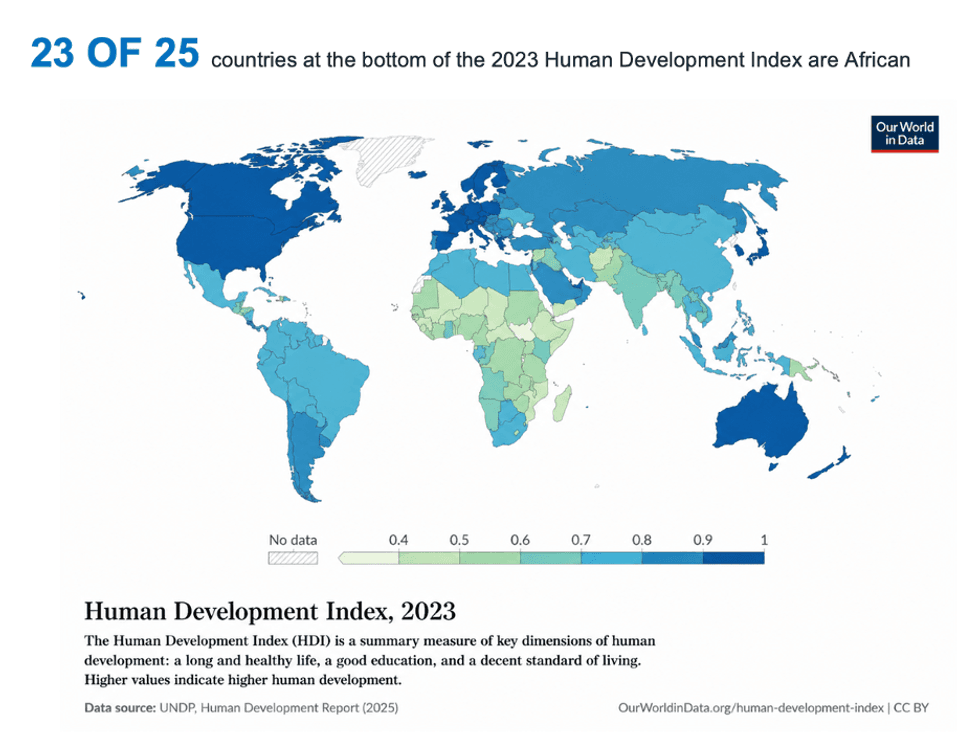
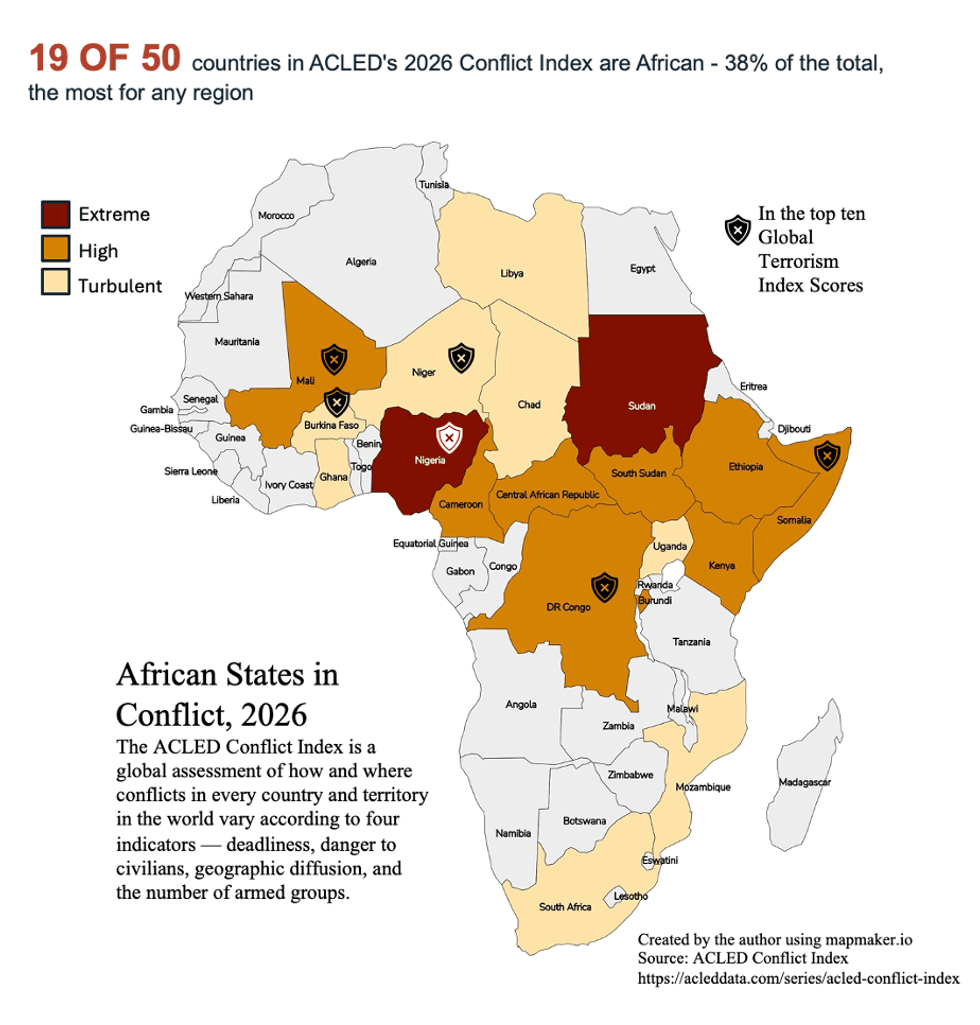
As an Africa watcher, I have long told the story of two continents, juxtaposing the region’s plight with its opportunities, often arguing that the West should prepare for the continent's strategic risks and opportunities. This is a decades-old mantra from across the Africa-watcher community. Alas, repeating these arguments over decades suggests we must work to deliver our message in a more compelling way. So, this is my attempt to tell the story of African issues more visually, with the hope that experts in geopolitics will gain a greater appreciation for the stories from the continent that carry compelling US implications.

The Effectiveness of Maps

For nearly three decades, I have grappled with the most compelling way to hook a reader, whether at the CIA, the Department of Defense, the State Department, in the university classroom, or working with industry partners. One consistent reality is that a good graphic is optimal for making a story stick. And in my experience, the map is the king of graphics. Indeed, in the countless briefings I delivered as an intelligence officer, I brought one or more maps along every time. Similarly, I have used at least one map in every class meeting with my students. Maps orient the reader geographically, grant easy visual context, and ground a story in scale.

Orientation: A reader can best relate to a story when they can see where it is taking place

Context: A map can provide a reader with helpful, visual facts, whether through data or comparison

Scale: The size and value of a specific trait are easily observable on a map

The Risk Side: Development Gaps and Conflict Reinforce Each Other


CRITICAL CONTEXT

Health

Poor healthcare infrastructure exacerbates communicable disease outbreaks, like Ebola in Congo in 2026 and West Africa in 2014, challenging global aid capacity.

Security

Lax development creates an environment ripe for extremism, creating a cycle where insecurity exacerbates underdevelopment that in turn fosters insecurity.

Geopolitics

Conflicts attract outside actors, creating a hotbed of geopolitical competition devoid of local interests and reducing African agency.

Why It Matters to Washington

Africa is the last entry in Washington’s National Security Strategy, reflecting a plan to allocate fewer resources to the continent, but Africa's crises often force unforeseen commitments. The Ebola outbreak in Congo underscores that weak health systems can turn outbreaks into global threats, compelling a US response. Insecurity due to extremist violence has prompted new and expanded US military action in Nigeria and Somalia, respectively. The continent leads the world in terrorist-related casualties, with more than half of global fatalities occurring in the Sahel, posing an enduring threat to greater African stability and attracting renewed US focus. This deepening malaise and Sudan’s civil war have become a magnet for regional and global competition, including increased intervention from Russia and China and adversarial action between US allies Saudi Arabia and the UAE.

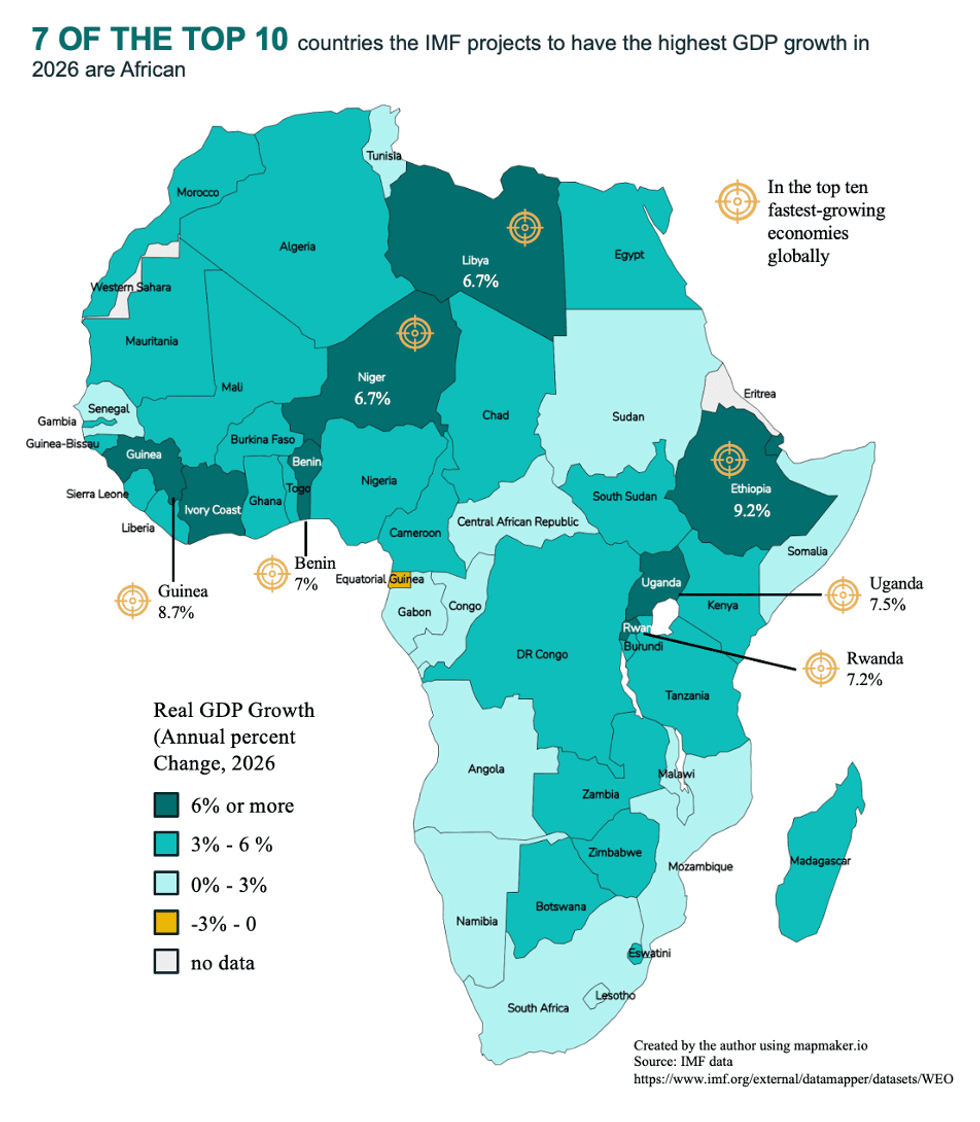
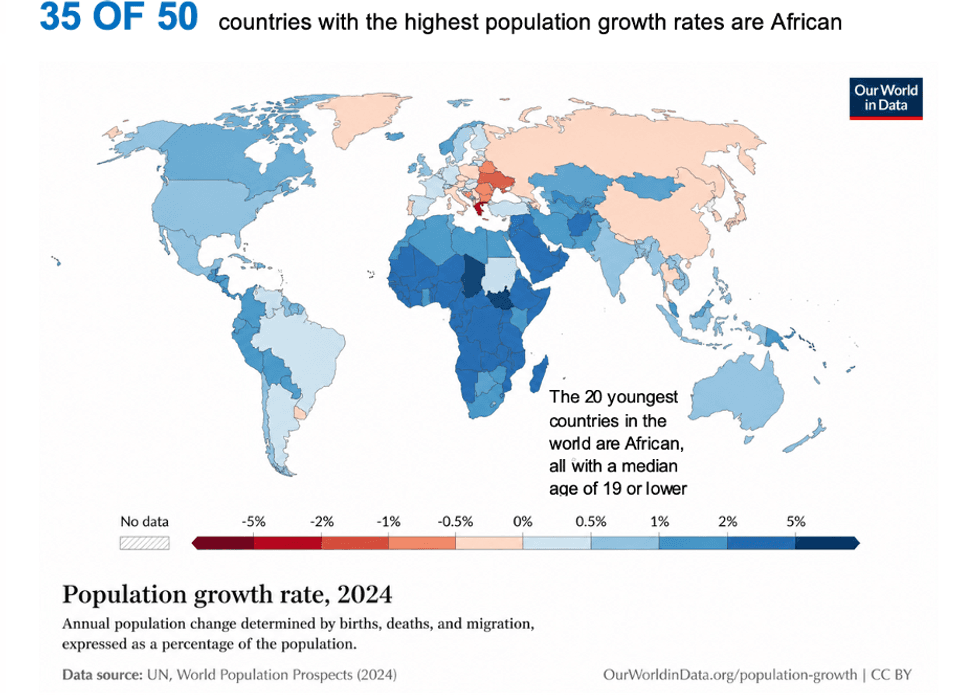
The Opportunity Side: Economic Growth and Demographics Are Standout

Strengths

CRITICAL CONTEXT

Growth Potential

Less developed countries have more room for economic growth. Africa has outperformed global growth by approximately 0.5 to 1.5 percentage points since 2000.

Imports

As economies and populations grow, so do imports. Africa is on track to outpace the rest of the world in merchandise import growth during 2026.

Workforce

Africans are the world’s future workforce. The OECD estimates that the continent’s working-age population (15-64 years old) will rise from about 850 million today to more than 1.5 billion in 2050, accounting for 85% of the global workforce increase.

Why It Matters to Washington

Africa’s GDP growth represents the high upside potential of the continent’s many comparatively less developed countries. Because African economies are not saturated, they have greater room to grow, making them attractive for investment gains. This coincides with the world's youngest population, which presents a range of reasons for outside nations to work with Africa, including circular migration deals for labor to sustain growth and to find markets for exports—60 countries are set to shrink in population this year alone, including economic juggernauts China, Germany, Japan, Italy, Russia, Spain, and South Korea.

- More pointedly for US implications, the country has been below the replacement fertility rate of 2.1 children per woman for nearly two decades (1.6 in 2024). Mexico, the top provider of immigrant workers to the US, has been below replacement fertility for about a decade (1.9 in 2024), suggesting Africa is positioned to serve as a sought-after source of workers.

- For example, Washington could leverage Kenya’s plan to broker agreements for 1 million of its citizens to work abroad annually. Nigeria is on track to surpass the US as the world’s third-largest country by population within the next three decades and will almost certainly have to find foreign destinations for its workforce.

- Canada stands out as having conspicuously higher population growth in North America, the result of purposeful legal migration, which is 3 times that of the US as a percentage of the overall population.

All statements of fact, opinion, or analysis expressed are those of the author and do not reflect the official positions or views of the U.S. Government. Nothing in the contents should be construed as asserting or implying U.S. Government authentication of information or endorsement of the author's views.

The Cipher Brief is committed to publishing a range of perspectives on national security issues submitted by deeply experienced national security professionals. Opinions expressed are those of the author and do not represent the views or opinions of The Cipher Brief.

Have a perspective to share based on your experience in the national security field? Send it to Editor@thecipherbrief.com for publication consideration.

Read more expert-driven national security insights, perspective and analysis in The Cipher Brief

❌